
Life, 1914-04-23 · page 26 of 44
Life — April 23, 1914 — page 26: what you’re looking at
What you’re looking at
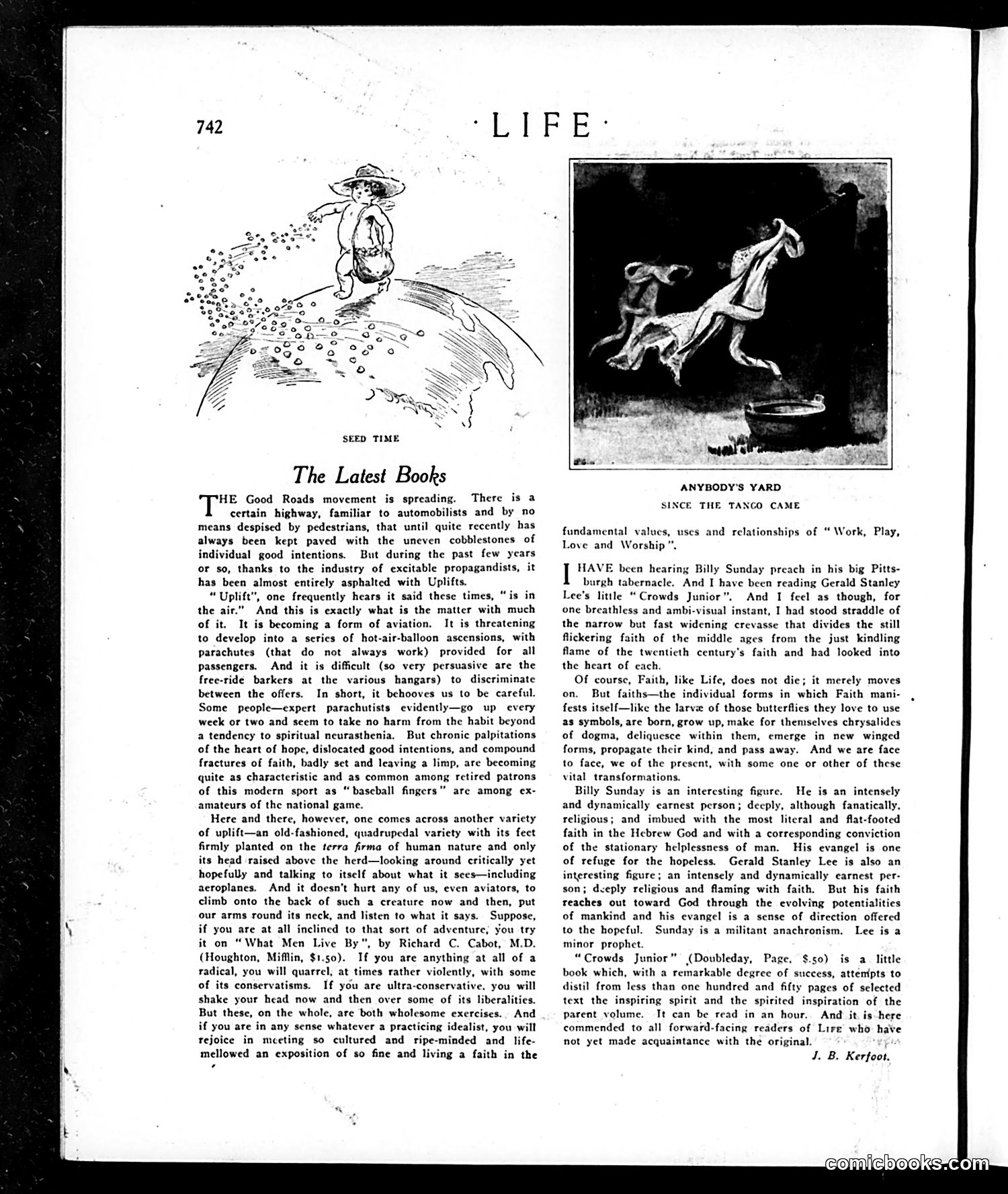
The left illustration satirizes the "Good Roads movement" and the broader "Uplift" craze of the era. A farmer sows seeds from atop a pig—visual metaphor for how modern uplift movements (social reform initiatives) are becoming ungrounded and frivolous. The text explains that "Uplift" has become fashionable but increasingly detached from reality, "becoming a form of aviation" with "hot-air-balloon ascensions." The cartoon mocks this disconnect: true reform should be grounded in practical human nature ("terra firma"), not abstract idealism. The right photograph titled "Anybody's Yard Since the Tango Came" shows people dancing the tango—a contemporary dance scandal. This likely references moral panic over the tango's perceived lewdness and threat to traditional values, connecting thematically to the page's broader critique of modern fads undermining stable institutions.
📄 Transcribed text from this page (OCR, searchable)
Machine-transcribed from the original scan — historical spelling and the odd misread are preserved.
° 0008 Fovore oo eo We 93. 2 SEED TIME The Latest Books HE Good Roads movement is spreading. There is a certain highway, familiar to automobilists and by no means despised by pedestrians, that until quite recently has always been kept paved with the uneven cobblestones of individual good intentions. But during the past few years or so, thanks to the industry of excitable propagandists, it has been almost entirely asphalted with Uplifts. “ Uplift", one frequently hears it said these times, “is in the air.” And this is exactly what is the matter with much of it. It is becoming a form of aviation. It is threatening to develop into a serics of hot-air-balloon ascensions, with parachutes (that do not always work) provided for all passengers. And it is difficult (so very persuasive are the free-ride barkers at the various hangars) to discriminate between the offers. In short, it behooves us to be careful. Some people—expert parachutists evidently—go up every week or two and seem to take no harm from the habit beyond a tendency to spiritual neurasthenia, But chronic palpitations of the heart of hope, dislocated good intentions, and compound fractures of faith, badly sct and leaving a limp, are becoming quite as chasacteristic and as common among retired patrons of this modern sport as “bascball fingers" are among ex- amateurs of the national game. Here and there, however, one comes across another varicty of uplift—an old-fashioned, quadrupedal variety with its fect firmly planted on the terra firma of human nature and only its head raised above the herd—looking around critically yet hopefully and talking to itself about what it secs—including aeroplanes. And it doesn't hurt any of us, even aviators, to climb onto the back of such a creature now and then, put our arms round its neck, and listen to what it says. Suppose, if you are at all inclined to that sort of adventure, you try it on “What Men Live By", by Richard C. Cabot, M.D. (Houghton, Mifflin, $1.50). If you are anything at all of a radical, you will quarrel, at times rather violently, with some of its conservatisms. If you are ultra-conservative, you will shake your head now and then over some of its liberalities. But these, on the whole, are both wholesome exercises. And if you are in any sense whatever a practicing idealist, you will rejoice in meeting so cultured and ripe-minded and life- mellowed an exposition of so fine and living a faith in the ANYBODY'S YARD SINCE THE TANGO CAME fundamental valucs, uses and relationships of “ Work, Play, Love and Worship”. HAVE been hearing Billy Sunday preach in his big Pitts- burgh tabernacle. And I have been reading Gerald Stanley Lee's little “Crowds Junior And I feel as though, for one breathless and ambi-visual instant, I had stood straddle of the narrow but fast widening crevasse that divides the still flickering faith of the middle ages from the just kindling flame of the twenticth century's faith and had looked into the heart of cach. Of course, Faith, like Life, does not die; it merely moves on. But faiths—the individual forms in which Faith mani- fests itself—like the larva of those butterflies they love to use as symbols, are born, grow up, make for themselves chrysalides of dogma, deliquesce within them, emerge in new winged forms, propagate their kind, and pass away. And we are face to face, we of the present, with some one or other of these vital transformations. Billy Sunday is an interesting figure. He is an intensely and dynamically earnest person; decply, although fanatically, religious; and imbued with the most literal and flat-footed faith in the Hebrew God and with a corresponding conviction of the stationary helplessness of man. His evangel is one of refuge for the hopeless. Gerald Stanley Lee is also an interesting figure; an intensely and dynamically earnest per- son; deeply religious and flaming with fai But his faith reaches out toward God through the evolving potentialities of mankind and his evangel is a sense of direction offered to the hopeful. Sunday is a militant anachronism. Lee is a minor prophet. “Crowds Junior” (Doubleday, Page, $.s0) is a little book which, with a remarkable degree of success, attemipts to distil from less than one hundred and fifty pages of selected text the inspiring spirit and the spirited inspiration of the parent volume. It can be read in an hour. And it is here commended to all forward-facing readers of Lire who have not yet made acquaintance with the original. J. B. Kerfoot.