
Life, 1914-04-23 · page 12 of 44
Life — April 23, 1914 — page 12: what you’re looking at
What you’re looking at
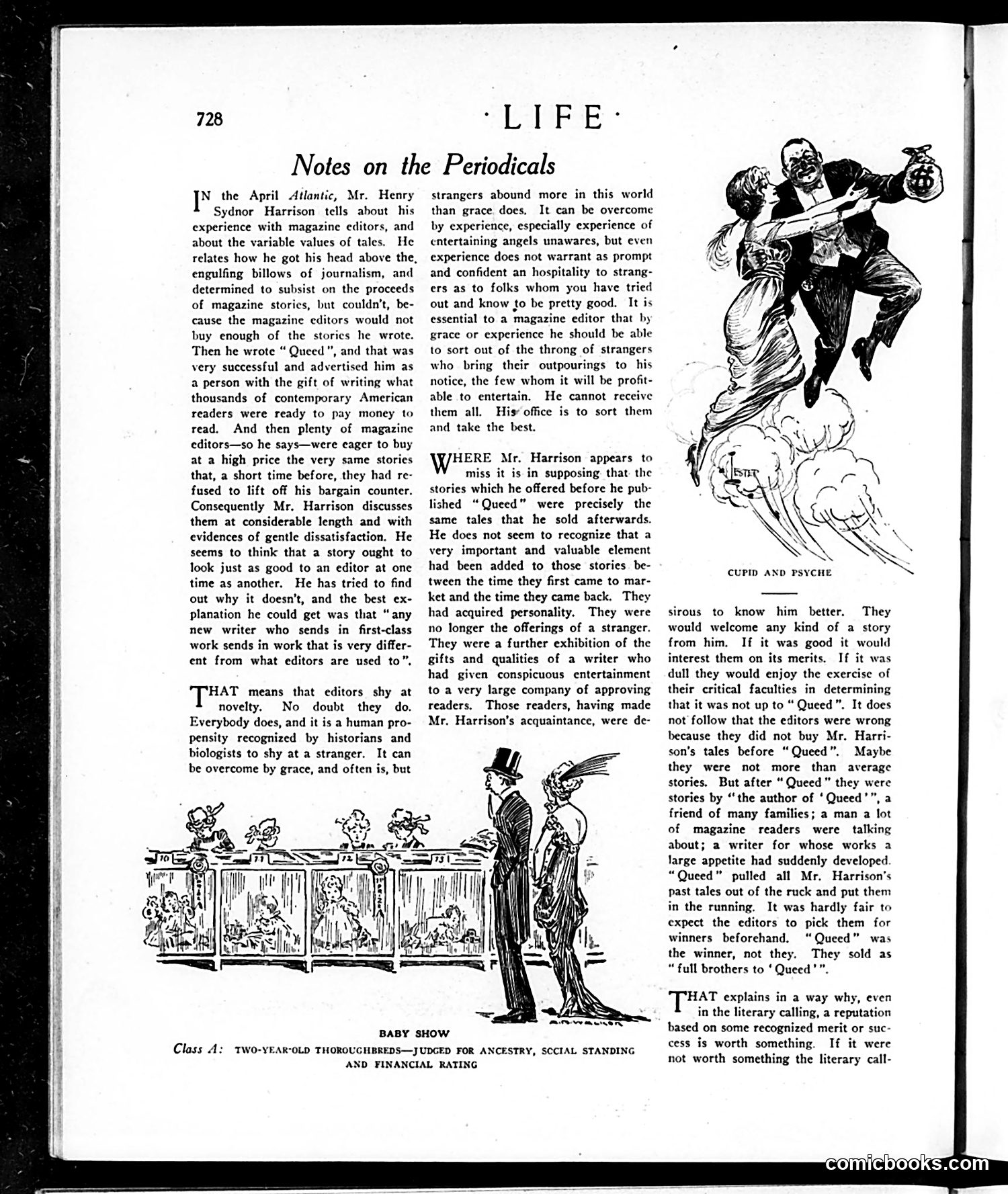
This page discusses magazine editorial practices, specifically referencing Henry Sydnor Harrison's experiences with editors. The text critiques editors who reject stories based on novelty rather than quality, noting that Harrison's previously rejected tales later became successful after he published "Queed" (his breakthrough work). The two illustrations satirize editorial gatekeeping: the top cartoon shows Cupid and Psyche (classical figures representing love and the soul), while the bottom depicts a "Baby Show" where figures in formal dress judge infants—a clear metaphor for editors judging literary submissions based on superficial criteria like pedigree and social standing rather than merit. The article argues that editors should evaluate work on quality alone, not reject stories simply because they're unfamiliar with the author.
📄 Transcribed text from this page (OCR, searchable)
Machine-transcribed from the original scan — historical spelling and the odd misread are preserved.
ms aESE * Notes on the Periodicals N the April Atlantic, Mr. Henry Sydnor Harrison tells about his experience with magazine editors, and about the variable values of tales. He relates how he got his head above the, engulfing billows of journalism, and determined to subsist on the proceeds of magazine storics, but couldn't, be- cause the magazine editors would not buy enough of the storics he wrote. Then he wrote “Queed”, and that was very successful and advertised him as a person with the gift of writing what thousands of contemporary American readers were ready to pay money to read. And then plenty of magazine editors—so he says—were eager to buy at a high price the very same stories that, a short time before, they had re- fused to lift off his bargain counter. Consequently Mr. Harrison discusses them at considerable length and with evidences of gentle dissatisfaction. He seems to think that a story ought to look just as good to an editor at one time as another. He has tried to find out why it doesn’t, and the best ex- planation he could get was that “any new writer who sends in first-class work sends in work that is very diffe ent from what editors are used to”. RAL means that editors shy at novelty. No doubt they do. Everybody does, and it is a human pro- pensity recognized by historians and biologists to shy at a stranger. It can be overcome by grace, and often is, but Sail y th wig Rexel fi | ee Ngee , coe strangers abound more in this world than grace does, It can be overcome by experience, especially experience of entertaining angels unawares, but even experience does not warrant as prompt and confident an hospitality to strang- ers as to folks whom you have tried out and know fo be pretty good. It is essential to a magazine editor that by grace or experience he should be able to sort out of the throng of strangers who bring their outpourings to his notice, the few whom it will be profit- able to entertain. He cannot receive them all. His’ office is to sort them and take the best. THERE Mr. Harrison appears to miss it is in supposing that the stories which he offered before he pub- lished “Queed” were precisely the same tales that he sold afterwards. He does not seem to recognize that a very important and valuable element had been added to those stories be- tween the time they first came to mar- ket and the time they came back. They had acquired personality. They were no longer the offerings of a stranger. They were a further exhibition of the gifts and qualities of a writer who had given conspicuous entertainment to a very large company of approving readers. Those readers, having made Mr. Harrison's acquaintance, were de- BABY SHOW Class A: TWO-YEAR-OLD THOROUGHBREDS—JUDGED FOR ANCESTRY, SCCIAL STANDING AND FINANCIAL RATING CUPID AND PSYCHE sirous to know him better. They would welcome any kind of a story from him. If it was good it would interest them on its merits. If it was dull they would enjoy the exercise of their critical faculties in determining that it was not up to “ Queed”. It does not follow that the editors were wrong because they did not buy Mr. Harri- son’s tales before “Queed”. Maybe they were not more than average stories. But after “Queed” they were stories by “‘the author of ‘Queed’”, a friend of many families; a man a lot of magazine readers were talking about; a writer for whose works a large appetite had suddenly developed. “Queed” pulled all Mr. Harrison’s past tales out of the ruck and put them in the running. It was hardly fair to expect the editors to pick them for winners beforehand. “Queed” was the winner, not they. They sold as “full brothers to ‘Queed’”. "THAT explains in away why, even in the literary calling, a reputation based on some recognized merit or suc- cess is worth something. If it were not worth something the literary call-