
Life, 1914-04-23 · page 28 of 44
Life — April 23, 1914 — page 28: what you’re looking at
What you’re looking at
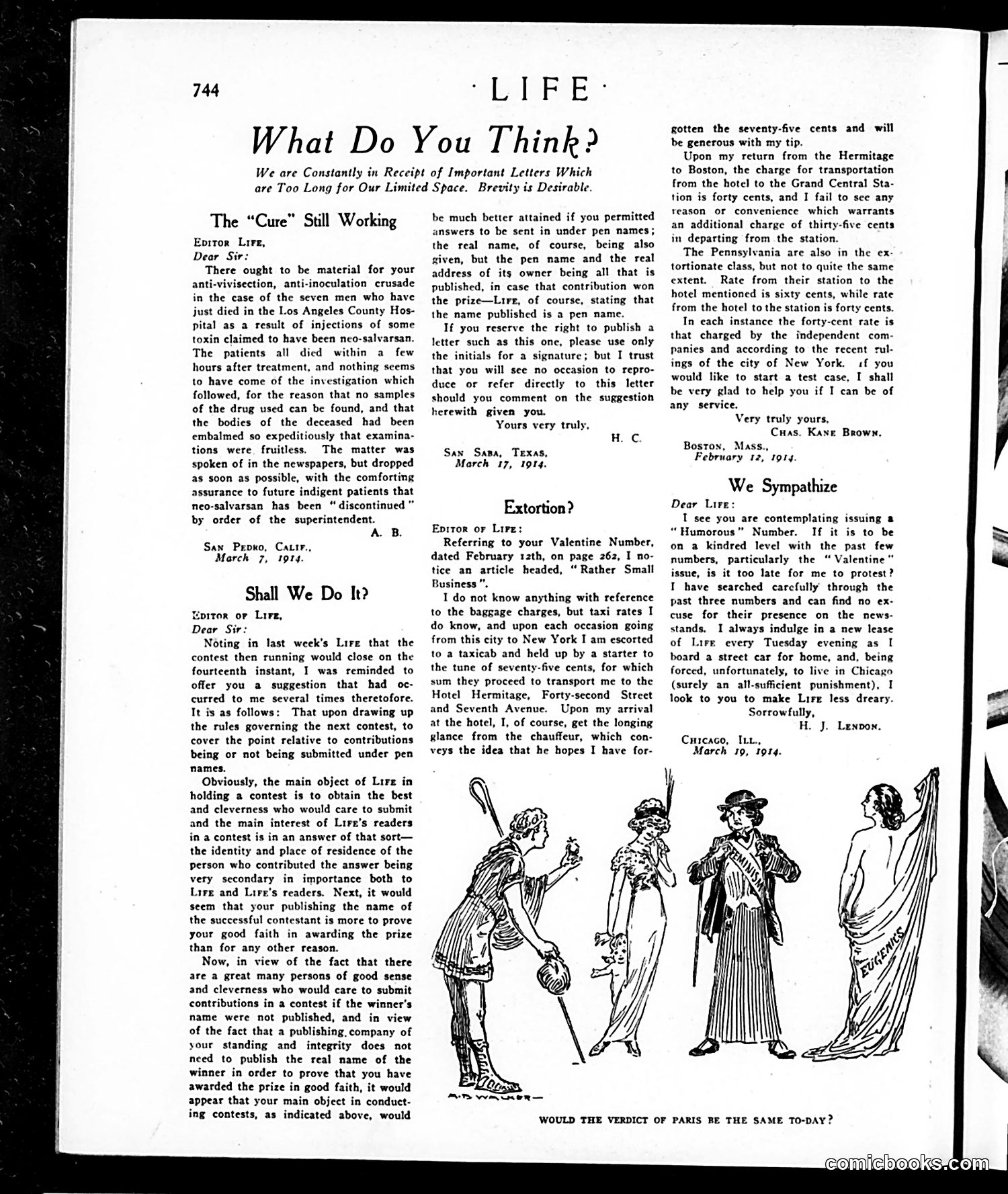
This page is a **reader letters section** titled "What Do You Think?" — essentially the magazine's opinion column. The content reflects early 20th-century social concerns: **Letter 1** discusses deaths from neo-salvarsan injections at a Los Angeles hospital, critiquing the medical establishment's lack of accountability and swift dismissal of the incident. **Letter 2** proposes Life magazine allow contest submissions under pen names while verifying winner identity privately — arguing this would encourage participation without requiring public identity disclosure. **Letter 3** complains about NYC taxi and hotel surcharges, describing them as extortionate "holding up" of travelers. The **political cartoon** at bottom shows classical figures (appearing to reference the Judgment of Paris from Greek mythology) with the caption "Would the verdict of Paris be the same to-day?" — likely satirizing how modern commercialism or standards have corrupted classical ideals. The page overall reflects turn-of-the-century anxieties: medical ethics, editorial fairness, and consumer exploitation.
📄 Transcribed text from this page (OCR, searchable)
Machine-transcribed from the original scan — historical spelling and the odd misread are preserved.
TEESE What Do You Think? We are Constantly in Receipt of Important Letters Which are Too Long for Our Limited Space. Brevity is Desirable. The “Cure” Still Working Eprtor Lire, Dear Sir: There ought to be material for your anti-vivisection, anti-inoculation crusade in the case of the seven men who have just died in the Los Angeles County Hos- pital as a result of injections of some toxin claimed to have been neo-salvarsan. The patients all died within a few hours after treatment, and nothing seems to have come of the investigation which followed, for the reason that no samples of the drug used can be found, and that the bodies of the deceased had been embalmed so expeditiously that examina- tions were fruitless. The matter was spoken of in the newspapers, but dropped as soon as possible, with the comforting assurance to future indigent patients that neo-salvarsan has been “discontinued ” by order of the superintendent. A. B. San Pepxo, Cattr., March 7, 1914. Shall We Do It? Epitor or Livg, Dear Sir: Noting in last week's Lire that the contest then running would close on the fourteenth instant, I was reminded to offer you a suggestion that had oc- curred to me several times theretofore. It is as follows: That upon drawing up the rules governing the next contest, to cover the point relative to contributions being or not being submitted under pen names. Obviously, the main object of Lire in holding a contest is to obtain the best and cleverness who would care to submit and the main interest of Lrre’s readers in a contest is in an answer of that sort— the identity and place of residence of the person who contributed the answer being very secondary in importance both to Lire and Lire’s readers. Next, it would seem that your publishing the name of the successful contestant is more to prove your good faith in awarding the prize than for any other reason. Now, in view of the fact that there are a great many persons of good sense and cleverness who would care to submit contributions in a contest if the winner's name were not published, and in view of the fact that a publishing. company of your standing and integrity does not need to publish the real name of the winner in order to prove that you have awarded the prize in good faith, it would appear that your main object in conduct- ing contests, as indicated above, would be much better attained if you permitted answers to be sent in under pen names; the real name, of course, being also given, but the pen name and the real address of its owner being all that is published, in case that contribution won the prize—Lire, of course, stating that the name published is a pen name. If you reserve the right to publish a letter such as this one, please use only the initials for a signature; but I trust that you will see no occasion to repro- duce or refer directly to this letter should you comment on the suggestion herewith given you. Yours very truly, Sax Sama, Texas, March 17, 1914. Extortion? Epitor or Lire: Referring to your Valentine Number, dated February 12th, on page 262, I no- tice an article headed, “ Rather Small Business ". I do not know anything with reference to the baggage charges, but taxi rates I do know, and upon each occasion going from this city to New York I am escorted to a taxicab and held up by a starter to the tune of seventy-five cents, for which sum they proceed to transport me to the Hotel Hermitage, Forty-second Street and Seventh Avenue. Upon my arrival at the hotel, I, of course, get the longing glance from the chauffeur, which con- veys the idea that he hopes I have for- Ds An wan oR— gotten the seventy-five cents and will be generous with my tip. Upon my return from the Hermitage to Boston, the charge for transportation from the hotel to the Grand Central Sta- tion is forty cents, and I fail to see any reason or convenience which warrants an additional charge of thirty-five cents in departing from the station. The Pennsylvania are also in the ex- tortionate class, but not to quite the same extent. Rate from their station to the hotel mentioned is sixty cents, while rate from the hotel to the station is forty cents. In each instance the forty-cent rate is that charged by the independent com- panies and according to the recent rul- ings of the city of New York. sf you would like to start a test case, I shall be very glad to help you if I can be of any service. Very truly yours, Cuas. Kane Brown. Bostox, Mass., February 12, 1914. We Sympathize Dear Lire: I see you are contemplating issuing a “Humorous” Number. If it is to be on a kindred level with the past few numbers, particularly the “ Valentine" issue, is it too late for me to protest? I have searched carcfully through the past three numbers and can find no ex- cuse for their presence on the news- stands, I always indulge in a new lease of Lire every Tuesday evening as I board a street car for home, and, being forced, unfortunately, to live in Chicago (surely an all-sufficient punishment), I look to you to make Lire less dreary. Sorrowfully, H. J. Lexvox. Cuicaco, Itt., March 19, 1914. WOULD THE VERDICT OF PARIS RE THE SAME TO-DAY?