
Life, 1914-04-23 · page 21 of 44
Life — April 23, 1914 — page 21: what you’re looking at
What you’re looking at
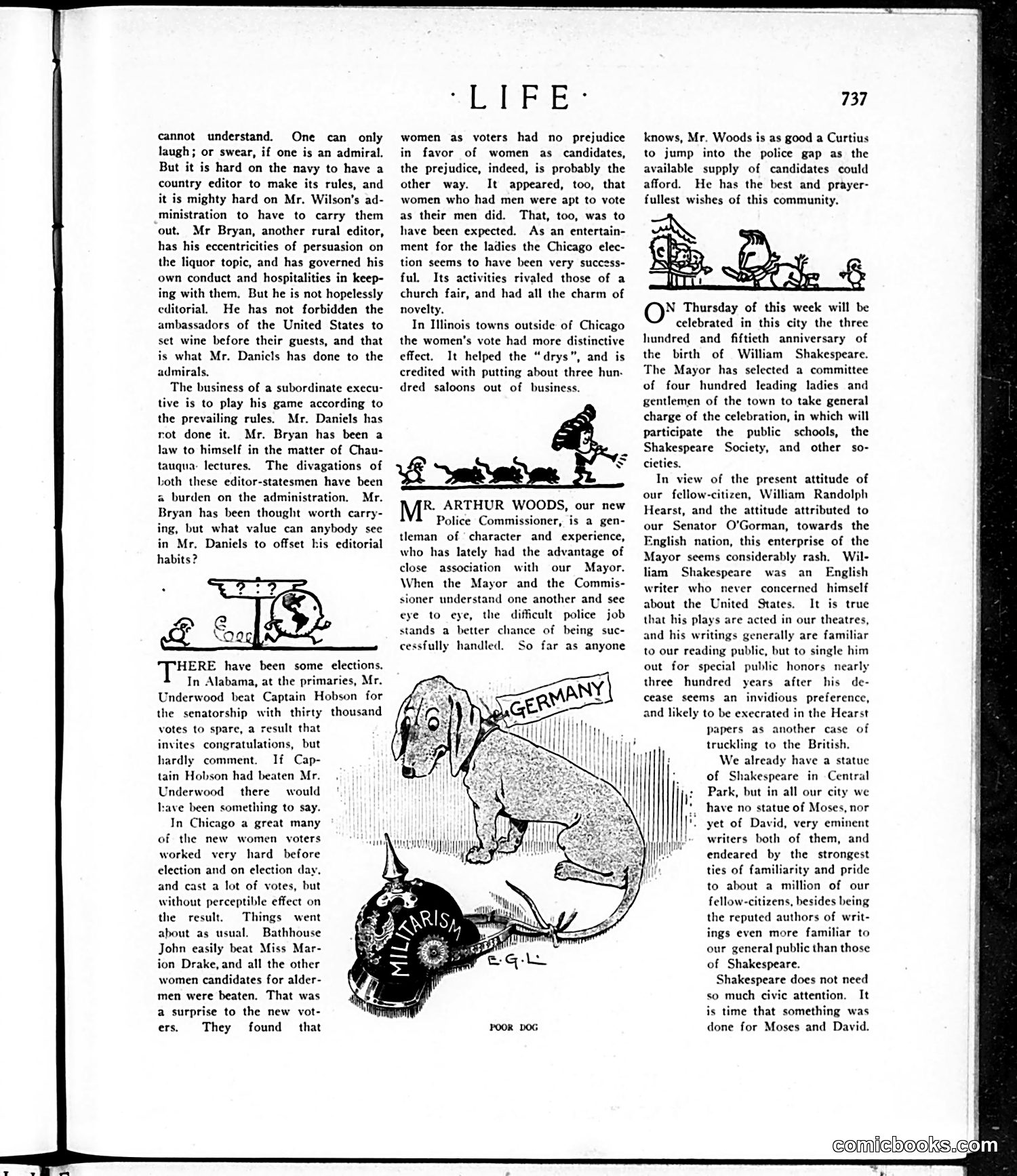
This page contains political commentary on Wilson administration officials and New York civic matters. **Main cartoon**: A dachshund labeled "Germany" and a bulldog labeled "Militarism" fight over a bone marked "Poor Dog." This satirizes European militarism and the arms race, likely reflecting American concerns about pre-WWI tensions. **Text satire**: The article criticizes Secretary of the Navy Josephus Daniels for imposing his editorial views (particularly a ban on alcohol at naval functions) on the military establishment, comparing him unfavorably to William Jennings Bryan. The writer argues subordinate executives should follow prevailing rules, not impose personal ideology. **Chicago elections commentary**: Women's newly gained voting rights are mocked—female candidates lost to male incumbents like "Bathhouse John," and women largely voted as their husbands did. The piece suggests women's suffrage was entertainment rather than transformative, though acknowledging women voters did help prohibition efforts. **Shakespeare celebration**: The final section expresses skepticism about New York celebrating Shakespeare given anti-British sentiment from William Randolph Hearst and Senator O'Gorman.
📄 Transcribed text from this page (OCR, searchable)
Machine-transcribed from the original scan — historical spelling and the odd misread are preserved.
cannot understand. One can only laugh; or swear, if one is an admiral. But it is hard on the navy to have a country editor to make its rules, and it is mighty hard on Mr. Wilson’s ad- ministration to have to carry them out. Mr Bryan, another rural editor, has eccentricities of persuasion on the liquor topic, and has governed his own conduct and hospitalities in keep- ing with them, But he is not hopelessly editorial. He has not forbidden the ambassadors of the United States to set wine before their guests, and that is what Mr. Danicls has done to the admirals, The business of a subordinate execu- tive is to play his game according to the prevailing rules. Mr. Daniels has rot done it. Mr. Bryan has been a law to himself in the matter of Chau- tauqua: lectures. The divagations of Loth these editor-statesmen have been a burden on the administration. Mr. Bryan has been thought worth carry- ing, but what value can anybody see in Mr. Daniels to offset his editorial HERE have been some elections. In Alabama, at the primaries, Mr. Underwood beat Captain Hobson for the senatorship with thirty thousand votes to spare, a result that invites congratulations, but hardly comment. If Cap- tain Hobson had beaten Mr. Underwood there would lrave been something to say. In Chicago a great many of the new women voters worked very hard before election and on election day, and cast a lot of votes, but without perceptible effect on the result. Things went about as usual. Bathhouse John easily beat Miss Mar- ion Drake, and all the other women candidates for alder- men were beaten. That was a surprise to the new vot- ers, They found that aL ESBS women as voters had no prejudice in favor of women as candidates, the prejudice, indeed, is probably the other way. It appeared, too, that women who had men were apt to vote as their men did. That, too, was to have been expected. As an entertain- ment for the ladies the Chicago elec- tion seems to have been very success- ful. Its activities rivaled those of a church fair, and had all the charm of novelty. In Illinois towns outside of Chicago the women’s vote had more distinctive effect. It helped the “drys”, and is credited with putting about three hun. dred saloons out of business. R. ARTHUR WOODS, our new Police Commissioner, is a gen- tleman of character and experience, who has lately had the advantage of close association with our Mayor. When the Mayor and the Commis- sioner understand one another and see eye to eye, the difficult police job stands a better chance of being suc- cessfully handled. So far as anyone knows, Mr. Woods is as good a Curtius to jump into the police gap as the available supply of candidates could afford. He has the best and prayer- fullest wishes of this community. O*’ Thursday of this week will be celebrated in this city the three hundred and fiftieth anniversary of the birth of William Shakespeare. The Mayor has selected a committee of four hundred leading ladies and gentlemen of the town to take general charge of the celebration, in which will participate the public schools, the Shakespeare Society, and other so- cieties. In view of the present attitude of our fellow-citizen, William Randolph Hearst, and the attitude attributed to our Senator O'Gorman, towards the English nation, this enterprise of the Mayor seems considerably rash. Wil- liam Shakespeare was an English writer who never concerned himself about the United States. It is true that his plays are acted in our theatres, and his writings generally are familiar to our reading public, but to single him out for special public honors nearly three hundred years after his de- cease seems an invidious preference, and likely to be execrated in the Hearst papers as another truckling to the Bri We already have a statue of Shakespeare in Central Park, but in all our city we have no statue of Moses, nor yet of David, very eminent writers both of them, and endeared by the strongest ties of familiarity and pride to about a million of our fellow-citizens, besides being the reputed authors of writ- ings even more familiar to our general public than those of Shakespeare. Shakespeare does not need so much civic attention. It is time that something was done for Moses and David. comichooks.