
Life, 1914-04-23 · page 25 of 44
Life — April 23, 1914 — page 25: what you’re looking at
What you’re looking at
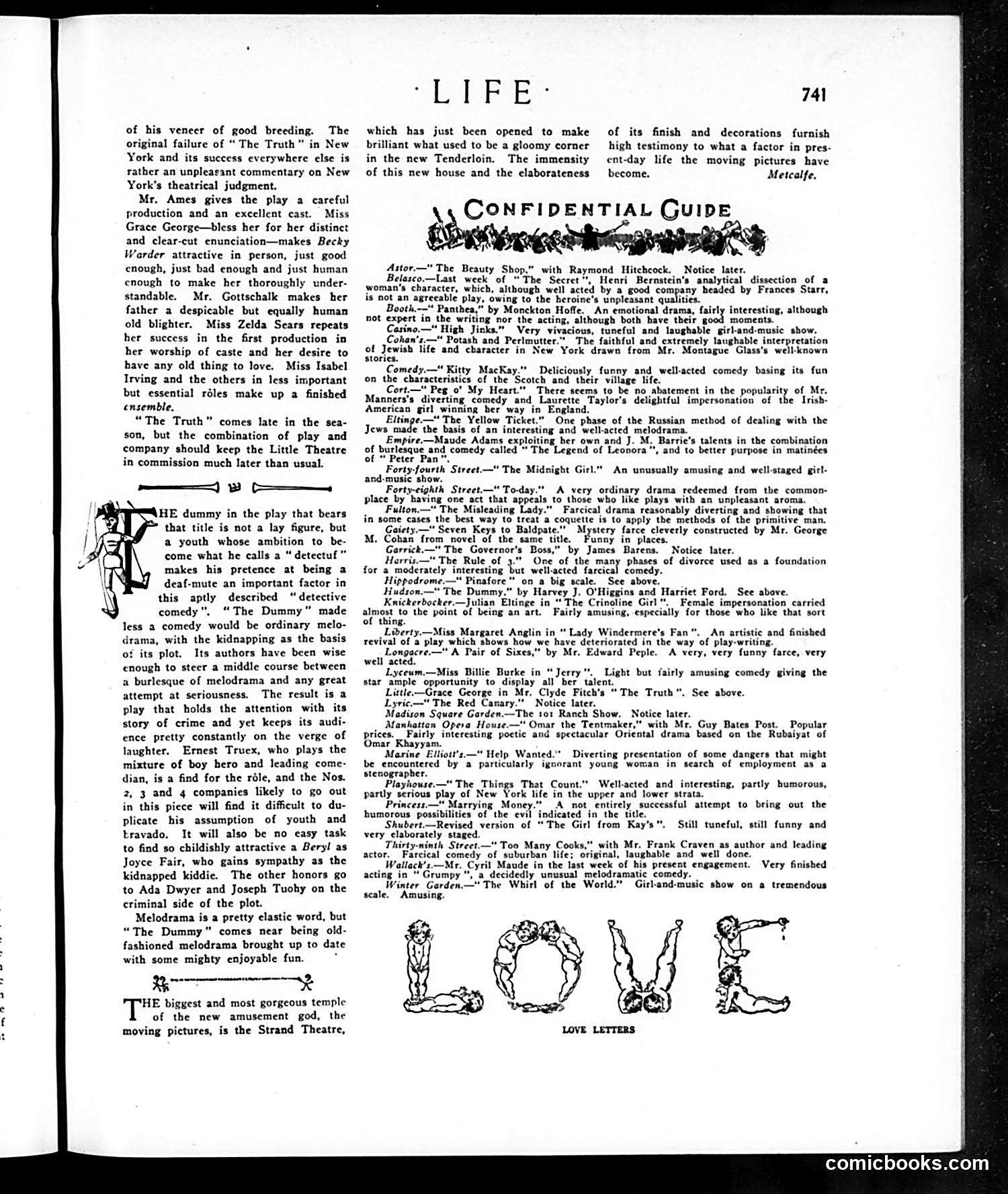
This page is primarily **theater reviews** rather than political satire. It discusses Broadway productions from the early 20th century, including "The Truth," "The Dummy," and various other plays. The only cartoon element is the decorative **"LOVE LETTERS"** illustration at the bottom—cherubic figures forming letters spelling that phrase. This appears to be a humorous advertisement or section header rather than political commentary. The substantive content reviews contemporary theatrical productions, praising or critiquing actors like Grace George, Ernest Truex, and others. There's also notice of the newly-opened Strand Theatre, described as a grand "temple" to the emerging entertainment medium of motion pictures—reflecting early cinema's cultural significance. The tone is critical but theatrical rather than political. No identifiable political figures or satirical targets appear. This is essentially **entertainment journalism** with light decorative art, typical of Life's mixed content format.
📄 Transcribed text from this page (OCR, searchable)
Machine-transcribed from the original scan — historical spelling and the odd misread are preserved.
of his veneer of good breeding. The original failure of “ The Truth” in New York and its success everywhere else is rather an unpleasant commentary on New York’s theatrical judgment. Mr. Ames gives the play a careful production and an excellent cast. Miss Grace George—bless her for her distinct and clear-cut enunciation—makes Becky Warder attractive in person, just good cnough, just bad enough and just human enough to make her thoroughly under- standable. Mr. Gottschalk makes her father a despicable but equally human old blighter. Miss Zelda Sears repeats her success in the first production in her worship of caste and her desire to have any old thing to love. Miss Isabel Irving and the others in less important but essential réles make up a finished ensemble, “The Truth” comes late in the sea- son, but the combination of play and company should keep the Little Theatre in commission much later than usual. ——$—=J vy HE dummy in the play that bears that title is not a lay figure, but a youth whose ambition to be- come what he calls a “ detectuf” makes his pretence at being a deaf-mute an important factor in this aptly described “detective comedy". “The Dummy” made less a comedy would be ordinary melo- drama, with the kidnapping as the basis of its plot. Its authors have been wise enough to steer a middle course between a burlesque of melodrama and any great attempt at seriousness. The result is a play that holds the attention with its story of crime and yet keeps its audi- ence pretty constantly on the verge of laughter. Ernest Truex, who plays the mixture of boy hero and leading come- dian, is a find for the réle, and the Nos. 2, 3 and 4 companies likely to go out in this piece will find it difficult to du- plicate his assumption of youth and travado. It will also be no easy task to find so childishly attractive a Beryl! as Joyce Fair, who gains sympathy as the kidnapped kiddie. The other honors go to Ada Dwyer and Joseph Tuohy on the criminal side of the plot. Melodrama is a pretty elastic word, but “The Dummy” comes near being old- fashioned melodrama brought up to date with some mighty enjoyable fun. a: HE biggest and most gorgeous temple of the new amusement god, the moving pictures, is the Strand Theatre, TEES which has just been opened to make brilliant what used to be a gloomy corner in the new Tenderloin. The immensity of this new house and the elaborateness 741 of its finish and decorations furnish high testimony to what a factor in pres- ent-day life the moving pictures have become. Metcalfe. The Beauty Shop.” with Raymond Hitchcock. Notice later. Belasco.—Last week of “The Secret, Henri Bernstein's analytical dissection of a woman's character, which, although well acted by a good company beaded by Frances Starr, is not an agreeable play, owing to the heroine's unpleasant qualities. Booth.“ Panthea,” by Monckton Hoffe. An emotional drama, fairly interesting, although not expert in the writing nor the acting, although both have their good moments. Casino.—" High Jinks.” Very vivacious, tuneful and laughable girl-and-music show. Cohan's—“ Potash and Perlmutter.” The faithful and extremely laughable interpretation of Jewish life and character in New York drawn from Mr. Montague Glass's well-known stofies. Comedy.—"' Kitty MacKay.” Deliciously funny and well-acted comedy bi on the characteristics of the Scotch and their village life. Cort—" Peg o' My Heart.” There seems to be no abatement in the popularit Manners's diverting comedy and Laurette Taylor's delightful impersonation of the American girl winning her way in England. Eltinge.—" The Yellow Ticket.” One phase of the Russian method of dealing with the Jews made the basis of an interesting and well-acted melodrama. Empire,—Maude Adams exploiting her own and J. M. Barrie's talents in the combination of burlesque and comedy called “ The Legend of Leonora’, and to better purpose in matinges of * Peter Pi The Midnight Girl.” Forty-fourth Street, and-music show. To-day." A very ordinary drama redeemed from the common- ‘appeals to those who like plays with an unpleasant aroma. “The Misleading Lady.” Farcical drama reasonably diverting and showing that in some cases the best way to treat a coquette is to apply the methods of the primitive man. Gaiety.—" Seven Keys to Baldpate."" Mystery farce cleverly constructed by Mr. George M. Cohan from novel of the same title, Funny in places. —"" The Governor's Boss,” by James Barens. Notice later. “The Rule of 3." One of the many phases of divorce used as a foundation for a moderately interesting but wellacted farcical comedy. Hippodrome.— Pinafore” on a big scale. See above. Hudson.—" The Dummy,” by Harvey J. O'Higgins and Harriet Ford. See above. Knickerbocker.—Julian Eltinge in “ The Crinoline Girl. Female impersonation. carried almost to the point of being an art. Fairly amusing, especially for those who like that sort of thing. Liderty.—Miss Margaret Anglin in “ Lady Windermere’s Fan”. An artistic and finished revival of a play which shows how we have deteriorated in the way of play-writing. Longacre.—" A Pair of Sixes,” by Mr. Edward Peple. A very, very funny farce, very well acted. Lyceum.—Miss Billie Burke in “ Jerry". Light but fairly amusing comedy giving the star ample opportunity to display all” her talent. Little-—Grace George in Mr. Clyde Fitch's “The Truth", See above. Lyric-—" The Red Canary.” Notice later. Madison Square Garden.—The 101 Ranch Show. Notice later. Manhotten Opera f “Omar the Tentmaker,” with Mr. Guy Bates Post. Popular prices. Fairly interesting poetic and spectacular Oriental drama based on the Rubaiyat of Omar Khayy: Marine Elliott's" Help Wanted." Diverting presentation of some dangers that might be encountered by a particularly ignorant young woman in search of employment as a stenographer. Playhouse.—" The Things That Count.” Well-acted and interesting, partly humorous, partly serious play of New York life in the upper and lower strata. Princess.—" Marrying Money.” A not entirely successful attempt to bring out the humorous possibilities of the evil indicated in the title. Shubert.—Revised version of “The Girl from Kay's”. very elaborately staged. Thirty-ninth Street.—" Too Many Cooks," with Mr. Frank Craven as author and leading actor. Farcical comedy of suburban life; original, laughable and well done. Wallack’s—Mr. Cyril Maude in the last week of his present engagement. Very finished acting in “ Grumpy decidedly unusual melodramatic comedy. Winter Garden." The Whirl of the World.” Girl-and-music show on a tremendous scale. Amusing. fof) WL LOVE LETTERS 1g its fun of Mr. Trish An unusually amusing and well-staged girl- Still tuneful, still funny and comicbooks.com