
A complete issue · 40 pages · 1914
Life — February 26, 1914
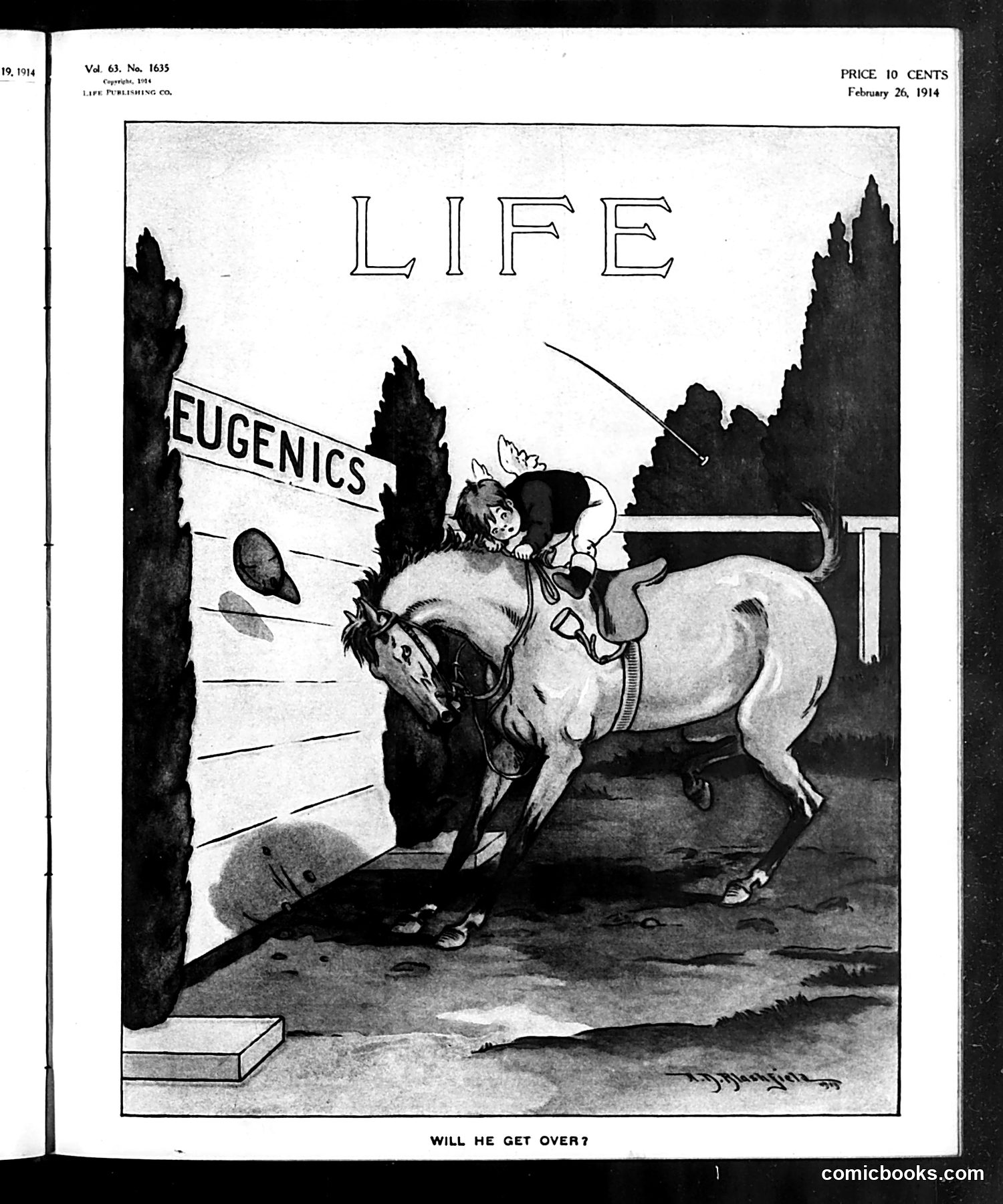
This editorial cartoon critiques the eugenics movement, which was popular among American progressives in the early 1900s. The image shows a rotund figure (representing a eugenicist or their ideology) riding a horse labeled "Eugenics," attempting to jump over a fence marked "Will He Get Over?" The satire questions whether the eugenics ideology can successfully "clear" its obstacles—likely referring to practical, ethical, or social barriers to implementing selective breeding policies. The bloated rider and straining horse suggest the movement's precarious position or the difficulty of achieving its goals. This reflects growing skepticism about eugenics among some Americans, though the movement would unfortunately persist for decades before being thoroughly discredited.
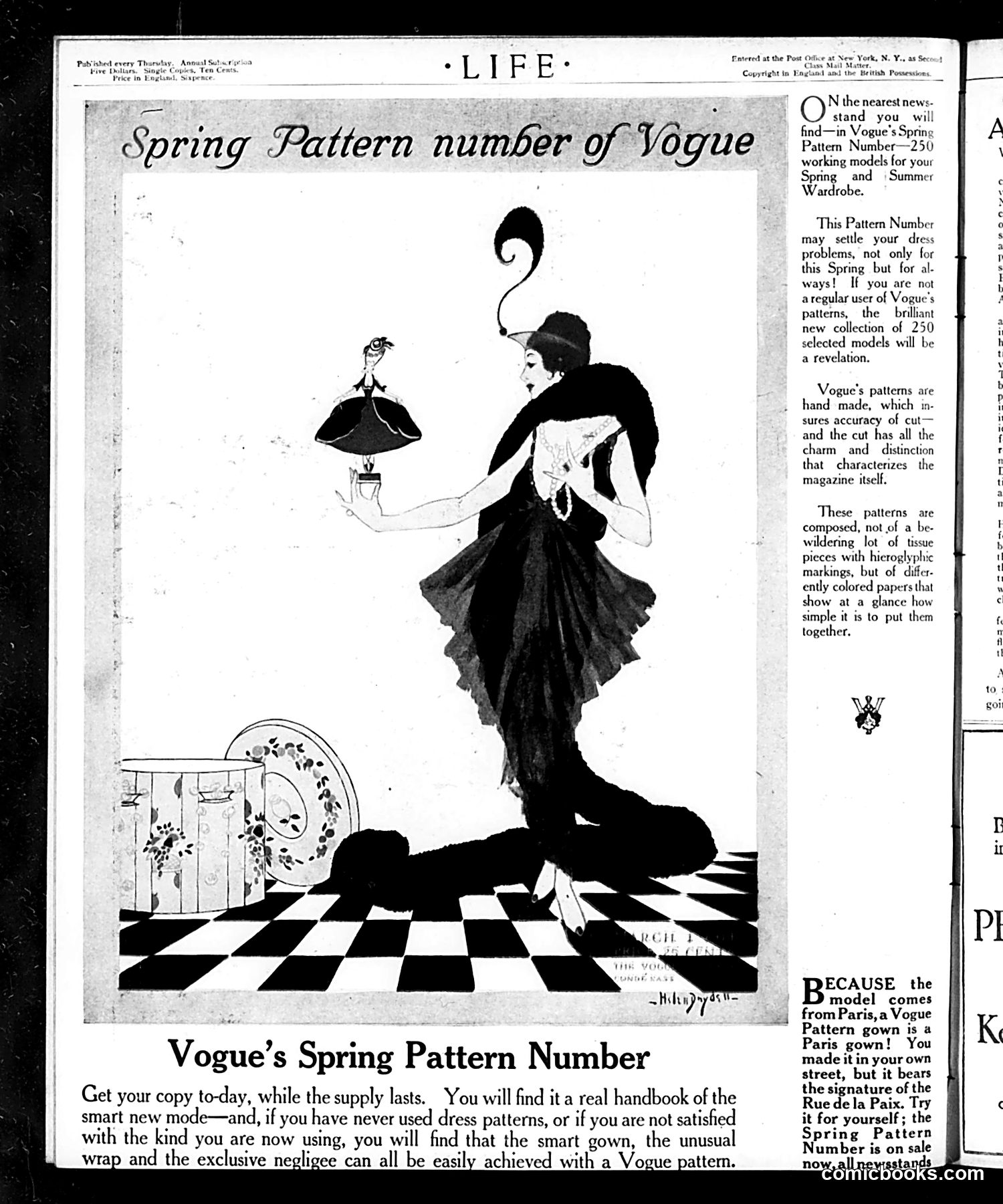
This page is primarily **advertising for Vogue's Spring Pattern Number 250**, not political satire. The illustration shows a fashionable woman in an elegant black gown displaying dress patterns. A small figure holding a question mark above her head appears to represent a customer's uncertainty about fashion choices. The text emphasizes that Vogue patterns are professionally designed ("hand made"), accurately cut, and composed of "differently colored papers" showing assembly simplicity. A key selling point is that patterns "come from Paris"—suggesting Paris fashion expertise lends prestige and authenticity to American home dressmakers. This reflects 1920s consumer culture: making clothes at home was economical, but Vogue patterns promised quality and sophistication rivaling ready-made garments.
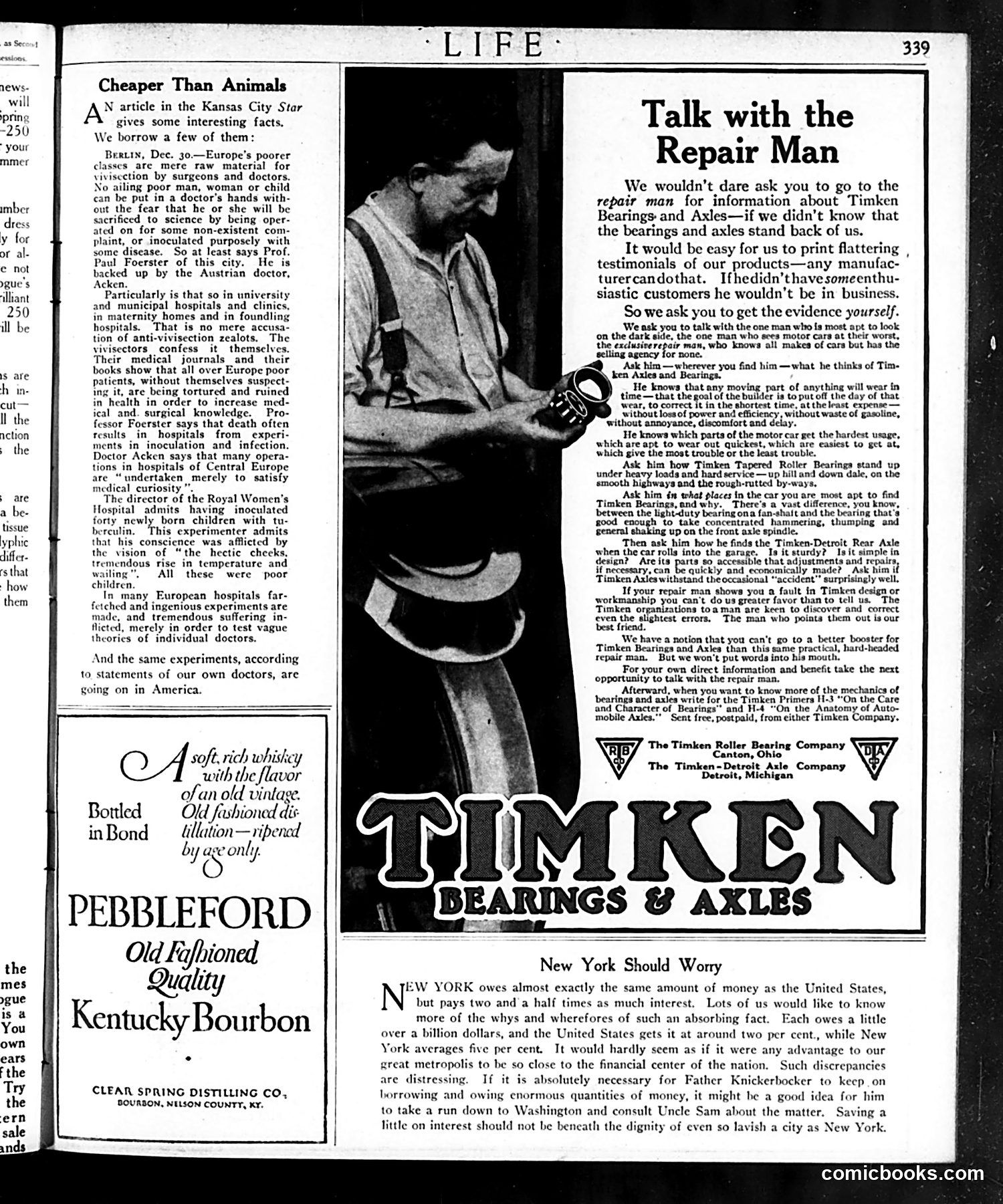
This page contains **no political cartoon**. Instead, it features: 1. **Left column**: An article titled "Cheaper Than Animals" discussing European medical experiments on poor patients, contrasting with mention of similar practices in America. It critiques unethical medical testing. 2. **Center/Right**: A large **Timken Bearings & Axles advertisement** with an illustration of a repair man and the heading "Talk with the Repair Man." The ad encourages consumers to ask mechanics about Timken products' reliability and performance. 3. **Bottom**: An article titled "New York Should Worry" about municipal finance. 4. **Left margin**: A Pebbleford Kentucky Bourbon whiskey advertisement. The page is primarily **advertising-driven** with supporting editorial content, not satirical commentary.
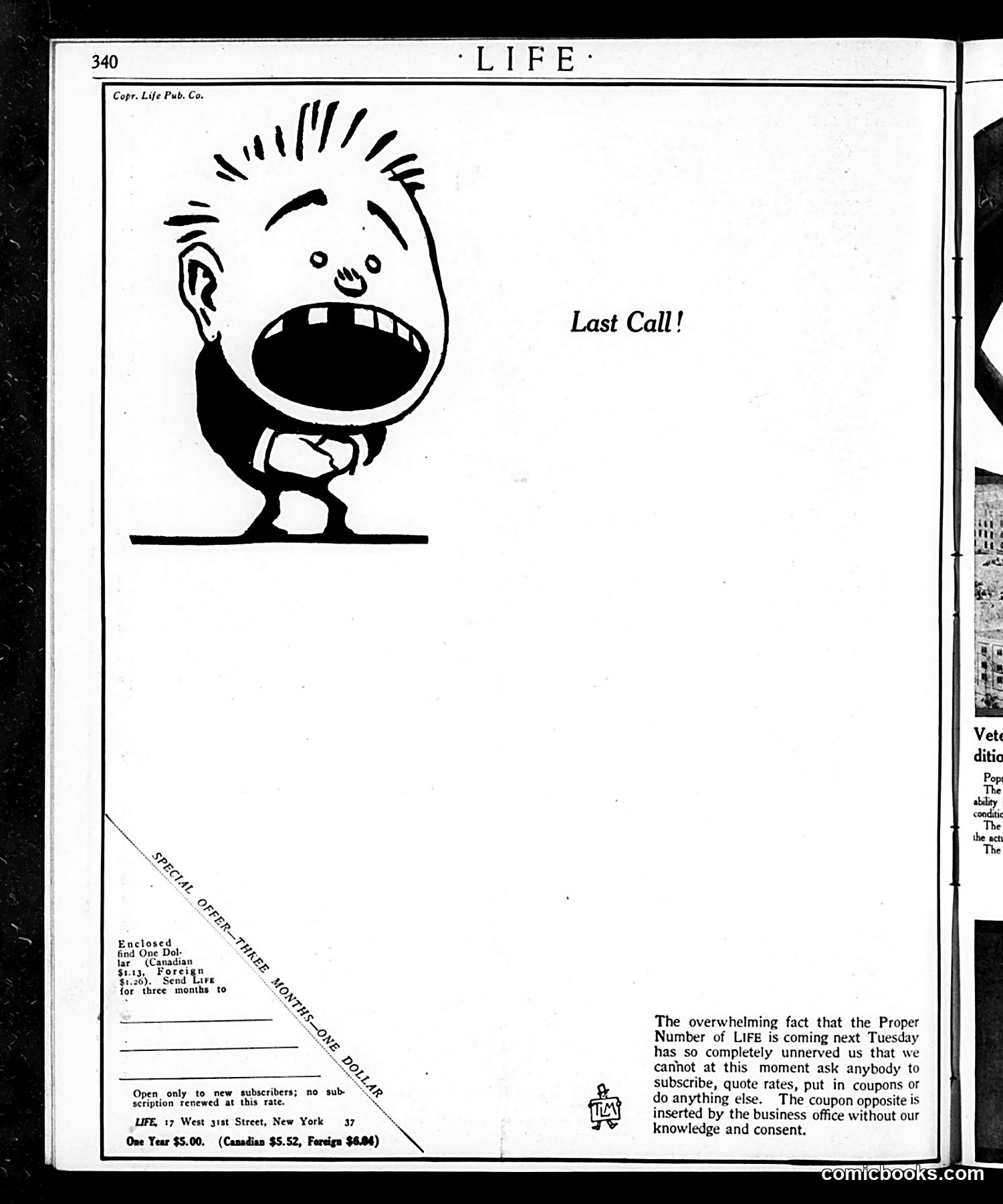
This page is primarily a **subscription advertisement** for LIFE magazine, not a political cartoon. The large illustration shows an exaggerated cartoon figure with an open mouth, labeled "Last Call!" — a visual metaphor for urgent deadline messaging. The text below explains the advertisement's purpose: LIFE's next issue is arriving "next Tuesday" and the magazine is requesting new subscriptions. The accompanying coupon offers three-month subscriptions at special rates (U.S. $1.13, Canadian $1.50, Foreign $1.25). The cartoon figure's theatrical expression of alarm reinforces the urgency of the subscription appeal — conveying that readers should act immediately before missing out on the upcoming issue. This is essentially a promotional pitch dressed in humorous visual language typical of early-to-mid 20th century magazine marketing.
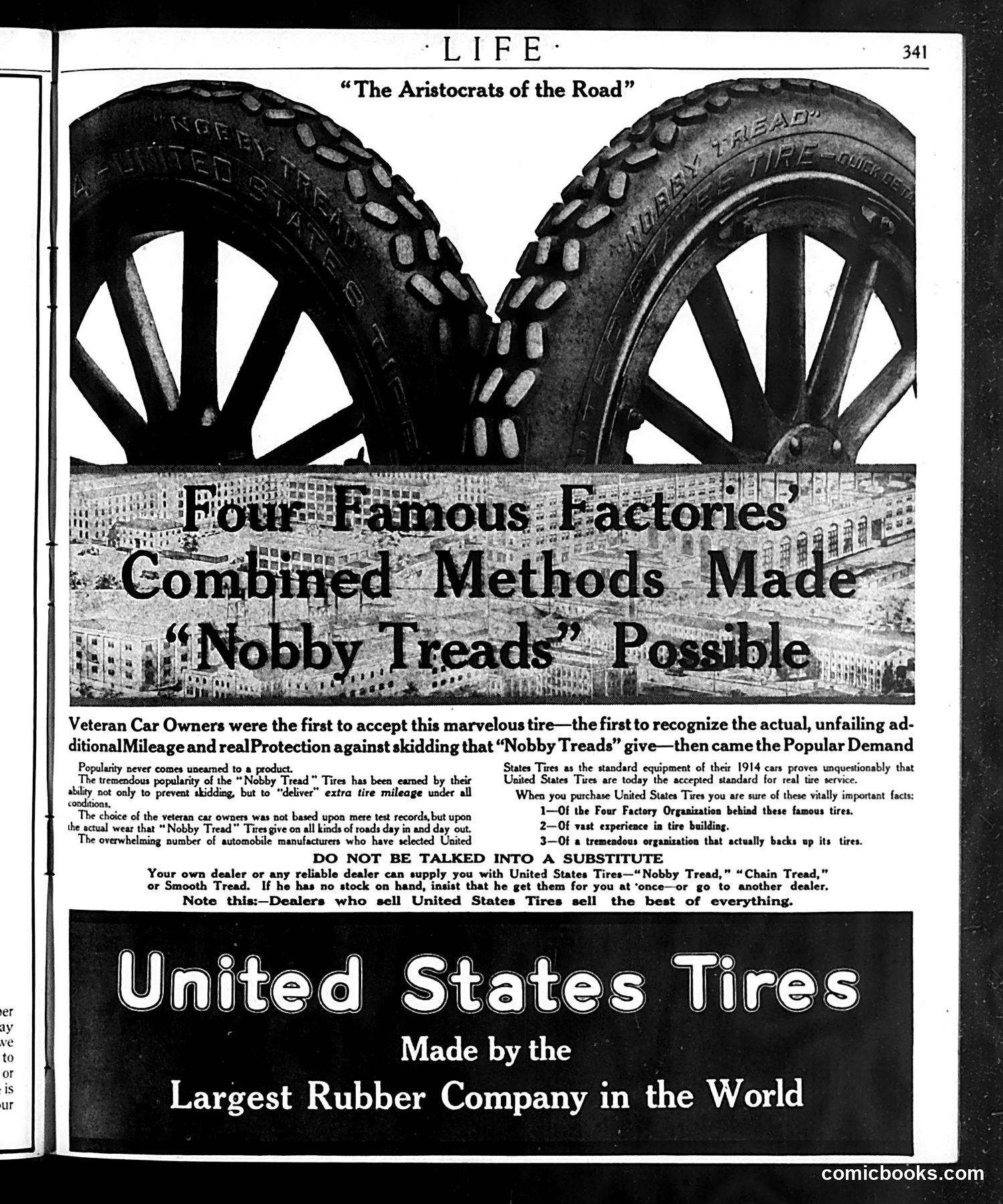
This page is primarily **advertising, not satire or political cartoon**. It's a United States Tires advertisement from Life magazine (page 341). The ad features two large automobile tires labeled "Nobby Treads" displayed prominently above an industrial cityscape. The headline claims these tires were "The Aristocrats of the Road" and that four factories used combined methods to manufacture them. The text emphasizes that veteran car owners were "first to accept" these tires and recognizes their superiority in preventing skidding. The ad warns consumers not to accept substitute brands and directs them to authorized dealers. This is straightforward product advertising targeting early 20th-century automobile owners, emphasizing quality, reliability, and brand loyalty—not political commentary.
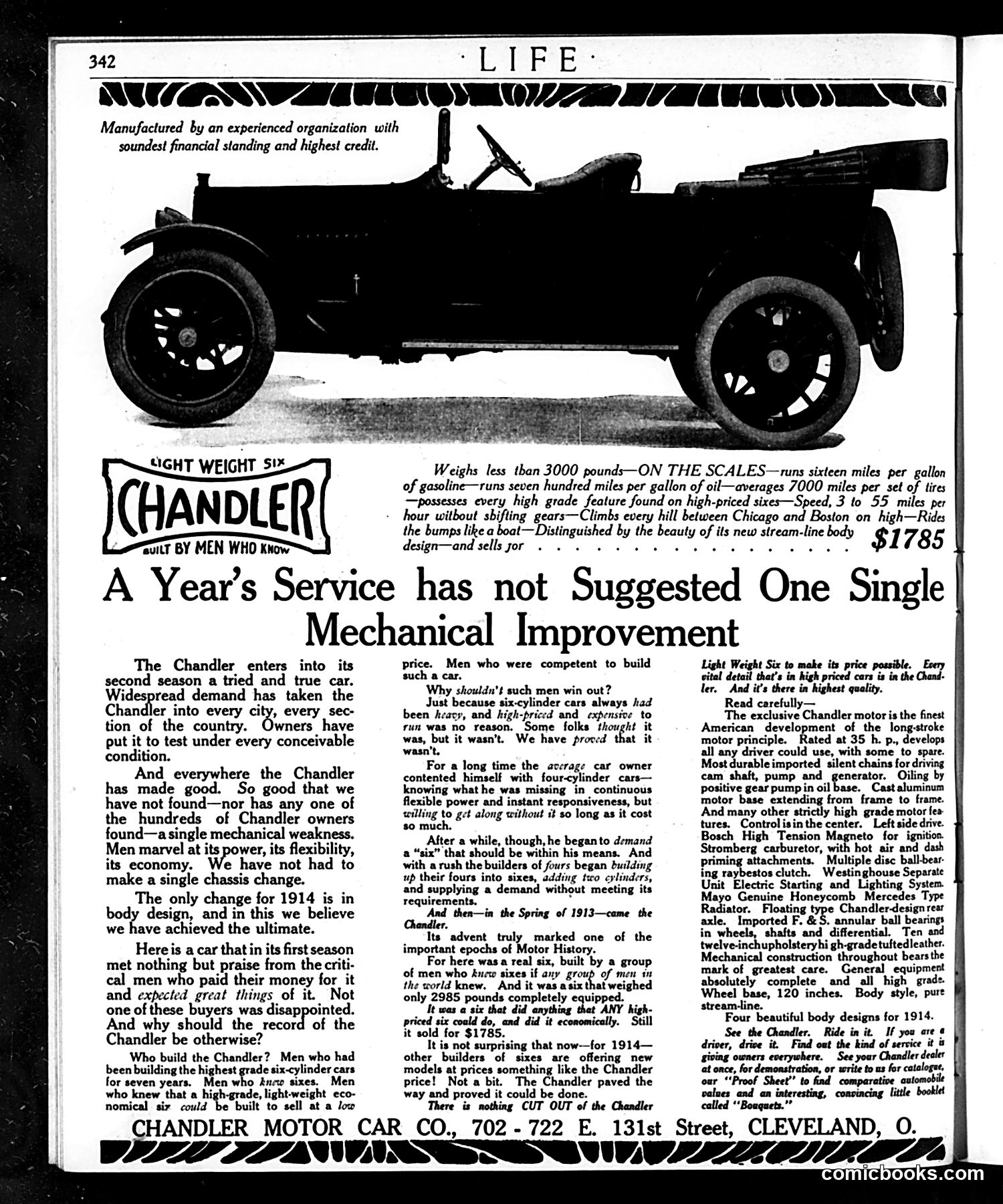
This page is **not a cartoon or satirical content**—it's a straightforward automobile advertisement for the Chandler Motor Car Company of Cleveland, Ohio. The ad promotes the "Light Weight Six" model, priced at $1,785. The text emphasizes the car's reliability and performance: it runs 16 miles per gallon of gasoline, averages 7,000 miles per tire set, and achieves 3-55 mph speeds. The advertisement's main claim is that "A Year's Service has not Suggested One Single Mechanical Improvement," arguing the vehicle requires no modifications because it was engineered correctly from the start. This early-1910s ad targets buyers seeking dependable, economical automobiles by highlighting engineering quality and proven durability rather than luxury features.
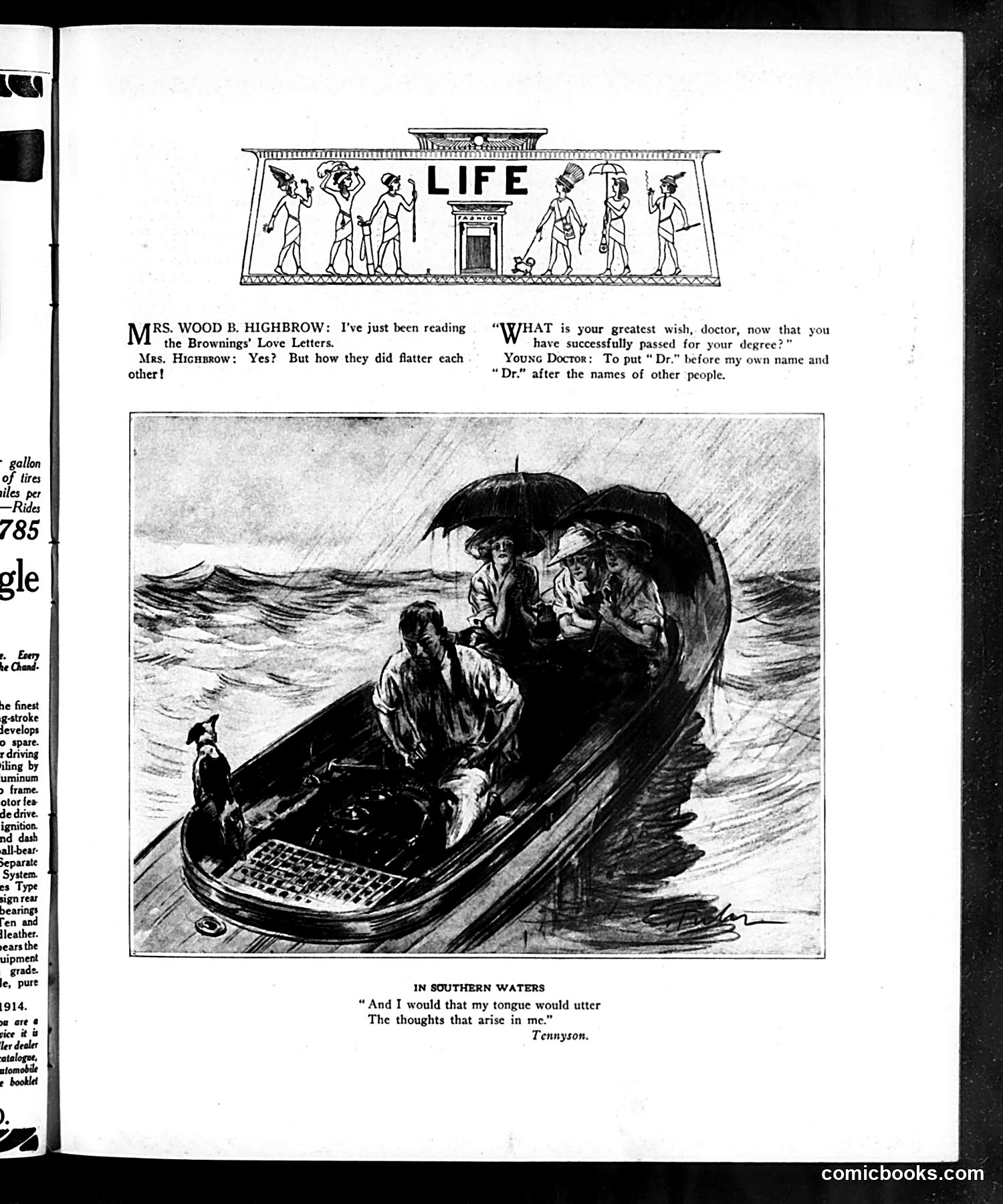
This page from *Life* magazine contains a satirical dialogue and illustration. At the top, **Mrs. Wood B. Highbrow** and **Mrs. Hennasow** discuss the Brownings' Love Letters, with the latter noting how the poets "fluttered each other." A **Young Doctor** is asked his greatest wish now that he's earned his degree—he replies he wants to put "Dr." before his name and after others' names (meaning he wants prestige and to be addressed formally). The main illustration, titled "In Southern Waters," depicts people in a boat during what appears to be rough conditions, accompanying a Tennyson quote about uttering one's innermost thoughts. The page satirizes social pretension, academic aspiration, and romantic sentimentality—typical *Life* magazine targets of gentle mockery for the educated American audience of this era.
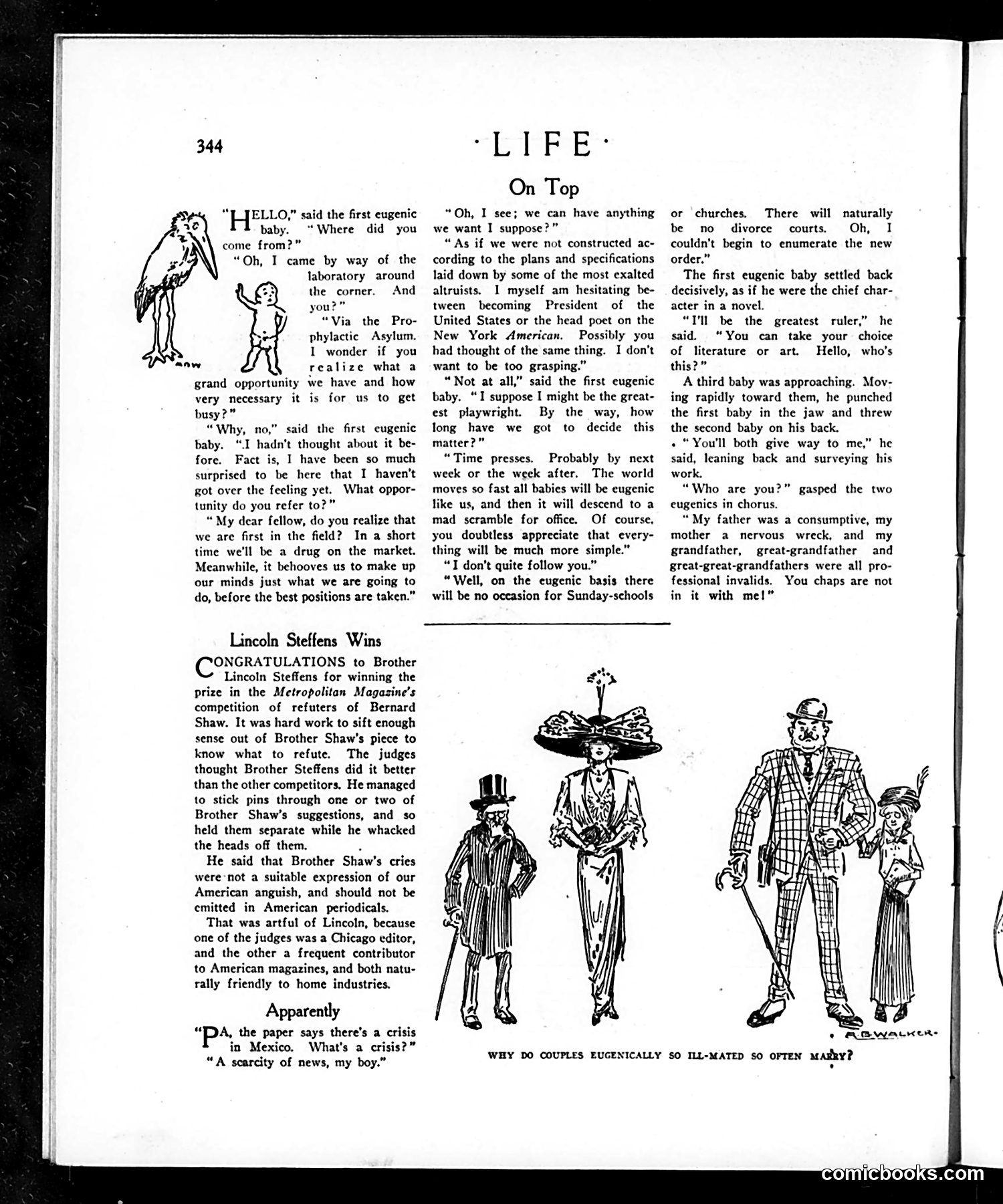
The page contains two satirical pieces. The upper section presents a dialogue between two "eugenic babies"—infants discussing whether one should become U.S. President or poet for the *New York American*. This mocks the eugenics movement (popular in early 20th century) by imagining babies already planning elite careers based on eugenic principles. The lower cartoon, captioned "Why do couples eugenically so ill-mated so often?", depicts four oddly-matched couples in absurd clothing and proportions. It satirizes eugenics ideology by suggesting that real human pairings contradict eugenic ideals of "scientific" mate selection. The humor lies in exposing the gap between eugenic theory and messy human reality.
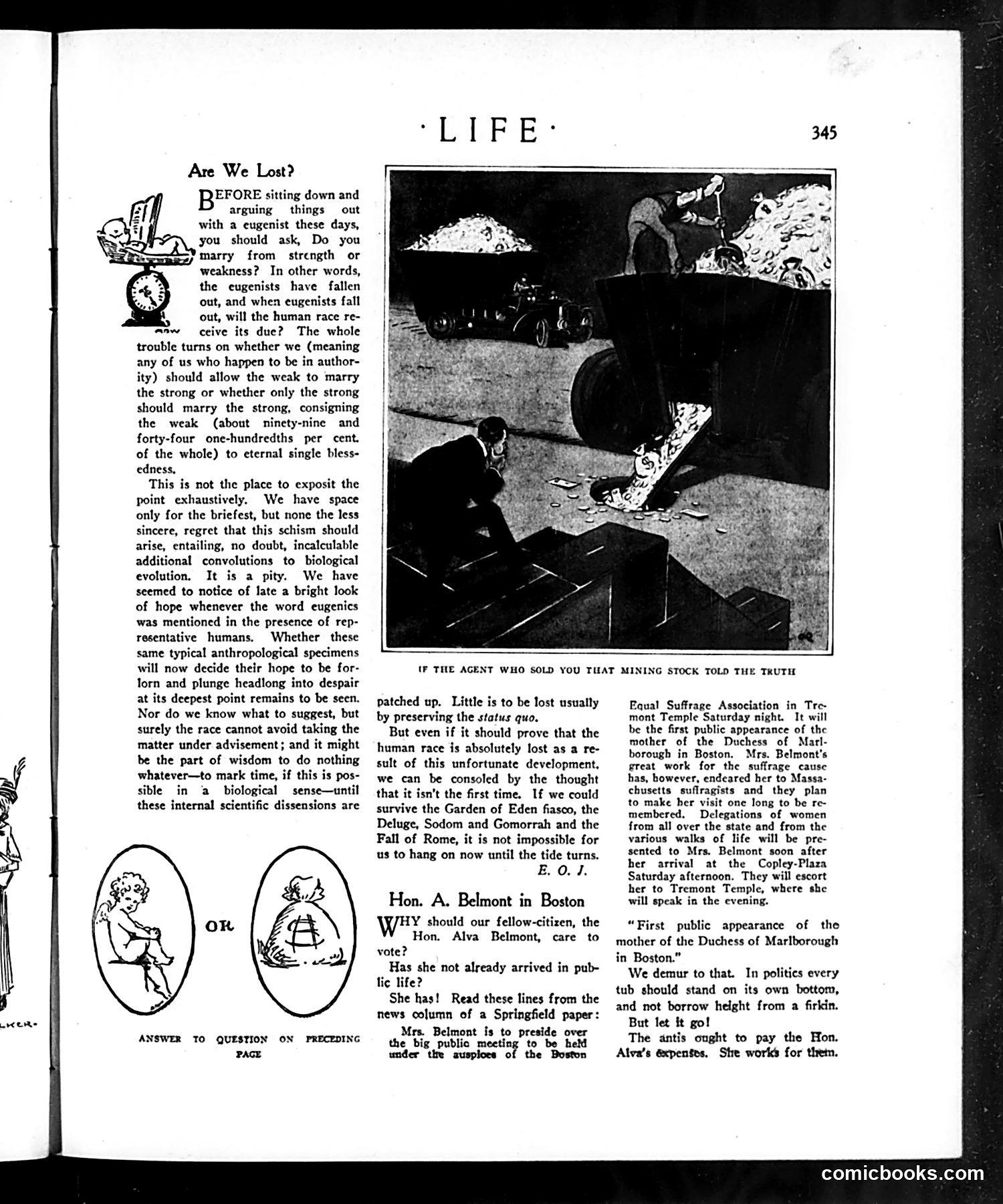
This page contains two distinct pieces of social commentary: **"Are We Lost?"** (main article): A serious essay questioning eugenics policy—whether weak individuals should be allowed to marry or reproduce. The author expresses concern that eugenic theory could cause "incalculable additional convolutions to biological evolution," though notes a "bright look of hope" when the word eugenics is mentioned. **"Hon. A. Belmont in Boston"** (right section): Brief commentary on suffragist Alva Belmont's public appearance at a Boston meeting. The text sarcastically notes she "already arrived in public life" and criticizes her seeking prominence, while defending that "every tub should stand on its own bottom" rather than borrowing credibility from others. The small cartoon below shows unclear allegorical figures in ovals labeled "ANSWER TO QUESTION ON PRECEDING PAGE."
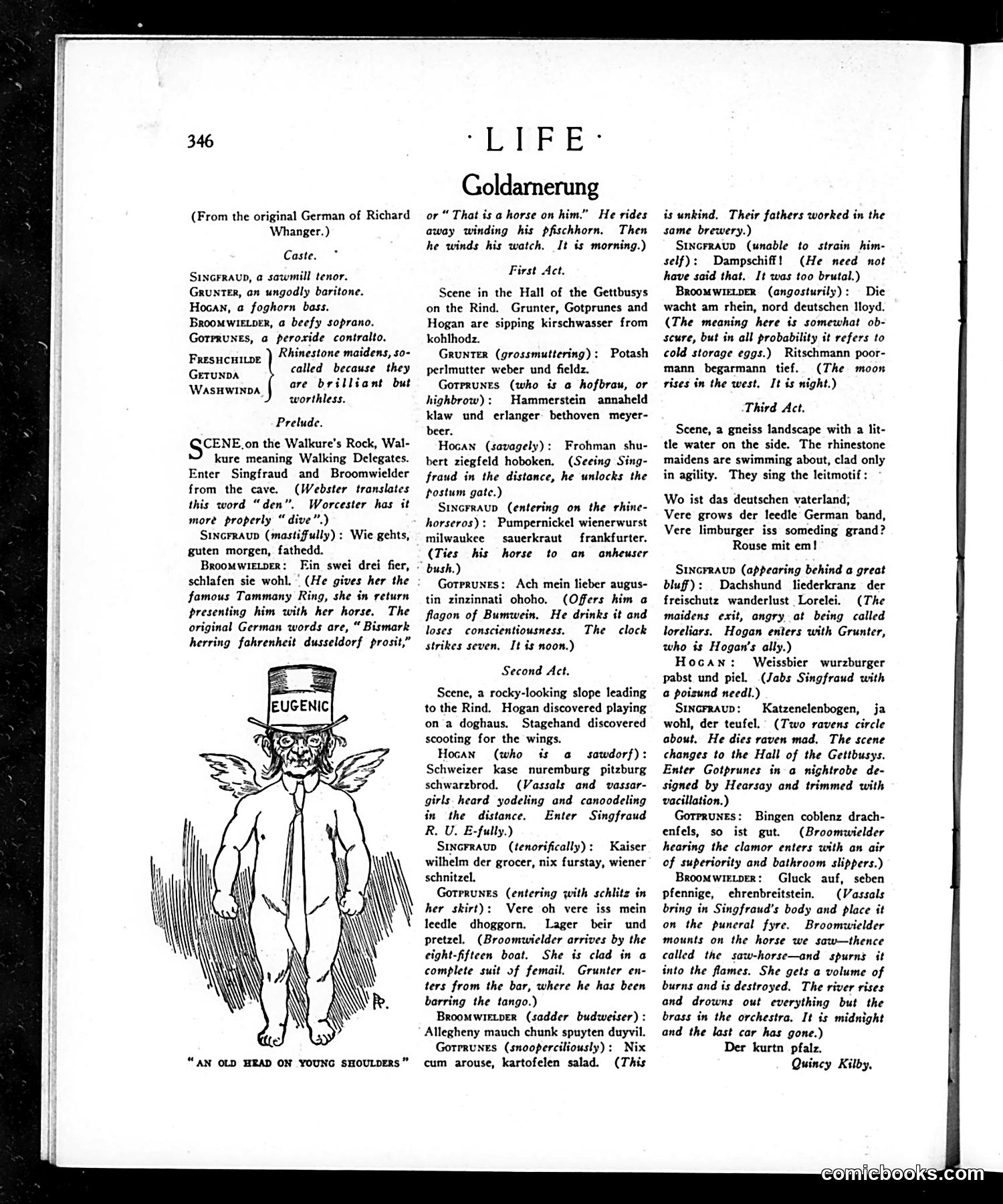
This page presents a satirical adaptation of Richard Whanger's German opera "Goldarnerung." The central illustration shows a grotesque figure labeled "AN OLD HEAD ON YOUNG SHOULDERS"—a caricatured, wingless cherub or imp wearing a top hat marked "EUGENIC." The satire appears to target eugenics movements popular in early 20th-century Germany and America. By pairing this ugly, misshapen creature with eugenics pseudoscience, the cartoonist mocks the contradiction between eugenics' promised "improvement" of humanity and actual results. The opera parody itself satirizes German cultural pretensions through absurdist humor, mixing high art with lowbrow comedy about beer, sausage, and provincial German life.
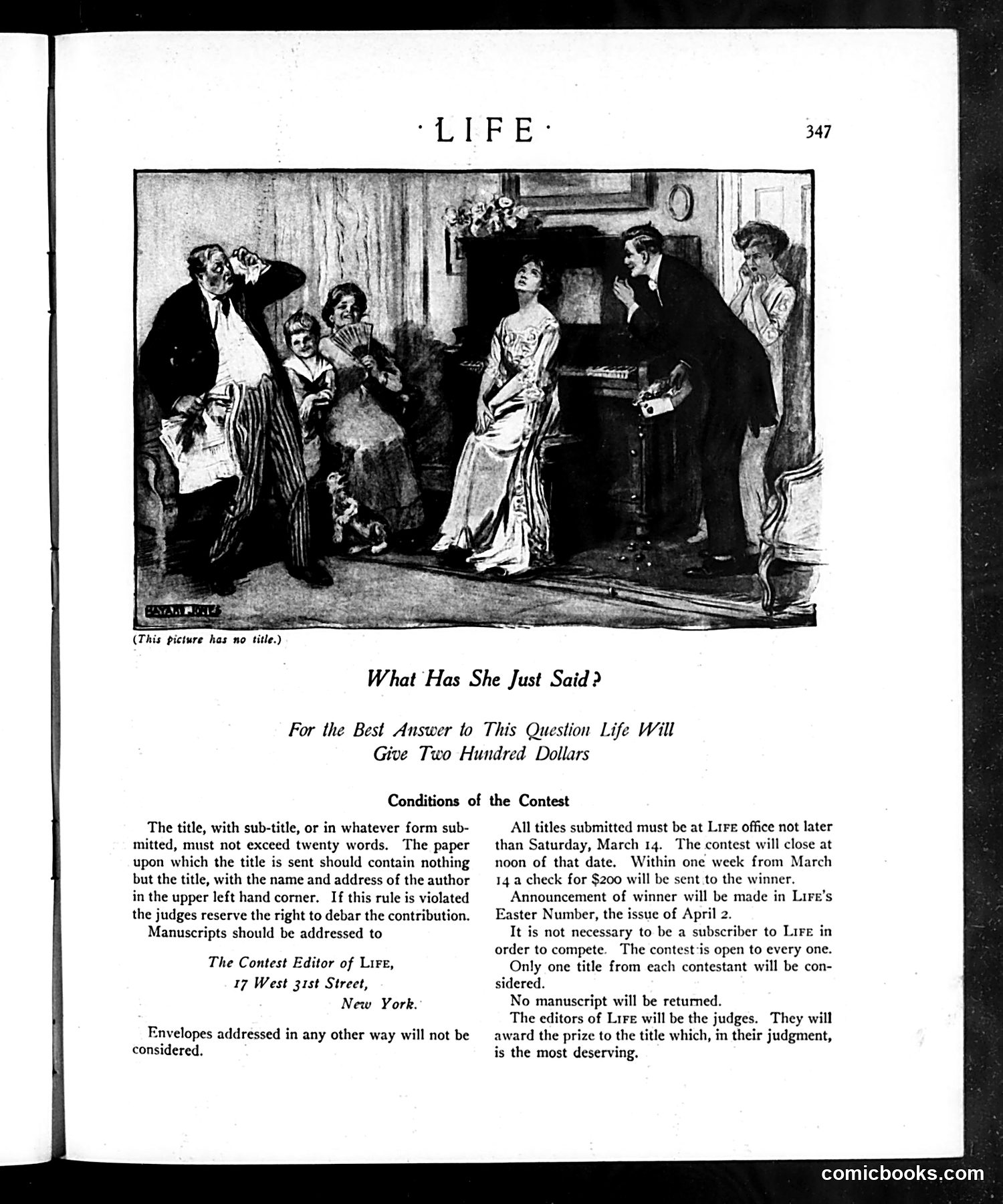
This page features a contest rather than a political cartoon. Life magazine is running a "caption contest" asking readers to identify what a woman has just said in the depicted scene. The illustration shows a domestic interior with multiple figures: a man on the left appearing shocked or distressed, several onlookers, and a woman in an elegant dress seated near a piano. The humor presumably derives from the woman's unseen statement causing the man's dramatic reaction. The contest offered $200 to the winner—a substantial prize for the era. Submissions were limited to twenty words maximum and had to arrive by March 14, with announcement in Life's Easter issue (April 2). This format was a common engagement strategy for magazines of this period, encouraging reader participation and repeat purchases.
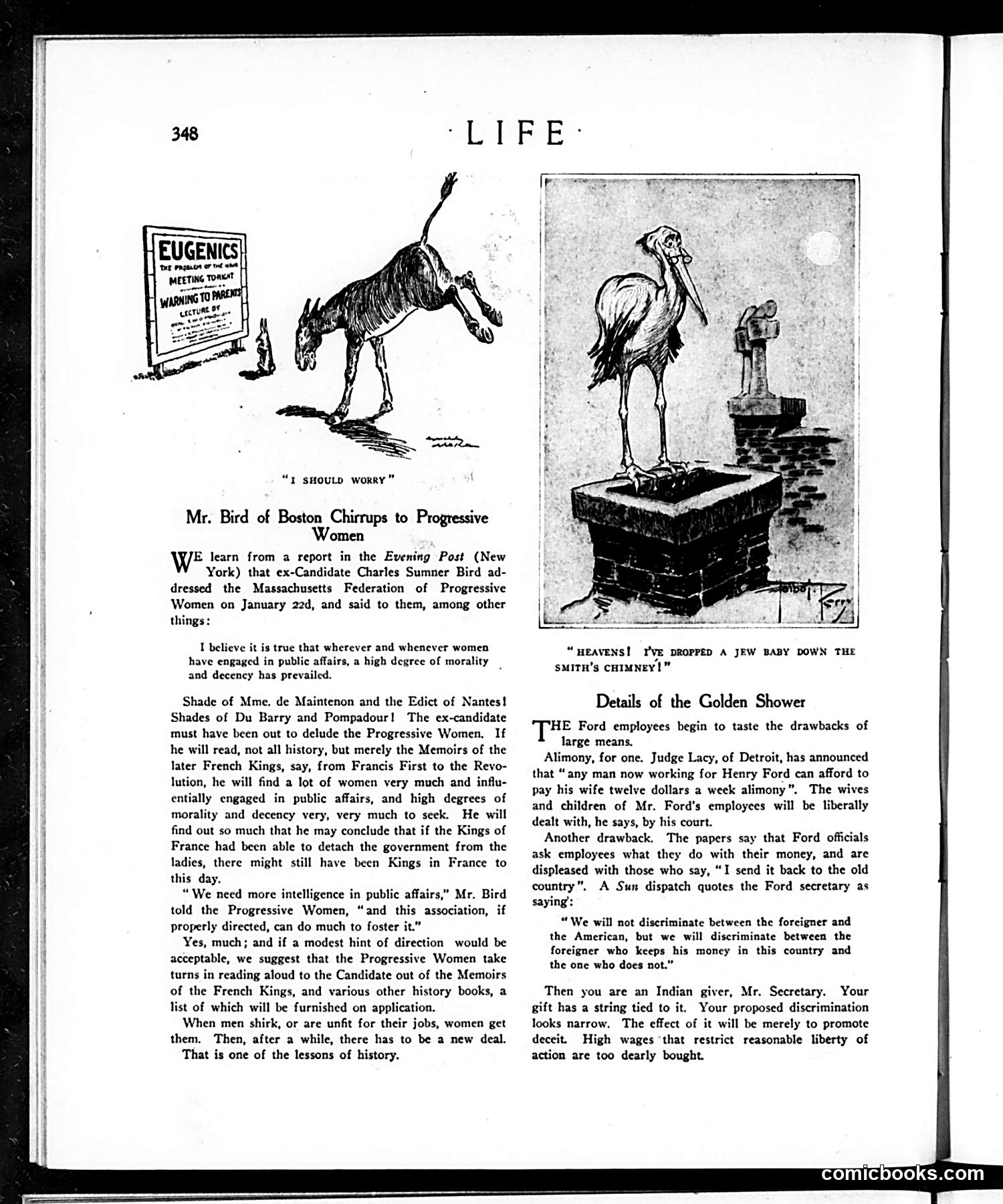
The left cartoon depicts a worried bird looking at a eugenics warning sign, satirizing Charles Sumner Bird's address to the Massachusetts Federation of Progressive Women. Bird apparently argued that women engaged in public affairs represented moral and social decline—an extreme position the cartoonist mocks by showing the bird's anxiety about "eugenics" (selective breeding to "improve" populations). The accompanying text quotes Bird extensively, then rebuts his historical claims about women's influence. The right cartoon shows a stork dropping a baby down a chimney, captioned about "Heavens!"—a crude visual pun on reproduction and Bird's eugenic concerns. The "Details of the Golden Shower" section satirizes Ford Motor Company's labor policies and wage discrimination, mocking corporate hypocrisy about American values while exploiting workers.
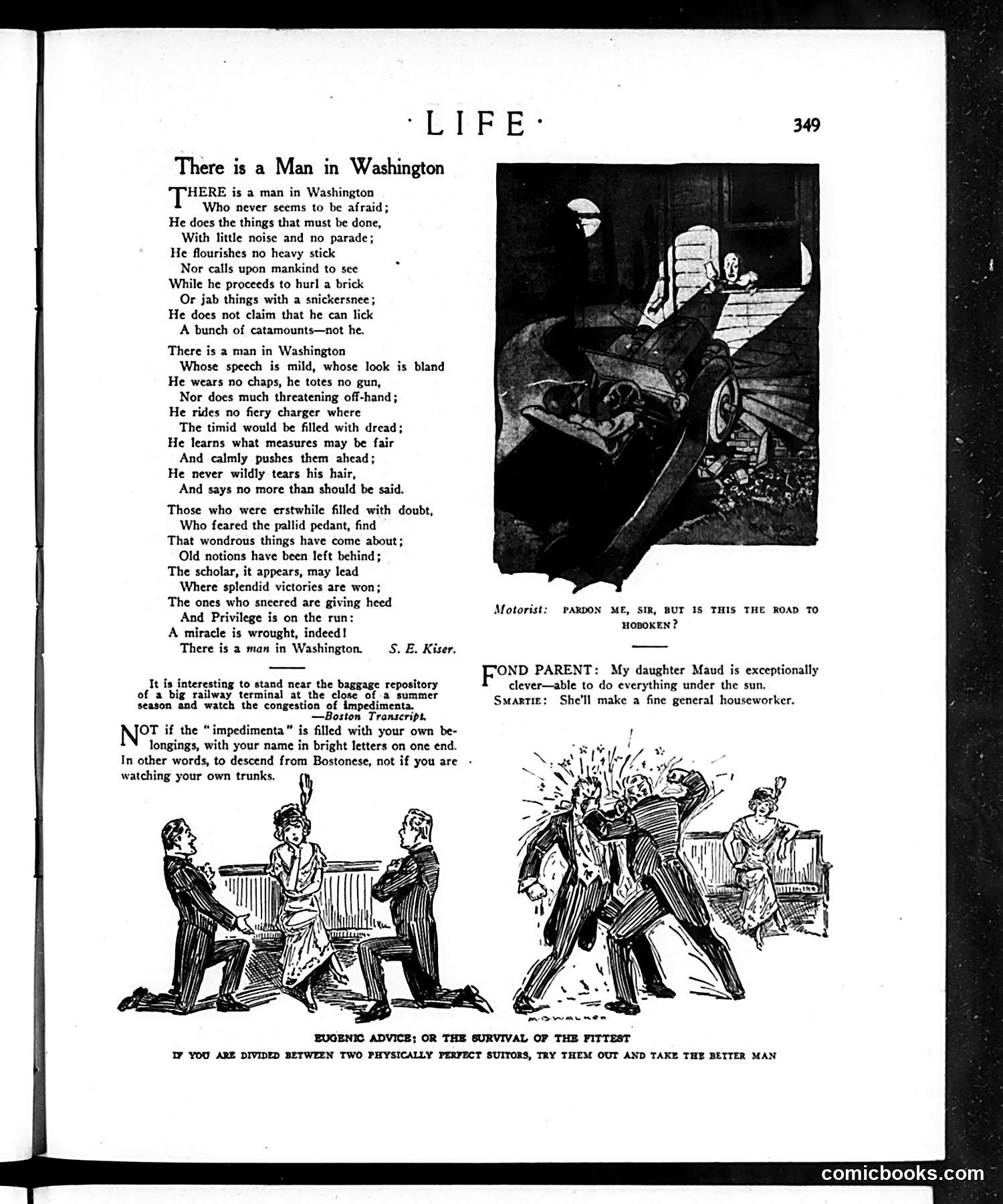
This page contains a poem titled "There is a Man in Washington" by S.E. Kiser, celebrating an unnamed political figure known for quiet, effective leadership—"mild...bland" speech, no theatrics, just getting things done. The poem appears to praise restrained, competent governance over bombastic rhetoric. Below are two cartoon vignettes: one depicting three men in suits (captioned about "impedimenta" and baggage), and another showing a man being thrown violently from a chair, labeled "Eugene Advice: or the Survival of the Fittest." The cartoons satirize social climbing and rough competition among businessmen/politicians. Without clearer identification, the specific political figures remain unclear, though the page overall celebrates pragmatic, understated leadership over flashy self-promotion.
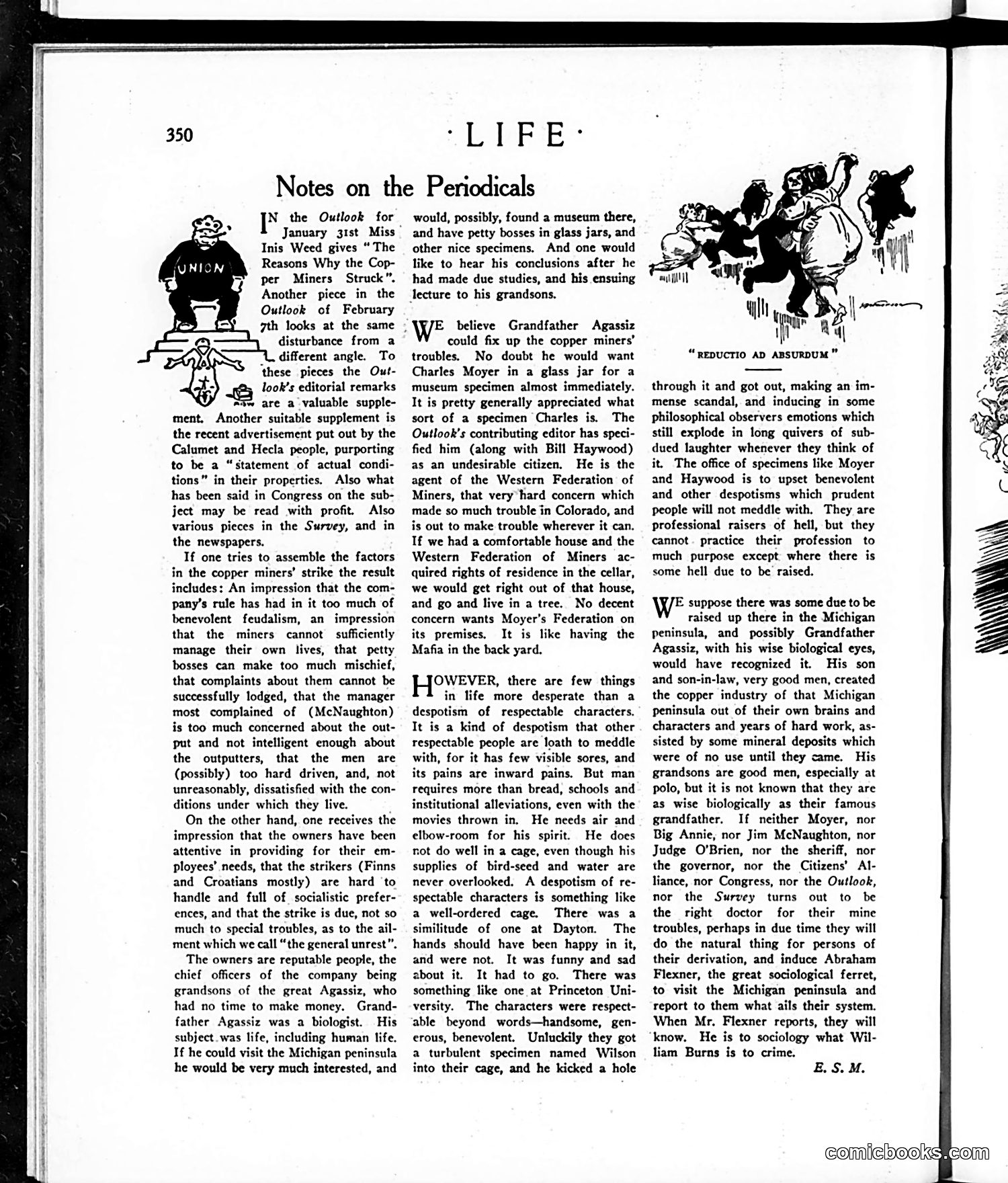
This page reviews recent articles from publications like the *Outlook*. The main cartoon, titled "REDUCTIO AD ABSURDUM," depicts what appears to be a chaotic scene of figures tumbling or being ejected. The text discusses labor disputes involving copper miners and the Western Federation of Miners, referencing Charles Moyer (a labor leader) and Bill Haywood. It critiques the *Outlook* magazine's coverage of labor unrest in Colorado, suggesting the publication sensationalizes conflicts between miners and management. The review also addresses despotism among "respectable characters" and references disputes in the Michigan peninsula, possibly involving Grandfather Agassiz (the naturalist). The overall tone suggests *Life* is satirizing both labor radicalism and journalistic handling of industrial conflicts.
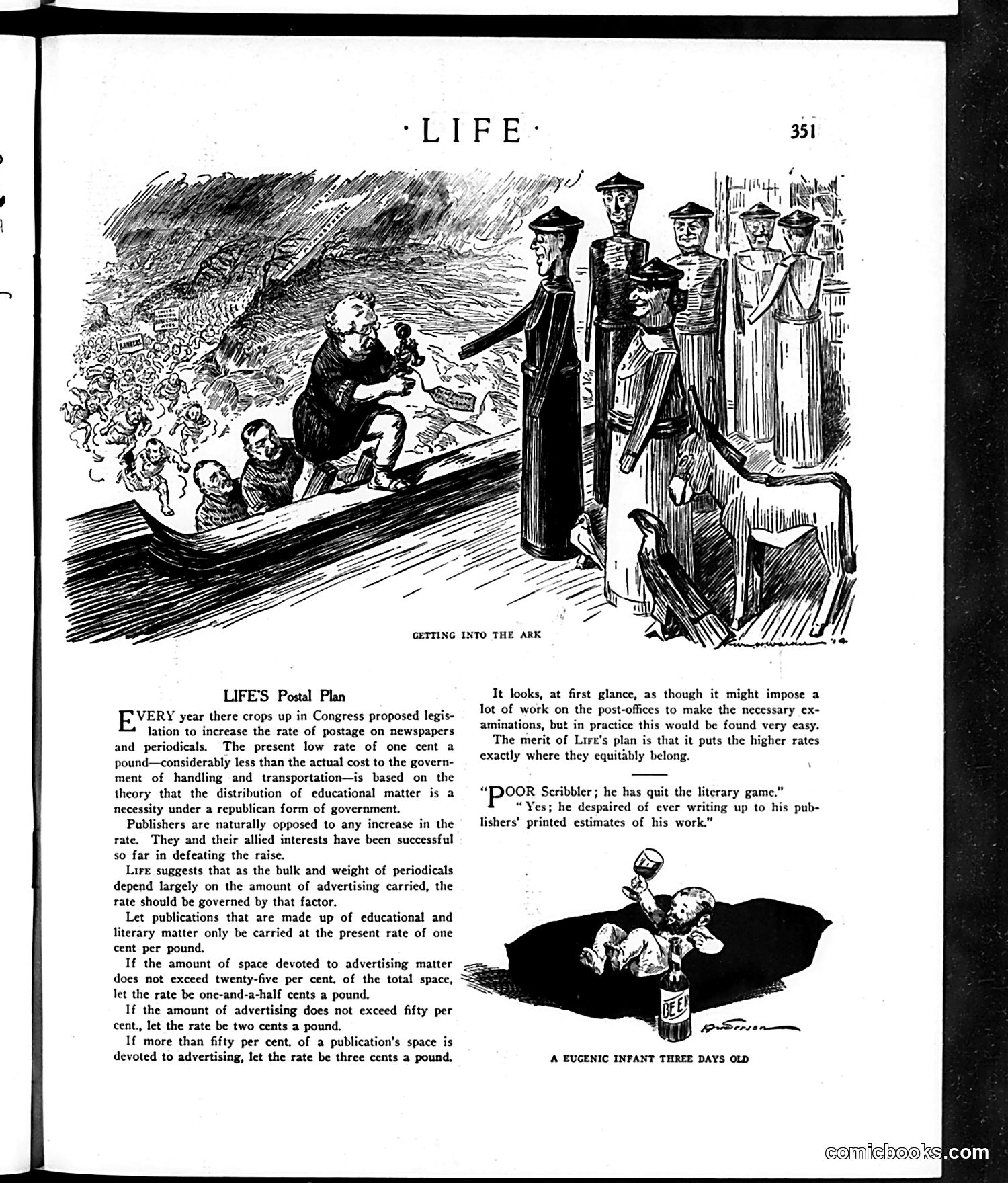
**Top Cartoon ("Getting Into the Ark"):** This satirical illustration depicts what appears to be officials or authorities (shown as tall figures in uniform on the right) selectively admitting people into an ark—a biblical reference suggesting safety or salvation. The crowded masses on the left, including women and children in a boat, represent those excluded or struggling to gain entry. This likely critiques discriminatory immigration or social policies of the era, suggesting arbitrary gatekeeping by authorities. **Main Article:** Life proposes a postal-rate reform plan based on advertising content. Currently, newspapers pay one cent per pound regardless of ad volume. Life argues advertising-heavy publications should pay higher rates (up to three cents per pound), since advertising—not educational content—drives their bulk and weight. **Bottom Cartoon:** A brief satirical exchange mocking a failed writer ("Poor Scribbler") who abandoned literature, having given up on meeting publishers' inflated expectations for his work. The page reflects Progressive-era concerns about corporate influence, honest pricing, and media accountability.
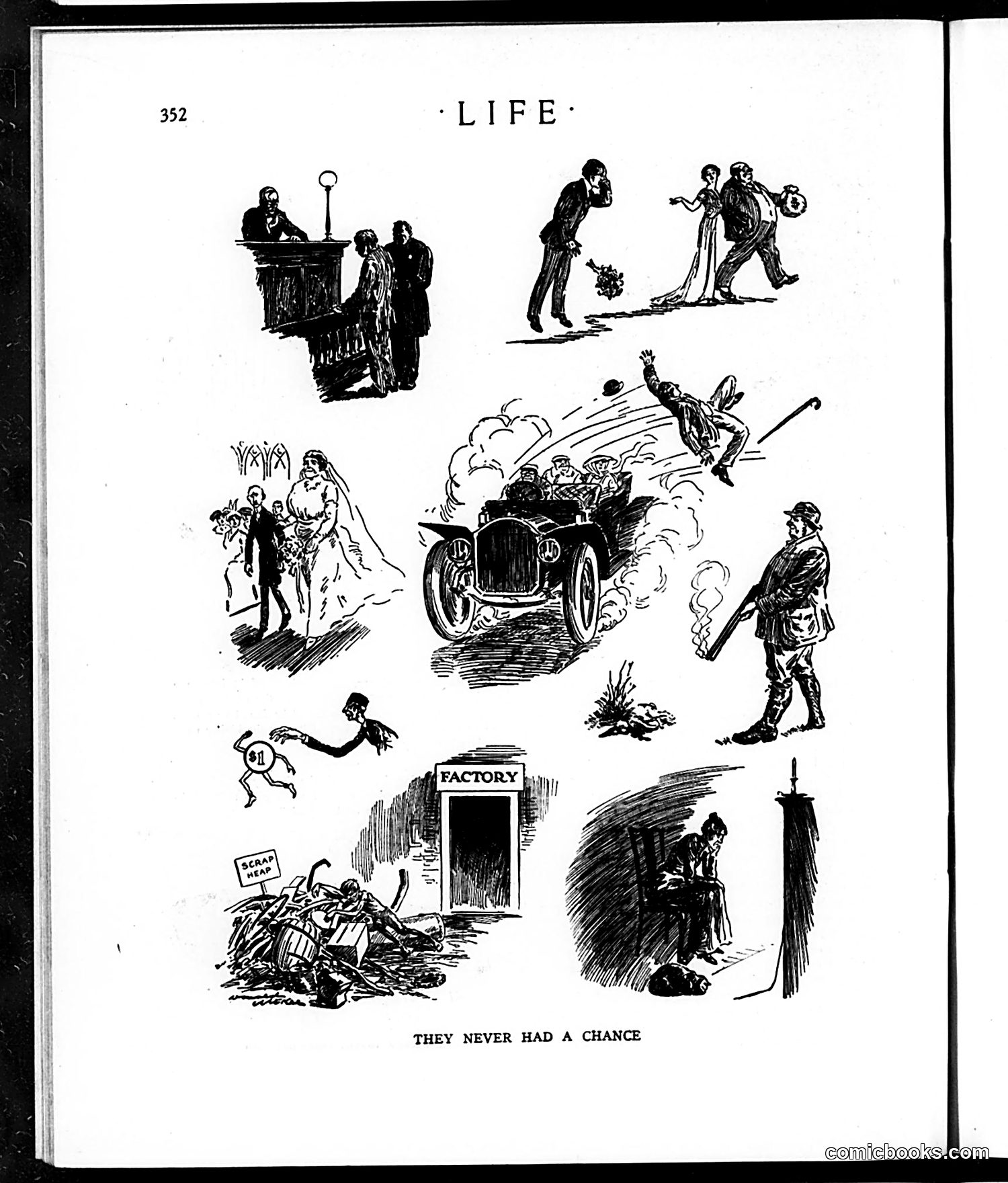
This Life magazine page presents a satirical commentary on tragic outcomes using multiple vignettes. The title "They Never Had a Chance" suggests predetermined failure or injustice. The scenes depict various misfortunes: a wedding interrupted, figures in danger from a speeding car, someone at a factory entrance (labeled "FACTORY"), a person drowning, and individuals in distress. One sketch shows "SCRAP HEAP" debris. The cartoon appears to critique either industrial accidents, social inequality, or the inevitability of poverty and tragedy for certain groups. The factory imagery and scrap heap suggest commentary on worker exploitation or dangerous working conditions where people lacked agency or protection. The juxtaposition of scenes emphasizes systemic injustice rather than individual failings—people doomed by circumstance beyond their control.
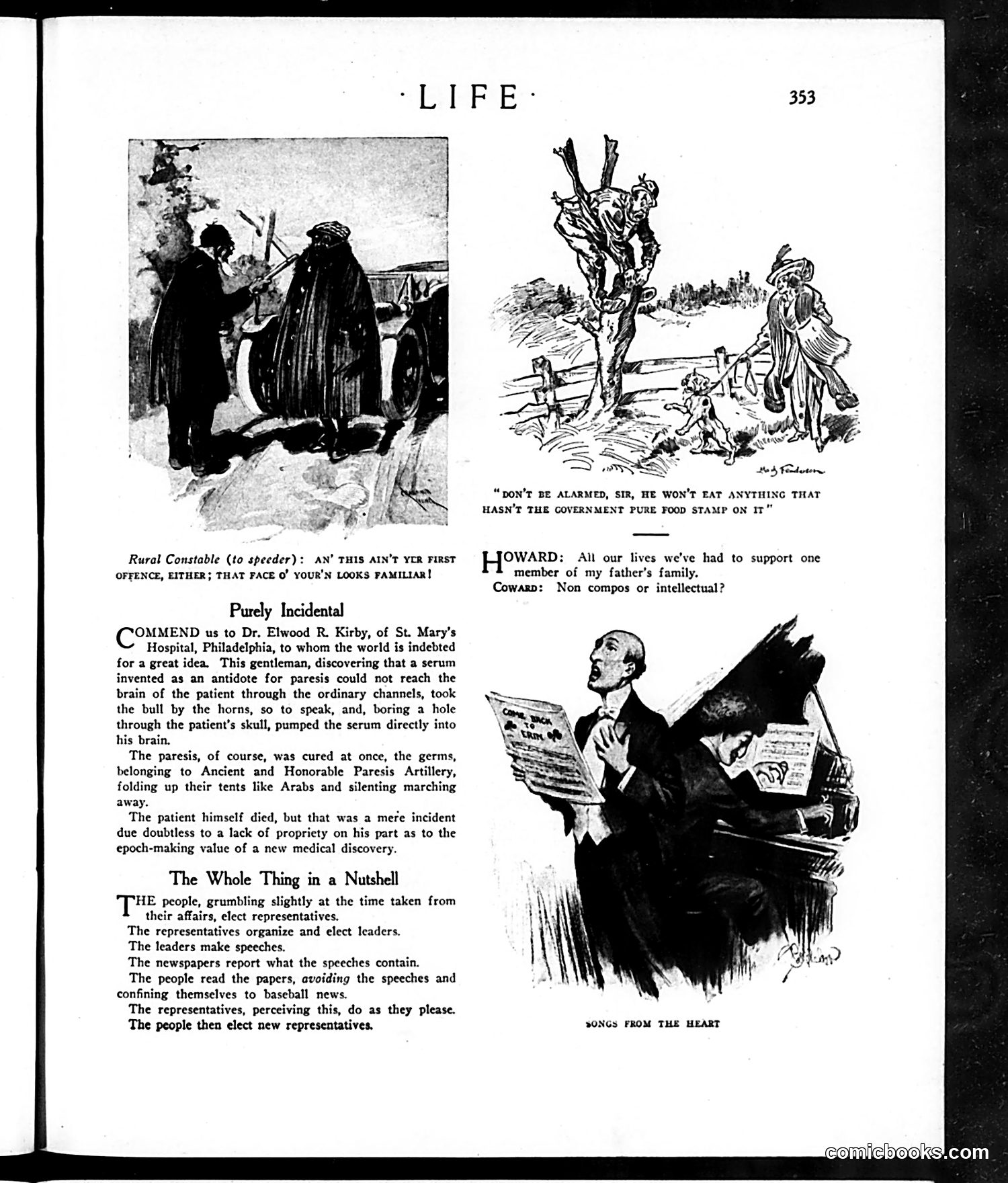
**Top Left Cartoon:** A rural police officer stops a speeder, noting the driver's face looks familiar from previous offenses. This mocks small-town policing and repeat offenders. **"Purely Incidental":** Sarcastically praises Dr. Kirby for drilling into a patient's skull to treat paresis (neurosyphilis). The joke's dark humor: the serum worked, but the patient died anyway—yet the discovery is celebrated as "epoch-making." This satirizes medical hubris and prioritizing innovation over patient survival. **"The Whole Thing in a Nutshell":** A cynical political commentary showing the cycle of democracy as largely theater: citizens elect representatives who make speeches, newspapers report them, citizens ignore speeches for baseball news, representatives do as they please, and the cycle repeats. It suggests voter apathy enables unchecked leadership. **Bottom Right:** References "government pure food stamps"—likely referencing early 20th-century food safety regulations, joking about a dependent family member's limited diet.
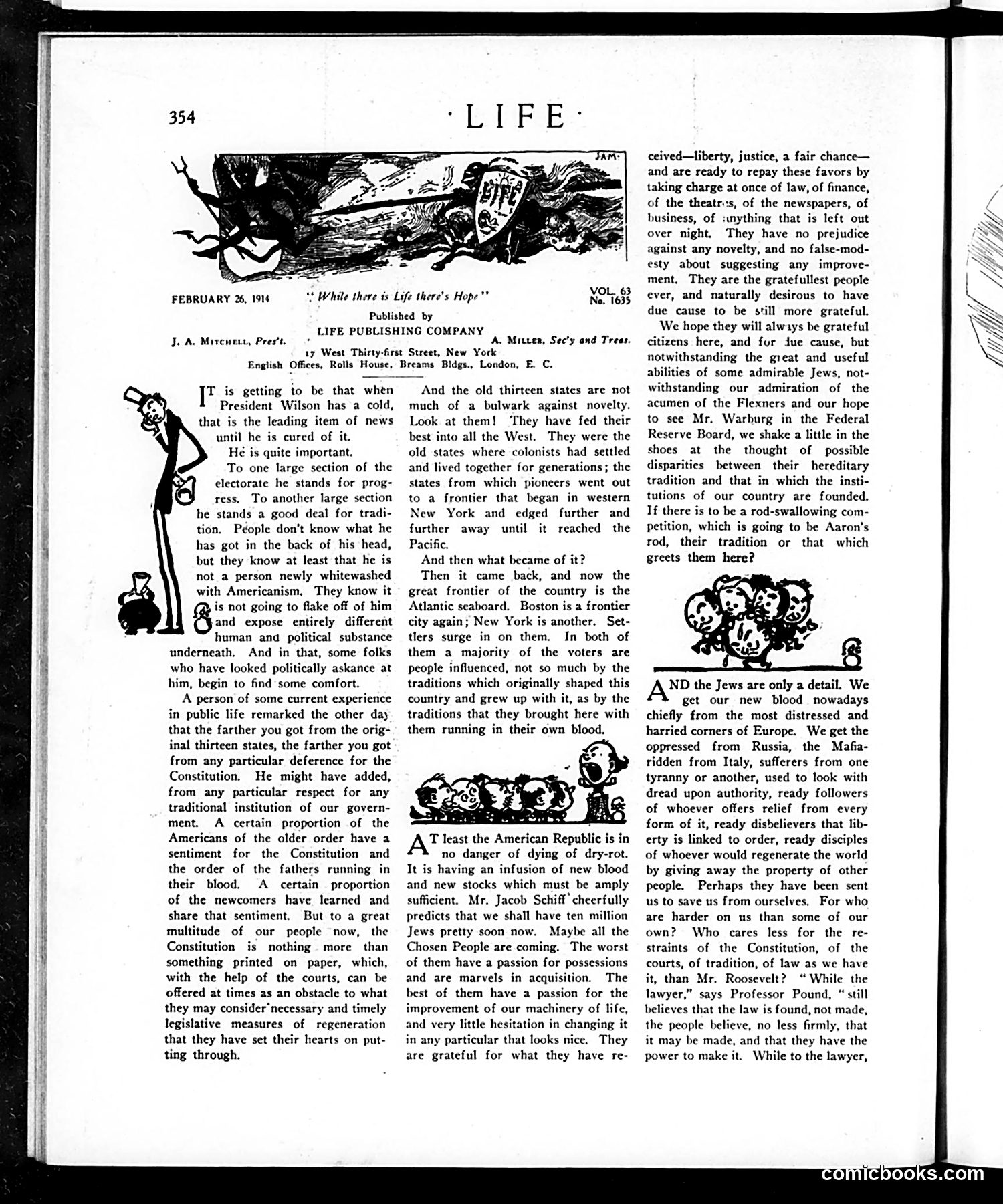
This editorial attack uses inflammatory anti-Semitic stereotypes to argue against Jewish immigration. The author contrasts "old" Americans (descended from the original thirteen states) who respect constitutional tradition with "new blood"—specifically Jews—who allegedly lack respect for established institutions. The piece references banker Jacob Schiff's prediction of ten million Jews in America, framing this as a threat. It caricatures Jewish immigrants as driven by acquisitive materialism and a desire to control finance, law, newspapers, and business. The author claims they cynically exploit American liberty while undermining American traditions. The cartoons (appearing to show caricatured immigrant figures) visualize these xenophobic arguments. This represents Life magazine's editorial stance during a period of intense anti-immigration sentiment and rising American anti-Semitism, predating the 1924 immigration restrictions.
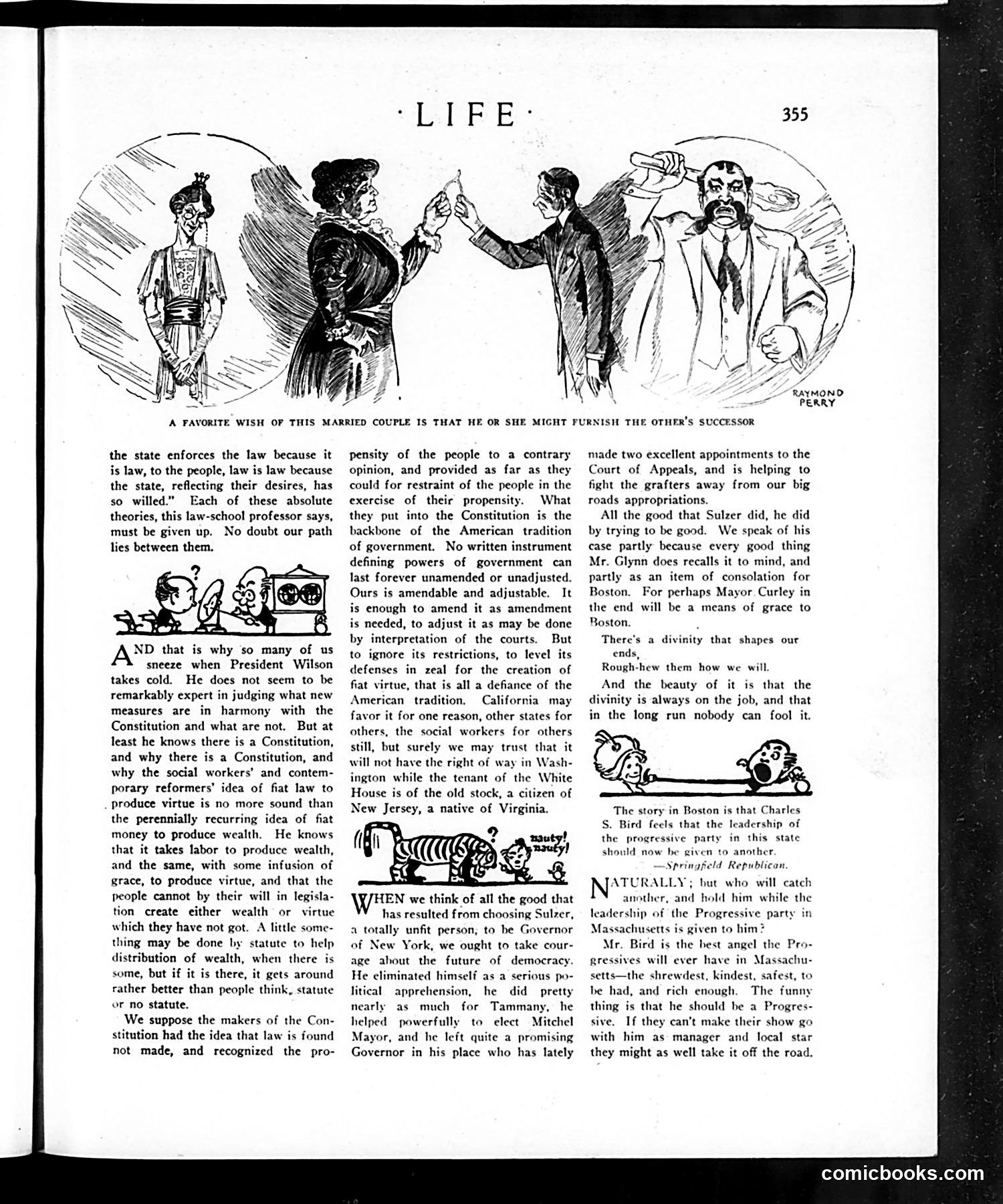
The top cartoon, captioned "A Favorite Wish of This Married Couple Is That He or She Might Furnish the Other's Successor," depicts a couple imagining potential replacements for each other—a dark joke about marital discord. The main article discusses President Wilson's understanding of constitutional law, contrasting him favorably with Governor **Sulzer of New York**, described as "totally unfit." The author argues that despite Sulzer's incompetence, good resulted anyway: he eliminated himself from politics, helped elect reform candidate **Mitchel** as Mayor, and his successor Governor **Glynn** made excellent court appointments and fought corruption. The article extends this "divine providence" theme to Boston's Mayor **Curley**, suggesting his incompetence might paradoxically benefit the city. It concludes with commentary on Massachusetts Progressive Party leadership, noting Charles S. Bird's view that leadership should pass to someone else—but questioning humorously who could manage it without bungling. The satire celebrates how incompetent politicians sometimes accidentally advance good outcomes through their failures.
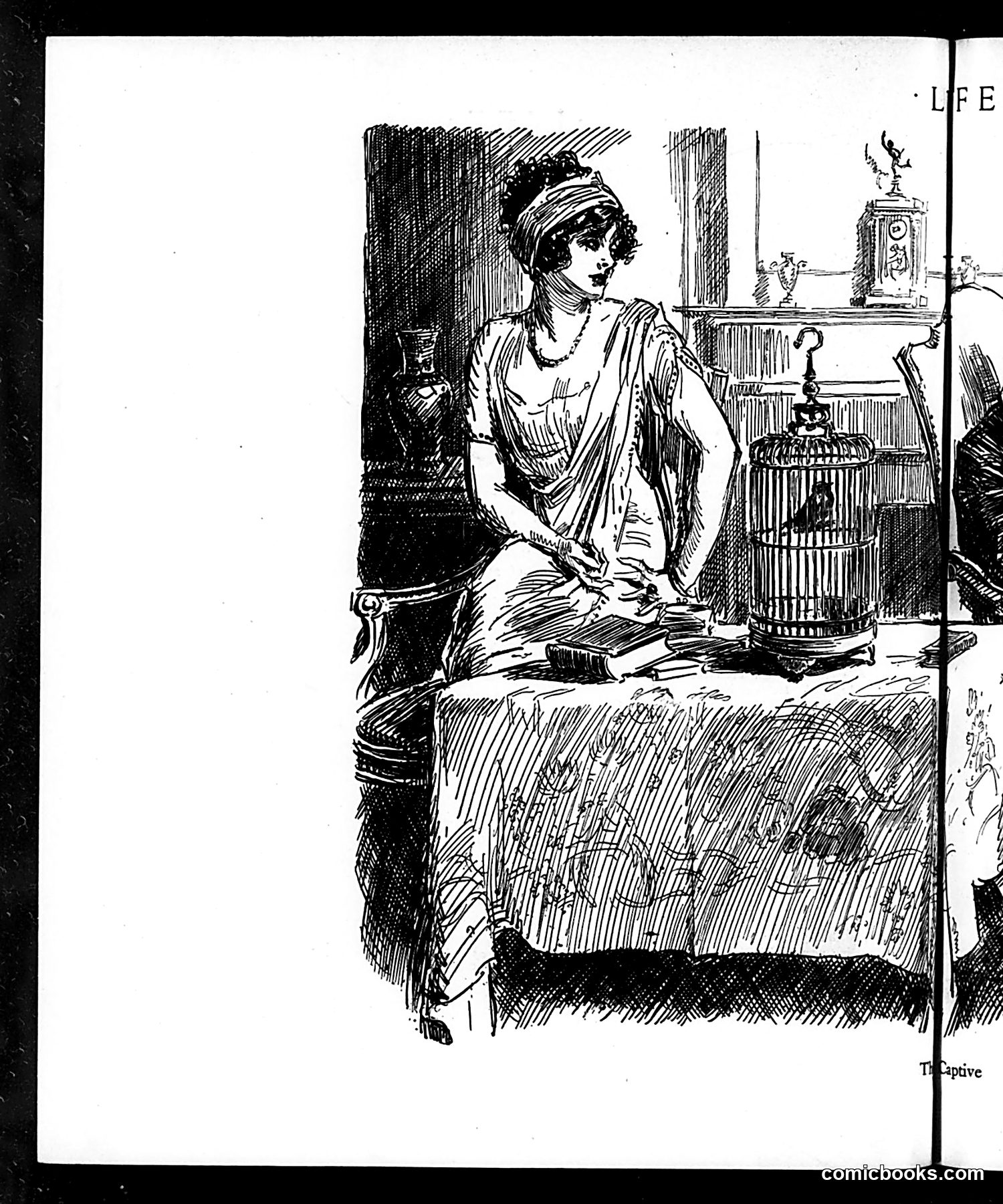
This is a sketch titled "The Captive" from *Life* magazine. It depicts a woman seated on a bed in what appears to be a bedroom or private chamber, surrounded by decorative furnishings including a birdcage, ornamental objects on a mantelpiece, and draped fabrics. She wears classical or period clothing with a headband. The title "The Captive" suggests commentary on women's domestic confinement or restricted social roles in the era when this was published. The birdcage—a common symbolic representation of captivity—reinforces this interpretation. The woman's contemplative, somewhat distant gaze suggests resignation or melancholy about her situation. Without additional context about the specific publication date or artist, I cannot identify the precise historical or political reference intended, but the image appears to critique the limitations placed on women's freedom and autonomy during this period.
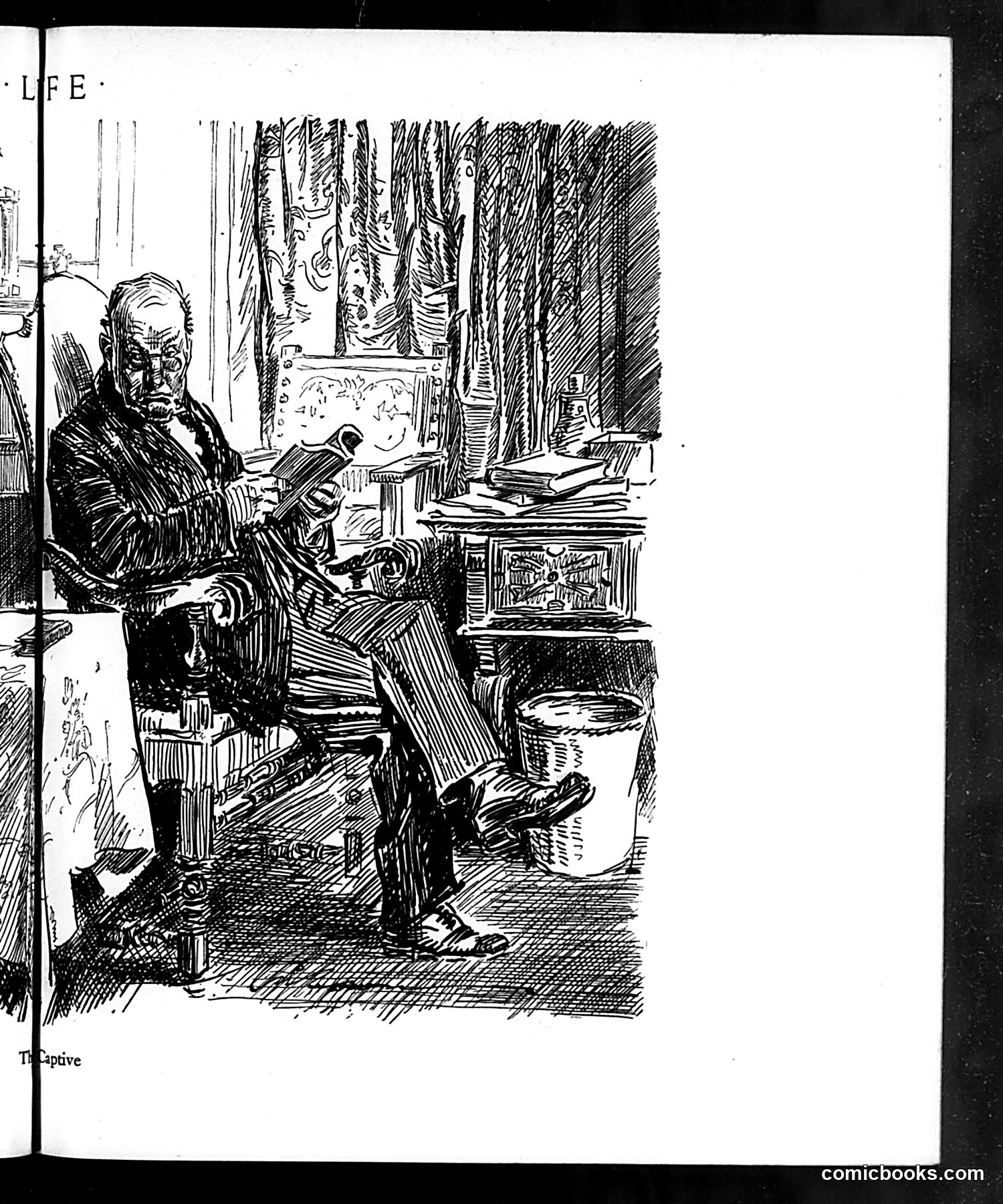
This ink sketch depicts a stern, scowling man seated at a desk in what appears to be an office or study, holding what looks like a bottle or vessel. The title "The Captive" suggests commentary on constraint or imprisonment. The cartoon likely satirizes a businessman or authority figure trapped by circumstance—possibly commenting on economic dependency, addiction, or professional obligation. The cluttered desk with papers and books, combined with the prominent bottle, suggests themes of either alcoholism or being bound to one's work/desk job. Without clearer context or visible publication date, the specific political or social target remains unclear, though the satirical style is consistent with Life magazine's commentary on American society and professional life.
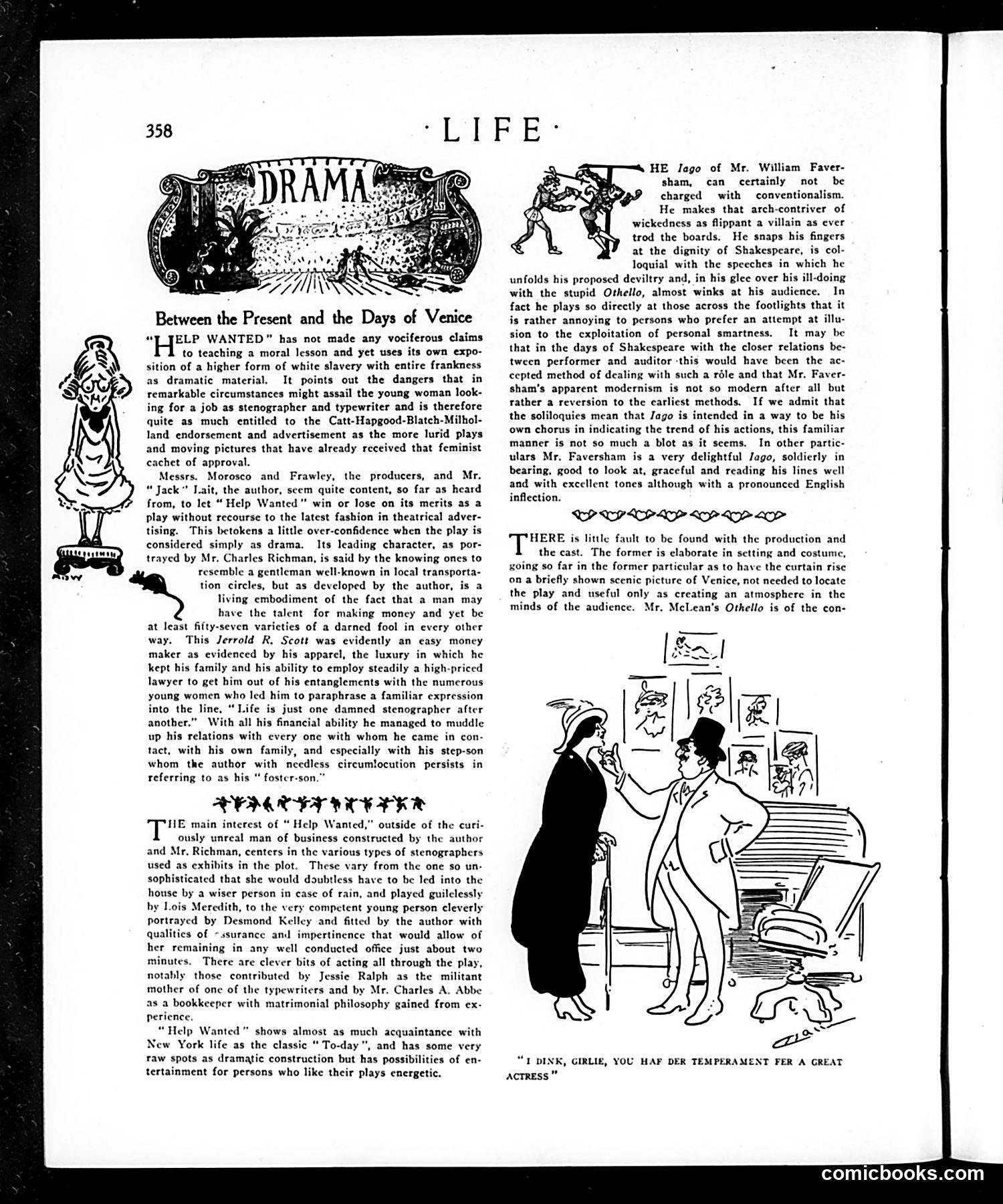
This page reviews two theatrical productions: "Help Wanted" and an unnamed play featuring William Faversham as Iago (from Shakespeare's *Othello*). **"Help Wanted"** concerns a wealthy businessman named Jerrold R. Scott (played by Charles Richman, apparently modeled on a real local transportation magnate) who, despite financial success, is a "fool" in personal matters. The plot centers on various stenographer characters—ranging from naive to competent and impertinent—whom he entangles himself with romantically. The review notes the play addresses "white slavery" concerns relevant to working women seeking employment. **The Iago review** criticizes Faversham's overly theatrical, winking villainy—he plays directly to the audience rather than maintaining dramatic illusion, which the critic finds annoying. The cartoon depicts a theater producer or director showing sketches to a woman, captioning her as having "temperament" suitable for a great actress—satirizing the theater world's pretensions and the casting couch dynamic.
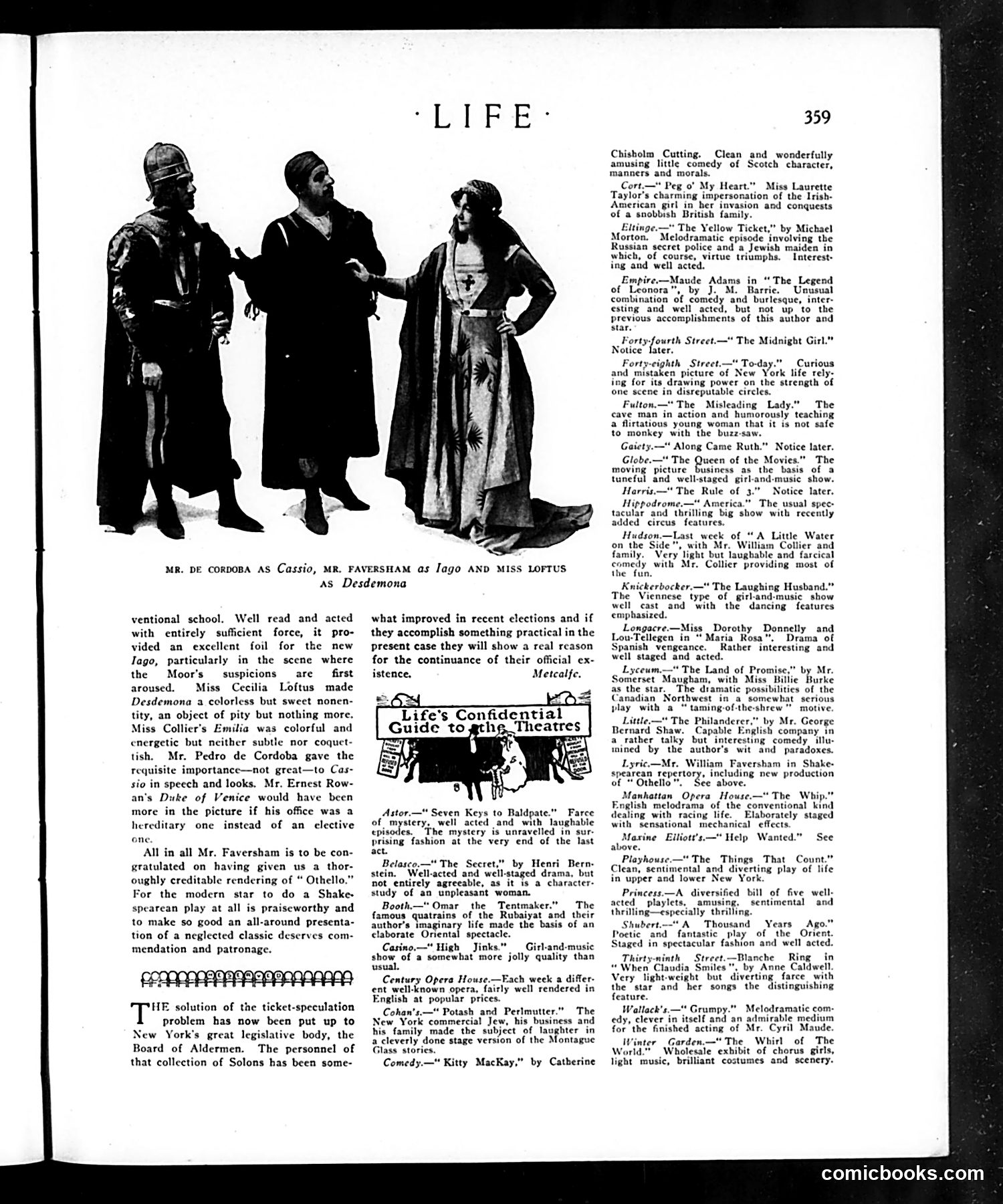
This page reviews Shakespeare's *Othello* and other current Broadway productions. The main image shows three actors in costume from the play: Mr. de Cordoba as Cassio, Mr. Faversham as Iago, and Miss Loftus as Desdemona. The review praises Mr. Faversham's performance as Iago while offering mixed assessments of other cast members—Miss Loftus's Desdemona is dismissed as "colorless," though Miss Collier's Emilia receives credit for energy. The critic commends Faversham for mounting a Shakespearean production at all, noting that modern stage stars rarely attempt classic theater. The page also contains a boxed feature titled "Life's Confidential Guide to the Theatres," followed by brief reviews of contemporary Broadway shows ranging from operetta to melodrama to musical comedy—typical commercial entertainment of the era.
This page is a literary review section, not a political cartoon. The prominent illustration at top-left appears to be Life magazine's decorative masthead featuring cherubs or putti on a vehicle—standard ornamental design for the era. The text discusses H.G. Wells's novels, particularly praising his innovation in storytelling. The reviewer argues that Wells's recent works ("The New Machiavelli," "Marriage," "The Passionate Friends") represent a new kind of narrative: rather than traditional plots where actions lead to results, Wells explores the formation of ideas and conscious self-understanding. The reviewer contends that critics have missed this fundamental innovation, focusing instead on conventional plot elements. The page includes a "Confidential Book Guide" listing contemporary works and brief reviews. This is a serious literary criticism piece from an era when Life magazine featured substantial cultural commentary alongside satire.
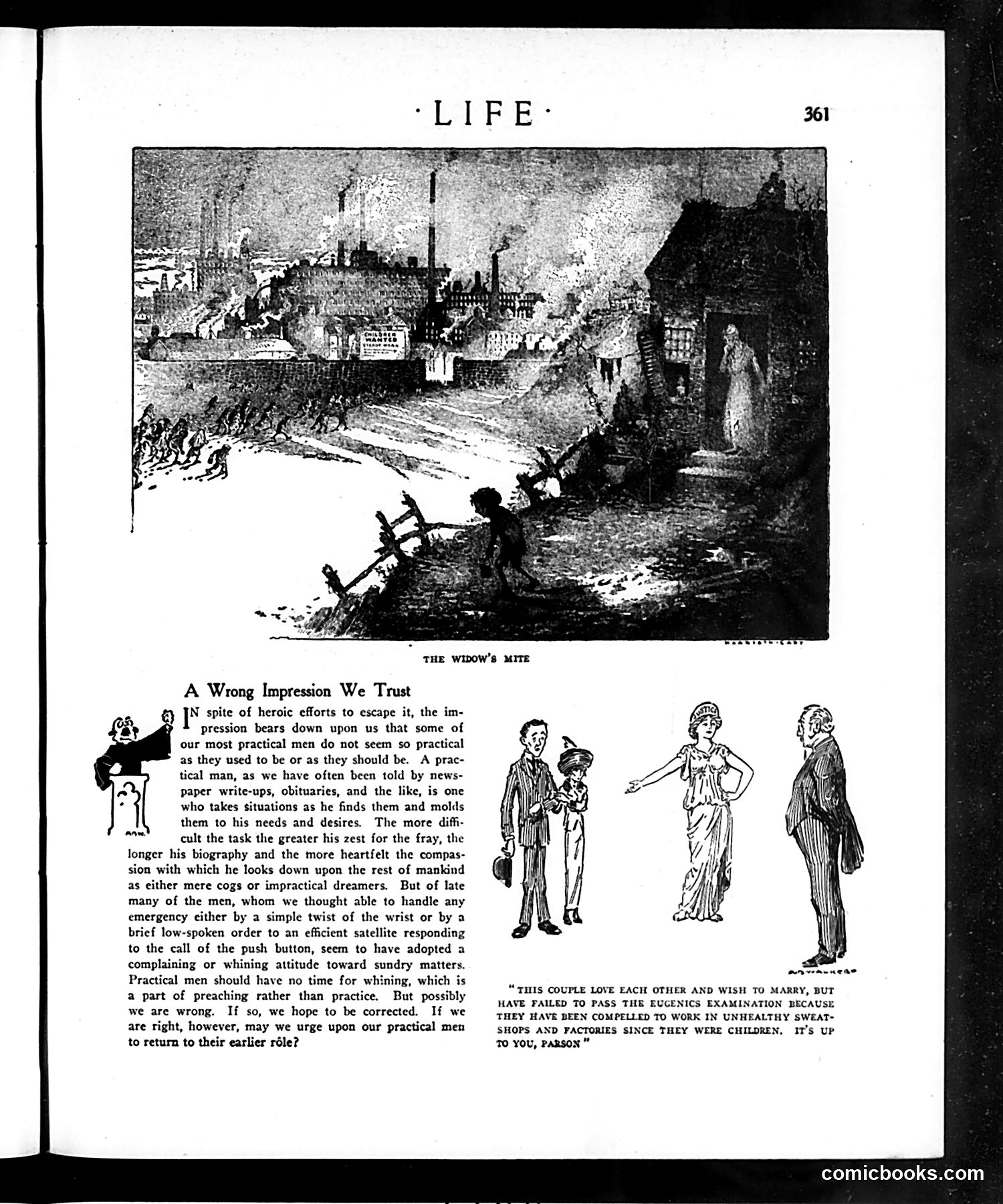
**Top Image ("The Widow's Mite"):** This appears to be an industrial scene showing a factory town with smoke and workers, likely illustrating the human cost of industrial labor. **Main Text ("A Wrong Impression We Trust"):** This editorial critique argues that prominent "practical men" of business and industry—traditionally celebrated in newspapers and obituaries for their toughness and problem-solving—have recently adopted a "complaining or whining attitude" about social matters. The author sarcastically urges them to return to their stoic, action-oriented ways rather than preaching about problems. **Bottom Cartoon:** Shows a couple unable to marry because they failed a eugenics examination. The parson is told their failure resulted from forced labor in unhealthy factories since childhood. This satirizes the absurdity of eugenics screening that ignores environmental/social causes of poor health, blaming individuals rather than exploitative labor conditions. The caption places responsibility on authority figures ("It's up to you, parson") to address systemic injustice. **Overall Point:** The page critiques wealthy industrialists' unwillingness to acknowledge their role in social problems, juxtaposing their claimed practicality with indifference to worker suffering.
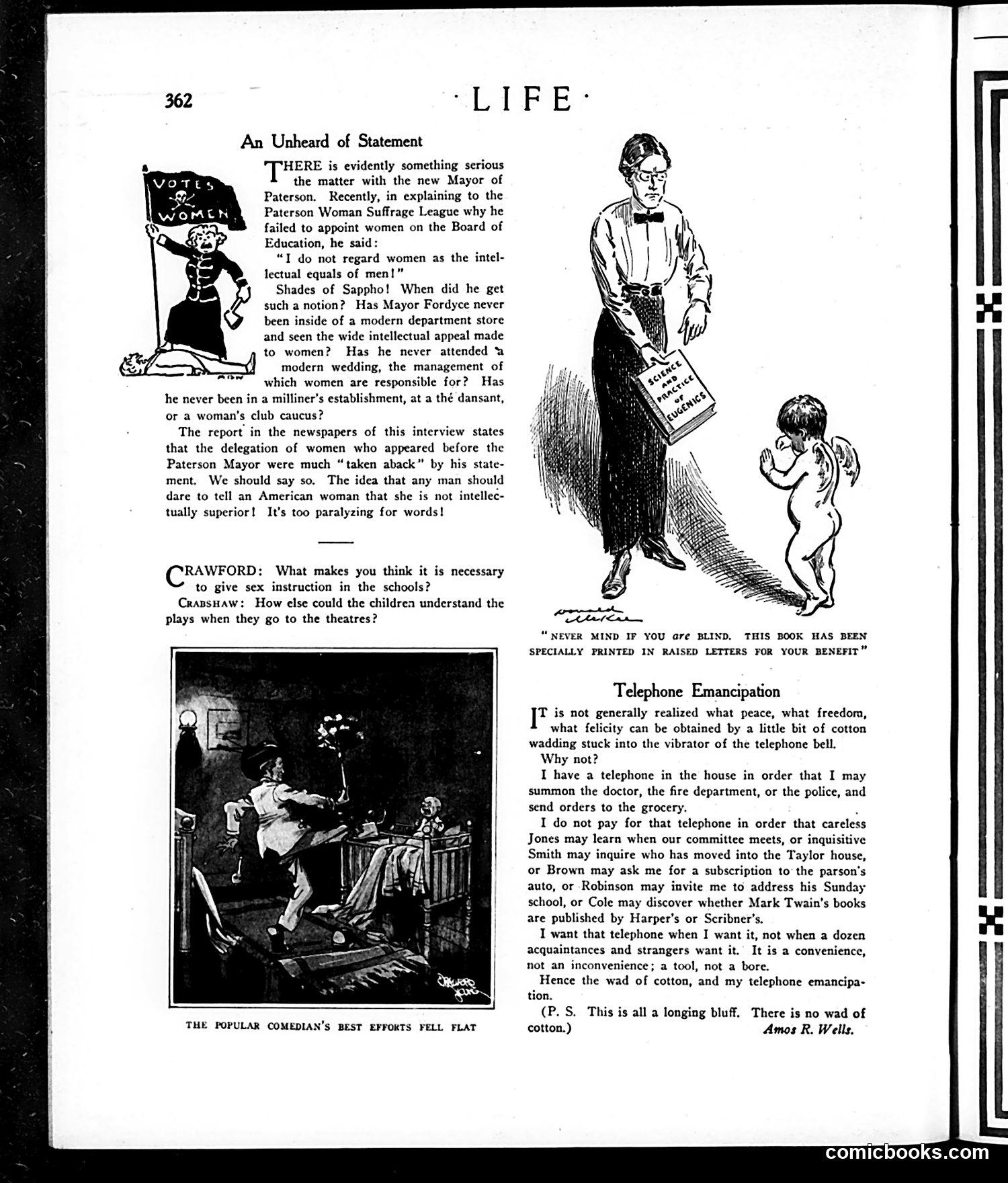
This page contains three satirical pieces mocking social attitudes of the era: **"An Unheard of Statement"** ridicules Paterson's Mayor Fordyce for claiming women aren't intellectual equals. The satire is biting: the author sarcastically suggests the Mayor has never observed women managing department stores, weddings, or millinery shops—implying women clearly *are* intellectually capable. The piece supports women's suffrage and education access. **The Crawford/Crasshaw exchange** is a joke playing on anxiety about sex education in schools, suggesting theatrical content requires prior instruction. **"Telephone Emancipation"** humorously complains about unwanted phone calls from neighbors and acquaintances interrupting privacy—suggesting stuffing cotton in the telephone's vibrator. The author admits this is fantasy ("a longing bluff"), making the piece a comedic lament about modern intrusion rather than serious advice. All three pieces reflect early 20th-century debates over women's rights, education, morality, and technology's social disruption.
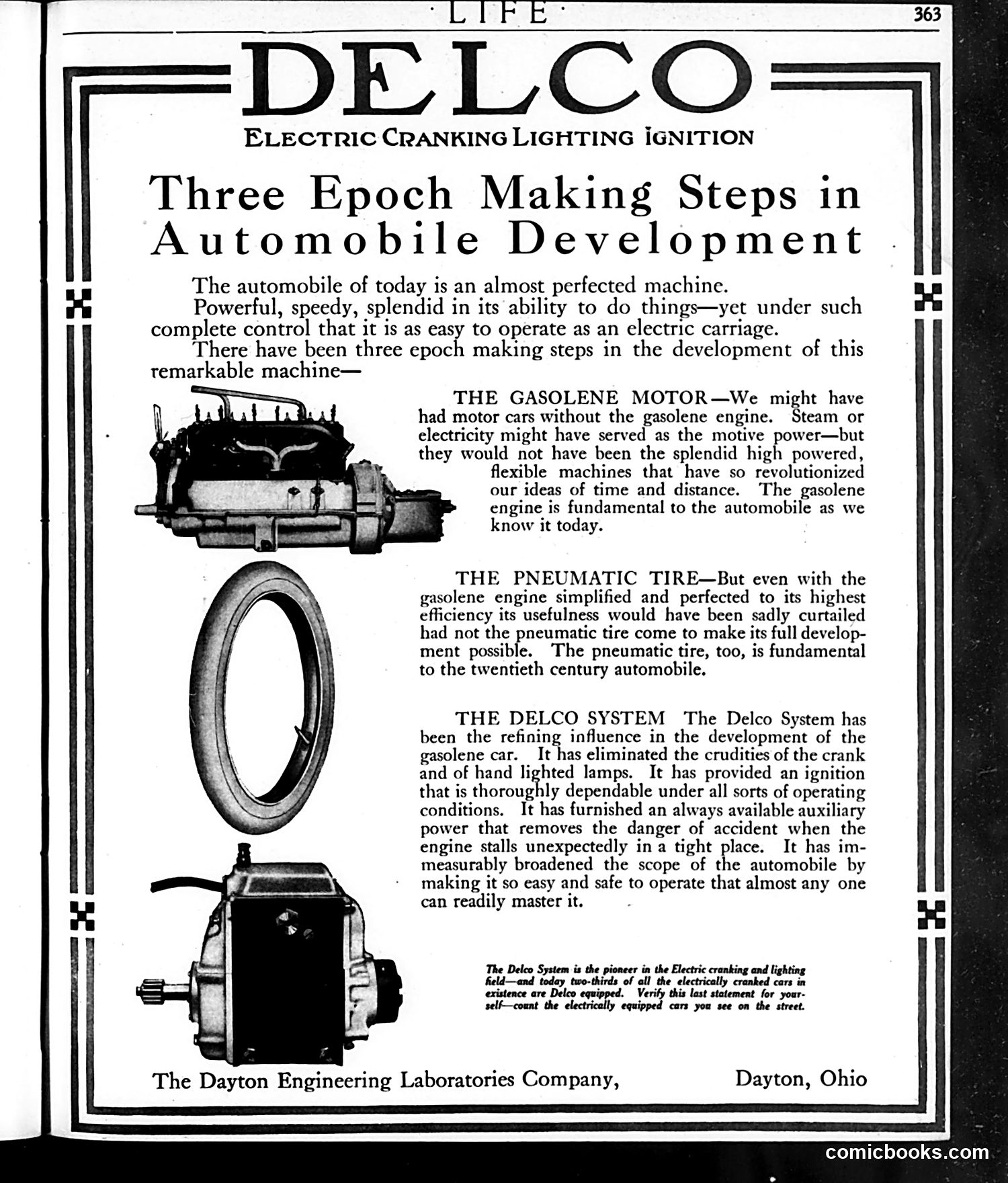
This is **not a cartoon or satire** — it's a straightforward **automobile advertisement** from Life magazine (page 363). The Dayton Engineering Laboratories Company (DELCO) promotes three innovations they claim revolutionized automobiles: the gasoline engine, pneumatic tires, and crucially, their own electric cranking and lighting system. The advertisement argues that while the gasoline engine and pneumatic tire were transformative, the **DELCO system eliminated the main barriers to widespread car ownership** — specifically, the dangerous hand-crank starting and unreliable manual lighting. By making cars easier and safer to operate, DELCO democratized automobile use for average people. The three images show the gasoline engine, pneumatic tire, and electrical starter motor. The claim that "two-thirds of all electrically cranked cars" use DELCO appears designed to establish market dominance through apparent ubiquity — a common advertising strategy. This reflects early 20th-century America's fascination with automotive technology as liberation and progress.
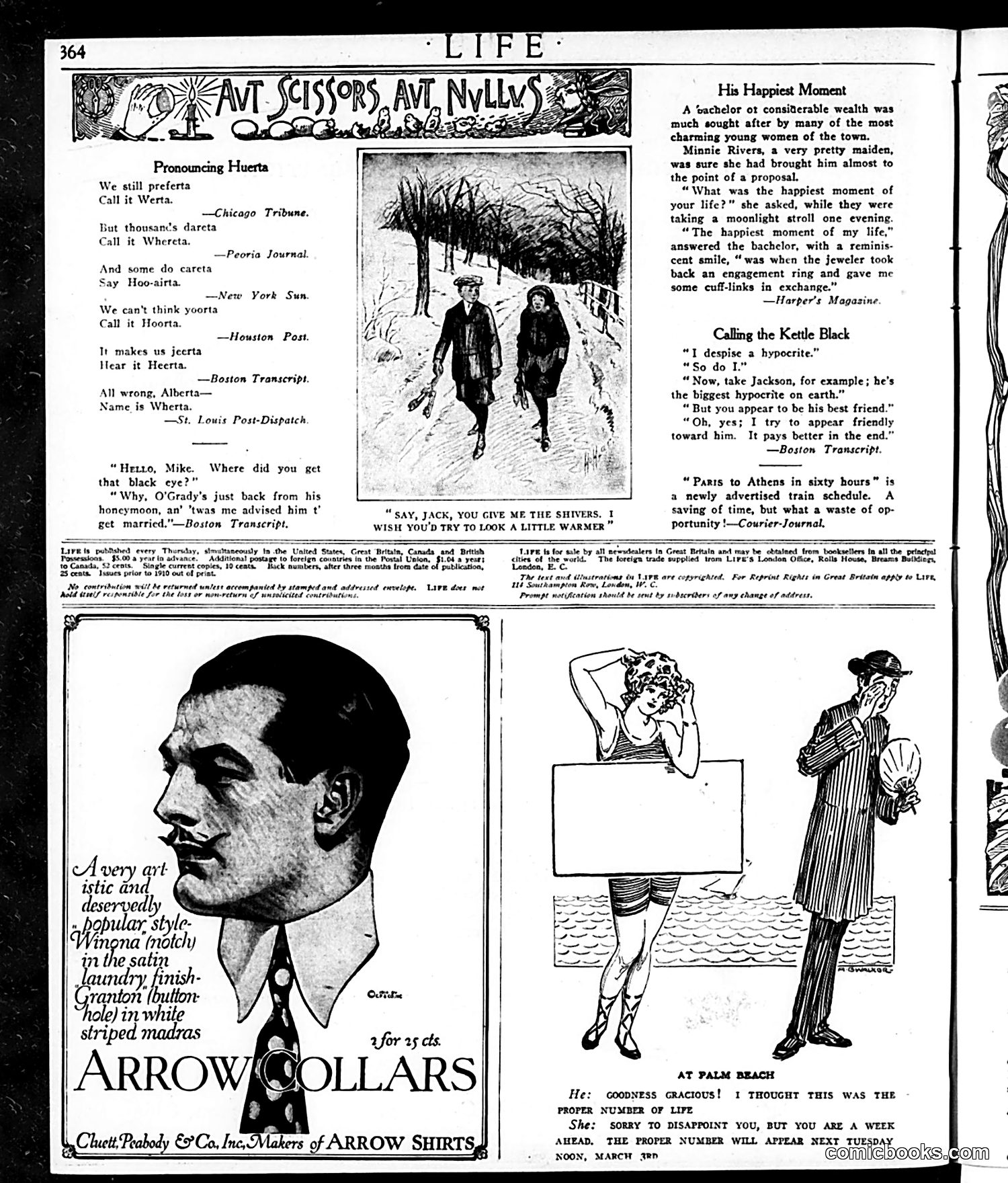
This page contains multiple satirical pieces typical of early 20th-century Life magazine humor: **Top section**: Competing newspaper pronunciation guides for "Huerta" (likely Victoriano Huerta, Mexican political figure). Different papers claim different pronunciations—a joke about regional American accents and newspaper authority. **Center stories**: Two brief anecdotes satirizing social behavior—one about a man's black eye from his honeymoon (implying marital discord), another mocking a bachelor rejecting marriage because an engagement ring exchange seemed better than commitment. **"Calling the Kettle Black"**: A hypocrite accuses another of hypocrisy while admitting he's friendly with him only for practical advantage—satirizing American social expedience. **Bottom**: Advertisement for Arrow Collars (a major brand) and a cartoon about a man at Palm Beach interrupting a woman, with the joke being she's a week ahead of schedule. The page reflects typical Life content: light social satire, wordplay, and advertising integrated throughout.
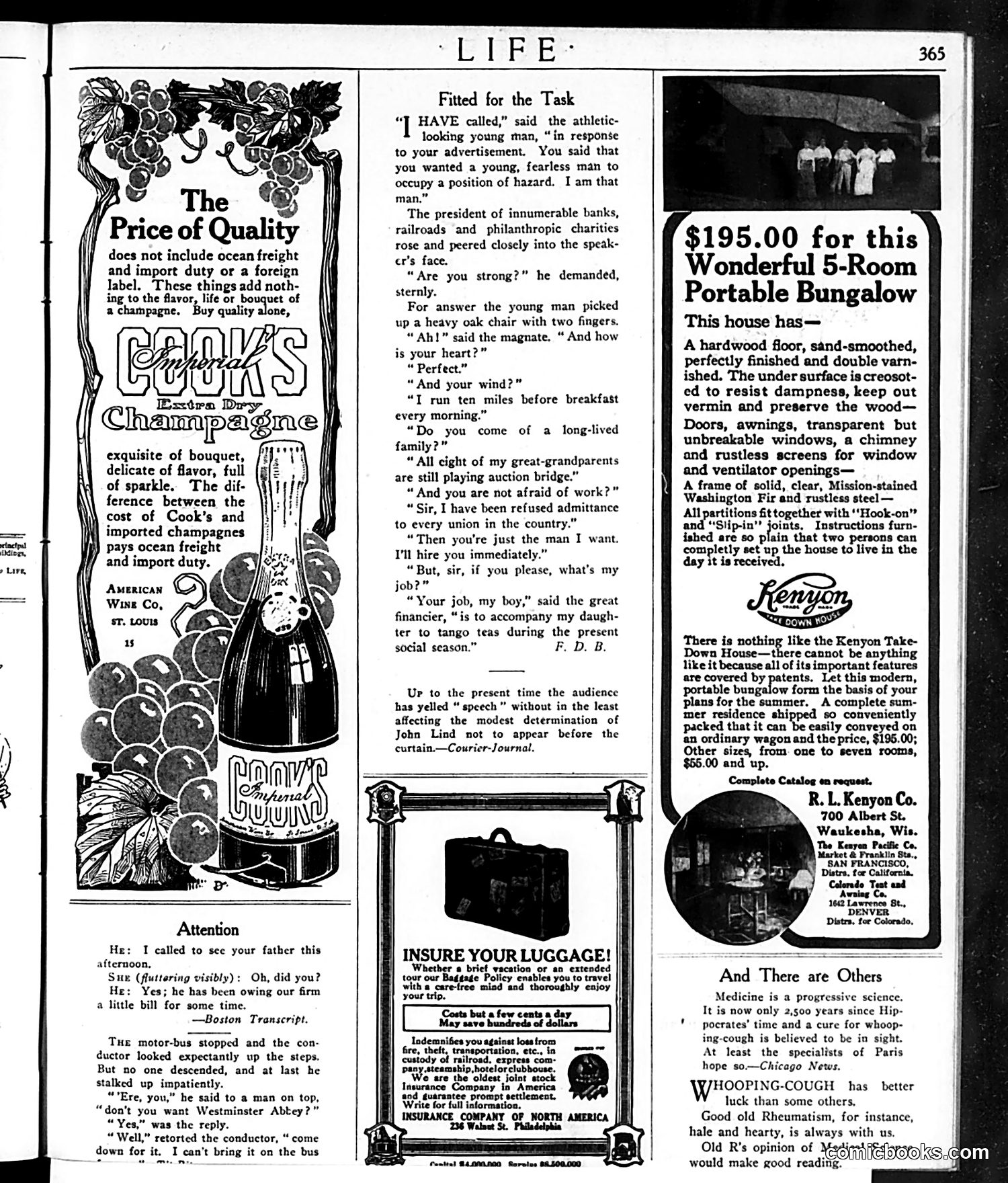
This page from *Life* magazine contains primarily **advertisements and short humorous anecdotes** rather than political cartoons. The main satirical piece, "Fitted for the Task," mocks wealthy industrialists' hiring practices. A young man applies for a position advertised as requiring a "fearless man" for hazardous work. He demonstrates physical strength, perfect health, and comes from a long-lived family unburdened by union membership—qualifications suggesting dangerous labor. The punchline reveals the "hazardous" job is merely **accompanying the financier's daughter to tango teas**—a trivial social obligation. The satire critiques how wealthy businessmen value strikebreaking and anti-union attitudes while treating genuinely risky work as disposable. The remaining content consists of advertisements (Cook's Champagne, luggage insurance, portable bungalows) and brief comic anecdotes about everyday situations. The page reflects early 20th-century class attitudes and labor tensions common to *Life's* satirical focus.
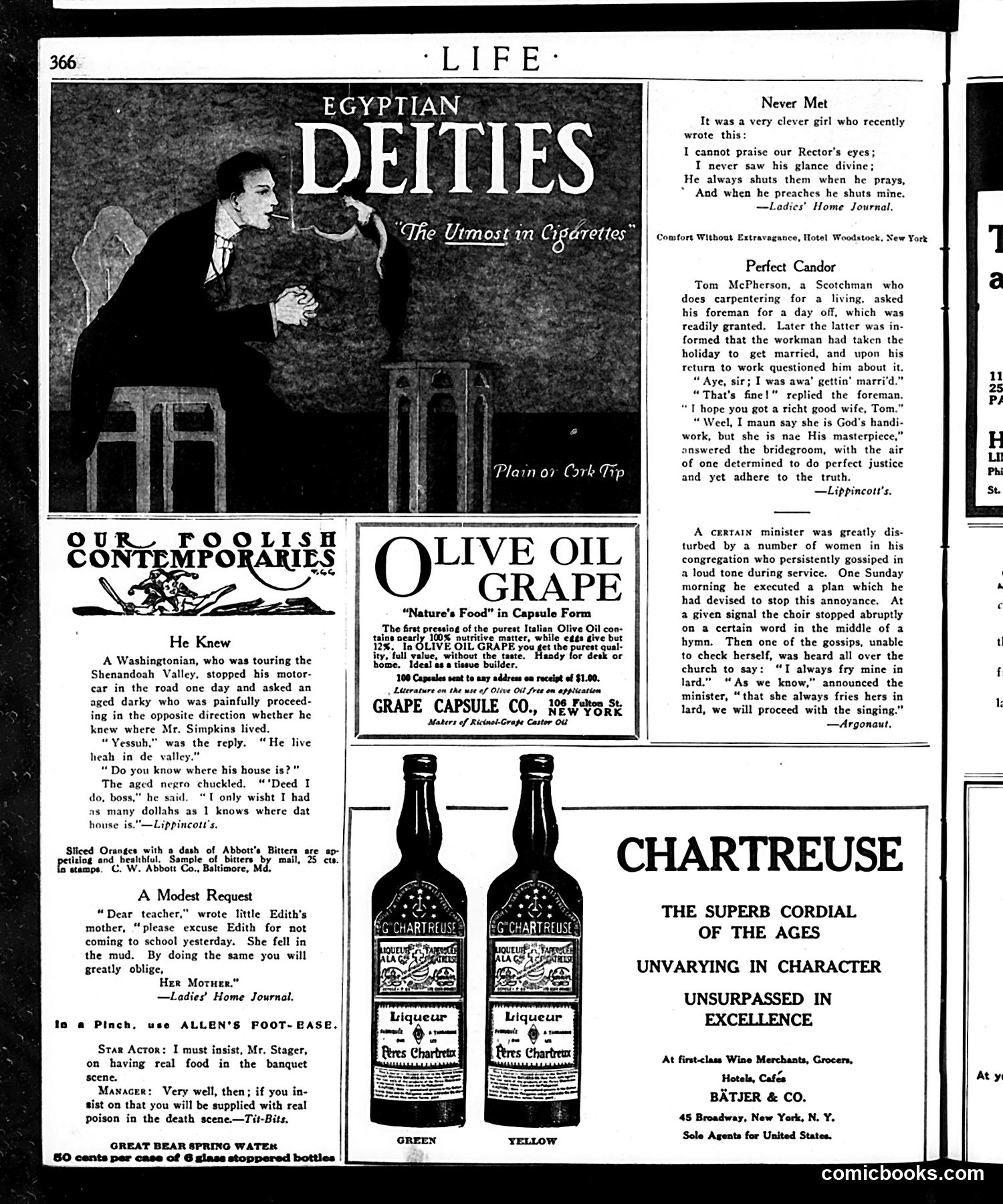
This page is primarily **advertisements and humorous anecdotes** rather than political cartoons. The main visual is an ad for "Egyptian Deities" cigarettes featuring a stylized profile, playing on exotic branding popular in that era. The text sections are brief jokes and stories typical of early 20th-century humor magazines: - **"He Knew"**: A racist dialect joke about a Black man in the Shenandoah Valley, reflecting common stereotypes of the period - **"Never Met"**: A girl's clever quip about the rector closing his eyes during prayer - **"Perfect Candor"**: A Scottish carpenter's blunt honesty about his new wife - **Church gossip anecdote**: Women's chattering is interrupted mid-hymn, exposing their off-topic conversation The page also advertises patent medicines (Olive Oil Grape capsules), foot powder, and Chartreuse liqueur—typical period advertising. No specific political commentary is evident; the humor relies on period stereotypes and gentle social observation.
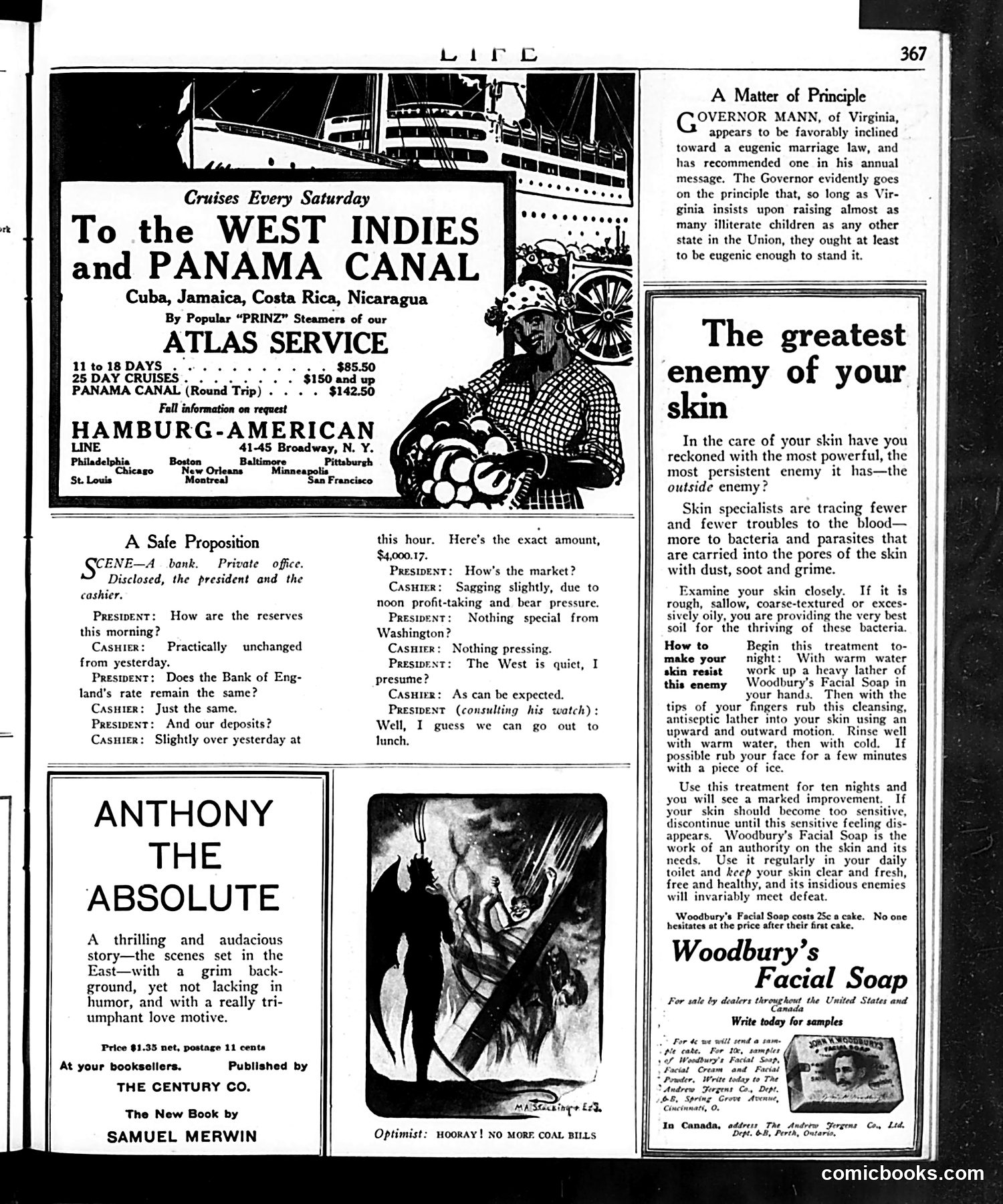
This page contains multiple sections typical of early 20th-century Life magazine: **"A Safe Proposition"** is a satirical dialogue mocking the banking industry's complacency. A bank president and cashier discuss reserves, markets, and deposits in deliberately calm, measured tones—yet the only concrete figure mentioned is $4,000.17 in deposits. The joke appears to criticize how banks operate with apparent stability while managing minimal actual assets, using vague financial jargon to mask the precariousness of their positions. **"A Matter of Principle"** satirizes Governor Mann of Virginia's proposal for a eugenic marriage law. The satire's bite: if Virginia insists on producing "almost as many illiterate children as any other state," the least they could do is ensure those children are "eugenic enough to stand it"—a dark, sarcastic critique of the eugenic movement's logic and Virginia's educational failures. The remaining content is **advertisements** (cruise lines, a novel, and Woodbury's Facial Soap) rather than editorial satire.
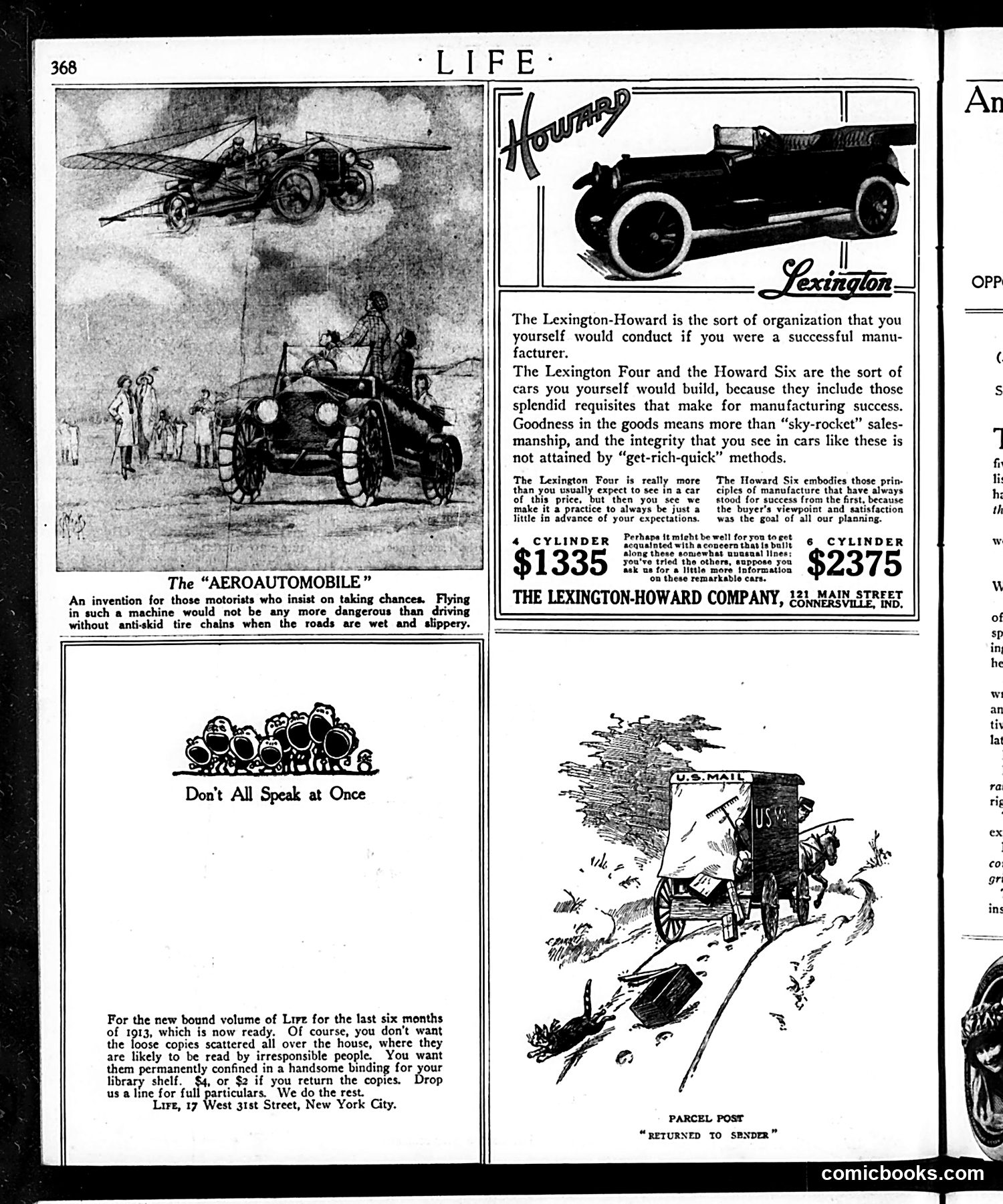
This page contains automotive advertisements and satirical content typical of early 1900s Life magazine. **The "Aeroautomobile"** (top left): A humorous illustration mocking reckless motorists. The cartoon shows a flying contraption combining car and airplane elements, sarcastically suggesting it's no more dangerous than driving without snow chains on icy roads. This satirizes both early aviation mania and dangerous driving habits of the era. **Lexington-Howard automobiles** (center-right): Straightforward advertisements for the Lexington Four ($1,335) and Howard Six ($2,375), emphasizing quality manufacturing and integrity over flashy salesmanship—a marketing contrast to competitor tactics. **"Don't All Speak at Once"** (lower left): A cartoon showing multiple faces, likely satirizing overly chatty people or committee decision-making. **"Parcel Post—Returned to Sender"** (lower right): A humorous illustration of a mail carrier struggling with a package, commenting on the newly-established parcel post service's challenges. The page reflects 1913 consumer culture, emerging transportation technologies, and period humor.
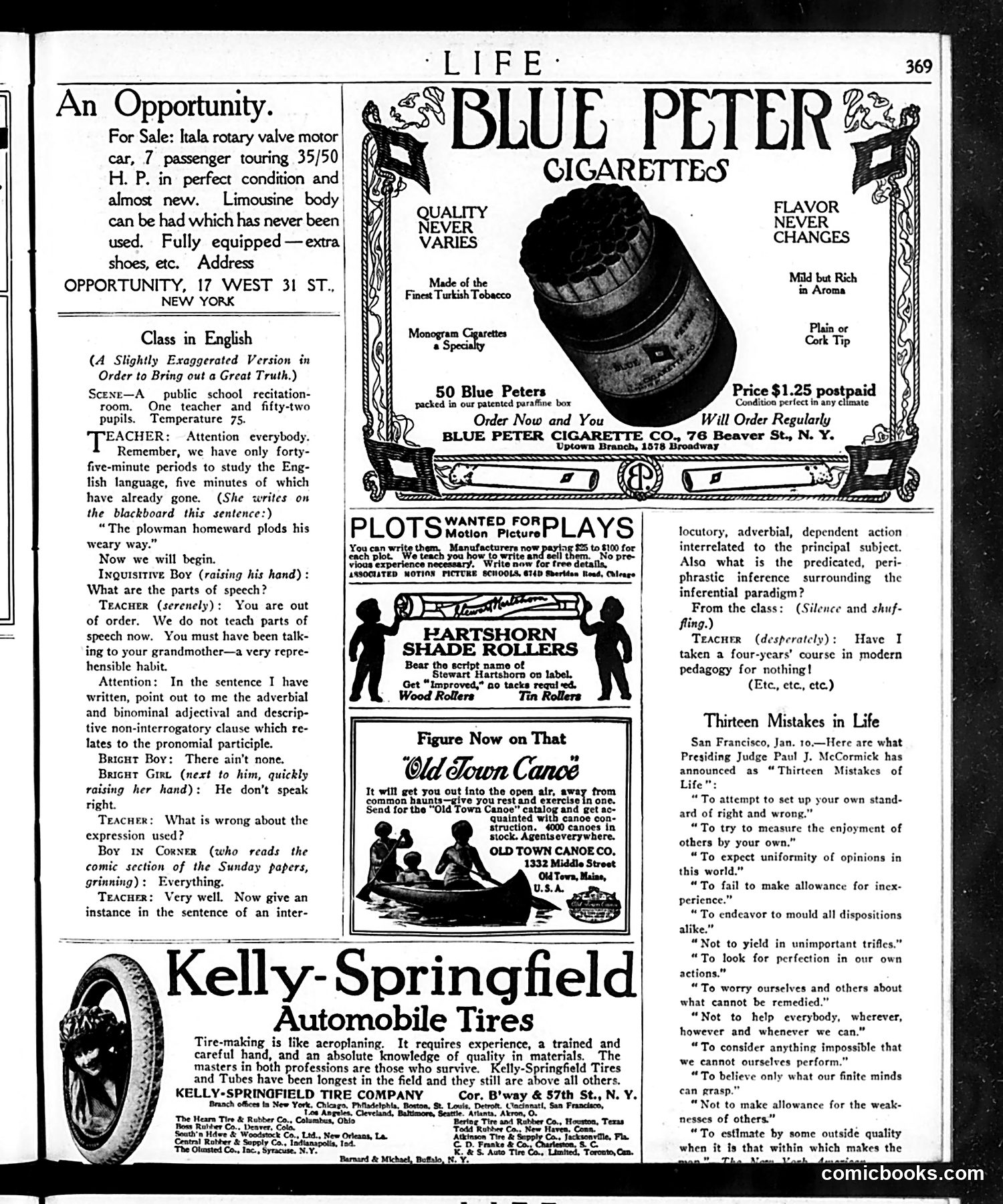
This page is primarily **advertisements** interspersed with one satirical piece on education. The main content is "Class in English," a classroom satire mocking progressive education theories of the era. A teacher asks students absurdly complex grammatical questions using made-up or overly technical terminology ("adverbial and binominal adjectival and descriptive non-interrogatory clause"). The students give common-sense answers ("There ain't none"), and the teacher criticizes their natural speech as wrong. The satire's point: Modern educational pedagogy has become so theoretically elaborate that it defeats practical learning. Teachers focus on jargon rather than teaching students to speak correctly. The exasperated teacher's final lament—"Have I taken a four-years' course in modern pedagogy for nothing!"—encapsulates the joke: excessive training in educational theory produces poor actual teaching. The surrounding ads (cigarettes, canoes, automobile tires, shade rollers) are period-typical commercial content with no satirical intent.
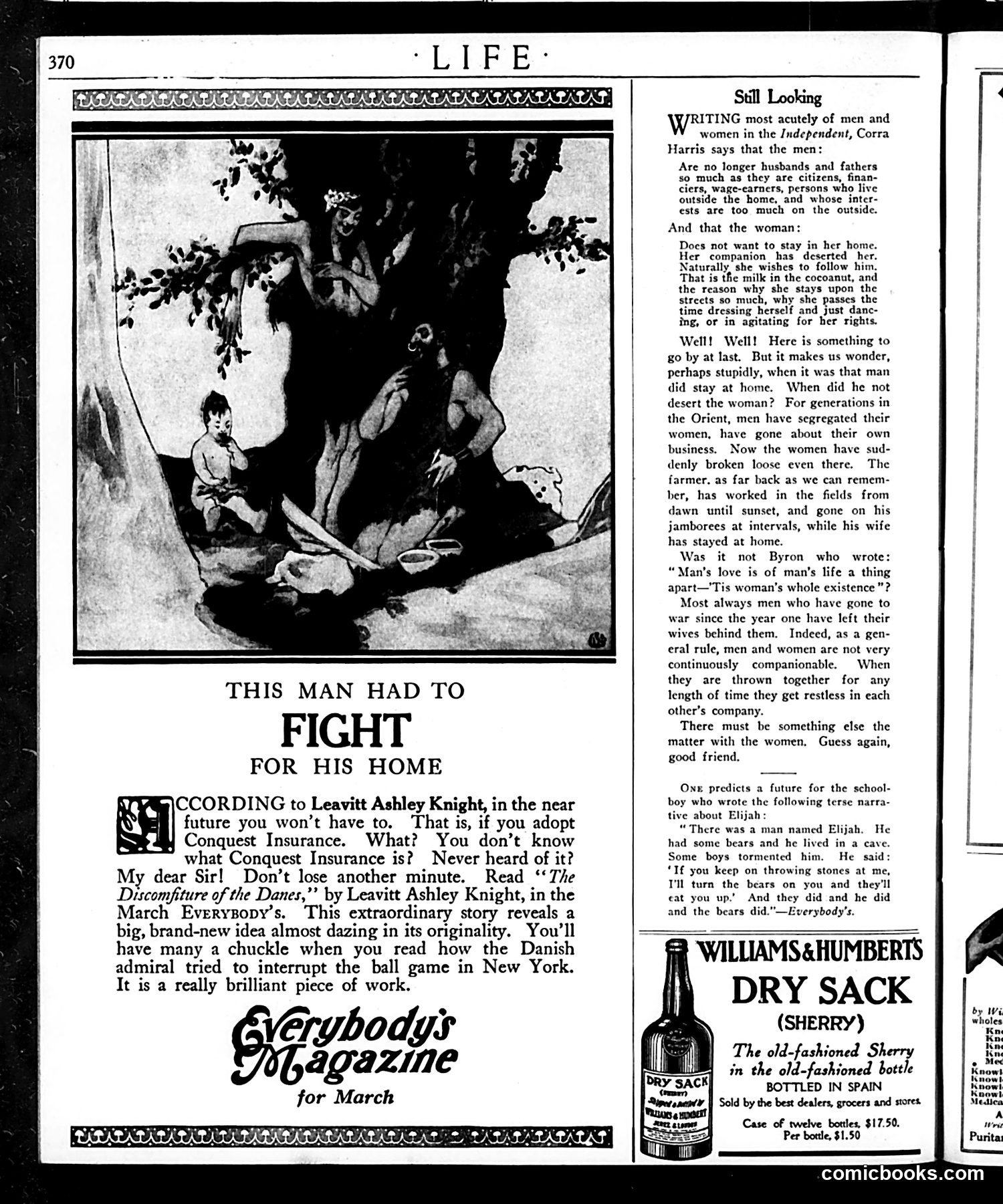
## Main Content The page features two distinct pieces: **Left: Advertisement for "Conquest Insurance"** disguised as editorial content. It promotes a fictional story by Leavitt Ashley Knight called "The Discomfiture of the Danes" from *Everybody's* Magazine, describing an absurd plot where a Danish admiral interrupts a ball game in New York. This is a playful cross-promotion touting insurance as a solution to home protection—the visual shows a man fighting what appears to be a large ape or beast, suggesting one must "fight" to protect one's home without proper insurance. **Right: "Still Looking"** commentary column discussing marital dynamics and gender roles. Writer Corra Harris (quoted from *The Independent*) argues men have abandoned domestic life for public/financial pursuits, causing women to leave home seeking companionship. The columnist sardonically questions this analysis, pointing out men have *always* worked outside the home—farmers, soldiers, travelers—while women remained domestic. He suggests deeper social issues are at play. **Context**: This reflects early 20th-century anxieties about changing gender roles and women's increasing independence and public presence.
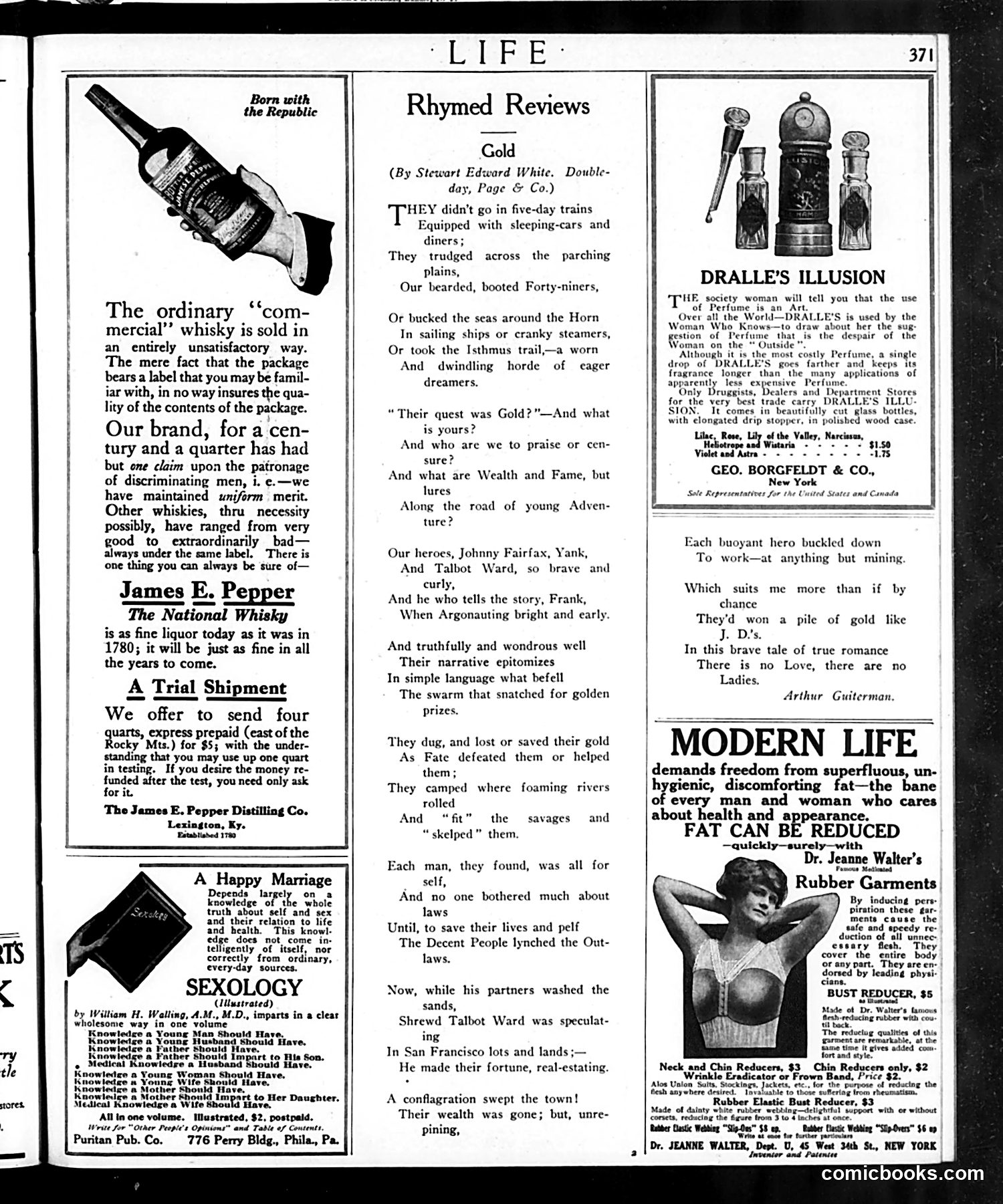
This page is primarily **advertising and literary content**, not political satire. The main elements are: **"Rhymed Reviews"** – A book review in verse of Stewart Edward White's novel *Gold*, about California Gold Rush prospectors (the "Forty-niners"). The review celebrates their adventurous spirit while questioning whether modern readers pursue wealth with similar nobility. **Advertisements** include: - **James E. Pepper whisky** – emphasizing consistent quality and heritage ("Born with the Republic," established 1780) - **Sexology** – a medical/educational book on marital relations, reflecting early 20th-century anxiety about sexual knowledge - **Dralle's Illusion perfume** – luxury product marketing to wealthy women - **Dr. Jeanne Walter's Rubber Garments** – weight-reduction undergarments for women The page reflects **1920s consumer culture and values**: nostalgia for American frontier heroism, concerns about proper sexual education, and the commercialization of beauty/health through products targeting affluent women. No specific political figures or events are referenced.
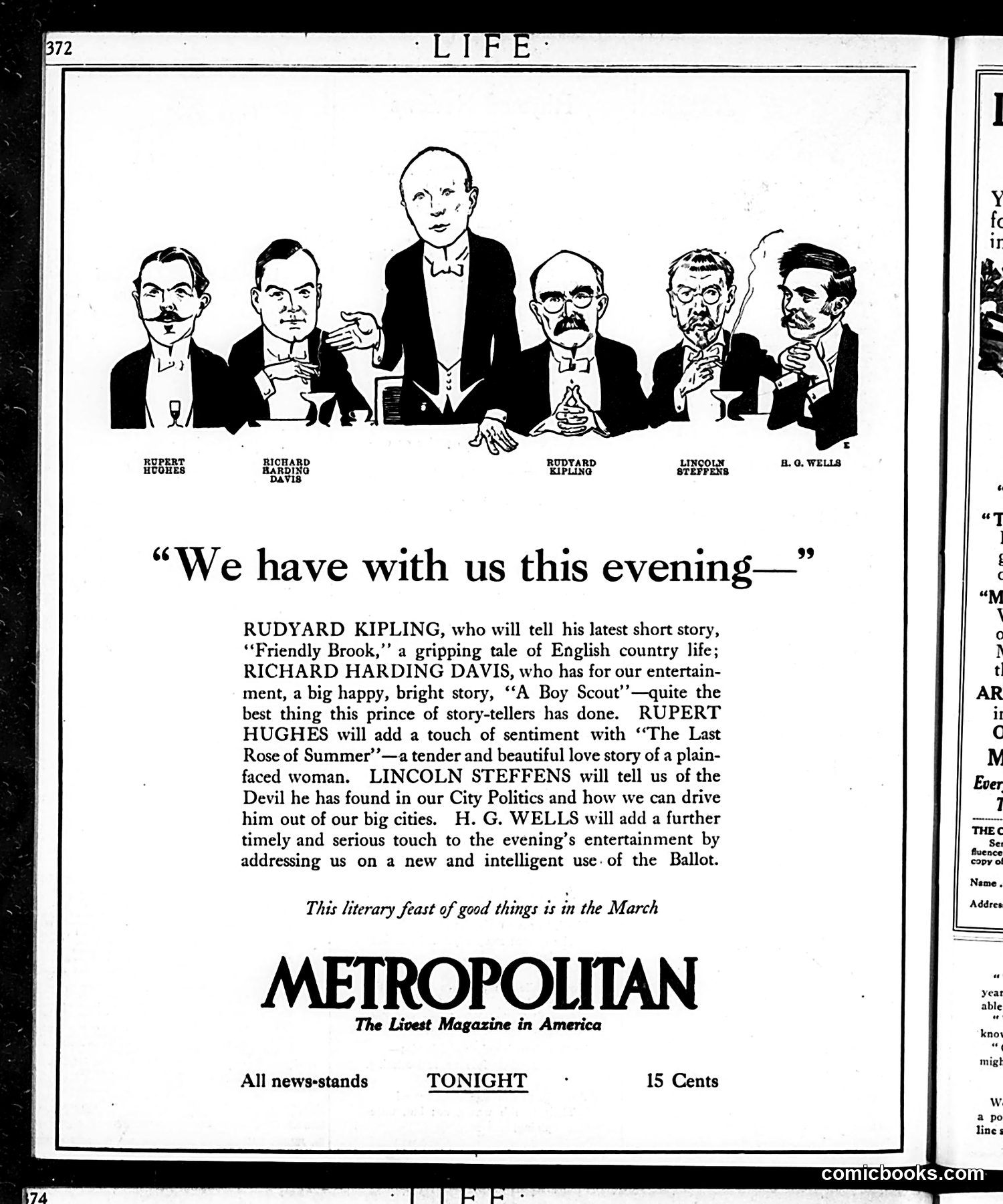
This is an advertisement for *Metropolitan* magazine announcing a special literary event featuring six prominent writers and public figures of the early 20th century. The caricatured portraits above identify (left to right): Rupert Hughes, Richard Harding Davis, an unnamed moderator, Rudyard Kipling, Lincoln Steffens, and H.G. Wells. The ad promotes an evening of readings: Kipling will share a story about English country life; Davis offers a Boy Scout tale; Hughes contributes sentimental romance; Steffens discusses urban political corruption; and Wells addresses voting reform. The announcement positions this as sophisticated entertainment for the magazine's readers, available that night at newsstands for 15 cents—positioning *Metropolitan* as "The Livest Magazine in America" with serious literary and civic content.
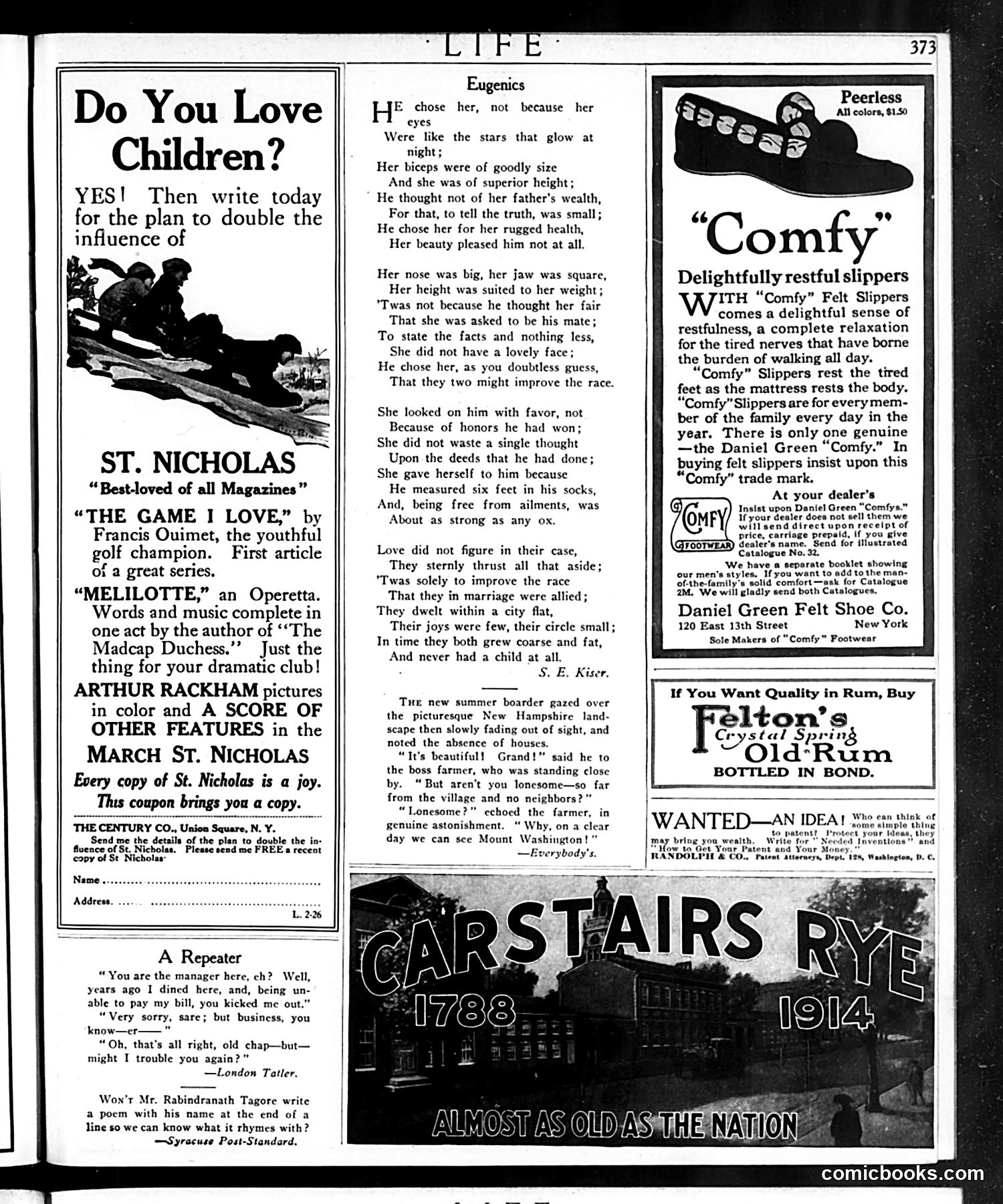
This page mixes editorial content with advertising, centered on early 20th-century concerns. **"Eugenics" Poem**: The featured poem satirizes the eugenics movement—the then-popular belief that selective breeding could "improve the race." It mocks a couple who marry solely for physical traits (strength, height, health) rather than love, explicitly rejecting romantic attraction to pursue genetic "improvement." The cruel irony: despite their eugenic intentions, they remain childless. This was social satire of a pseudoscientific movement that was disturbingly mainstream in this era. **Other Content**: Includes typical magazine promotions (St. Nicholas children's magazine), a brief London anecdote about a restaurant manager, and an advertisement for "Comfy" felt slippers emphasizing comfort for tired feet—reflecting the pre-automobile era's emphasis on walking. The page reflects Life's satirical approach to contemporary fads and social movements, using humor to critique eugenic ideology.
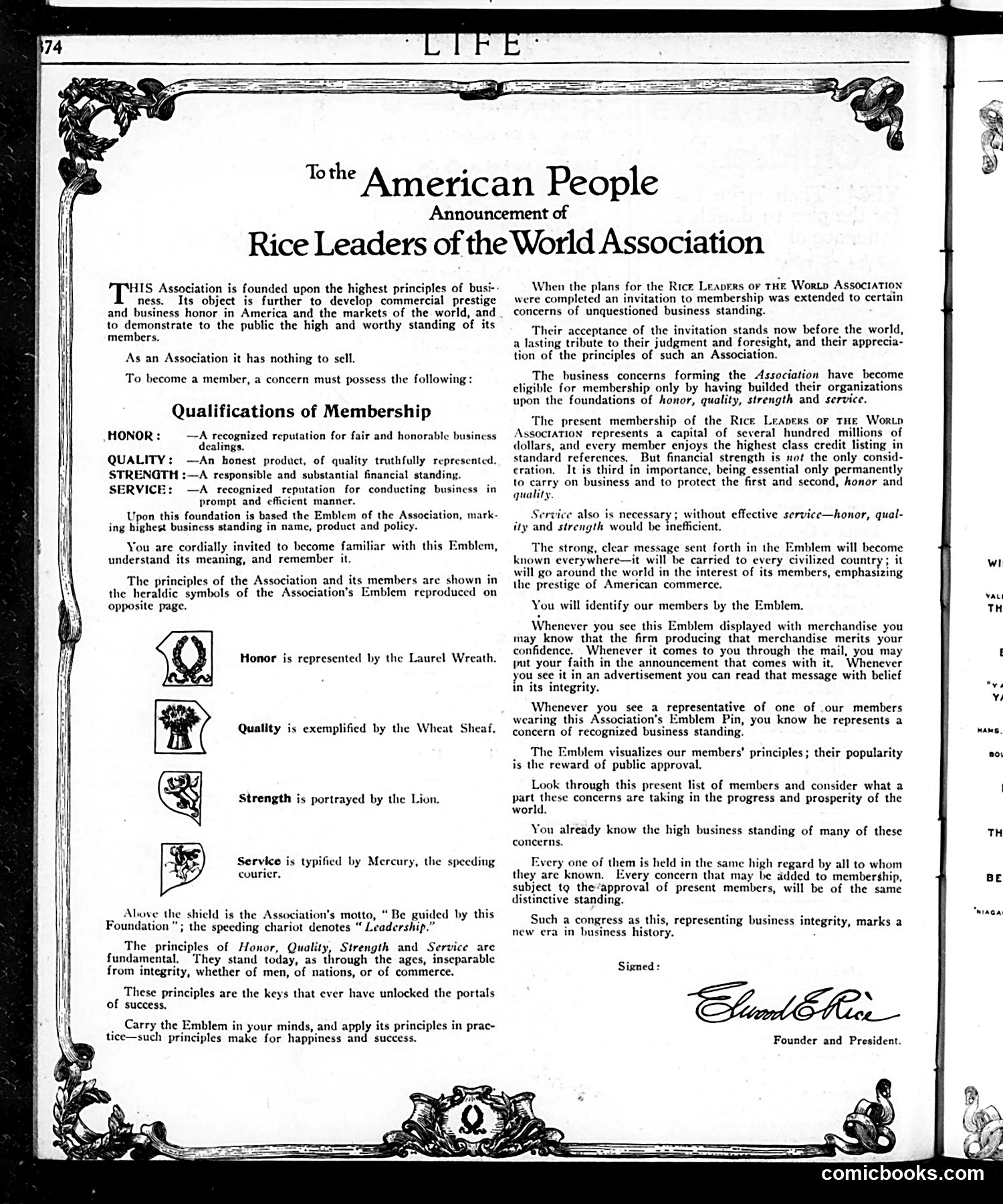
This is **not a political cartoon but a legitimate business advertisement**, published in *Life* magazine. It announces the "Rice Leaders of the World Association"—a trade organization promoting American commercial integrity and business ethics. The page establishes membership qualifications based on four principles represented by heraldic symbols: Honor (Laurel Wreath), Quality (Wheat Sheaf), Strength (Lion), and Service (Mercury). The text emphasizes that financial standing ranks third in importance, behind honor and quality. This appears to be **sincere advocacy** for ethical business practices during the early 20th century, signed by a founder president. The ornate design and formal tone reflect contemporary business culture's attempt to establish professional standards. No satirical intent is evident—*Life* magazine simply provided advertising space for this association's announcement to American readers and potential member companies.
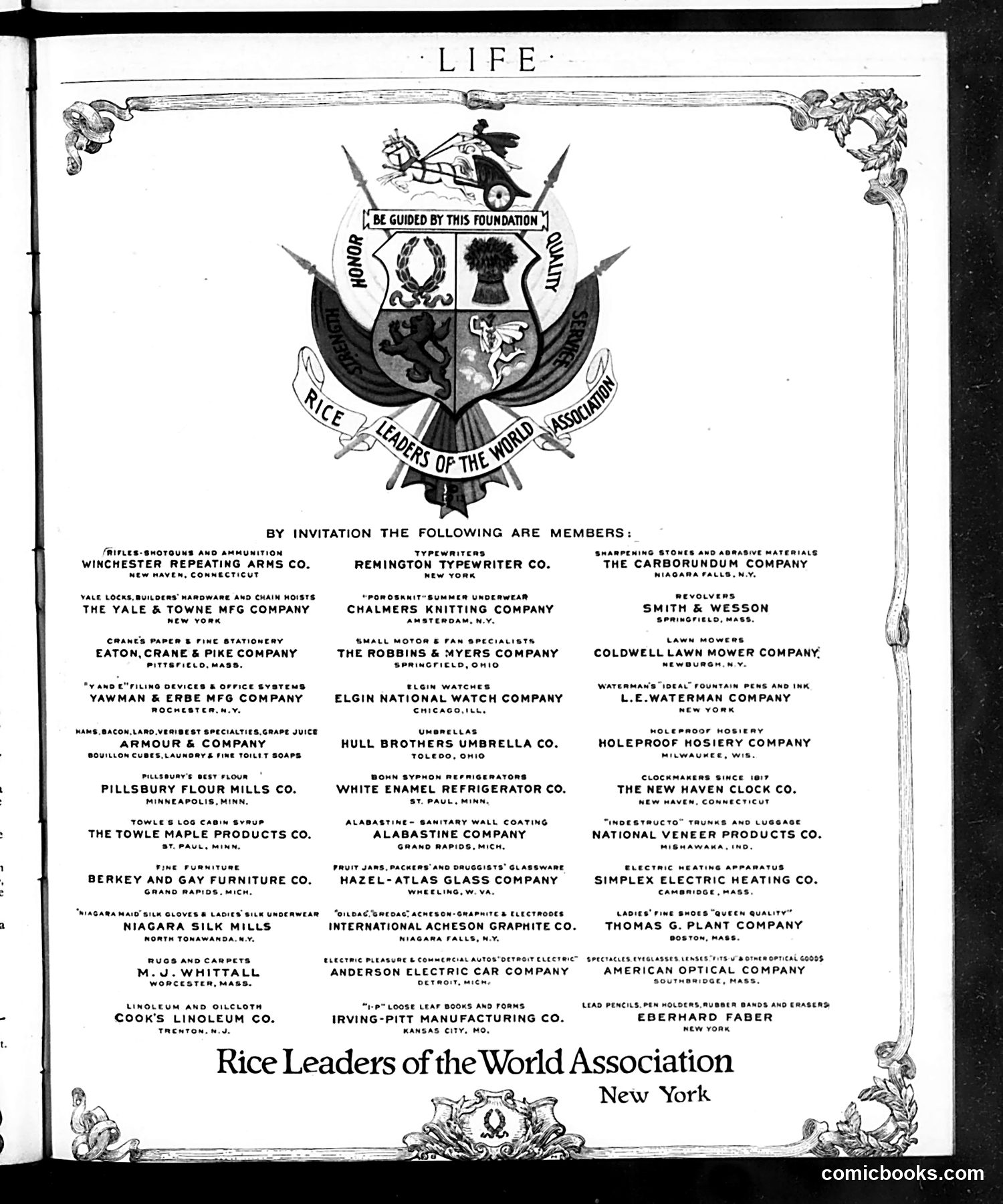
This is a **title page/membership roster**, not a political cartoon. The "Rice Leaders of the World Association" appears to be a satirical organization with an ornate heraldic crest claiming to be "guided by this foundation" (the motto is unclear but references honor, wisdom, and the world). The satire lies in the membership list itself: over 50 major American corporations across firearms, food, furniture, appliances, and consumer goods are presented as members of this grandiose "association." The joke seems to be mocking **corporate self-importance and manufactured prestige**—these mundane manufacturers of typewriters, watches, and linoleum are humorously elevated to "leaders of the world." This likely satirizes American corporate culture's pretensions and the era's proliferation of business associations and clubs claiming worldly significance. The detailed heraldic styling adds to the mockery, presenting industrial capitalism as if it were nobility.
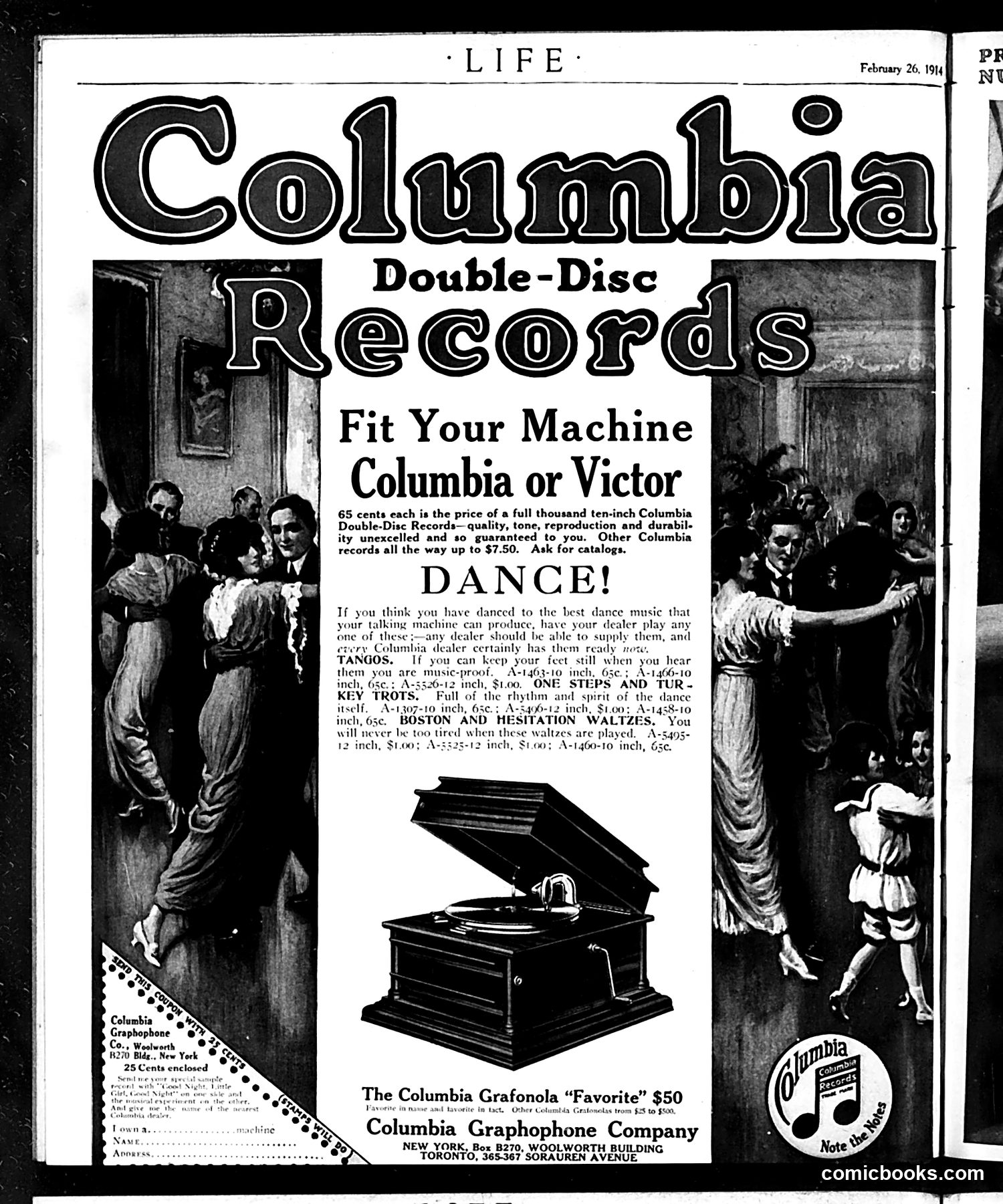
This is **primarily a full-page advertisement**, not a political cartoon or satirical content. The page advertises Columbia Double-Disc Records and the Columbia Grafonola phonograph (a $50 model shown center). The text promotes record pricing (65 cents for ten-inch discs) and lists available dance music selections: tangos, one-steps, waltzes, and Boston/hesitation waltzes. The illustrations flanking the advertisement depict **couples dancing** — scenes showing men and women in early 1910s attire engaged in ballroom dancing. These images support the advertisement's pitch that Columbia records provide quality music for home dancing. The only notable social context: this reflects the **era's popular dance crazes** (tangos, one-steps, waltzes) and the emerging consumer market for home entertainment via phonographs. The advertisement implicitly suggests that owning records and a phonograph enables middle-class households to host dances, reflecting 1910s leisure culture. There is **no political satire** or caricature on this page — it's straightforward commercial messaging from the Columbia Graphophone Company.