
Life, 1914-02-26 · page 18 of 40
Life — February 26, 1914 — page 18: what you’re looking at
What you’re looking at
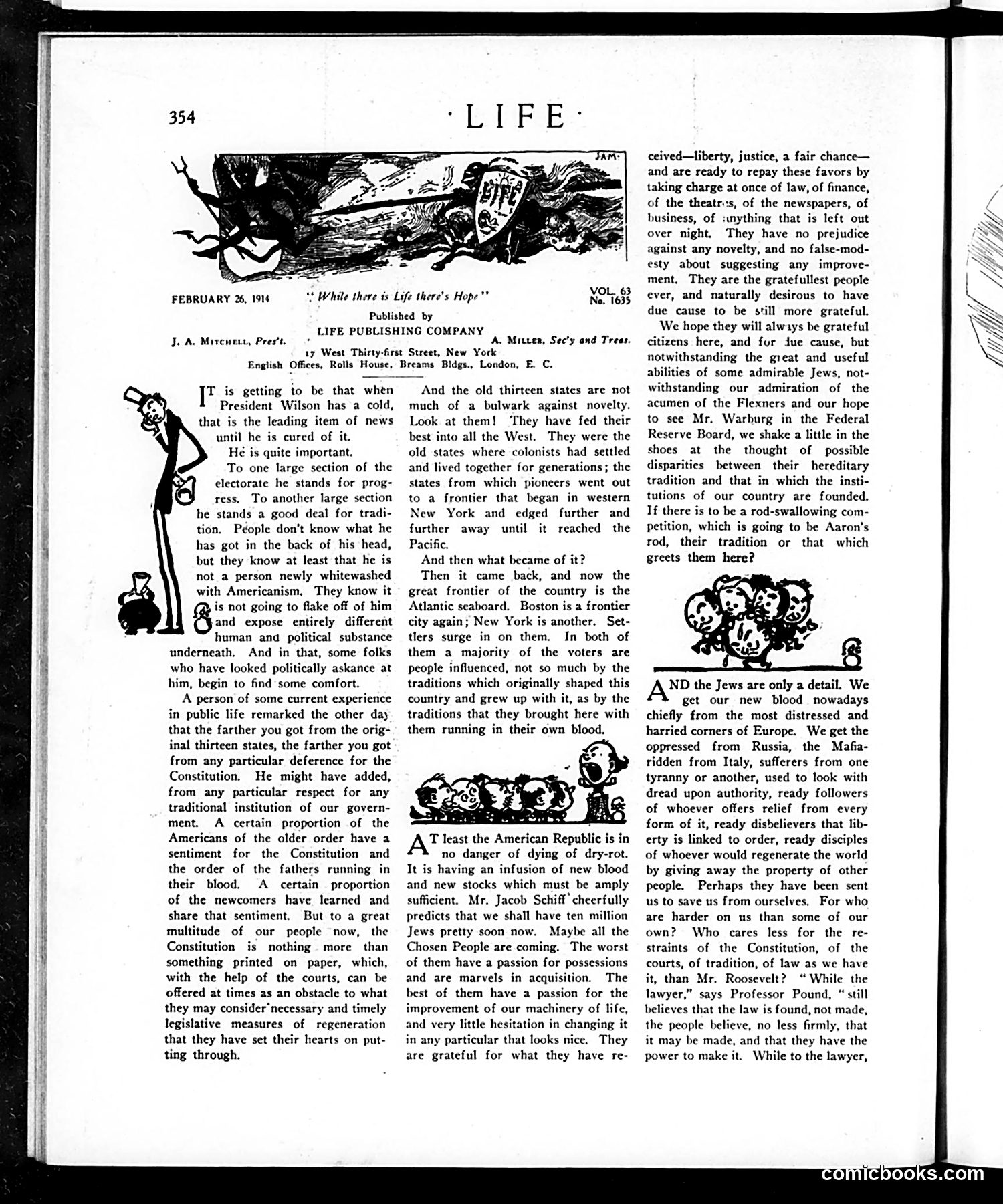
This editorial attack uses inflammatory anti-Semitic stereotypes to argue against Jewish immigration. The author contrasts "old" Americans (descended from the original thirteen states) who respect constitutional tradition with "new blood"—specifically Jews—who allegedly lack respect for established institutions. The piece references banker Jacob Schiff's prediction of ten million Jews in America, framing this as a threat. It caricatures Jewish immigrants as driven by acquisitive materialism and a desire to control finance, law, newspapers, and business. The author claims they cynically exploit American liberty while undermining American traditions. The cartoons (appearing to show caricatured immigrant figures) visualize these xenophobic arguments. This represents Life magazine's editorial stance during a period of intense anti-immigration sentiment and rising American anti-Semitism, predating the 1924 immigration restrictions.
📄 Transcribed text from this page (OCR, searchable)
Machine-transcribed from the original scan — historical spelling and the odd misread are preserved.
FEBRUARY 26, 1916 ‘| While there és Life there's Hope” No, 1635 Published by J. A. Mivcnens, Pres’t. LIFE PUBLISHING COMPANY A. Mitten, Sec’y and Treas. 17 West Thirty-first Street, New York English Offices, Rolls House, Breams Bldgs., London, E. C. I is getting to be that when President Wilson has a cold, that is the leading item of news until he is cured of it. He is quite important. To one large section of the electorate he stands for prog- ress. To another large section he stands a good deal for tradi- tion. People don’t know what he has got in the back of his head, but they know at least that he is not a person newly whitewashed with Americanism. They know it R is not going to flake off of him and expose entirely different human and political substance underneath. And in that, some folks who have looked politically askance at him, begin to find some comfort. A person of some current experience in public life remarked the other day that the farther you got from the orig- inal thirteen states, the farther you got from any particular deference for the Constitution. He might have added, from any particular respect for any traditional institution of our govern- ment. A certain proportion of the Americans of the older order have a sentiment for the Constitution and the order of the fathers running in their blood. A certain proportion of the newcomers have learned and share that sentiment. But to a great multitude of our people now, the Constitution is nothing more than something printed on paper, which, with the help of the courts, can be offered at times as an obstacle to what they may consider’necessary and timely legislative measures of regeneration that they have set their hearts on put- ting through. And the old thirteen states are not much of a bulwark against novelty. Look at them! ‘They have fed their best into all the West. They were the old states where colonists had settled and lived together for generations; the states from which pioneers went out to a frontier that began in western New York and edged further and further away until it reached the Pacific. And then what became of it? Then it came back, and now the great frontier of the country is the Atlantic seaboard. Boston is a frontier city again; New York is another. Set- tlers surge in on them. In both of them a majority of the voters are people influenced, not so much by the traditions which originally shaped this country and grew up with it, as by the traditions that they brought here with them running in their own blood. A’ least the American Republic is in no danger of dying of dry-rot. It is having an infusion of new blood and new stocks which must be amply sufficient. Mr. Jacob Schiff’ cheerfully predicts that we shall have ten million Jews pretty soon now. Maybe all the Chosen People are coming. The worst of them have a passion for possessions and are marvels in acquisition. The best of them have a passion for the improvement of our machinery of life, and very little hesitation in changing it in any particular that looks nice. They are grateful for what they have re- ceived—liberty, justice, a fair chance— and are ready to repay these favors by taking charge at once of law, of finance, of the theatr.:s, of the newspapers, of business, of nything that is left out over night. They have no prejudice against any novelty, and no false-mod- esty about suggesting any improve- ment. They are the gratefullest people ever, and naturally desirous to have due cause to be still more grateful. We hope they will always be grateful citizens here, and fur due cause, but notwithstanding the great and useful abilities of some admirable Jews, not- withstanding our admiration of the acumen of the Flexners and our hope to see Mr. Warburg in the Federal Reserve Board, we shake a little in the shoes at the thought of possible disparities between their hereditary tradition and that in which the insti- tutions of our country are founded. If there is to be a rod-swallowing com- petition, which is going to be Aaron’s rod, their tradition or that which greets them here? A®? the Jews are only a detail. We get our new blood nowadays chiefly from the most distressed and harried corners of Europe. We get the oppressed from Russia, the Mafia- ridden from Italy, sufferers from one tyranny or another, used to look with dread upon authority, ready followers of whoever offers relief from every form of it, ready disbelievers that lib- erty is linked to order, ready disciples of whoever would regenerate the world by giving away the property of other people. Perhaps they have been sent us to save us from ourselves. For who are harder on us than some of our own? Who cares less for the re- straints of the Constitution, of the courts, of tradition, of law as we have it, than Mr. Roosevelt? “ While the lawyer,” says Professor Pound, “still believes that the law is found, not made, the people believe, no less firmly, that it may be made, and that they have the power to make it. While to the lawyer, comicbooks.com