
Life, 1914-02-26 · page 8 of 40
Life — February 26, 1914 — page 8: what you’re looking at
What you’re looking at
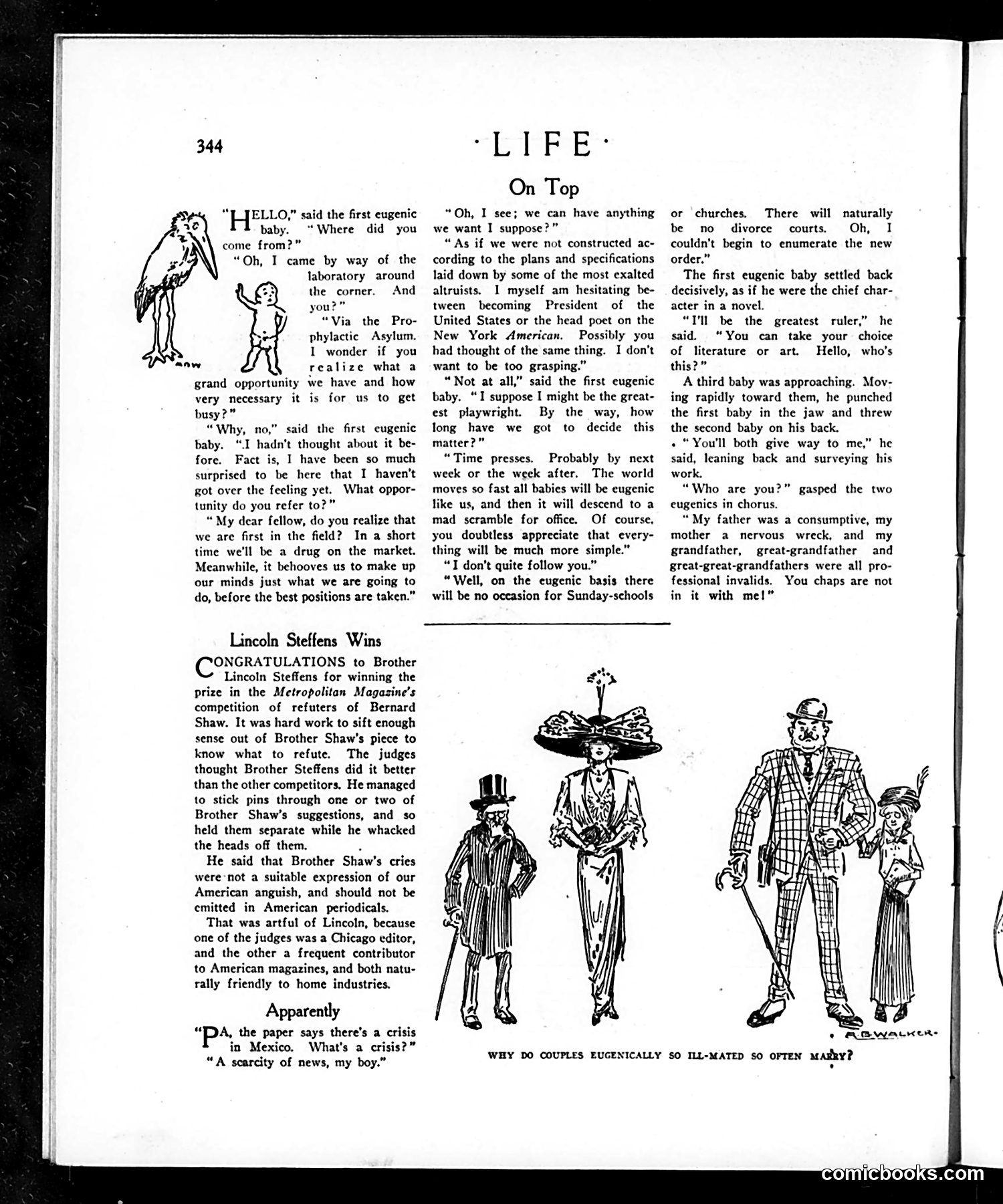
The page contains two satirical pieces. The upper section presents a dialogue between two "eugenic babies"—infants discussing whether one should become U.S. President or poet for the *New York American*. This mocks the eugenics movement (popular in early 20th century) by imagining babies already planning elite careers based on eugenic principles. The lower cartoon, captioned "Why do couples eugenically so ill-mated so often?", depicts four oddly-matched couples in absurd clothing and proportions. It satirizes eugenics ideology by suggesting that real human pairings contradict eugenic ideals of "scientific" mate selection. The humor lies in exposing the gap between eugenic theory and messy human reality.
📄 Transcribed text from this page (OCR, searchable)
Machine-transcribed from the original scan — historical spelling and the odd misread are preserved.
344 “LJELLO,” said the first eugenic baby. “Where did you come from?” “Oh, I came by way of the laboratory around the corner. And you?” “Via the Pro- phylactic Asylum. I wonder if you realize what a grand opportunity we have and how very necessary it is for us to get busy?” “Why, no,” said the first cugenic baby. “I hadn't thought about it be- fore. Fact is, I have been so much surprised to be here that I haven't got over the feeling yet. What oppor- tunity do you refer to?” “My dear fellow, do you realize that we are first in the field? In a short time we'll be a drug on the market. Meanwhile, it behooves us to make up our minds just what we are going to do, before the best positions are taken.” Lincoln Steffens Wins 'ONGRATULATIONS to Brother Lincoln Steffens for winning the prize in the Metropolitan Magazine's competition of refuters of Bernard Shaw. It was hard work to sift enough sense out of Brother Shaw’s piece to know what to refute. The judges thought Brother Steffens did it better than the other competitors, He managed to stick pins through one or two of Brother Shaw’s suggestions, and so held them separate while he whacked the heads off them. : He said that Brother Shaw's cries were not a suitable expression of our American anguish, and should not be emitted in American periodicals. That was artful of Lincoln, because one of the judges was a Chicago editor, and the other a frequent contributor to American magazines, and both natu- rally friendly to home industries. Apparently “P* the paper says there's a crisis in Mexico. What's a crisis?” “A scarcity of news, my boy.” “5 PSE On Top “Oh, I see; we can have anything we want I suppose?” “As if we were not constructed ac- cording to the plans and specifications laid down by some of the most exalted altruists. 1 myself am hesitating be- tween becoming President of the United States or the head poet on the New York American. Possibly you had thought of the same thing. I don’t want to be too grasping.” “Not at all,” said the first eugenic baby. “I suppose I might be the great- est playwright. By the way, how long have we got to decide this matter?” “Time presses. Probably by next week or the week after. The world moves so fast all babies will be eugenic like us, and then it will descend to a mad scramble for office. Of course, you doubtless appreciate that every- thing will be much more simple.” “TI don't quite follow you.” “Well, on the cugenic basis there will be no occasion for Sunday-schools or churches. There will naturally be no divorce courts. Oh, I couldn't begin to enumerate the new order.” The first eugenic baby settled back decisively, as if he were the chief char- acter in a novel. “T'll be the greatest ruler,” he said. “You can take your choice of literature or art. Hello, who's this?” A third baby was approaching. Mov- ing rapidly toward them, he punched the first baby in the jaw and threw the second baby on his back. + “You'll both give way to me,” he said, leaning back and surveying his work, “Who are you?” gasped the two eugenics in chorus. “My father was a consumptive, my mother a nervous wreck, and my grandfather, great-grandfather and great-great-grandfathers were all pro- fessional invalids. You chaps are not in it with me!”