
Life, 1914-02-26 · page 22 of 40
Life — February 26, 1914 — page 22: what you’re looking at
What you’re looking at
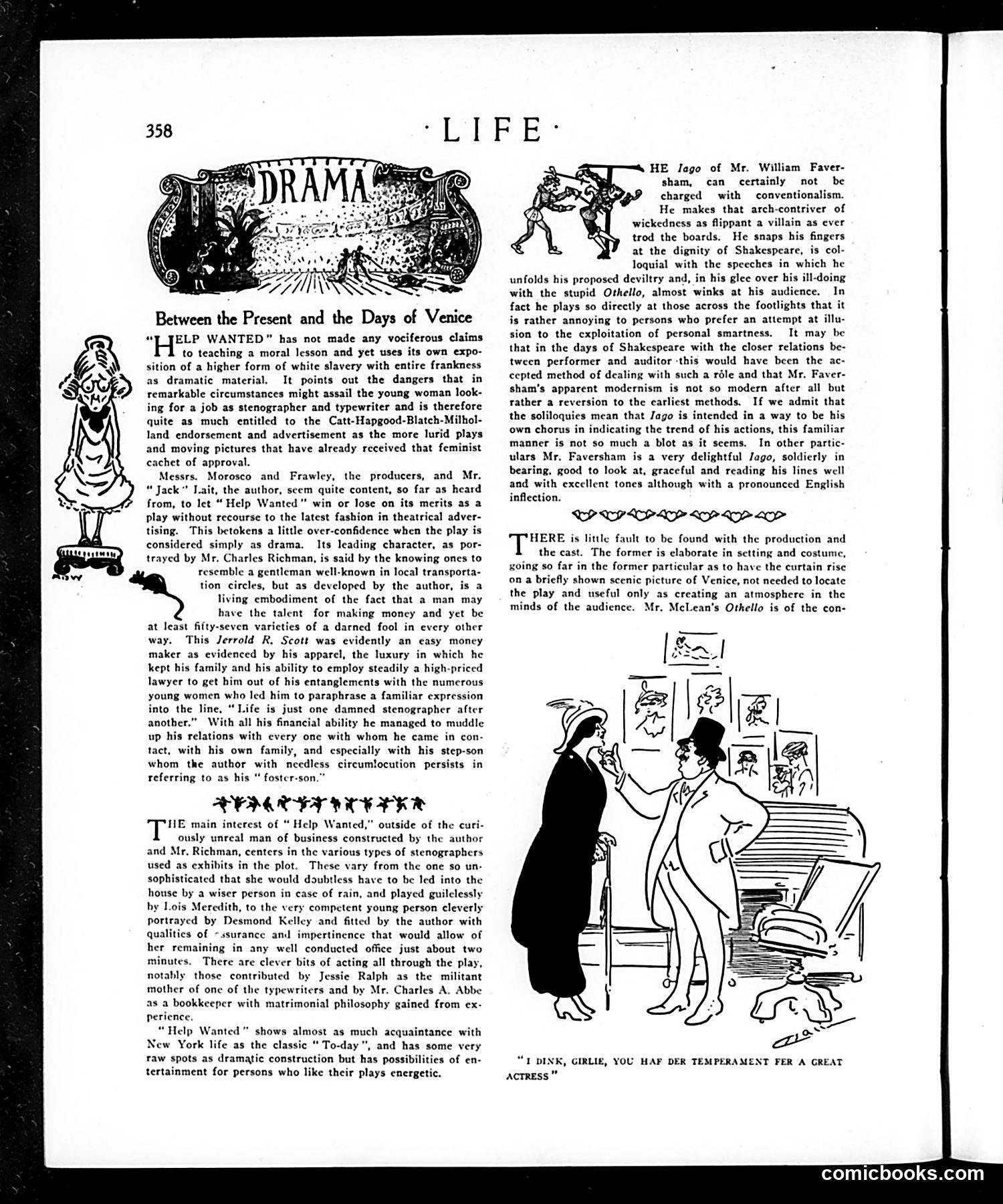
This page reviews two theatrical productions: "Help Wanted" and an unnamed play featuring William Faversham as Iago (from Shakespeare's *Othello*). **"Help Wanted"** concerns a wealthy businessman named Jerrold R. Scott (played by Charles Richman, apparently modeled on a real local transportation magnate) who, despite financial success, is a "fool" in personal matters. The plot centers on various stenographer characters—ranging from naive to competent and impertinent—whom he entangles himself with romantically. The review notes the play addresses "white slavery" concerns relevant to working women seeking employment. **The Iago review** criticizes Faversham's overly theatrical, winking villainy—he plays directly to the audience rather than maintaining dramatic illusion, which the critic finds annoying. The cartoon depicts a theater producer or director showing sketches to a woman, captioning her as having "temperament" suitable for a great actress—satirizing the theater world's pretensions and the casting couch dynamic.
📄 Transcribed text from this page (OCR, searchable)
Machine-transcribed from the original scan — historical spelling and the odd misread are preserved.
ELP WANTED” has not made any vociferous claims to teaching a moral lesson and yet uses its own expo- sition of a higher form of white slavery with entire frankness as dramatic material. It points out the dangers that in remarkable circumstances might assail the young woman look- ing for a job as stenographer and typewriter and is therefore quite as much entitled to the Catt-Hapgood-Blatch-Milhol- land endorsement and advertisement as the more lurid plays and moving pictures that have already received that feminist cachet of approval. Messrs. Morosco and Frawley, the producers, and Mr. “Jack” Lait, the author, seem quite content, so far as heard from, to let “Help Wanted” win or lose on its merits as a play without recourse to the latest fashion in theatrical adver- tising. This betokens a little over-confidence when the play is considered simply as drama. Its leading character, as por- trayed by Mr, Charles Richman, is said by the knowing ones to resemble a gentleman well-known in local transporta- tion circles, but as developed by the author, is a living embodiment of the fact that a man may have the talent for making moncy and yet be at least fifty-seven varieties of a darned fool in every other way. This Jerrold R. Scott was evidently an easy money maker as evidenced by his apparel, the luxury in which he kept his family and his ability to employ steadily a high-priced lawyer to get him out of his entanglements with the numerous young women who led him to paraphrase a familiar expression into the line, “Life is just one damned stenographer after another.” With all his financial ability he managed to muddle up his relations with every one with whom he came in con- tact, with his own family, and especially with his step-son whom the author with needless circumlocution persists in referring to as his “ foster-son.” REPRE POE EKR HE main interest of “ Help Wanted,” outside of the curi- ously unreal man of business constructed by the author and Mr, Richman, centers in the various types of stenographers used as exhibits in the plot. These vary from the one so un- sophisticated that she would doubtless have to be led into the house by a wiser person in case of rain, and played guilelessly by Lois Meredith, to the very competent young person cleverly Portrayed by Desmond Kelley and fitted by the author with qualitics of ~ssurance and impertinence that would allow of her remaining in any well conducted office just about two minutes. There are clever bits of acting all through the play, notably those contributed by Jessie Ralph as the militant mother of one of the typewriters and by Mr. Charles A. Abbe as a bookkeeper with matrimonial philosophy gained from ex- perience. “Help Wanted” shows almost as much acquaintance with d York life as the classic “ To-day”, and has some very taw spots as dramatic construction but has possibilities of en- tertainment for persons who like their plays energetic. HE Jago of Mr. William Faver- sham, can certainly not be 7 charged with conventionalism. He makes that arch-contriver of wickedness as flippant a villain as ever trod the boards. He snaps his fingers loquial with the speeches in which he unfolds his proposed deviltry and, in his glee over his ill-doing with the stupid Othello, almost winks at his audience. In fact he plays so directly at those across the footlights that it is rather annoying to persons who prefer an attempt at illu- sion to the exploitation of personal smartness. It may be that in the days of Shakespeare with the closer relations be- tween performer and auditor this would have been the ac- cepted method of dealing with such a réle and that Mr. Faver- sham’s apparent modernism is not so modern after all but rather a reversion to the earliest methods. If we admit that the soliloquies mean that Jago is intended in a way to be his own chorus in indicating the trend of his actions, this familiar manner is not so much a blot as it seems. In other partic- ulars Mr. Faversham is a very delightful Jago, soldierly in bearing, good to look at, graceful and reading his lines well and with excellent tones although with a pronounced English inflection. LPI LPL OP OPO HERE is little fault to be found with the production and the cast. The former is elaborate in setting and costume, going so far in the former particular as to have the curtain rise on a briefly shown scenic picture of Venice, not needed to locate the play and useful only as creating an atmosphere in the minds of the audience. Mr. McLean’s Othello is of the con- comicbooks.com