
Life, 1914-02-26 · page 19 of 40
Life — February 26, 1914 — page 19: what you’re looking at
What you’re looking at
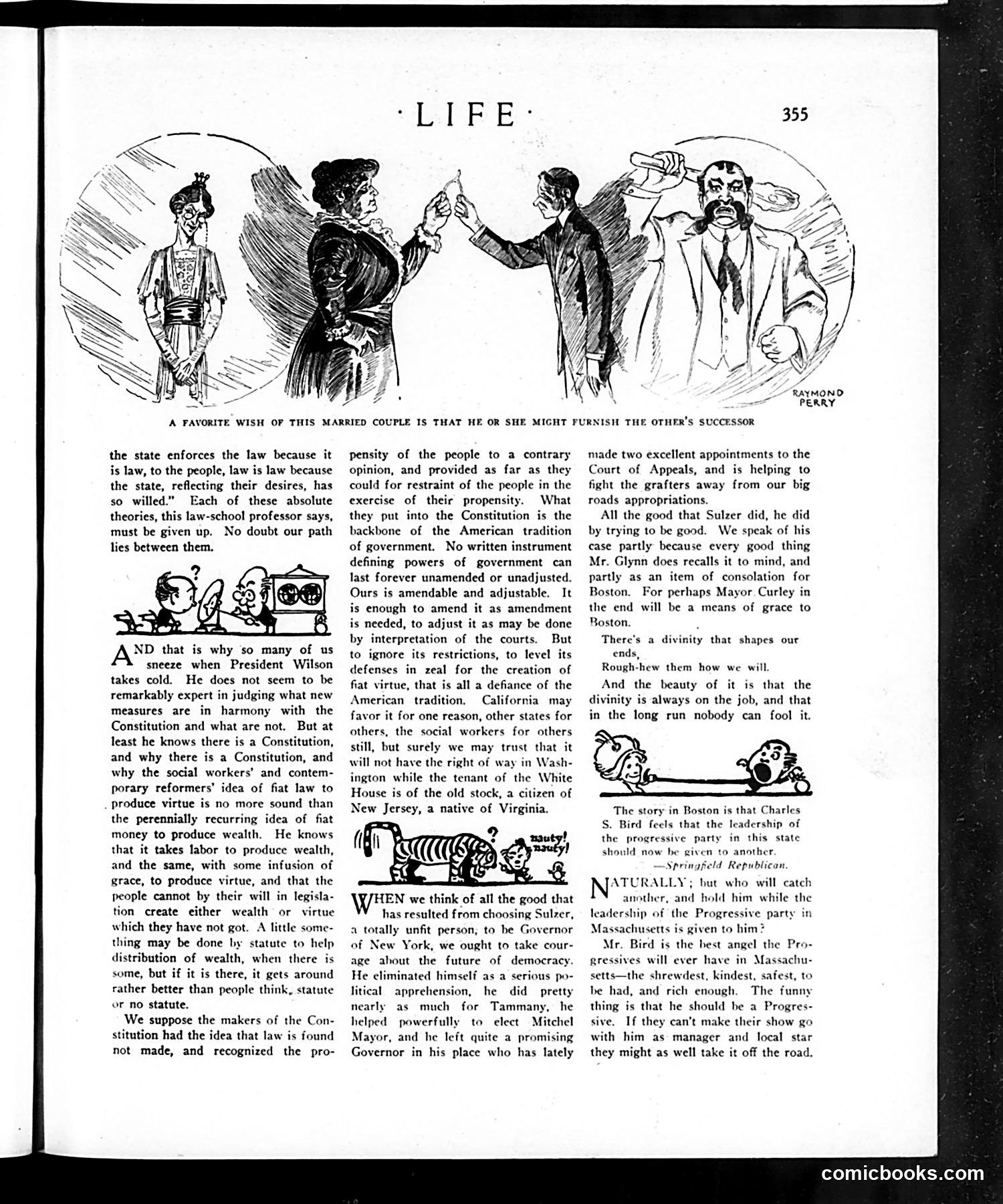
The top cartoon, captioned "A Favorite Wish of This Married Couple Is That He or She Might Furnish the Other's Successor," depicts a couple imagining potential replacements for each other—a dark joke about marital discord. The main article discusses President Wilson's understanding of constitutional law, contrasting him favorably with Governor **Sulzer of New York**, described as "totally unfit." The author argues that despite Sulzer's incompetence, good resulted anyway: he eliminated himself from politics, helped elect reform candidate **Mitchel** as Mayor, and his successor Governor **Glynn** made excellent court appointments and fought corruption. The article extends this "divine providence" theme to Boston's Mayor **Curley**, suggesting his incompetence might paradoxically benefit the city. It concludes with commentary on Massachusetts Progressive Party leadership, noting Charles S. Bird's view that leadership should pass to someone else—but questioning humorously who could manage it without bungling. The satire celebrates how incompetent politicians sometimes accidentally advance good outcomes through their failures.
📄 Transcribed text from this page (OCR, searchable)
Machine-transcribed from the original scan — historical spelling and the odd misread are preserved.
A FAVORITE WISH OF THIS MARRIED COUPLE IS THAT HE OR SHE MIGHT FURNISH THE OTHER'S SUCCESSOR the state enforces the law because it is law, to the people, law is law because the state, reflecting their desires, has so willed.” Each of these absolute theories, this law-school professor says, must be given up. No doubt our path lies between them. A®? that is why so many of us sneeze when President Wilson takes cold. He does not seem to be remarkably expert in judging what new measures are in harmony with the Constitution and what are not. But at least he knows there is a Constitution, and why there is a Constitution, and why the social workers’ and contem- porary reformers’ idea of fiat law to produce virtue is no more sound than the perennially recurring idea of fiat money to produce wealth. He knows that it takes labor to produce wealth, and the same, with some infusion of grace, to produce virtue, and that the people cannot by their will in legisla- tion create either wealth or virtue which they have not got. A little some- thing may be done by statute to help distribution of wealth, when there is some, but if it is there, it gets around rather better than people think, statute or no statute. We suppose the makers of the Con- stitution had the idea that law is found not made, and recognized the pro- pensity of the people to a contrary opinion, and provided as far as they could for restraint of the people in the exercise of their propensity. What they put into the Constitution is the backbone of the American tradition of government. No written instrument defining powers of government can last forever unamended or unadjusted. Ours is amendable and adjustable. It is enough to amend it as amendment is needed, to adjust it as may be done by interpretation of the courts. But to ignore its restrictions, to level its defenses in zeal for the creation of fiat virtue, that is all a defiance of the American tradition, California may favor it for one reason, other states for others, the social workers for others still, but surely we may trust that it will not have the right of way in Wash- ington while the tenant of the White House is of the old stock, a citizen of New Jersey, a native of Virginia. EN we think of all the good that has resulted from choosing Sulzer, a totally unfit person, to be Governor of New York, we ought to take cour- age about the future of democracy. He eliminated himself as a serious po- litical, apprehension, he nearly as much for Tammany, he helped powerfully to elect Mitchel Mayor, and he left quite a promising Governor in his place who has lately did pretty made two excellent appointments to the Court of Appeals, and is helping to fight the grafters away from our big roads appropriations. All the good that Sulzer did, he did by trying to be good. We speak of his case partly because every good thing Mr. Glynn does recalls it to mind, and partly as an item of consolation for Boston. For perhaps Mayor Curley in the end will be a means of grace to Boston. . There's a divinity that shapes our ends, Rough-hew them how we will And the beauty of it is that the divinity is always on the job, and that in the long run nobody can fool it. The story in Boston is that Charles S. Bird feels that the leadership of the progressive party in this state should now be given to another Springfield Republican. ATURALLY; but who will catch another, and hold him while the leadership of the Progressive party in Massachusetts is given to him Mr. Bird is the best angel the Pro- gressives will ever have in Massachu- setts—the shrewdest, kindest, safest, to be had, and rich enough. The funny thing is that he should be a Progres- sive. If they can’t make their show go. with him as manager and local star they might as well take it off the road. comicbooks.com