
Life, 1914-02-26 · page 24 of 40
Life — February 26, 1914 — page 24: what you’re looking at
What you’re looking at
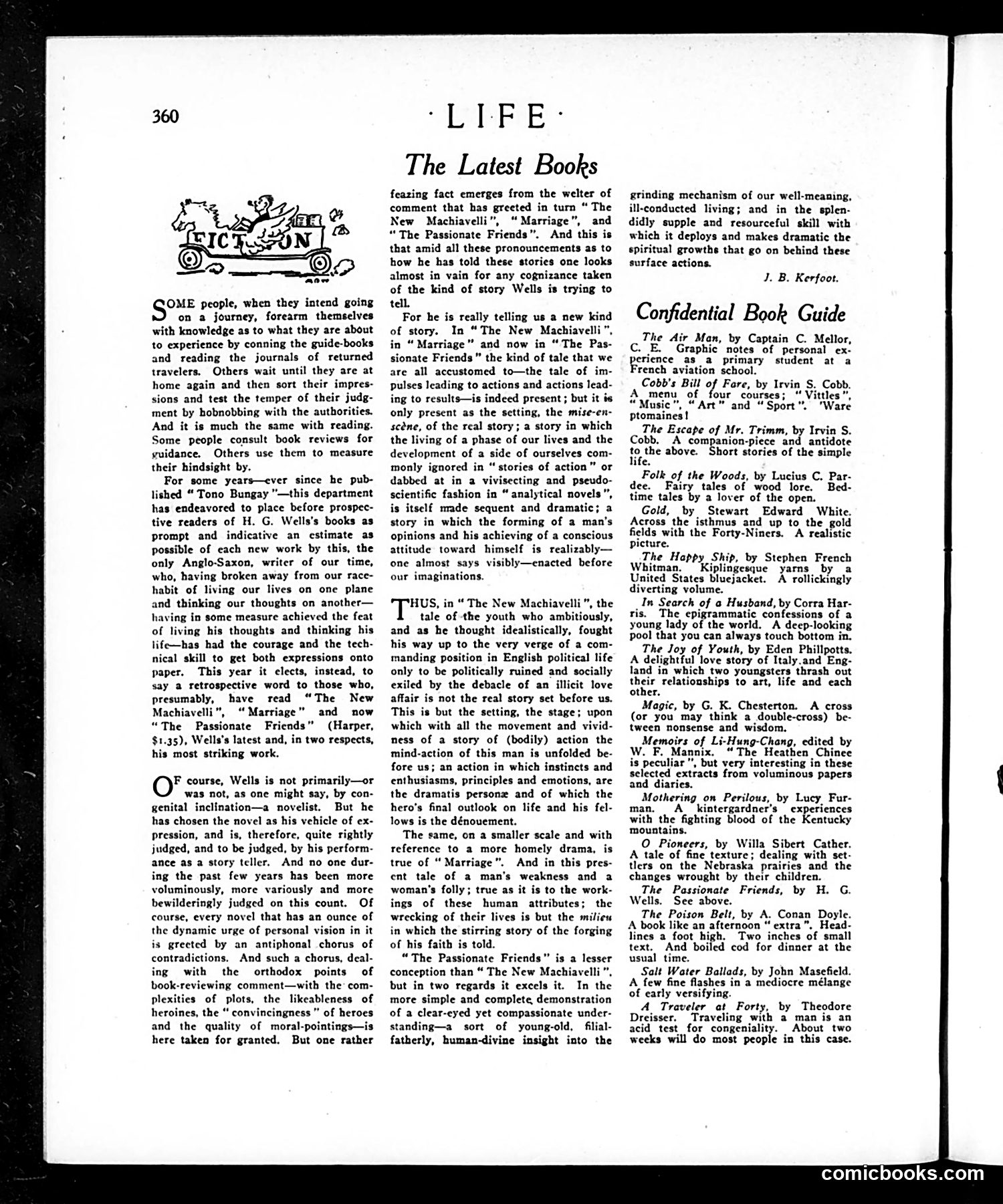
This page is a literary review section, not a political cartoon. The prominent illustration at top-left appears to be Life magazine's decorative masthead featuring cherubs or putti on a vehicle—standard ornamental design for the era. The text discusses H.G. Wells's novels, particularly praising his innovation in storytelling. The reviewer argues that Wells's recent works ("The New Machiavelli," "Marriage," "The Passionate Friends") represent a new kind of narrative: rather than traditional plots where actions lead to results, Wells explores the formation of ideas and conscious self-understanding. The reviewer contends that critics have missed this fundamental innovation, focusing instead on conventional plot elements. The page includes a "Confidential Book Guide" listing contemporary works and brief reviews. This is a serious literary criticism piece from an era when Life magazine featured substantial cultural commentary alongside satire.
📄 Transcribed text from this page (OCR, searchable)
Machine-transcribed from the original scan — historical spelling and the odd misread are preserved.
OME people, when they intend going on a journey, forearm themselves with knowledge as to what they are about to experience by conning the guide-books and reading the journals of returned travelers. Others wait until they are at home again and then sort their impres- sions and test the temper of their judg- ment by hobnobbing with the authorities. And it is much the same with reading. Some people consult book reviews for yuidance, Others use them to measure their hindsight by. For some years—ever since he pub- lished “ Tono Bungay "—this department has endeavored to place before prospec- tive readers of H. G. Wells's books as Prompt and indicative an estimate as possible of cach new work by this, the only Anglo-Saxon, writer of our time, who, having broken away from our race- habit of living our lives on one plane and thinking our thoughts on another— having in some measure achieved the feat of living his thoughts and thinking his life—has had the courage and the tech- nical skill to get both expressions onto paper. This year it elects, instead, to say a retrospective word to those who, presumably, have read “The New Machiavelli”, “Marriage” and now “The Passionate Friends” (Harper, $1.35), Wells's latest and, in two respects, his most striking work. F course, Wells is not primarily—or was not, as one might say, by con- genital inclination—a novelist. But he has chosen the novel as his vehicle of ex- pression, and is, therefore, quite rightly judged, and to be judged, by his perform- ance as a story teller. And no one dur- ing the past few years has been more voluminously, more variously and more bewilderingly judged on this count. Of course, every novel that has an ounce of the dynamic urge of personal vision in it is greeted by an antiphonal chorus of contradictions. And such a chorus, deal- ing with the orthodox points of book-reviewing comment—with the com- plexities of plots, the likeableness of heroines, the “ convincingness " of heroes and the quality of moral-pointings—is here taken for granted. But one rather EERE The Latest Books feazing fact emerges from the welter of comment that has greeted in turn “ The New Machiavelli”, “ Marriage”, and “ The Passionate Friends”. And this is that amid all these pronouncements as to how he has told these stories one looks almost in vain for any cognizance taken of the kind of story Wells is trying to tell. For he is really telling us a new kind of story. In “The New Machiavelli”, in “ Marriage” and now in “The Pas- sionate Friends” the kind of tale that we are all accustomed to—the tale of im- pulses leading to actions and actions lead- ing to results—is indeed present ; but it is only present as the setting, the mise-en- scéne, of the real story; a story in which the living of a phase of our lives and the development of a side of ourselves com- monly ignored in “ stories of action” or dabbed at in a vivisecting and pseudo- scientific fashion in “ analytical novels”, is itself mrade sequent and dramatic; a story in which the forming of a man’s opinions and his achieving of a conscious attitude toward himself is realizably— one almost says visibly—enacted before our imaginations. 'HUS, in “ The New Machiavelli”, the tale of the youth who ambitiously, and as he thought idealistically, fought his way up to the very verge of a com- manding position in English political life only to be politically ruined and socially exiled by the debacle of an illicit love affair is not the real story set before us. This is but the setting, the stage; upon which with all the movement and vivid- ness of a story of (bodily) action the mind-action of this man is unfolded be- fore us; an action in which instincts and enthusiasms, principles and emotions, are the dramatis persone and of which the hero's final outlook on life and his fel- lows is the dénouement. The same, on a smaller scale and with reference to a more homely drama, is true of “Marriage”. And in this pres- ent tale of a man's weakness and a woman's folly; true as it is to the work- ings of these human attributes; the wrecking of their lives is but the miliew in which the stirring story of the forging of his faith is told. “The Passionate Friends” is a lesser conception than “ The New Machiavelli”, but in two regards it excels it. In the more simple and complete, demonstration of a clear-eyed yet compassionate under- standing—a sort of young-old, filial- fatherly, human-divine insight into the grinding mechanism of our well-meaning, ill-conducted living; and in the splen- didly supple and resourceful skill with which it deploys and makes dramatic the iritual growths that go on behind these surface actions. J. B. Kerfoot. Confidential Book Guide The Air Man, by Captain C. Mellor, 7 Graphic notes of personal ex- perience asa primary student at a ‘rench aviation school. Cobb's Bill of Fare, by Irvin S. Cobb. A. menu of four courses; “ Vittles”, “Music”, “Art” and “Sport”. "Ware ptomaines! The Escape of Mr. Trimm, by Irvin S. Cobb. A companion-piece and antidote fo the above. Short stories of the simple life. Folk of the Woods, by Lucius C, Par- dee. Fairy tales of wood lore. Bed- time tales by a lover of the open. Gold, by Stewart Edward White. Across the isthmus and up to the gold fields with the Forty-Niners. A realistic picture. The Happy Ship, by Stephen French Kiplingesque yarns by a A rollickingly Whitman. United States bluejacket. diverting volume. In Search of a Husband, by Corra Har- ris. The epigrammatic confessions of a young lady of the world. A deep-looking pool that you can always touch bottom in. The Joy of Youth, by Eden Phillpotts. A delightful love story of Italy.and Eng- land in which two youngsters thrash out their relationships to art, life and each other. Magic, by G. K. Chesterton. A cross (or you may think a double-cross) be- tween nonsense and wisdom. Memoirs of Li-Hung-Chang, edited by F, Mannix. “The Heathen Chinee is peculiar", but very interesting in these selected extracts from voluminous papers and diaries. Mothering on Perilous, by Lucy Fur- man. A_ kintergardner’s experiences with the fighting blood of the Kentucky mountains. O Pioneers, by Willa Sibert Cather. A tale of fine texture; dealing with set- tlers on the Nebraska prairies and the changes wrought by their children. The Passionate Friends, by H. G. Wells. See above. The Poison Belt, by A. Conan Doyle. A book like an afternoon “extra”. Head- lines a foot high, Two inches of small text. And boiled cod for dinner at the usual time. Salt Water Ballads, by John Masefield. A few fine flashes in a mediocre mélange of early versifying. A_ Traveler at Forty, by Theodore Dreisser. Traveling with a man is an acid test for congeniality. About two weeks will do most people in this case. comicbooks.com