
Life, 1914-02-26 · page 14 of 40
Life — February 26, 1914 — page 14: what you’re looking at
What you’re looking at
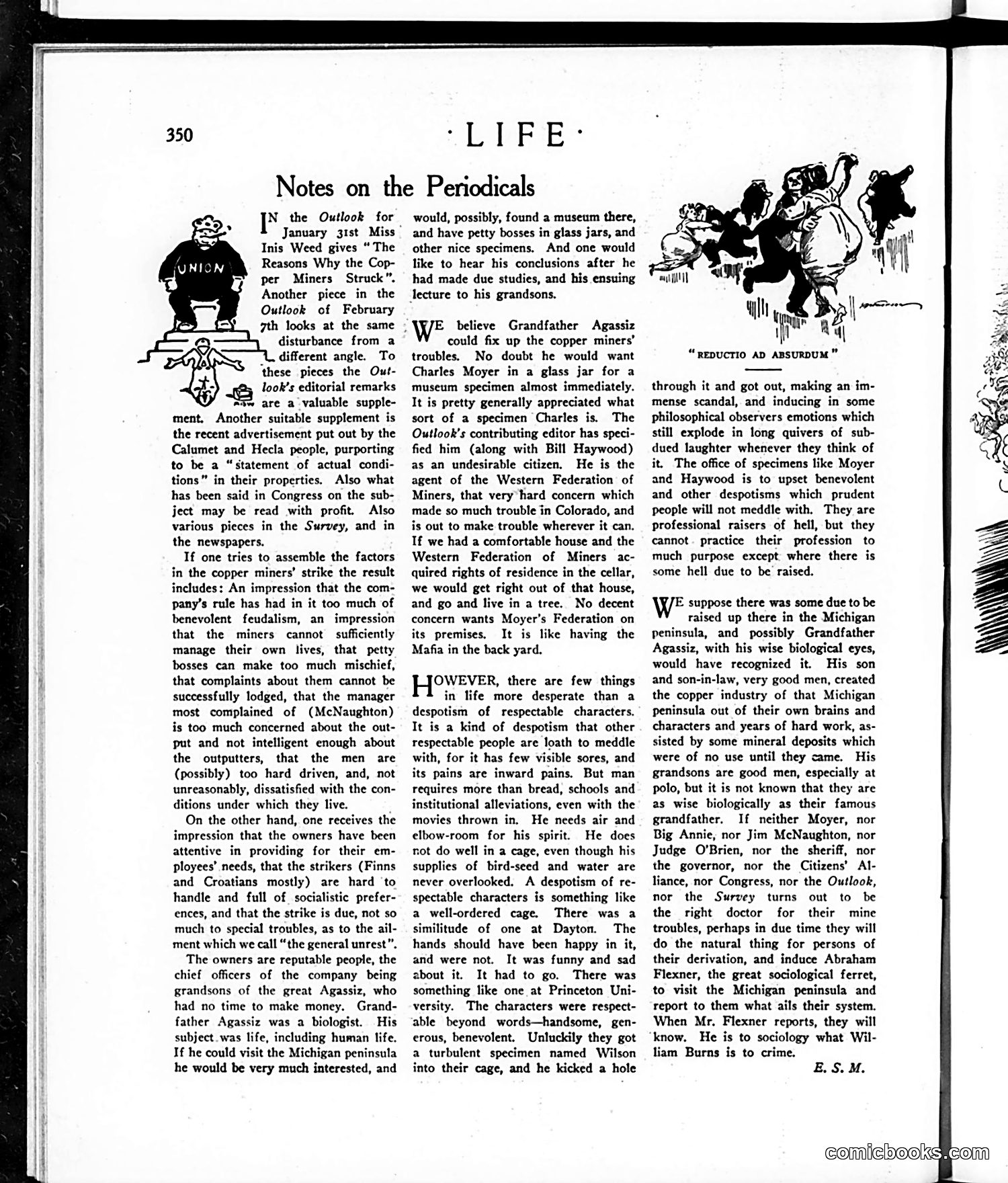
This page reviews recent articles from publications like the *Outlook*. The main cartoon, titled "REDUCTIO AD ABSURDUM," depicts what appears to be a chaotic scene of figures tumbling or being ejected. The text discusses labor disputes involving copper miners and the Western Federation of Miners, referencing Charles Moyer (a labor leader) and Bill Haywood. It critiques the *Outlook* magazine's coverage of labor unrest in Colorado, suggesting the publication sensationalizes conflicts between miners and management. The review also addresses despotism among "respectable characters" and references disputes in the Michigan peninsula, possibly involving Grandfather Agassiz (the naturalist). The overall tone suggests *Life* is satirizing both labor radicalism and journalistic handling of industrial conflicts.
📄 Transcribed text from this page (OCR, searchable)
Machine-transcribed from the original scan — historical spelling and the odd misread are preserved.
7 LPP Notes on the Periodicals the Outlook for January 31st Miss Inis Weed gives “ The Reasons Why the Cop- per Miners Struck”. Another piece in the Outlook of February 7th looks at the same ; disturbance from a different angle. To ‘these pieces the Out- look’s editorial remarks are a valuable supple- ment. Another suitable supplement is the recent advertisement put out by the Calumet and Hecla people, purporting to be a “statement of actual condi- tions” in their properties. Also what has been said in Congress on the sub- ject may be read with profit. Also various pieces in the Survey, and in the newspapers. If one tries to assemble the factors in the copper miners’ strike the result includes: An impression that the com- pany’s rule has had in it too much of benevolent feudalism, an impression that the miners cannot sufficiently manage their own lives, that petty bosses can make too much mischief, that complaints about them cannot be successfully lodged, that the manager most complained of (McNaughton) is too much concerned about the out- put and not intelligent enough about the outputters, that the men are (possibly) too hard driven, and, not unreasonably, dissatisfied with the con- ditions under which they live. On the other hand, one receives the impression that the owners have been attentive in providing for their em- ployees’ needs, that the strikers (Finns and Croatians mostly) are hard ‘to handle and full of. socialistic prefer- ences, and that the strike is due, not so much to special troubles, as to the ail- ment which we call “the general unrest”. The owners are reputable people, the chief officers of the company being grandsons of the great Agassiz, who had no time to make money. Grand- father Agassiz was a biologist. His subject.was life, including human life. If he could visit the Michigan peninsula he would be very much interested, and would, possibly, found a museum there, and have petty bosses in glass jars, and other nice specimens. And one would like to hear his conclusions after he had made due studies, and his ensuing lecture to his grandsons. E believe Grandfather Agassiz could fix up the copper miners’ troubles. No doubt he would want Charles Moyer in a glass jar for a museum specimen almost immediately. It is pretty generally appreciated what sort of a specimen Charles is. The Outlook's contributing editor has speci- fied him (along with Bill Haywood) as an undesirable citizen. He is the agent of the Western Federation of Miners, that very hard concern which made so much trouble in Colorado, and is out to make trouble wherever it can. If we had a comfortable house and the Western Federation of Miners ac- quired rights of residence in the cellar, we would get right out of that house, and go and live in a tree. No decent concern wants Moyer’s Federation on its premises. It is like having the Mafia in the back yard. HOWEVER, there are few things in life more desperate than a despotism of respectable characters. It is a kind of despotism that other respectable people are loath to meddle with, for it has few visible sores, and its pains are inward pains. But man requires more than bread, schools and institutional alleviations, even with the movies thrown in. He needs air and elbow-room for his spirit. He does not do well in a cage, even though his supplies of bird-seed and water are never overlooked. A despotism of re- spectable characters is something like a well-ordered cage. There was a similitude of one at Dayton. The hands should have been happy in it, and were not. It was funny and sad about it. It had to go. There was something like one at Princeton Uni- versity. The characters were respect- able beyond words—handsome, gen- erous, benevolent. Unluckily they got a turbulent specimen named Wilson into their cage, and he kicked a hole “REDUCTIO AD ABSURDUM” through it and got out, making an im- mense scandal, and inducing in some Philosophical observers emotions which still explode in long quivers of sub- dued laughter whenever they think of it. The office of specimens like Moyer and Haywood is to upset benevolent and other despotisms which prudent people will not meddle with, They are professional raisers of hell, but they cannot. practice their profession to much purpose except where there is some hell due to be raised. E suppose there was some due to be raised up there in the Michigan peninsula, and possibly Grandfather Agassiz, with his wise biological eyes, would have recognized it. His son and son-in-law, very good men, created the copper industry of that Michigan peninsula out of their own brains and characters and years of hard work, as- sisted by some mineral deposits which were of no use until they came. His grandsons are good men, especially at polo, but it is not known that they are as wise biologically as their famous grandfather. If neither Moyer, nor Big Annie, nor Jim McNaughton, nor Judge O'Brien, nor the sheriff, nor the governor, nor the Citizens’ Al- liance, nor Congress, nor the Outlook, nor the Survey turns out to be the right doctor for their mine troubles, perhaps in due time they will do the natural thing for persons of their derivation, and induce Abraham Flexner, the great sociological ferret, to visit the Michigan peninsula and report to them what ails their system. When Mr. Flexner reports, they will know. He is to sociology what Wil- liam Burns is to crime. E.S.M.