
Life, 1914-02-26 · page 34 of 40
Life — February 26, 1914 — page 34: what you’re looking at
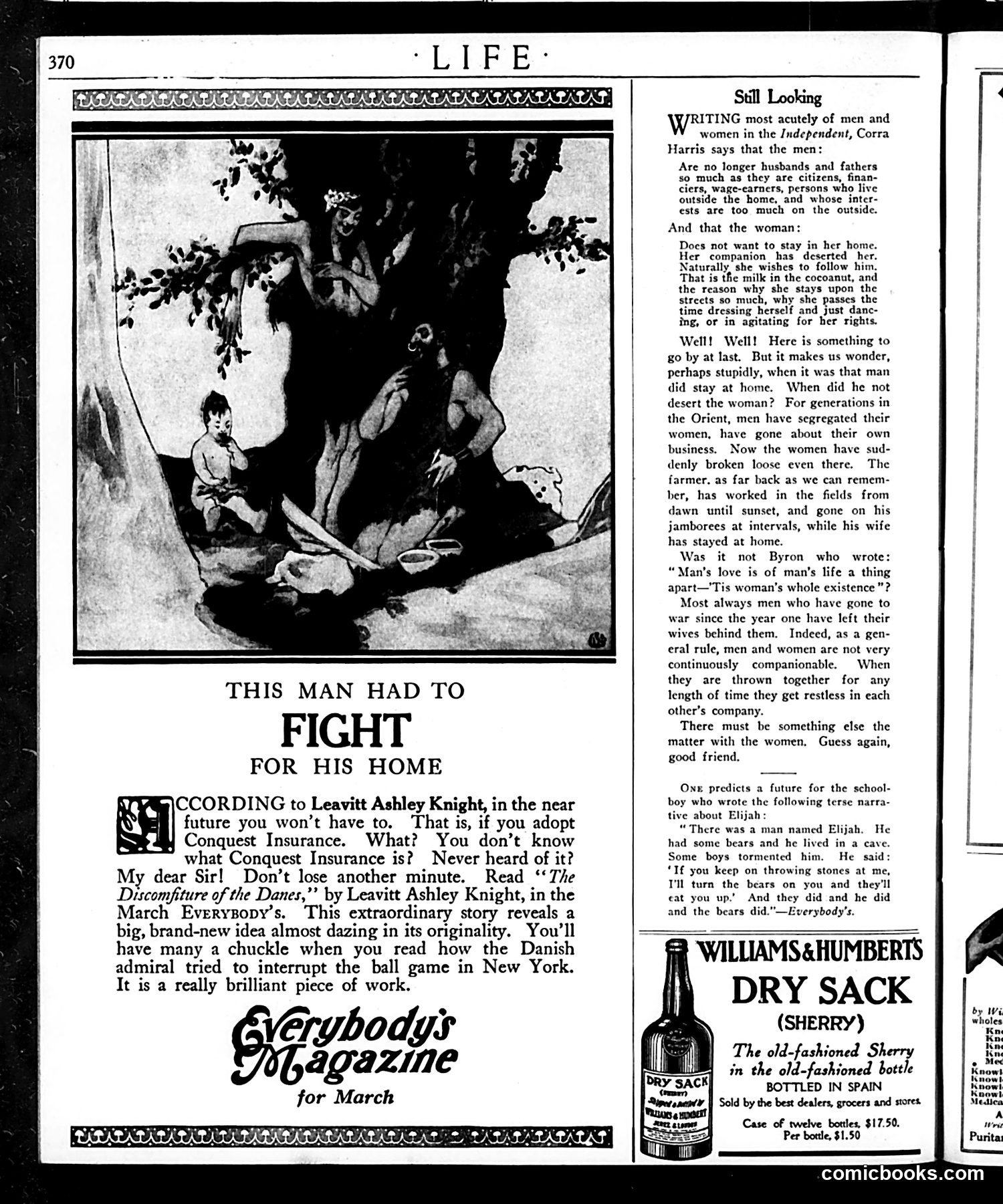
What you’re looking at
## Main Content The page features two distinct pieces: **Left: Advertisement for "Conquest Insurance"** disguised as editorial content. It promotes a fictional story by Leavitt Ashley Knight called "The Discomfiture of the Danes" from *Everybody's* Magazine, describing an absurd plot where a Danish admiral interrupts a ball game in New York. This is a playful cross-promotion touting insurance as a solution to home protection—the visual shows a man fighting what appears to be a large ape or beast, suggesting one must "fight" to protect one's home without proper insurance. **Right: "Still Looking"** commentary column discussing marital dynamics and gender roles. Writer Corra Harris (quoted from *The Independent*) argues men have abandoned domestic life for public/financial pursuits, causing women to leave home seeking companionship. The columnist sardonically questions this analysis, pointing out men have *always* worked outside the home—farmers, soldiers, travelers—while women remained domestic. He suggests deeper social issues are at play. **Context**: This reflects early 20th-century anxieties about changing gender roles and women's increasing independence and public presence.
📄 Transcribed text from this page (OCR, searchable)
Machine-transcribed from the original scan — historical spelling and the odd misread are preserved.
THIS MAN HAD TO FIGHT FOR HIS HOME CCORDING to Leavitt Ashley Knight, in the near future you won’t have to. That is, if you adopt Conquest Insurance. What? You don’t know what Conquest Insurance is? Never heard of it? My dear Sir! Don’t lose another minute. Read ‘‘ The Discomfiture of the Danes,’’ by Leavitt Ashley Knight, in the March Everysopy’s. This extraordinary story reveals a big, brand-new idea almost dazing in its originality. You'll have many a chuckle when you read how the Danish admiral tried to interrupt the ball game in New York. It is a really brilliant piece of work. verybodys agazime for March Suill Looking WRITING most acutely of men and women in the Independent, Corra Harris says that the men: Are no longer husbands and fathers so much as they are citizens, finan- ciers, wage-earners, persons who live outside the home, and whose inter- ests are too much on the outside. And that the woman: Does not want to stay in her home. Her companion has deserted her. Naturally she wishes to follow him. That is the milk in the cocoanut, and the reason why she stays upon the streets so much, why she passes the time dressing herself and just danc- ing, or in agitating for her rights. Well! Well! Here is something to go by at last. But it makes us wonder, perhaps stupidly, when it was that man did stay at home. When did he not desert the woman? For generations in the Orient, men have segregated their women, have gone about their own business. Now the women have sud- denly broken loose even there. The farmer. as far back as we can remem- her, has worked in the fields from dawn until sunset, and gone on his jamborees at intervals, while his wife has stayed at home. Was it not Byron who wrote: “Man’s love is of man’s life a thing apart—'Tis woman’s whole existence"? Most always men who have gone to war since the year one have left their wives behind them. Indeed, as a gen- eral rule, men and women are not very continuously companionable. When they are thrown together for any length of time they get restless in each other’s company. There must be something else the matter with the women, Guess again, good friend. One predicts a future for the school- boy who wrote the following terse narra- tive about Elijah: “There was a man named Elijah, He had some bears and he lived in a cave. Some boys tormented him. He said: ‘If you keep on throwing stones at me, T'll turn the bears on you and they'll eat you up.’ And they did and he did and the bears did."—Everybody’s. WILLIAMS&HUMBERTS DRY SACK (SHERRY) The old-fashioned Sherry in the old-fashioned bottle BOTTLED IN SPAIN am Sipet once || Sold by the best dealers, grocers and stores, Pears moses Case of twelve bottles, $17.50. Per bortle, $1.50 comicbooks.com