
Life, 1914-02-26 · page 15 of 40
Life — February 26, 1914 — page 15: what you’re looking at
What you’re looking at
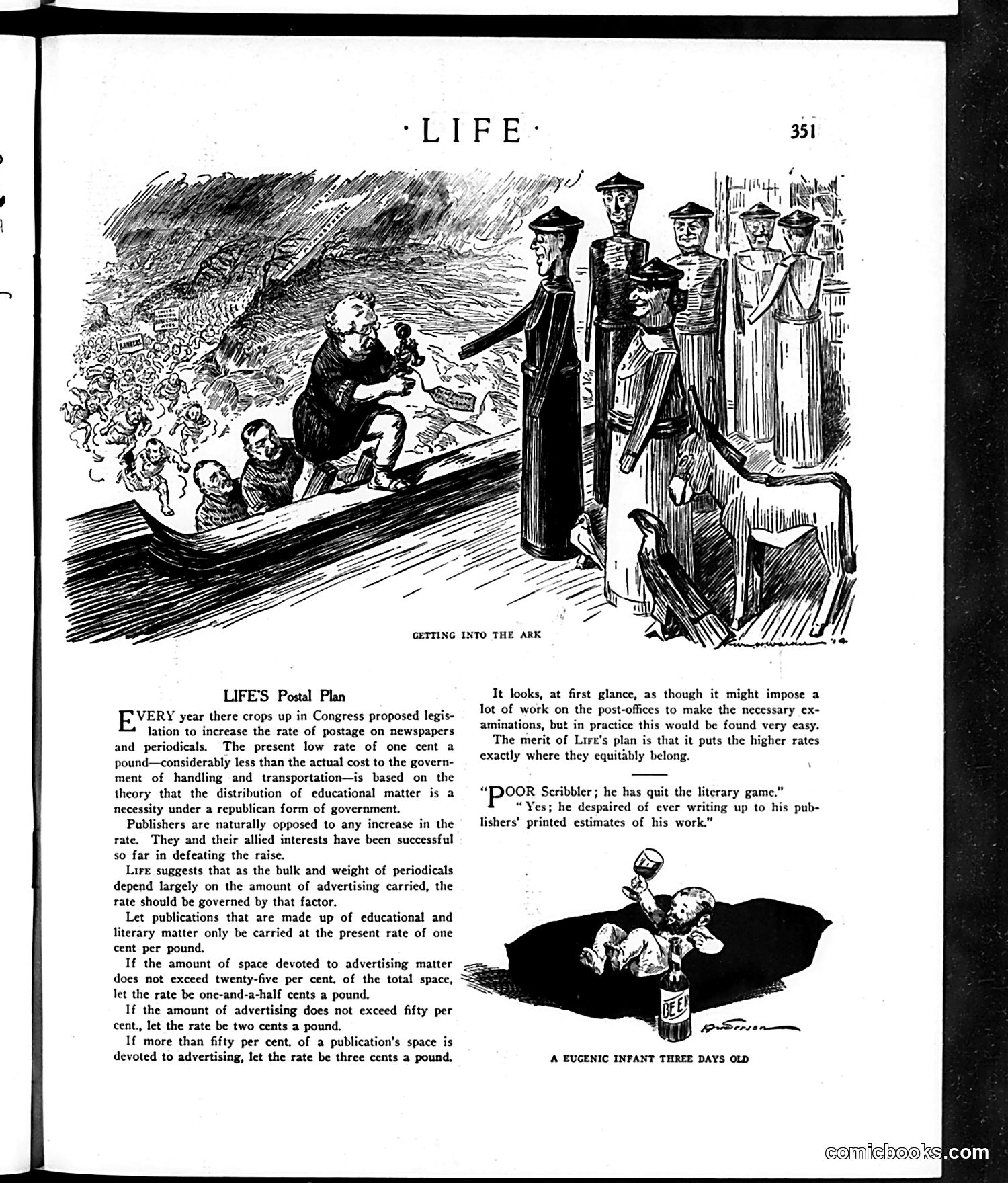
**Top Cartoon ("Getting Into the Ark"):** This satirical illustration depicts what appears to be officials or authorities (shown as tall figures in uniform on the right) selectively admitting people into an ark—a biblical reference suggesting safety or salvation. The crowded masses on the left, including women and children in a boat, represent those excluded or struggling to gain entry. This likely critiques discriminatory immigration or social policies of the era, suggesting arbitrary gatekeeping by authorities. **Main Article:** Life proposes a postal-rate reform plan based on advertising content. Currently, newspapers pay one cent per pound regardless of ad volume. Life argues advertising-heavy publications should pay higher rates (up to three cents per pound), since advertising—not educational content—drives their bulk and weight. **Bottom Cartoon:** A brief satirical exchange mocking a failed writer ("Poor Scribbler") who abandoned literature, having given up on meeting publishers' inflated expectations for his work. The page reflects Progressive-era concerns about corporate influence, honest pricing, and media accountability.
📄 Transcribed text from this page (OCR, searchable)
Machine-transcribed from the original scan — historical spelling and the odd misread are preserved.
GETTING INTO THE ARK LIFE'S Postal Plan EVERY year there crops up in Congress proposed legis- lation to increase the rate of postage on newspapers and periodicals. The present low rate of one cent a pound—considerably less than the actual cost to the govern- ment of handling and transportation—is based on the theory that the distribution of educational matter is a necessity under a republican form of government. Publishers are naturally opposed to any increase in the rate. They and their allied interests have been successful so far in defeating the raise. Lire suggests that as the bulk and weight of periodicals depend largely on the amount of advertising carried, the rate should be governed by that factor. Let publications that are made up of educational and literary matter only be carried at the present rate of one cent per pound. If the amount of space devoted to advertising matter does not exceed twenty-five per cent. of the total space, let the rate be one-and-a-half cents a pound. If the amount of advertising does not exceed fifty per cent., let the rate be two cents a pound. If more than fifty per cent. of a publication's space is devoted to advertising, let the rate be three cents a pound. It looks, at first glance, as though it might impose a lot of work on the post-offices to make the necessary ex- aminations, but in practice this would be found very easy. The merit of Lire’s plan is that it puts the higher rates exactly where they equitably belong. “pork Scribbler; he has quit the literary game.” “Yes; he despaired of ever writing up to his pub- lishers’ printed estimates of his work.” A EUGENIC INFANT THREE DAYS OLD