
A complete issue · 44 pages · 1914
Life — February 5, 1914
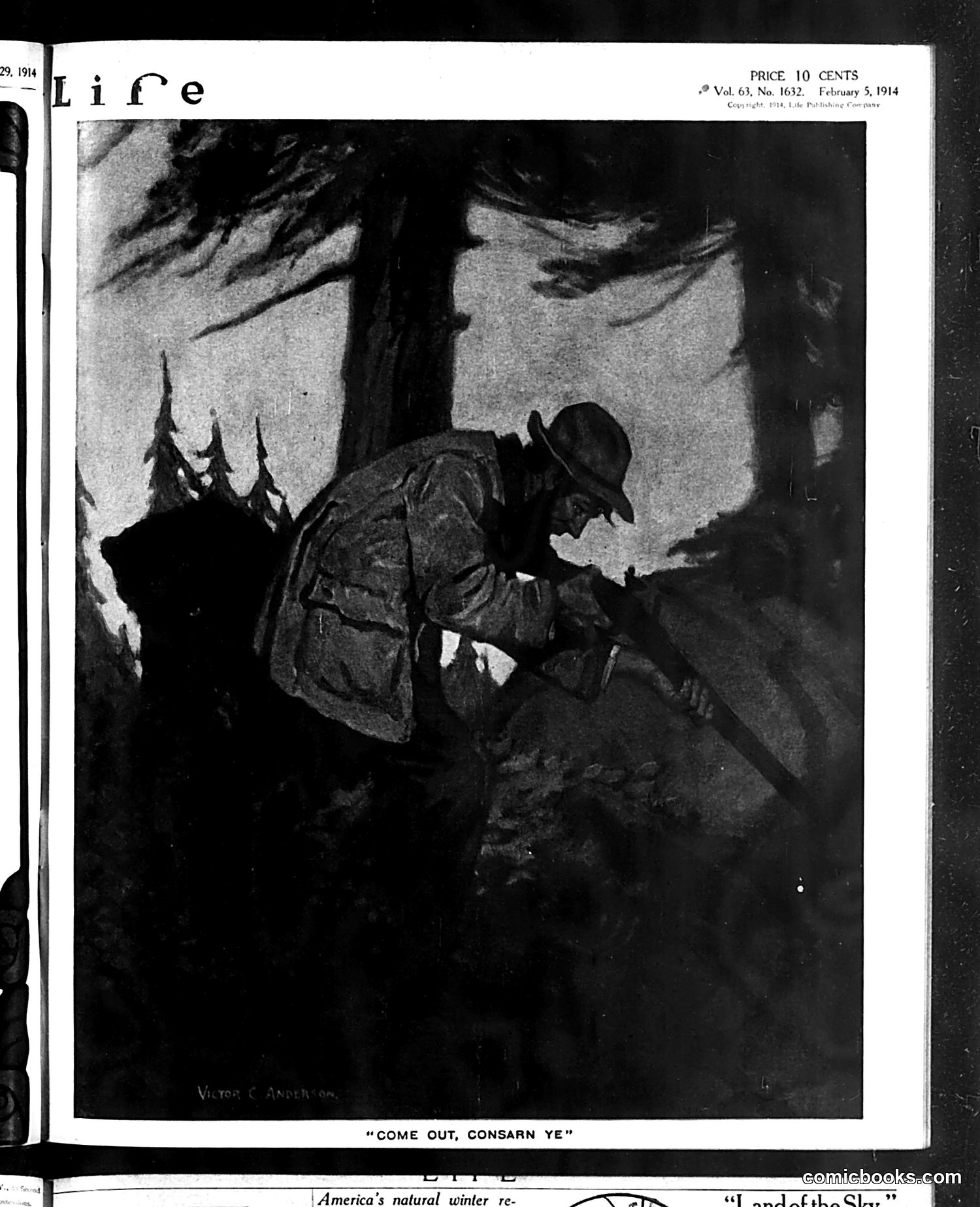
This Life magazine cover from February 5, 1914 depicts a figure in winter clothing calling out to someone or something hidden in a snowy, forested setting. The caption "Come Out, Consarn Ye" (dialectal for "confound you") suggests coaxing someone reluctant to emerge. The image likely references a contemporary political or social figure reluctant to take public action or make a statement. The winter setting and frontier-style language ("consarn") add rustic, colloquial humor typical of Life's satirical commentary. The photographer credit reads "Victor C. Anderson." Without additional context from the magazine's contents, the specific political reference remains unclear, though the tone suggests mockery of someone avoiding public scrutiny or responsibility during early 1914.
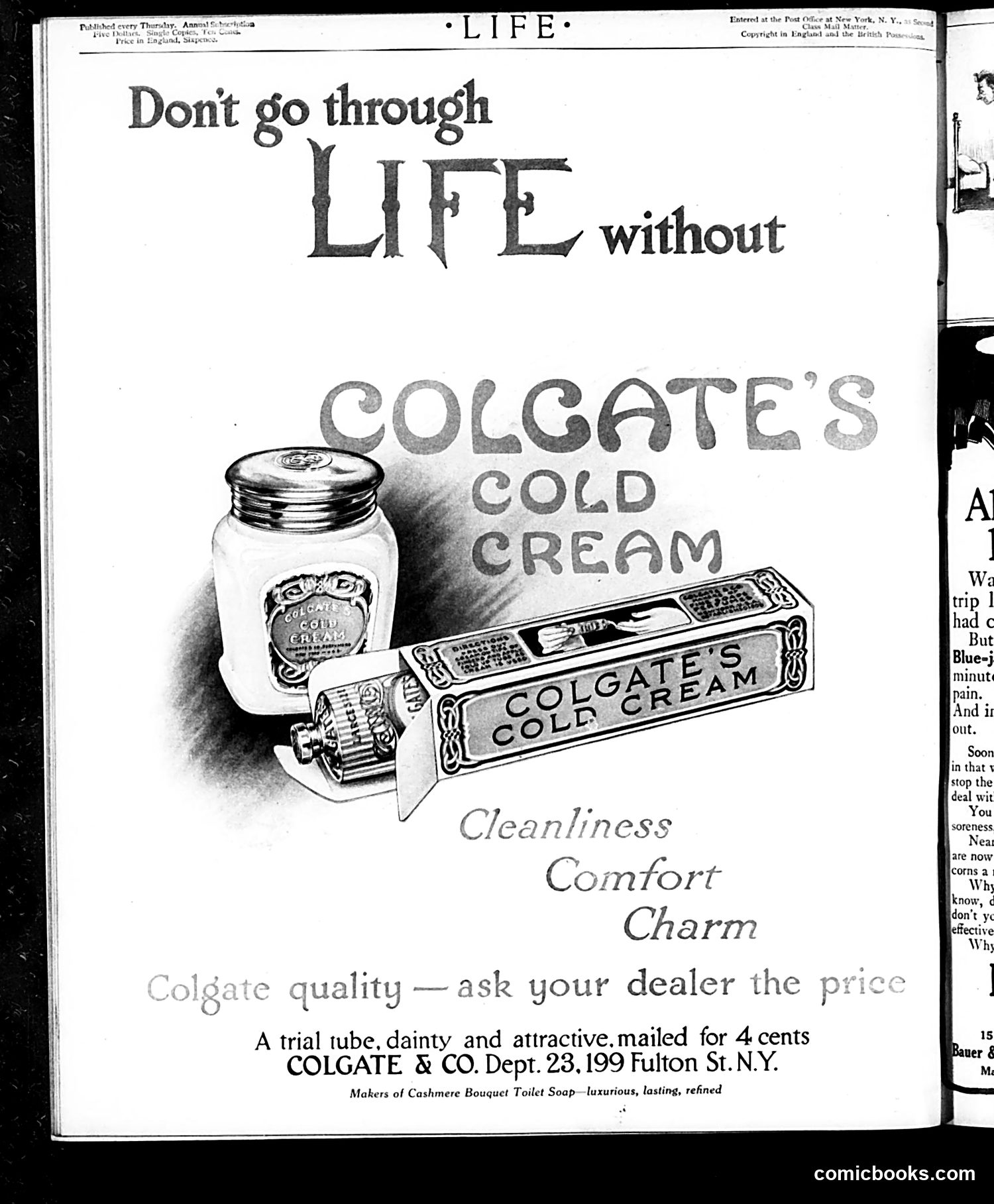
This page is **primarily a Colgate's Cold Cream advertisement**, not political satire. The large headline "Don't go through LIFE without COLGATE'S COLD CREAM" dominates the upper portion, accompanied by product images (a jar and a tube). The advertisement emphasizes three selling points: "Cleanliness, Comfort, Charm." The copywriting uses aspirational language typical of early-20th-century cosmetics marketing, suggesting the product is essential to living a full life. The call-to-action offers "a trial tube, dainty and attractive, mailed for 4 cents" to interested consumers at Colgate & Co.'s New York address. There is no political cartoon or satire present on this page—it is straightforward commercial advertising from Life magazine's pages.
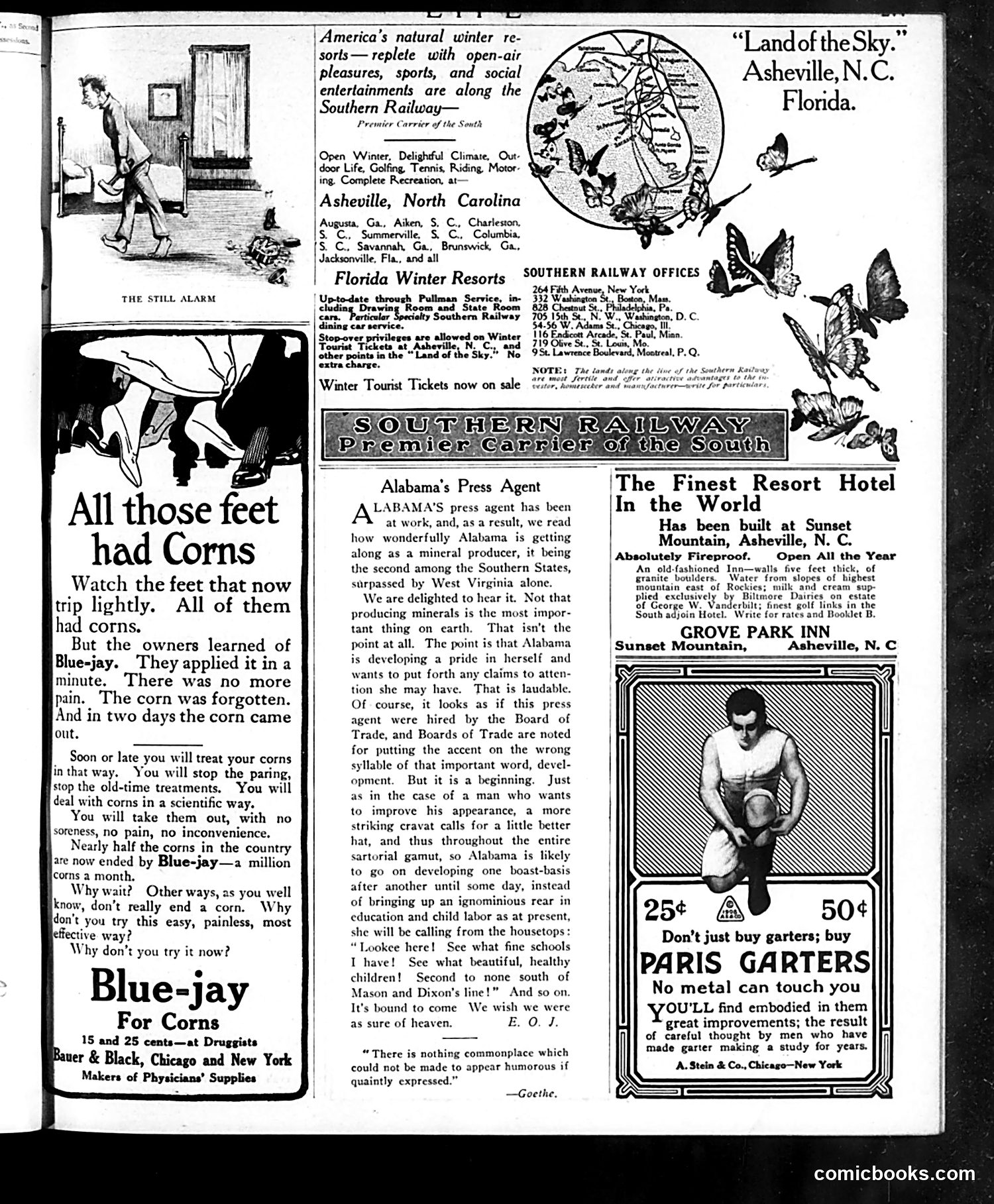
This page is primarily **advertising and travel promotion**, not political satire. The content includes: 1. **"The Still Alarm"** (top left): An illustrated advertisement for Asheville, North Carolina winter resorts via Southern Railway, promoting outdoor recreation and mild climate. 2. **"All those feet had Corns"** (bottom left): A humorous advertisement for Blue-jay corn remover, using a narrative about Blue Jays (the birds) discovering the product works, encouraging readers to try it. 3. **Center**: Informational text about Alabama's press agent and mineral production. 4. **Right side**: Advertisements for resort hotels in Asheville and Paris Garters. The page reflects early 20th-century consumer advertising strategies: combining light humor with product endorsements and tourism promotion. There is no evident political commentary or satirical critique—it's a commercial publication page.
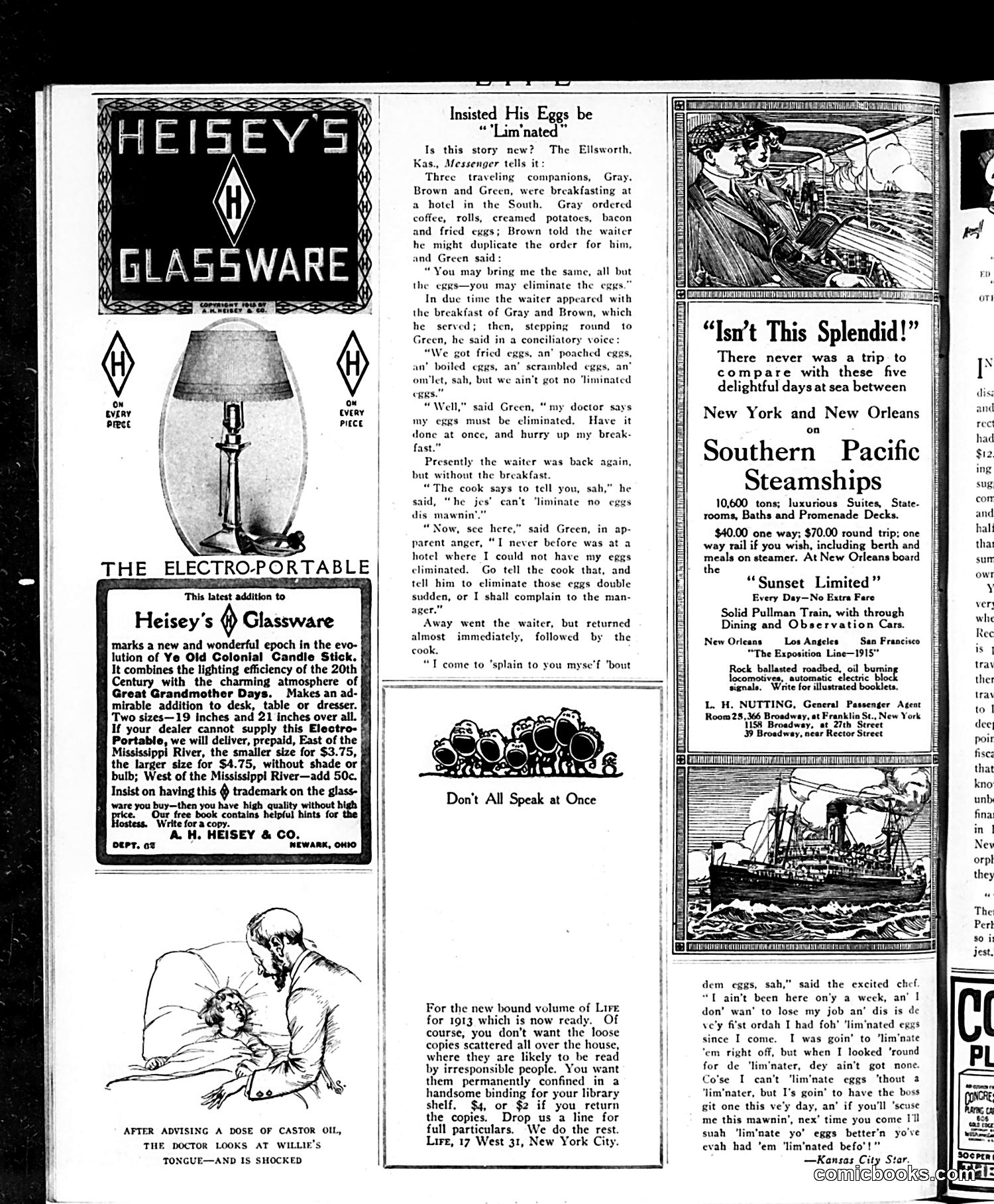
This page is primarily **advertising and fiction**, not political satire. The left side features an advertisement for Heisey's Glassware, promoting their "Electro-Portable" lamp—a new product combining glassware with electric lighting for home use. The center contains a short story titled "Insisted His Eggs be 'Lim'nated'" about three traveling companions at a Southern hotel. A guest obsessively demands his eggs be "eliminated" (prepared without eggs), frustrating the kitchen staff. The humor is situational—a play on the absurdity of his contradictory demand. The right side advertises Southern Pacific Steamships' luxury travel between New York and New Orleans. The bottom illustration, captioned "After Advising a Dose of Castor Oil, the Doctor Looks at Patient's Tongue—and Is Shocked," shows a doctor's comedic reaction to a patient's tongue after administering medicine. No significant political commentary appears on this page.
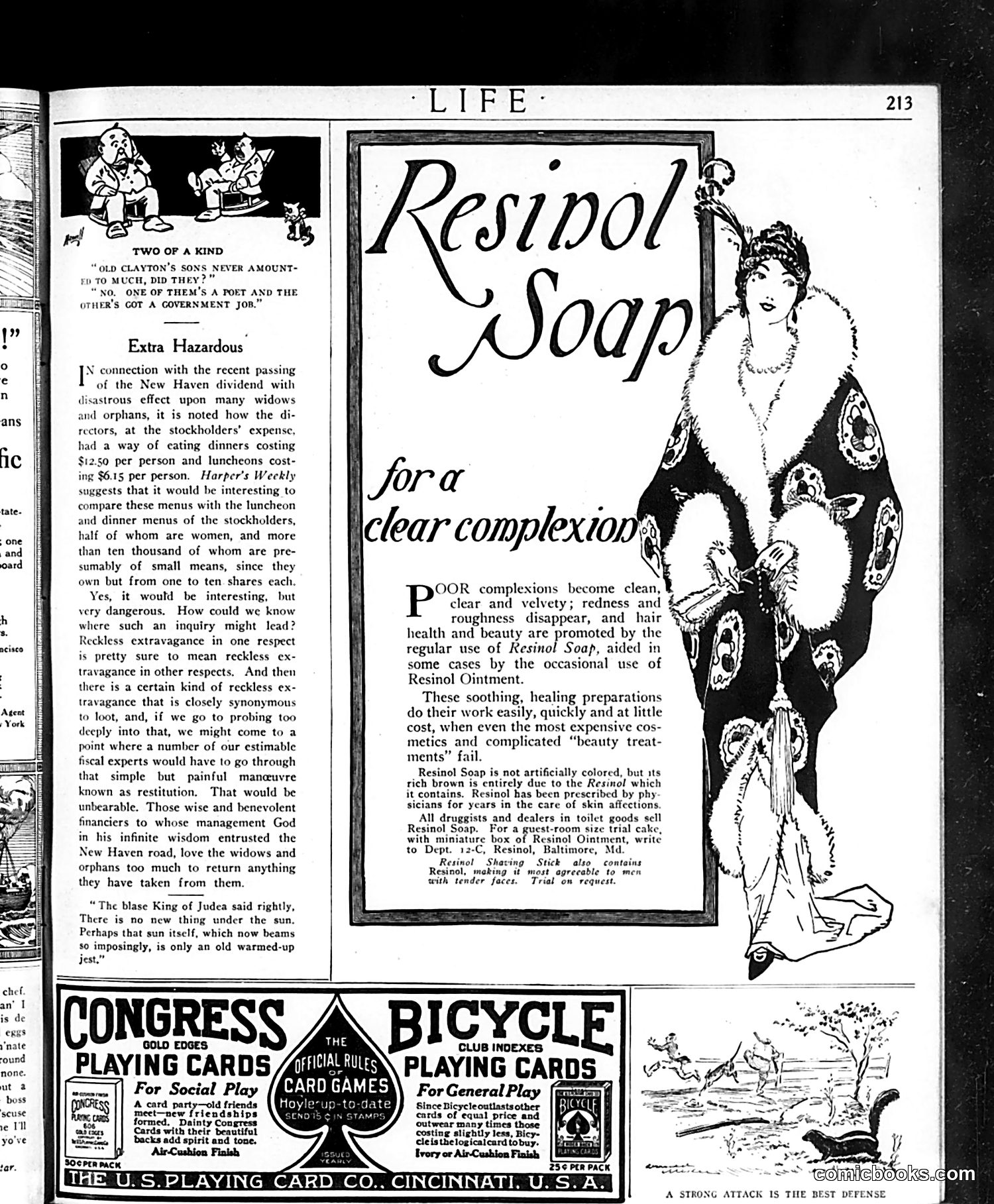
This page contains two distinct elements: **Left column:** A brief satirical article titled "Extra Hazardous" criticizing the New Haven Railroad's directors for dining expensively ($12.50-$16.15 per person) while the company paid minimal dividends to stockholders—many of whom are widows and orphans. The piece argues such executive extravagance while shareholders suffer is financial recklessness, comparing it to mismanagement of public funds. It concludes with a biblical quote about improper stewardship. **Right side:** A full-page advertisement for Resinol Soap, featuring an elegantly dressed woman promoting the product's skin-clearing properties. The satirical contrast appears intentional: corporate greed and mismanagement juxtaposed against consumerism and beauty products—both reflecting early 20th-century concerns about wealth inequality and corporate accountability.
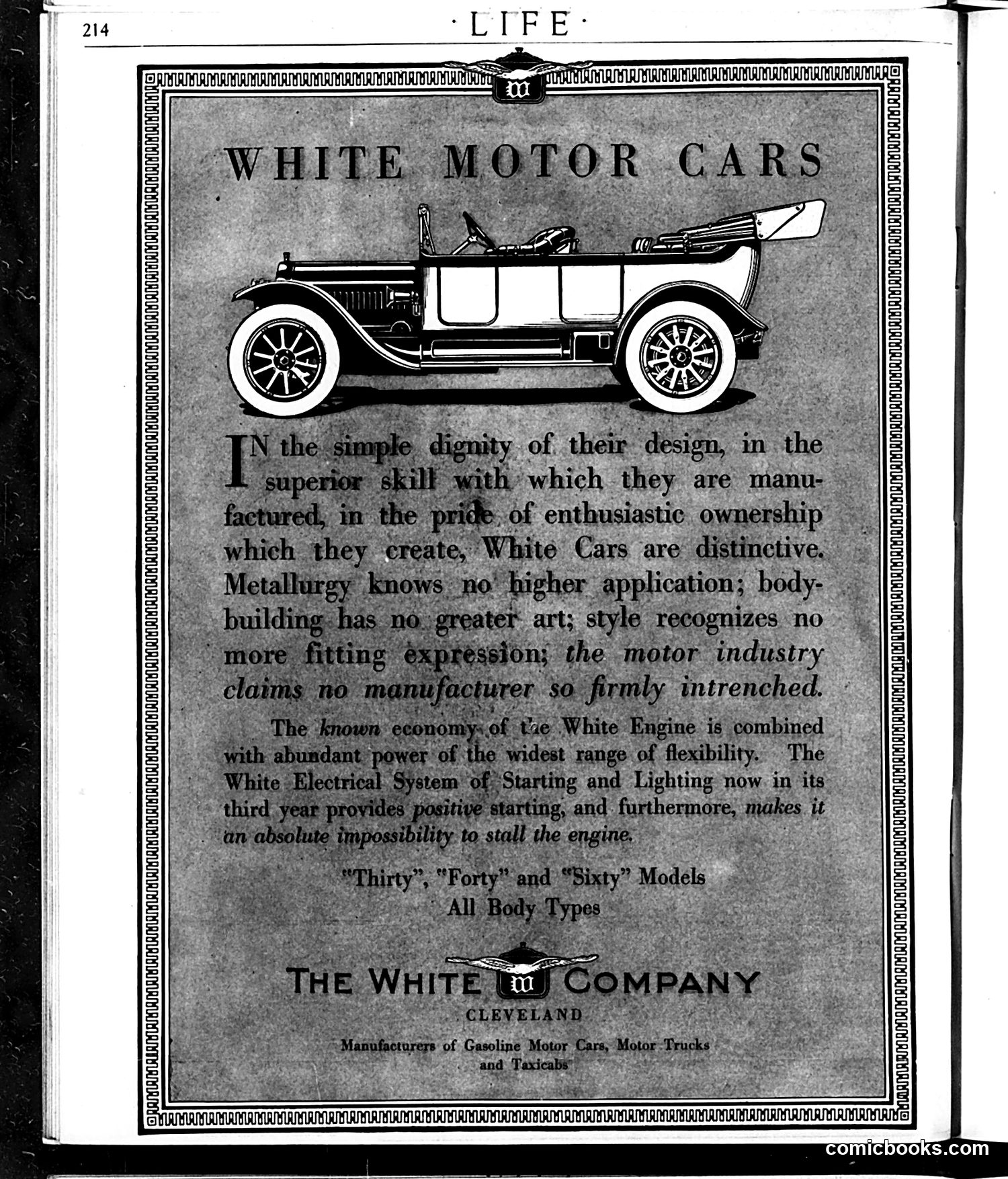
This page is **not a cartoon or satirical content**—it is a **straightforward advertisement** for White Motor Cars, placed in Life magazine (page 214). The ad promotes the White Company of Cleveland, a manufacturer of gasoline motor cars, trucks, and taxicabs. The image shows a side-view illustration of an open-air touring car typical of the early 1900s. The advertisement emphasizes the company's manufacturing quality, the White Engine's economy and power, and their electrical starting and lighting system (described as now in its "third year"). The copy claims White Cars are distinctive and that no manufacturer is "so firmly intrenched" in the industry. This represents standard early automotive advertising—no satire is present.
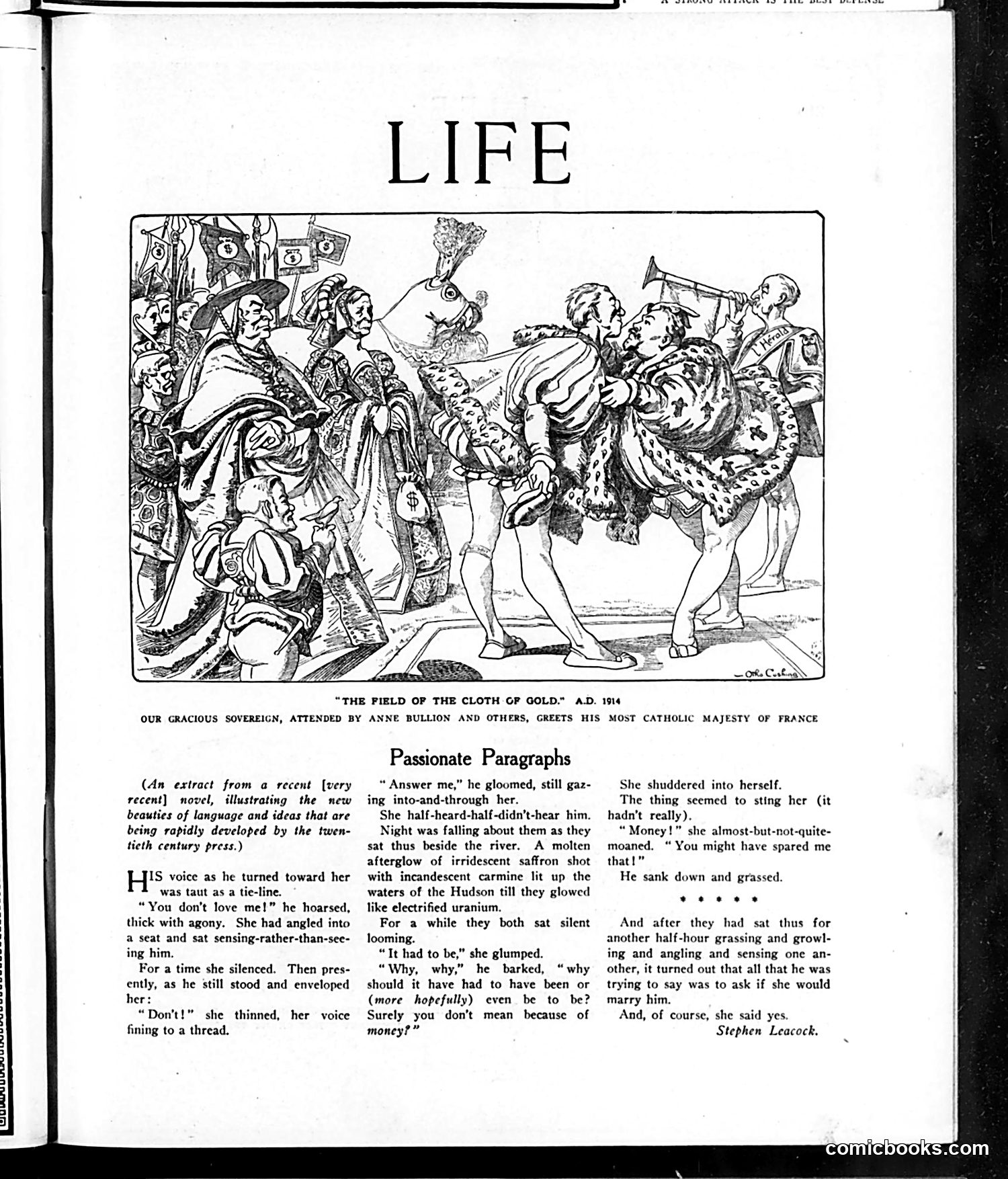
The main illustration depicts a historical scene titled "The Field of the Cloth of Gold," A.D. 1514, referencing the famous diplomatic meeting between King Henry VIII of England and King Francis I of France. The elaborate engraving shows richly dressed nobles in ornate period costumes greeting each other—likely representing the two monarchs and their courts. The accompanying short story, "Passionate Paragraphs" by Stephen Leacock, appears unrelated to the historical image. It's a modern romantic narrative about a couple's relationship conflict, ending with a marriage proposal—likely satirizing contemporary romantic conventions. The juxtaposition suggests *Life* magazine's typical format: pairing historical/classical imagery with contemporary humor to comment on timeless human situations.
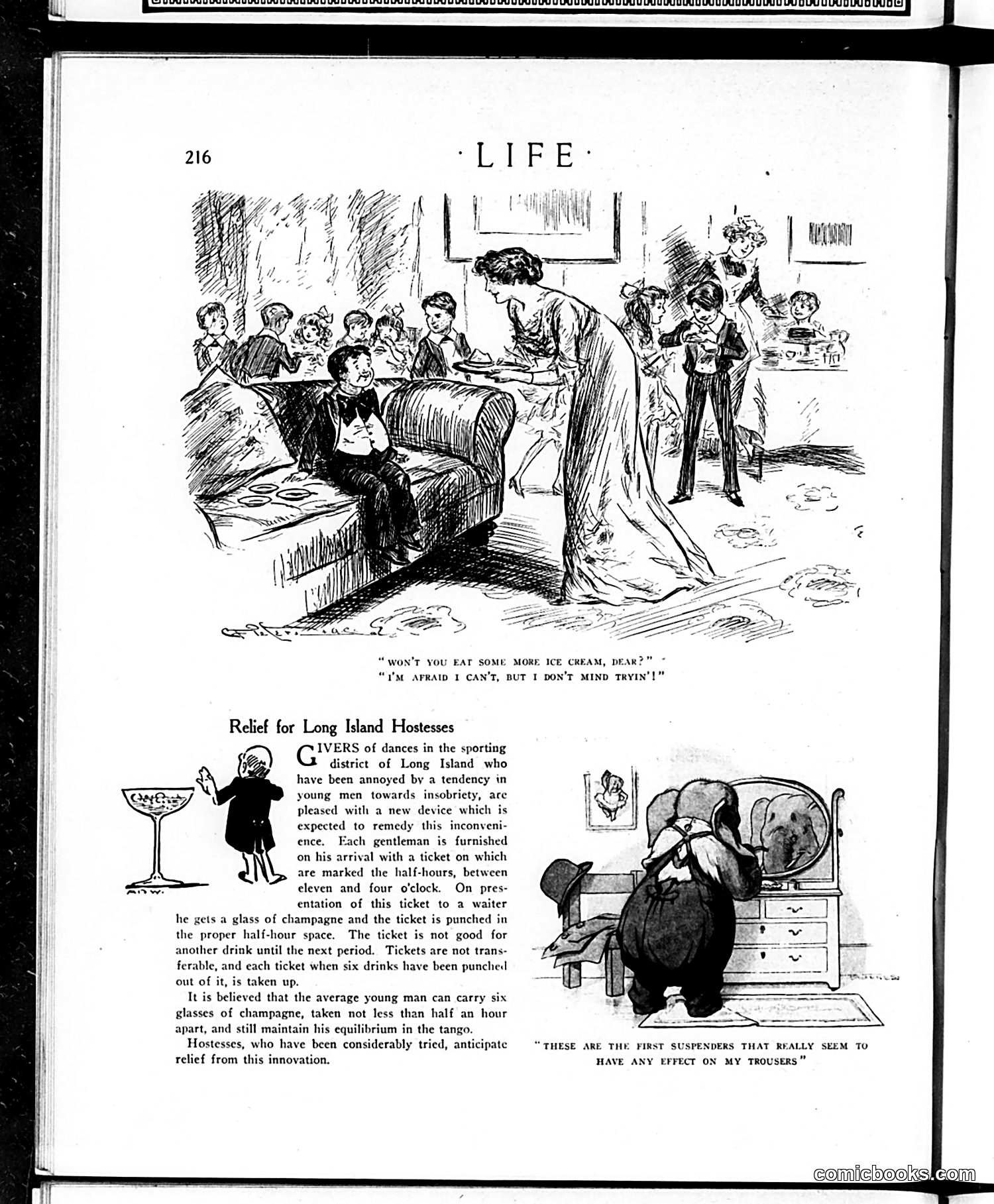
This page contains two humorous illustrations satirizing social behavior: **Top cartoon**: A domestic scene where a child refuses more ice cream, saying "I'm afraid I can't, but I don't mind tryin'!" The joke plays on a child's contradiction—claiming inability while demonstrating willingness. **Bottom section**: "Relief for Long Island Hostesses" mocks the social problem of young men's insobriety at dances. The article describes a ticketing system where gentlemen receive champagne at regulated intervals to maintain "equilibrium in the tango." The accompanying illustration shows a man examining his trousers with concern, captioned "These are the first suspenders that really seem to have any effect on my trousers"—joking that even suspenders fail when someone becomes sufficiently drunk and disheveled. Both pieces satirize upper-class social etiquette and its frequent failures.
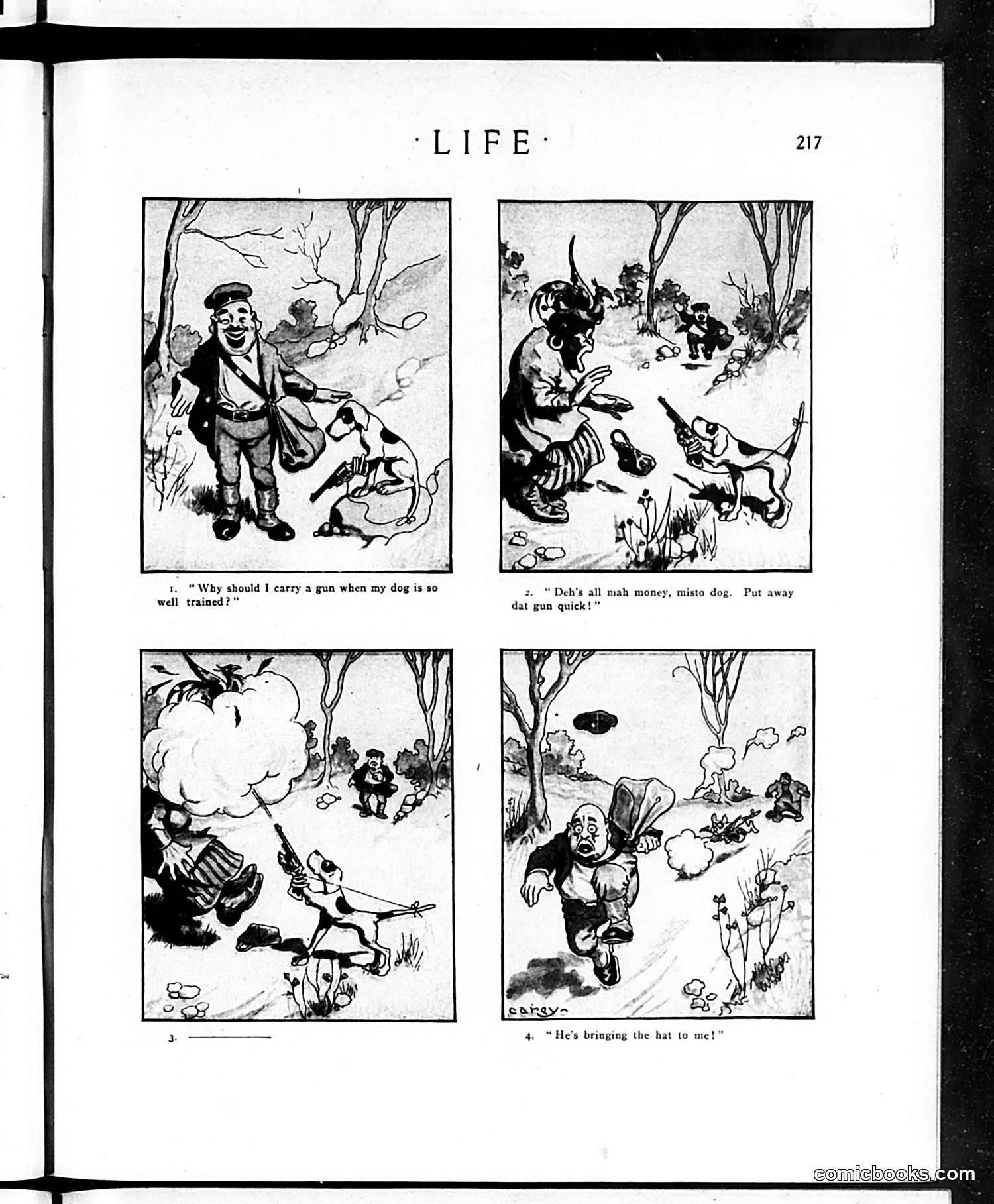
This is a four-panel comic strip about a hunter and his well-trained dog. The joke relies on the dog's superior hunting ability, which ironically makes the hunter's gun unnecessary. Panel 1 establishes the premise: the hunter questions why he needs a gun when his dog is so well-trained. Panel 2 shows the dog commanding other animals to drop their weapons. Panels 3-4 depict escalating chaos—the dog appears to have accidentally shot the hunter instead, and is now retrieving him like game. The satire mocks the idea of having the "right tool for the job" when circumstances prove otherwise. It's a straightforward physical comedy strip with no apparent political content, using animal anthropomorphism for humorous effect.
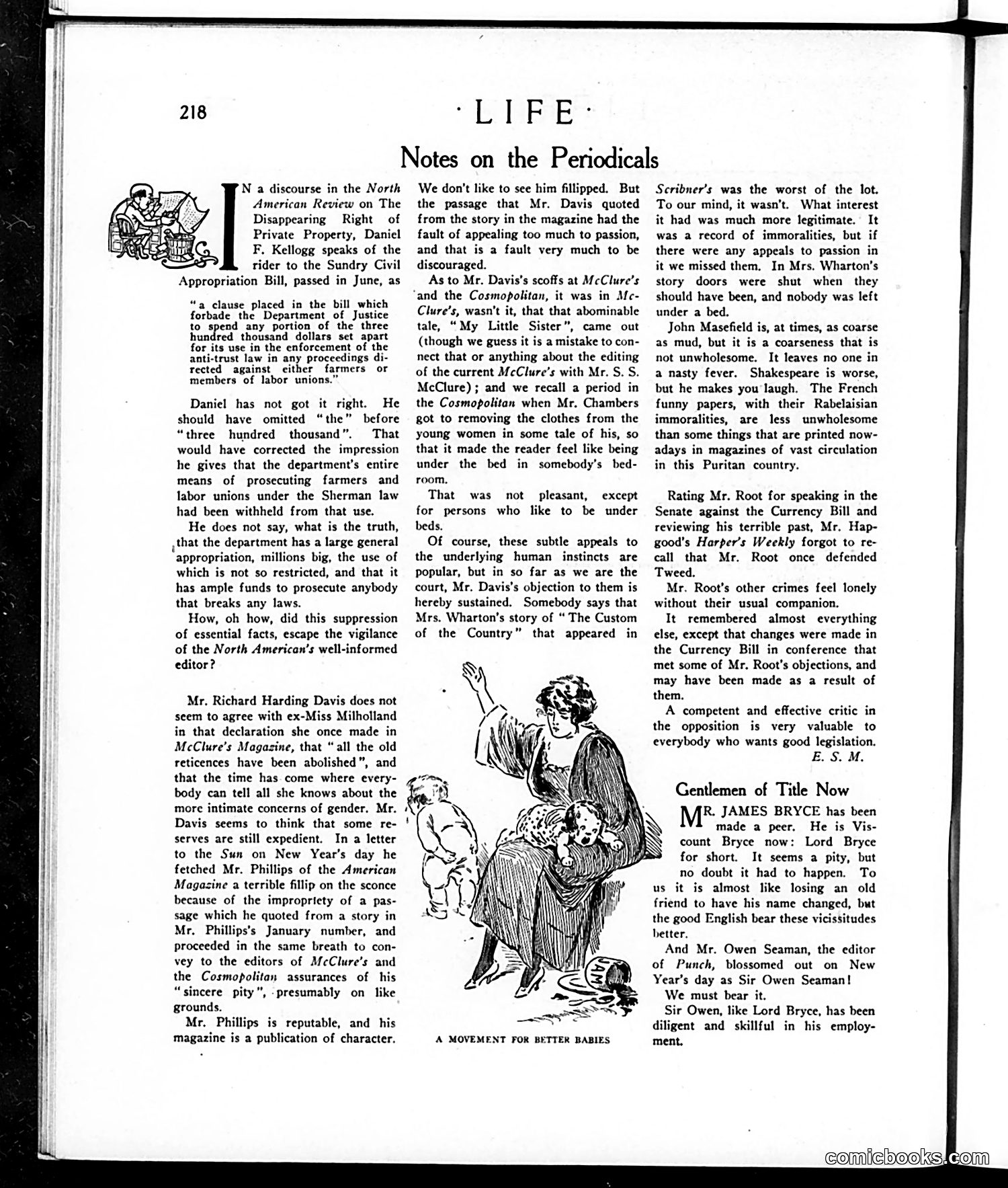
This page contains editorial commentary on early 20th-century magazine controversies. The main illustration, titled "A Movement for Better Babies," depicts a woman with children—likely referencing the contemporaneous "Better Babies" movement, a eugenics-influenced public health campaign. The text discusses disputes between magazines: *McClure's*, the *Cosmopolitan*, and others over editorial practices and content standards. Richard Harding Davis criticized *McClure's* for publishing sensational material. The editors debate whether certain stories (like Mrs. Wharton's "The Custom of the Country") are too coarse or immoral for popular magazines. The final section announces that James Bryce and Owen Seaman have received peerages, treating this as noteworthy social promotion.
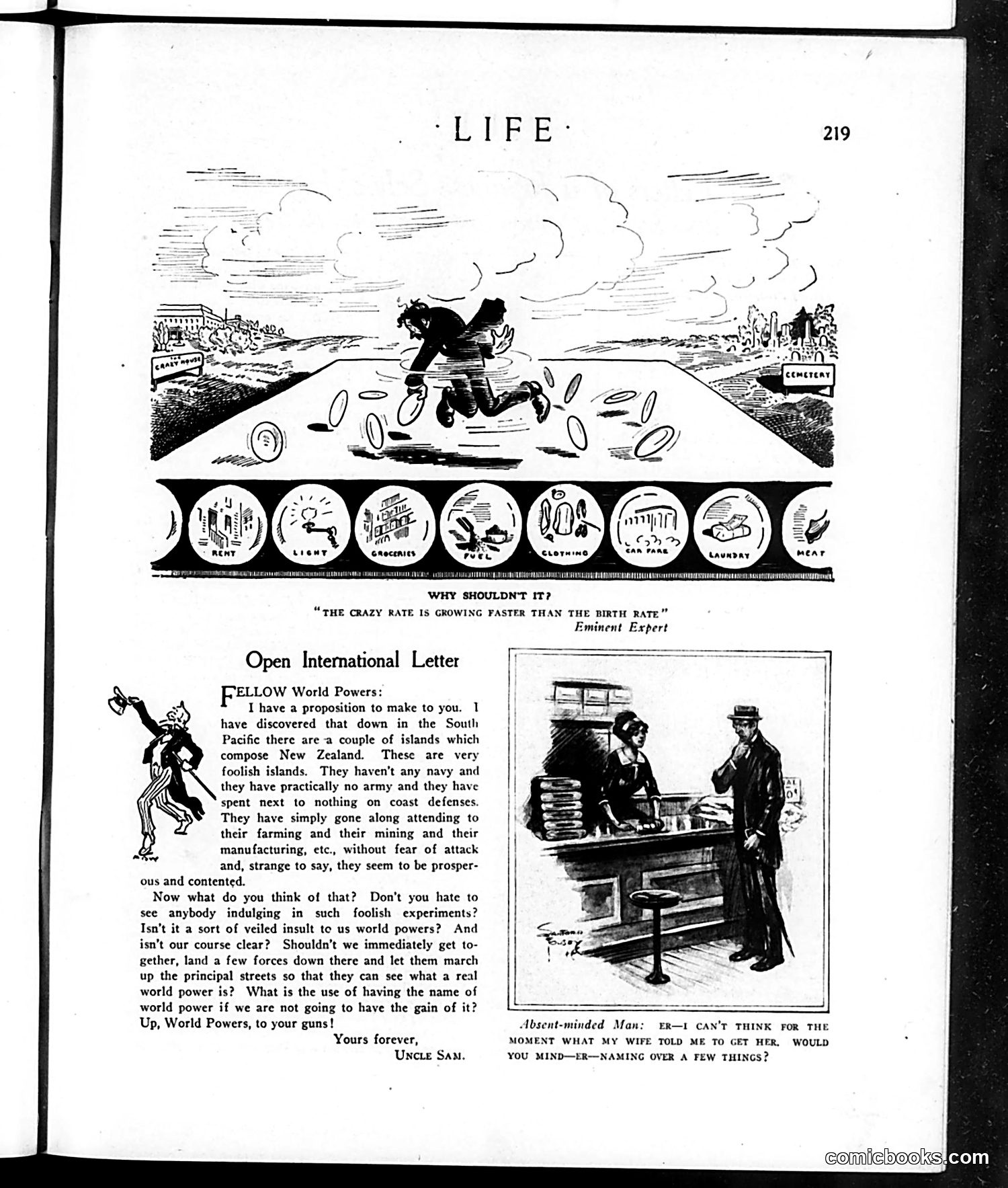
The top cartoon satirizes modern life's frantic pace—a figure sprints frantically down a road between a cemetery and city, dodging scattered debris. The caption quotes an "Eminent Expert" claiming "the crazy rate is growing faster than the birth rate," suggesting society's speed and chaos are outpacing human reproduction. Below, an "Open International Letter" from "Uncle Sam" sarcastically proposes that world powers invade New Zealand, portrayed as foolishly peaceful and undefended. The letter mocks nations that neglect military buildup, rhetorically asking why world powers shouldn't exploit such vulnerability. It's satire critiquing American and global militarism and colonial attitudes. The bottom sketch shows an absent-minded man who forgot his wife's instructions—standard domestic humor.
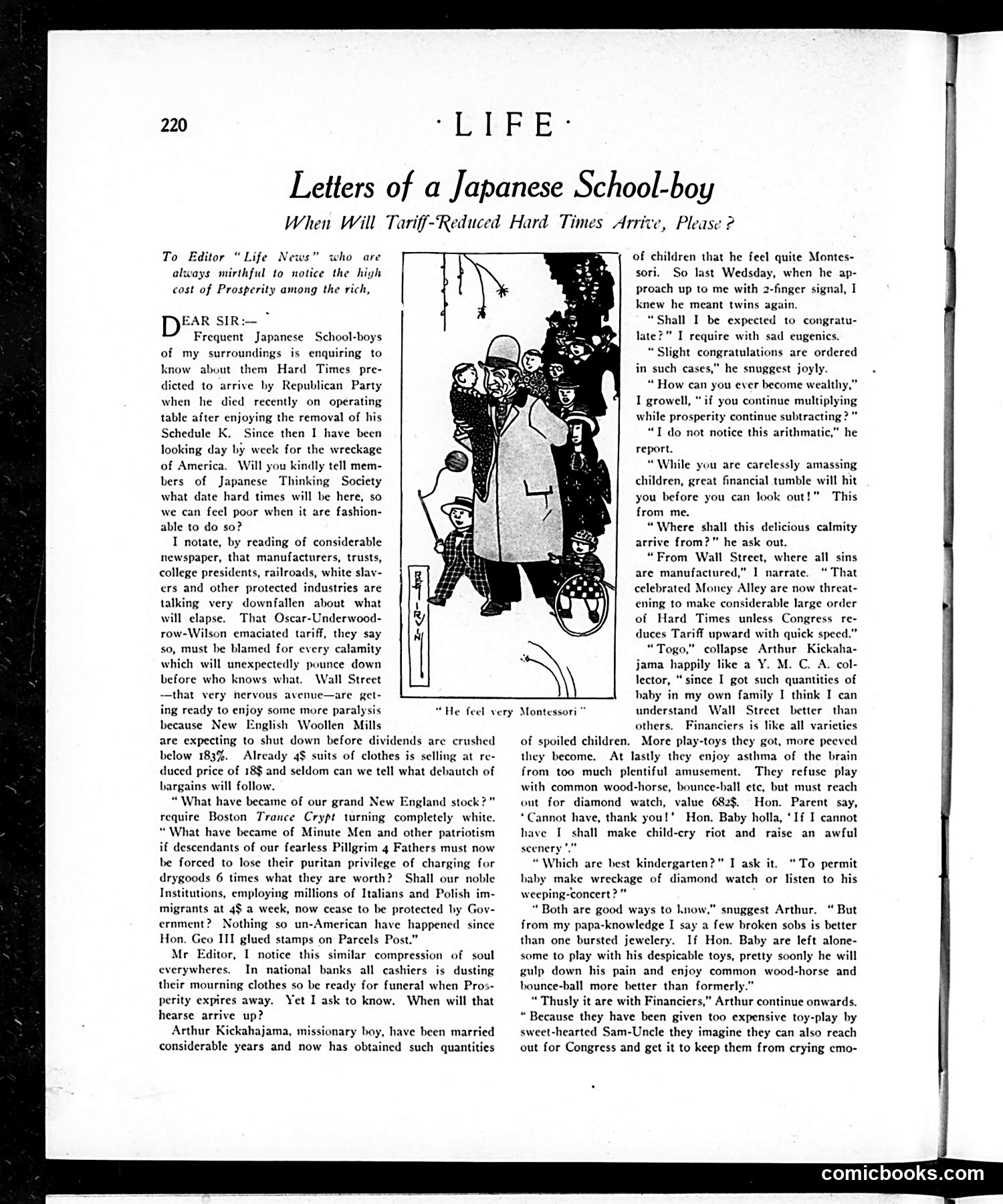
This is a satirical letter to Life's editor from the perspective of a Japanese schoolboy named Arthur Kickahajama, commenting on American economic hardship during what appears to be a recession or depression era. The cartoon shows Arthur with American children, illustrating his observations about wealth inequality. The satire mocks: 1. **American economic anxiety** – The letter references tariff disputes, factory closures, and financial instability affecting American manufacturers and workers 2. **Ironic reversal** – A Japanese observer lectures Americans about prosperity while Americans struggle economically 3. **Spoiled children as metaphor** – Arthur compares American children's excessive toy consumption to broader financial recklessness, suggesting Americans live beyond their means The humor targets American anxiety about Asian economic competition and domestic financial mismanagement during uncertain economic times.
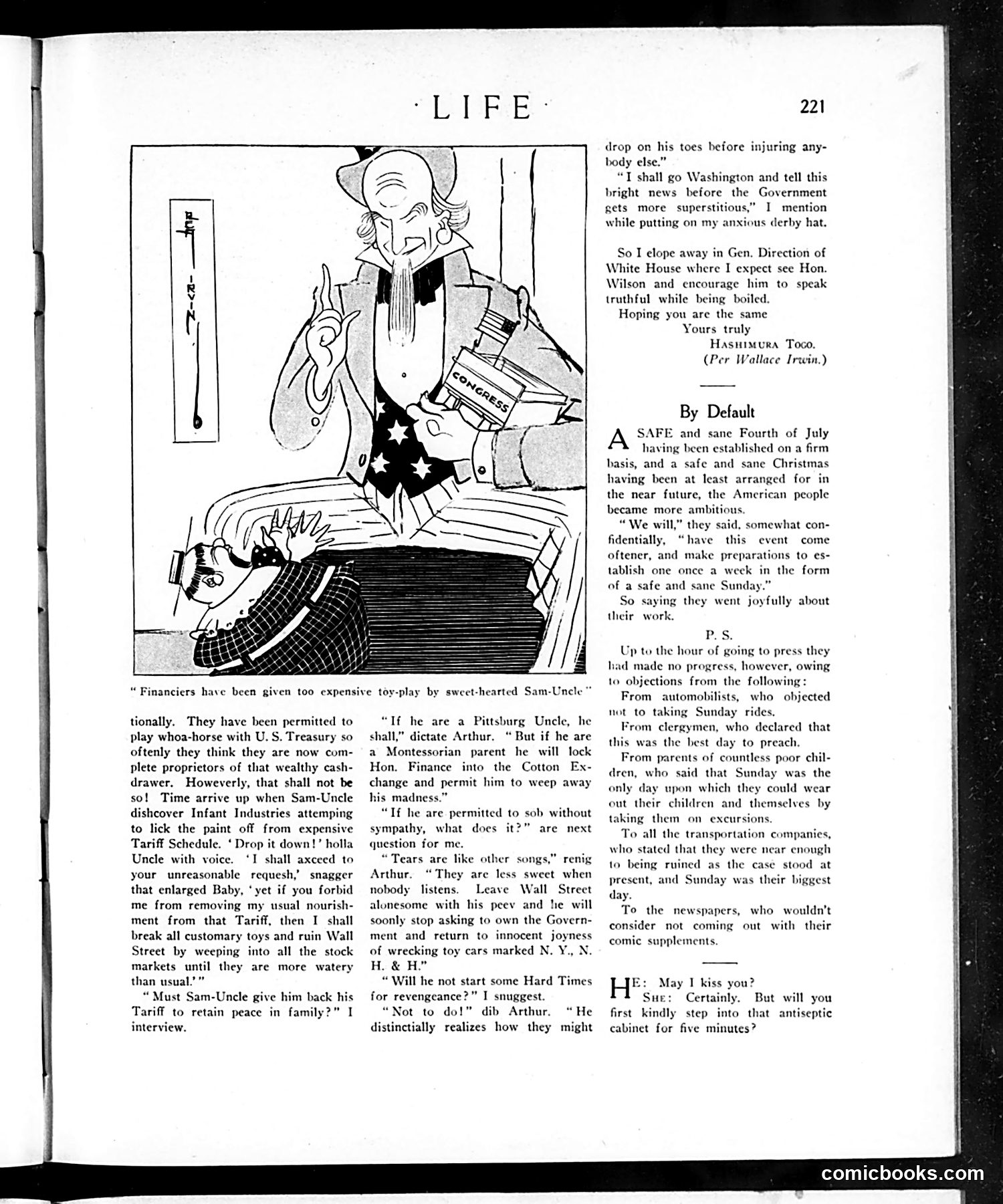
This cartoon satirizes financiers' speculation in U.S. Treasury bonds during what appears to be a post-WWI economic period. The caricatured figure labeled "Sam-Uncle" (Uncle Sam) is depicted as overly permissive, allowing wealthy financial interests to gamble with government securities like toys. The text criticizes how financiers exploit Treasury bonds for profit, comparing their behavior to disruptive "toy" manipulation of markets. The satire suggests government should restrict such speculation to prevent Wall Street from destabilizing the economy. The overall message: Uncle Sam (federal government) has been too lenient with wealthy speculators who treat serious financial instruments as frivolous gambling devices, endangering ordinary citizens' welfare.
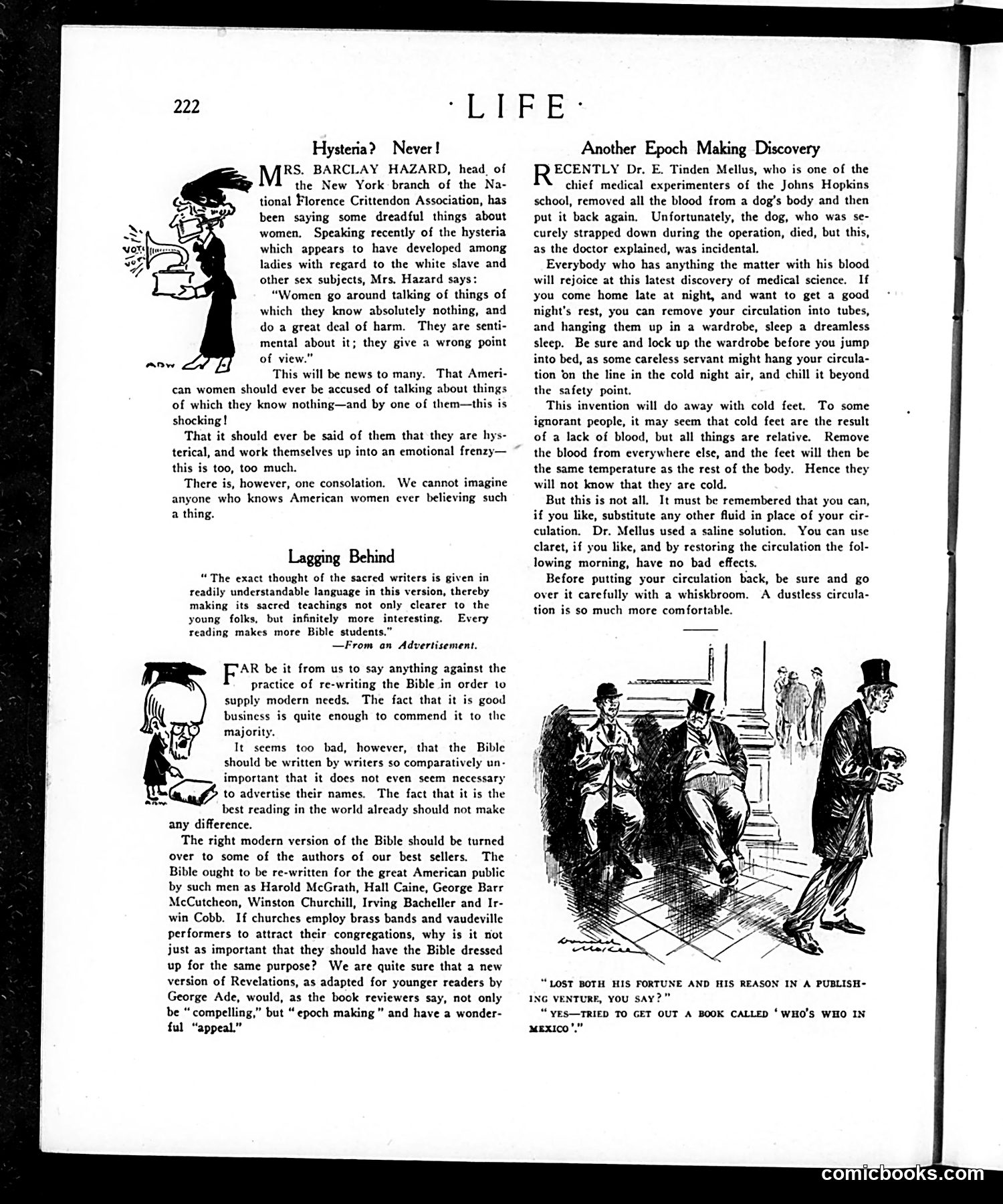
This page contains three distinct pieces of social commentary: 1. **"Hysteria? Never!"** - A caricatured woman's head introduces Mrs. Barclay Hazard's critique of the National Florence Crittenden Association's claims that women discussing sexual topics causes "hysteria." The satire targets pseudo-scientific justifications for keeping women ignorant about sex. 2. **"Lagging Behind"** - A small cartoon criticizes the practice of rewriting the Bible in modern language. The text argues the Bible should instead be adapted by major literary figures for contemporary readers. 3. **"Lost Both His Fortune..."** - The bottom cartoon depicts three well-dressed men discussing a publishing failure—someone who lost money trying to publish a book called "Who's Who in Mexico," likely satirizing failed business ventures or poor market judgment.
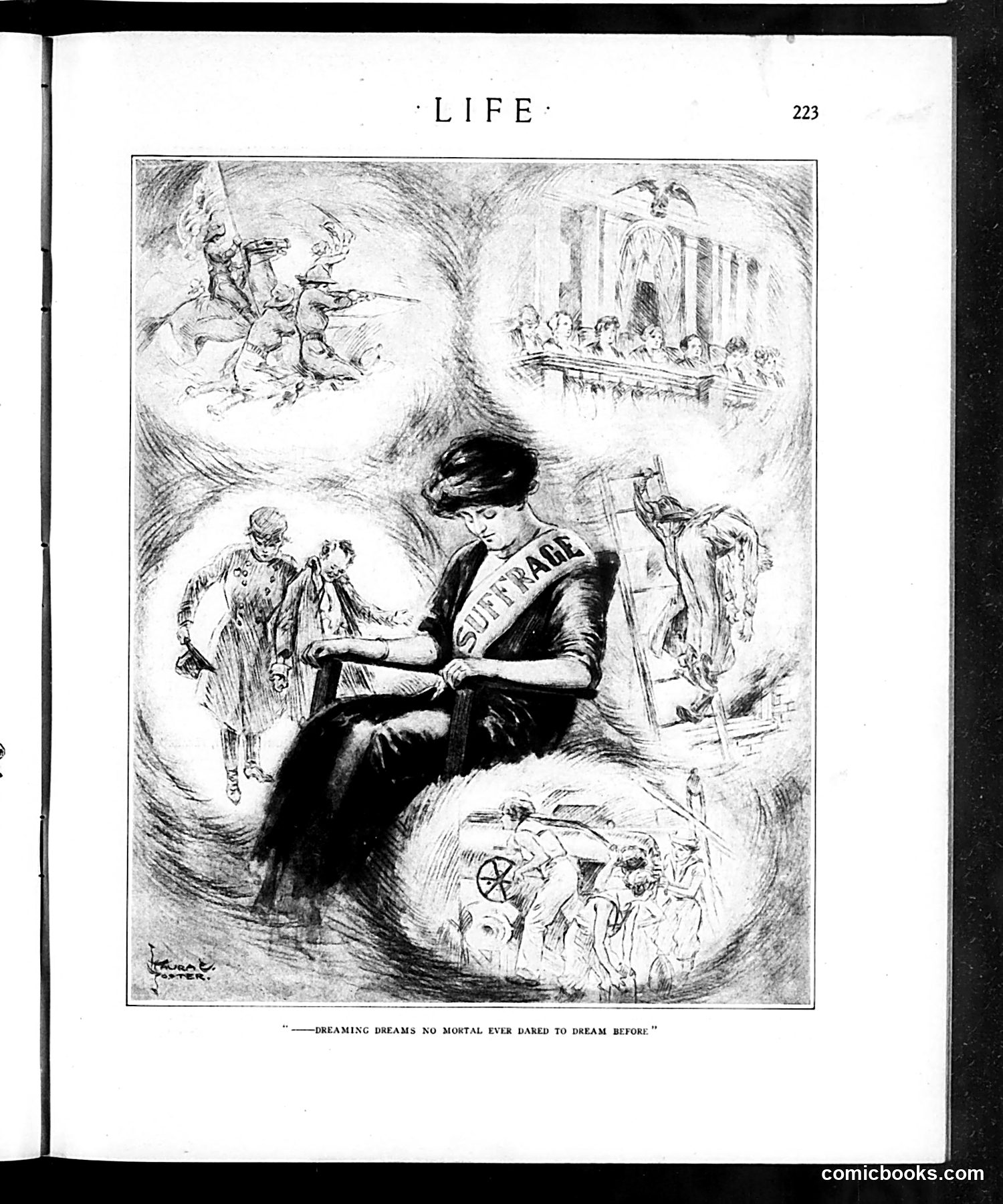
This illustration depicts a woman wearing a "SUFFRAGE" sash, sitting centrally while dreaming. The thought bubbles surrounding her show various scenes: military conflict, formal political gatherings, domestic situations, and what appears to be maritime or industrial activity. The caption—"Dreaming dreams no mortal ever dared to dream before"—is satirical commentary on women's suffrage aspirations. The cartoon suggests that women's voting rights activists are fantasizing about unprecedented power and influence across multiple spheres (military, government, commerce). The work satirizes suffrage supporters by implying their ambitions are unrealistic fantasies rather than reasonable political demands. This reflects anti-suffrage sentiment common in early 20th-century American satire, mocking women's political aspirations as overreaching and impractical.
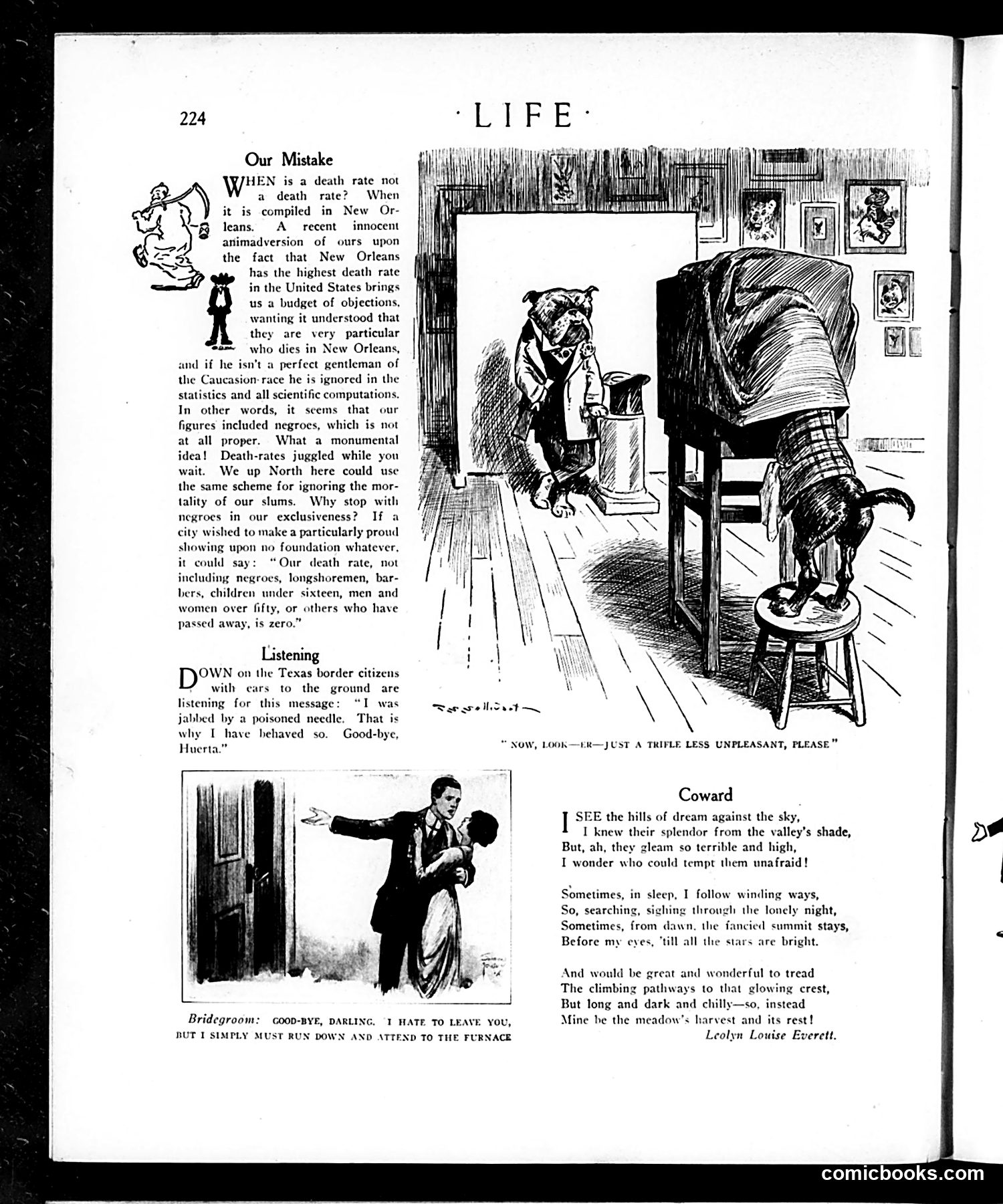
**"Our Mistake"** satirizes New Orleans' claim to the lowest death rate by excluding Black citizens from mortality statistics. The article mocks Southern racial exclusion as absurd—if cities could arbitrarily omit inconvenient populations (the poor, immigrants, children), death rates become meaningless. The joke is that New Orleans' "perfect gentleman of the Caucasion race" qualifier reveals the statistical dishonesty. **"Listening"** references the Texas-Mexico border during the Mexican Revolution (likely Pancho Villa or similar turbulent period), depicting citizens awaiting news of political violence or intrigue—the poisoned needle reference suggests assassination rumors common to that era. **The illustration** showing a man leaving a woman for furnace duties is captioned as a "bridegroom," suggesting domestic tedium and masculine duty override romantic commitment—a common early-20th-century domestic humor trope. **"Coward"** is a sentimental poem about hesitation and choosing safety over ambition.
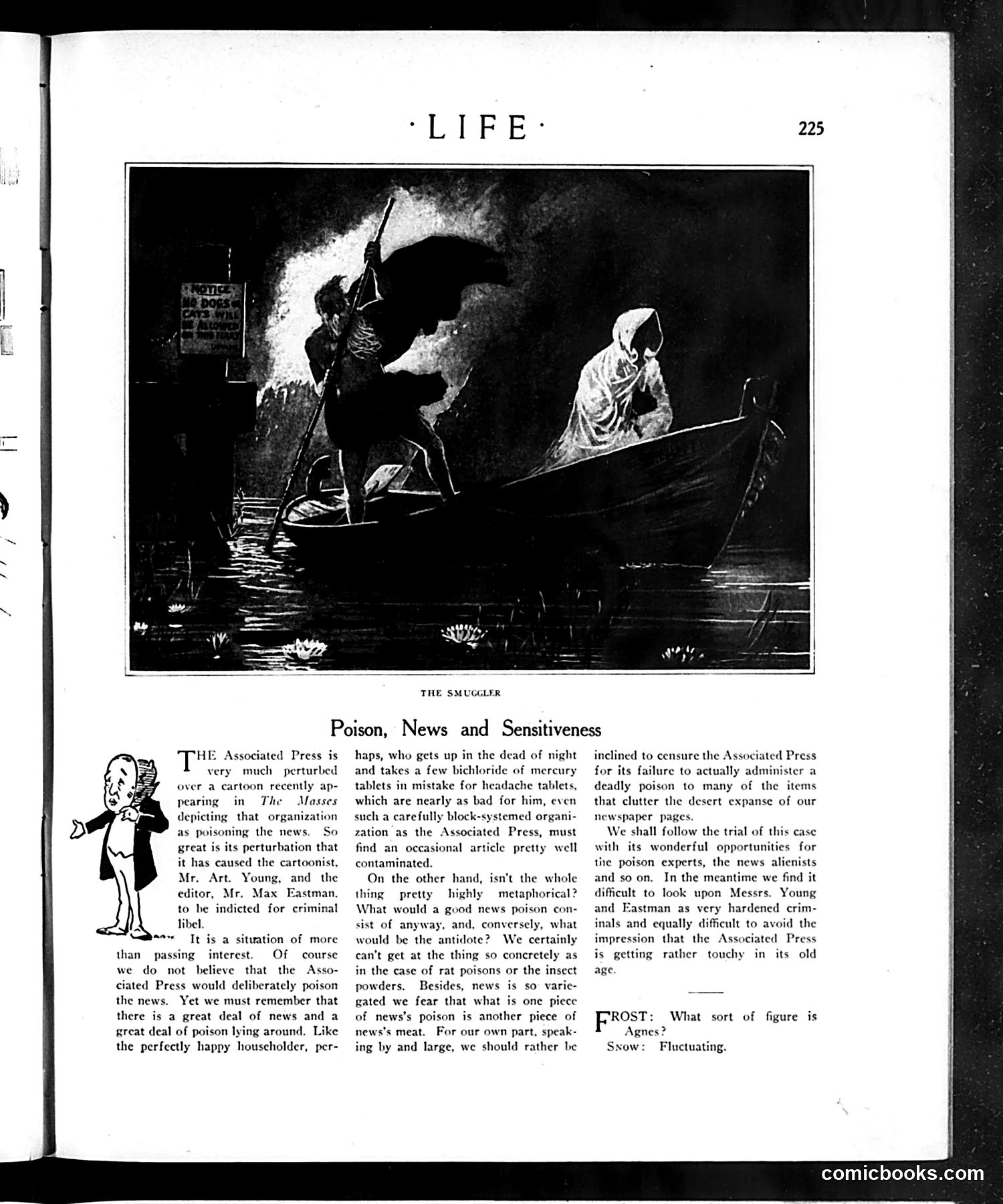
This page discusses a real legal case: cartoonist Art Young and editor Max Eastman were indicted for criminal libel by the Associated Press after *The Masses* magazine published Young's cartoon depicting AP as "poisoning the news." The illustration shows a nighttime smuggling scene—a visual metaphor for how the AP allegedly contaminates news coverage. Life's editorial takes a satirical middle position: while defending Young and Eastman's right to criticize, it argues the metaphor of "poison news" is too abstract to prove literally. The author sarcastically suggests AP's real problem is failing to poison *enough* news—implying much published content deserves suppression. The piece mocks AP's sensitivity to criticism ("getting rather touchy in its old age") while questioning whether news manipulation can be prosecuted as criminal libel. The debate reflects early 20th-century tensions over press freedom and corporate media accountability.
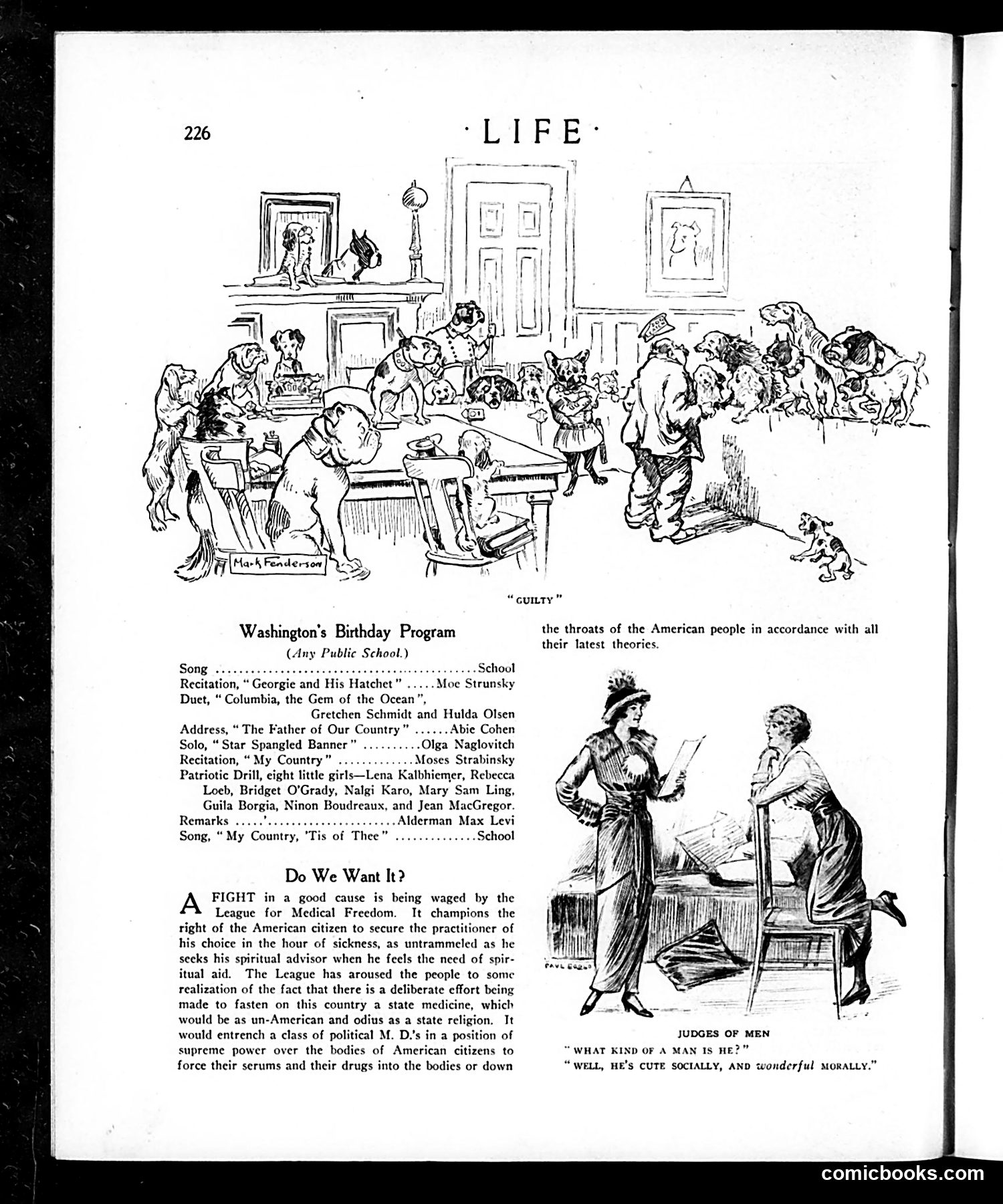
**Top Cartoon ("Guilty"):** This depicts a chaotic schoolroom during a "Washington's Birthday Program." The satire targets early 20th-century immigration anxieties: the program lists children with obviously immigrant surnames (Cohen, Naglovitch, O'Grady, Ling, Boudreaux, MacGregor) performing patriotic exercises. The cartoon mocks concerns that immigrant children couldn't be properly "Americanized"—the disorder suggests these children are unfit to represent American values, playing on nativist fears prevalent in the 1910s-1920s. **"Do We Want It?" Section:** This opposes "state medicine"—a precursor to public healthcare debates. The League for Medical Freedom argues that government-mandated medical practitioners threaten individual liberty, comparing it to "state religion." This reflects anti-government sentiment and opposition to what would later become commonplace medical licensing. **Bottom Cartoon ("Judges of Men"):** Two women evaluate a man's character, noting he's "cute socially" and "wonderful morally" despite unknown substantive qualities—satirizing superficial social judgment.
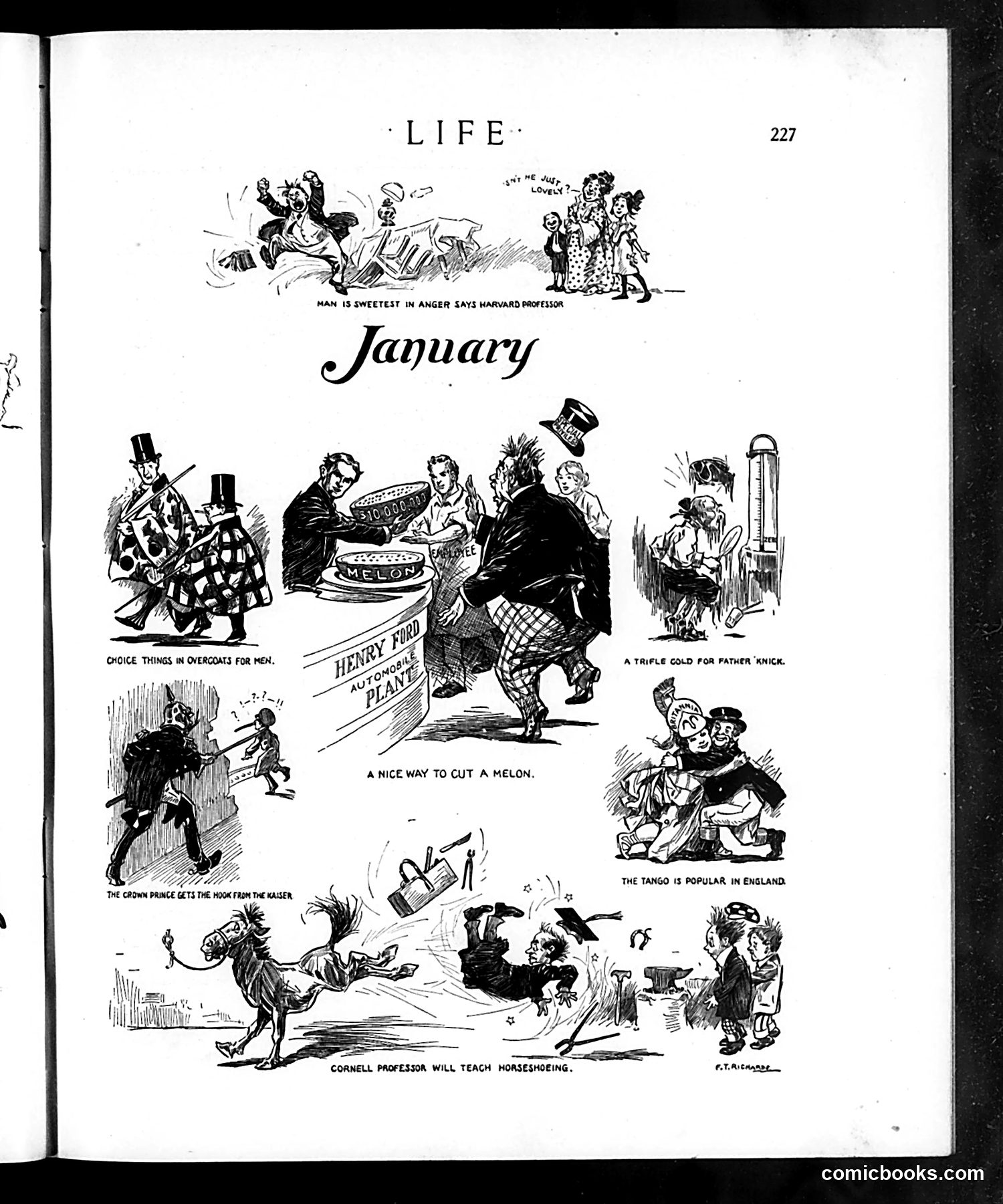
This page contains multiple January-themed satirical vignettes mocking contemporary social customs and notable figures. The central cartoon depicts men cutting a melon labeled "Henry Ford Automobile Plant," satirizing Ford's industrial operations. Other sketches mock gentlemen's fashion ("Choice things in overcoats for men"), domestic life ("A nice way to cut a melon"), cold weather hardships ("A trifle cold for Father Knick"), and popular culture ("The tango is popular in England"). The bottom cartoon references "The Crown Prince gets the hook from the Kaiser," likely alluding to tensions within the German imperial family—the Crown Prince and Kaiser Wilhelm II had documented conflicts. The horseshoeing joke references "Cornell Professor will teach horseshoeing," mocking academic pretension. The humor relies on exaggerated caricatures and wordplay typical of early 20th-century American satirical magazines.
This page critiques regulatory overreach in Progressive Era business reform. The article attacks proposed trust-regulation bills (likely Sherman Act amendments), arguing they're excessive and unenforceable. **Key figures:** Sam McCall (Massachusetts politician who lost reelection) and George Wickersham (former Attorney General) represent skeptics of new regulations. The piece sarcastically opposes detailed legislation targeting interstate business practices. **The satire's point:** The author warns against translating moral principles ("Golden Rule") into rigid laws—they become oppressive machinery rather than ethical guidance. The cartoon (showing a figure being crushed) visually reinforces this message about regulation's burden. **Context for modern readers:** This reflects genuine Progressive-era tension between reformers wanting corporate oversight versus business interests and their allies opposing "excessive" government intervention. The piece mocks regulatory specificity as unworkable overkill, a debate that persists today.
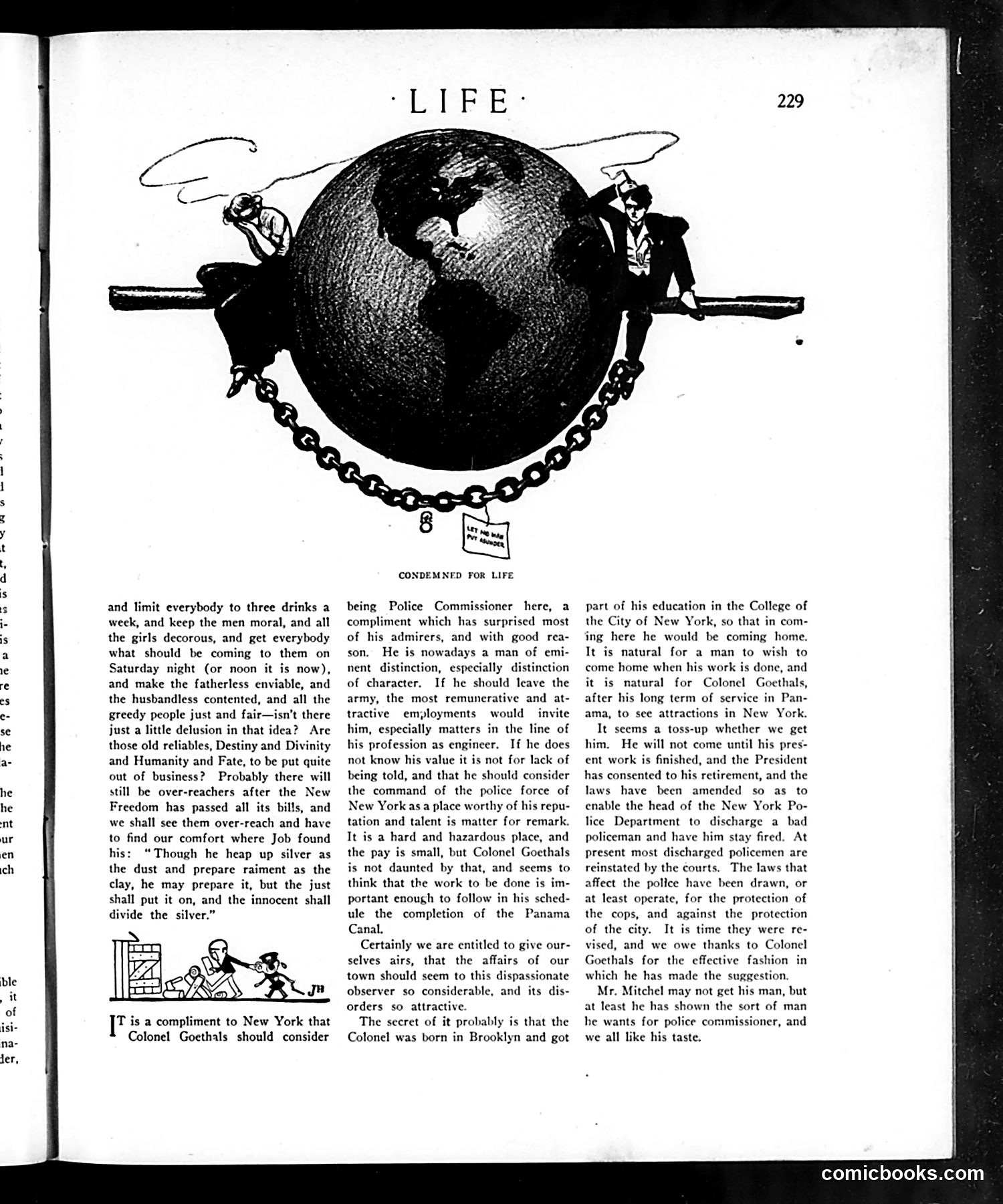
The main cartoon depicts two men sitting on a seesaw balanced on a globe wrapped in chains, labeled "Condemned for Life." This illustrates the page's central topic: Colonel George Goethals, famous engineer of the Panama Canal, being considered for New York Police Commissioner. The text praises Goethals' potential appointment, arguing he's a man of "eminence" and "distinction of character" who would bring needed reform—particularly fixing laws that allow discharged corrupt police to be reinstated by courts. The satirical angle: despite his accomplishments and the city's entreaties, Goethals may decline because he's committed to finishing the Panama Canal first and awaiting legal amendments enabling real police discipline. The piece credits Mayor Mitchel for recognizing what leadership should look like, even if he doesn't secure Goethals. The "condemned for life" metaphor suggests both the burdensome responsibility of reform work and perhaps the trapped state of a city needing such reform.
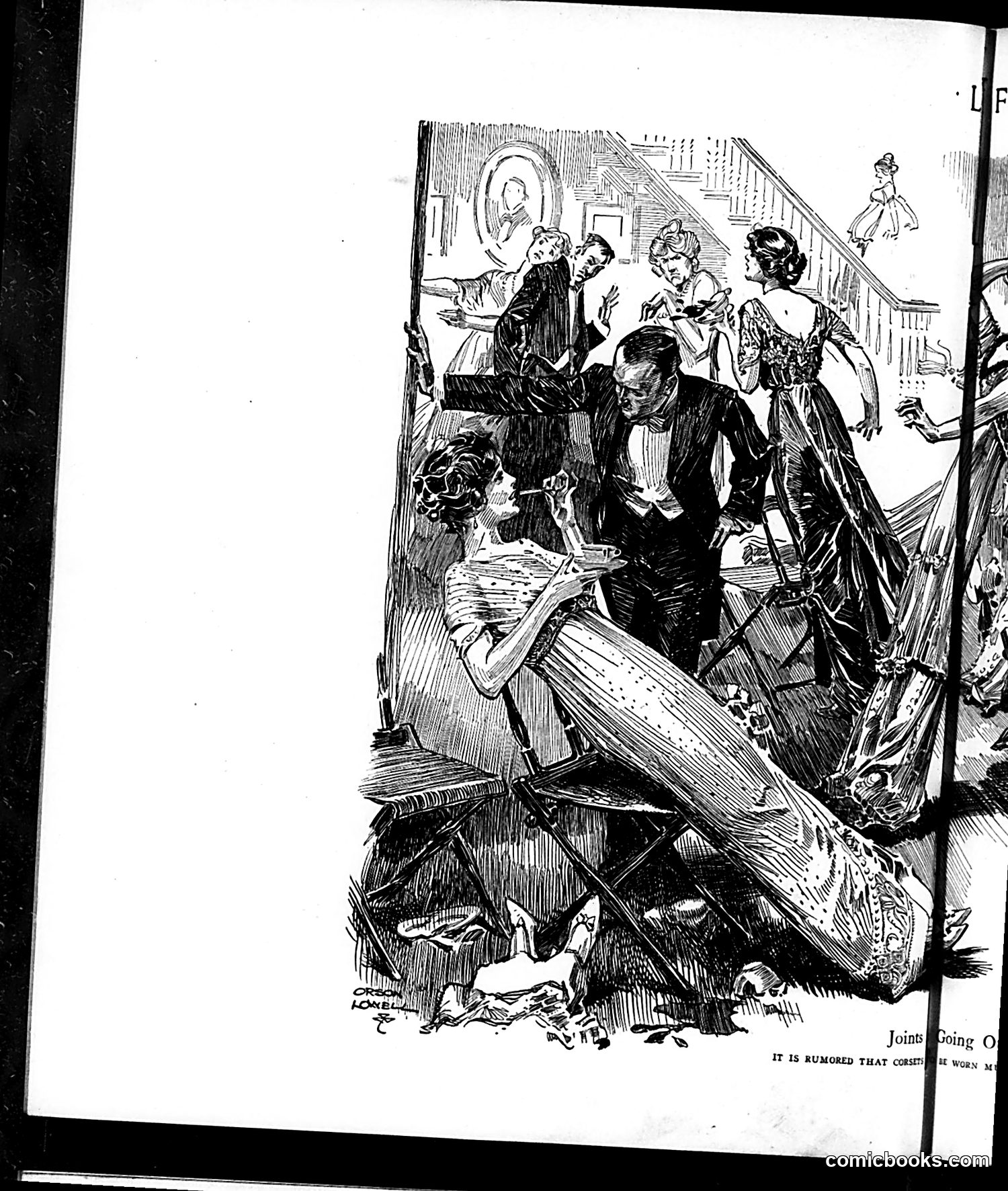
This appears to be a satirical illustration from *Life* magazine depicting a social scene, likely from the early 20th century based on the clothing and drawing style. The image shows well-dressed figures in what seems to be an interior setting, with a woman seated prominently in the foreground and several standing figures around her. The partial caption at bottom reads "It is rumored that..." suggesting gossip or scandal is the subject. However, the OCR text is too corrupted to determine the specific social commentary or who is being satirized. The illustration's focus on fashionable dress and apparent high-society setting suggests satire of upper-class society, manners, or behavior, but without legible text, the precise point of the joke remains unclear.
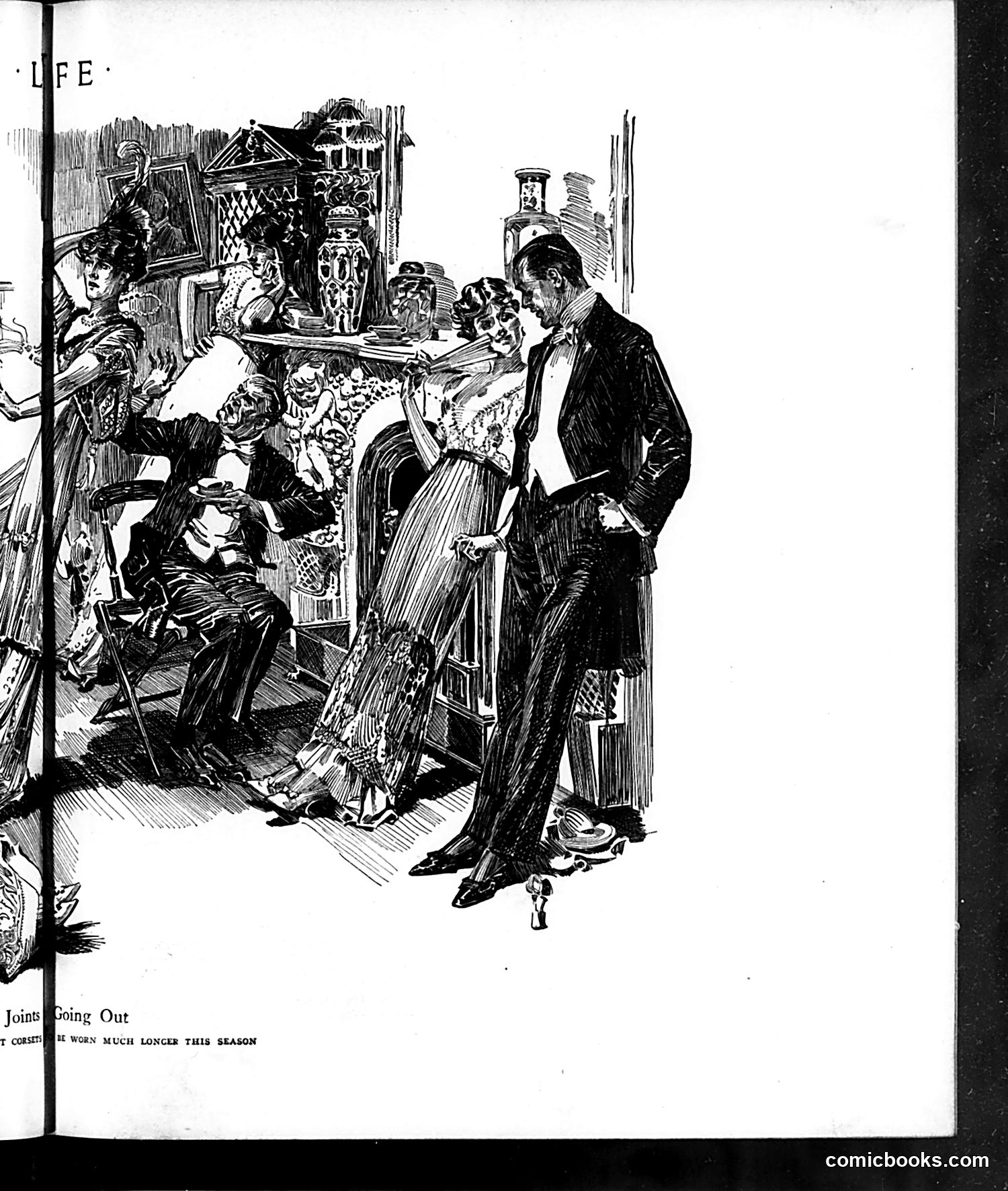
This illustration depicts a social scene at what appears to be an upscale establishment (suggested by the decorative vases and refined furnishings visible in the background). The caption "Joints Going Out" combined with the text "Corsets! Worn much longer this season" suggests satirical commentary on fashion and social venues during the Prohibition era. The drawing likely mocks the tension between changing women's fashion (looser, shorter corsets) and lingering Victorian formality. "Joints" was slang for illicit speakeasies during Prohibition. The humor appears to target how establishments catering to fashionable crowds were becoming outdated or "going out" of style, possibly while corset manufacturers ironically promoted longer styles—a backward trend contradicting the era's modernizing fashion sensibilities and increasingly relaxed social norms for women.
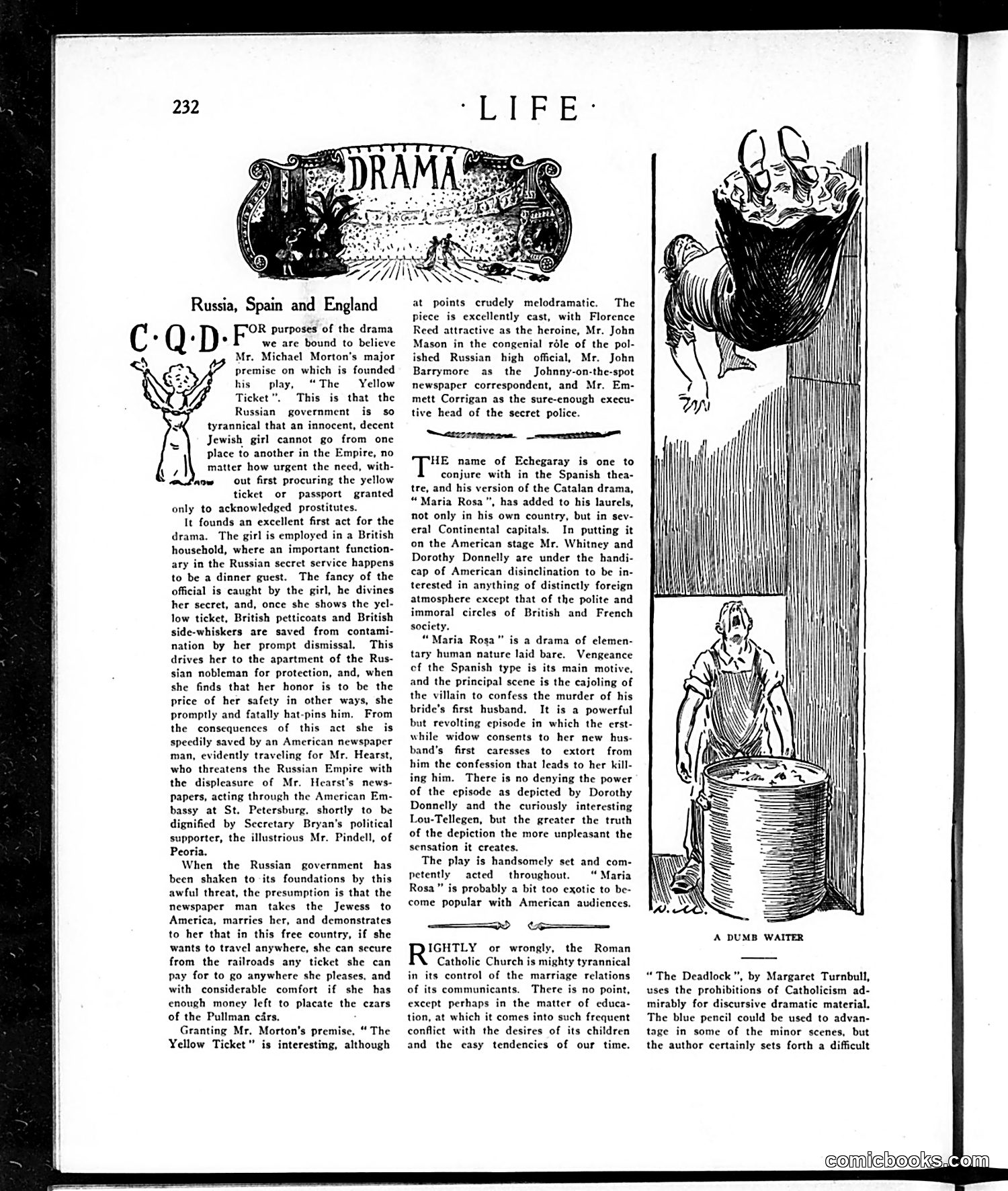
This page reviews three plays: "The Yellow Ticket," "Maria Rosa," and "The Deadlock." The main illustration shows a cartoon figure labeled "A DUMB WAITER"—likely satirizing the waiter character or concept from one of these productions. The text critiques "The Yellow Ticket," which depicts Russian tyranny so severe that innocent Jewish women need prostitution permits to travel. The reviewer notes the irony: an American newspaper man (working for William Randolph Hearst) threatens the Russian Empire into submission, then marries the heroine and brings her to America—where railroad monopolies (the "czars of the Pullman cars") exploit passengers almost as badly as the Russian government. The satire targets both Russian autocracy and American corporate power, suggesting that while America claims freedom, its railroad barons exercise comparable tyranny over ordinary citizens. The reviewer finds the premise melodramatic but effective.
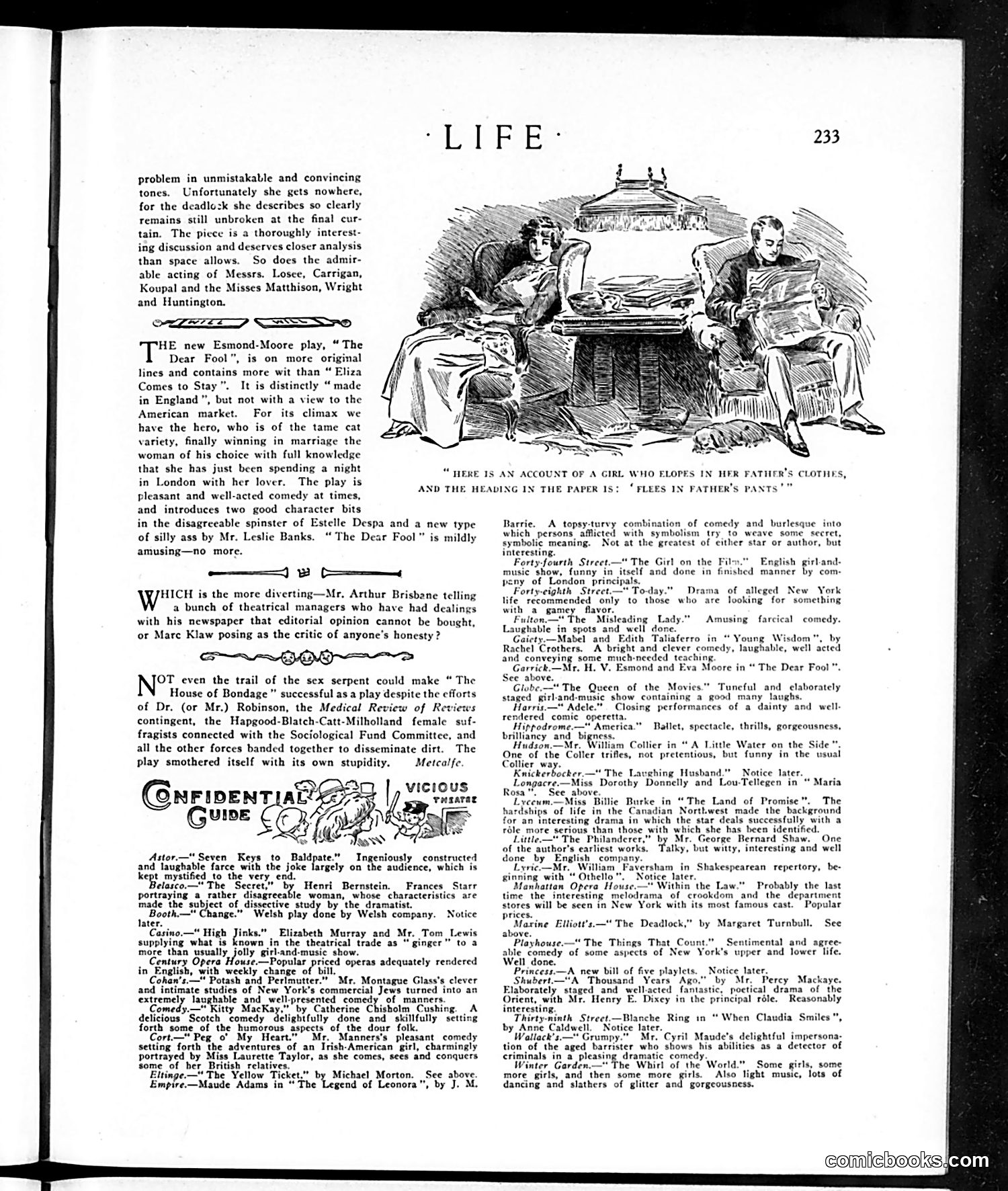
This page from *Life* magazine contains a single cartoon with an obvious visual pun. The illustration shows a girl who has eloped wearing her father's clothes, heading toward a newspaper office. The joke centers on the newspaper's headline: "FLIES IN FATHER'S PANTS." The humor relies on the double meaning of "flies"—both the verb meaning "runs away hastily" and the noun referring to the trouser opening. Modern readers would recognize this as a play on words common to early 20th-century satirical humor. The caption explicitly spells out the setup, suggesting the magazine expected readers might miss the wordplay otherwise—a telling indication of how comedy conventions have shifted over a century.
This page contains literary reviews without political cartoons. The text discusses two novels: **"The Joy of Youth"** by Eden Phillpotts—a love story between a young painter from Rome and a rural English girl. The reviewer uses humorous analogies (a mountain horse refusing oats, a spaniel encountering real grass) to suggest readers' unpredictable reactions to genuine romantic content, implying the book breaks from conventional literary expectations where love stories traditionally end at the altar rather than exploring authentic passion. **"In Search of a Husband"** by Cora Harris—appealing to the newly intellectually awakened public. The reviewer critiques it as pseudo-sophisticated, predicting it will attract "newly disillusioned young" readers attracted to its cynical pose, while questioning its actual depth. The "Confidential Book Guide" below lists other contemporary titles. This represents Life's literary criticism function during the magazine's satirical heyday, targeting educated middle-class readers' intellectual pretensions and evolving social attitudes about romance and women's roles.
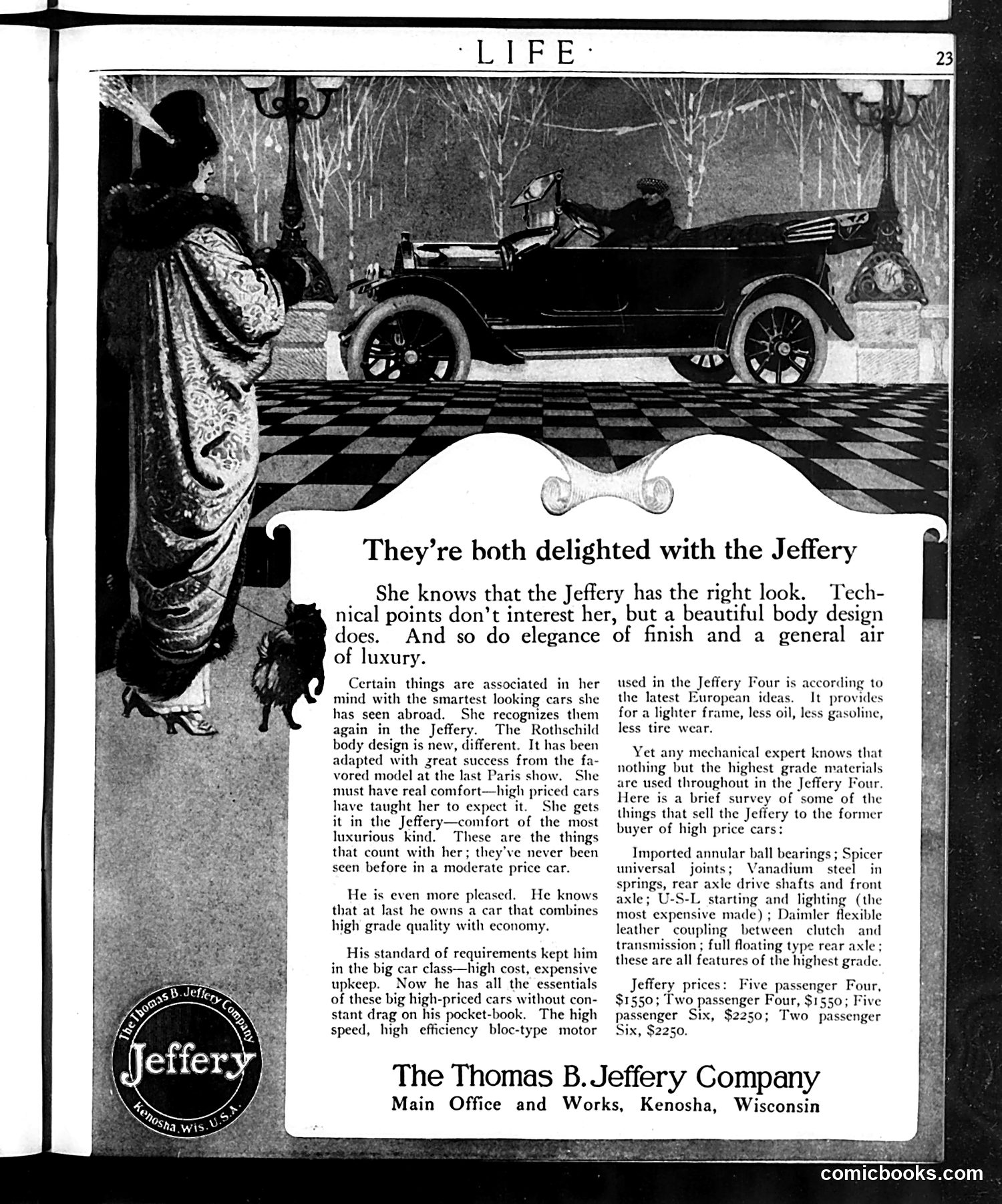
This is a **car advertisement**, not political satire. The Jeffery automobile company is marketing their vehicle to both men and women by appealing to different values. The ad uses a gendered sales pitch typical of early 20th-century advertising: the woman (shown in fashionable dress on the left) is attracted to the car's elegant European-inspired design and comfort, while the man appreciates that it offers luxury features at a moderate price—high quality without the expense of traditional luxury cars. The humor/appeal lies in the premise that she doesn't care about "technical points" but appreciates style, while he values the practical economics. The Jeffery promises to bridge this gap: sophisticated appearance with affordability. This reflects pre-1920s attitudes about gender (women as style-conscious, men as practical) while marketing the car as a democratic luxury—accessible to the middle class rather than only the wealthy.
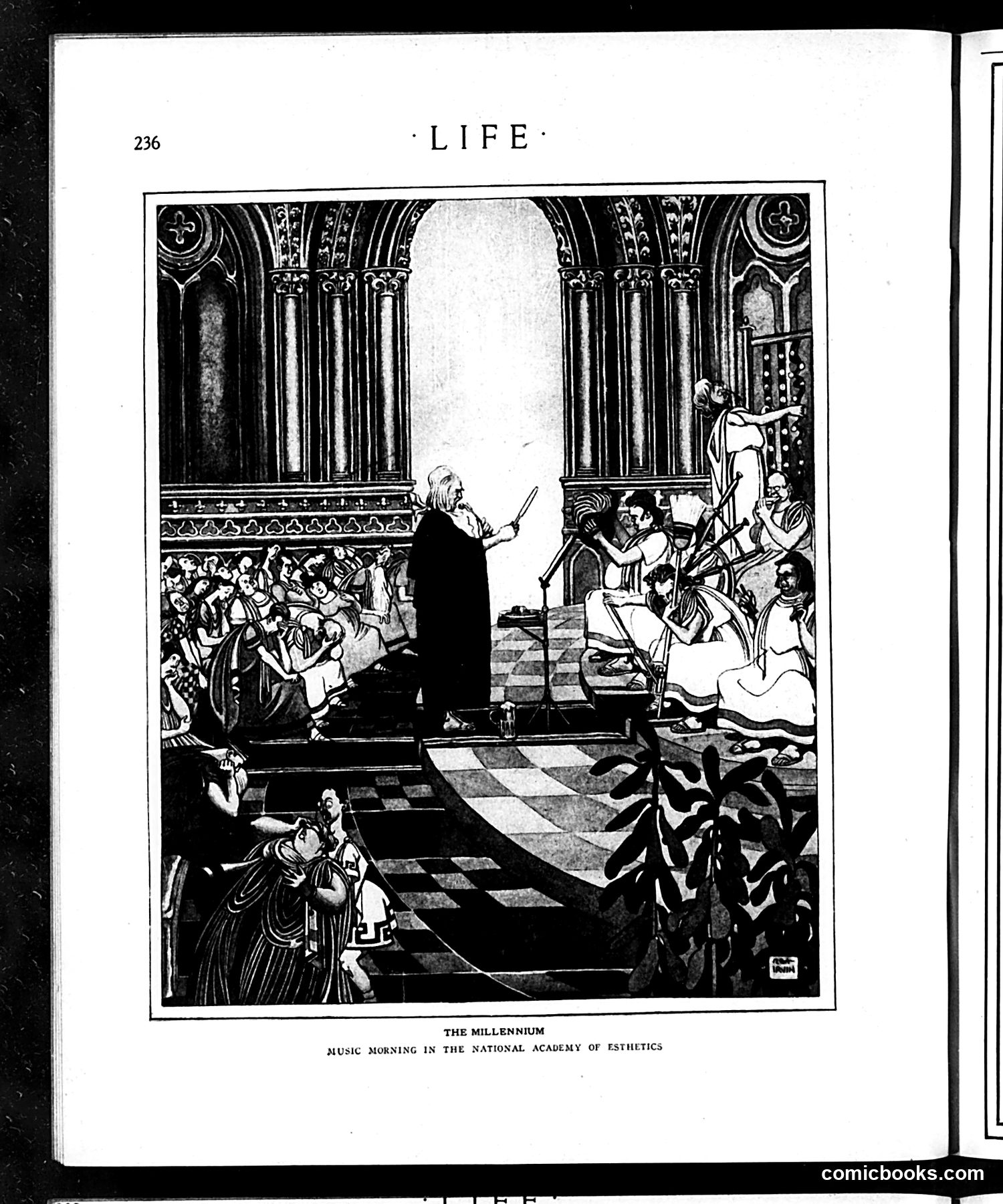
This illustration depicts an idealized future "millennium" scene titled "Music Morning in the National Academy of Esthetics." The image shows an ornate cathedral-like interior with elaborate Gothic architecture. A conductor leads musicians and singers in what appears to be a harmonious, refined musical performance before an assembled audience. The satire likely mocks contemporary aspirations toward cultural perfection and aesthetic idealism—suggesting a utopian vision of future society devoted entirely to high art and music. The grandiose architectural setting and formal presentation exaggerate these ideals. Without additional context from the magazine's date and surrounding articles, the specific target remains unclear, but it appears to satirize either progressive visions of future civilization or contemporary debates about art's role in society during the early 20th century.
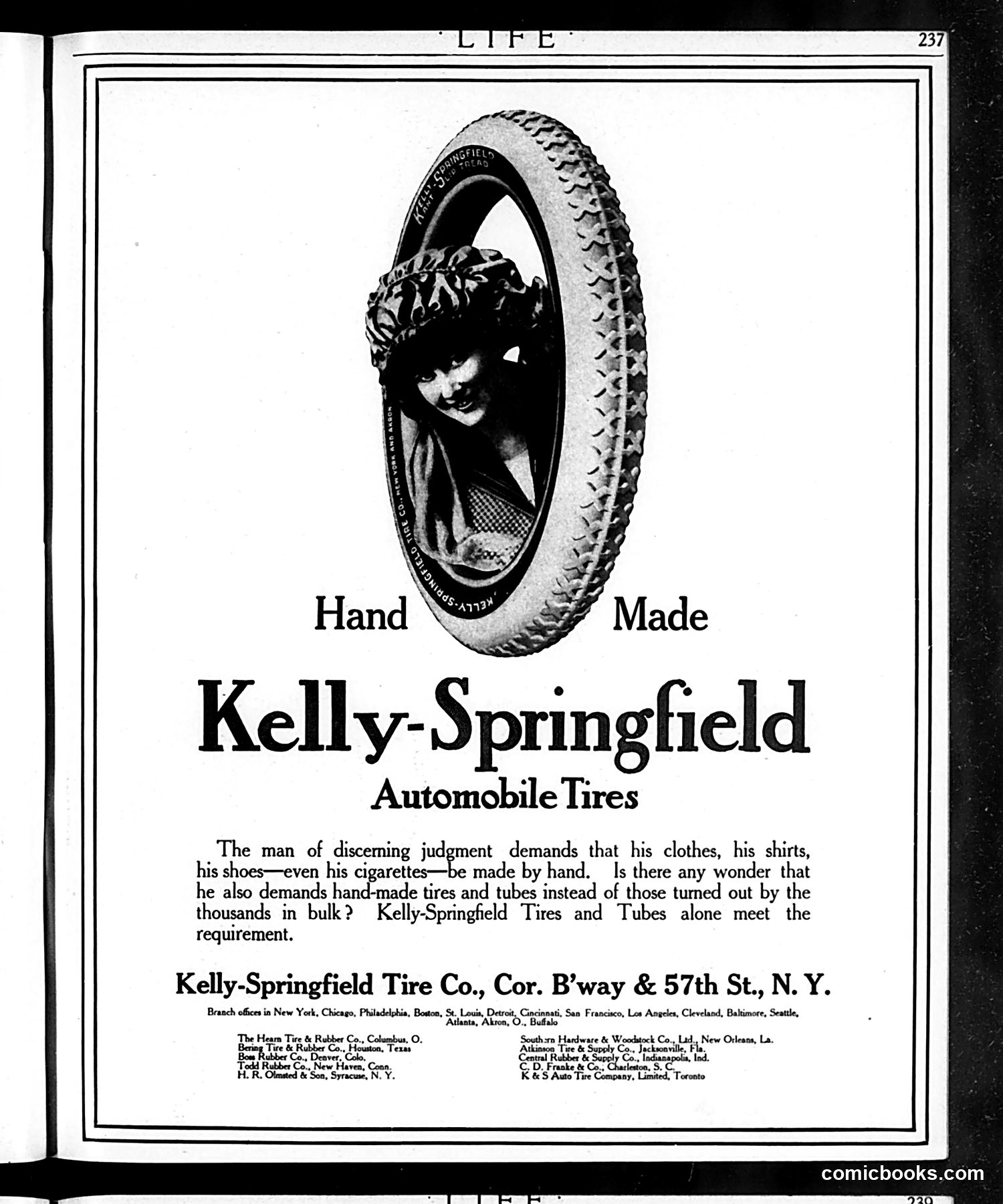
This is a **product advertisement**, not political satire. It promotes Kelly-Springfield automobile tires by appealing to consumer snobbery about handmade goods. The ad features a tire with a woman's face visible through its center—likely representing quality or craftsmanship personified. The text argues that discerning gentlemen who demand hand-made clothes, shirts, shoes, and cigarettes should logically prefer hand-made tires over mass-produced ones. The pitch exploits early-twentieth-century consumer anxieties: mass manufacturing was viewed with suspicion by the wealthy, who associated handcraft with superior quality and exclusivity. The ad suggests that choosing Kelly-Springfield tires signals refined taste and social status—a common marketing strategy of the era that equated luxury goods with personal distinction. The page lists numerous branch offices and distributors across North America, indicating this was a major tire company seeking upmarket customers.
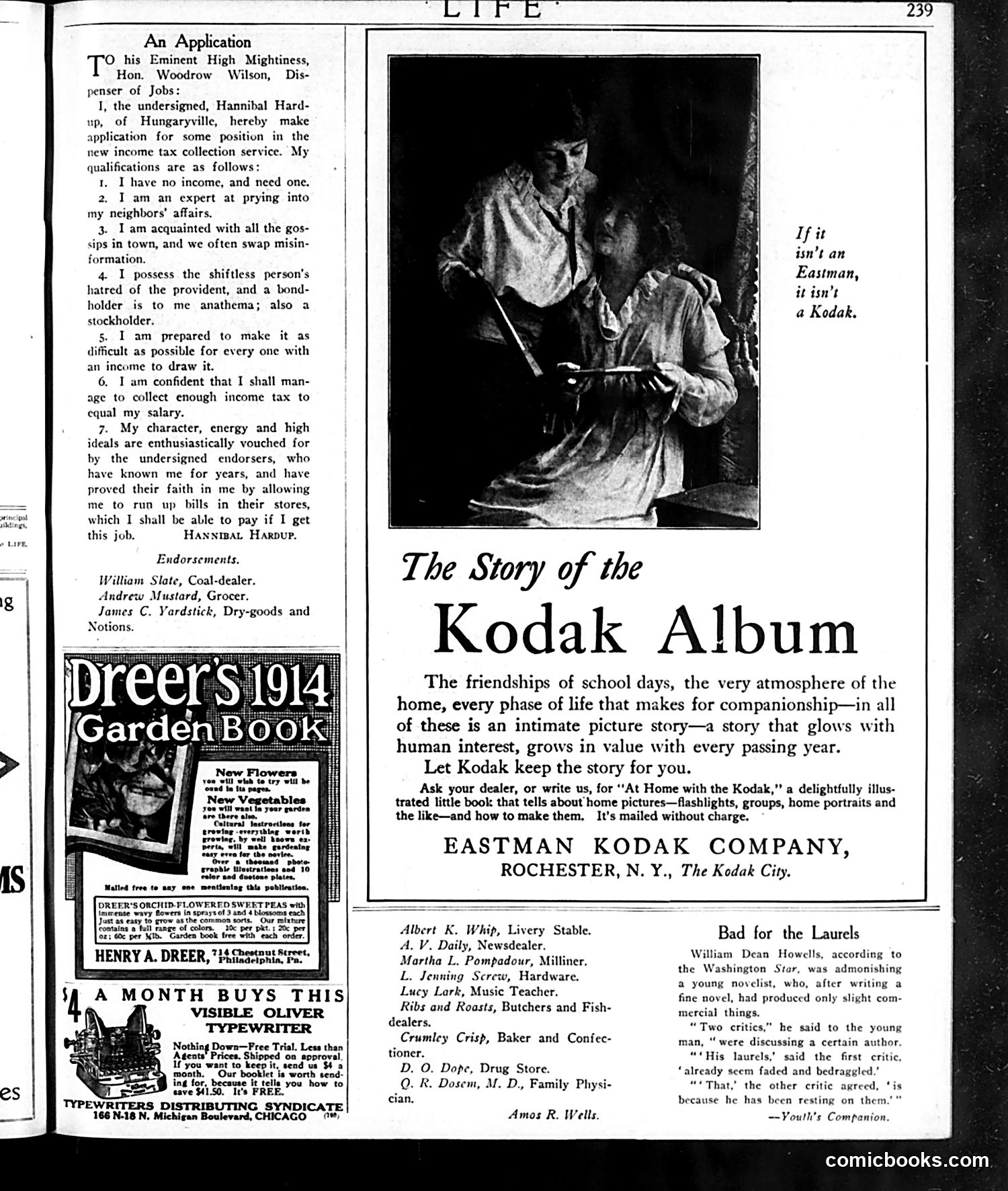
This page contains three distinct satirical pieces: **"An Application"** mocks the new income tax system under President Woodrow Wilson. A character named Hannibal Hardup applies for a tax-collection job, listing absurd "qualifications": having no income, spying on neighbors, spreading gossip, hating the wealthy, and making it difficult for others to claim income. The satire targets both the incompetence of patronage-based government hiring and resentment toward Wilson's redistributive tax policies. His endorsers (a coal dealer, grocer, drygoods merchant) are local businessmen—implying the system rewards ordinary people connected through local networks. **"The Story of the Kodak Album"** is a Kodak advertisement (not satire) promoting photography as a way to preserve family memories. **"Bad for the Laurels"** is a brief literary anecdote about critic William Dean Howells mocking a young novelist whose early fame has faded because he rests on past achievements rather than producing new work. The page emphasizes contemporary concerns: taxation, patronage politics, and literary merit.
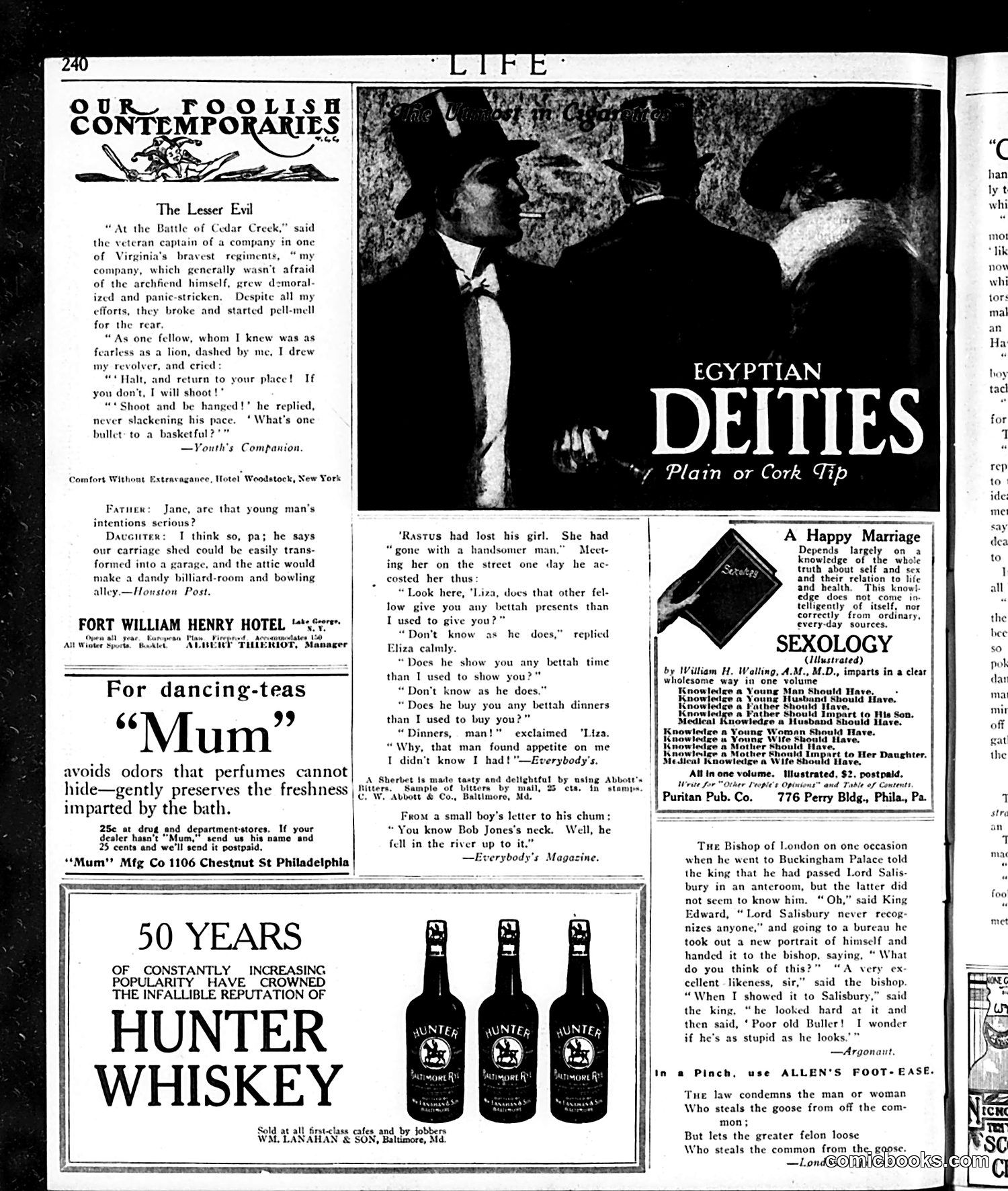
This page is primarily **advertising and humor pieces** rather than political cartoons. The content includes: **"The Lesser Evil"** presents a Civil War anecdote about a panicked soldier at Cedar Creek, where a captain threatens to shoot him for retreating. The soldier's reply—"What's one bullet to a basketful?"—suggests soldiers faced such frequent danger that individual threats became meaningless. **Racial humor** appears in the "Rastus" dialogue, using stereotypical dialect to depict a Black man comparing himself unfavorably to a rival suitor—typical of early 20th-century minstrel-style comedy found in Life. **Social commentary** emerges in the final poem condemning legal hypocrisy: the law punishes stealing a goose from commons but ignores powerful figures who steal common land itself—critiquing how justice protects wealthy interests. The page is dominated by **commercial advertisements** for whiskey, deodorant, and sexuality advice books, reflecting the magazine's reliance on advertising revenue while maintaining satirical editorial content.
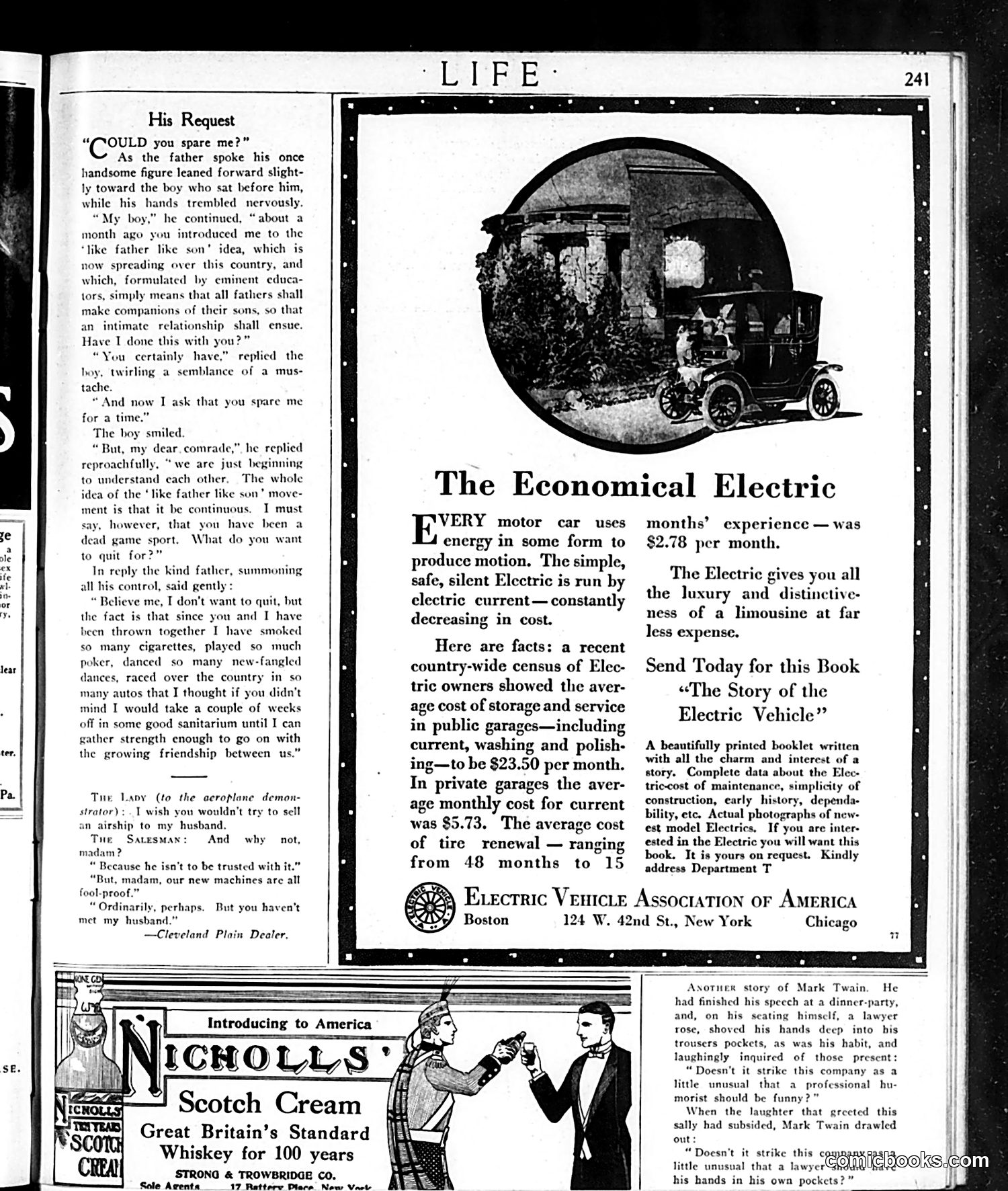
This page contains satirical humor typical of early 20th-century Life magazine. The main cartoon, "His Request," mocks the contemporary "like father like son" movement—an educational philosophy promoting father-son companionship. The joke: a exhausted father begs his teenage son for a break, having been worn out by constant cigarette-smoking, poker-playing, dancing, and reckless auto racing to bond with him. The son refuses, insisting the relationship must be "continuous." The satire targets both the fad's impracticality and generational conflict. Secondary jokes poke fun at wives' concerns about husbands' foolishness and Mark Twain's wit. The bulk of the page advertises electric vehicles and Scotch whiskey—typical period advertising claiming cost-efficiency and luxury. These ads were likely placed alongside the satire as standard magazine content, not as part of the humor.
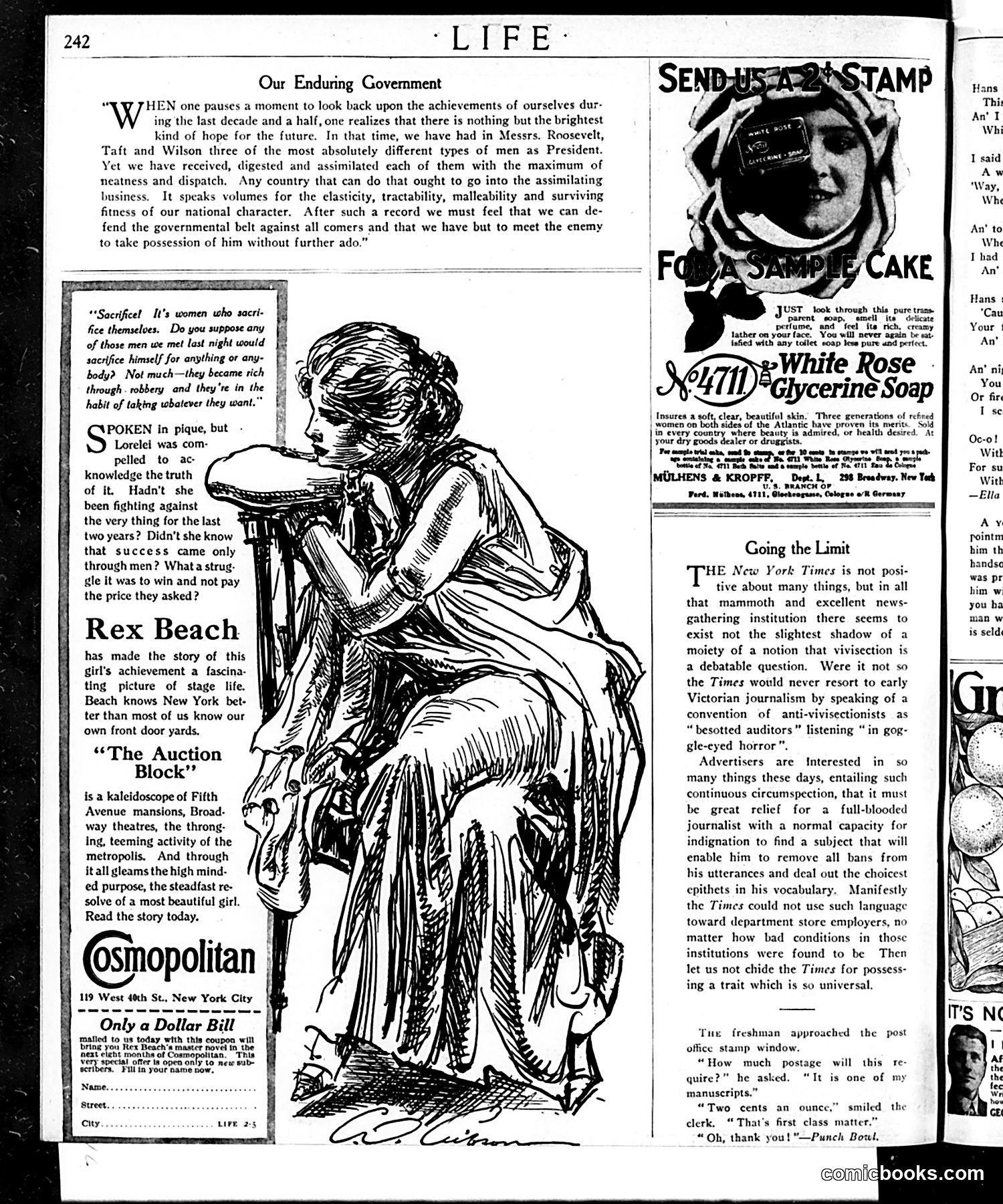
This page combines political commentary with period advertisements. The main editorial, "Our Enduring Government," praises American democracy's ability to absorb three dramatically different presidents (Roosevelt, Taft, and Wilson), celebrating national resilience and flexibility. The accompanying illustration shows a woman in classical dress, accompanying a piece questioning gender and sacrifice. A character "Lorelei" challenges the notion that men sacrifice themselves—she notes they became rich through "robbery" while women actually bear the burden of sacrifice. This reflects early-1910s feminist debates about women's roles and economic inequality. The "Going the Limit" section satirizes the *New York Times'* selective moral outrage: the paper condemns vivisection passionately but avoids criticizing department stores' poor labor conditions. The satire exposes journalistic hypocrisy—the Times applies ethical standards inconsistently based on advertiser interests. The page also includes period advertisements for White Rose glycerin soap and a Cosmopolitan magazine offer, typical of Life's revenue model.
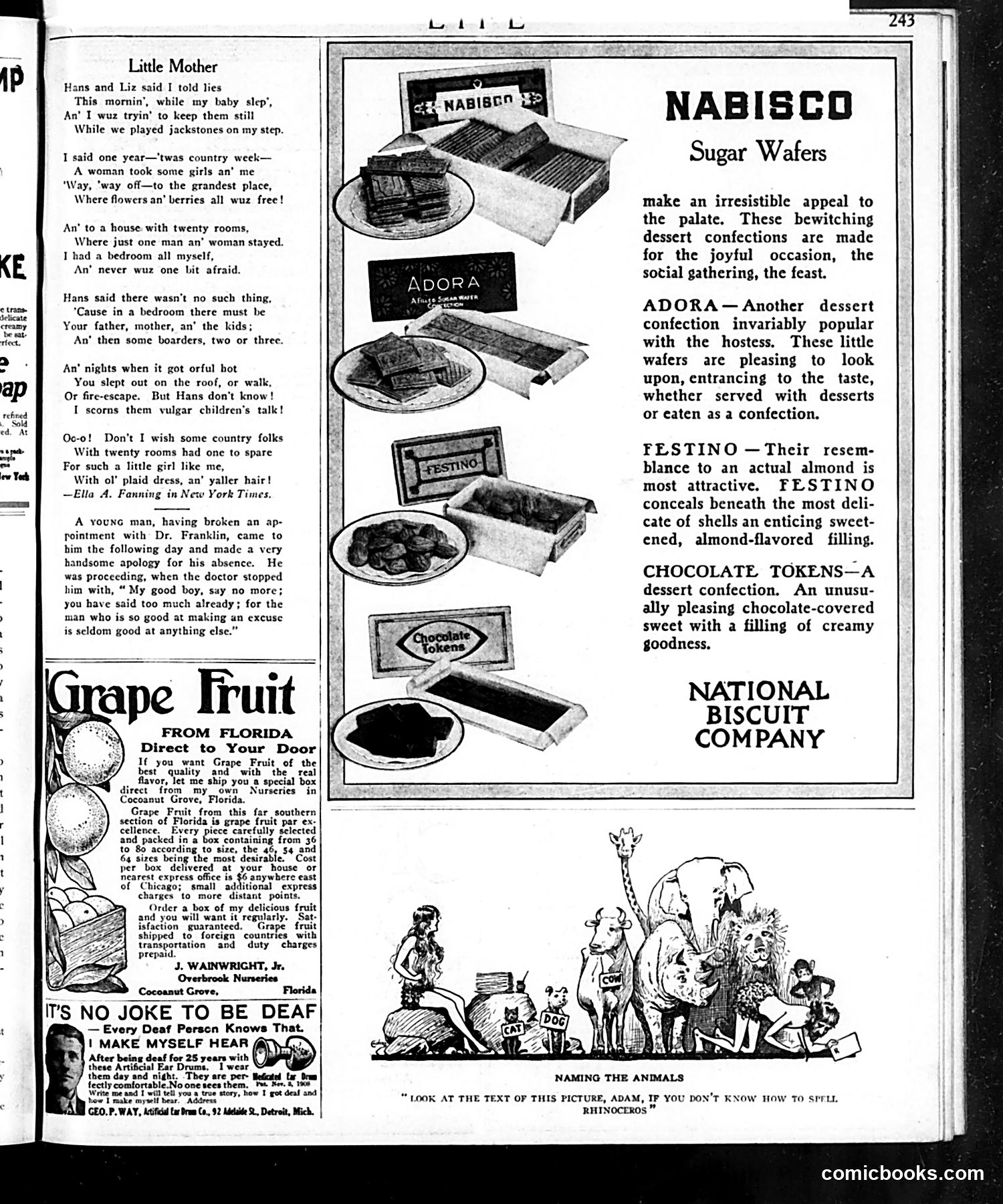
This page mixes satirical poetry, advertisements, and a cartoon. The main literary content is "Little Mother," a dialect poem about a poor urban girl who lies to her tenement-dwelling peers about visiting a grand country estate with private rooms—a fantasy sharply contrasting with their crowded, multi-family living conditions. The poem satirizes the social reality of early 20th-century urban poverty: working-class children sleeping on fire escapes in summer heat and sharing bedrooms with parents and boarders. Below is an unrelated anecdote mocking excuse-makers, followed by period advertisements for Nabisco confections, Florida grapefruit, and artificial ear drums. The cartoon at bottom ("Naming the Animals") shows Adam instructing a child on spelling "rhinoceros"—a gentle joke about parental instruction and childhood mispronunciation, with no apparent political content. The page primarily reflects Progressive-era concern with urban poverty and child welfare.
This page is primarily **advertising and corporate listings**, not political satire. It contains: 1. **Pétrole Hahn** hair product ad (top left): Claims to nourish hair roots with oil, targeting those with undernourished hair. Typical early 20th-century cosmetic marketing. 2. **Astor Trust Company** (center left): Lists officers and directors of this financial institution—standard corporate disclosure. 3. **New Dress Cottons and Linens** (top right): James McCutcheon & Co. advertises spring fabrics including crepes, voiles, and linens with pattern options. 4. **Club Cocktails** (bottom right): G.F. Heublein & Brother promotes pre-mixed cocktails, emphasizing precise measurement over "guess-work" mixing—appealing to cocktail culture during Prohibition era. The page reflects 1920s consumer culture: cosmetics, finance, fashion, and alcohol (via "cocktails" framing). No political cartoons or satire appear on this particular page.
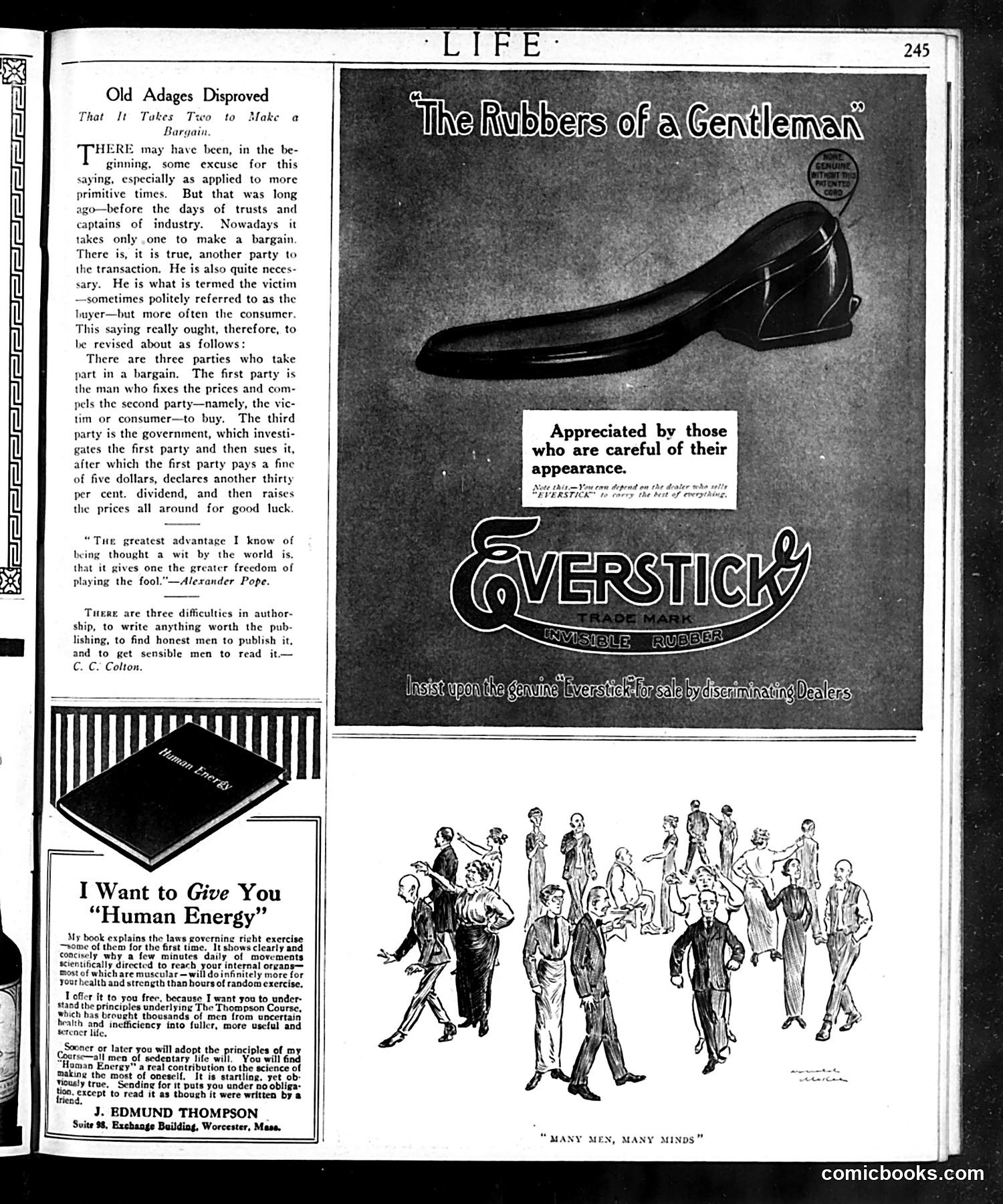
This page contains satirical commentary on modern capitalism and corporate power. **"Old Adages Disproved"** mocks the saying "it takes two to make a bargain." The satire argues that in the industrial age, only one party (big business/monopolies) actually controls transactions. The "consumer" or "victim" has no real choice. The piece sarcastically describes how corporations set prices, exploit consumers, then when government fines them minimal amounts ("five dollars"), they simply raise prices further to compensate—profiting from their own misconduct. The Alexander Pope and C.C. Colton quotes reinforce the magazine's satirical tone about truth-telling. **The advertisements** (Everstick rubber and "Human Energy" book) are typical period ads unrelated to the satire. **"Many Men, Many Minds"** (bottom illustration) depicts diverse crowds, likely illustrating individual variation referenced in the adage. The overall message critiques how industrial-era monopolies and trusts had rendered consumers powerless, with government enforcement too weak to meaningfully restrain corporate practices.
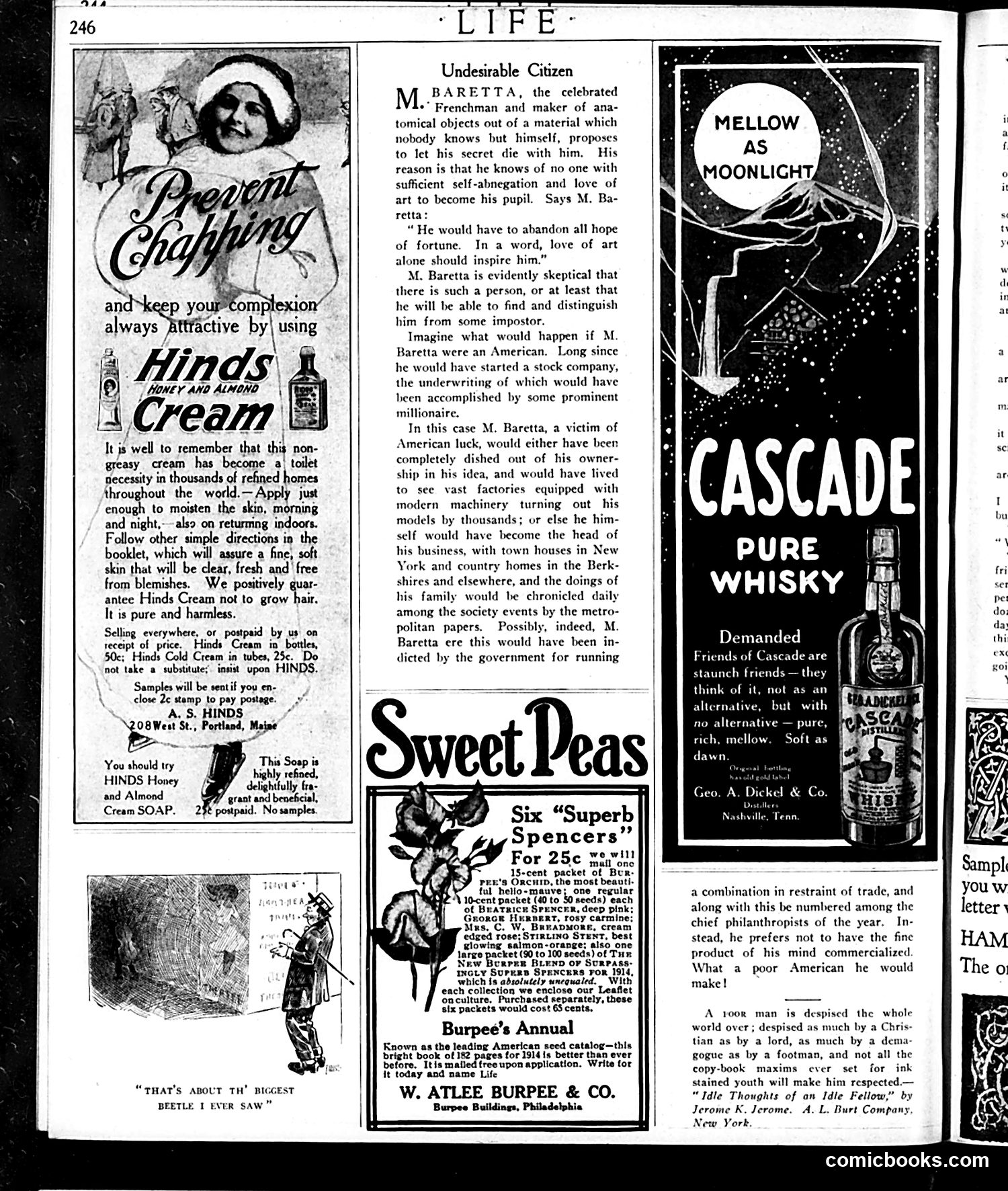
This page is primarily **advertisements** interspersed with a brief satirical essay titled "Undesirable Citizen." The essay mocks **M. Baretta**, a French anatomical sculptor who refuses to commercialize his secret craft, insisting his pupil must be motivated purely by artistic devotion rather than profit. Life's satire targets Baretta's naïveté: if he were American, the piece argues, he'd have inevitably been drawn into capitalism—either losing control of his invention to investors or becoming a wealthy industrialist himself, perhaps even indicted for monopolistic practices. The joke reflects early-20th-century American cynicism about the impossibility of maintaining artistic purity in a commercial society. Baretta's principled refusal to profit is presented as almost absurdly foreign to American values, where even artists eventually get "dished out" of their ideas or become wealthy businessmen. The surrounding ads (Hinds Cream, Burpee seeds, Cascade Whisky) reinforce the page's commercial context, making the satirical point visually ironic.
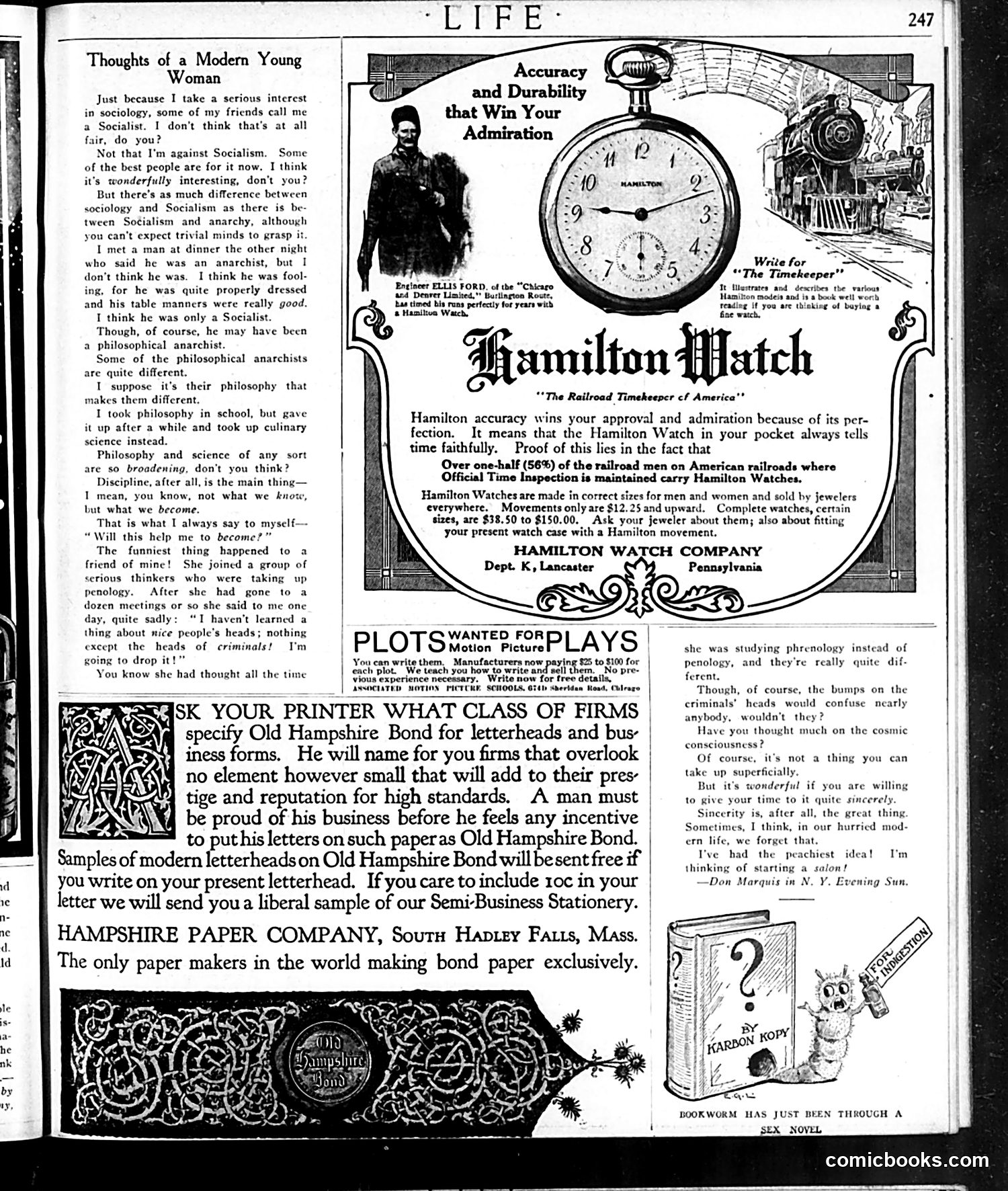
This page contains satirical commentary on an educated young woman's intellectual pretensions. The essay "Thoughts of a Modern Young Woman" mocks a type of person—likely from the Jazz Age era—who adopts fashionable progressive causes (socialism, penology, phrenology) without genuine understanding. The humor lies in her conflating distinct concepts (sociology vs. socialism vs. anarchism), abandoning serious study for "culinary science," and fundamentally misunderstanding subjects she claims to study. Her friend's anecdote about studying phrenology while thinking it was penology exemplifies the satire's point: superficial engagement with intellectual trends. The page also contains period advertisements (Hamilton Watch, Hampshire Paper Company, and acting school), typical of Life magazine's format. The satire targets upper-class dilettantism and the fashionable adoption of radical ideas without substantive commitment—a common critique of 1920s intellectualism.
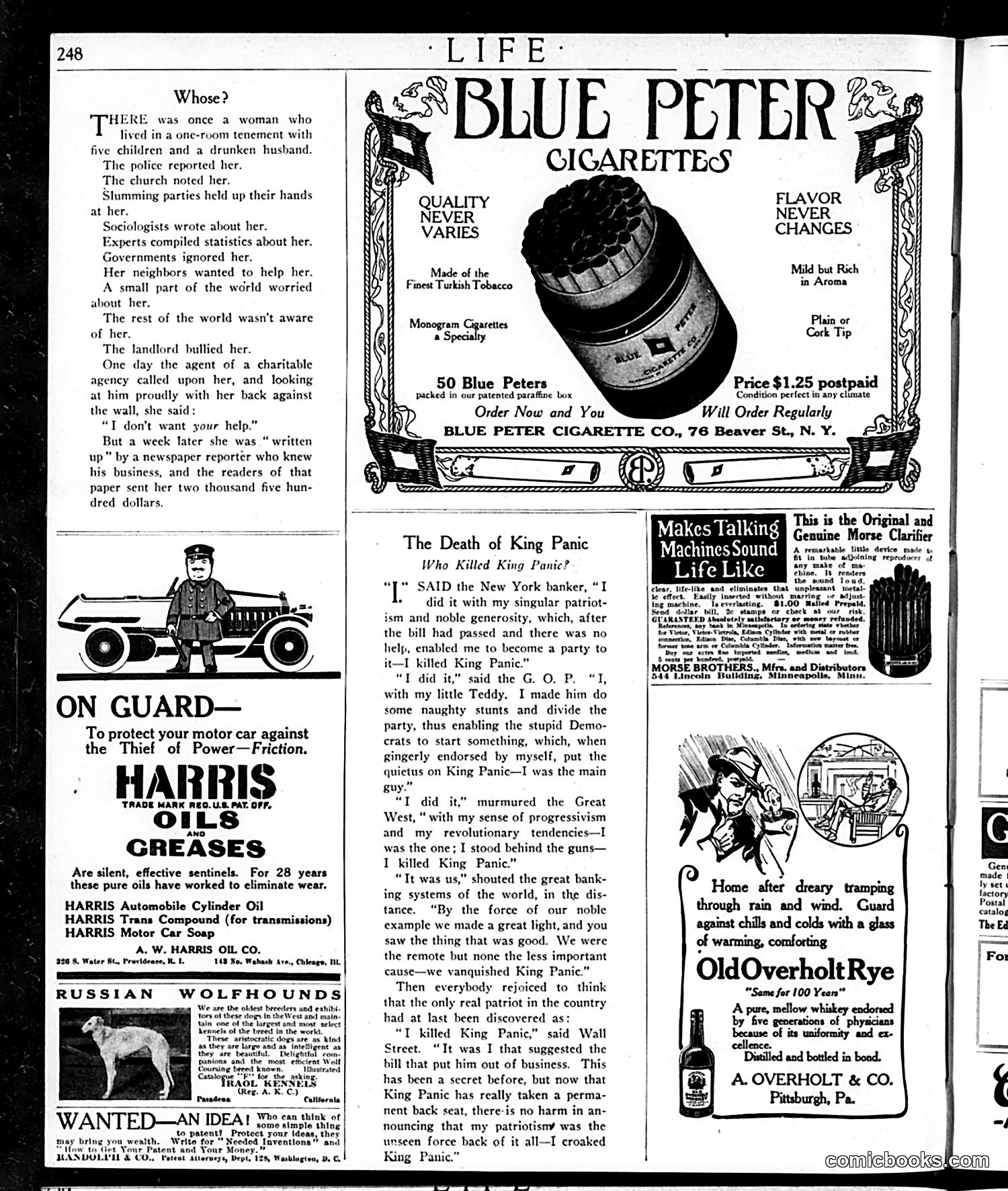
This page primarily contains **period advertisements and satirical editorial content** from an era of social reform discourse (early 20th century). The main satirical piece, "The Death of King Panic," mocks competing claims about who deserves credit for ending an economic crisis (likely the Panic of 1907). Each narrator—a New York banker, the Republican Party (referenced via "Teddy" Roosevelt), the Progressive West, international banking systems, and Wall Street—boasts of their patriotic role. The satire exposes how different power centers opportunistically claim credit for stabilizing the economy while the actual crisis resolution remains murky. The opening "Whose?" poem satirizes indifference toward urban poverty: a poor woman living in a tenement attracts sociological study, charity offers, and judgment—but only newspaper publicity generates actual financial help ($2,500). This critiques how media spectacle, rather than systematic solutions, drives public compassion. The advertisements (cigarettes, motor oil, patent services) are period-typical commercial content.
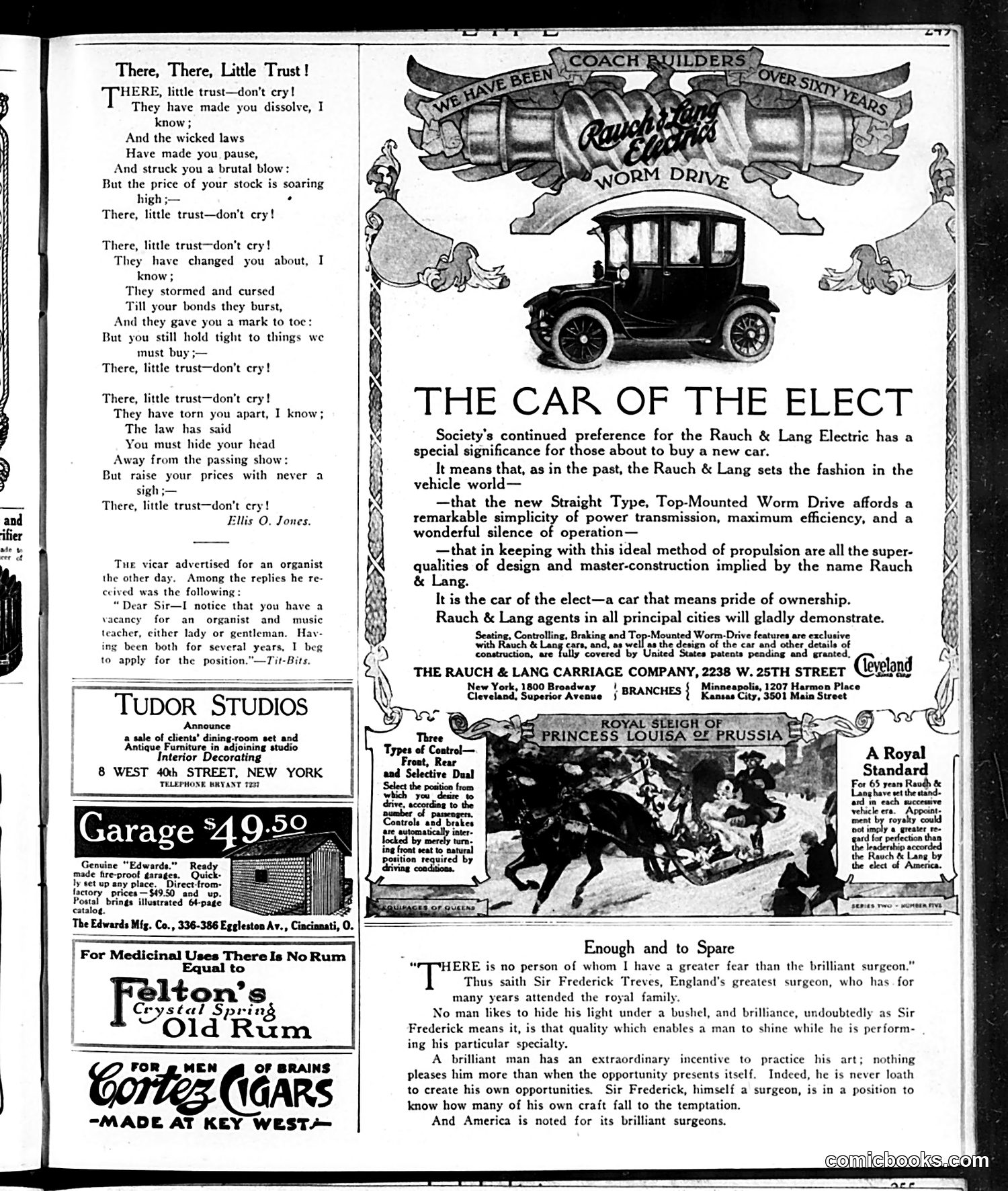
**"There, There, Little Trust!"** is a satirical poem by Ellis O. Jones addressing monopolistic business trusts. The speaker consolingly addresses "Little Trust" as if it were a child, acknowledging that antitrust laws have forced its dissolution and restructuring, yet assuring it that its real power remains intact—it still controls "things we must buy" and can "raise your prices with never a sigh." The satire targets the ineffectiveness of antitrust legislation in the early 20th century. Despite legal intervention meant to break up monopolies, these corporations retained economic dominance through price control. The poem mocks both the inadequacy of regulatory reform and the cynical resilience of corporate power, suggesting that legal action against trusts was largely performative—appearing to punish them while their essential monopolistic control persisted. The page also contains period advertisements (Rauch & Lang automobiles, rum, cigars) typical of *Life* magazine's commercial content.
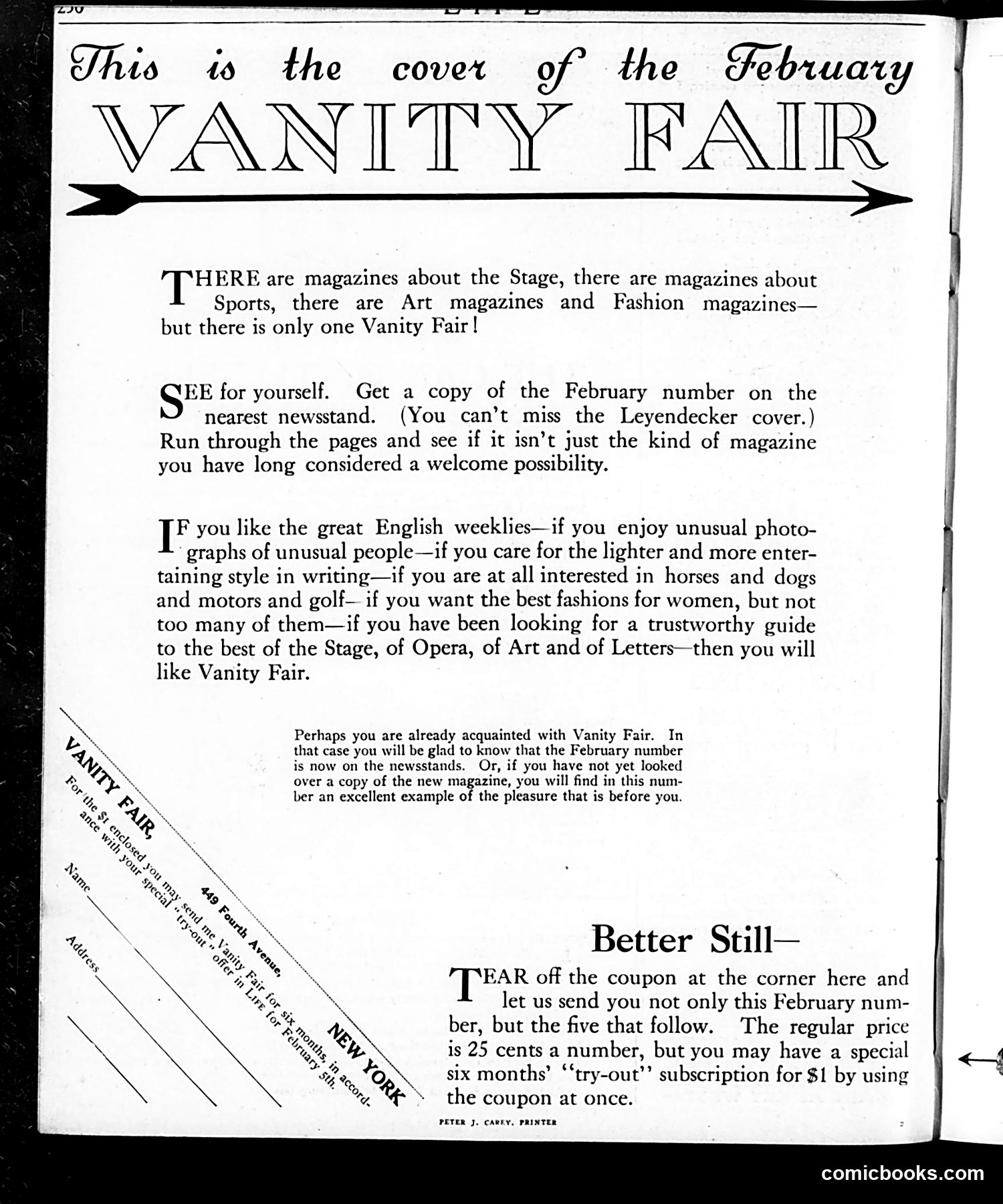
This is primarily **advertising copy**, not a political cartoon. It's a promotional page for *Vanity Fair* magazine's February issue. The page promotes *Vanity Fair* as a sophisticated, comprehensive lifestyle magazine—distinct from specialized publications covering only Stage, Sports, Art, or Fashion. It emphasizes the magazine's appeal to educated, leisured readers interested in culture (opera, theater, letters), leisure activities (horses, golf, motors), and refined fashion. The text references a **Leyendecker cover**—likely J.C. Leyendecker, a prominent illustrator of the era known for glamorous imagery. The page includes a subscription coupon offering six months for $1 (versus 25 cents per issue), a common promotional tactic. The diagonal text on the left appears to be subscription details or address information, though partially obscured. **Context for modern readers**: This reflects early-20th-century American magazine culture, when *Vanity Fair* positioned itself as the arbiter of sophisticated taste for the affluent, educated class.
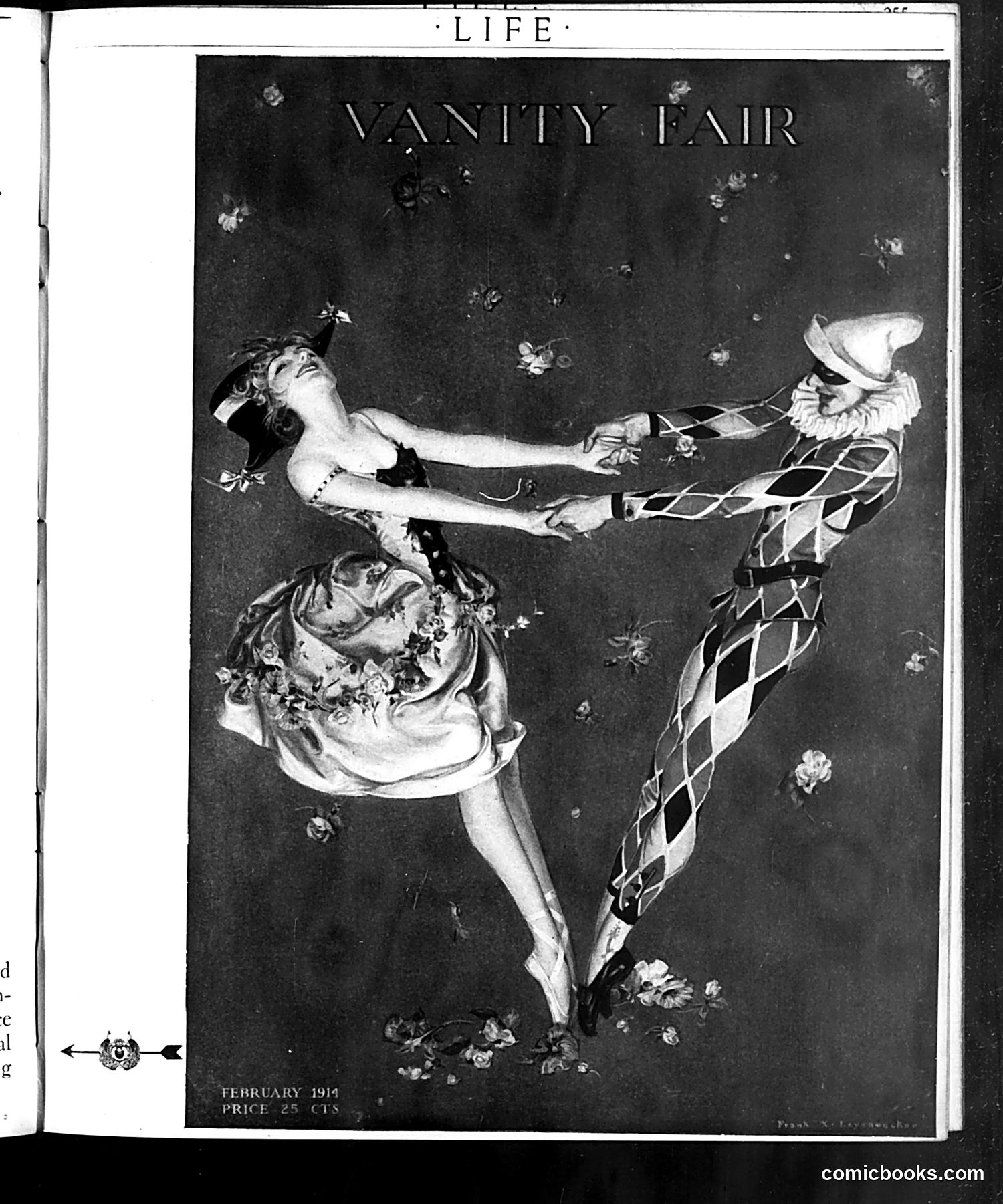
This is a Vanity Fair magazine cover from February 1914, priced at 25 cents. The illustration shows two figures in an ornate, theatrical composition: a woman in an elaborate dress with floral details reclining or floating, and a figure in diamond-patterned harlequin costume holding her hand. Small flowers scatter across the dark background. The image appears to be a satirical commentary on vanity and theatrical pretense—themes central to Life magazine's social satire. The harlequin figure and decorative staging suggest mockery of affectation and artifice in high society or entertainment. The composition's dreamlike, romantic quality contrasts with the satirical intent, emphasizing the gap between fashionable self-presentation and reality that the magazine sought to ridicule. However, without additional context, the specific individuals or events referenced remain unclear.
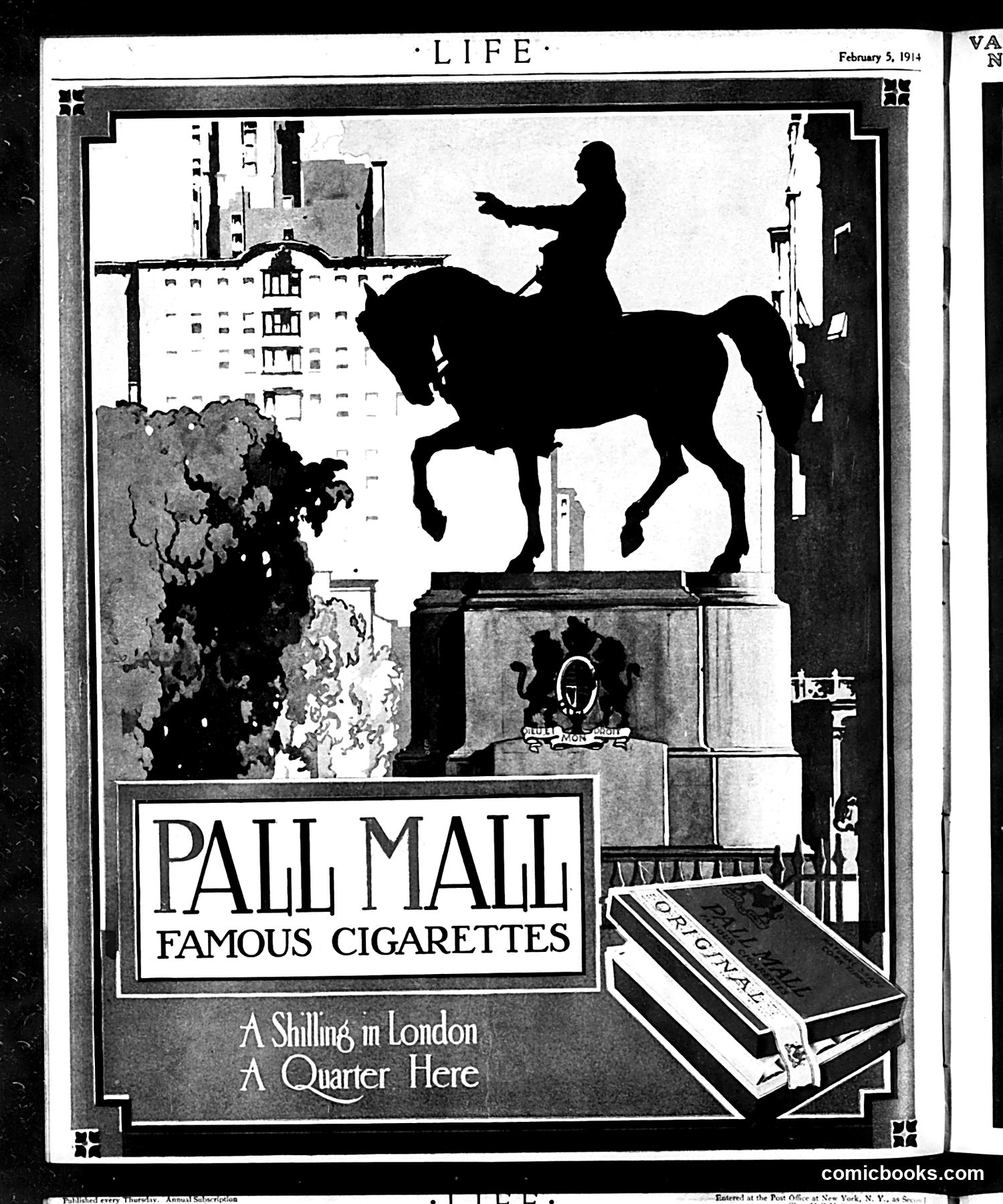
This is a **Pall Mall cigarette advertisement** from Life magazine (February 5, 1914), not political satire. The image depicts an equestrian statue of a figure on horseback in an urban London setting, with period buildings visible in the background. The advertisement's text reads "A Shilling in London / A Quarter Here," emphasizing the cigarettes' affordability and international availability—a Pall Mall cost one shilling in London but only a quarter (25 cents) in America. The equestrian monument likely references a famous London landmark, though the specific statue isn't clearly identified in the visible text. The silhouette style was common in early 20th-century advertising design. The ad aims to convey sophistication and British prestige while highlighting competitive American pricing.