
Life, 1914-02-05 · page 7 of 44
Life — February 5, 1914 — page 7: what you’re looking at
What you’re looking at
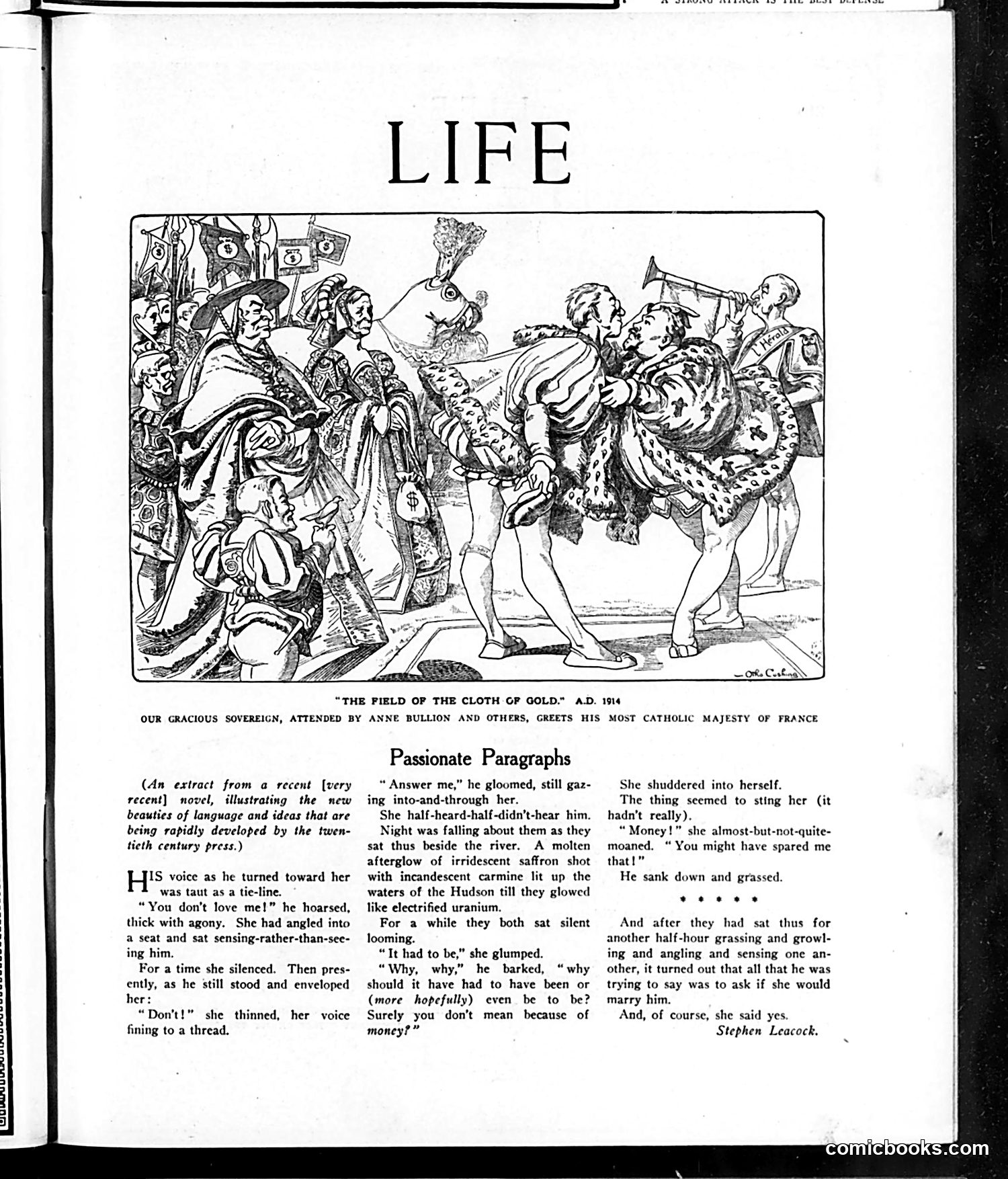
The main illustration depicts a historical scene titled "The Field of the Cloth of Gold," A.D. 1514, referencing the famous diplomatic meeting between King Henry VIII of England and King Francis I of France. The elaborate engraving shows richly dressed nobles in ornate period costumes greeting each other—likely representing the two monarchs and their courts. The accompanying short story, "Passionate Paragraphs" by Stephen Leacock, appears unrelated to the historical image. It's a modern romantic narrative about a couple's relationship conflict, ending with a marriage proposal—likely satirizing contemporary romantic conventions. The juxtaposition suggests *Life* magazine's typical format: pairing historical/classical imagery with contemporary humor to comment on timeless human situations.
📄 Transcribed text from this page (OCR, searchable)
Machine-transcribed from the original scan — historical spelling and the odd misread are preserved.
SETIONG “THE FIELD OF THE CLOTH OF GOLD.” A.D. 1914 OUR GRACIOUS SOVEREIGN, ATTENDED BY ANNE BULLION AND OTHERS, GREETS HIS MOST CATHOLIC MAJESTY OF FRANCE (An extract from a recent [very recent] novel, illustrating the new beauties of language and ideas that are being rapidly developed by the twen- tieth century press.) IS voice as he turned toward her was taut as a tie-line. “You don't love me!” he hoarsed, thick with agony. She had angled into a seat and sat sensing-rather-than-see- ing him. For a time she silenced. Then pres- ently, as he still stood and enveloped her: “Don't!” she thinned, her voice fining to a thread. Passionate Paragraphs “ Answer me,” he gloomed, still gaz- ing into-and-through her. She half-heard-half-didn’t-hear him. Night was falling about them as they sat thus beside the river. A molten afterglow of irridescent saffron shot with incandescent carmine lit up the waters of the Hudson till they glowed like electrified uranium. For a while they both sat silent looming. “It had to be,” she glumped. “Why, why,” he barked, “why should it have had to have been or (more hopefully) even be to be? Surely you don’t mean because of money?” She shuddered into herself. The thing seemed to sting her (it hadn't really). “Money!” she almost-but-not-quite- moaned. “ You might have spared me that!” He sank down and grassed. ee eee And after they had sat thus for another half-hour grassing and growl- ing and angling and sensing one an- other, it turned out that all that he was trying to say was to ask if she would marry him. And, of course, she said yes. Stephen Leacock.