
Life, 1914-02-05 · page 24 of 44
Life — February 5, 1914 — page 24: what you’re looking at
What you’re looking at
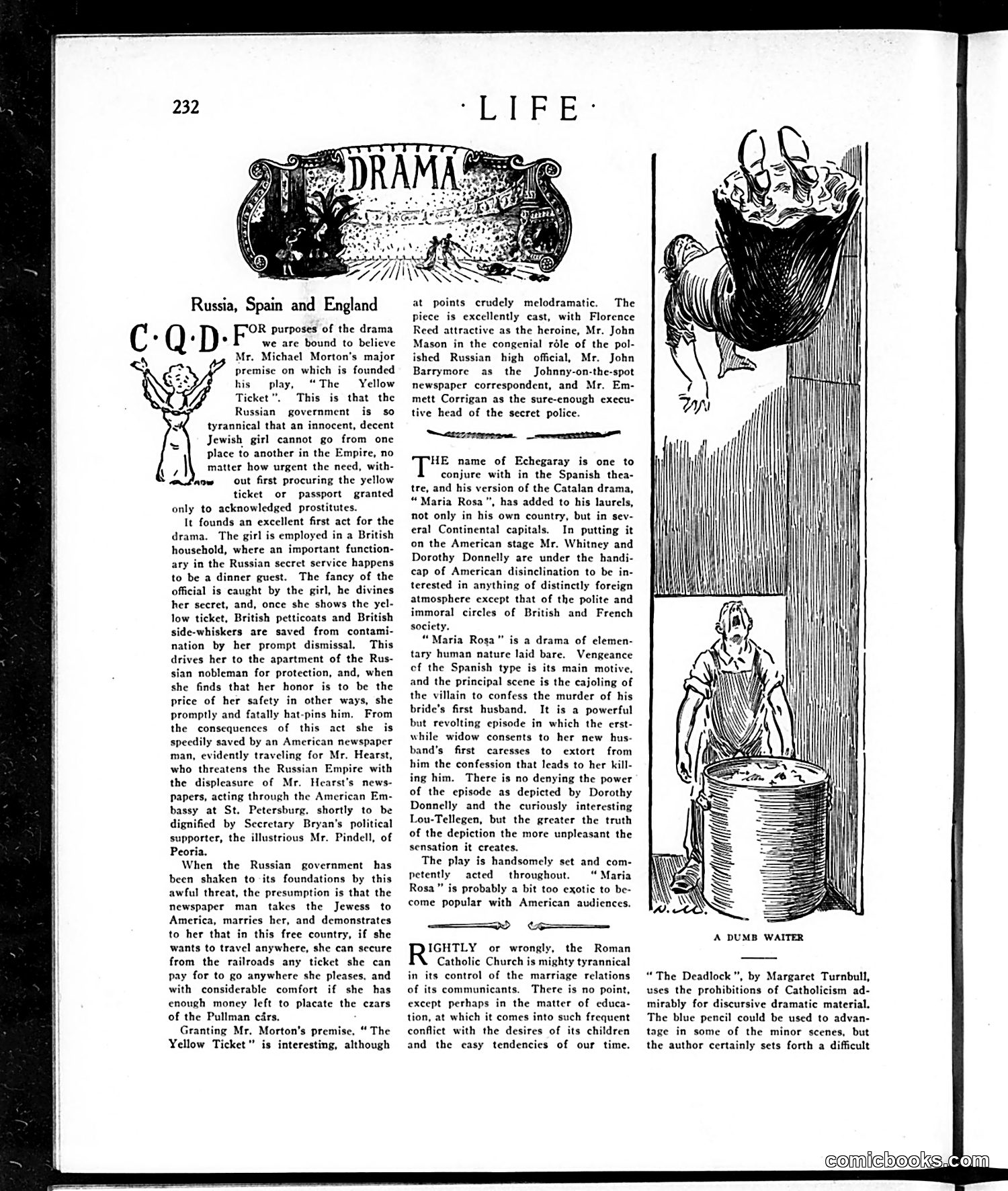
This page reviews three plays: "The Yellow Ticket," "Maria Rosa," and "The Deadlock." The main illustration shows a cartoon figure labeled "A DUMB WAITER"—likely satirizing the waiter character or concept from one of these productions. The text critiques "The Yellow Ticket," which depicts Russian tyranny so severe that innocent Jewish women need prostitution permits to travel. The reviewer notes the irony: an American newspaper man (working for William Randolph Hearst) threatens the Russian Empire into submission, then marries the heroine and brings her to America—where railroad monopolies (the "czars of the Pullman cars") exploit passengers almost as badly as the Russian government. The satire targets both Russian autocracy and American corporate power, suggesting that while America claims freedom, its railroad barons exercise comparable tyranny over ordinary citizens. The reviewer finds the premise melodramatic but effective.
📄 Transcribed text from this page (OCR, searchable)
Machine-transcribed from the original scan — historical spelling and the odd misread are preserved.
Russia, Spain and England . ‘OR purposes of the drama ‘vp we are bound to believe 4 Mr. Michael Morton's major : 4 premise on which is founded his play, “The Yellow Ticket”. This is that the Russian government is so tyrannical that an innocent, decent Jewish girl cannot go from one place to another in the Empire, no matter how urgent the need, with- innw «out first procuring the yellow ticket or passport granted only to acknowledged prostitutes. It founds an excellent first act for the drama. The girl is employed in a British household, where an important function- ary in the Russian secret service happens to be a dinner guest. The fancy of the official is caught by the girl, he divines her secret, and, once she shows the ycl- low ticket, British petticoats and British side-whiskers are saved from contami- nation by her prompt dismissal, This drives her to the apartment of the Rus- sian nobleman for protection, and, when she finds that her honor is to be the price of her safety in other ways, she promptly and fatally hat-pins him. From the consequences of this act she is speedily saved by an American newspaper man, evidently traveling for Mr. Hearst, who threatens the Russian Empire with the displeasure of Mr. Hearst’s news- papers, acting through the American Em- bassy at St. Petersburg. shortly to be dignified by Secretary Bryan's political supporter, the illustrious Mr. Pindell, of Peoria. When the Russian government has been shaken to its foundations by this awful threat, the presumption is that the Newspaper man takes the Jewess to America, marrics her, and demonstrates to her that in this free country, if she wants to travel anywhere, she can secure from the railroads any ticket she can pay for to go anywhere she pleases, and with considerable comfort if she has enough money left to placate the czars of the Pullman cars. Granting Mr. Morton's premise, “ The Yellow Ticket” is interesting, although at points crudely melodramatic. The piece is excellently cast, with Florence Reed attractive as the heroine, Mr. John Mason in the congenial réle of the pol- ished Russian high official, Mr. John Barrymore as the Johnny-on-the-spot newspaper correspondent, and Mr. Em- mett Corrigan as the sure-enough execu- tive head of the secret police. “ature eee ‘HE name of Echegaray is one to conjure with in the Spanish thea- tre, and his version of the Catalan drama, “Maria Rosa”, has added to his laurels, not only in his own country, but in sev- eral Continental capitals. In putting it on the American stage Mr. Whitney and Dorothy Donnelly are under the handi- cap of American disinclination to be in- terested in anything of distinctly foreign atmosphere except that of the polite and immoral circles of British and French society. Maria Rosa” is a drama of elemen- tary human nature laid bare. Vengeance ef the Spanish type is its main motive, and the principal scene is the cajoling of the villain to confess the murder of his bride's first husband, It is a powerful but revolting episode in which the erst- while widow consents to her new hus- band’s first caresses to extort from him the confession that leads to her kill- ing him. There is no denying the power of the episode as depicted by Dorothy Donnelly and the curiously interesting Lou-Tellegen, but the greater the truth of the depiction the more unpleasant the sensation it creates. The play is handsomely set and com- petently acted throughout. —“ Maria Rosa” is probably a bit too exotic to be- come popular with American audiences. SD IGHTLY or wrongly, the Roman Catholic Church is mighty tyrannical in its control of the marriage relations of its communicants. There is no point, except perhaps in the matter of educa- tion, at which it comes into such frequent conflict with the desires of its children and the casy tendencics of our time. i Me ln Mf “The Deadlock”, by Margaret Turnbull, uses the prohibitions of Catholicism ad- mirably for discursive dramatic material. The blue pencil could be used to advan- tage in some of the minor scenes, but the author certainly sets forth a difficult comichooks. fo