
Life, 1914-02-05 · page 41 of 44
Life — February 5, 1914 — page 41: what you’re looking at
What you’re looking at
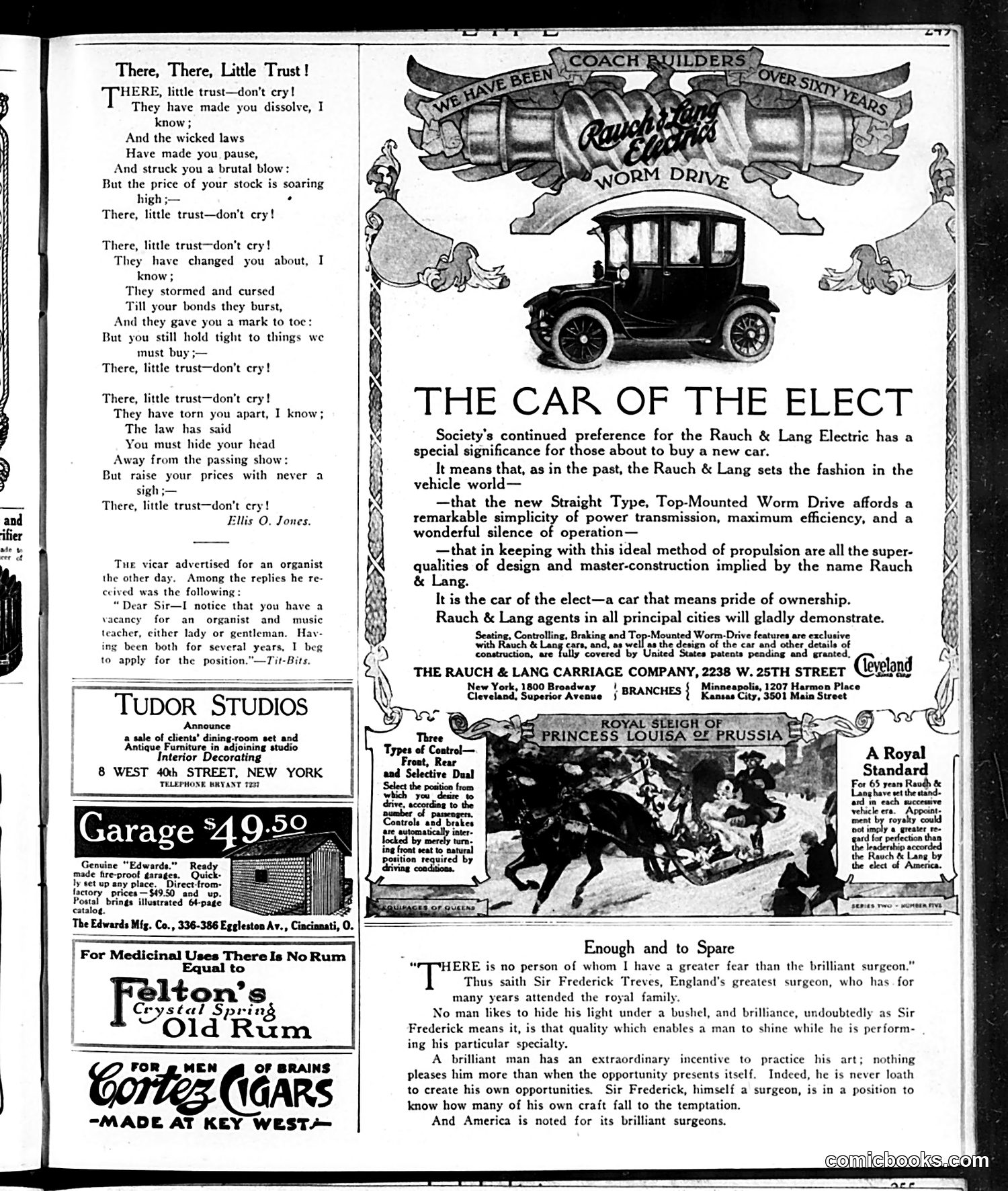
**"There, There, Little Trust!"** is a satirical poem by Ellis O. Jones addressing monopolistic business trusts. The speaker consolingly addresses "Little Trust" as if it were a child, acknowledging that antitrust laws have forced its dissolution and restructuring, yet assuring it that its real power remains intact—it still controls "things we must buy" and can "raise your prices with never a sigh." The satire targets the ineffectiveness of antitrust legislation in the early 20th century. Despite legal intervention meant to break up monopolies, these corporations retained economic dominance through price control. The poem mocks both the inadequacy of regulatory reform and the cynical resilience of corporate power, suggesting that legal action against trusts was largely performative—appearing to punish them while their essential monopolistic control persisted. The page also contains period advertisements (Rauch & Lang automobiles, rum, cigars) typical of *Life* magazine's commercial content.
📄 Transcribed text from this page (OCR, searchable)
Machine-transcribed from the original scan — historical spelling and the odd misread are preserved.
There, There, Little Trust ! HERE, little trust—don't ery! They have made you dissolve, 1 know ; And the wicked laws Have made you pause, And struck you a brutal blow: But the price of your stock is soaring high ;— . There, little trust—don’t cry! There, little trust—don’t cry! They have changed you about, I know ; They stormed and cursed Till your bonds they burst, And they gave you a mark to toc: But you still hold tight to things we must buy ;- There, little trust—don’t cry! There, little trust—don't cry! They have torn you apart, I know; The law has said You must hide your head Away from the passing show: But raise your prices with never a sigh ;— There, little trust—don’t cry! Ellis O. Jones. Tue vicar advertised for an organist the other day, Among the replies he re- ceived was the following : “Dear Sir—I notice that you have a vacancy for an organist and music teacher, cither lady or gentleman. Hav- ing been both for several years, I beg to apply for the position."—Tit-Bits. TUDOR STUDIOS a sale of clients’ dining-room set and Antique Furniture in adjoining studio | Interior Decorating | 8 WEST 40h STREET, NEW YORK | i TELEPHONE BRYANT 1237 Genuine “Edwards.” Ready made hre-proof garages. Quick ly set up any place. Direct-from- factory prices — ‘and up. Postal brings illustrated 64-page catalog. The Edwards Mig. Co., 336-386 Eggleston Av., Cincinnati, O. | For Medicinal Uses There Is No Rum Equal to Iton’ Crystal Lod Old Rum FOR g MEN OF BRAINS IGARS “MADE AT KEY WEST THE CAR OF THE ELECT Society's continued preference for the Rauch & Lang Electric has a special significance for those about to buy a new car. It means that, as in the past, the Rauch & Lang sets the fashion in the vehicle world— —that the new Straight Type, Top-Mounted Worm Drive affords a remarkable simplicity of power transmission, maximum efficiency, and a wonderful silence of operation— —that in keeping with this ideal method of propulsion are all the super- qualities of design and master-construction implied by the name Rauch & Lang. It is the car of the elect—a car that means pride of ownership. Rauch & Lang agents in all principal cities will gladly demonstrate. Seating, Controlling, Braking and Top-Mounted Worm-Drive features are exclusive with Ruch & Lang cars, and. aa well as the design of the car and other detaile of Construction, are fully covered by United States patents pending and granted, THE RAUCH & LANG CARRIAGE COMPANY, 2238 W. 25TH STREET Cveland New York, 1800 Broadway | Minneapolis, 1207 Harmon Pl Cicreloadt Seperioe Avense j BRANCHES {| inossect 350] Main Street Coatrols and brakes are, inter Enough and to Spare ERE is no person of whom | have a greater fear than the brilliant surgeon.” Thus saith Sir Frederick Treves, England's greatest surgeon, who has for many years attended the royal family. No man likes to hide his light under a bushel, and brilliance, undoubtedly as Frederick means it, is that quali ing his particular specialty. A brilliant man has an extraordinary incentive to practice his art; nothing pleases him more than when the opportunity presents itself. Indeed, he is never loath to create his own opportunities. Sir Frederick, himself a surgeon, is in a position to know how many of his own craft fall to the temptation. And America is noted for its brilliant surgeons. y which enables a man to shine while he is perform-