
Life, 1914-02-05 · page 33 of 44
Life — February 5, 1914 — page 33: what you’re looking at
What you’re looking at
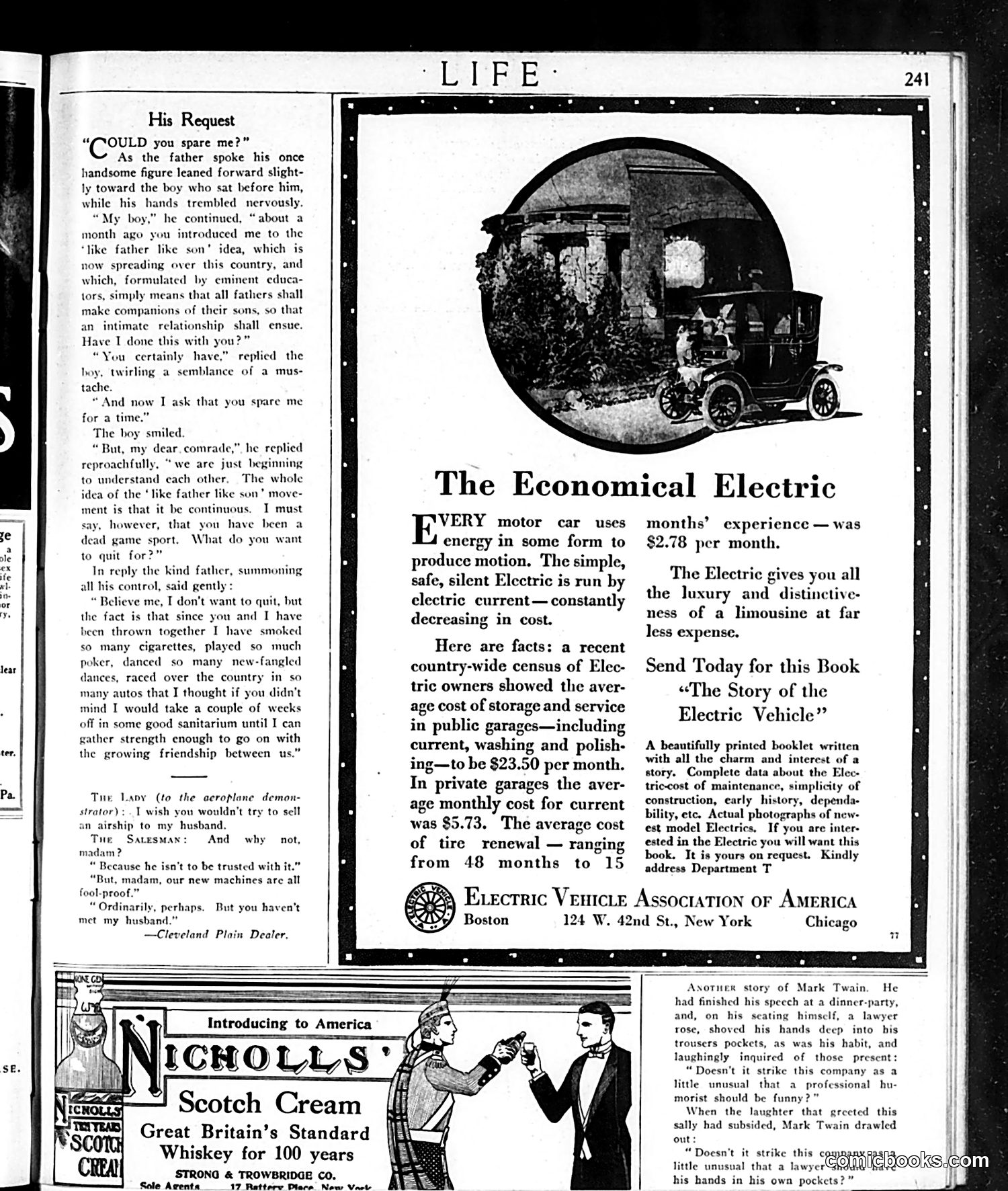
This page contains satirical humor typical of early 20th-century Life magazine. The main cartoon, "His Request," mocks the contemporary "like father like son" movement—an educational philosophy promoting father-son companionship. The joke: a exhausted father begs his teenage son for a break, having been worn out by constant cigarette-smoking, poker-playing, dancing, and reckless auto racing to bond with him. The son refuses, insisting the relationship must be "continuous." The satire targets both the fad's impracticality and generational conflict. Secondary jokes poke fun at wives' concerns about husbands' foolishness and Mark Twain's wit. The bulk of the page advertises electric vehicles and Scotch whiskey—typical period advertising claiming cost-efficiency and luxury. These ads were likely placed alongside the satire as standard magazine content, not as part of the humor.
📄 Transcribed text from this page (OCR, searchable)
Machine-transcribed from the original scan — historical spelling and the odd misread are preserved.
lear His Request “(COULD you spare me?” As the father spoke his once handsome figure leaned forward slight- ly toward the boy who sat before him, while his hands trembled nervously. “My boy,” he continued, “about a month ago introduced me to the ‘like father like son’ idea, which is now spreading over this country, and which, formulated by eminent educa- tors, simply means that all fathers shall make companions of their sons, so that an intimate relationship shall ensue. Have I done this with you?” “You certainly hav replied the hoy, twirling a semblance of a mus- tache. “And now I ask that you spare me for a time.” The hoy smiled. “But, my dear. comrade,” he replied reproachfully, “we are just beginning to understand each other, The whole idea of the ‘like father like son’ move- ment is that it be continuous. I must , however, that you have been a dead game sport. What do you want to quit for?” In reply the kind father, summoning all his control, said gently : “ Believe me, I don’t want to quit, but the fact is that since you and I have heen thrown together I have smoked so many cigarettes, played so much poker, danced so many new-fangled dances, raced over the country in so many autos that I thought if you didn't mind I would take a couple of wecks off in some good sanitarium until I can gather strength enough to go on with the growing friendship between us.” Tun Lapy (to the aeroplane demon- strator): 1 wish you wouldn't try to sell an airship to my husband. Tue Satesmax: And why not, madam? “ Because he isn’t to be trusted with it.” “But, madam, our new machines are all fool-proof. “ Ordinarily, perhaps. But you haven't met my husband.” —Cleveland Plain Dealer. The Economical Electric VERY motor car uses energy in some form to produce motion. The simple, safe, silent Electric is run by electric current — constantly decreasing in cost. Here are facts: a recent country-wide census of Elec- tric owners showed the aver- age cost of storage and service in public garages—including current, washing and polish- ing—to be $23.50 per month. In private garages the aver- age monthly cost for current was $5.73. The average cost of tire renewal — ranging from 48 months to 15 Sole Agenta Scotch Cream Great Britain’s Standard Whiskey for 100 years STRONG & TROWBRIDGE CO. 17 Rettere Place New Vacl months’ experience — was $2.78 per month. The Electric gives you all the luxury and distinctive- ness of a limousine at far less expense. Send Today for this Book «The Story of the Electric Vehicle” A beautifully printed booklet written with all the charm and interest of a story. Complete data about the Elec- tric-cost of maintenance, simplicity of construction, early history, dependa- bility, etc, Actual photographs of new- est model Electrics, If you are inter ested in the Electric you will want this book. It is yours on request. Kindly address Department T Ayoruer story of Mark Twain. He had finished his speech at a dinner-party, and, on his seating himsclf, a lawyer rose, shoved his hands deep into bis trousers pockets, as was his habit, and laughingly inquired of those present: “Doesn't it strike this company as a little unusual that a professional hu- morist should be funny?” When the laughter that greeted this sally had subsided, Mark Twain drawled out: “Doesn't it strike this ¢ his hands in his owa pockets?” om