
Life, 1914-02-05 · page 37 of 44
Life — February 5, 1914 — page 37: what you’re looking at
What you’re looking at
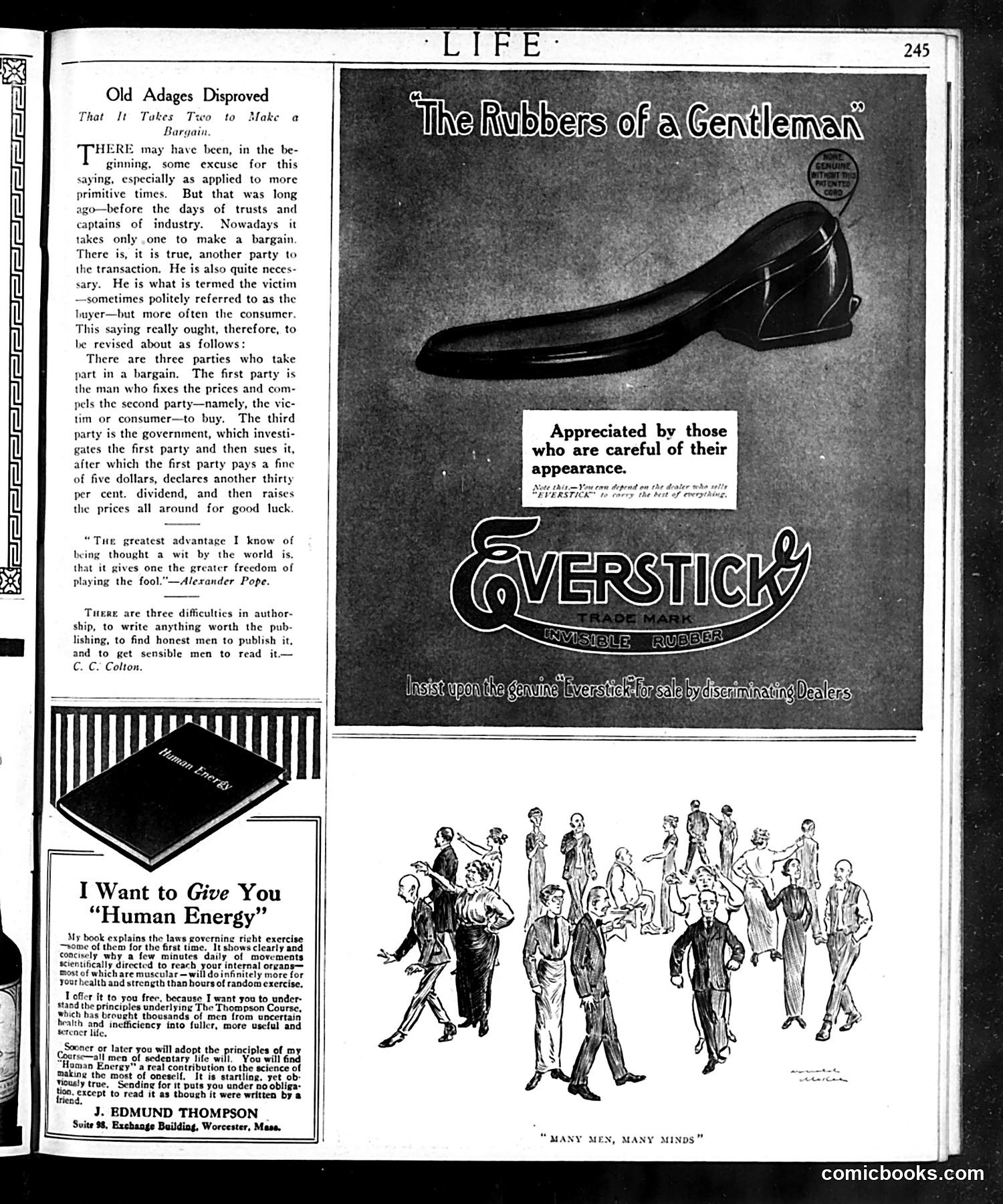
This page contains satirical commentary on modern capitalism and corporate power. **"Old Adages Disproved"** mocks the saying "it takes two to make a bargain." The satire argues that in the industrial age, only one party (big business/monopolies) actually controls transactions. The "consumer" or "victim" has no real choice. The piece sarcastically describes how corporations set prices, exploit consumers, then when government fines them minimal amounts ("five dollars"), they simply raise prices further to compensate—profiting from their own misconduct. The Alexander Pope and C.C. Colton quotes reinforce the magazine's satirical tone about truth-telling. **The advertisements** (Everstick rubber and "Human Energy" book) are typical period ads unrelated to the satire. **"Many Men, Many Minds"** (bottom illustration) depicts diverse crowds, likely illustrating individual variation referenced in the adage. The overall message critiques how industrial-era monopolies and trusts had rendered consumers powerless, with government enforcement too weak to meaningfully restrain corporate practices.
📄 Transcribed text from this page (OCR, searchable)
Machine-transcribed from the original scan — historical spelling and the odd misread are preserved.
Old Adages Disproved That It Takes Two to Make a Bargain. HERE may have been, in the be- ginning, some excuse for this saying, especially as applied to more primitive times. But that was long ago—before the days of trusts and captains of industry. Nowadays it takes only one to make a_ bargain. There is, it is true, another party to the transaction. He is also quite neces- sary. He is what is termed the victim —sometimes politely referred to as the luyer—but more often the consumer. This saying really ought, therefore, to be revised about as follows: There are three parties who take part in a bargain. The first party is the man who fixes the prices and com- pels the second party—namely, the vic- tim or consumer—to buy. The third party is the government, which investi- gates the first party and then sues it, after which the first party pays a fine of five dollars, declares another thirty per cent. dividend, and then raises the prices all around for good luck. “Tue greatest advantage I know of being thought a wit by the world is, that it gives one the greater freedom of playing the fool."—Alexander Pope. Tuere are three difficulties in author- ship, to write anything worth the pub- lishing, to find honest men to publish it, and to get sensible men to read it.— C. C. Colton. BD I Want to Give You “Human Energy” My book explains the laws governing right exercise some of them for the first time. It shows clearly and concisely why a few minutes daily of movements Kientifically directed to reach your internal organs— most of which are muscular — will do infinitely more for yourhealth and strength than hours of random exercise. T offer it to you free, because I want you to under stand the principles underlying The Thompson Course, Bich has brought thousands of men from uncertain health and inefficiency into fuller, more useful and ener life, Sooner of later you will adopt the principles of m Goarse—all men of sedentary life will. You will 60d Homan Energy” a real contribut the science of making the most of oneself. It is startling, yet ob- Tiously true. Sending for it puts you under no obliga- £20, FCebt to read it as though it were written by Appreciated by those who are careful of their appearance. Note Ait Vou eam depend on Oe doater wha 0 ote carry the best of every) J. EDMUND THOMPSON k 98, Exchange Building, Worcester, Mase, “MANY MEN, MANY MINDS” comicbooks.com