
Life, 1914-02-05 · page 20 of 44
Life — February 5, 1914 — page 20: what you’re looking at
What you’re looking at
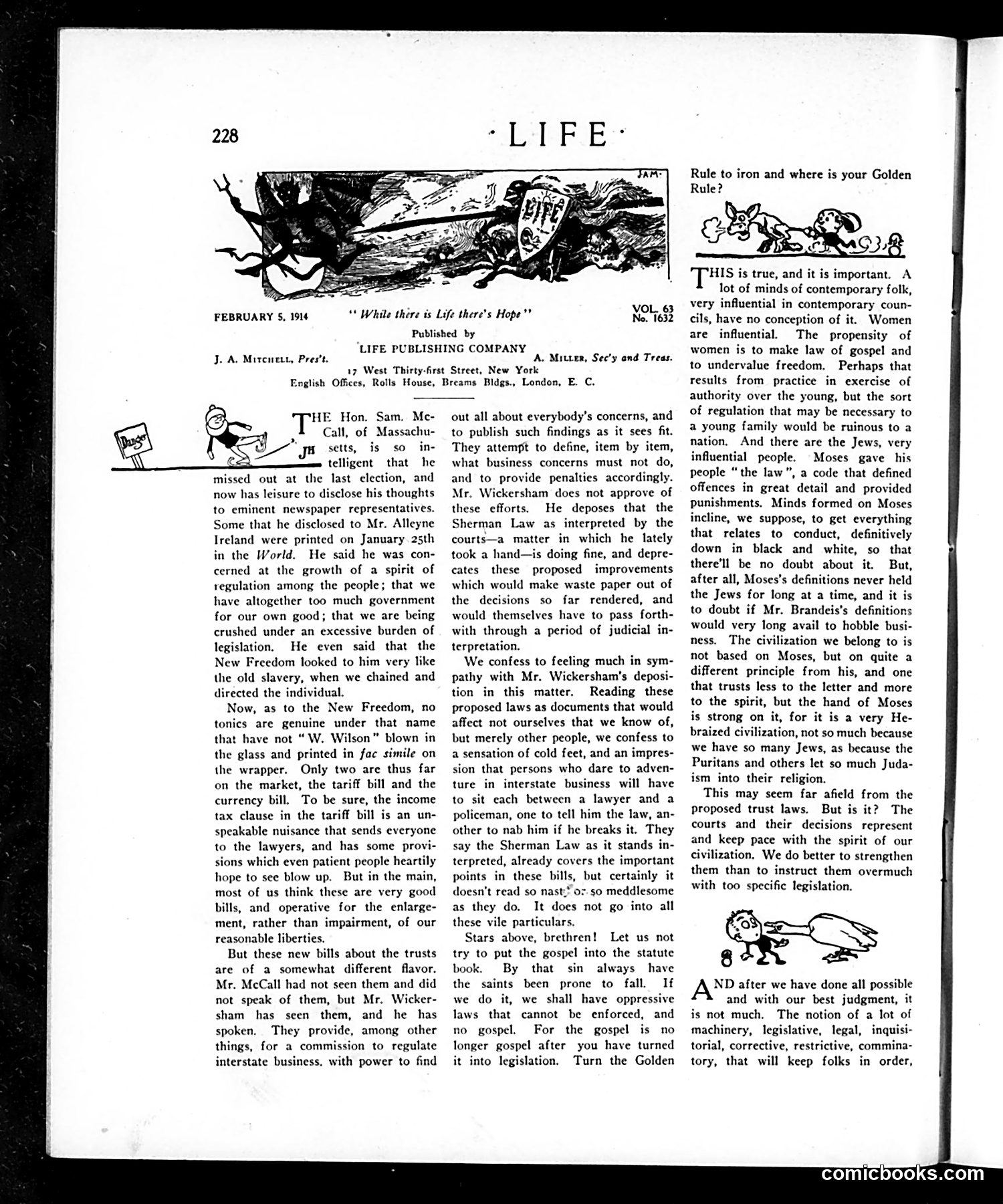
This page critiques regulatory overreach in Progressive Era business reform. The article attacks proposed trust-regulation bills (likely Sherman Act amendments), arguing they're excessive and unenforceable. **Key figures:** Sam McCall (Massachusetts politician who lost reelection) and George Wickersham (former Attorney General) represent skeptics of new regulations. The piece sarcastically opposes detailed legislation targeting interstate business practices. **The satire's point:** The author warns against translating moral principles ("Golden Rule") into rigid laws—they become oppressive machinery rather than ethical guidance. The cartoon (showing a figure being crushed) visually reinforces this message about regulation's burden. **Context for modern readers:** This reflects genuine Progressive-era tension between reformers wanting corporate oversight versus business interests and their allies opposing "excessive" government intervention. The piece mocks regulatory specificity as unworkable overkill, a debate that persists today.
📄 Transcribed text from this page (OCR, searchable)
Machine-transcribed from the original scan — historical spelling and the odd misread are preserved.
FEBRUARY §, 1914 “* While there is Life there’s Hope"’ Published by LIFE PUBLISHING COMPANY J. A. Mitcnett, Pres’t. HE Hon. Sam. Mc- Call, of Massachu- o- ys setts, is so in- telligent that he missed out at the last election, and now has leisure to disclose his thoughts to eminent newspaper representatives. Some that he disclosed to Mr. Alleyne Ireland were printed on January 25th in the World. He said he was con- cerned at the growth of a spirit of regulation among the people; that we have altogether too much government for our own good; that we are being crushed under an excessive burden of legislation. He even said that the New Freedom looked to him very like the old slavery, when we chained and directed the individual, Now, as to the New Freedom, no tonics are genuine under that name that have not “W. Wilson” blown in the glass and printed in fac simile on the wrapper. Only two are thus far on the market, the tariff bill and the currency bill, To be sure, the income tax clause in the tariff bill is an un- speakable nuisance that sends everyone to the lawyers, and has some provi- sions which even patient people heartily hope to see blow up. But in the main, most of us think these are very good bills, and operative for the enlarge- ment, rather than impairment, of our reasonable liberties. But these new bills about the trusts are of a somewhat different flavor. Mr. McCall had not seen them and did not speak of them, but Mr. Wicker- sham has seen them, and he has spoken. They provide, among other things, for a commission to regulate interstate business, with power to find A. Mitten, Sec’y and Treas. 17 West Thirty-first Street, New York English Offices, Rolls House, Breams Bldgs., London, E. C. out all about everybody's concerns, and to publish such findings as it sees fit. They attempt to define, item by item, what business concerns must not do, and to provide penalties accordingly. Mr. Wickersham does not approve of these efforts. He deposes that the Sherman Law as interpreted by the courts—a matter in which he lately took a hand—is doing fine, and depre- cates these proposed improvements which would make waste paper out of the decisions so far rendered, and would themselves have to pass forth- with through a period of judicial in- terpretation. We confess to feeling much in sym- pathy with Mr. Wickersham's deposi- tion in this matter. Reading these proposed laws as documents that would affect not ourselves that we know of, but merely other people, we confess to a sensation of cold feet, and an impres- sion that persons who dare to adven- ture in interstate business will have to sit each between a lawyer and a policeman, one to tell him the law, an- other to nab him if he breaks it. They say the Sherman Law as it stands in- terpreted, already covers the important points in these bills, but certainly it doesn’t read so nast,* oz. s0 meddlesome as they do. It does not go into all these vile particulars. Stars above, brethren! Let us not try to put the gospel into the statute book. By that sin always have the saints been prone to fall. If we do it, we shall have oppressive laws that cannot be enforced, and no gospel. For the gospel is no longer gospel after you have turned it into legislation, Turn the Golden Rule to iron and where is your Golden Rule? THs is true, and it is important. A lot of minds of contemporary folk, very influential in contemporary coun- cils, have no conception of it. Women are influential. The propensity of women is to make law of gospel and to undervalue freedom. Perhaps that results from practice in exercise of authority over the young, but the sort of regulation that may be necessary to a young family would be ruinous to a nation, And there are the Jews, very influential people. Moses gave his people “the law”, a code that defined offences in great detail and provided punishments. Minds formed on Moses incline, we suppose, to get everything that relates to conduct, definitively down in black and white, so that there'll be no doubt about it. But, after all, Moses’s definitions never held the Jews for long at a time, and it is to doubt if Mr. Brandeis’s definitions would very long avail to hobble busi- ness. The civilization we belong to is not based on Moses, but on quite a different principle from his, and one that trusts less to the letter and more to the spirit, but the hand of Moses is strong on it, for it is a very He- braized civilization, not so much because we have so many Jews, as because the Puritans and others let so much Juda- ism into their religion. This may seem far afield from the Proposed trust laws. But is it? The courts and their decisions represent and keep pace with the spirit of our civilization, We do better to strengthen them than to instruct them overmuch with too specific legislation. ND after we have done all possible and with our best judgment, it is not much. The notion of a lot of machinery, legislative, legal, inquisi- torial, corrective, restrictive, commina- tory, that will keep folks in order, comicbooks.com