
Life, 1914-02-05 · page 10 of 44
Life — February 5, 1914 — page 10: what you’re looking at
What you’re looking at
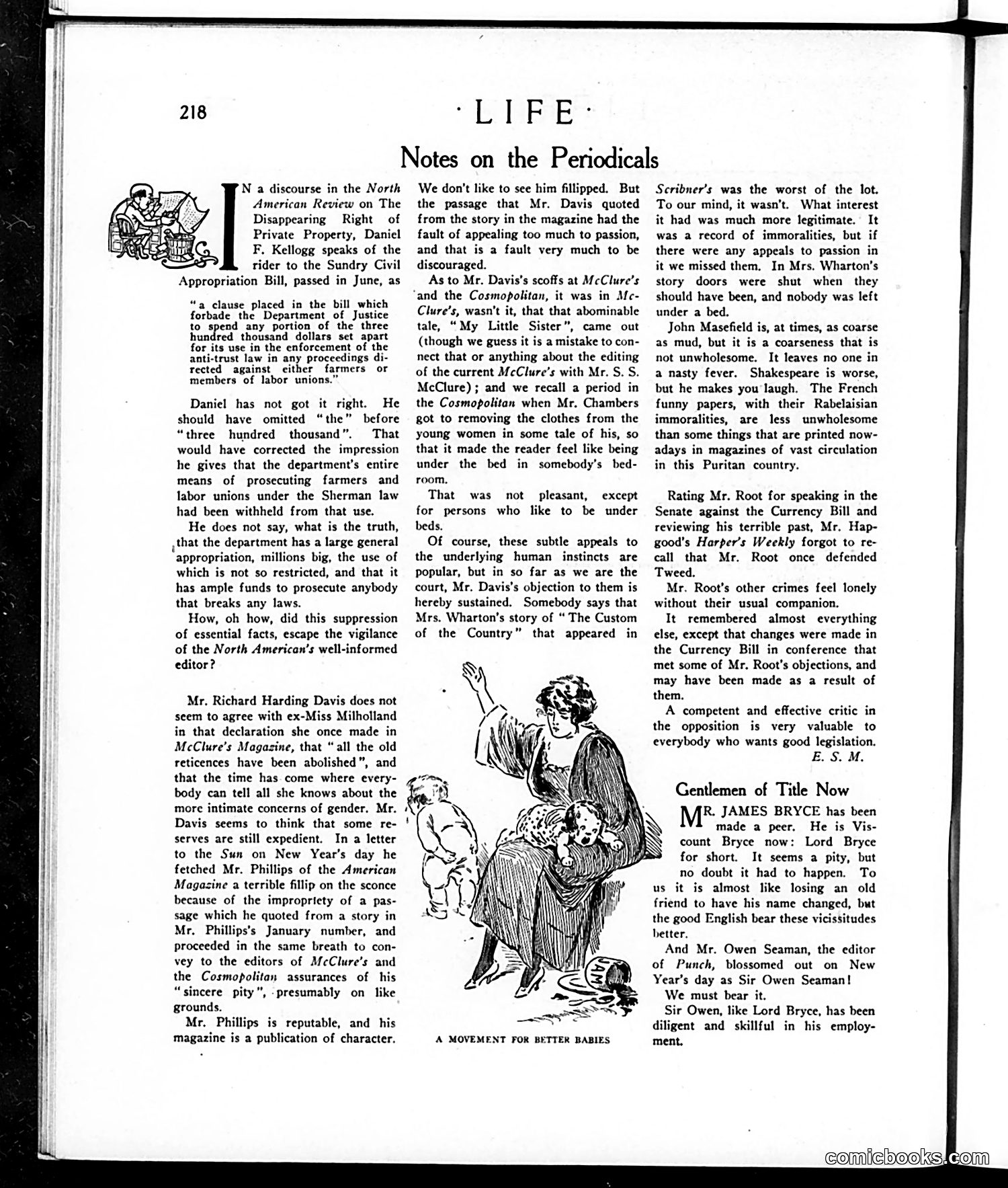
This page contains editorial commentary on early 20th-century magazine controversies. The main illustration, titled "A Movement for Better Babies," depicts a woman with children—likely referencing the contemporaneous "Better Babies" movement, a eugenics-influenced public health campaign. The text discusses disputes between magazines: *McClure's*, the *Cosmopolitan*, and others over editorial practices and content standards. Richard Harding Davis criticized *McClure's* for publishing sensational material. The editors debate whether certain stories (like Mrs. Wharton's "The Custom of the Country") are too coarse or immoral for popular magazines. The final section announces that James Bryce and Owen Seaman have received peerages, treating this as noteworthy social promotion.
📄 Transcribed text from this page (OCR, searchable)
Machine-transcribed from the original scan — historical spelling and the odd misread are preserved.
N a discourse in the North American Review on The Disappearing Right of Private Property, Daniel F. Kellogg speaks of the rider to the Sundry Civil Appropriation Bill, passed in June, as “a clause placed in the bill which forbade the Department of Justice to spend any portion of the three hundred thousand dollars set apart for its use in the enforcement of the anti-trust law in any proceedings di- rected against either farmers or members of labor unions.” Daniel has not got it right. He should have omitted “the” before “three hundred thousand”. That would have corrected the impression he gives that the department’s entire means of prosecuting farmers and labor unions under the Sherman law had been withheld from that use. He does not say, what is the truth, ,that the department has a large general appropriation, millions big, the use of which is not so restricted, and that it has ample funds to prosecute anybody that breaks any laws. How, oh how, did this suppression of essential facts, escape the vigilance of the North American’s well-informed editor? Mr. Richard Harding Davis does not seem to agree with ex-Miss Milholland in that declaration she once made in McClure’s Magazine, that “all the old reticences have been abolished”, and that the time has come where every- body can tell all she knows about the morc intimate concerns of gender. Mr. Davis seems to think that some re- serves are still expedient. In a letter to the Sun on New Year’s day he fetched Mr. Phillips of the American Magaszine a terrible fillip on the sconce because of the impropriety of a pas- sage which he quoted from a story in Mr. Phillips's January number, and proceeded in the same breath to con- vey to the editors of McClure’s and the Cosmopolitan assurances of his “sincere pity", -presumably on like grounds. Mr. Phillips is reputable, and his magazine is a publication of character. “EEE Notes on the Periodicals We don't like to see him fillipped. But the passage that Mr. Davis quoted from the story in the magazine had the fault of appealing too much to passion, and that is a fault very much to be discouraged. As to Mr. Davis's scoffs at McClure’s and the Cosmopolitan, it was in Mc- Clure’s, wasn't it, that that abominable tale, “My Little Sister”, came out (though we guess it is a mistake to con- nect that or anything about the editing of the current McClure’s with Mr. S. S. McClure) ; and we recall a period in the Cosmopolitan when Mr. Chambers got to removing the clothes from the young women in some tale of his, so that it made the reader feel like being under the bed in somebody’s bed- room, That was not pleasant, except for persons who like to be under beds. Of course, these subtle appeals to the underlying human instincts are popular, but in so far as we are the court, Mr. Davis's objection to them is hereby sustained. Somebody says that Mrs. Wharton's story of “ The Custom of the Country” that appeared in 4] \ M® A MOVEMENT FOR BETTER BABIES Scribner's was the worst of the lot. To our mind, it wasn't. What interest it had was much more legitimate. It was a record of immoralities, but if there were any appeals to passion in it we missed them. In Mrs, Wharton's story doors were shut when they should have been, and nobody was left under a bed. John Masefield is, at times, as coarse as mud, but it is a coarseness that is not unwholesome. It leaves no one in a nasty fever. Shakespeare is worse, but he makes you laugh. The French funny papers, with their Rabelaisian immoralities, are less unwholesome than some things that are printed now- adays in magazines of vast circulation in this Puritan country. Rating Mr. Root for speaking in the Senate against the Currency Bill and reviewing his terrible past, Mr. Hap- good's Harper's Weekly forgot to re- call that Mr. Root once defended Tweed. Mr. Root’s other crimes feel lonely without their usual companion. It remembered almost everything else, except that changes were made in the Currency Bill in conference that met some of Mr. Root’s objections, and may have been made as a result of them. A competent and effective critic in the opposition is very valuable to everybody who wants good legislation. E.S.M. Gentlemen of Title Now JAMES BRYCE has been made a peer. He is Vis- count Bryce now: Lord Bryce for short. It seems a pity, but no doubt it had to happen. To us it is almost like losing an old friend to have his name changed, but the good English bear these vicissitudes better. And Mr. Owen Seaman, the editor of Punch, blossomed out on New Year’s day as Sir Owen Seaman! We must bear it. Sir Owen, like Lord Bryce, has been diligent and skillful in his employ- ment. comichooks,