
Life, 1914-02-05 · page 17 of 44
Life — February 5, 1914 — page 17: what you’re looking at
What you’re looking at
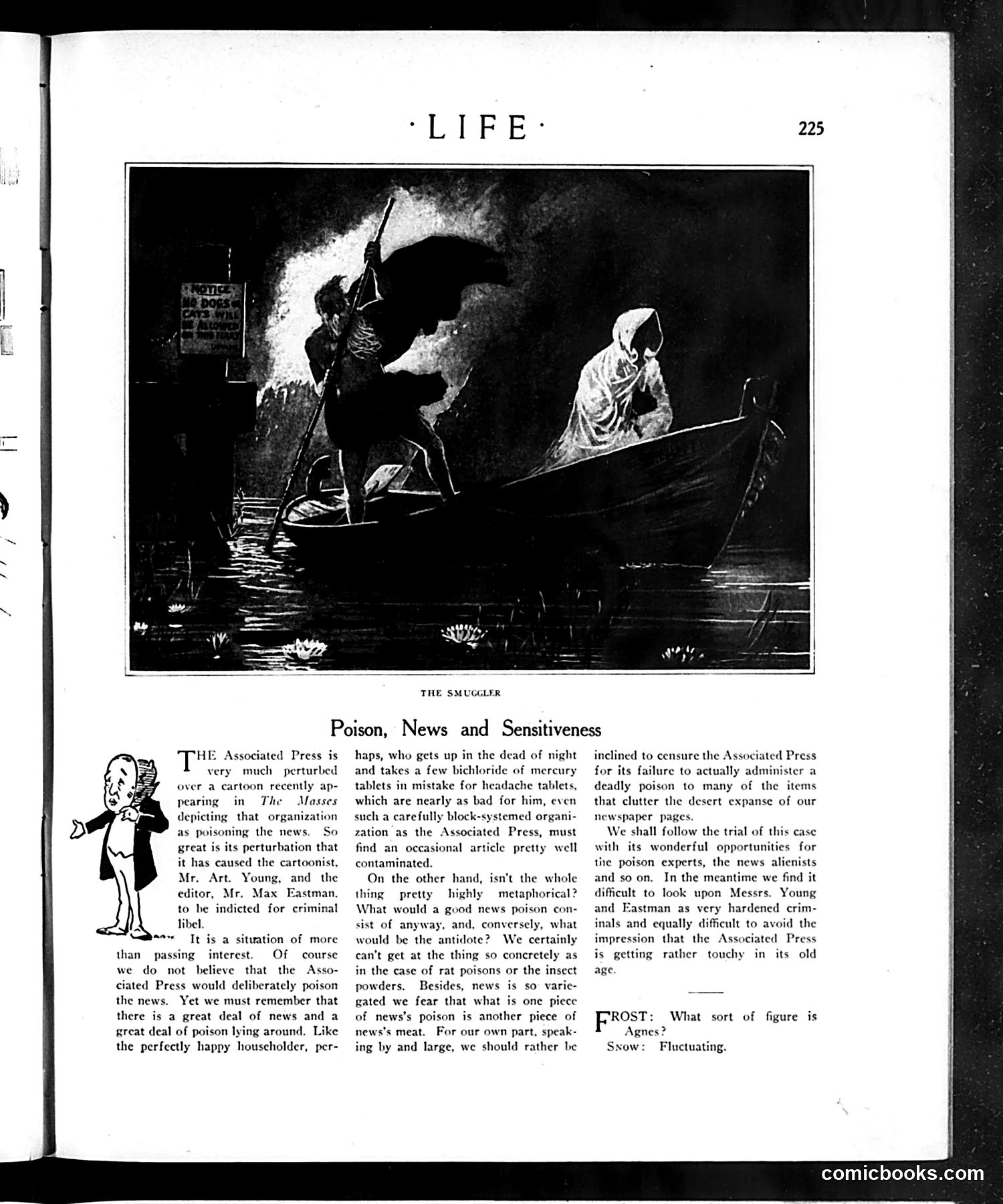
This page discusses a real legal case: cartoonist Art Young and editor Max Eastman were indicted for criminal libel by the Associated Press after *The Masses* magazine published Young's cartoon depicting AP as "poisoning the news." The illustration shows a nighttime smuggling scene—a visual metaphor for how the AP allegedly contaminates news coverage. Life's editorial takes a satirical middle position: while defending Young and Eastman's right to criticize, it argues the metaphor of "poison news" is too abstract to prove literally. The author sarcastically suggests AP's real problem is failing to poison *enough* news—implying much published content deserves suppression. The piece mocks AP's sensitivity to criticism ("getting rather touchy in its old age") while questioning whether news manipulation can be prosecuted as criminal libel. The debate reflects early 20th-century tensions over press freedom and corporate media accountability.
📄 Transcribed text from this page (OCR, searchable)
Machine-transcribed from the original scan — historical spelling and the odd misread are preserved.
THE SMUGGLER Poison, News and Sensitiveness ssociated Press is much perturbed aE: | very over a cartoon recently ap- pearing in) The Masses depicting that organization as poisoning the news. So great is its perturbation that it has caused the cartoonist, Mr, Art. Young, and the editor, Mr. Max Eastman, to be indicted for criminal libel. It is a sitwation of more than passing — interest. Of we do not believe that the Asso- ciated Press would deliberately poison the news. Yet we must remember that there is a great deal of news and a great deal of poison lying around. Like the perfectly happy householder, per- course haps, who gets up in the dead of night and takes a few bichloride of mercury tablets in mistake for headache tablets, which are nearly as bad for him, even such a carefully block-systemed organi- zation as the Associated Press, must find an occasional article pretty well contaminated. On the other hand, isn’t the whole thing pretty highly metaphorical? What would a good news poison con- sist of anyway, and, conversely, what would be the antidote? We certainly can’t get at the thing so concretely as in the case of rat poisons or the insect powders, Besides, news is so varie- gated we fear that what is one piece of news’s poison is another piece of news’s meat. For our own part, speak- ing by and large, we should rather be inclined to censure the Associated Press for its failure to actually administer a deadly poison to many of the items that clutter the desert expanse of our newspaper pages. We shall follow the trial of this case with its wonderful opportunities for the poison experts, the news alienists and so on. In the meantime we find it difficult to look upon Messrs. Young and Eastman as very hardened crim- inals and equally difficult to avoid the impression that the Associated Press is getting rather touchy in its old age ROST: Agnes? Snow: Fluctuating. What sort of figure is comicbooks.com