
A complete issue · 44 pages · 1913
Life — November 20, 1913
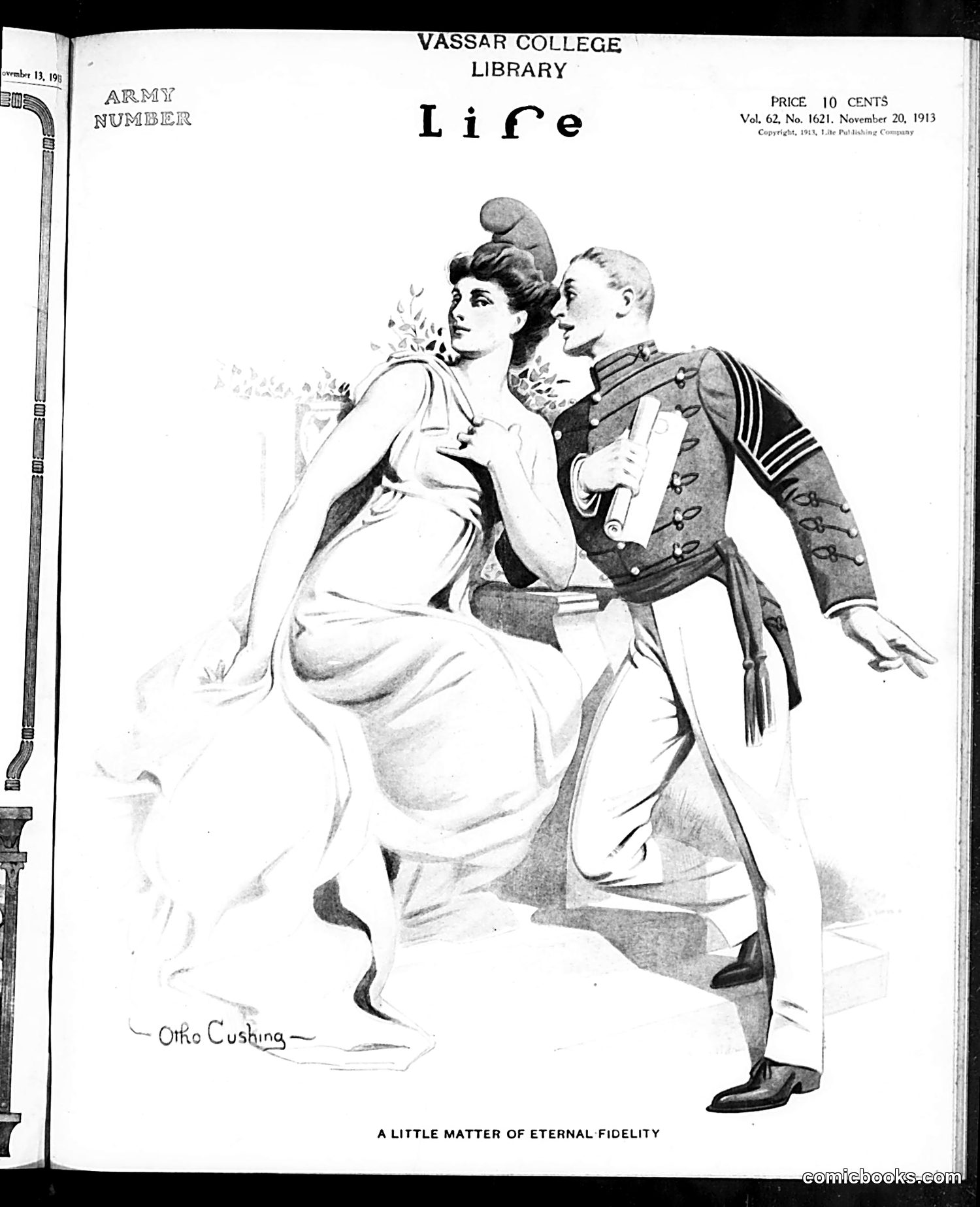
This cartoon by Otto Cushing depicts a romantic scene with military undertones typical of WWI-era Life magazine humor. A woman in classical draped clothing appears torn between two men—one in formal dress on the left, and one in a military uniform (with officer's insignia and medals) on the right. The title "A Little Matter of Eternal Fidelity" suggests ironic commentary on romantic loyalty during wartime. The cartoon likely satirizes the tension women faced between civilian suitors and military officers during the First World War—when soldiers' uniforms and status created romantic appeal, challenging existing romantic commitments. The classical styling of the woman and non-specific setting suggest universal romantic dilemmas rather than a specific scandal or event.
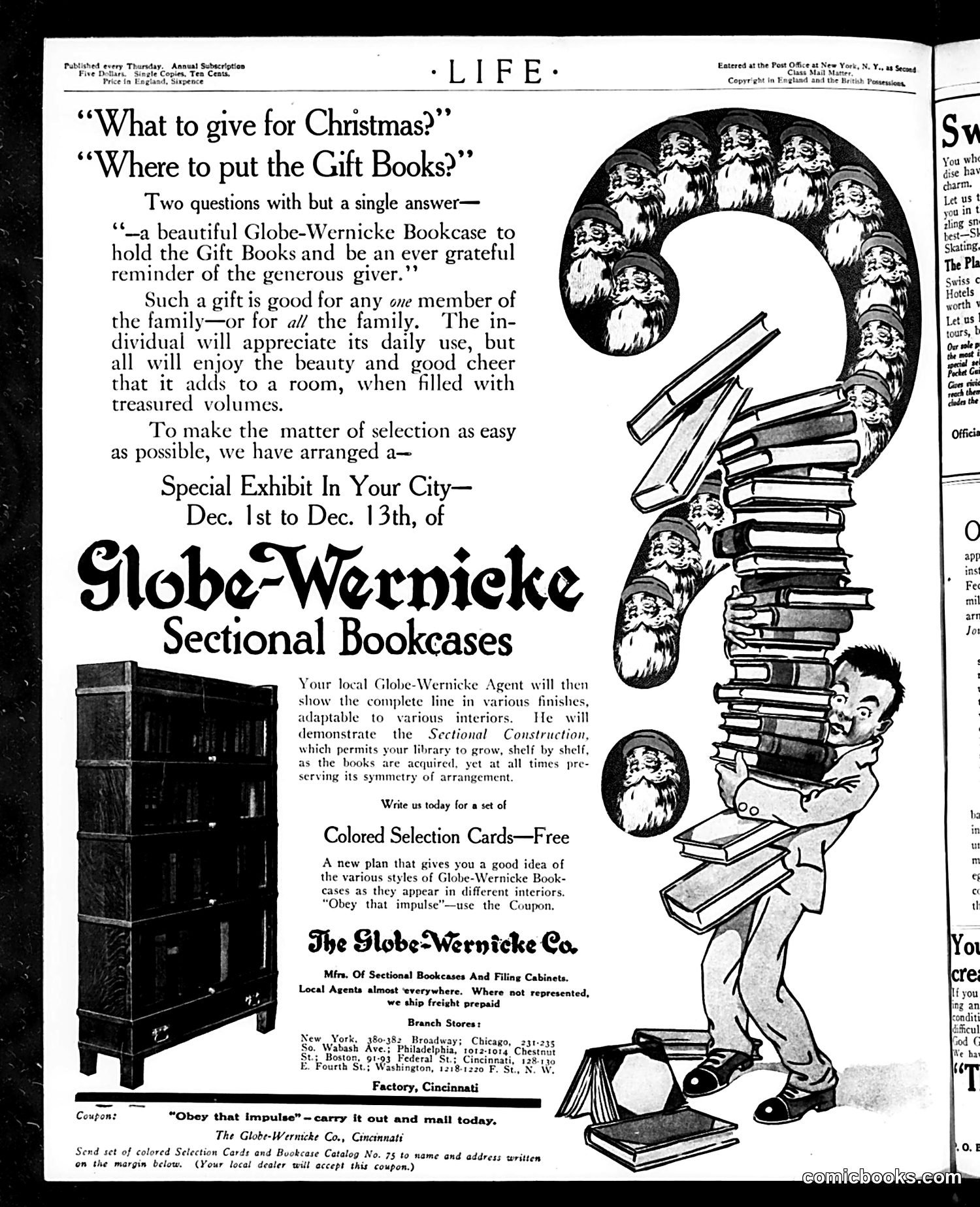
This is primarily a **commercial advertisement**, not political satire. The page promotes Globe-Wernicke sectional bookcases as Christmas gifts. The illustration shows a comical figure—a man struggling under an enormous stack of books arranged in a question mark shape, with Santa faces emerging from the curve. The visual joke is straightforward: the man represents the customer's dilemma about what Christmas gift to buy and where to store books. The advertisement emphasizes the bookcase's "sectional construction," allowing shelves to grow as one's book collection expands. It announces a special exhibit running December 1-13 and offers free colored selection cards. This reflects early 20th-century consumer culture, targeting educated, book-owning families who could afford furniture. There is no political content or satire present.
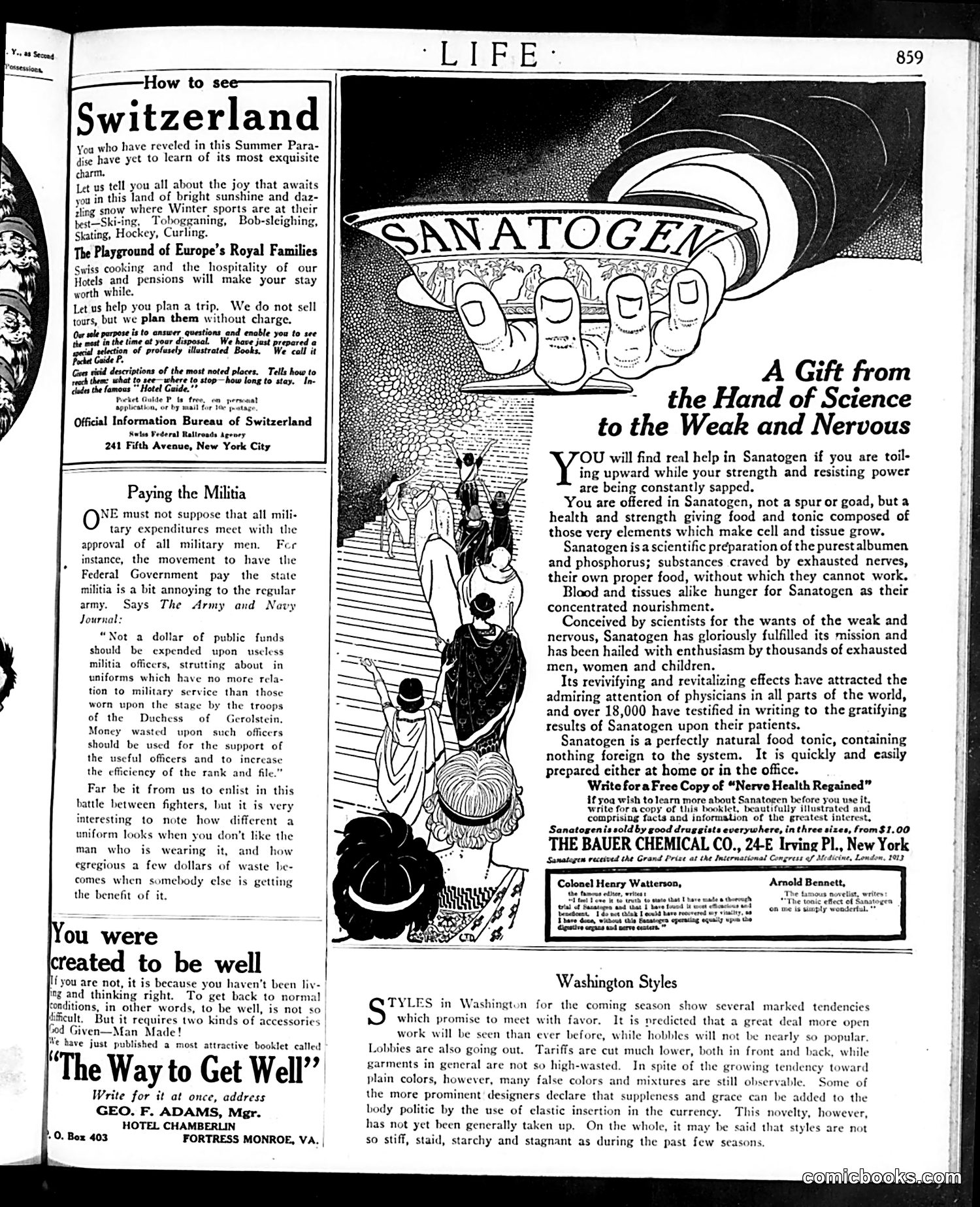
This page is primarily **advertising and lifestyle content** rather than political satire. The main visual element is a large advertisement for "Sanatogen," a patent medicine marketed as treatment for "the weak and nervous." The illustration shows a hand holding the product, with testimonials below claiming thousands of satisfied users. The page also includes: - A Switzerland travel advertisement - An article titled "Paying the Militia" criticizing wasteful military spending on uniforms and officers - A brief piece "You were created to be well" promoting a health booklet - A "Washington Styles" fashion column The Sanatogen ad represents typical early 20th-century medical marketing, making broad health claims now considered dubious. The militia article offers genuine social criticism about government expenditure.
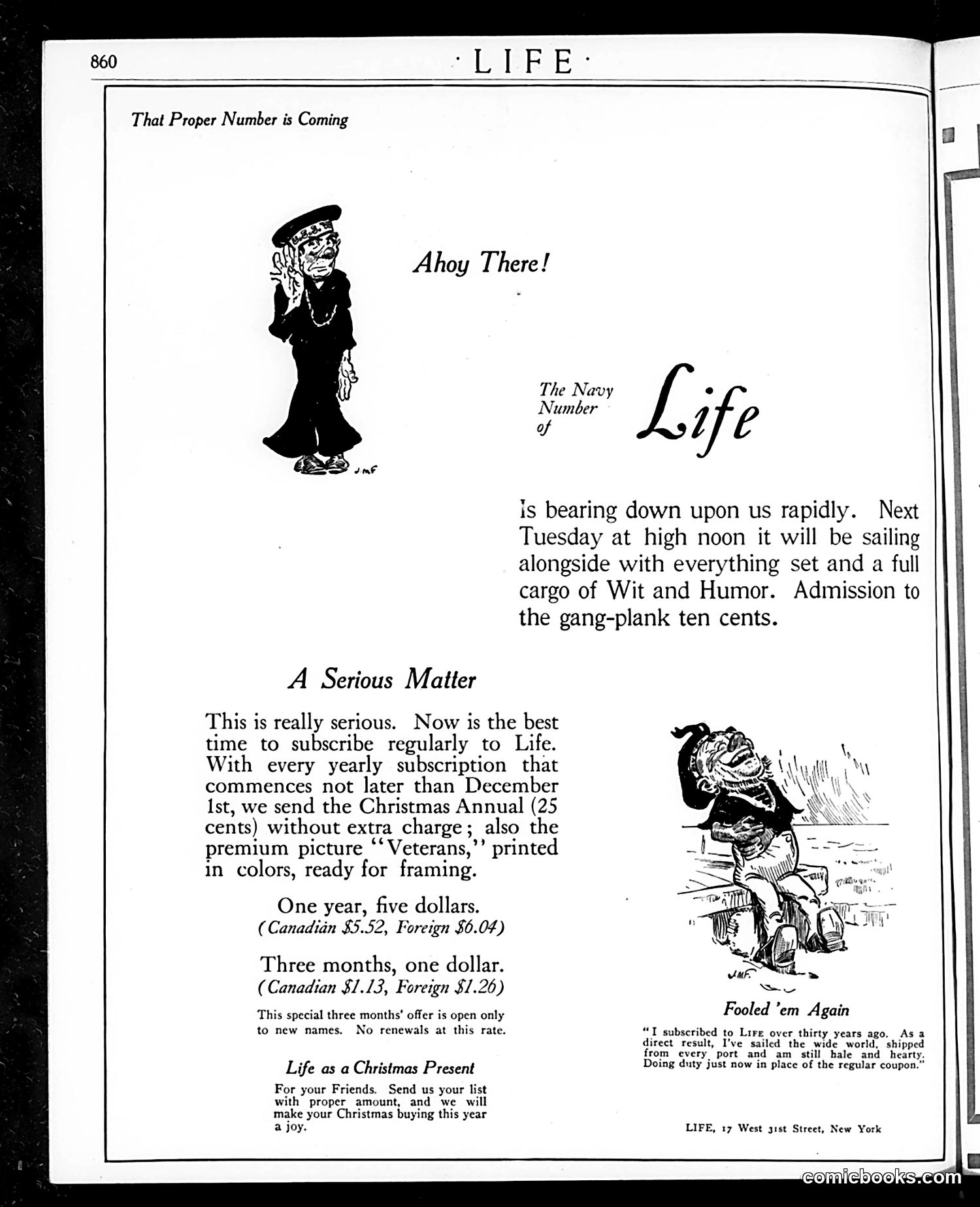
This is primarily **advertising content** for Life magazine subscriptions, not political satire. The page features two cartoons as decorative elements alongside subscription offers: 1. **"That Proper Number is Coming"** shows a sailor-like character saying "Ahoy There!" announcing the upcoming issue, which will contain "Wit and Humor" (admission: ten cents). 2. **"Fooled 'em Again"** depicts a figure who subscribed to Life and traveled the world, now "doing duty just now in place of the regular coupon"—a self-referential joke about Life's subscription system. The main content promotes subscription rates (one year for five dollars; three months for one dollar) and mentions a Christmas Annual premium. This is essentially **magazine marketing material** dressed up with lighthearted illustrations rather than political commentary.
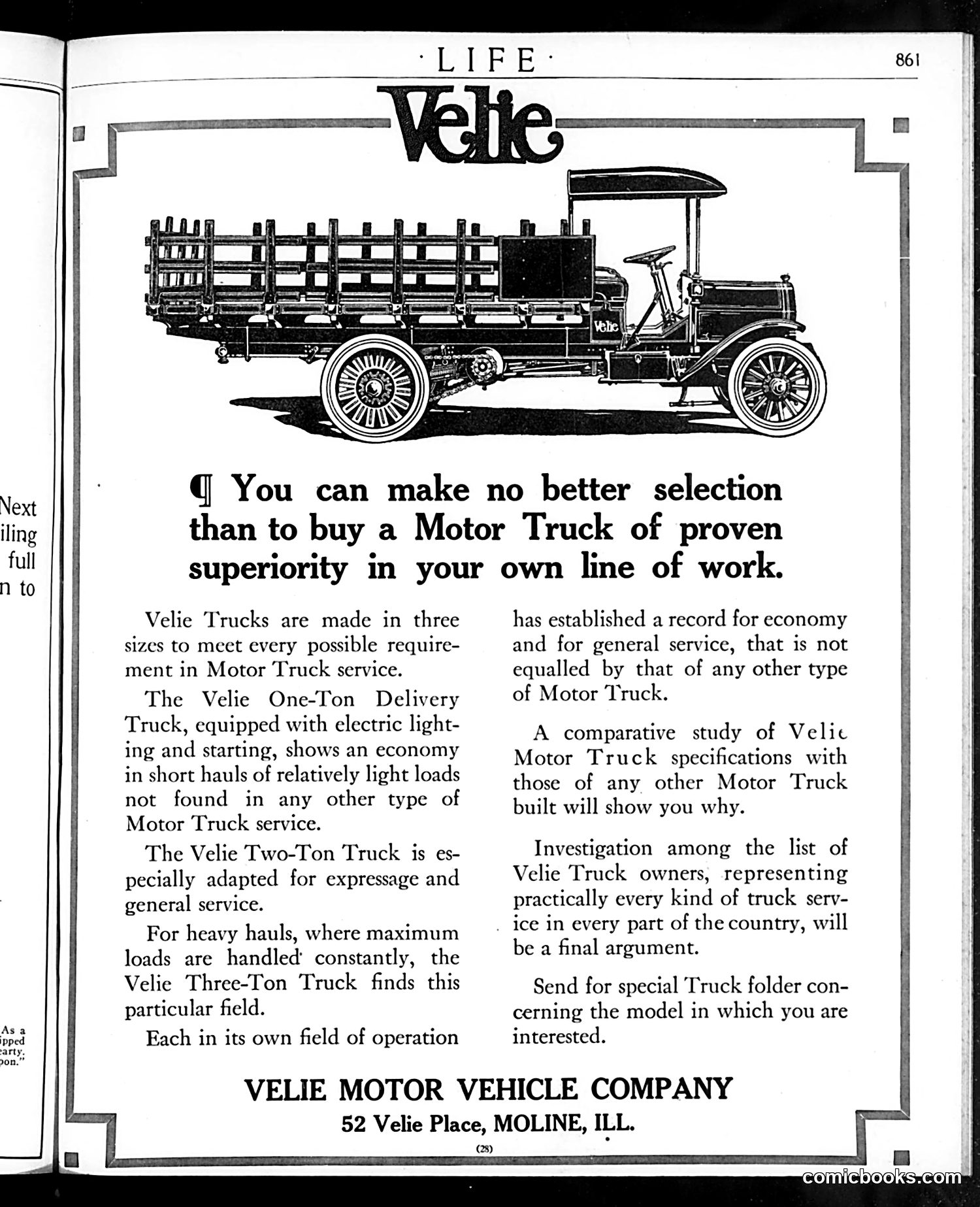
This page is **primarily an advertisement**, not satirical content. It's a Velie Motor Vehicle Company ad promoting their truck line, appearing in Life magazine (page 861). The image shows a detailed technical illustration of a Velie motorized delivery truck with an open cargo bed and canopy top—representing early 1900s commercial vehicle design. The ad copy uses standard marketing rhetoric of the era: emphasizing the truck's "proven superiority," economy, reliability, and availability in three sizes for different hauling needs. It appeals to business owners by claiming comparative advantages over competitors and inviting inquiries about specific models. This reflects the period when motor trucks were relatively new commercial technology competing for adoption in American business and industry.
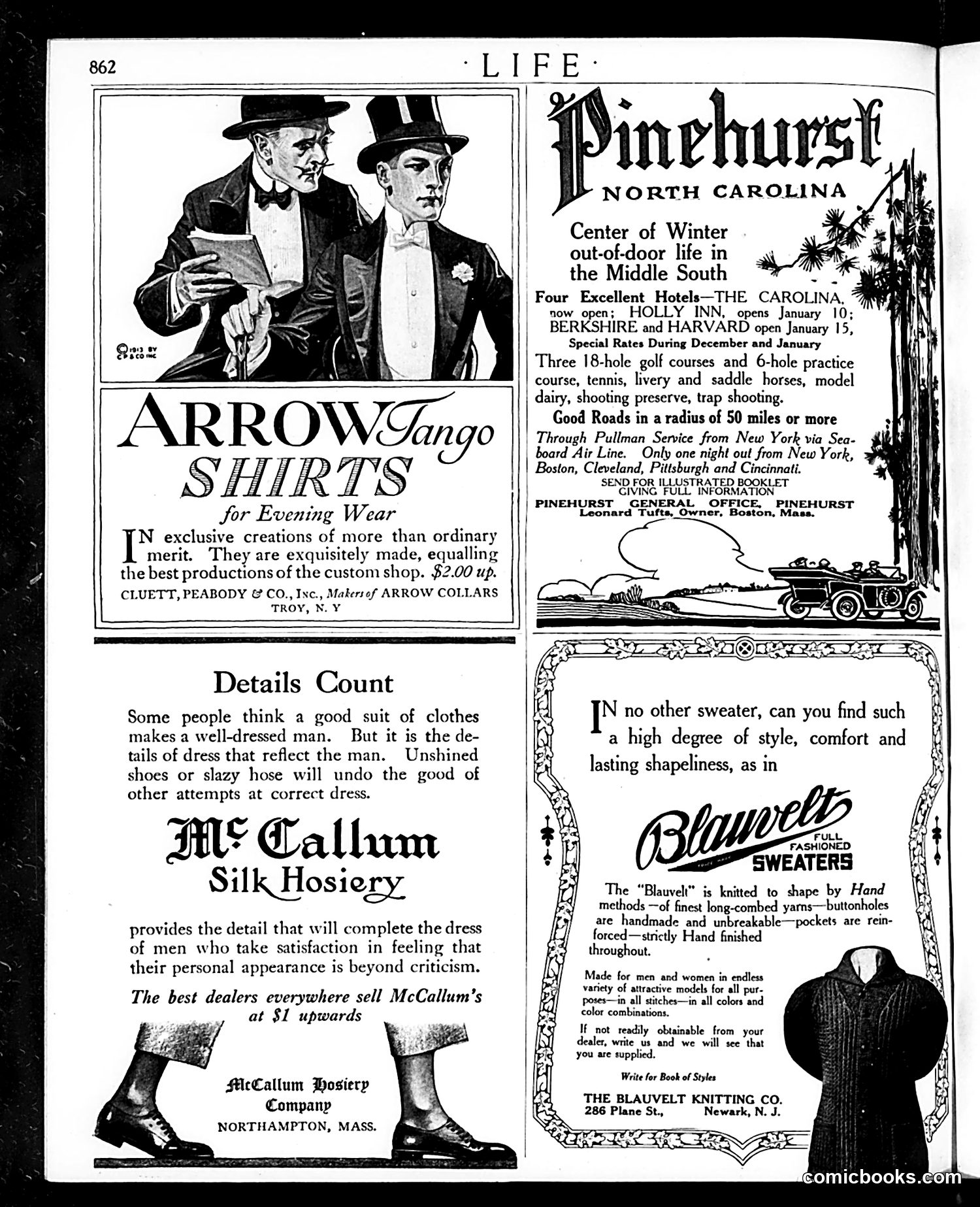
This page is **primarily advertising** with minimal satirical content. The top left features an Arrow Tango Shirts advertisement showing two formally dressed men in evening wear, one reading what appears to be a program or document—likely depicting a theater or social setting. The ad emphasizes the shirts as "exclusive creations" for evening occasions. The remaining advertisements promote McCallum Silk Hosiery, Pinehurst North Carolina as a winter resort destination, and Blauvelt Fashioned Sweaters. The only substantive editorial content is a brief piece titled "Details Count," arguing that a well-dressed man's appearance depends on attentive grooming details rather than expensive clothing alone. This reflects early 20th-century consumer culture emphasizing personal refinement and propriety.
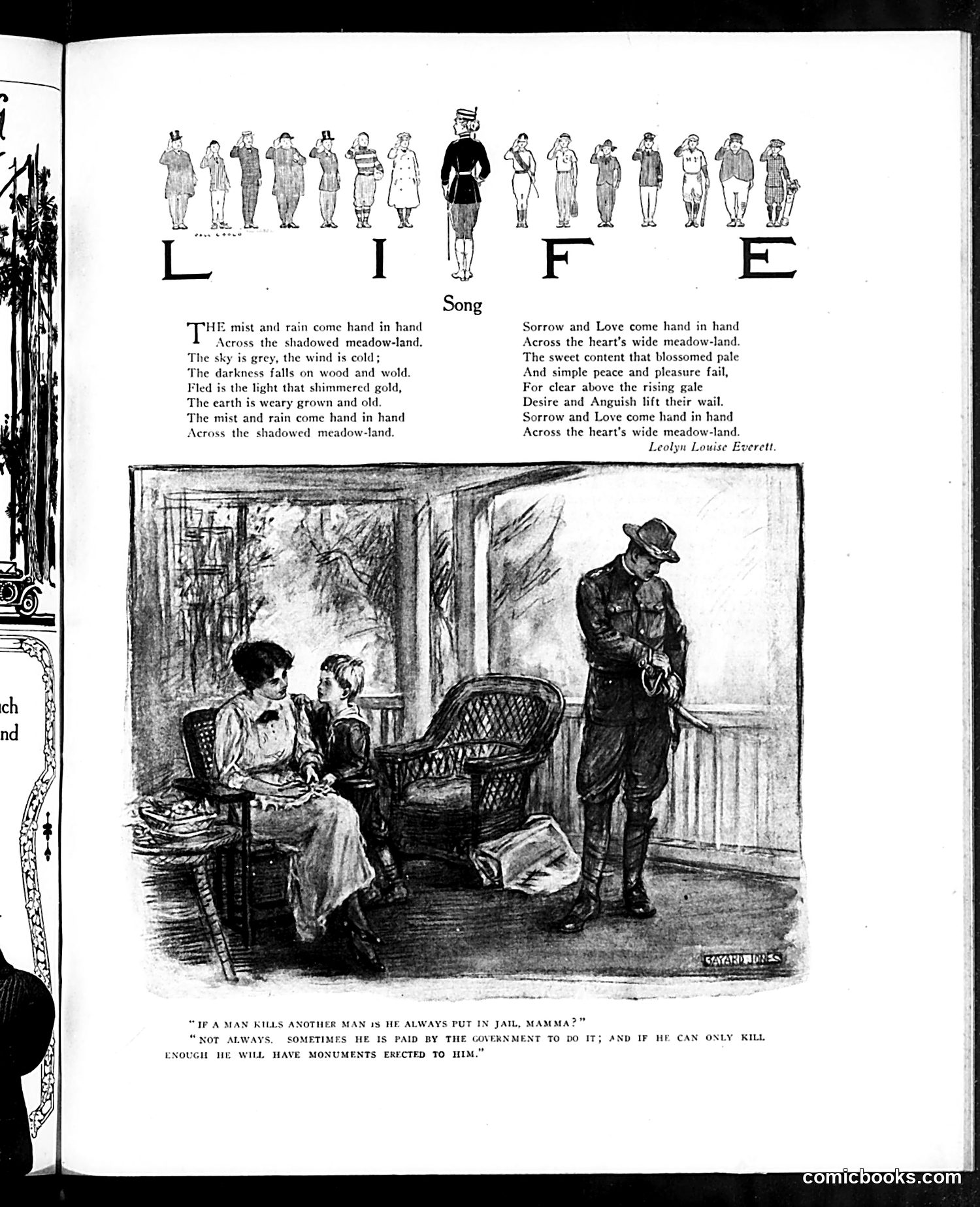
This page presents a song titled "Life" with accompanying illustration and dialogue. The sketch depicts an indoor scene with a woman, child, and man in working-class attire, suggesting a domestic dispute or confrontation. The caption below references capital punishment: a child asks if killers always go to jail, and an adult responds that "sometimes he is paid by the government to do it" — meaning execution — and that those with sufficient wealth "will have monuments erected to him." This appears to be social satire critiquing the inequality of justice: wealthy or politically connected individuals who commit murder face different consequences than poor people. The "Life" theme suggests commentary on how life, death, and justice operate differently across social classes in America.
This page is a serious editorial essay (not satire) titled "The Army," advocating for military service as a respectable profession. The small illustration shows a soldier in uniform. The text argues that army service offers practical benefits: decent pay (starting around $15-17 per month for enlisted men), food, clothing, medical care, and opportunity for advancement to officer rank through merit. The author positions the military as a legitimate career path comparable to other professions, countering what appears to be contemporary social stigma against soldiers as low-status or unmotivated. The essay emphasizes that modern warfare requires trained, educated soldiers—not merely "wage-earning and money-getting" men—and that military science demands intellectual rigor alongside physical capability. It presents army service as patriotic duty and practical self-improvement.
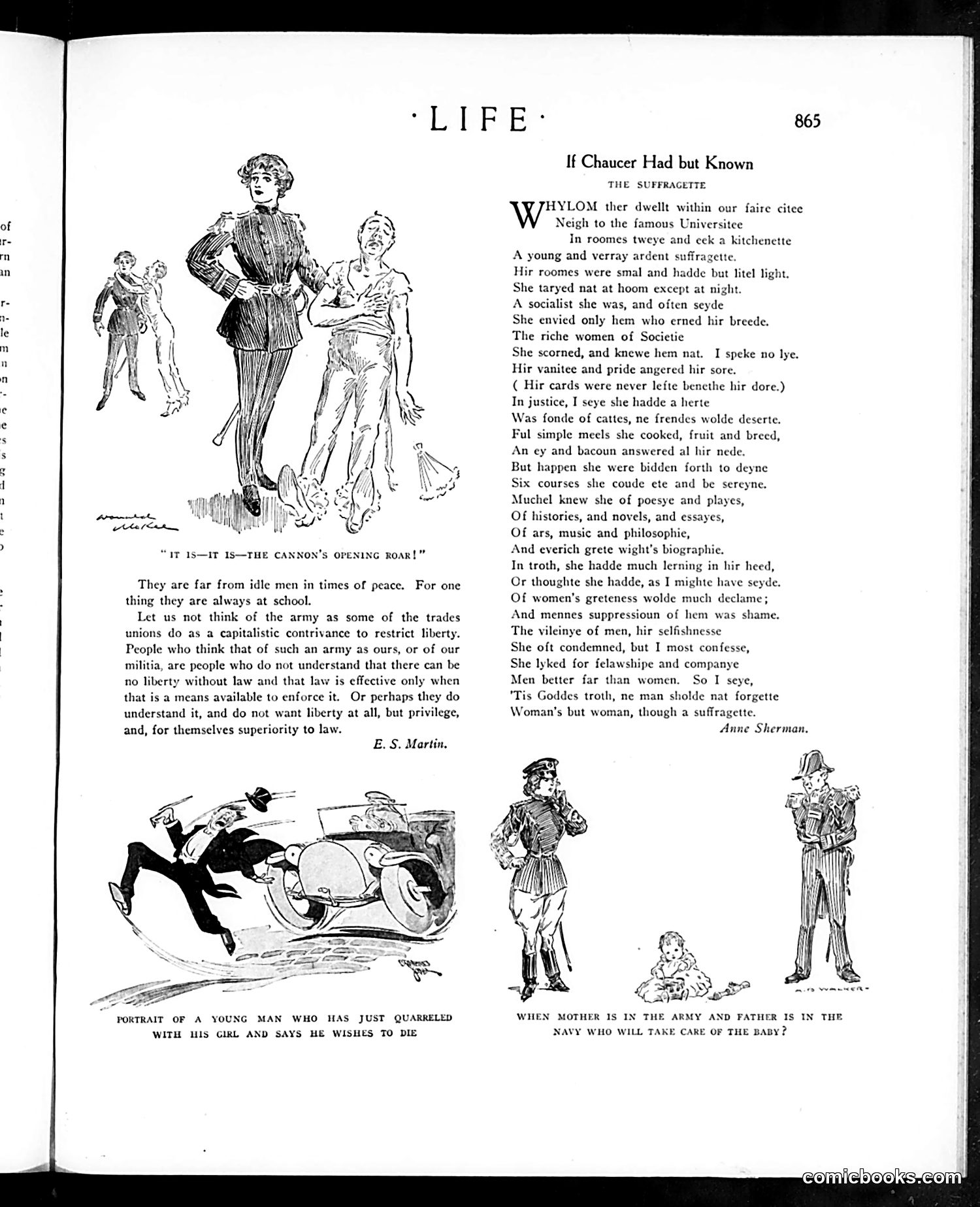
This page satirizes early 20th-century gender politics through two main pieces: **"If Chaucer Had but Known"** (by Anne Sherman) is a poem mocking an educated "suffragette" living near a university. She's depicted as bookish and intellectual but vain, proud, and condemning of other women. The satire suggests such women are hypocritical—they demand equality and education while judging less-ambitious women harshly. The concluding couplet undercuts feminist arguments by reducing the suffragette to "Woman's but woman, though a suffragette." **The cartoons below** illustrate domestic/military absurdities: a young couple's quarrel, and the question of childcare when both parents serve in the military—poking fun at women's new public roles during wartime. The overall message is anti-suffrage, portraying educated women activists as self-righteous and their aspirations as fundamentally at odds with traditional family life.
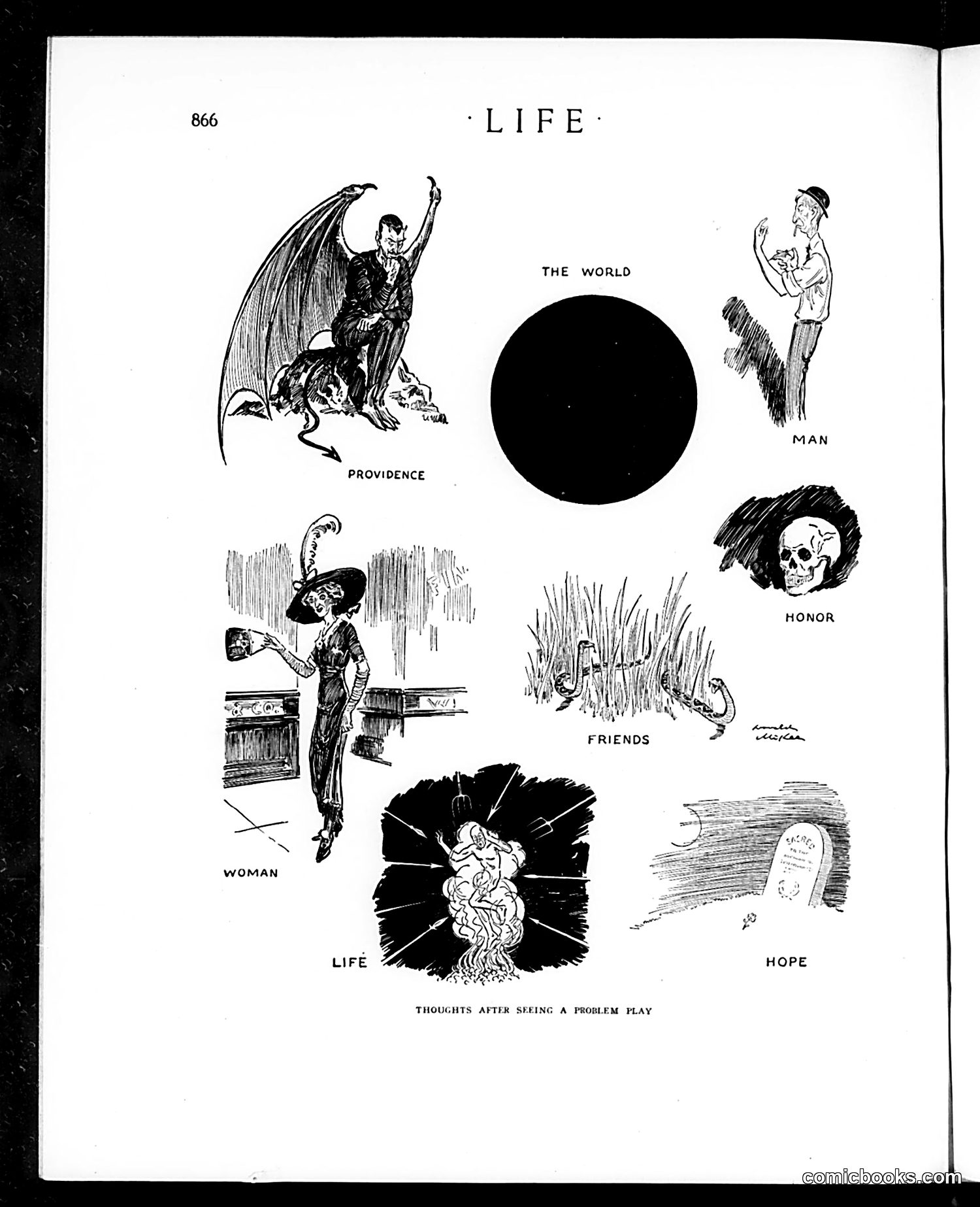
This is a satirical commentary on serious dramatic theater—likely the "problem plays" popular in early 20th-century American drama that addressed social issues. The central black circle labeled "THE WORLD" is surrounded by eight illustrations representing different human concerns: - **Providence** (demon with wings) - **Man** (figure in distress) - **Honor** (skull) - **Woman** (fashionable figure) - **Friends** (snakes) - **Life** (figure engulfed in flames) - **Hope** (gravestone) The satire suggests that after watching such earnest, heavy theatrical productions exploring life's problems, audiences are left contemplating dark, pessimistic themes: death, betrayal, suffering, and hopelessness. It mocks both the drama's relentless bleakness and perhaps audiences' tendency toward melodramatic brooding inspired by such plays.
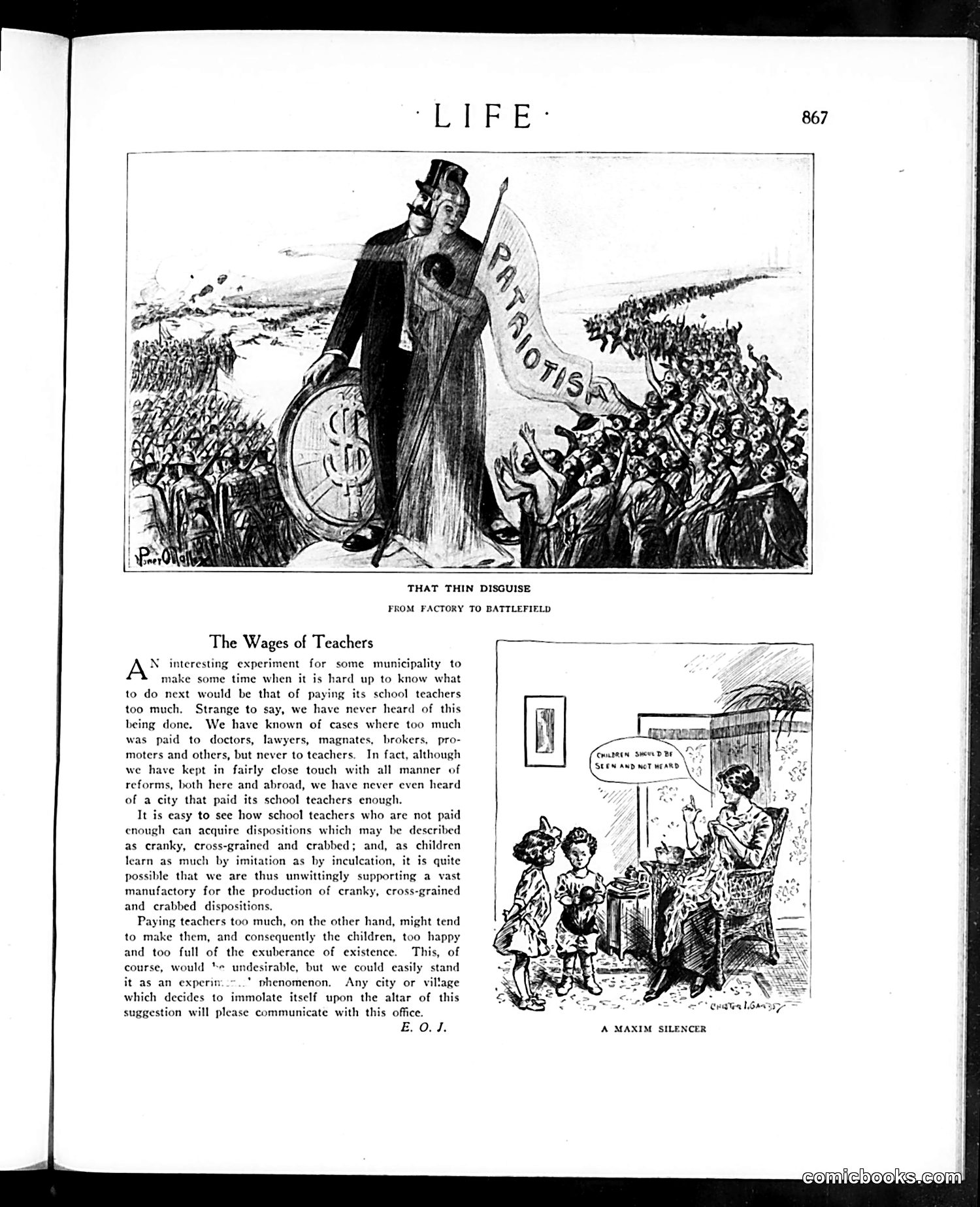
**Top Cartoon: "That Thin Disguise"** This political cartoon depicts a tall, skeletal figure labeled "Patriotism" holding a large dollar sign wheel and an American flag. The figure stands before massive crowds on both sides, suggesting how patriotic rhetoric is used to mobilize public support. The satire critiques how financial interests ("From Factory to Battlefield") disguise themselves as patriotism to encourage military participation and industrial production—likely referencing WWI-era concerns about profiteering from war. **Article: "The Wages of Teachers"** The text argues teachers are underpaid relative to other professionals (doctors, lawyers), and that insufficient wages create cranky, cross-grained teachers who negatively influence children. The accompanying cartoon shows a teacher addressing students, illustrating the everyday impact of this issue. Both pieces critique institutional failures and hidden economic motivations beneath public virtue.
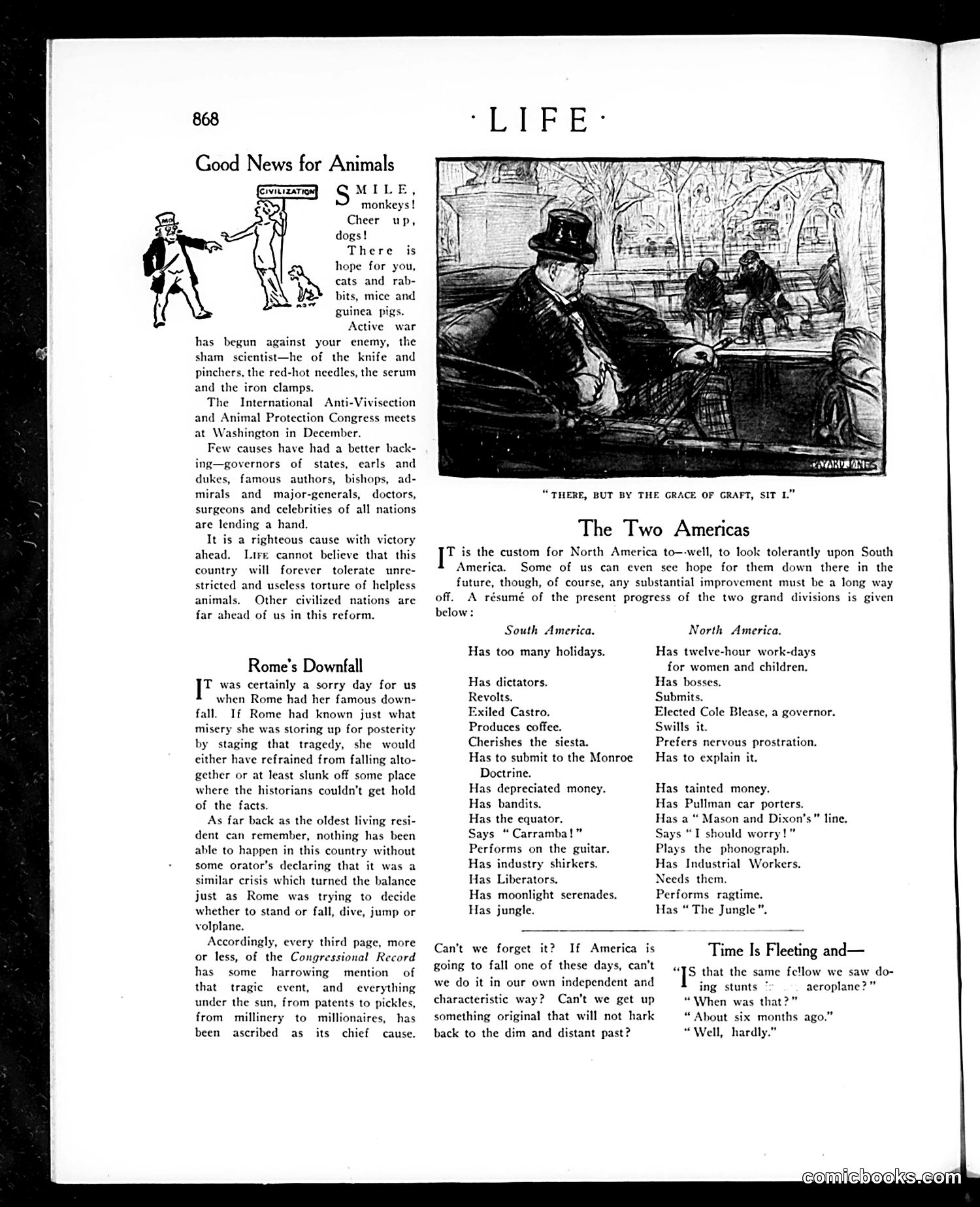
The page contains three distinct sections: **"Good News for Animals"** celebrates an international anti-vivisection movement, mocking scientists who use animals in medical research through caricature and text condemning "knife pinchers, red-hot needles, serum and iron clamps." **"Rome's Downfall"** is a political allegory comparing Rome's historical fall to contemporary American political instability, suggesting that like Rome, America faces collapse through internal discord—specifically citing the Congressional Record as evidence of constant crisis and partisan conflict. **"The Two Americas"** presents a humorous comparison table contrasting North and South America's characteristics, satirizing South American political instability (dictators, revolts, Castro) against North American progress, though with subtle jabs at American institutions (corrupt politicians, industrial workers). The cartoons employ period satire addressing animal welfare, political dysfunction, and hemispheric geopolitics.
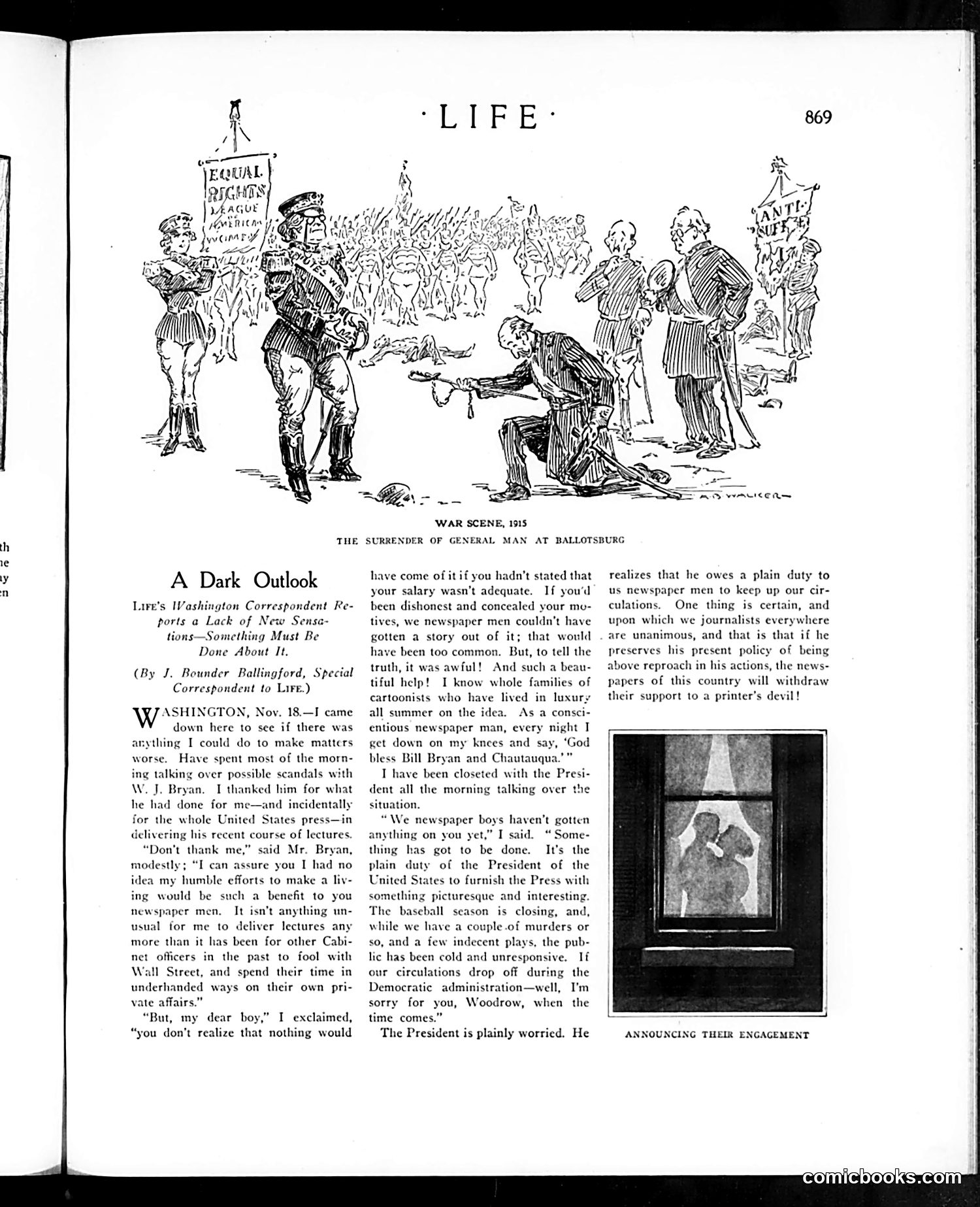
The top cartoon depicts "War Scene, 1915: The Surrender of General Man at Ballotsburg," showing a military figure kneeling in surrender before a crowd holding signs reading "Equal Rights" and "Anti-Suffrage." This is political satire about the women's suffrage debate—the cartoonist suggests that opposition to women's voting rights is a losing battle, personified as "General Man" surrendering to the suffrage movement. Below, columnist J. Rounder Ballingford reports a conversation with William Jennings Bryan about newspaper scandals and press freedom. Bryan allegedly suggests newspapers avoid controversial stories to protect their business interests. The piece critiques both Bryan's views and newspapers' complicity in self-censorship during the Wilson administration. The adjacent photograph announces an engagement, likely unrelated to the political commentary.
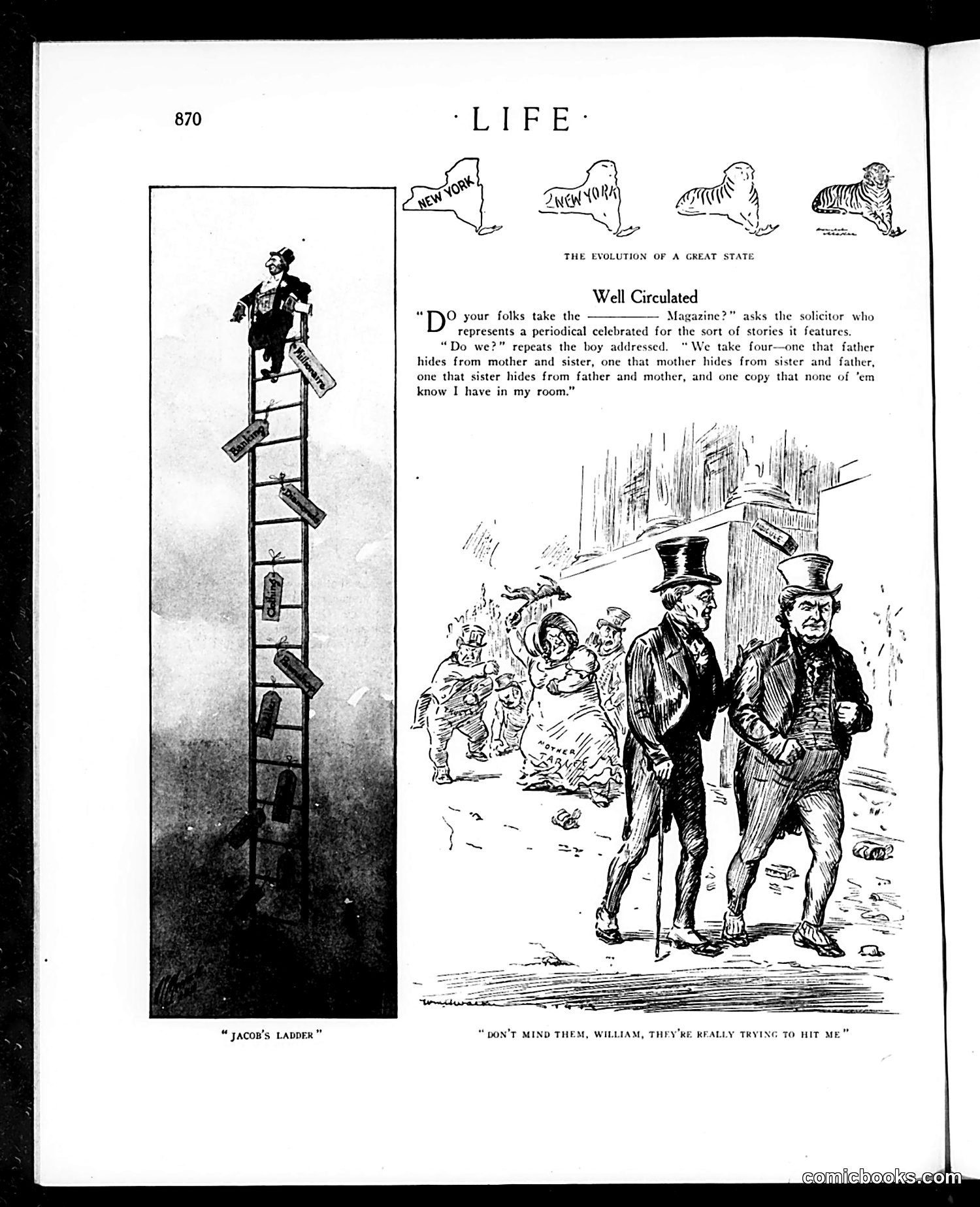
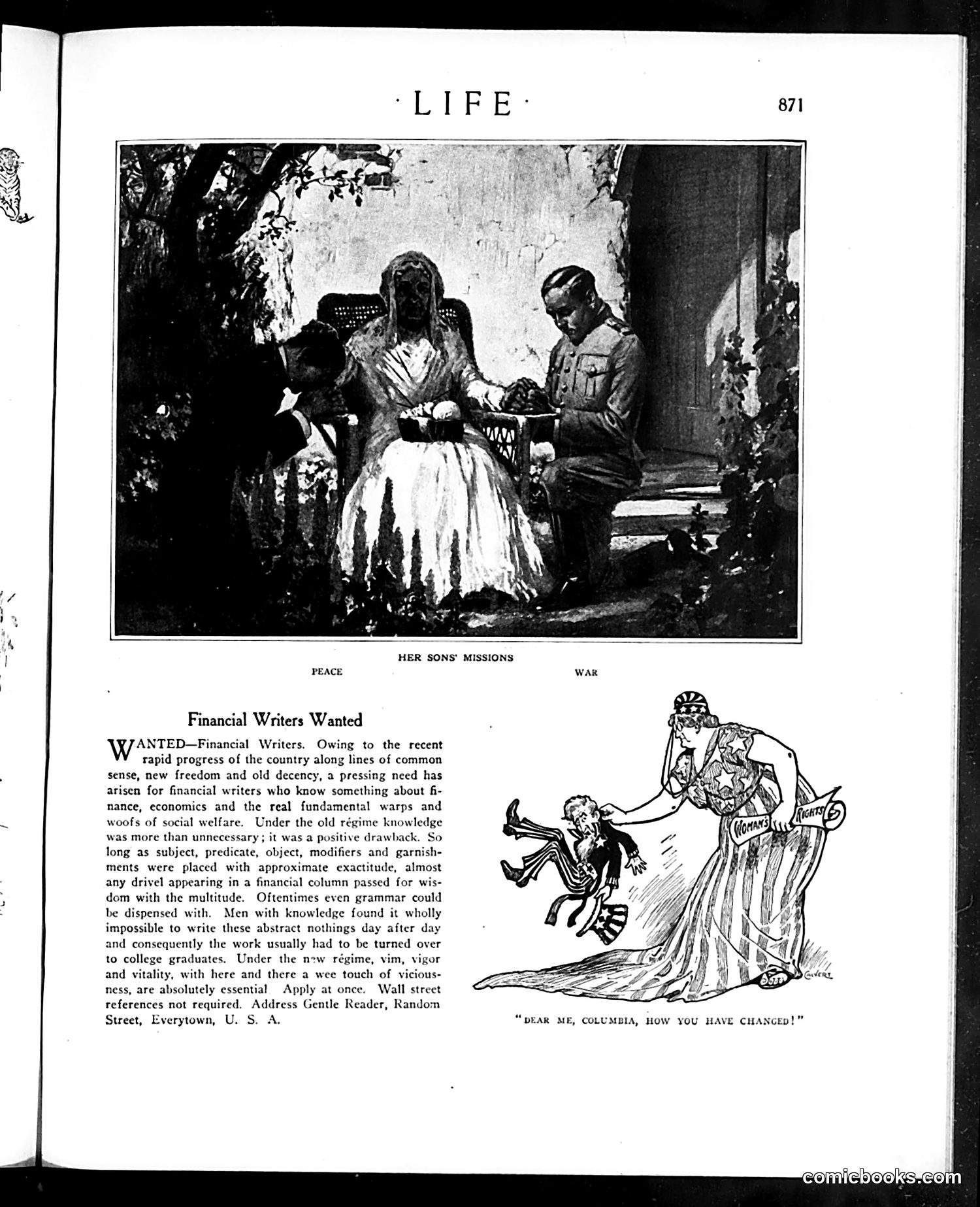
**Top Image:** "Her Sons' Missions" contrasts Peace and War—showing a mother receiving soldiers, illustrating the dual roles sons undertake during wartime. **Main Cartoon:** Columbia (female personification of America) sits with a soldier, saying "Dear me, Columbia, how you have changed!" The satire comments on America's transformation, likely during or after WWI, from isolationism to military involvement. **"Financial Writers Wanted" Section:** This is satirical classified advertising. It mocks pre-war financial journalism as intellectually hollow—writers could succeed without actual financial knowledge, relying only on grammar and obfuscation to fool readers. The piece applauds the "new régime" demanding actual competence: "vim, vigor and vitality" and genuine economic understanding. It's a jab at both old financial columnists' incompetence and Wall Street's dubious practices, suggesting the country has progressed toward "common sense, new freedom and old decency." The overall page celebrates American transformation toward greater accountability and expertise.
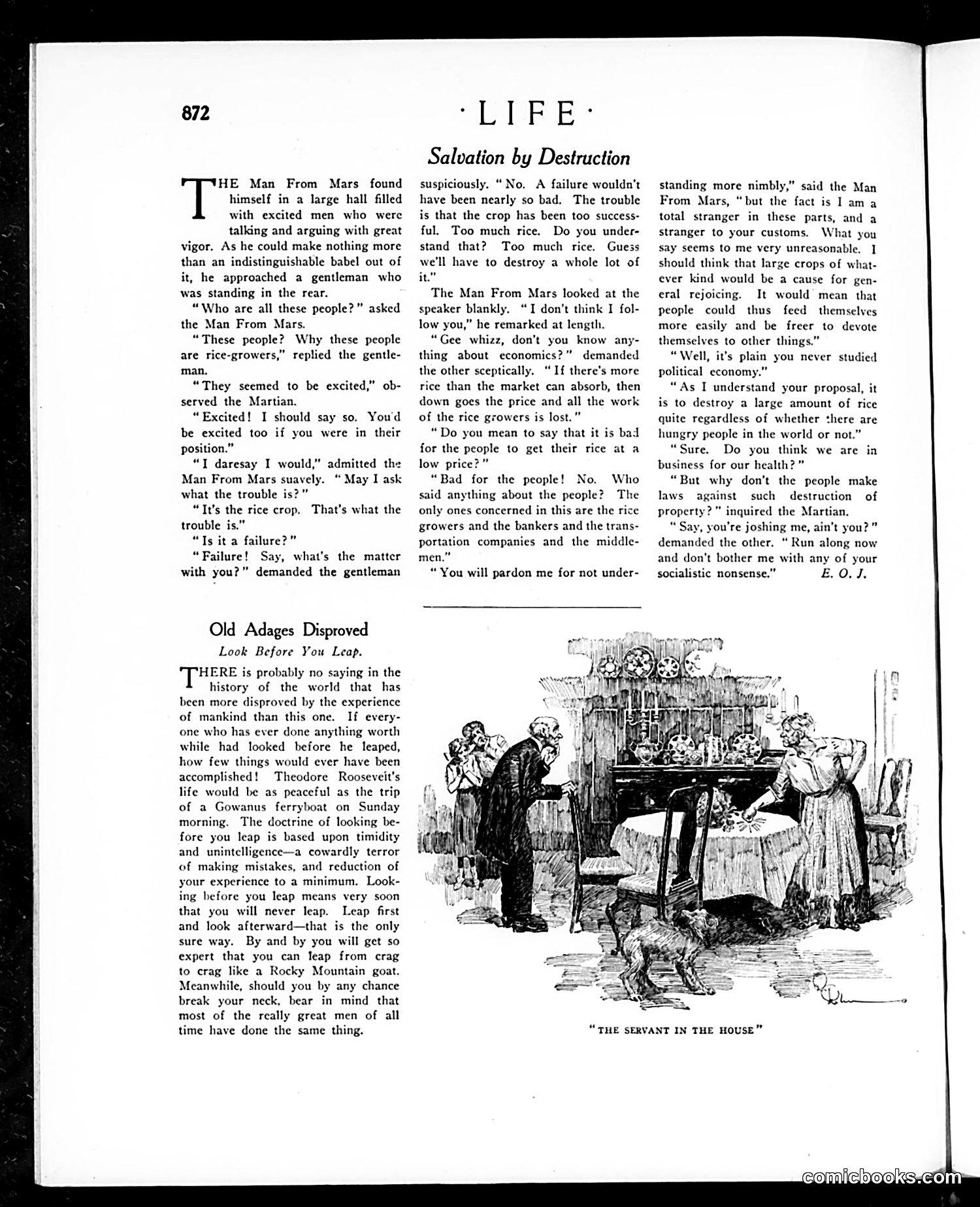
This satirical dialogue uses a Martian visitor as a naive outsider to critique early-20th-century American agricultural economics. The "Man From Mars" represents rational common sense; the rice-grower spokesman embodies callous capitalism. The satire exposes a perverse economic logic: farmers must **destroy surplus rice** to maintain prices and profits, even though abundant food could feed hungry people. When the Martian reasonably asks why destruction benefits anyone, he's dismissed with accusations of "socialistic nonsense." The joke targets the disconnect between what *should* make sense—abundant crops feed people—and what capitalism actually does: prioritize profits for growers, bankers, and middlemen over human welfare. By making the profit-motive seem absurd through an outsider's perspective, Life mocks the system's fundamental irrationality and its defenders' inability to justify it rationally. This reflects Progressive-era criticism of unregulated capitalism and waste during economic inefficiency.
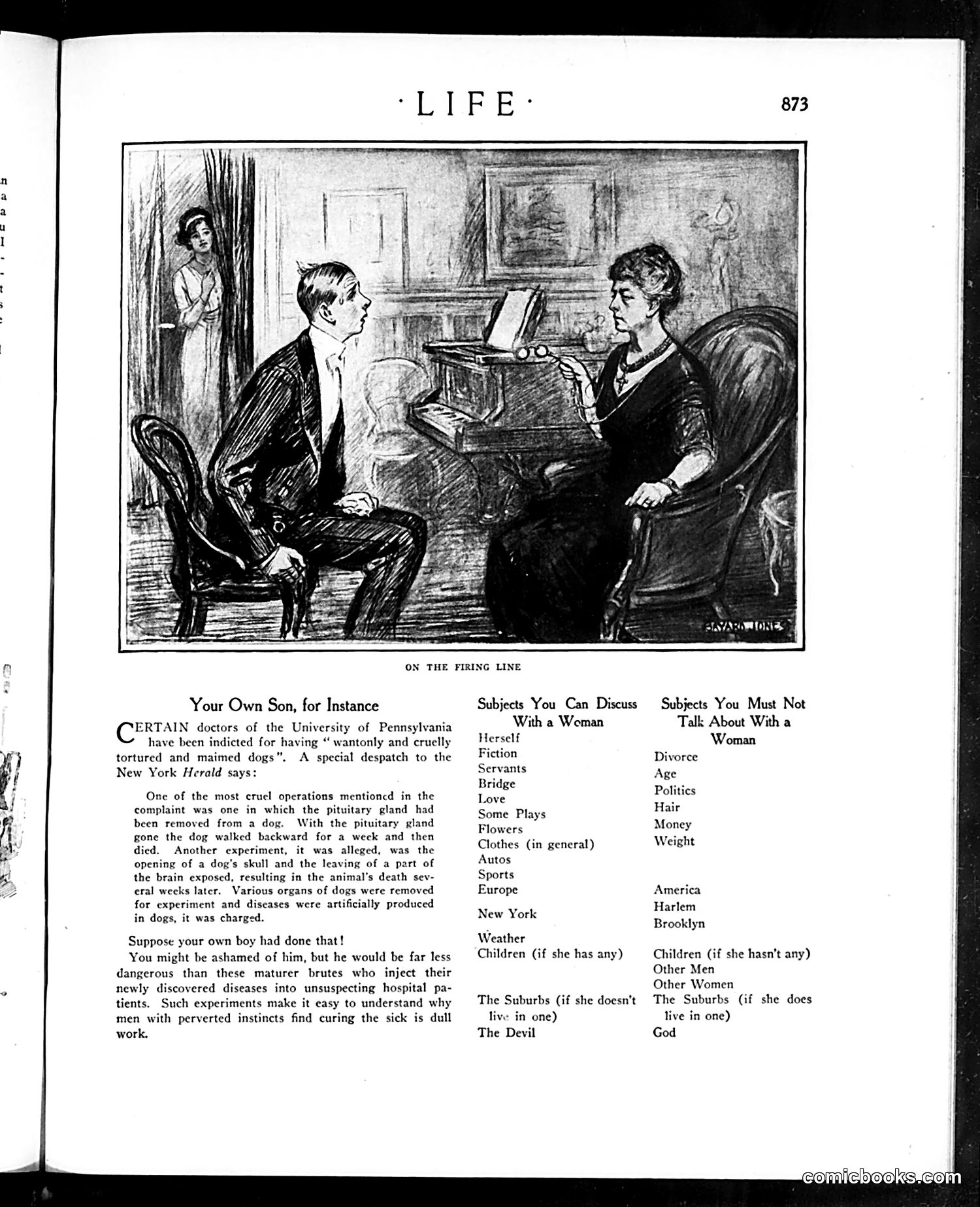
This page contains two separate satirical pieces: **Top cartoon** ("On the Firing Line"): Responds to indictments of University of Pennsylvania doctors for cruel animal experimentation on dogs—removing pituitary glands, exposing brains, artificially inducing diseases. The satire's point: if we're horrified by these experiments on dogs, imagine if your own son conducted them. Yet these same "maturer brutes" (adult physicians) perform similar unethical experiments on hospital patients without outcry, suggesting perverted sadism motivates medical researchers rather than genuine healing. **Bottom section**: A humorous etiquette guide listing safe and forbidden conversation topics with women. It reflects early 20th-century gender assumptions—women supposedly cannot discuss politics, money, age, or their own childlessness without offense, but welcome talk of fashion, servants, and romance. The contrast between "The Devil" (acceptable) and "God" (forbidden) suggests the absurdity of these arbitrary social rules.
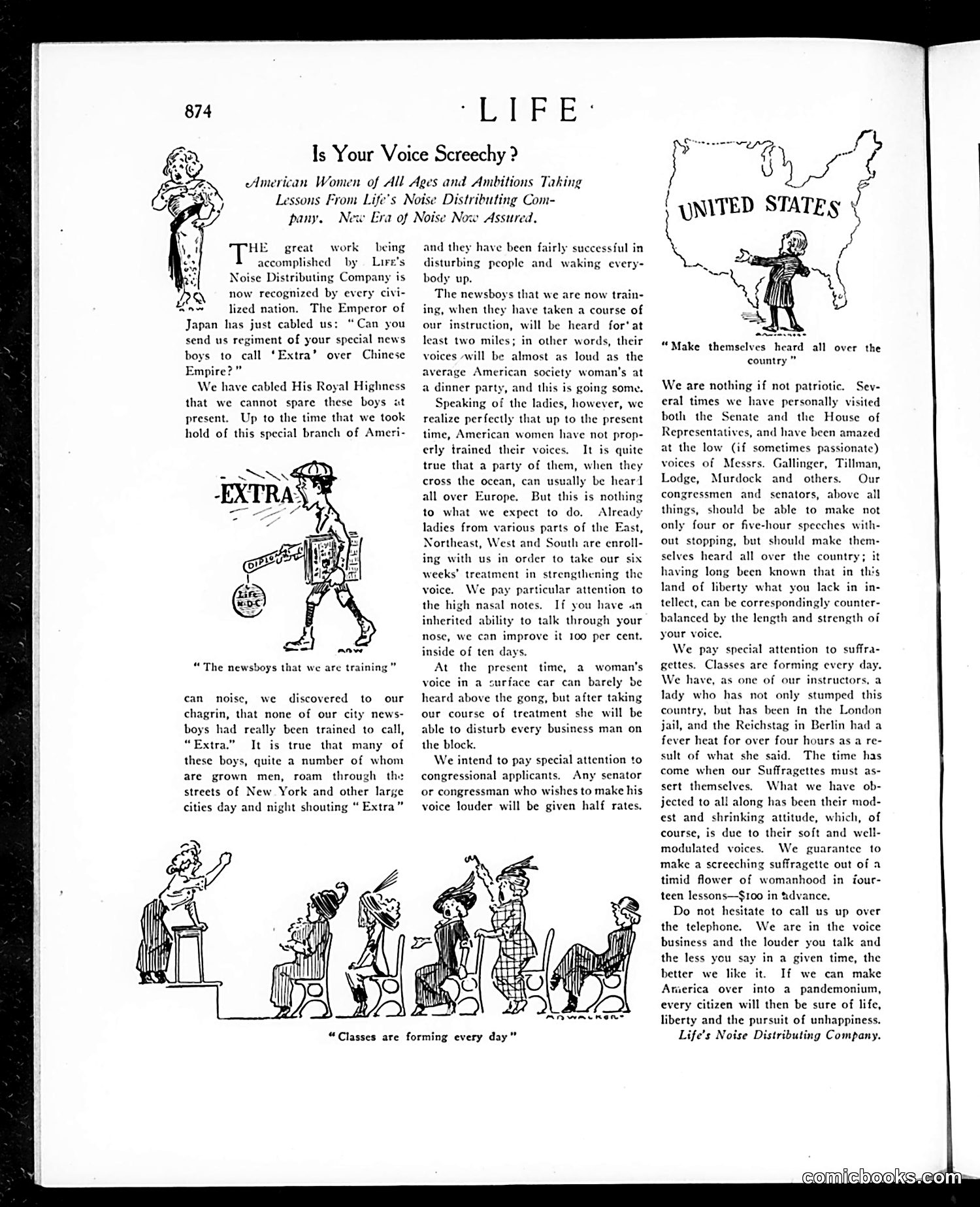
This satirical piece mocks the emerging women's suffrage movement by advertising a fictional "Life's Noise Distributing Company" offering voice-training for women. The humor operates on multiple levels: **The Central Joke:** Women seeking political power are stereotyped as naturally loud and shrill. The company claims to strengthen women's voices so they can be heard "all over the country"—both literally (newsboys, suffragettes) and metaphorically (gaining political influence). **The Targets:** The satire ridicules: - American women's supposed lack of vocal refinement - Suffragettes (women's voting-rights activists) as shrewish and aggressive - Male politicians' ineffectual speaking voices, implying women should "outshout" them - The notion that volume equals political authority **The Political Context:** Written during the suffrage era, this mocks women's political ambitions by reducing their cause to a crude joke about female loudness—a common anti-feminist trope of the era. **The Irony:** By offering suffragettes special rates, the satirist suggests their cause is so unreasonable it's laughable.
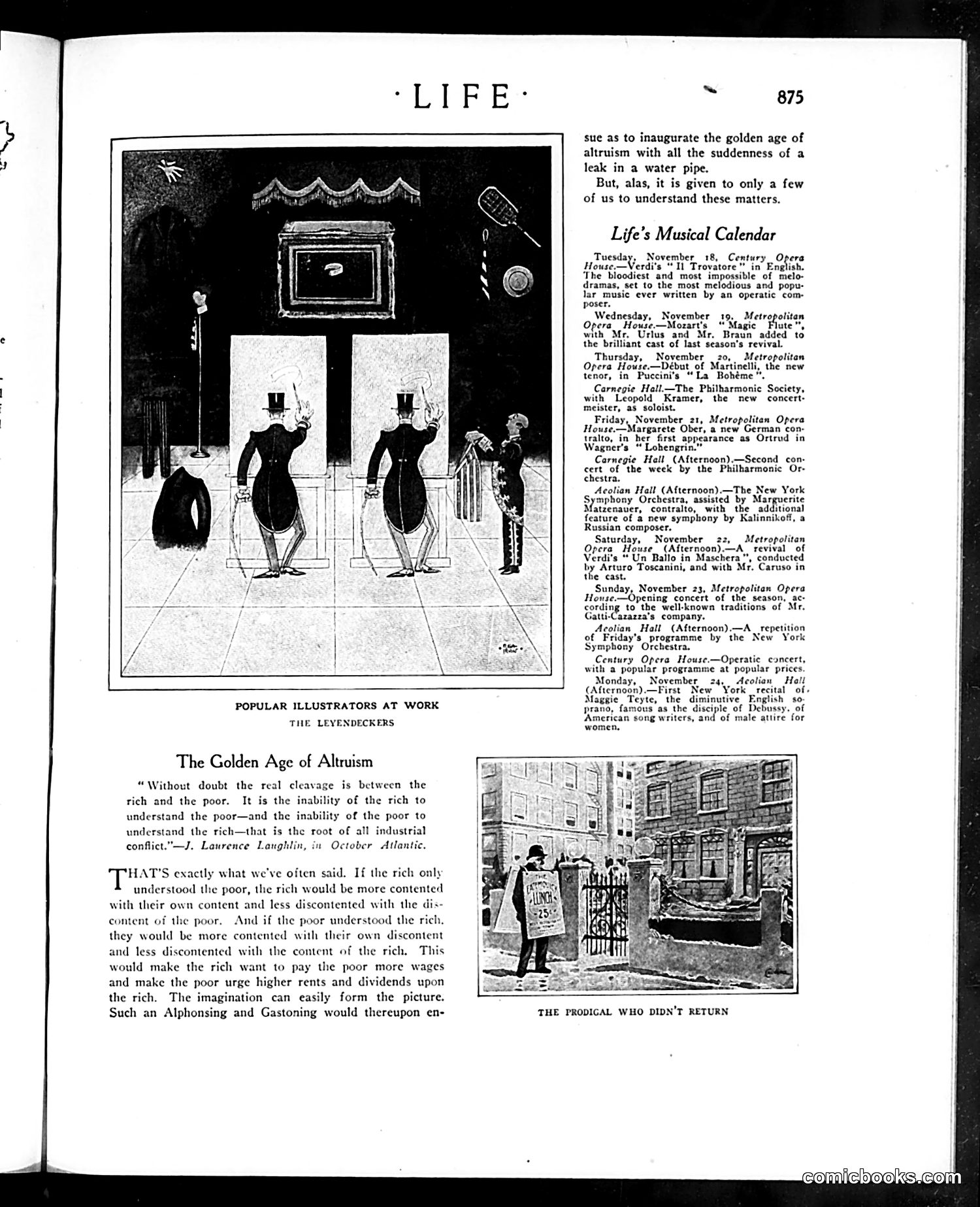
**Main Article: "The Golden Age of Altruism"** This satirical piece mocks the notion that mutual understanding between rich and poor would solve industrial conflict. Life quotes J. Laurence Laughlin's serious sociological argument, then savagely inverts it: if rich understood poor and vice versa, they'd simply exploit each other *more effectively*—the poor would demand higher rents and dividends from the rich. Life's punch line is bitterly ironic: such mutual understanding would usher in an "altruistic" golden age with all the likelihood of "a leak in a water pipe"—essentially impossible. The satire targets both Gilded Age optimism about class harmony and the naïveté of assuming empathy solves structural economic problems. **Illustration: The Leyendeckers** The top illustration credits "Popular Illustrators at Work" to The Leyendeckers (likely J.C. Leyendecker and his brother), showing what appears to be theatrical or fashion-related figure drawing. **Secondary Content** The page includes a musical calendar listing opera and orchestra performances (November 1909), and a cartoon captioned "The Prodigal Who Didn't Return," though details remain unclear.
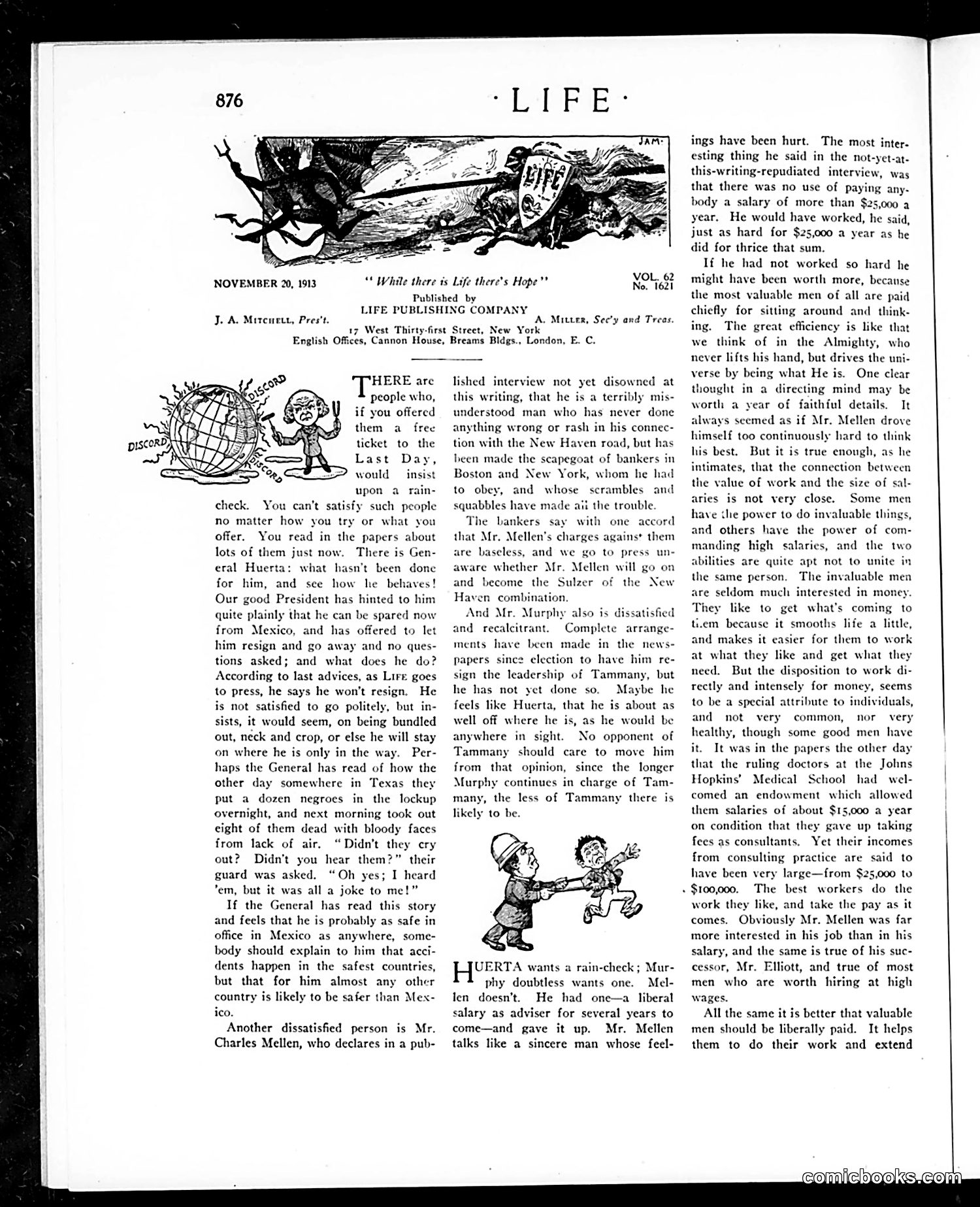
This editorial attacks three prominent figures as unreasonable complainers: **General Huerta** (Mexican military leader) refuses President Wilson's offer to resign and leave Mexico, insisting instead on being forcibly removed. The article sarcastically suggests he may prefer staying, given the violence against Black prisoners in Texas. **Charles Mellen** (New Haven Railroad executive) claims he's a misunderstood scapegoat of Boston and New York bankers, despite his responsibility for the railroad's troubles. The satire notes his hypocrisy: he claims no one should earn over $25,000 yearly, yet he abandoned a generous consulting salary. **Charles Murphy** (Tammany Hall boss) refuses to resign his leadership despite newspaper campaigns demanding it. The "rain-check" metaphor—refusing even a free ticket to the Last Day unless you could reschedule—describes ungrateful men who reject reasonable exit offers. The cartoon's message: these powerful figures stubbornly cling to positions despite obvious incentives to leave.
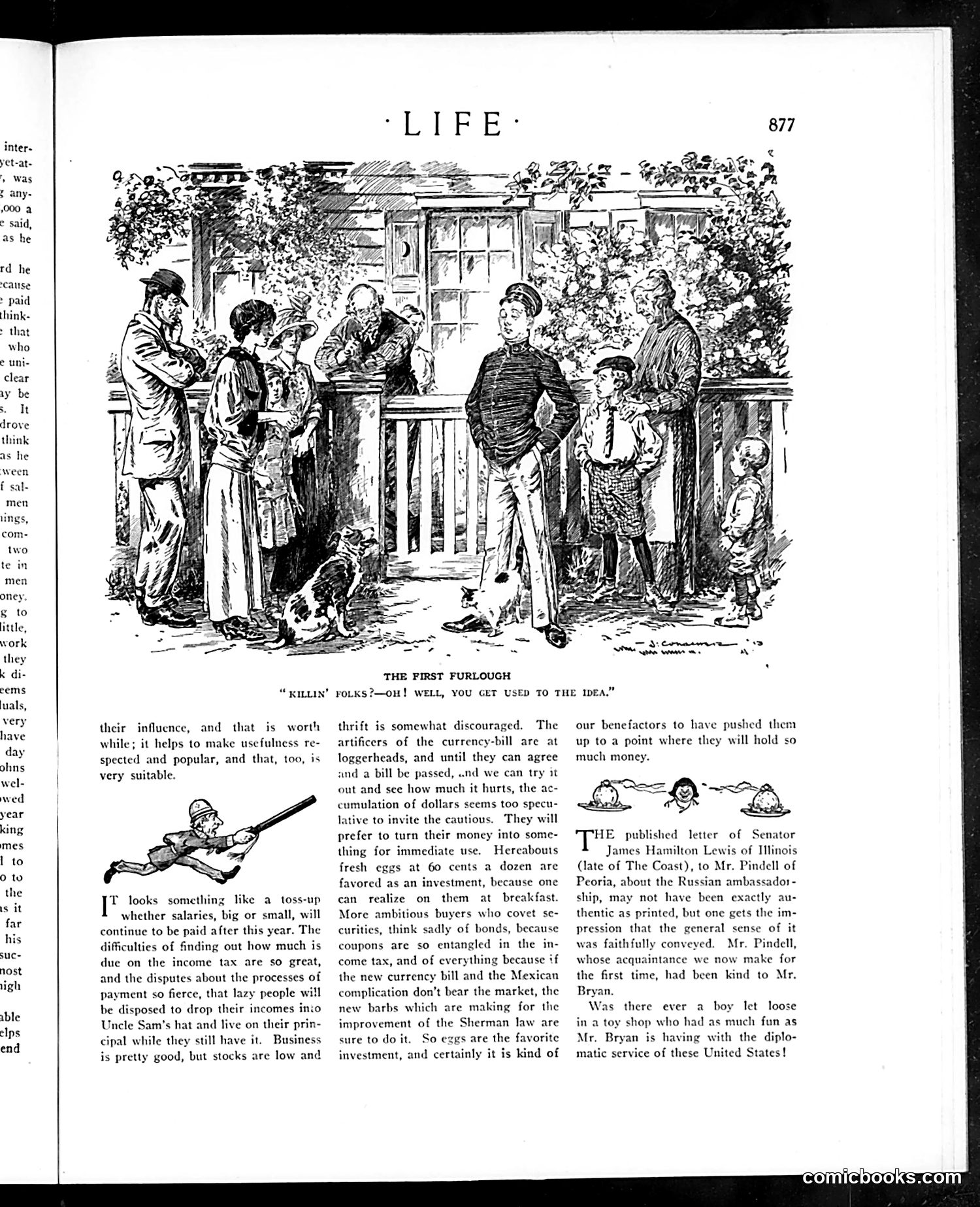
**The Cartoon:** Depicts a soldier home on leave surrounded by civilians (including children and a dog), with the caption "KILLIN' FOLKS?—OH! WELL, YOU GET USED TO THE IDEA." **Context:** This appears to reference World War I military service. The satire shows a returning soldier casually discussing combat killing with civilians, suggesting the disturbing normalization of warfare and violence. The rural/domestic setting contrasts sharply with the soldier's matter-of-fact attitude about lethal combat. **The Text Below:** Discusses financial anxiety—income tax complications, currency bill debates, and investment uncertainty. Citizens are reportedly favoring egg purchases as "investments" because they provide tangible returns at breakfast, avoiding complicated financial instruments entangled in taxation and regulation. **The Satire's Point:** Life juxtaposes grim war realities with domestic financial anxieties, suggesting Americans remain preoccupied with petty economic concerns even as young men casually accept killing as routine. This critiques both wartime callousness and peacetime materialism.
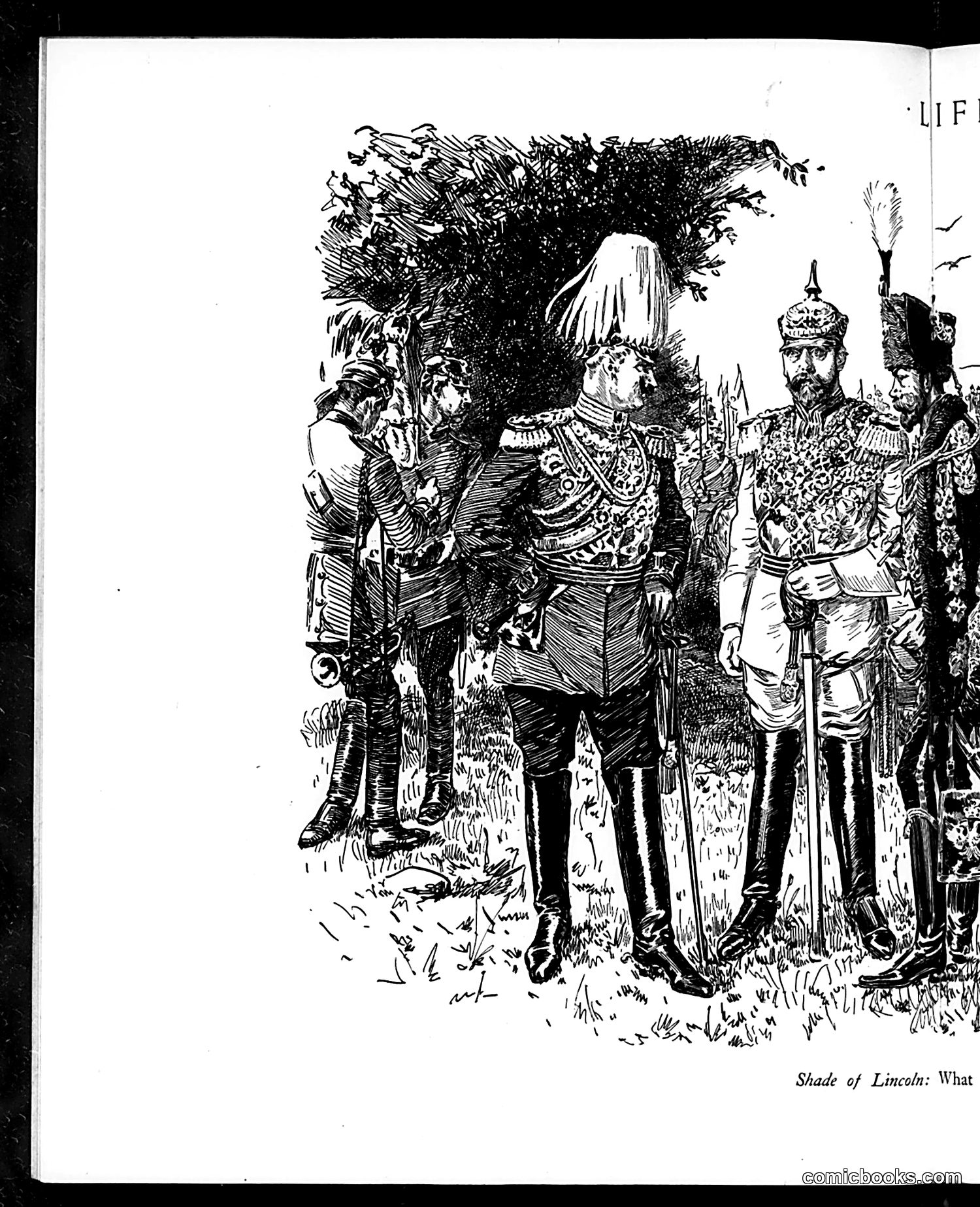
This political cartoon depicts several military figures in ornate uniforms with spiked helmets, characteristic of German or Prussian military dress from the early 20th century. The title references Lincoln's "shade" (ghost/spirit), suggesting a commentary on what the 16th president would think of contemporary events. The elaborate uniforms and imperial styling suggest militarism and autocracy—likely critiquing either German imperialism or American military expansion during this era. The incomplete caption "What" suggests the original page continues, leaving the full argument unstated here. Without the complete text and publication date, the specific political event remains unclear, but the cartoon appears to be satirizing militaristic governance through the lens of American democratic ideals Lincoln represented.
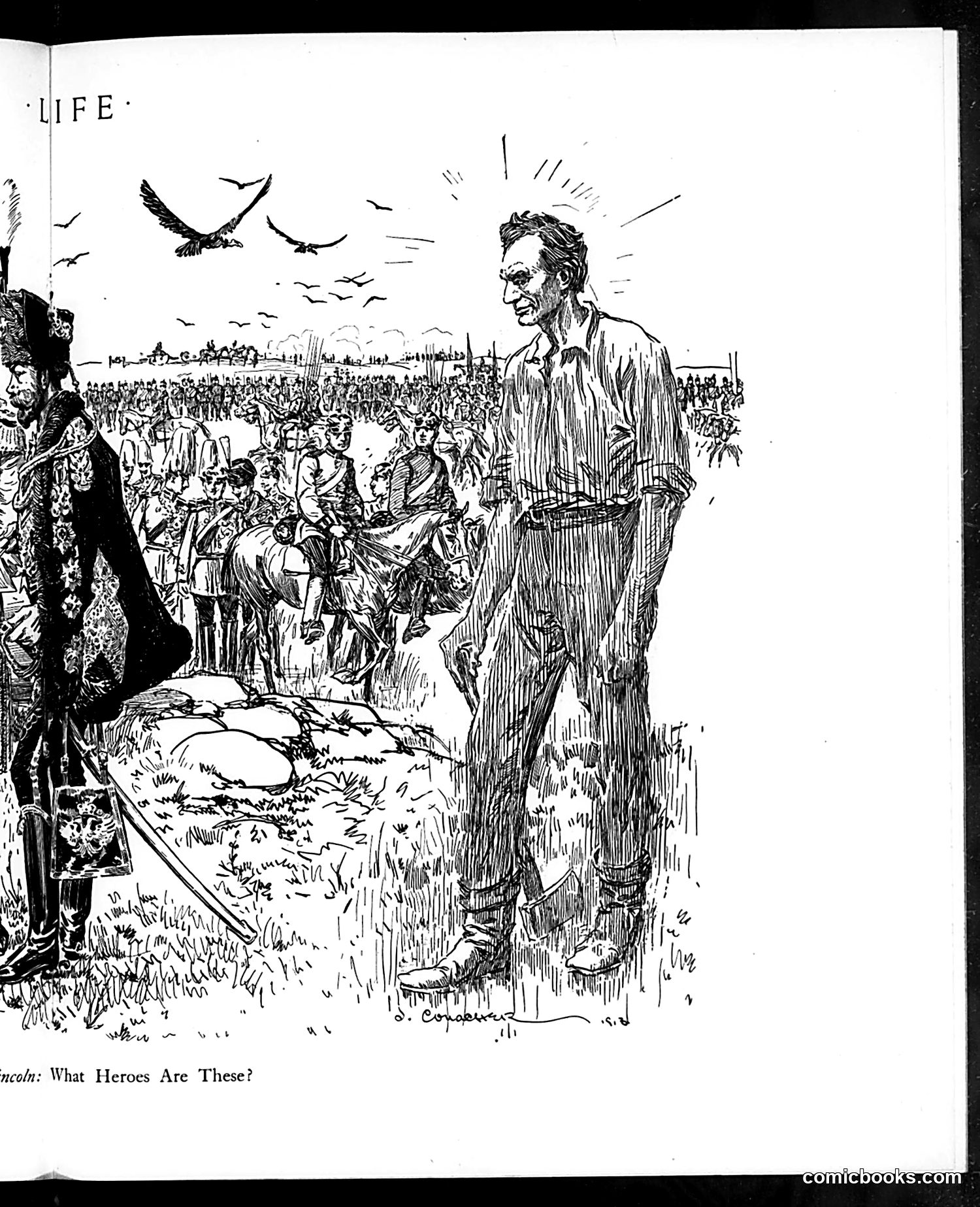
This appears to be a satirical illustration from *Life* magazine showing a tall, gaunt figure (likely representing Abraham Lincoln, given the caption reference) standing before a large crowd and what appears to be a grave or burial site. The caption "Lincoln: What Heroes Are These?" suggests bitter irony—the figure is questioning who these people are that are being commemorated or mourned. The satire likely critiques either the glorification of fallen soldiers, political leadership, or perhaps civilian casualties from war. The massive crowd in the background and the solemn scene suggest commentary on Civil War casualties or political costs. The style and composition emphasize the figure's moral questioning in the face of mass death, typical of *Life* magazine's sharp political commentary during the 19th-20th centuries.
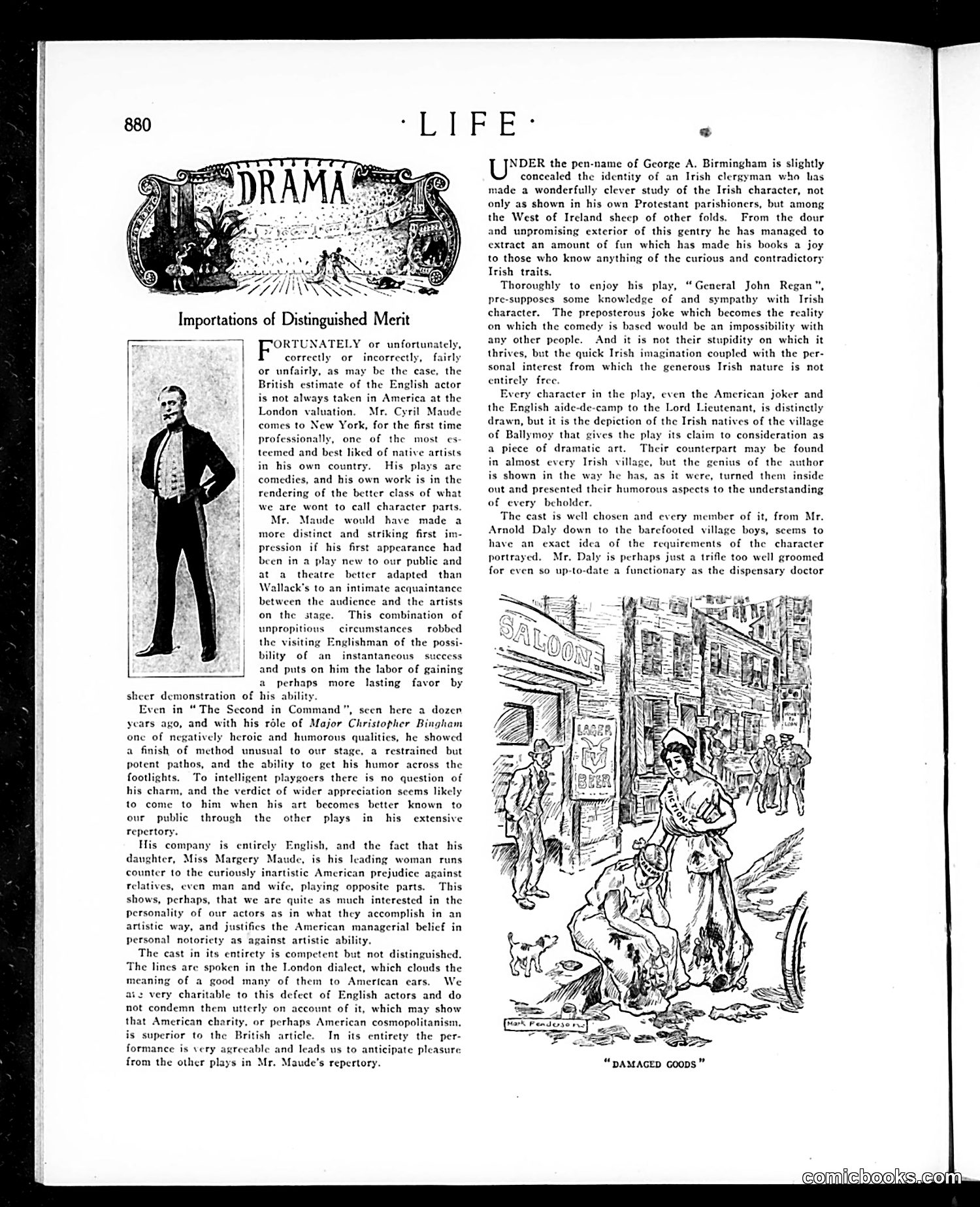
This page reviews two theatrical "importations" to America—English and Irish plays. **The Cyril Maude Review** (left): Discusses British actor Cyril Maude's New York debut in comedies. The critique notes that English actors aren't always valued in America as highly as in London. The article praises Maude's skill but suggests the venue and unfamiliar material limited his initial success. It also comments on the American prejudice against relatives (his daughter Margery) performing together on stage—revealing that Americans care more about actors' personalities than artistic merit. **The "General John Regan" Review** (right): Examines an Irish play by George A. Birmingham (a pen-name for an Irish clergyman). The review suggests the comedy relies on specifically Irish character traits—quick imagination and personal interest—making it incomprehensible to other nationalities. The illustration labeled "Damaged Goods" appears to show a street scene, likely depicting Irish village life central to the play. Both reviews reflect early 20th-century attitudes about transatlantic theatrical taste and national character stereotyping.
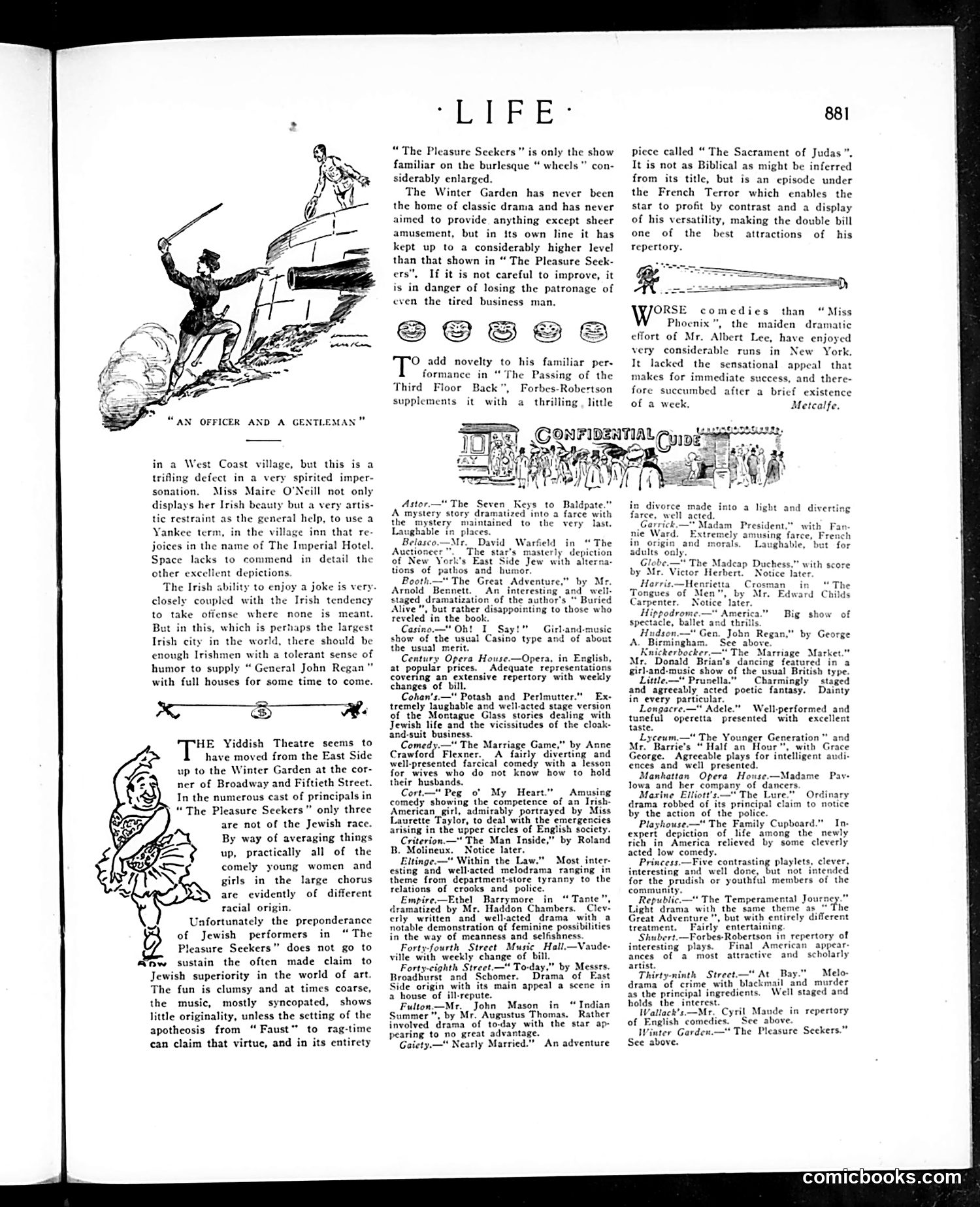
This page contains theater reviews reflecting early 20th-century attitudes toward ethnic performers and entertainment. The main illustrated cartoon shows "An Officer and a Gentleman"—a comedic scene depicting physical comedy typical of vaudeville. The reviews reveal period prejudices: the critic dismisses "The Pleasure Seekers" at the Winter Garden, noting that while most chorus girls are "of different racial origin," the Jewish performers cannot sustain "claims to Jewish superiority in the world of art." The production is called "clumsy" with unoriginal "syncopated" music—coded language reflecting contemporary ethnic stereotypes. Conversely, reviews praise Irish performers like Miss Maire O'Neill and the play "General John Regan," appealing to Irish audiences' "ability to enjoy a joke," though with a patronizing tone. The theater listings mention "Potash and Perlmutter" (Jewish characters) and "Peg o' My Heart" (Irish-American protagonist)—shows the magazine reviews alongside its ethnic commentary, documenting how entertainment reflected and reinforced early-1900s social hierarchies.
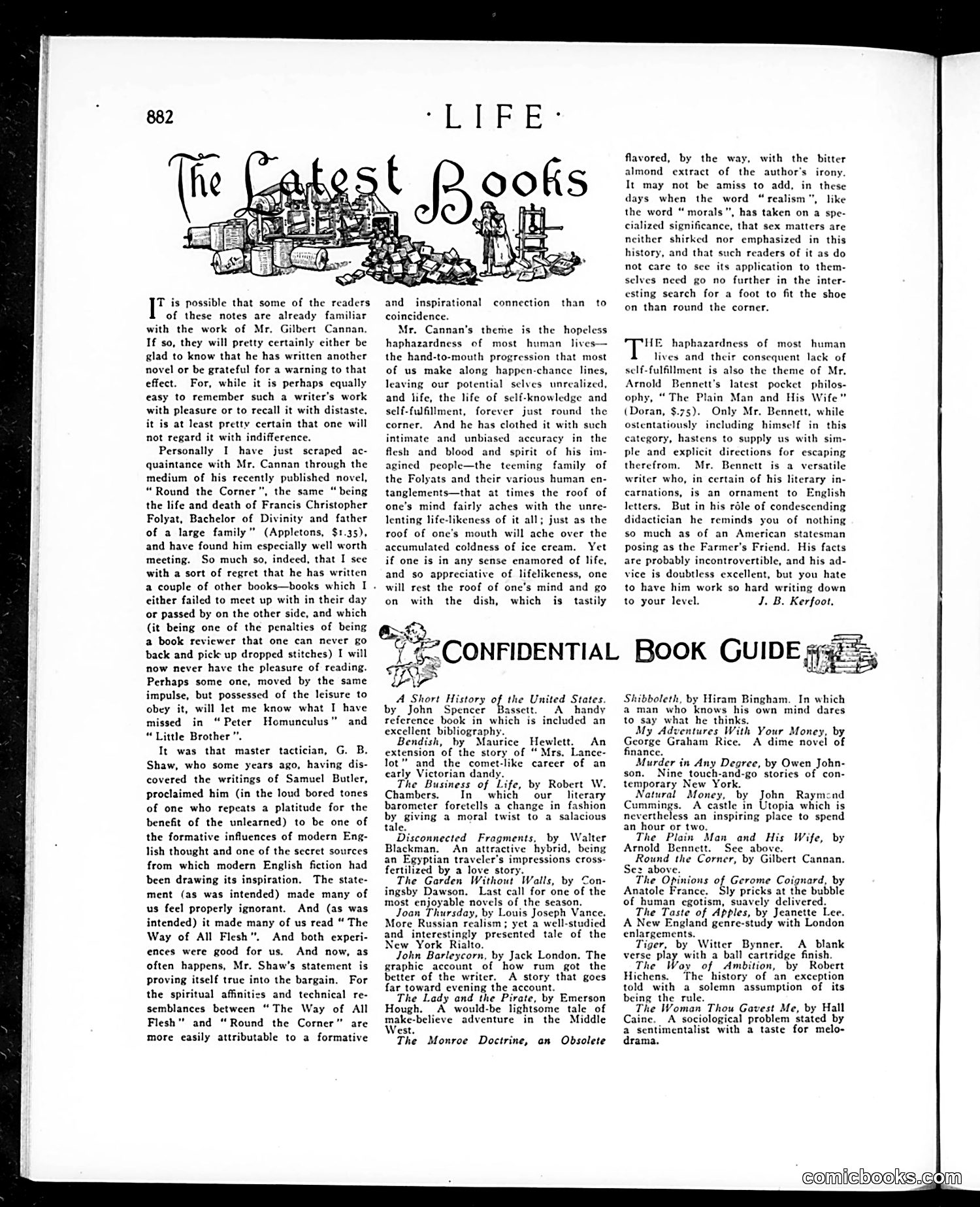
This is a book review column titled "The Cakest Books," discussing novelist Gilbert Cannan's work "Round the Corner." The reviewer compares Cannan favorably to Samuel Butler (author of "The Way of All Flesh"), crediting Butler as a formative influence on modern English fiction—a claim the reviewer attributes to critic G.B. Shaw. The satire is gentle: the reviewer playfully admits to feeling "properly ignorant" after Shaw's pronouncement about Butler's importance, then sheepishly following Shaw's lead by reading the book anyway. The joke involves intellectual pretension and how critics like Shaw use authority to make readers feel inadequate, yet the strategy paradoxically works—the reading proves worthwhile. The "Confidential Book Guide" section below lists recent publications with brief descriptions, functioning as advertisement/recommendations for contemporary titles.
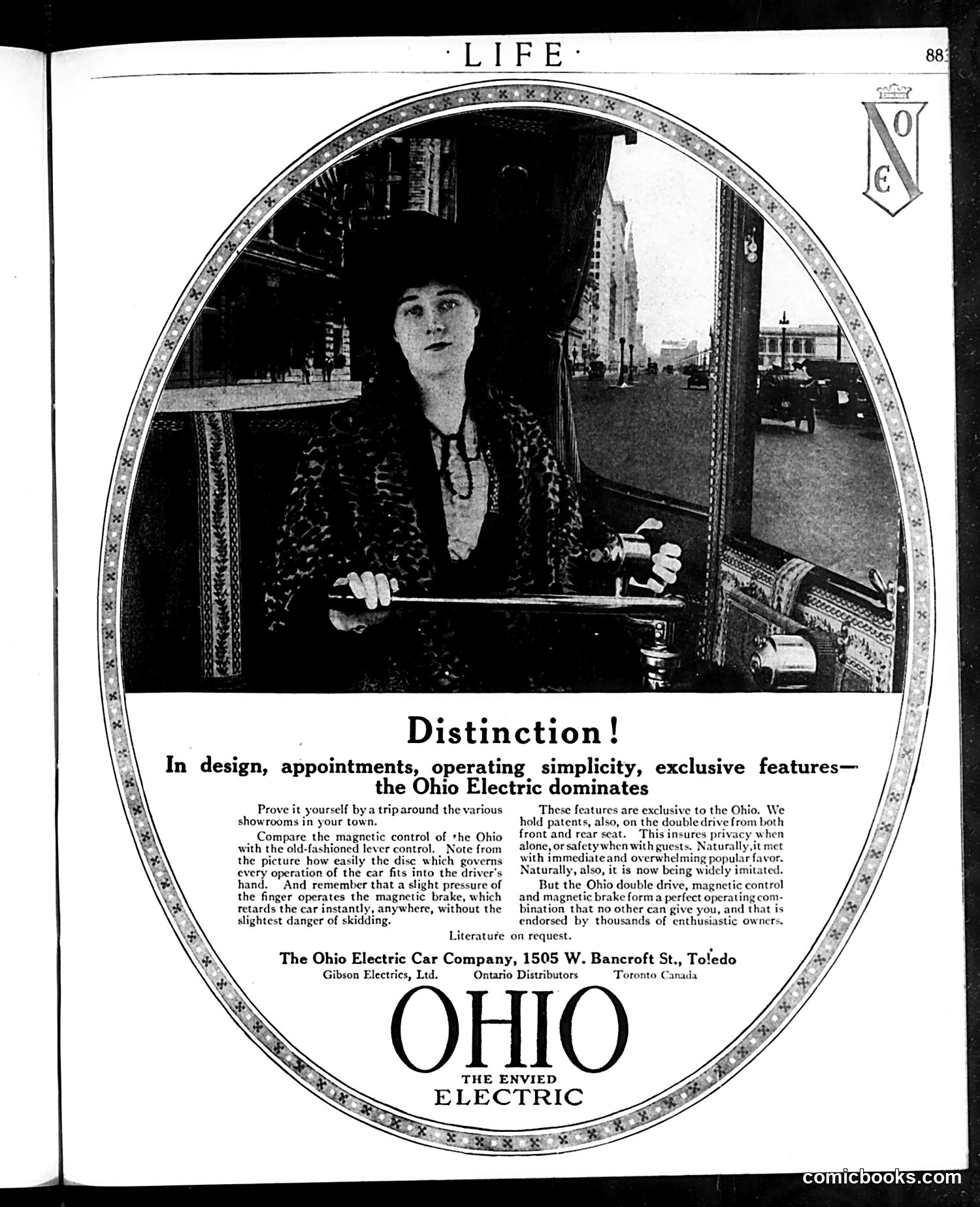
This is not a political cartoon but a **commercial advertisement** for the Ohio Electric Car Company of Toledo, Ohio. The page features a photograph of a well-dressed woman at the wheel of an electric automobile, positioned as a glamorous endorsement. The ad emphasizes the car's "distinction" through technological features: magnetic control, double drive, and magnetic braking—all presented as exclusive patents. The copy appeals to early 20th-century consumers by highlighting ease of operation (finger-pressure controls), safety, and privacy (double drive enables solo driving or private seating). Notably, the ad acknowledges competitors are imitating the Ohio's features, positioning imitation as flattery ("the Ohio double drive...is now being widely imitated"). This reflects the competitive electric automobile market of the 1910s-1920s, before gasoline vehicles dominated. The elegant presentation targets affluent consumers—particularly women drivers, a growing market segment—by emphasizing comfort and technological sophistication over raw power.
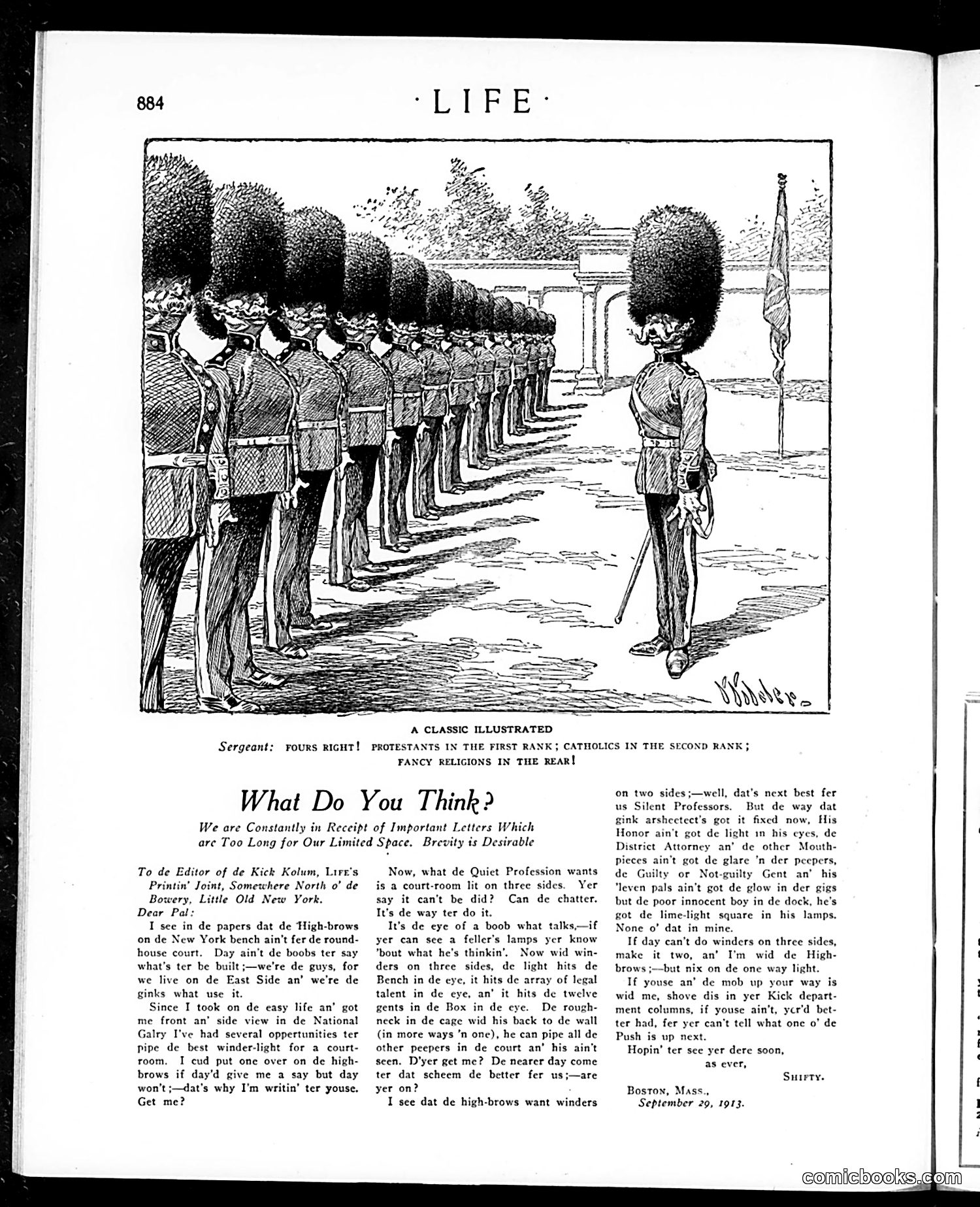
## The Cartoon The illustration depicts a sergeant organizing soldiers by religious affiliation: Protestants in the front rank, Catholics in the second rank, and "fancy religions" relegated to the rear. This is satire on religious discrimination and segregation practices, likely reflecting tensions about Irish Catholic immigration and prejudice in American military and civic institutions around 1913. ## The Letter Column Below is a humorous letter from "Shirty," written in exaggerated working-class dialect ("de ginks," "High-brows"). He advocates for three-sided courtroom lighting rather than the architect's one-sided design—arguing that proper lighting exposes the defendant's face while hiding the accused's ability to read others' expressions. This is satirical commentary on courtroom justice, suggesting the system advantages the guilty over the innocent poor. Both items critique institutional discrimination and unfair practices affecting marginalized groups—religious minorities and the working-class accused.
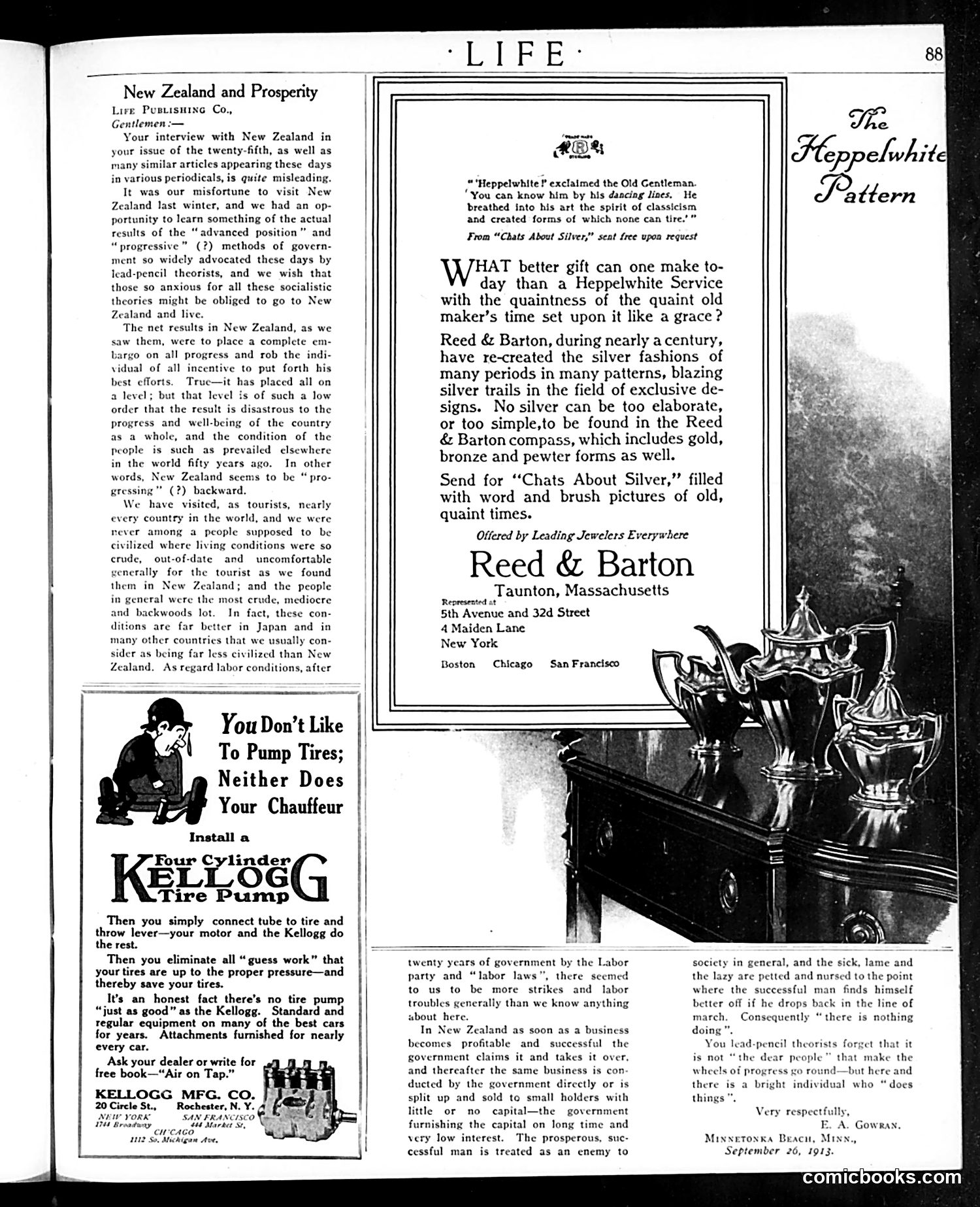
This page contains a reader's letter criticizing New Zealand's socialist government policies, presented as counterpoint to a favorable earlier article in Life. **The Letter's Argument:** The writer, claiming firsthand experience, argues that New Zealand's "advanced" and "progressive" socialist methods have backfired. Rather than improving conditions, he claims they've created equality at an unacceptably low level, stalling progress and leaving the country technologically and socially backward—worse even than Japan. He alleges labor unrest persists despite socialist labor laws. **Historical Context:** This reflects early 20th-century American debate over socialism. New Zealand had implemented pioneering welfare-state policies under the Liberal government (1891-1912). American conservatives like this correspondent used such examples as cautionary tales against similar proposals gaining traction in the U.S. **The Page's Advertisements:** The Kellogg tire pump and Reed & Barton silverware ads are unrelated commercial content typical of Life's revenue model. The letter represents skepticism toward the socialist experiment that would intensify during subsequent decades of labor conflict.
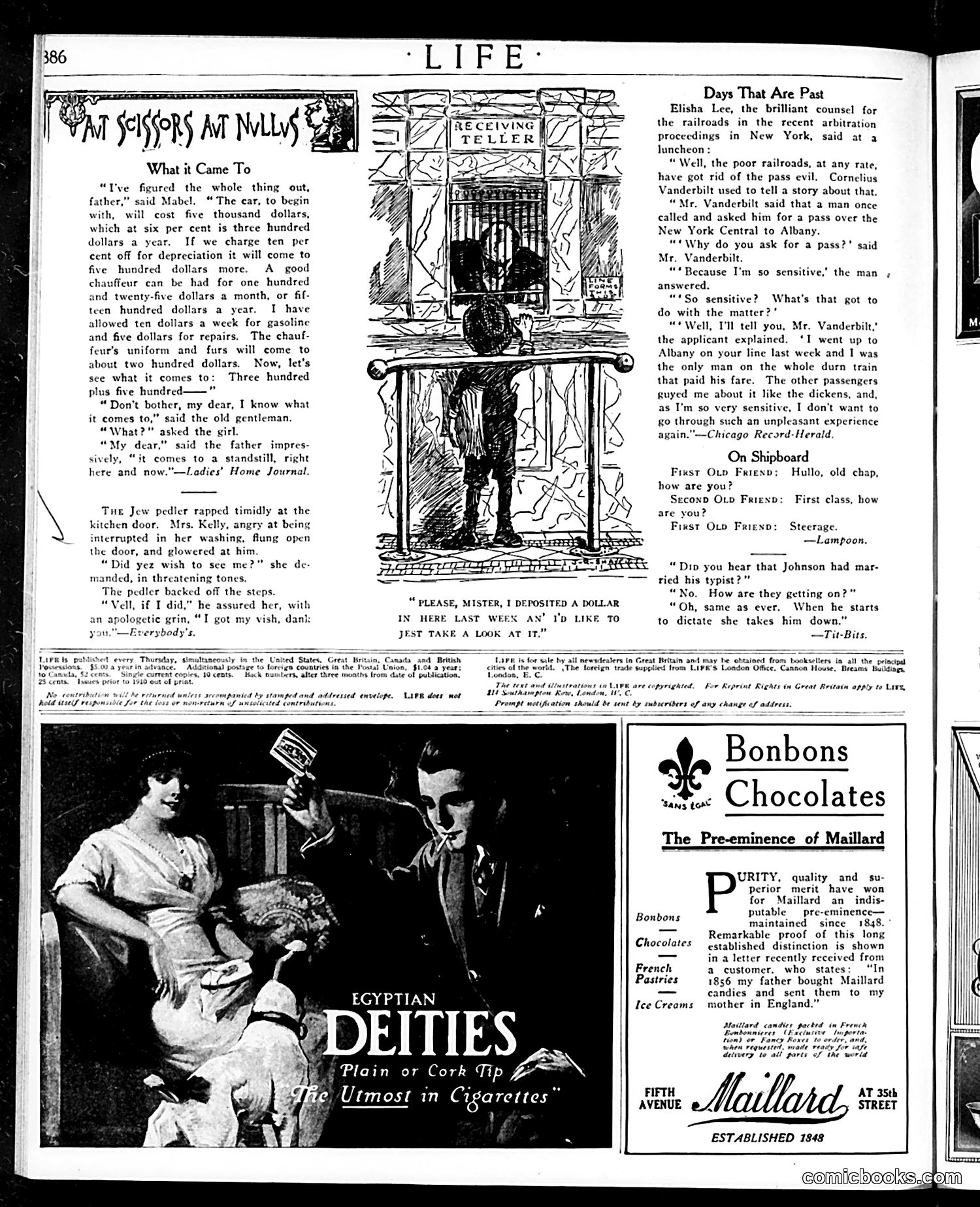
This page contains three separate humorous pieces typical of early 20th-century satirical magazines: **"What It Came To"**: A father refuses to fund his daughter's automobile purchase by itemizing all ownership costs (depreciation, chauffeur salary, fuel, repairs, uniforms). The joke is that when the daughter asks what the total "comes to," the father says it "comes to a standstill, right here and now"—a pun meaning both the financial endpoint and that the discussion ends there. **Two short anecdotes**: One depicts a Jewish peddler and Irish housewife in period-typical dialect humor (common but now considered offensive). The other plays on class anxiety—a passenger secretly checking on his deposited dollar in a bank teller window, implying distrust of financial institutions. **"Days That Are Past"**: A Vanderbilt anecdote about railroad passes, satirizing how railroad magnates once offered free travel to influential people (the "pass evil"). The humor concerns a sensitive man who paid full fare and was mocked for it—social commentary on 19th-century railway corruption. The advertisements promote Egyptian Deities cigarettes and Maillard chocolates.
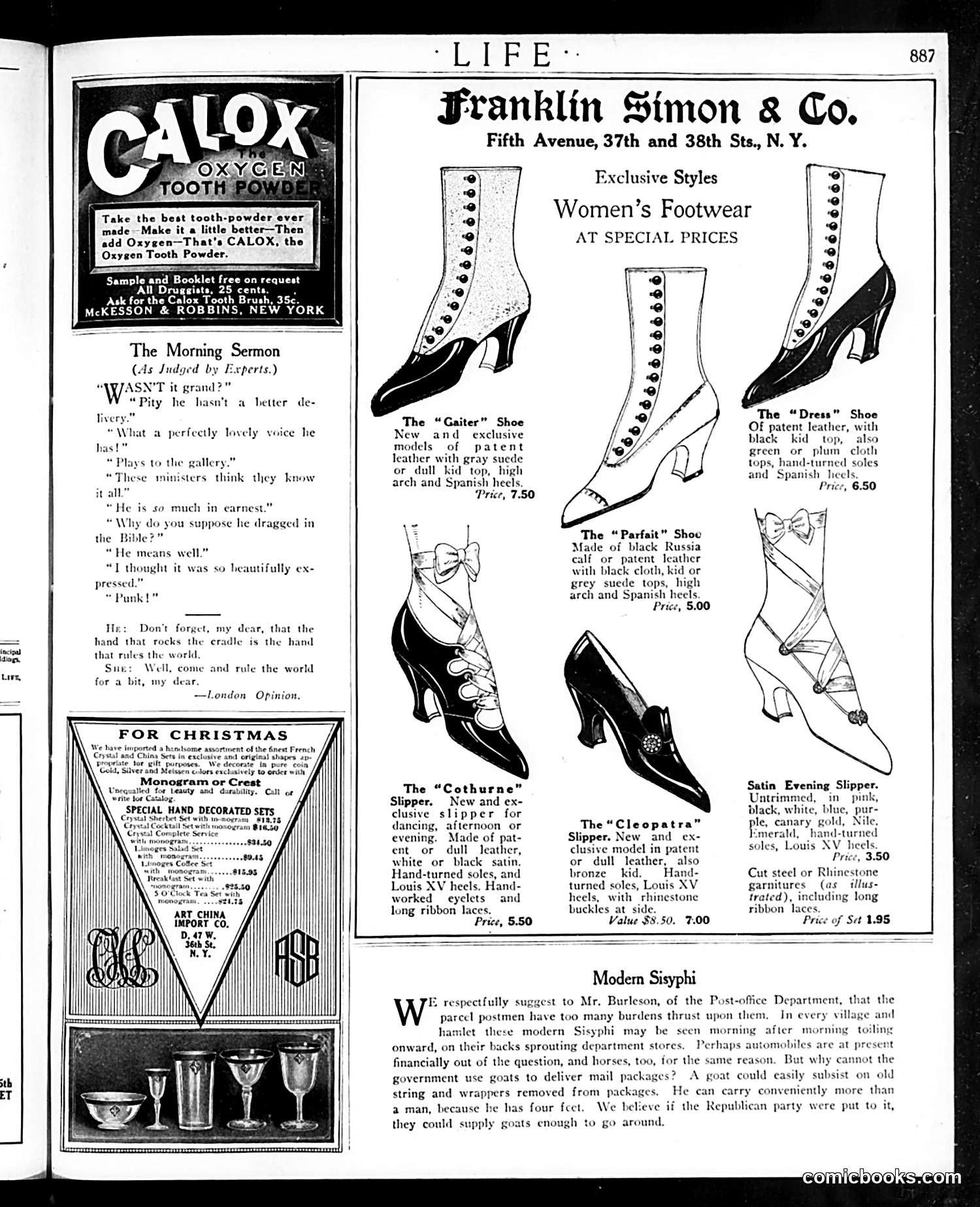
This page is primarily **advertising** for women's shoes and other luxury goods, with two separate satirical pieces: **"The Morning Sermon"** mocks church-goers who critique the minister's performance rather than listen to his message. The joke shows conflicting opinions ("grand" vs. "punk") about delivery, voice, and content—suggesting people judge sermons like entertainment rather than spiritual instruction. **"Modern Sisyphi"** (bottom) is political satire directed at Postmaster General Albert Burleson. It criticizes mail carriers being overburdened delivering packages, comparing them to Sisyphus pushing his boulder eternally. The writer sarcastically suggests the government could save money by using goats instead of horses to deliver mail—a jab at perceived government inefficiency and penny-pinching. The reference to the "Republican party" indicates this appeared during a Democratic administration (likely Wilson's). The shoe advertisements showcase fashionable women's footwear with ornate names ("Gaiter," "Parfait," "Cleopatra") and Spanish heels—luxury goods for wealthy women.
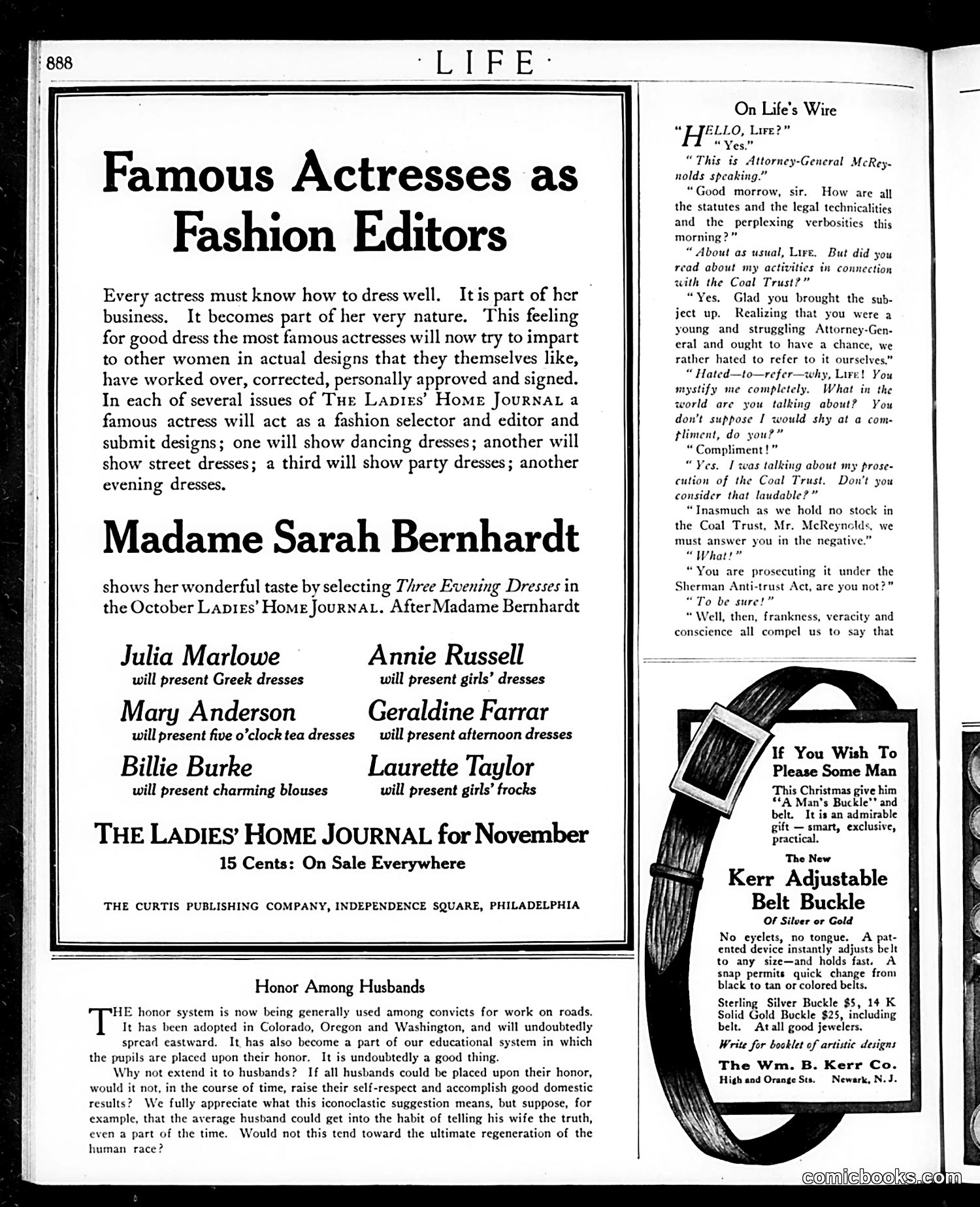
This page contains advertisements and articles rather than political cartoons. The main content promotes "Famous Actresses as Fashion Editors"—a marketing campaign where renowned stage actresses like Sarah Bernhardt, Julia Marlowe, and Annie Russell would design and endorse clothing for *The Ladies' Home Journal*, leveraging their fashion credibility to sell magazines and fashions to women readers. The satirical article "Honor Among Husbands" is a social commentary suggesting that if husbands operated under an "honor system" (like prisoners or students were beginning to), they might tell their wives the truth occasionally, supposedly improving domestic life and "human regeneration." "On Life's Wire" appears to be a witty dialogue mocking Attorney-General McReynolds's prosecution of the Coal Trust, implying his zeal for antitrust action is motivated by financial self-interest rather than principle.
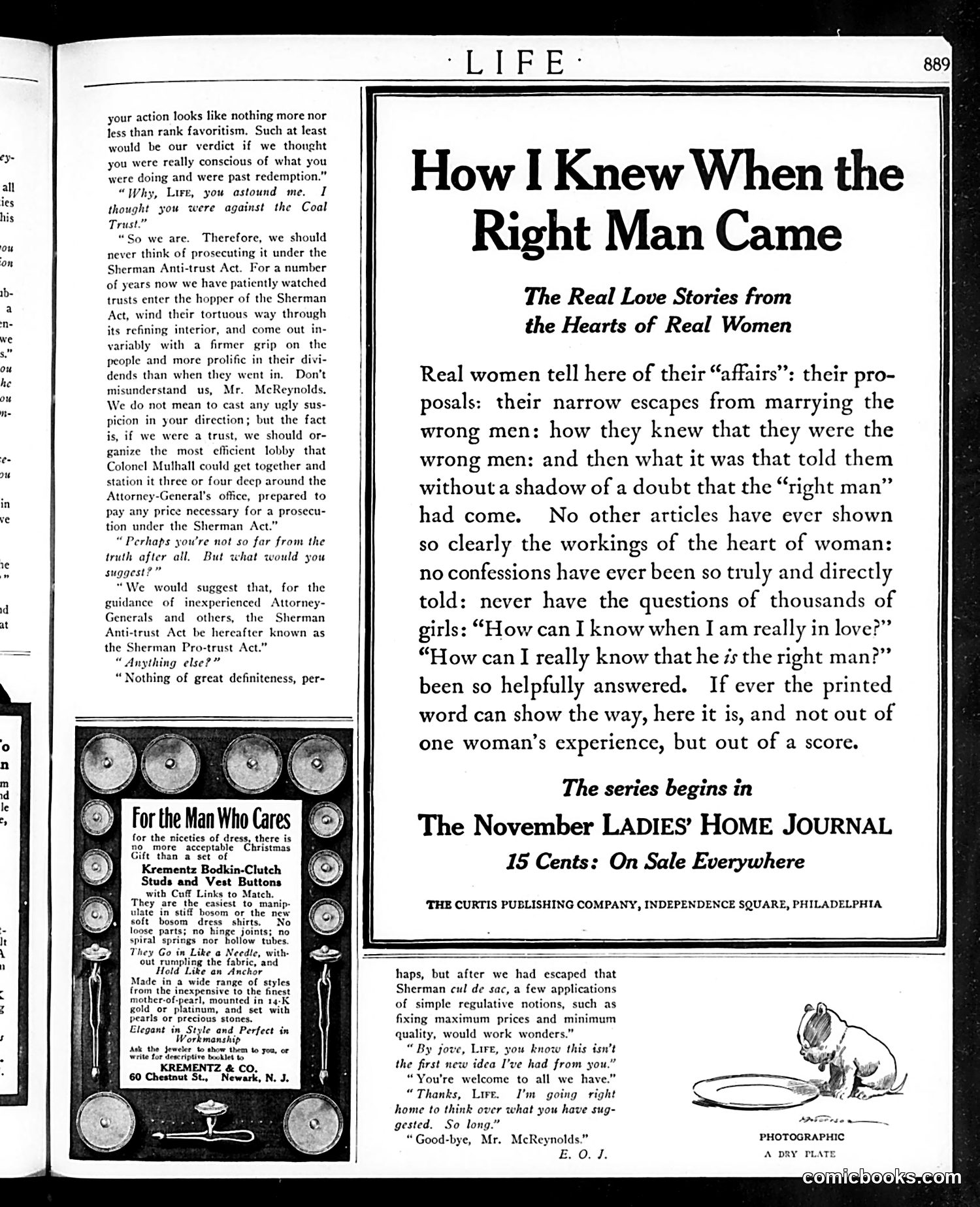
This page features **political satire targeting the Sherman Anti-Trust Act's ineffectiveness**. The dialogue between "Lire" (Life magazine's voice) and "Mr. McReynolds" (likely James C. McReynolds, Attorney General under President Wilson) critiques how the Sherman Act, intended to break up monopolies like the Coal Trust, actually strengthens them instead. The satirist's key argument: trusts enter prosecution under the Sherman Act and emerge "invariably with a firmer grip on the people and more prolific in their dividends than when they went in." The joke culminates in renaming it the "Sherman **Pro**-trust Act"—suggesting the law does the opposite of its intended purpose. The remainder of the page contains **unrelated advertising** (Krementz jewelry studs) and a **promotional announcement** for the Ladies' Home Journal's new romantic-advice series.
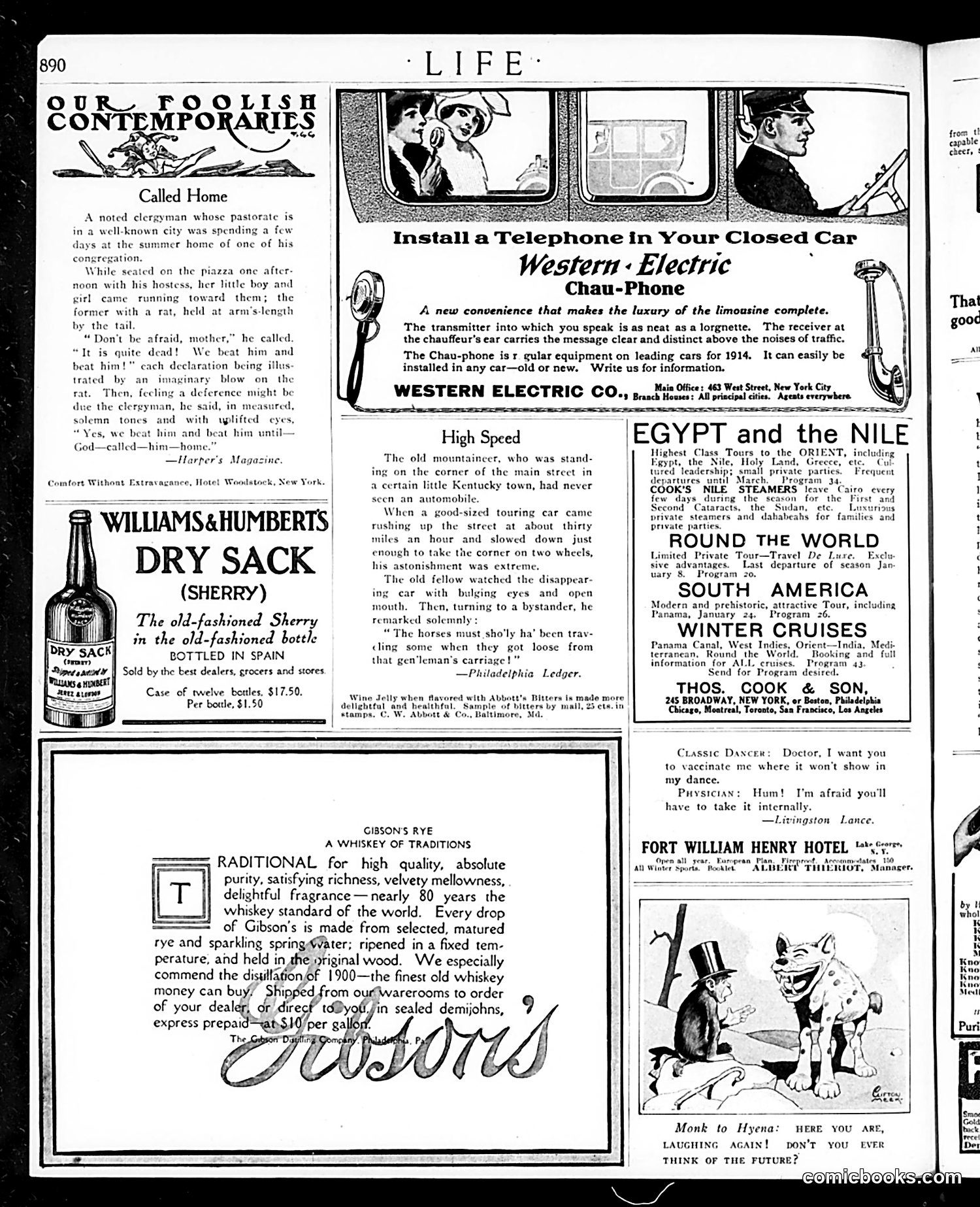
This page mixes advertisements with satirical humor typical of *Life* magazine's early 1900s format. **"Called Home"** satirizes religious hypocrisy: a clergyman's hosts' children proudly describe beating a rat to death, then, noticing the minister's presence, solemnly declare they beat it "until God—called—him—home"—mimicking religious euphemism for death. The joke is the children's sudden, transparent shift to pious language when authority arrives. **"High Speed"** mocks rural ignorance of automobiles. An old Kentucky mountaineer watches a car take a corner at speed on two wheels and concludes the *horses must have broken loose*—he cannot conceive the vehicle is mechanically powered, not horse-drawn. The remaining content is primarily **advertisements** for luxury goods (whiskey, telephone equipment for cars, travel tours) targeting wealthy readers—reflecting *Life's* upscale audience in 1914. A small medical joke mocks vanity: a dancer requests vaccination "where it won't show."
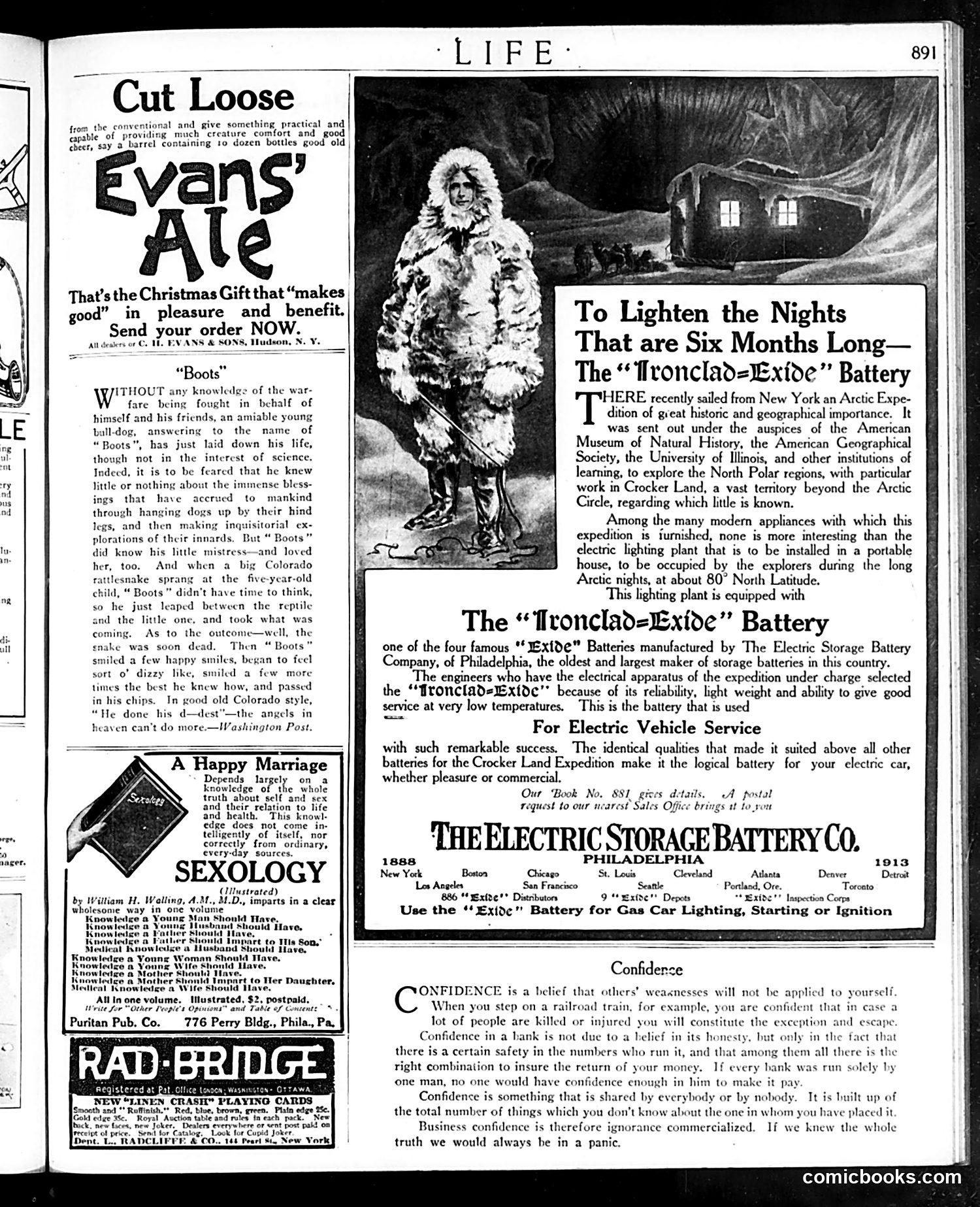
This page contains several **advertisements and short humorous pieces** rather than political cartoons. The main items are: 1. **Evans' Ale advertisement** — a Christmas gift pitch for beer barrels 2. **"Boots" story** — a sentimental anecdote about a loyal dog that sacrifices itself protecting a child from a rattlesnake in Colorado. The piece celebrates the dog's heroism and loyalty, presented in a folksy, touching manner typical of early 20th-century sentimental humor. 3. **"Tronclad-Exide" Battery advertisement** — promoting electric storage batteries used in an Arctic expedition, marketed as reliable for extreme cold conditions and electric vehicles 4. **"Sexology" book advertisement** — promoting an educational text about sexual health and marriage 5. **"Rad-Bridge" card game advertisement** 6. **"Confidence" essay** — a brief reflection on trust and banking safety The page is primarily **commercial content** with light human-interest pieces. There are no political cartoons or satire requiring historical context.
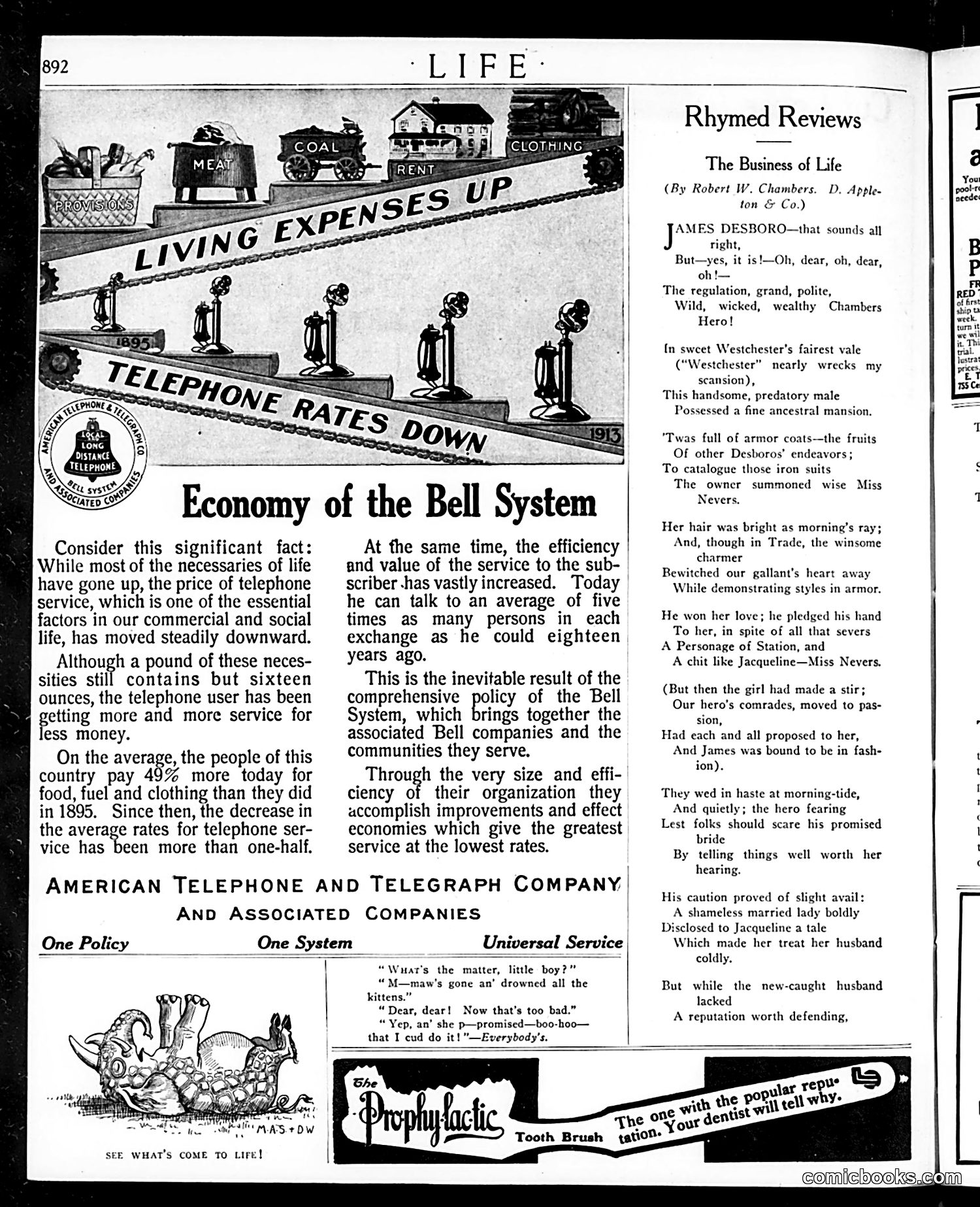
This page contains a **corporate advertisement** for American Telephone & Telegraph (AT&T) disguised as public service messaging. The cartoon titled "Living Expenses Up / Telephone Rates Down" uses a visual metaphor—various household costs (meat, coal, rent, clothing) climbing upward on a train track while telephone rates descend—to argue that telephone service is exceptionally affordable compared to other necessities. The ad claims that while food, fuel, and clothing costs rose 49% since 1895, telephone rates dropped over 50%, and service quality improved five-fold. This is **corporate propaganda**: AT&T presents itself as a benevolent monopoly serving the public interest through efficient organization. The page also includes a **humorous anecdote** about a boy whose mother drowned kittens he wanted to drown himself, and a **book review** in verse about a romance novel involving class differences.
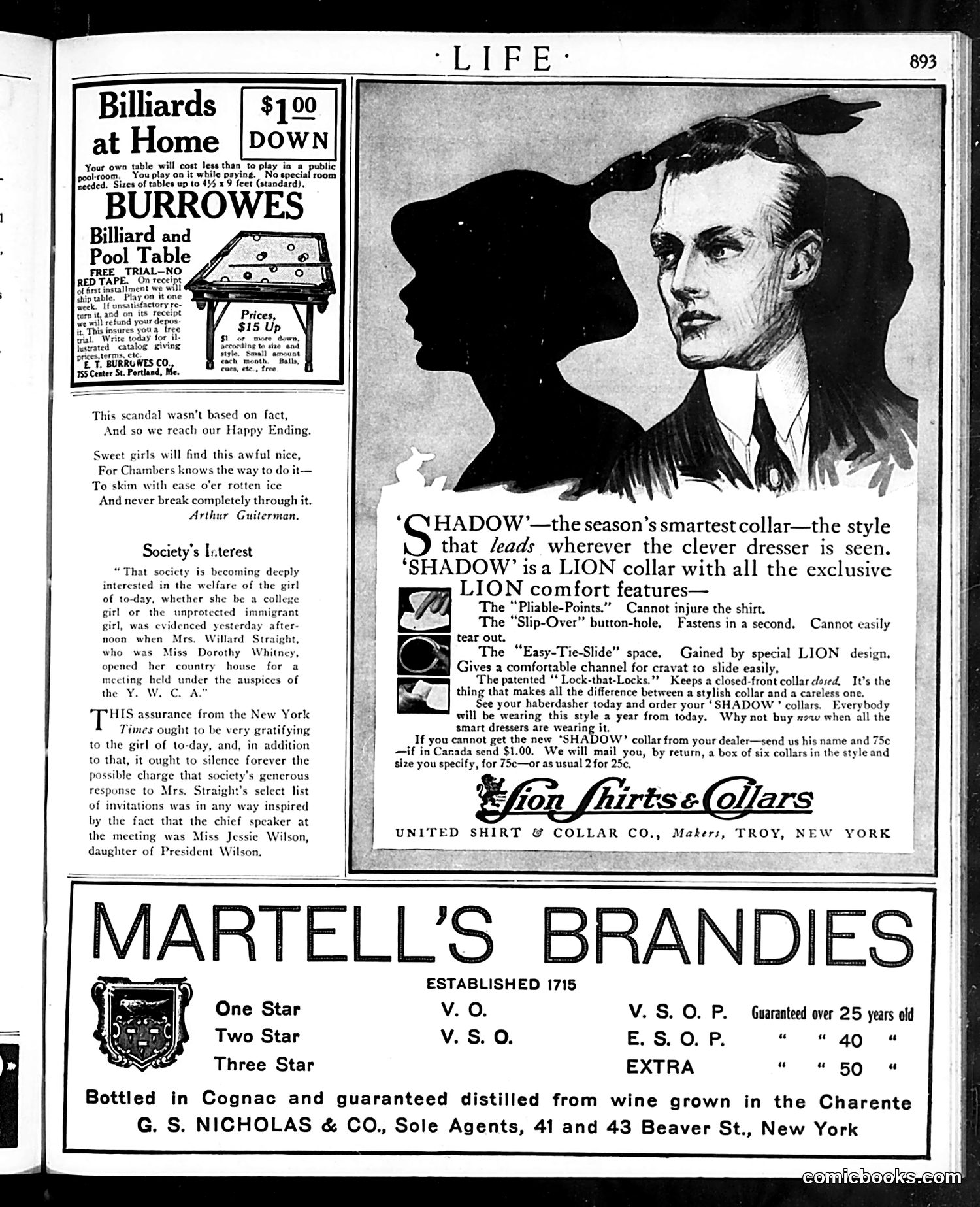
This page contains satirical commentary embedded in advertisements. The key content is the poem by Arthur Guiterman accompanying a society column note about Mrs. Willard Straight (formerly Dorothy Whitney) hosting a charity meeting. The satire targets wealthy society's hypocrisy. The column notes that society's "generous response" to Straight's invitation was supposedly motivated by genuine concern for girls' welfare—but Guiterman's poem sarcastically suggests otherwise. He implies the real draw was the appearance of **Jessie Wilson, daughter of President Woodrow Wilson**, the featured speaker. The poem's metaphor about "skating over rotten ice" without breaking through suggests society women attend fashionable charity events for prestige, not genuine philanthropic commitment—they skillfully navigate social obligations while avoiding real moral engagement. The remaining content consists primarily of period advertisements for billiard tables, shirt collars, and brandy.
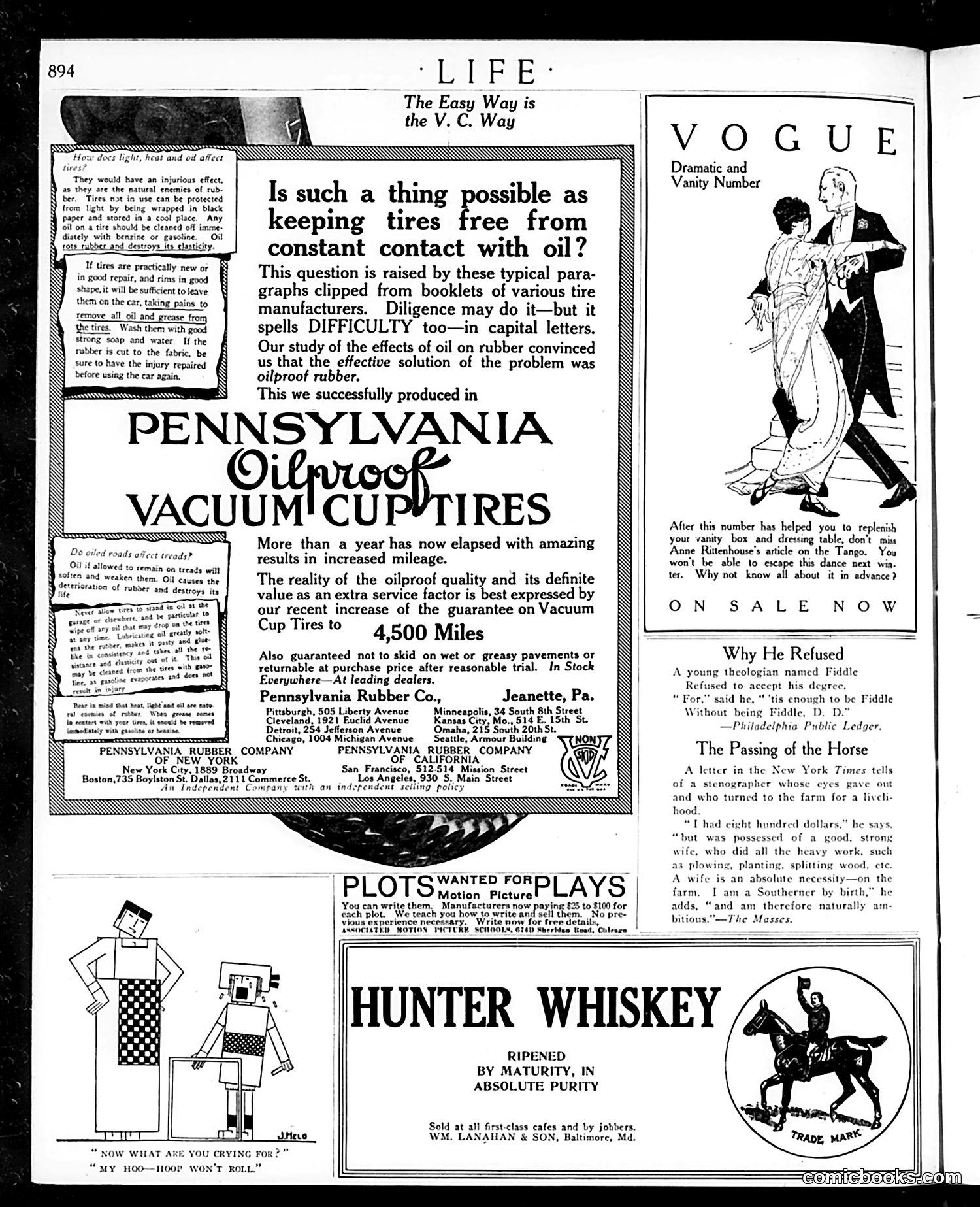
This page is primarily **advertising-driven**, featuring several product promotions typical of early 20th-century Life magazine. The main content includes: **Pennsylvania Vacuum Cup Tires advertisement**: Promotes "oilproof rubber" technology, claiming tires can resist oil degradation better than competitors. The ad addresses a genuine consumer concern about tire maintenance and longevity. **Vogue section header** (top right): Announces a "Dramatic and Vanity Number" with fashion illustration of a couple dancing—likely the Tango, referenced in accompanying text about Anne Rittenhouse's article. **Humorous verse**: A brief joke about "Fiddle" refusing a theology degree to avoid being "Fiddle, D.D."—simple wordplay humor. **"The Passing of the Horse"** excerpt: A New York Times letter satirizing a farm stenographer's claim that a wife is "an absolute necessity" for farm work, while he boasts of Southern ambition despite contributing little labor. **Hunter Whiskey advertisement**: Standard spirits promotion emphasizing "absolute purity." The cartoon at bottom shows geometric figures with caption about a hoop not rolling—likely unrelated filler humor.
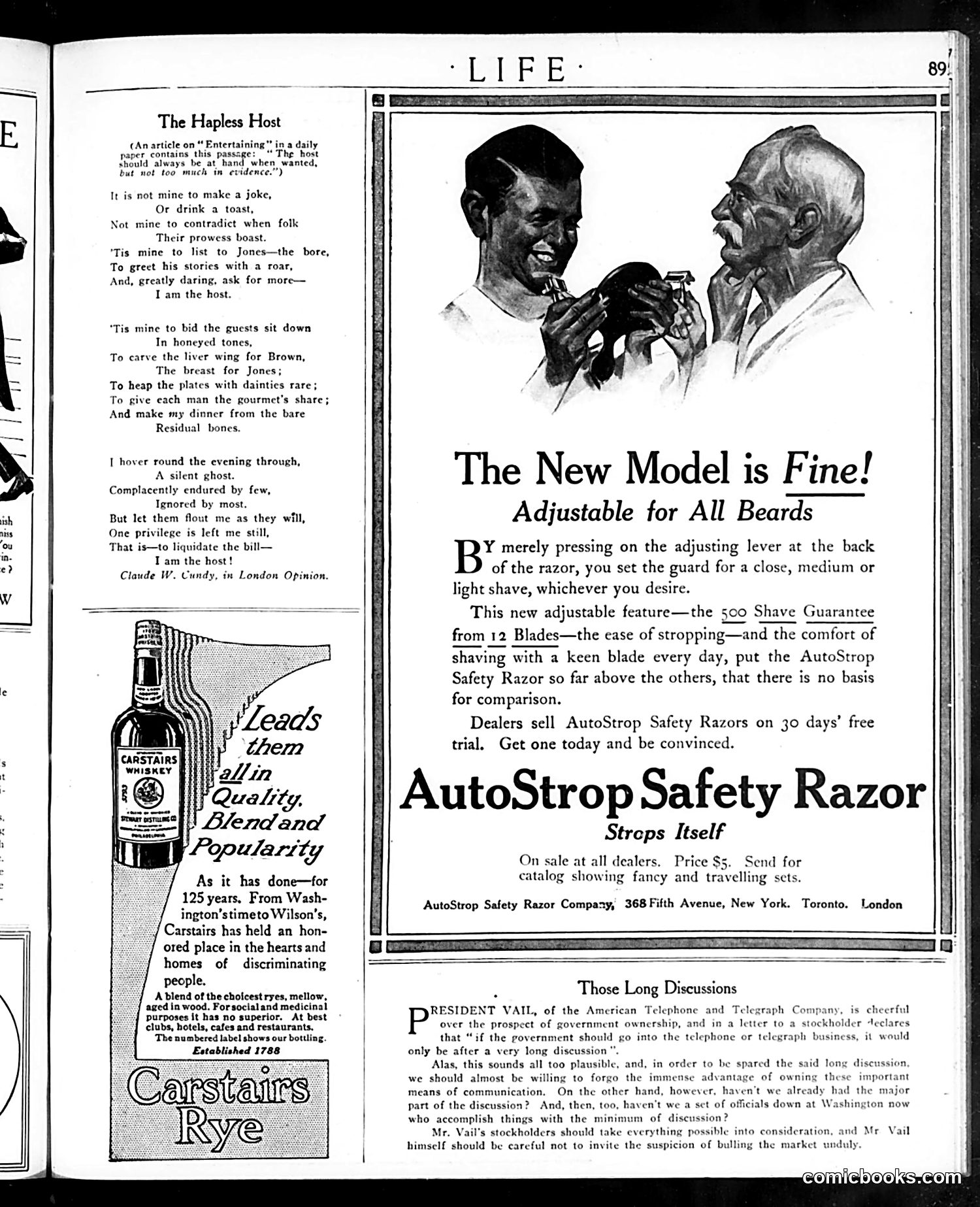
This page contains three distinct pieces of satirical content: **"The Hapless Host"** (left): A poem mocking the contradictory expectations of entertaining. The host must be simultaneously present yet invisible, attentive yet unobtrusive, generous with food yet eating scraps, and cheerfully enduring bores—his only consolation being he gets to pay the bill. It satirizes the servile, thankless role expected of hosts in early 20th-century social conventions. **Advertisements** (center and left margin): For Carstairs Whiskey and AutoStrop Safety Razors—standard period product ads with no satirical content. **"Those Long Discussions"** (bottom right): Mocks President Vail of AT&T, who claimed government takeover of telephone/telegraph would require "very long discussion." The satire suggests this is an excuse to delay—and that the current Washington administration actually *gets things done* quickly. This likely references the Progressive Era's efficiency concerns or WWI-era government intervention.
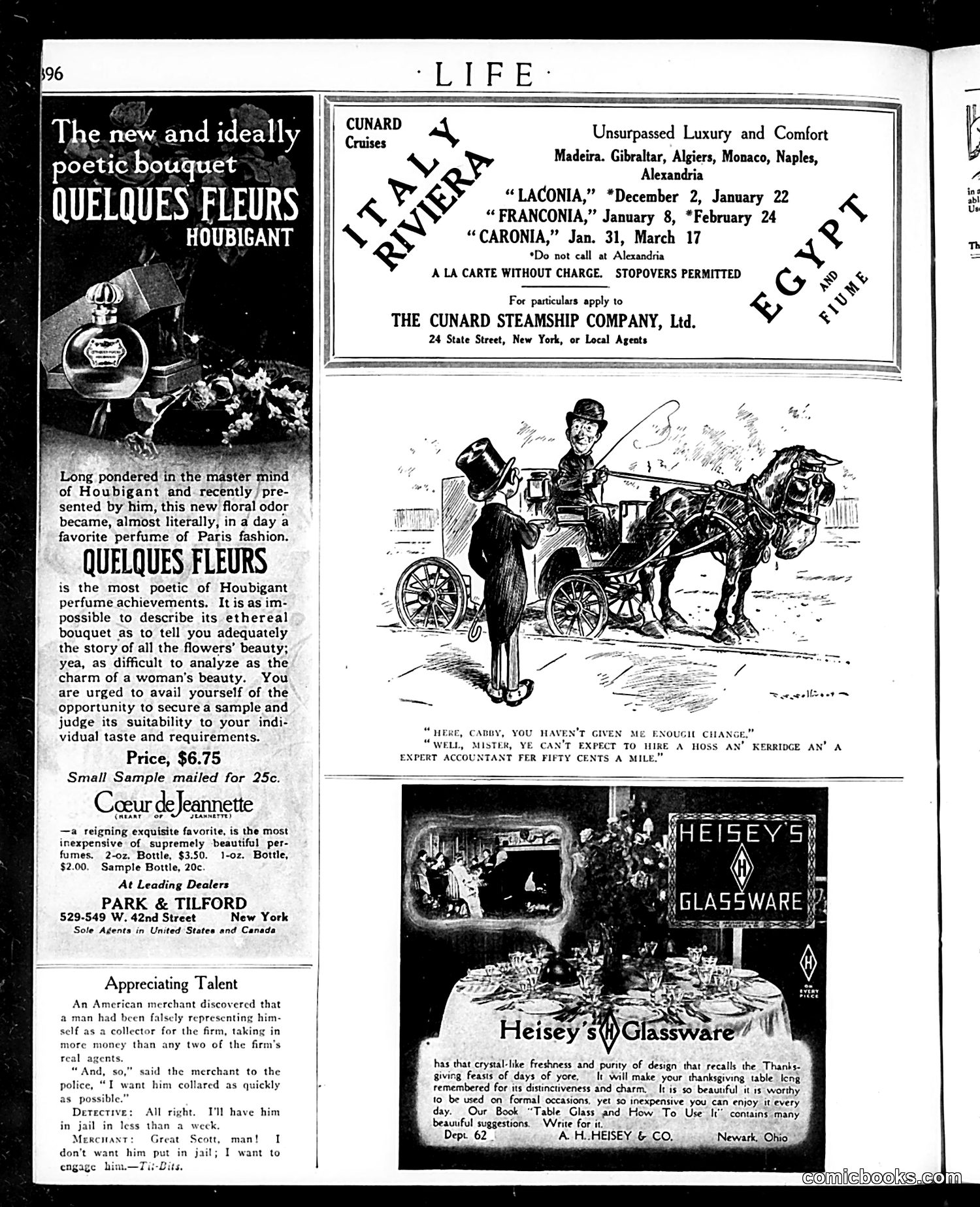
This page is primarily **advertising**, with one small satirical anecdote at the bottom. ## The Cartoon/Joke: The text piece "Appreciating Talent" tells of a merchant who discovers an employee falsely posing as a company collector—but wildly outperforming legitimate agents. When the merchant asks police to arrest him, the detective assumes it's punishment. The merchant's punchline: he wants to *hire* him instead. ## The Point: This is a simple joke about **merit over legality or credentials**. The satirical point: a man's actual talent and salesmanship ability matter more than his official authorization or honest methods. It reflects early-20th-century attitudes about business success rewarding results regardless of moral shortcuts—mildly mocking both the merchant's willingness to overlook fraud and the assumption that crime should always mean jail. The rest of the page advertises **perfume** (Quelques Fleurs by Houbigant), **Cunard cruise lines** to Mediterranean ports, and **Heisey glassware**.
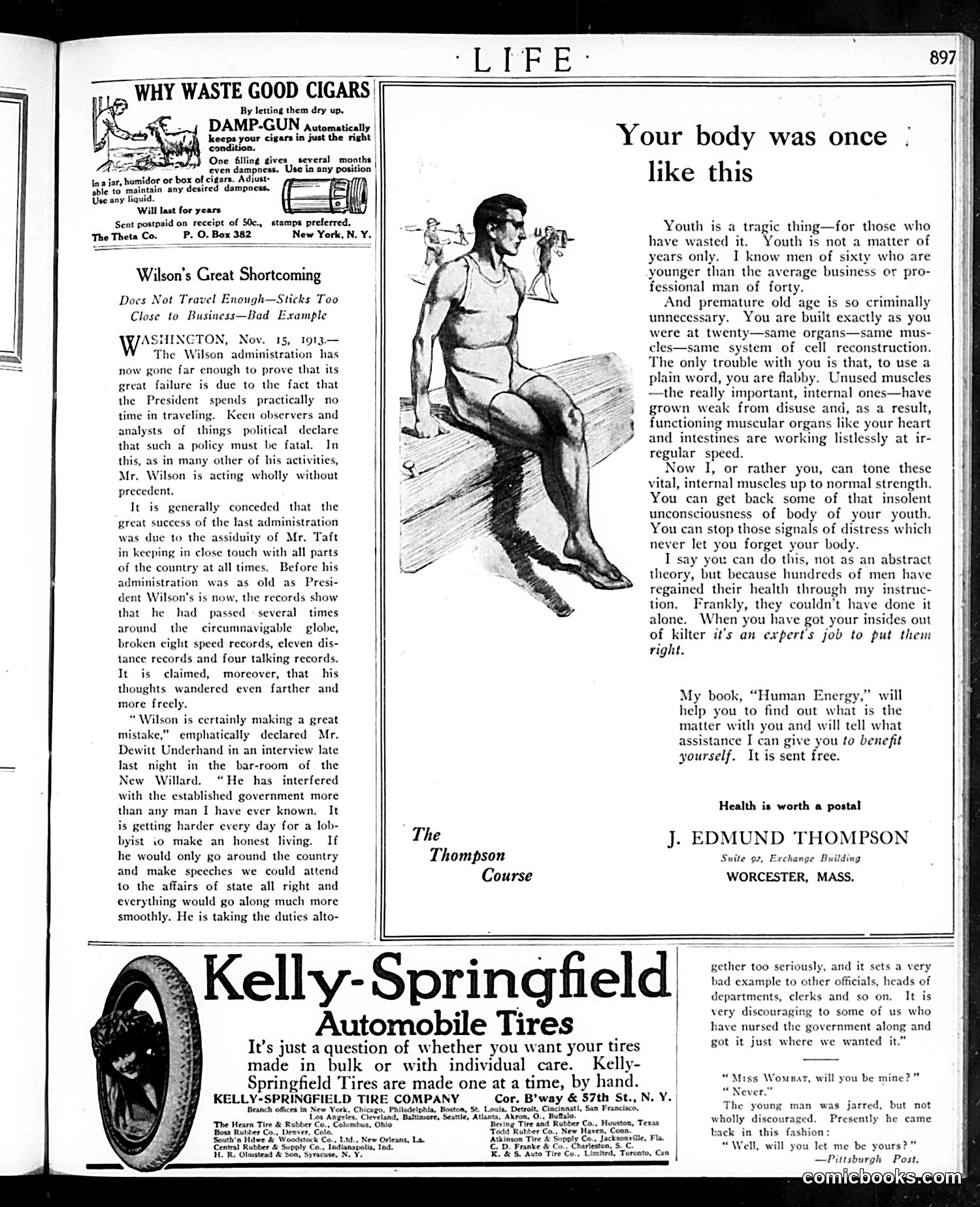
This page mixes advertisements with political satire. The main editorial piece attacks President Woodrow Wilson, claiming his "great failure" is not traveling enough. The unnamed satirist contrasts Wilson unfavorably with his predecessor William Howard Taft, who allegedly traveled extensively, broke speed records, and went around the globe multiple times. The satire's target becomes clear in the quoted interview with "Mr. Dewitt Underhand" (a transparent fictional name suggesting dishonest dealings). This character—apparently representing lobbyists and corrupt officials—complains that Wilson's focus on actual governance makes it "harder every day for a lobbyist to make an honest living." He laments that Wilson takes duties "too seriously" and sets a bad example by not traveling around making speeches while letting officials handle affairs of state. The joke critiques both Wilson (for allegedly neglecting travel) and, more sharply, exposes the corruption of the previous administration and the lobbying interests opposing Wilson's reformist approach.
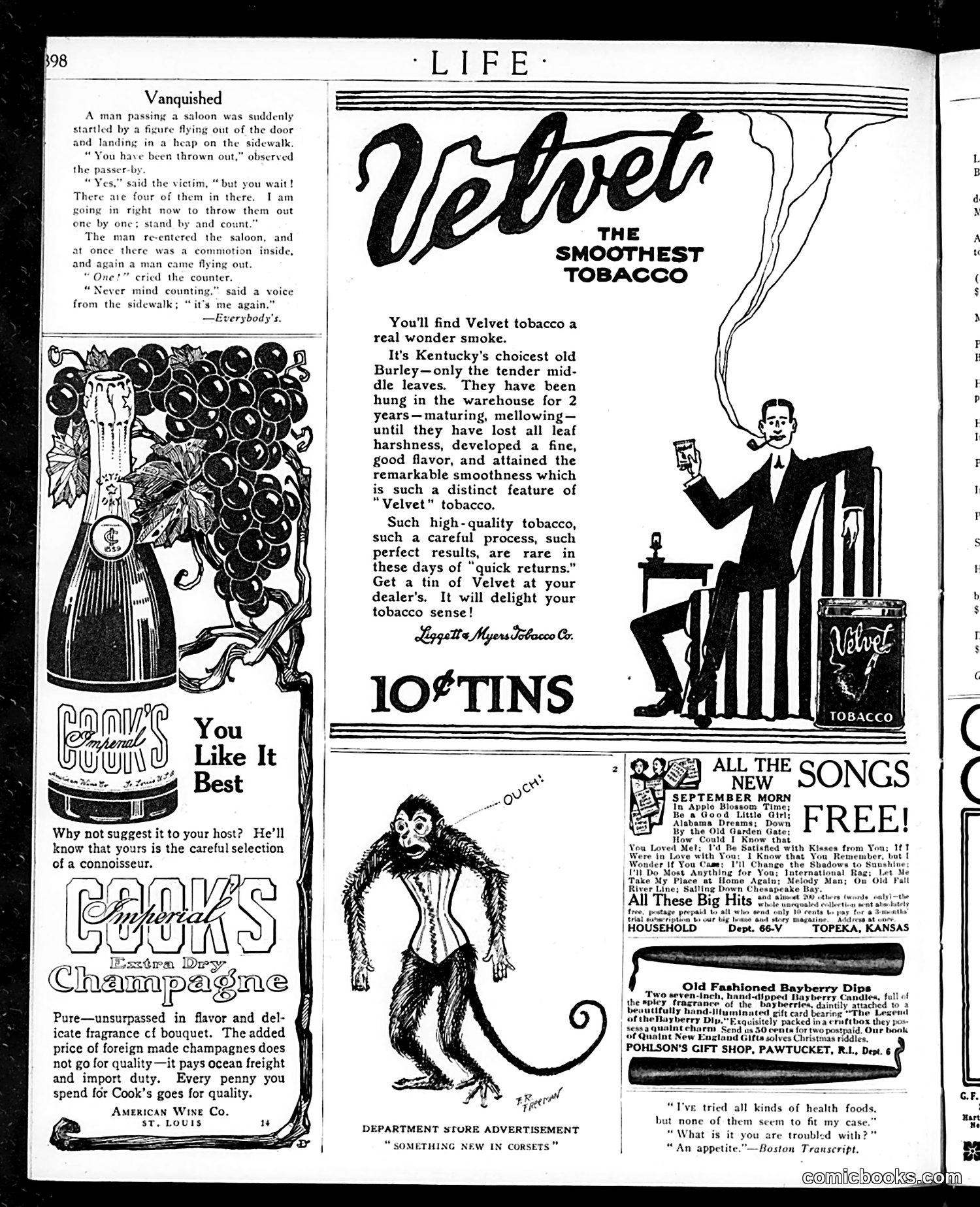
This page contains period advertisements and a brief humorous anecdote titled "Vanquished." **The Main Story:** A drunk man is ejected from a saloon, then vows to return and throw out the four men inside "one by one." When he re-enters, another man quickly flies out again—implying the drunk was thrown out *again* rather than accomplishing his boast. The joke relies on the punchline "it's me again," revealing his grandiose plan failed immediately. **Advertisements:** The page features vintage ads for Cook's champagne, Velvet tobacco (emphasizing quality and aging process), and a department store corset promotion. A cartoon shows a monkey in formal dress, captioned as a department store advertisement about "something new in corsets"—likely a visual gag about fashion or body shape. **Historical Context:** These ads reflect early 20th-century consumer marketing, with emphasis on quality, careful manufacturing, and imported prestige. The humor is gentle rather than satirical—typical of *Life* magazine's lighter content alongside social commentary.
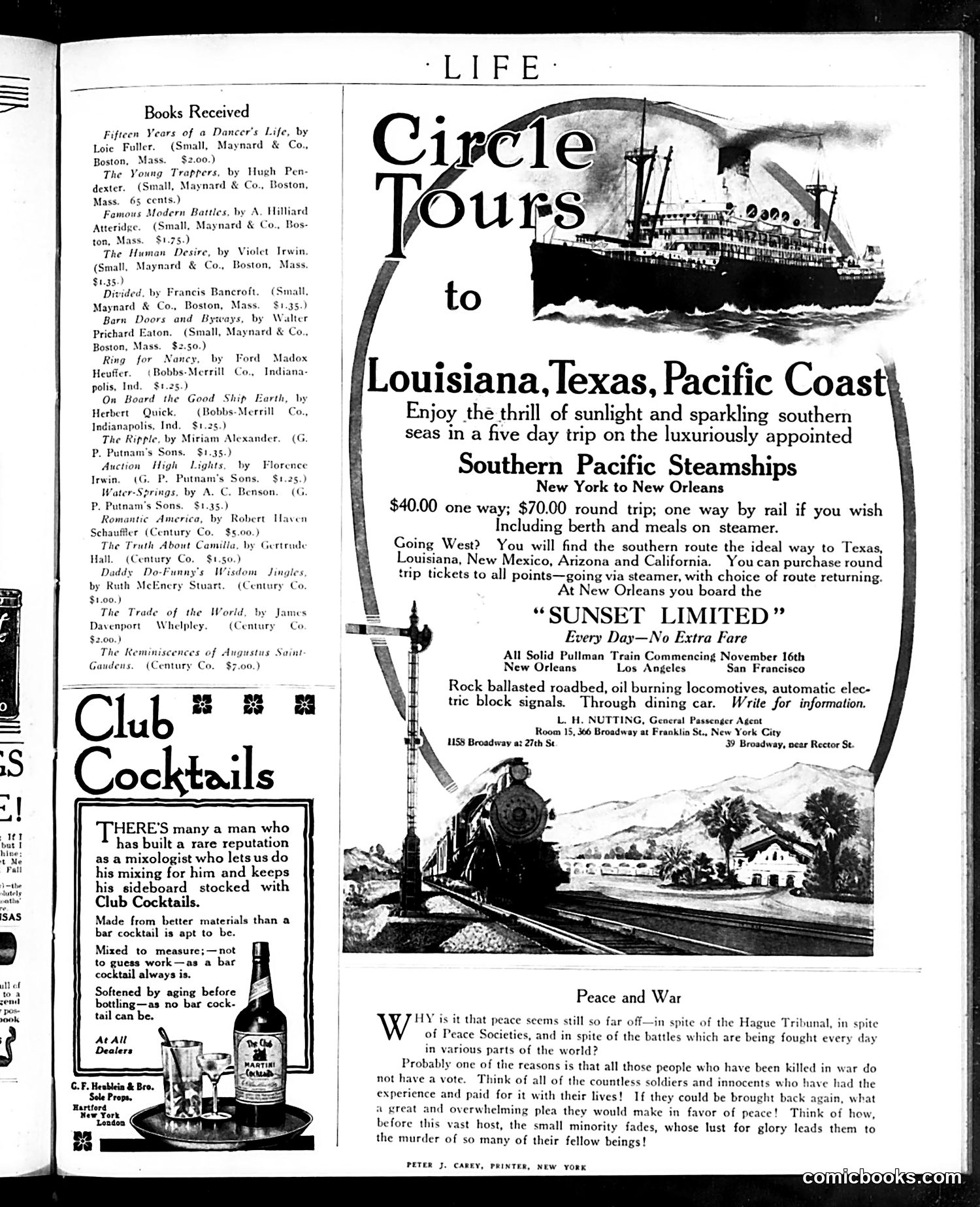
This page combines advertisements with editorial commentary on peace and war. The left side lists newly published books and promotes "Club Cocktails"—a pre-made cocktail product marketed as superior to bartender-made drinks because it uses better ingredients, precise measuring, and aging. The dominant advertisement features the "Sunset Limited" train and Southern Pacific Steamships, promoting luxury travel from New York to New Orleans and points west (California, Texas). This reflects early 1900s leisure travel marketing. The editorial piece titled "Peace and War" argues that lasting peace remains elusive despite peace societies and international tribunals. Its critique is striking: it notes that war's victims—soldiers and innocents—cannot vote, so their moral authority against war is silenced. The author suggests that if the dead could return, their overwhelming "plea" for peace would dwarf the small group whose "lust for glory" drives warfare. This is antiwar advocacy questioning why humanity repeats conflicts when their human cost is catastrophic.
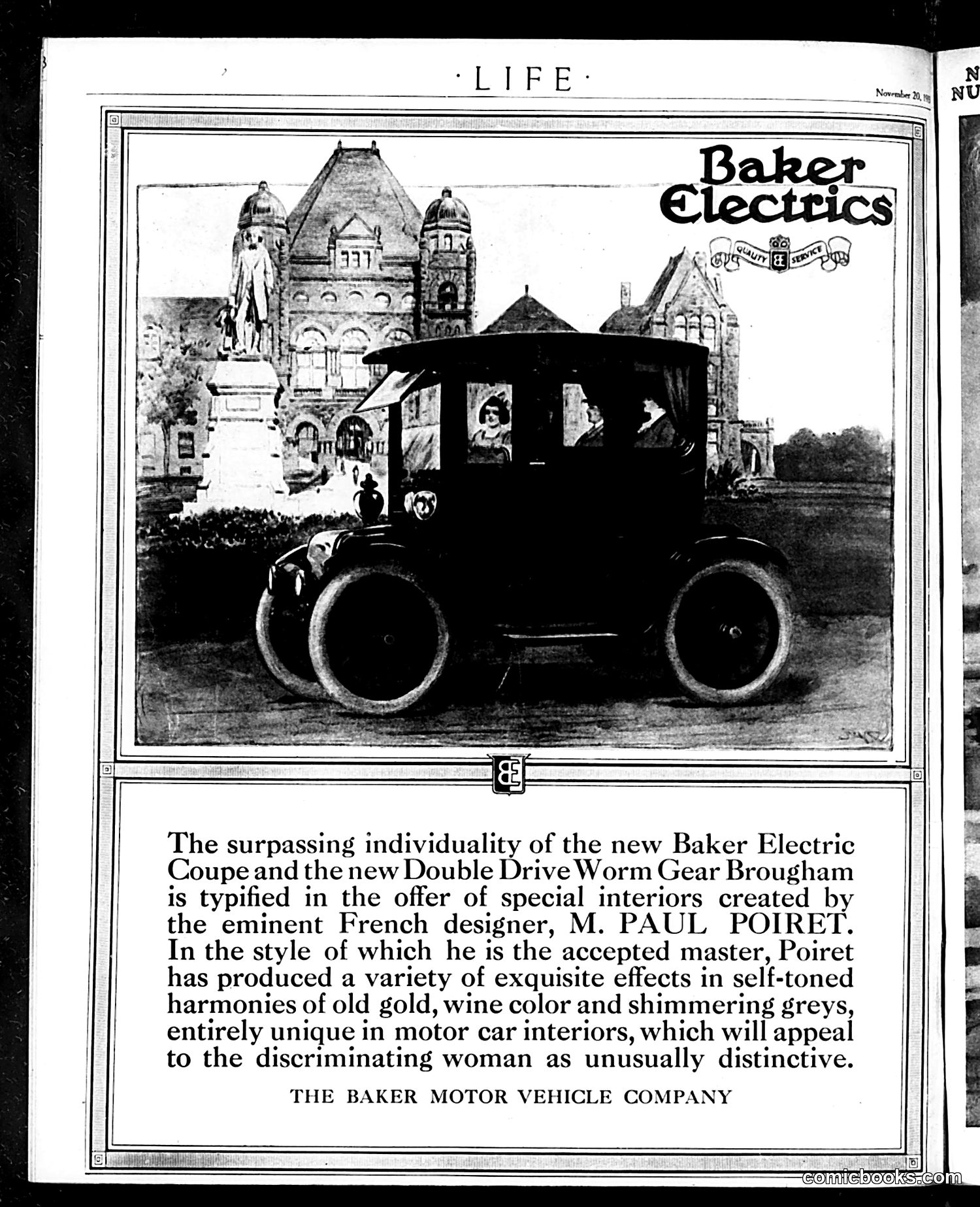
This is primarily an **advertisement**, not a political cartoon. It promotes Baker Electric automobiles, featuring an illustration of a luxury car positioned against an ornate institutional building (possibly a courthouse or civic structure). The ad emphasizes luxury and exclusivity by name-dropping **Paul Poiret**, a renowned French fashion designer of the early 20th century, to lend prestige to the vehicle's interior design. The marketing strategy targets "the discriminating woman," appealing to wealthy female consumers through associations with high fashion, refined aesthetics ("old gold, wine color"), and European sophistication. There is no satire or political commentary visible. This is straightforward luxury marketing leveraging celebrity designer association—a common advertising technique that remains familiar today.