
Life, 1913-11-20 · page 25 of 44
Life — November 20, 1913 — page 25: what you’re looking at
What you’re looking at
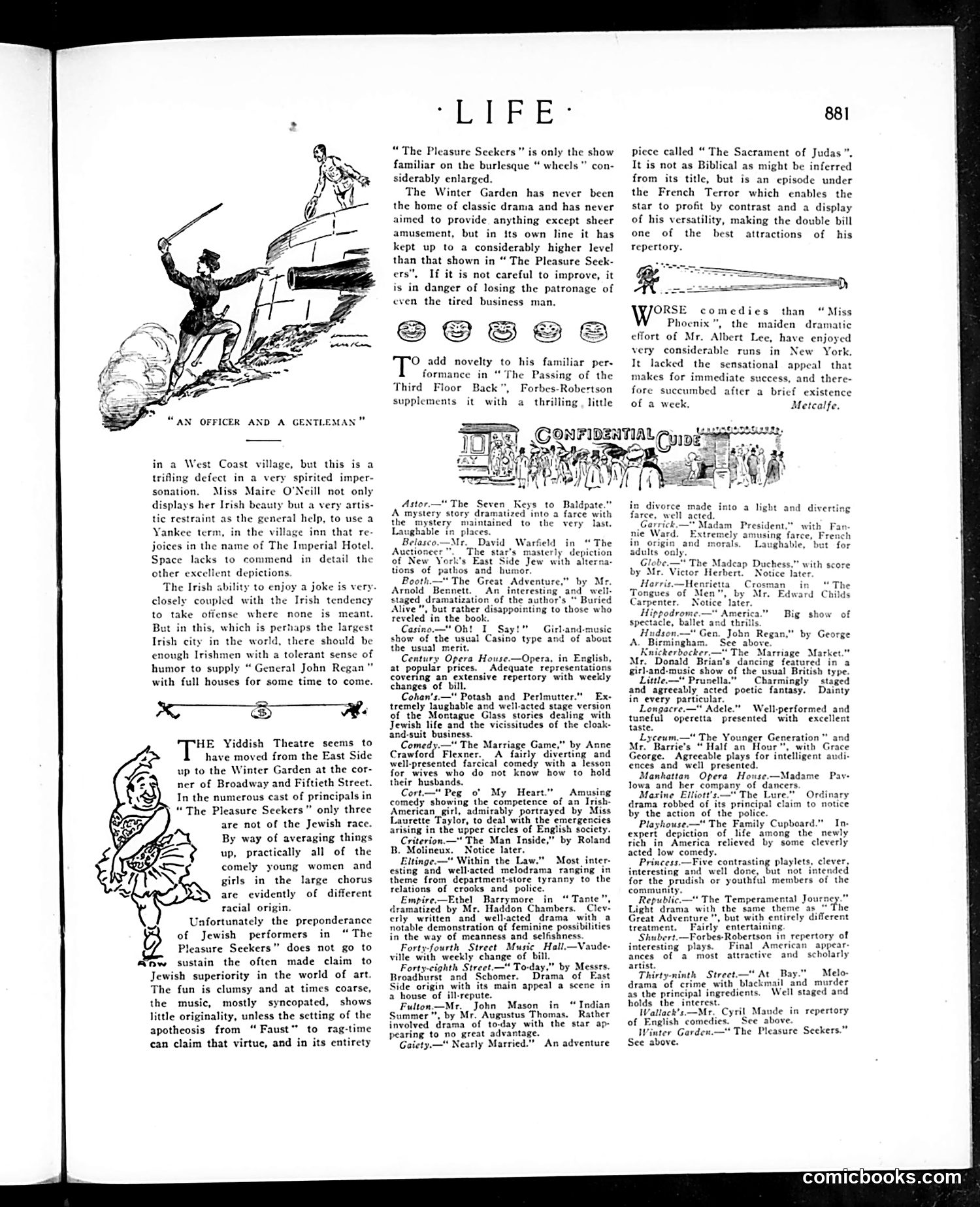
This page contains theater reviews reflecting early 20th-century attitudes toward ethnic performers and entertainment. The main illustrated cartoon shows "An Officer and a Gentleman"—a comedic scene depicting physical comedy typical of vaudeville. The reviews reveal period prejudices: the critic dismisses "The Pleasure Seekers" at the Winter Garden, noting that while most chorus girls are "of different racial origin," the Jewish performers cannot sustain "claims to Jewish superiority in the world of art." The production is called "clumsy" with unoriginal "syncopated" music—coded language reflecting contemporary ethnic stereotypes. Conversely, reviews praise Irish performers like Miss Maire O'Neill and the play "General John Regan," appealing to Irish audiences' "ability to enjoy a joke," though with a patronizing tone. The theater listings mention "Potash and Perlmutter" (Jewish characters) and "Peg o' My Heart" (Irish-American protagonist)—shows the magazine reviews alongside its ethnic commentary, documenting how entertainment reflected and reinforced early-1900s social hierarchies.
📄 Transcribed text from this page (OCR, searchable)
Machine-transcribed from the original scan — historical spelling and the odd misread are preserved.
NTLEMAN" in a West Coast village, but this is a trifling defect in a very spirited imper- sonation. Miss Maire O'Neill not only displays her Irish beauty but a very artis- tic restraint as the general help, to use a Yankee term, in the village inn that re- joices in the name of The Imperial Hotel. Space lacks to commend in detail the other excellent depictions The Irish ability to enjoy a joke is very. closely coupled with the Irish tendency to take where none is meant. But in this, which is perhaps the largest Irish city in the world, there should be enough Irishmen with a tolerant sense of humor to supply “General John Regan” with full houses for some time to come. offense HE Yiddish Theatre seems to have moved from the East Side up to the Winter Garden at the cor- ner of Broadway and Fiftieth Street. In the numerous cast of principals in “The Pleasure Seekers” only three are not of the Jewish race. By way of averaging things up, practically all of the comely young women and girls in the large chorus are evidently of different racial origin. Unfortunately the preponderance of Jewish performers in “The leasure Seekers” does not go to ‘Dw sustain the often made claim to Jewish superiority in the world of art The fun is clumsy and at times coarse, the music, mostly syncopated, shows. little originality, unless the setting of the apotheosis from “ Faust” to rag-time can claim that virtue, and in its entirety “EAR ESE “The Pleasure Seekers” is only the show familiar on the burlesque “ wheels" con- siderably enlarged. The Winter Garden has never been the home of classic drama and has never aimed to provide anything except sheer amusement, but in its own line it has kept up to a considerably higher level than that shown in “ The Pleasure Seek- ers", If it is not careful to improve, it is in danger of losing the patronage of even the tired business man. ‘0 add novelty to his familiar pers formance in “The Passing of the Third Floor Back”, Forbes-Robertson supplements it with a thrilling, little CONFIDENTIAL Cy Astor.—" The Seven Keys to Baldpate."” A mystery story dramatized into a farce with the mystery maintained to the very last. Laughable in places. Mr, David Warfield in “The The star's masterly depiction East Side Jew with altern tions of pathos and humor. Pooth.—" The Great Adventure,” by Mr. Arnold Bennett. An interesting and well- staged dramatization of the author's " Buried Alive", but rather disappointing to those who reveled’ in the book. Casino.—" Oh! I. Say!" Girl-and-musie show of the usual Casino type and of about the usual merit. Century Opera House.—Opera, in English, at popular prices. Adequate representations covering an extensive repertory with weekly changes of bill. Cohan’s.—" Potash and Perlmutter.” Ex- tremely laughable and well-acted stage version of the Montague Glass stories dealing with Jewish life and the vicissitudes of the cloak- and-suit business. Comedy.—* The Marriage Game," by Anne Crawford Flexner. A fairly diverting and well-presented farcical comedy with a lesson for wives who do not know how to hold their husbands. Cort—" Peg oo’ My Heart.” Amusing comedy showing the competence of an Irish- American girl, admirably portrayed by Miss Laurette Taylor, to deal with the emergencies arising in the upper circles of English society. Criterion.—" The Man Inside,” by Roland B. Molineux. Notice later. Itinge—" Within the Law." Most. inter- esting and well-acted melodrama ranging in theme from department-store tyranny to the relations of crooks and police. Empire-—Ethel Barrymore in.“ Tante" dramatized by Mr. Haddon Chambers. Cle crly written and. well-acted drama with a notable demonstration gf feminine possibilities in the way of meanness and selfishness. Forty-fourth Street Music Hall.—Vaude- ville with weekly change of bill. Forty-cighth Street.—" To-day,” by Messrs. Broadburst and Schomer. Drama of East Side origin with its main appeal a scene in a house of ill-repute. Fulton —Mr. John Mason in “Indian Summer”, by Mr. Augustus Thomas. Rather wolved drama of to-day with the star ap- pearing to no great advantage. Gaiety.—" Nearly Married.” An adventure 881 piece called “ The Sacrament of Judas". It is not as Biblical as might be inferred from its title, but is an episode under the French Terror which enables the star to profit by contrast and a display of his versatility, making the double bill one of the best attractions of his repertory. ORSE comedies than Phoenix”, the maiden dra: effort of Mr, Albert Lee, have enjoyed very considerable runs in New York. It lacked the sensational appeal that makes for immediate success, and there- fore succumbed after a brief existence of a week. Metcalfe. sasyetematunngy. L GIR. 1D (ose orce made into a li farce, well acted. . Garrick.—"* Madam President.” with. Far nie Ward. ly amusing farce, French i morals. Laughable, but for —" The Madcap Duchess. by Mr. Victor Herbert. Notice later, Horris.—Henrietta | Crosman ir Tongues of Men”, by Mr. Edward Carpenter. tice later. Hippodrome.— spectacle, ballet a Hudson.—" Gen. John Rega A. Birmingham. See above. Knickerbocker.—" The Marriage Market.” Mr. Donald Brian's dancing featured in a Birl-and-music show of the usual British type. Little. —" Prunella.” Charmingly staged and agreeably acted poetic fantasy. Dainty in every particular. Lengacre.—" Adele.” Well-performed and tuneful operetta presented with excellent taste. Lyceum.—" The Younger Generation" and Mr. Barrie’s “ Half an Hour”, with Grace George. Agreeable plays for intelligent audi- ences and well presented Manhattan Opera House.—Madame lowa and her company of dancers. Marine Elliott’s.—" The Lure.” drama robbed of its principal claim to notice by the action of the police. Playhouse.—" The Family Cupboard." In- expert depiction of life among the newly rich in America relieved by some cleverly acted low comedy. Princess—Five contrasting playlets, clever, interesting and well done, but not intended for the prudish or youthful members of the community. Republic.—" The Temperamental Journey.” ight drama with the same theme as he Great Adventure", but with entirely different treatment. fairly entertaining. ‘Shubert.—Forbes-Robertson in repertory of interesting plays. Final American appear- ances of a most attractive and scholarly artist, Thirty-ninth Strect—" At Bay.” Melo- drama of crime. with blackmail and murder as the principal ingredients. Well staged and holds the interest. Wallack's.—Mr. Cyril Maude in repertory of English comedies. See above. Winter Garden.—" The Pleasure Seekers.” See above. with score “The Childs Big show of by George Pay+ comicbooks.com