
Life, 1913-11-20 · page 30 of 44
Life — November 20, 1913 — page 30: what you’re looking at
What you’re looking at
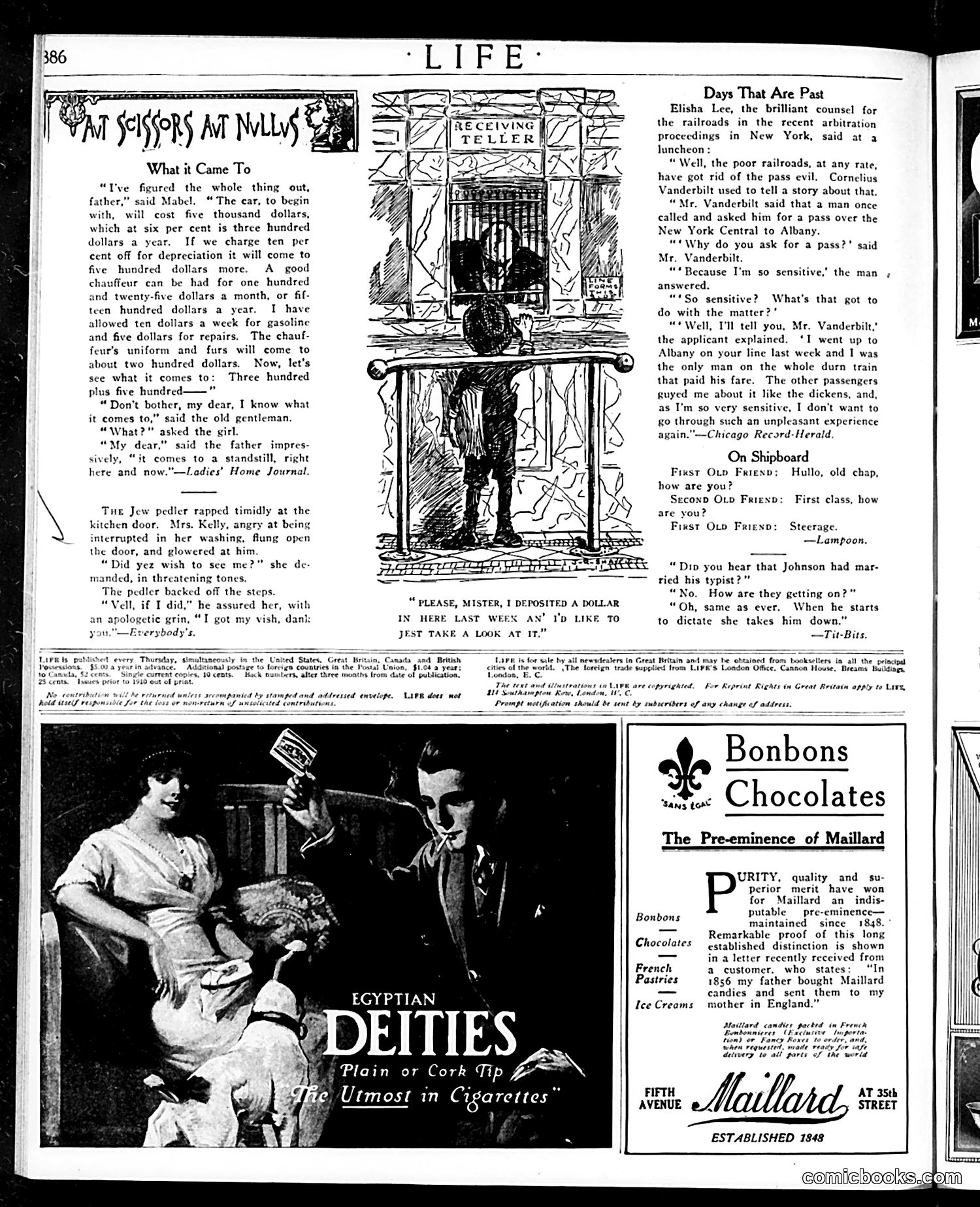
This page contains three separate humorous pieces typical of early 20th-century satirical magazines: **"What It Came To"**: A father refuses to fund his daughter's automobile purchase by itemizing all ownership costs (depreciation, chauffeur salary, fuel, repairs, uniforms). The joke is that when the daughter asks what the total "comes to," the father says it "comes to a standstill, right here and now"—a pun meaning both the financial endpoint and that the discussion ends there. **Two short anecdotes**: One depicts a Jewish peddler and Irish housewife in period-typical dialect humor (common but now considered offensive). The other plays on class anxiety—a passenger secretly checking on his deposited dollar in a bank teller window, implying distrust of financial institutions. **"Days That Are Past"**: A Vanderbilt anecdote about railroad passes, satirizing how railroad magnates once offered free travel to influential people (the "pass evil"). The humor concerns a sensitive man who paid full fare and was mocked for it—social commentary on 19th-century railway corruption. The advertisements promote Egyptian Deities cigarettes and Maillard chocolates.
📄 Transcribed text from this page (OCR, searchable)
Machine-transcribed from the original scan — historical spelling and the odd misread are preserved.
What it Came To “T've figured the whole thing out, id Mabel. “ The car, to begin will cost five thousand dollars, which at six per cent is three hundred dollars a year. If we charge ten per cent off for depreciation it will come to five hundred dollars more. A good chauffeur can be had for one hundred and twenty-five dollars a month, or fif- teen hundred dollars a year. I have allowed ten dollars a week for gasoline and five dollars for repairs. The chauf- feur’s uniform and furs will come to about two hundred dollars. Now, let's see what it comes to: Three hundred plus five hundred. fe “Don't bother, my dear, I know what it comes to,” said the old gentleman. “What? sked the girl. “My dear,” said the father impres- sively, “it comes to a standstill, right here and now."—Ladies’ Home Journal. Tue Jew pedler rapped timidly at the kitchen door. Mrs. Kelly, angry at being interrupted in her washing, flung open the door, and glowered at him Did yez wish to sce me manded, in threatening tones, The pedler backed off the steps. “Vell, if I did,” he assured her, with ologetic grin, “I got my vish, dank: Everybody's. she de- “PLEASE, MISTER, I DEPOSITED A DOLLAR IN HERE LAST WEEX AN’ I'D LIKE TO JEST TAKE A LOOK AT IT.” irned uniest accompanied by stamped and addressed end ted COMEPABUELRS urn of mnbe le by all newscdealers in Days That Are Past Elisha Lee, the brilliant counsel for the railroads in the recent arbitration proceedings in New York, said at a luncheon : “Well, the poor railroads, at any rate, have got rid of the pass evil. Cornelius Vanderbilt used to tell a story about that. “Mr. Vanderbilt said that a man once called and asked him for a pass over the New York Central to Albany, “*Why do you ask for a pass?’ said Mr. Vanderbilt. “*Because I'm so sensitive,’ the man ; answered. “*So sensitive? What's that got to do with the matter?’ “*Well, I'll tell you, Mr. Vanderbilt,’ the applicant explained. ‘I went up to Albany on your line last week and I was the only man on the whole durn train that paid his fare. The other passengers guyed me about it like the dickens, and, as I'm a0 very sensitive, I don't want to go through such an unpleasant experience again."—Chicago Record-Herald. On Shipboard Fixst Oto Friexp: Hullo, old chap, how are you? Seconn Ob Friexo: First class, how are you? Fixst Ot Frisnp: Steerage. —Lampoon. “ Dip you hear that Johnson had mar- ried his typist?” “No. How are they getting on?” “Oh, same as ever. When he starts to dictate she takes him down.” —Tit-Bits. Br f. (The foreign trade supplied London, E The text ustrations ta LARK ave copyrighted, For Keprint Rights in Lire dees mot 411 Southampton Kore, London HW, Prompt metifcation should be sent by snubsertbert of any change of address, Plain or Cork Tip oN Utmost in Cigarettes” ’ Bonbons ‘tans to Chocolates The _Pre-eminence_of Maillard URITY, quality and su- perior merit have won for Maillard an indis- putable — pre-eminence— maintained since 1848. Remarkable proof of this long Chocolates established distinction is shown — in a letter recently received from French a customer, who states: “In Pastri 1856 my father bought Maillard — candies and sent them to my Ice Creams mother in England.” Maitiard candies packed in French Bombounieres (vein porte: fiom) or Fancy Reset ler, amd, hen requested, made Lor vase delivery’ to all parts of the world AT 35th STREET ESTABLISHED 1848 comichooks.gom