
Life, 1913-11-20 · page 8 of 44
Life — November 20, 1913 — page 8: what you’re looking at
What you’re looking at
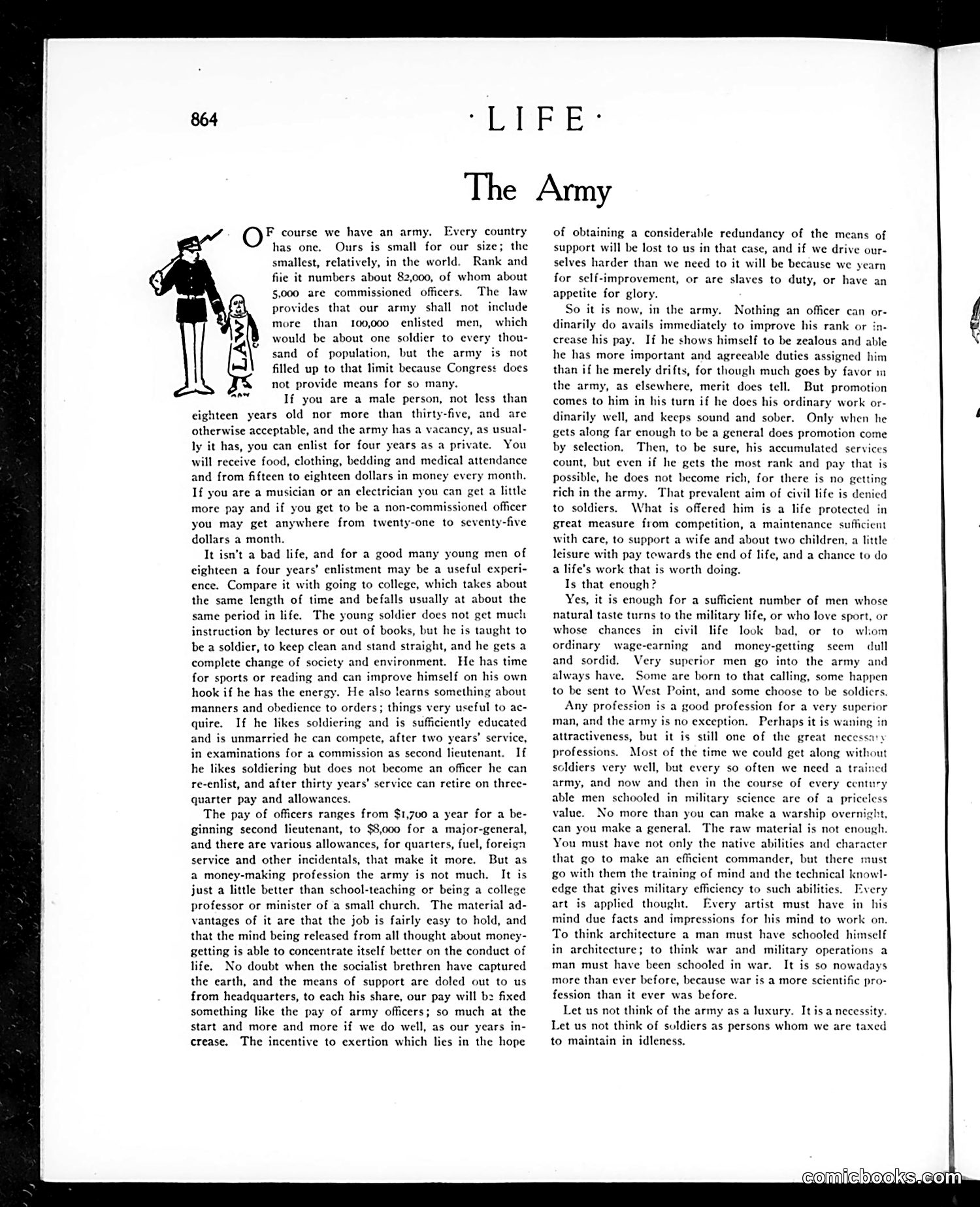
This page is a serious editorial essay (not satire) titled "The Army," advocating for military service as a respectable profession. The small illustration shows a soldier in uniform. The text argues that army service offers practical benefits: decent pay (starting around $15-17 per month for enlisted men), food, clothing, medical care, and opportunity for advancement to officer rank through merit. The author positions the military as a legitimate career path comparable to other professions, countering what appears to be contemporary social stigma against soldiers as low-status or unmotivated. The essay emphasizes that modern warfare requires trained, educated soldiers—not merely "wage-earning and money-getting" men—and that military science demands intellectual rigor alongside physical capability. It presents army service as patriotic duty and practical self-improvement.
📄 Transcribed text from this page (OCR, searchable)
Machine-transcribed from the original scan — historical spelling and the odd misread are preserved.
LTE E* The Army F course we have an army. Every country has one. Ours is small for our size; the smallest, relatively, in the world. Rank and fiie it numbers about 82,000, of whom about §,000 are commissioned officers. The law provides that our army shall not include more than 100,000 enlisted men, which would be about one soldier to every thou- sand of population, but the army is not filled up to that limit because Congress does not provide means for so many. If you are a male person, not less than eighteen years old nor more than thirty-five, and are otherwise acceptable, and the army has a vacancy, as usual- ly it has, you can enlist for four years as a private. You will receive food, clothing, bedding and medical attendance and from fifteen to eighteen dollars in money every month. If you are a musician or an electrician you can get a little more pay and if you get to be a non-commissioned officer you may get anywhere from twenty-one to seventy-five dollars a month. It isn’t a bad life, and for a good many young men of eighteen a four years’ enlistment may be a useful experi- ence. Compare it with going to college, which takes about the same length of time and befalls usually at about the same period in life. The young soldier does not get much instruction by lectures or out of books, but he is taught to be a soldier, to keep clean and stand straight, and he gets a complete change of society and environment. He has time for sports or reading and can improve himself on his own hook if he has the energy. He also learns something about manners and obedience to orders; things very useful to ac- quire. If he likes soldiering and is sufficiently educated and is unmarried he can compete, after two years’ service, in examinations for a commission as second lieutenant. If he likes soldiering but does not become an officer he can re-enlist, and after thirty years’ service can retire on three- quarter pay and allowances. The pay of officers ranges from $1,700 a year for a be- ginning second lieutenant, to $8,000 for a major-general, and there are various allowances, for quarters, fuel, foreign service and other incidentals, that make it more. But as a money-making profession the army is not much. It is just a little better than school-teaching or being a college professor or minister of a small church. The material ad- vantages of it are that the job is fairly easy to hold, and that the mind being released from all thought about money- getting is able to concentrate itself better on the conduct of life. No doubt when the socialist brethren have captured the earth, and the means of support are doled out to us from headquarters, to each his share, our pay will bz fixed something like the pay of army officers; so much at the start and more and more if we do well, as our years in- crease, The incentive to exertion which lies in the hope ele ) ann of obtaining a considerable redundancy of the means of support will be lost to us in that case, and if we drive our- selves harder than we need to it will be because we yearn for self-improvement, or are slaves to duty, or have an appetite for glory. So it is now, in the army. Nothing an officer can or- dinarily do avails immediately to improve his rank or i crease his pay. If he shows himself to be zealous and able he has more important and agreeable duties assigned him than if he merely drifts, for though much goes by favor im the army, as elsewhere, merit does tell. But promotion comes to him in his turn if he does his ordinary work or- dinarily well, and keeps sound and sober. Only when he gets along far enough to be a general does promotion come by selection, Then, to be sure, his accumulated services count, but even if he gets the most rank and pay that is possible, he does not become rich, for there is no getting rich in the army. That prevalent aim of civil life is denied to soldiers. What is offered him is a life protected in great measure from competition, a maintenance sufficient with care, to support a wife and about two children, a little leisure with pay towards the end of life, and a chance to do a life’s work that is worth doing. Is that enough? Yes, it is enough for a sufficient number of men whose natural taste turns to the military life, or who love sport, or whose chances in civil life look bad, or to whom ordinary wage-earning and money-getting seem dull and sordid. Very superior men go into the army and always have. Some are born to that calling, some happen to be sent to West Point, and some choose to be soldiers, Any profession is a good profession for a very superior man, and the army is no exception. Perhaps it is waning in attractiveness, but it is still one of the great necessary professions. Most of the time we could get along without soldiers very well, but every so often we need a trained army, and now and then in the course of every century able men schooled in military science are of a priceless value. No more than you can make a warship overnight, can you make a general. The raw material is not enough. You must have not only the native abilities and character that go to make an efficient commander, but there must go with them the training of mind and the technical knowl- edge that gives military efficiency to such abilities. Every art is applied thought. Every artist must have in his mind due facts and impressions for his mind to work on. To think architecture a man must have schooled himself in architecture; to think war and military operations a man must have been schooled in war. It is so nowadays more than ever before, because war is a more scientific pro- fession than it ever was before. Let us not think of the army as a luxury. It isa necessity. Let us not think of soldiers as persons whom we are taxed to maintain in idleness.