
Life, 1913-11-20 · page 13 of 44
Life — November 20, 1913 — page 13: what you’re looking at
What you’re looking at
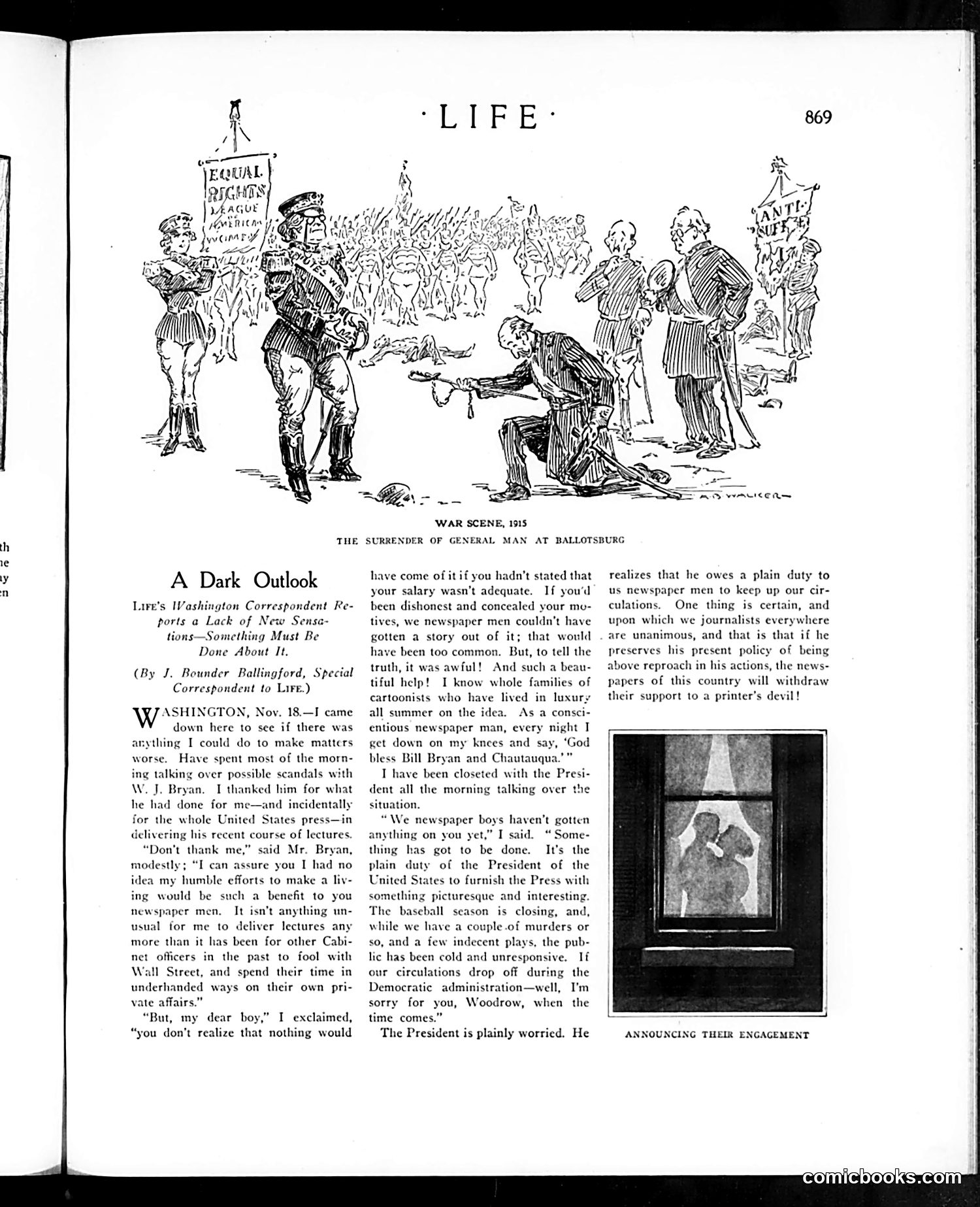
The top cartoon depicts "War Scene, 1915: The Surrender of General Man at Ballotsburg," showing a military figure kneeling in surrender before a crowd holding signs reading "Equal Rights" and "Anti-Suffrage." This is political satire about the women's suffrage debate—the cartoonist suggests that opposition to women's voting rights is a losing battle, personified as "General Man" surrendering to the suffrage movement. Below, columnist J. Rounder Ballingford reports a conversation with William Jennings Bryan about newspaper scandals and press freedom. Bryan allegedly suggests newspapers avoid controversial stories to protect their business interests. The piece critiques both Bryan's views and newspapers' complicity in self-censorship during the Wilson administration. The adjacent photograph announces an engagement, likely unrelated to the political commentary.
📄 Transcribed text from this page (OCR, searchable)
Machine-transcribed from the original scan — historical spelling and the odd misread are preserved.
7{\ “— EQUAL RIGHTS VAAGUE HOM iene 44 jecienry fi © THE SURRENDER OF ERAL A Dark Outlook Lare's Washington Correspondent Re- ports a Lack of New Sensa- tions—Something Must Be Done About It. (By J. Bounder Ballingford, Special Correspondent to Lire.) W ASHINGTON, Noy. 18.—I came down here to see if there was anything I could do to make matters worse. Have spent most of the morn- ing talking over possible scandals with W. J. Bryan. I thanked him for what he had done for me—and incidentally for the whole United States press—in delivering his recent course of lectures, “Don't thank me,” said Mr. Bryan, modestly; “I can assure you I had no idea my humble efforts to make a liv- ing would be such a benefit to you newspaper men, It isn’t anything un- usual for me to deliver lectures any more than it has been for other Cabi- net officers in the past to fool with Wall Street, and spend their time in underhanded ways on their own pri- vate affair: “But, my dear boy,” I exclaimed, “you don't realize that nothing would Fy Tess aye < 4) CT RUIN aes LEA Poh. Cae Nod = WAR SCENE, 1915 MAN have come of itif you hadn't stated that your salary wasn’t adequate. If you’d been dishonest and concealed your mo- tives, we newspaper men couldn't have gotten a story out of it; that would have been too common. But, to tell the truth, it was awful! And such a beau- tiful help! I know whole families of cartoonists who have lived in luxury all summer on the idea. As a consci- entious newspaper man, every night I get down on my knees and say, ‘God bless Bill Bryan and Chautauqua.’ I have been closeted with the Presi- dent all the morning talking over the situation. “We newspaper boys haven't gotten anything on you yet,” I sai “Some- thing has got to be done. It’s the plain duty of the President of the United States to furnish the Press with something picturesque and interesting. The baseball season is closing, and, while we have a couple.of murders or so, and a few indecent plays, the pub- lic has been cold and unresponsive. If our circulations drop off during the Democratic administration—well, I'm sorry for you, Woodrow, when the time comes.” The President is plainly worried. He AT BALLOTSBURG realizes that he owes a plain duty to us newspaper men to keep up our cir- culations. One thing is certain, and ich we journalists everywhere imous, and that is that if he preserves his present policy of being above reproach in his actions, the news- papers of this country will withdraw their support to a printer's devil! ANNOUNCING THEIR ENGAGEMENT