
Life, 1913-11-20 · page 19 of 44
Life — November 20, 1913 — page 19: what you’re looking at
What you’re looking at
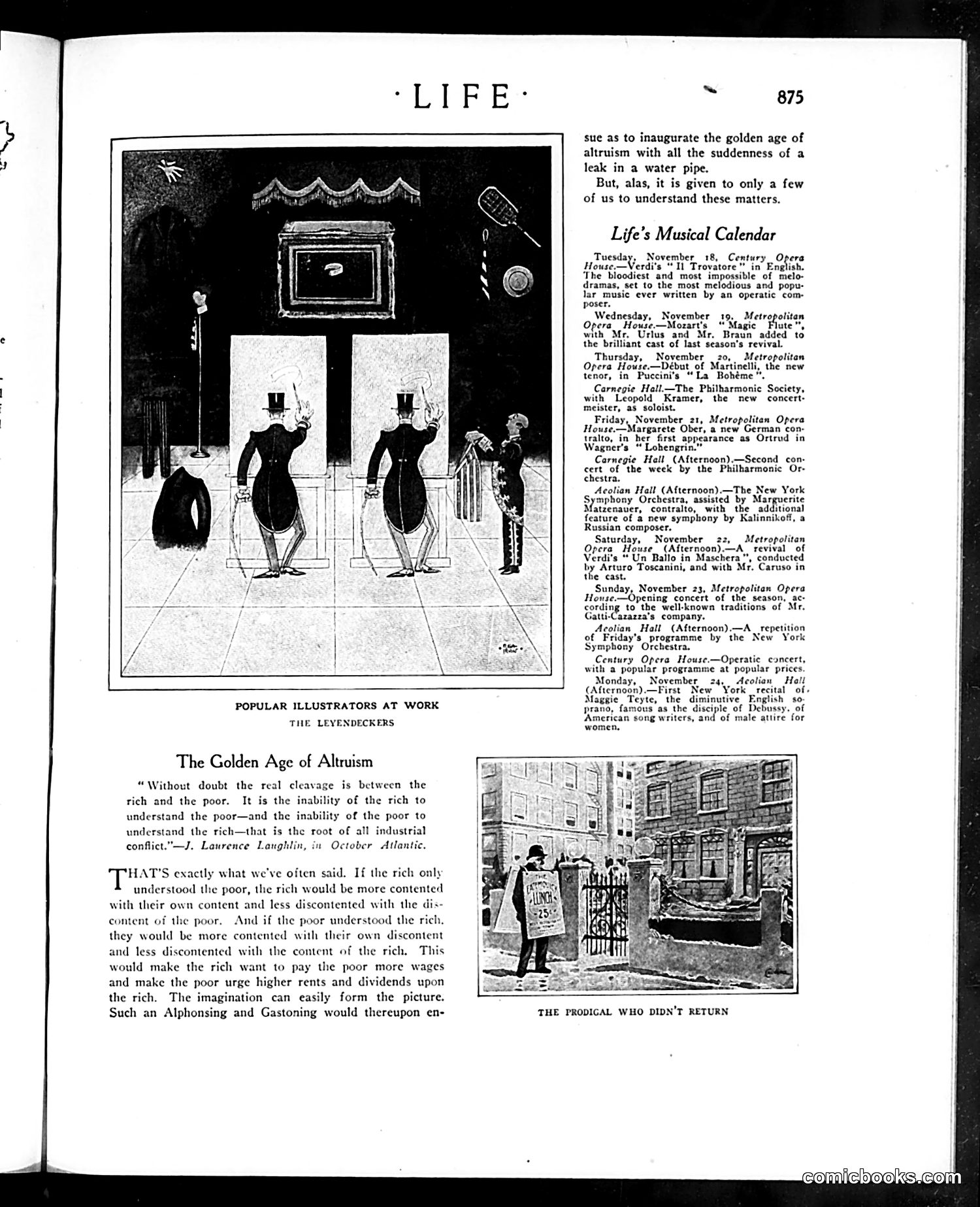
**Main Article: "The Golden Age of Altruism"** This satirical piece mocks the notion that mutual understanding between rich and poor would solve industrial conflict. Life quotes J. Laurence Laughlin's serious sociological argument, then savagely inverts it: if rich understood poor and vice versa, they'd simply exploit each other *more effectively*—the poor would demand higher rents and dividends from the rich. Life's punch line is bitterly ironic: such mutual understanding would usher in an "altruistic" golden age with all the likelihood of "a leak in a water pipe"—essentially impossible. The satire targets both Gilded Age optimism about class harmony and the naïveté of assuming empathy solves structural economic problems. **Illustration: The Leyendeckers** The top illustration credits "Popular Illustrators at Work" to The Leyendeckers (likely J.C. Leyendecker and his brother), showing what appears to be theatrical or fashion-related figure drawing. **Secondary Content** The page includes a musical calendar listing opera and orchestra performances (November 1909), and a cartoon captioned "The Prodigal Who Didn't Return," though details remain unclear.
📄 Transcribed text from this page (OCR, searchable)
Machine-transcribed from the original scan — historical spelling and the odd misread are preserved.
POPULAR ILLUSTRATORS AT WORK THE LEYENDECKERS The Golden Age of Altruism “Without doubt the real cleavage is between the rich and the poor. It is the inability of the rich to understand the poor—and the inability of the poor to understand the rich—that is the root of all industrial conflict."—J. Laurence Laughlin, in October Atlantic. ° I *HAT’S exactly what we've often said. If the rich only understood the poor, the rich would be more contented with their own content and less discontented with the dis- content of the poor. And if the poor understood the rich, they would be more contented with their own discontent and less discontented with the content of the rich, This would make the rich want to pay the poor more wages and make the poor urge higher rents and dividends upon the rich. The imagination can easily form the picture, Such an Alphonsing and Gastoning would thereupon en- 875 sue as to inaugurate the golden age of altruism with all the suddenness of a leak in a water pipe. But, alas, it is given to only a few of us to understand these matters. Life’s Musical Calendar Tuesday, November 18, Century Opera House-—Verd “Ti Trovatore” in English. The bloodiest and most impossible of melo- dramas, set to the most melodious and popu- lar music ever written by an operatic com- poser. Wednesday, November 19, Metropolitan Opera Howse.—Mozart's “Magic Flute", with Mr. Urlus and Mr, Braun added to the brilliant cast of last season's revival. Thursday, November 20, Metropolitan Opera House.—Début of Martinelli, the new tenor, in Puccini's “La Bohéme *, Carnegie Hall.—The Philharmonic Society, with Leopold Kramer, the new concert: meister, a5 soloist. Friday, November 21, Metropolitan Opera House.—Margarete Ober, a new German con- tralto, in her first appearance as Ortrud in Wagner's“ Lohengrin.” Carnegie Hell (Afternoon).—Second con- cert of the week by the Philharmonic Or- chestra. Aeolian Hall (Afternoon).—The New York Symphony Orchestra, assisted by Marguerite Matzenauer, contralto, with the additional feature of a new symphony by Kalinnikoff, a Russian composer. Saturday, November 22, Metropolitan Opera House (Afternoon).—A_ revival of Verdi's “ Un Ballo in Maschera”, conducted by Arturo Toscanini, and with Mr. Caruso in the cast. Sunday, November 23, Metropolitan Opera Honse.—Opening concert of the season, ac- cording to the well-known traditions of Mr. Gatti-Cazazza’s company. Aeolian Hall (Afternoon).—A_ repetition of Friday's programme by the New York Symphony Orchestra. Century Opera House.—Operatic concert, with a popular programme at popular prices Monday, November 24, Aeolian Hal! (Afternoon).—First. New York recital of Maggie Teyte, the diminutive English so: prano, famous'as the disciple of Debussy. of American song writers, and of male attire for women, THE PRODIGAL WHO DIDN'T RETURN