
Life, 1913-11-20 · page 24 of 44
Life — November 20, 1913 — page 24: what you’re looking at
What you’re looking at
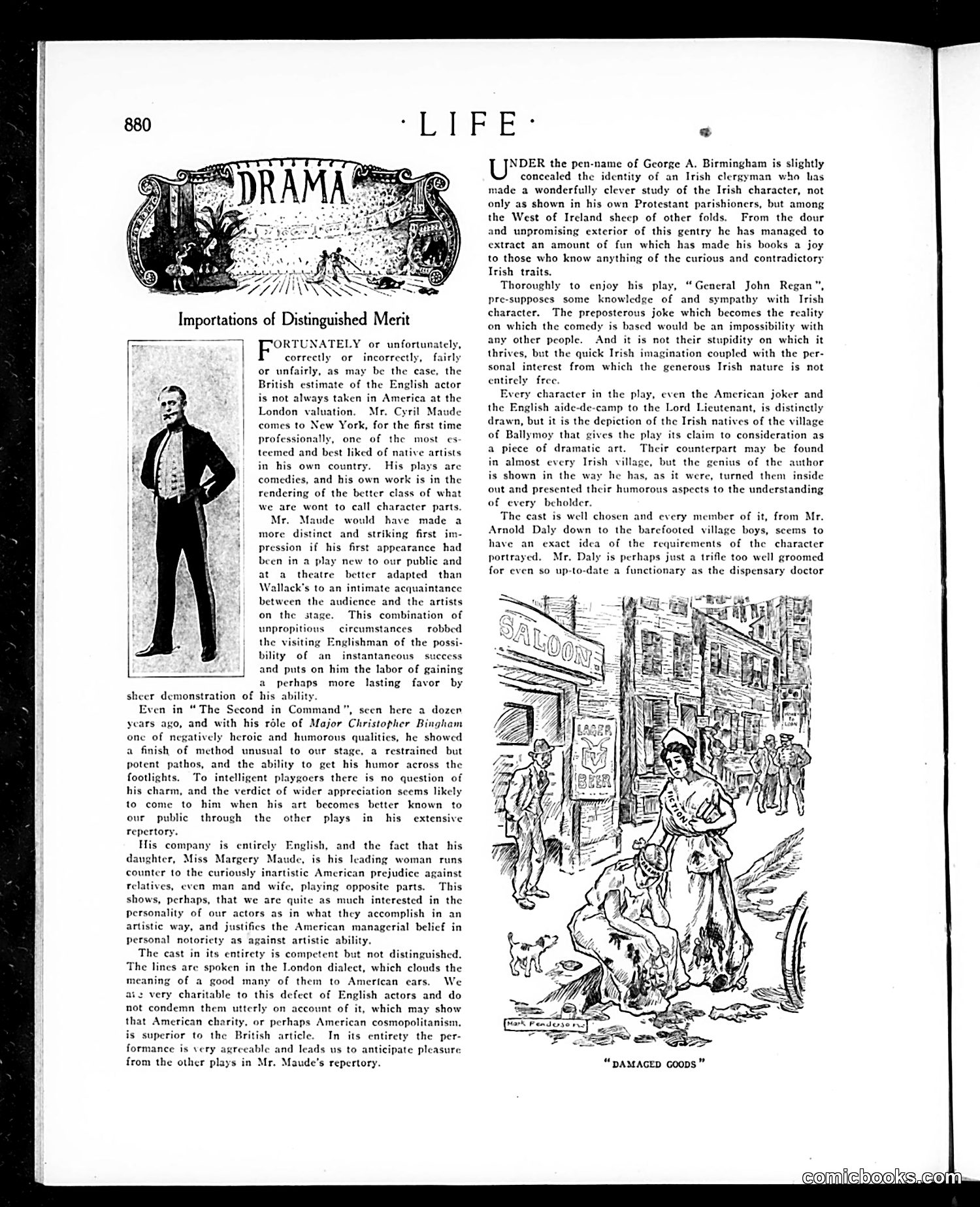
This page reviews two theatrical "importations" to America—English and Irish plays. **The Cyril Maude Review** (left): Discusses British actor Cyril Maude's New York debut in comedies. The critique notes that English actors aren't always valued in America as highly as in London. The article praises Maude's skill but suggests the venue and unfamiliar material limited his initial success. It also comments on the American prejudice against relatives (his daughter Margery) performing together on stage—revealing that Americans care more about actors' personalities than artistic merit. **The "General John Regan" Review** (right): Examines an Irish play by George A. Birmingham (a pen-name for an Irish clergyman). The review suggests the comedy relies on specifically Irish character traits—quick imagination and personal interest—making it incomprehensible to other nationalities. The illustration labeled "Damaged Goods" appears to show a street scene, likely depicting Irish village life central to the play. Both reviews reflect early 20th-century attitudes about transatlantic theatrical taste and national character stereotyping.
📄 Transcribed text from this page (OCR, searchable)
Machine-transcribed from the original scan — historical spelling and the odd misread are preserved.
ia ire! cae cles « Rrra 0 77H. RS Importations of Distinguished Merit ‘ORT ELY or unfortunate! correctly or incorrectly, fairly or unfairly, as may be the case, the British estimate of the English actor is not always taken in America at the London valuation. Mr. Cyril Maude comes to New York, for the first time professionally, one of the most es teemed and best liked of native artists in his own country. His plays are comedies, and his own work is in the rendering of the better class of what we are wont to call character parts. Mr. Maude would have made a more distinct and striking first im- pression if his first appearance had been in a play new to our public and at a theatre better adapted than Wallack’s to an intimate acquaintance between the audience and the artists on the stage. This combination of unpropitious circumstances robbed the visiting Englishman of the possi- bility of an instantaneous success and puts on him the labor of gaining a perhaps more lasting favor by sheer demonstration of his ability. Even in “The Second in Command”, seen here a dozer years ago, and with his réle of Major Christopher Bingham one of negatively heroic and humorous qualities, he showed a finish of method unusual to our stage, a restrained but potent pathos, and the ability to get his humor across the footlights. To intelligent playgoers there is no question of his charm, and the verdict of wider appreciation scems likely to come to him when his art becomes better known to our public through the other plays in his extensive repertory. His company is entirely English, and the fact that his daughter, Miss Margery Maude, is his leading woman runs counter to the curiously inartistic American prejudice against relatives, even man and wife, playing opposite parts. This shows, perhaps, that we are quite as much interested in the personality of our actors as in what they accomplish in an artistic way, and justifics the American managerial belief in personal notoriety as against artistic ability. The cast in its entirety is compet but not distinguished. The lines are spoken in the London dialect, which clouds the meaning of a good many of them to American cars. We ais very charitable to this defect of English actors and do not condemn them utterly on account of it, which may show that American charity, or perhaps American cosmopolitanism, is superior to the British article. In its entirety the per- formance is very agreeable and leads us to anticipate pleasure from the other plays in Mr. Maude’s repertory. NDER the pen-name of George A. Birmingham is slightly concealed the identity of an Irish clergyman who las made a wonderfully clever study of the Irish character, not only as shown in his own Protestant parishioners, but among the West of Ireland sheep of other folds. From the dour and unpromising exterior of this gentry he has managed to extract an amount of fun which has made his books a joy to those who know anything of the curious and contradictory Irish traits, Thoroughly to enjoy his play, “General John Regan”, pre-supposes some knowledge of and sympathy with Irish character. The preposterous joke which becomes the reality on which the comedy is based would be an impossibility with any other people. And it is not their stupidity on which it thrives, but the quick Irish imagination coupled with the per- sonal interest from which the generous Irish nature is not entirely free Every character in the play, even the American joker and the English aide-de-camp to the Lord Lieutenant, is distinetly drawn, but it is the depiction of the Irish natives of the village of Ballymoy that gives the play its claim to consideration as a piece of dramatic art. Their counterpart may be found in almost every Irish village, but the genius of the author is shown in the way he has, as it were, turned them inside out and presented their humorous aspects to the understanding of every beholder. The cast is well chosen and every member of it, from Mr. Arnold Daly down to the barefooted village boys, scems to have an exact idea of the requirements of the character portrayed. Mr, Daly is perhaps just a trifle too well groomed for even so up-to-date a functionary as the dispensary doctor “DAMAGED Goops”