
Life, 1913-11-20 · page 26 of 44
Life — November 20, 1913 — page 26: what you’re looking at
What you’re looking at
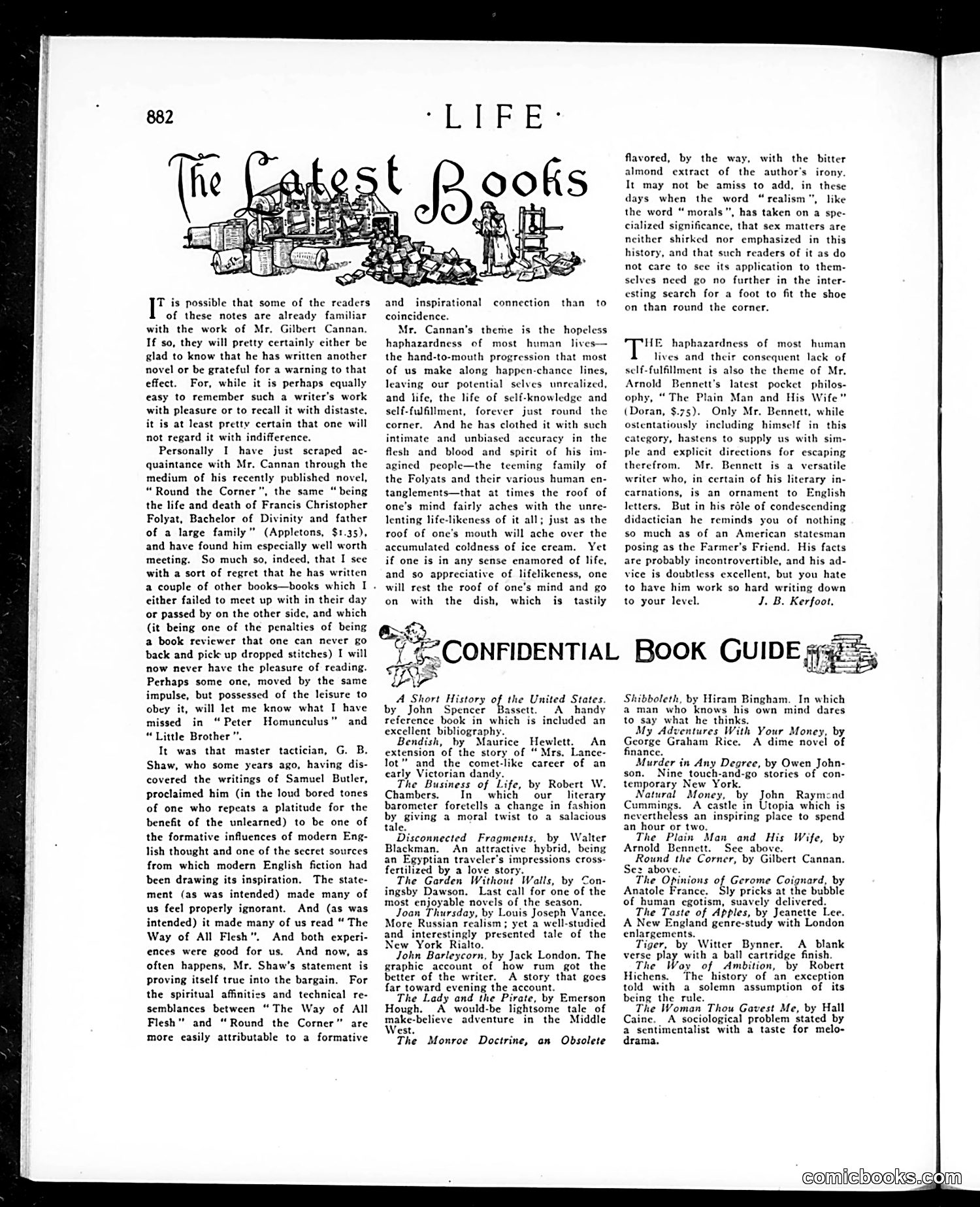
This is a book review column titled "The Cakest Books," discussing novelist Gilbert Cannan's work "Round the Corner." The reviewer compares Cannan favorably to Samuel Butler (author of "The Way of All Flesh"), crediting Butler as a formative influence on modern English fiction—a claim the reviewer attributes to critic G.B. Shaw. The satire is gentle: the reviewer playfully admits to feeling "properly ignorant" after Shaw's pronouncement about Butler's importance, then sheepishly following Shaw's lead by reading the book anyway. The joke involves intellectual pretension and how critics like Shaw use authority to make readers feel inadequate, yet the strategy paradoxically works—the reading proves worthwhile. The "Confidential Book Guide" section below lists recent publications with brief descriptions, functioning as advertisement/recommendations for contemporary titles.
📄 Transcribed text from this page (OCR, searchable)
Machine-transcribed from the original scan — historical spelling and the odd misread are preserved.
T is possible that some of the readers of these notes are already familiar with the work of Mr. Gilbert Cannan, If so, they will pretty certainly cither be glad to know that he has written another novel or be grateful for a warning to that effect. For, while it is perhaps equally easy to remember such a writer's work with pleasure or to recall it with distaste, it is at least pretty certain that one will not regard it with indifference. Personally I have just scraped ac- quaintance with Mr. Cannan through the medium of his recently published novel, “Round the Corner", the same “being the life and death of Francis Christopher Folyat, Bachelor of Divinity and father of a large family” (Appletons, $1.35), and have found him especially well worth meeting. So much so, indeed, that I sce with a sort of regret that he has written a couple of other books—books which I . either failed to meet up with in their day or passed by on the other side, and which (it being one of the penalties of being a book reviewer that one can never go back and pick up dropped stitches) I will now never have the pleasure of reading. Perhaps some one, moved by the same impulse, but possessed of the leisure to obey it, will let me know what I have missed in “Peter Homunculus” and “Little Brother”. Tt was that master tactician, G. B. Shaw, who some years ago, having dis- covered the writings of Samuel Butler, proclaimed him (in the loud bored tones of one who repeats a platitude for the benefit of the unlearned) to be one of the formative influences of modern Eng- lish thought and one of the secret sources from which modern English fiction had been drawing its inspiration. The state- ment (as was intended) made many of us feel properly ignorant. And (as was intended) it made many of us read “ The Way of All Flesh”. And both experi- ences were good for us. And now, as often happens, Mr. Shaw’s statement is proving itself true into the bargain. For the spiritual affinities and technical re- semblances between “The Way of All Flesh" and “Round the Corner” are more easily attributable to a formative and inspirational connection than to coincidence. Mr. Cannan’s theme is the hopeless haphazardness of most human live the hand-to-mouth progression that most of us make along happen-chance lines, leaving our potential selves unrealized, and life, the life of self-knowledge and self-fulfillment, forever just round the corner. And he has clothed it with such intimate and unbiased accuracy in the flesh and blood and spirit of his im- agined people—the teeming family of the Folyats and their various human en- tanglements—that at times the roof of one’s mind fairly aches with the unre- lenting life-likeness of it all; just as the roof of one’s mouth will ache over the accumulated coldness of ice cream. Yet if one is in any sense enamored of life, and so appreciative of lifelikeness, one will rest the roof of one’s mind and go on with the dish, which is tastily > CONFIDENTIAL Book GUIDE aS A Short History of the United States. by John Spencer Bassett. A handy reference book in which is included an excellent bibliography. Bendish, by Maurice Hewlett. An extension of the story of “ Mrs. Lance- lot" and the comet-like career of an early Victorian dandy The Business of Life, by Robert W. Chambers. In which’ our literary barometer foretells a change in fashion by giving a moral twist to a salacious tale. Disconnected Fragments, by Walter Blackman. An attractive hybrid, being an Egyptian traveler's impressions cross- fertilized by a love story. The Garden Without Walls, by Con- ingsby Dawson. Last call for one of the most enjoyable novels of the season, Joan Tersdes, by Louis Joseph Vance. More Russian realism; yet a well-studied and interestingly presented tale of the New York Rialto. John Barleycorn, by Jack London. The graphic account of how rum got the better of the writer. A story that goes far toward evening the account. The Lady and the Pirate, by Emerson Hough. A would-be lightsome tale of makebelieve adventure in the Middle Vest. The Monroe Doctrine, an Obsolete flavored, by the way, with the bitter almond extract of the author's irony. It may not be amiss to add, in these days when the word “realism”, like the word “ morals”, has taken on a spe- cialized significance, that sex matters are neither shirked nor emphasized in this history, and that such readers of it as do not care to sce its application to them- selves need go no further in the inter- esting search for a foot to fit the shoe on than round the corner. HE haphazardness of most human lives and their consequent lack of self-fulfillment is also the theme of Mr. Arnold Bennett's latest pocket philos- ophy, “ The Plain Man and His Wife” (Doran, $.75). Only Mr. Bennett, while ostentatiously including himself in this category, hastens to supply us with sim- ple and explicit directions for escaping therefrom. Mr. Bennett is a versatile writer who, in certain of his literary in- carnations, is an ornament to English letters. But in his réle of condescending didactician he reminds you of nothing so much as of an American statesman posing as the Farmer's Friend. His facts are probably incontrovertible, and his ad- vice is doubtless excellent, but you hate to have him work so hard writing down to your level. J. B. Kerfoot. i Se) Shibboleth, by Hiram Bingham. In which a man who knows his own mind dares to say what he thinks. My Adventures With Your Money, by George Graham Rice. A dime novel of finance. Murder in Any Degree, by Owen John- son. Nine touch-and-go stories of con- temporary New York. Natural Money, by John Raymend Cummings. A castle in Utopia which is nevertheless an inspiring place to spend an hour or two. The Plain Man. and His Wife, by Arnold Bennett. See above. Round the Corner, by Gilbert Cannan. Sez above. The Opinions of Gerome Coignard, by Anatole France. Sly pricks at the bubble of human egotism, suavely delivered. The Taste of Apples, by Jeanette Lee. A New England genre-study with London enlargements. Tiger, by Witter Bynner. A_ blank verse play with a ball cartridge finish. The Way of Ambition, by Robert Hichens. The history of an exception told with a solemn assumption of its being the rule. The Woman Thou Gavest Me, by Hall Caine. A sociological problem stated by a sentimentalist with a taste for melo- drama. comicbooks.com