
Life, 1913-11-20 · page 20 of 44
Life — November 20, 1913 — page 20: what you’re looking at
What you’re looking at
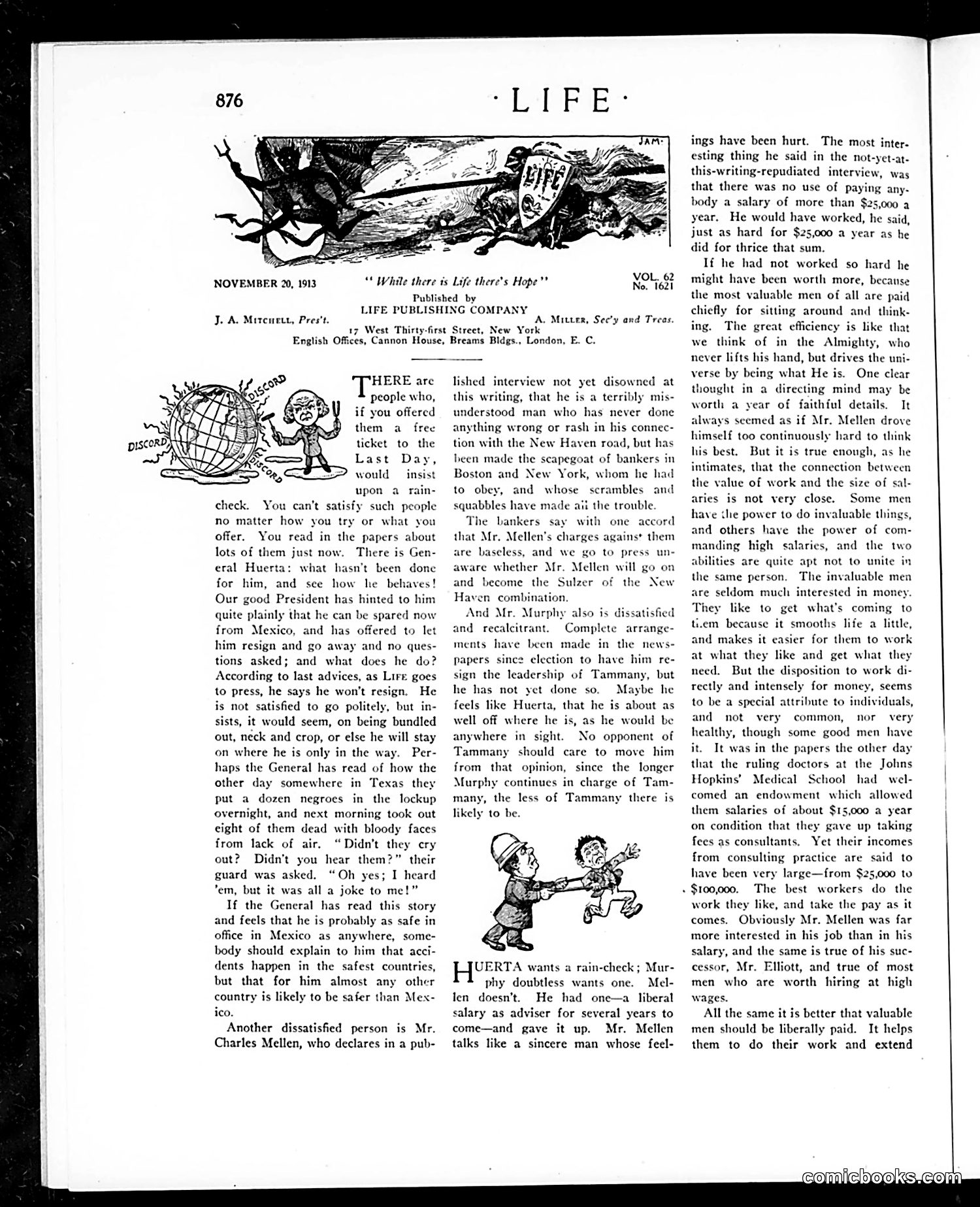
This editorial attacks three prominent figures as unreasonable complainers: **General Huerta** (Mexican military leader) refuses President Wilson's offer to resign and leave Mexico, insisting instead on being forcibly removed. The article sarcastically suggests he may prefer staying, given the violence against Black prisoners in Texas. **Charles Mellen** (New Haven Railroad executive) claims he's a misunderstood scapegoat of Boston and New York bankers, despite his responsibility for the railroad's troubles. The satire notes his hypocrisy: he claims no one should earn over $25,000 yearly, yet he abandoned a generous consulting salary. **Charles Murphy** (Tammany Hall boss) refuses to resign his leadership despite newspaper campaigns demanding it. The "rain-check" metaphor—refusing even a free ticket to the Last Day unless you could reschedule—describes ungrateful men who reject reasonable exit offers. The cartoon's message: these powerful figures stubbornly cling to positions despite obvious incentives to leave.
📄 Transcribed text from this page (OCR, searchable)
Machine-transcribed from the original scan — historical spelling and the odd misread are preserved.
NOVEMBER 2, 1913 “* While there is Life there's Hope”? VOL. 62 No. 1621 Published by LIFE PUBLISHING COMPANY J. A. Mircuett, Pres’t. A. Mitter, Sec’y and Treas. 17 West Thirty-first Street, New York English Offices, Cannon House, Breams Bldgs., London, E. C. HERE are people who, if you offered them a free ticket to the Last Day, would — insist upon a rain- check. You can’t satisfy such people no matter how you try or what you offer. You read in the papers about lots of them just now. There is Gen- eral Huerta: what hasn't been done for him, and see how he behaves! Our good President has hinted to him quite plainly that he can be spared now from Mexico, and has offered to let him resign and go away and no ques- tions asked; and what does he do? According to last advices, as Lire goes to press, he says he won't resign. He is not satisfied to go politely, but in- sists, it would seem, on being bundled out, neck and crop, or else he will stay on where he is only in the way. Per- haps the General has read of how the other day somewhere in Texas they put a dozen negroes in the lockup overnight, and next morning took out eight of them dead with bloody faces from lack of air. “Didn't they cry out? Didn't you hear them?” their guard was asked. “Oh yes; I heard "em, but it was all a joke to me!” If the General has read this story and feels that he is probably as safe in office in Mexico as anywhere, some- body should explain to him that acci- dents happen in the safest countries, but that for him almost any other country is likely to be safer than Mex- ico. Another dissatisfied person is Mr. Charles Mellen, who declares in a pub- lished interview not yet disowned at this writing, that he is a terribly mis- understood man who has never done anything wrong or rash in his connec- tion with the New Haven road, but has heen made the scapegoat of bankers in Boston and New York, whom he had to obey, and and squabbles have made aii the trouble. The bankers with accord that Mr. Mellen’s charges agains? them are baseless, and we go to press un- aware whether Mr. Mellen will go on and the Sulzer of the N Haven combination. And Mr. Murphy also is dissatisfied and recalcitrant. Complete arrange- whose scrambles say one become w ments have been made in the news- papers since election to have him re- sign the leadership of Tammany, but he has not yet done so. Maybe he feels like Huerta, that he is about as well off where he is, as he would be anywhere in sight. No opponent of Tammany should care to move him from that opinion, since the longer Murphy continues in charge of Tam- many, the less of Tammany there is likely to be. UERTA wants a rain-check ; Mur- phy doubtless wants one. Mel- Ien doesn’t. He had one—a liberal salary as adviser for several years to come—and gave it up. Mr. Mellen talks like a sincere man whose feel- + $100,000. The best ings have been hurt. The most inter- esting thing he said in the not-yet-at- this-writing-repudiated interview, was that there was no use of paying any- body a salary of more than $25,000 a year. He would have worked, he said, just as hard for $25,000 a year as he did for thrice that sum. If he had not worked so hard he might have been worth more, becanse the most valuable men of all are paid chiefly for sitting around and think- ing. The great efficiency is like that we think of in the Almighty, who never lifts his hand, but drives the uni- verse by being what He is. One clear thought in a directing mind may be worth a y of faithful details. It always seemed as if Mr. Mellen drove himself too continuously hard to think his best. But it is true enough, as he intimates, that the connection between the value of work and the size of sal- aries is not very close. Some men have the power to do invaluable things, and others have the power of com- manding high salaries, and the two abilities are quite apt not to unite in the same person. The invaluable men are seldom much interested in money. They like to get what's coming to tiem because it smooths life a little, and makes it easier for them to work at what they like and get what they But the disposition to work di- rectly and intensely for money, seems to be a special attribute to individuals, not very common, nor very healthy, though some good men have need. and it. It was in the papers the other day that the ruling doctors at the Johns Hopkins’ Medical School had wel- comed an endowment which allowed them salaries of about $15,000 a year on condition that they gave up taking fees as consultants. Yet their incomes from consulting practice are said to have been very large—from $25,000 to workers do the work they like, and take the pay as it comes. Obviously Mr. Mellen was far more interested in his job than in hi salary, and the same is true of his suc- cessor, Mr. Elliott, and true of mo: men who are worth hiring at wages. All the same it is better that valuable men should be liberally paid. It helps them to do their work and extend