
Life, 1913-11-20 · page 16 of 44
Life — November 20, 1913 — page 16: what you’re looking at
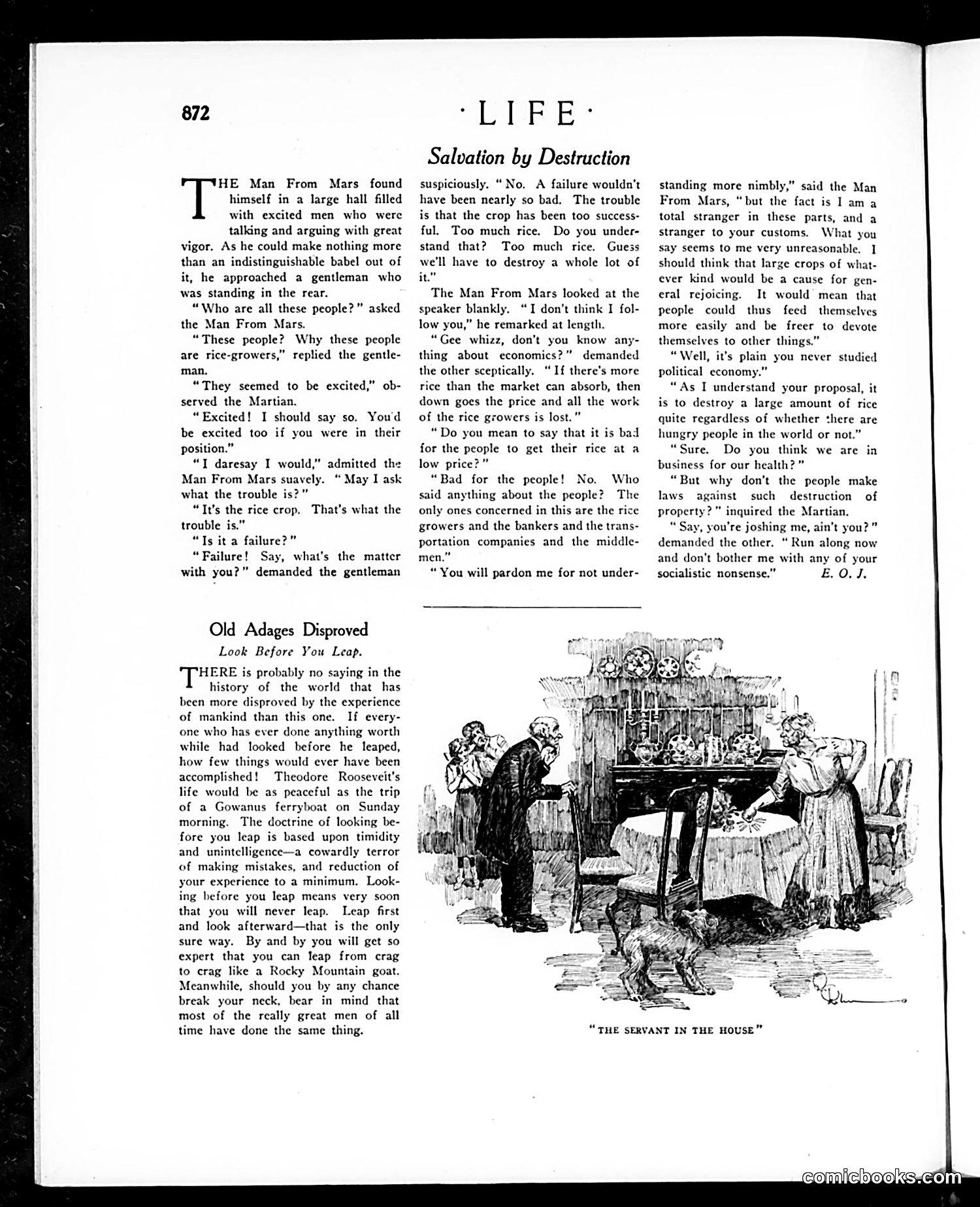
What you’re looking at
This satirical dialogue uses a Martian visitor as a naive outsider to critique early-20th-century American agricultural economics. The "Man From Mars" represents rational common sense; the rice-grower spokesman embodies callous capitalism. The satire exposes a perverse economic logic: farmers must **destroy surplus rice** to maintain prices and profits, even though abundant food could feed hungry people. When the Martian reasonably asks why destruction benefits anyone, he's dismissed with accusations of "socialistic nonsense." The joke targets the disconnect between what *should* make sense—abundant crops feed people—and what capitalism actually does: prioritize profits for growers, bankers, and middlemen over human welfare. By making the profit-motive seem absurd through an outsider's perspective, Life mocks the system's fundamental irrationality and its defenders' inability to justify it rationally. This reflects Progressive-era criticism of unregulated capitalism and waste during economic inefficiency.
📄 Transcribed text from this page (OCR, searchable)
Machine-transcribed from the original scan — historical spelling and the odd misread are preserved.
TT" Man From Mars found himself in a large hall filled with excited men who were talking and arguing with great vigor. As he could make nothing more than an indistinguishable babel out of it, he approached a gentleman who was standing in the rear. “Who are all these people?” asked the Man From Mars. “These people? Why these people are rice-growers,” replied the gentle- man. “They seemed to be excited,” ob- served the Martian. “Excited! I should say so. You'd be excited too if you were in their position.” “T daresay I would,” admitted the Man From Mars suavely. “ May I ask what the trouble is?” “It’s the rice crop. trouble is.” “Ts it a failure?” “Failure! Say, what's the matter with you?” demanded the gentleman That's what the Old Adages Disproved Look Before You Leap. HERE is probably no saying in the history of the world that has been more disproved by the experience of mankind than this one. If every- one who has ever done anything worth while had looked before he leaped, how few things would ever have been accomplished! Theodore Rooseveit’s life would be as peaceful as the trip of a Gowanus ferryboat on Sunday morning. The doctrine of looking be- fore you leap is based upon timidity and unintelligence—a cowardly terror of making mistakes, and reduction of your experience to a minimum. Look- ing before you leap means very soon that you will never leap. Leap first and look afterward—that is the only sure way. By and by you will get so expert that you can leap from crag to crag like a Rocky Mountain goat. Meanwhile, should you by any chance break your neck, bear in mind that most of the really great men of all time have done the same thing. “GEE * Salvation by Destruction suspiciously. “No. A failure wouldn't have been nearly so bad. The trouble is that the crop has been too success- ful. Too much rice. Do you under- stand that? Too much rice. Guess we'll have to destroy a whole lot of it” The Man From Mars looked at the speaker blankly. “I don’t think I fol- low you,” he remarked at length, “Gee whizz, don't you know any- thing about economics?” demanded the other sceptically, “If there's more rice than the market can absorb, then down goes the price and all the work of the rice growers is lost.” “Do you mean to say that it is bad for the people to get their rice at a low price?” “Bad for the people! No. Who said anything about the people? The only ones concerned in this are the rice growers and the bankers and the trans- portation companies and the middle- men.” “ You will pardon me for not under- standing more nimbly,” said the Man From Mars, “but the fact is I am a total stranger in these parts, and a stranger to your customs. What you say seems to me very unreasonable. | should think that large crops of what- ever kind would be a cause for gen- eral rejoicing. It would mean that people could thus feed themselves more easily and be freer to devote themselves to other things.” “Well, it’s plain you never studied political economy.” “As I understand your proposal, it is to destroy a large amount of rice quite regardless of whether there are hungry people in the world or not.” “Sure. Do you think we are in business for our health?” “But why don’t the people make laws against such destruction of property?” inquired the Martian. “Say, you're joshing me, ain't you?” demanded the other, “Run along now and don't bother me with any of your socialistic nonsense,” £.0.J. “THE SERVANT IN THE HOUSE”