
Life, 1913-11-20 · page 9 of 44
Life — November 20, 1913 — page 9: what you’re looking at
What you’re looking at
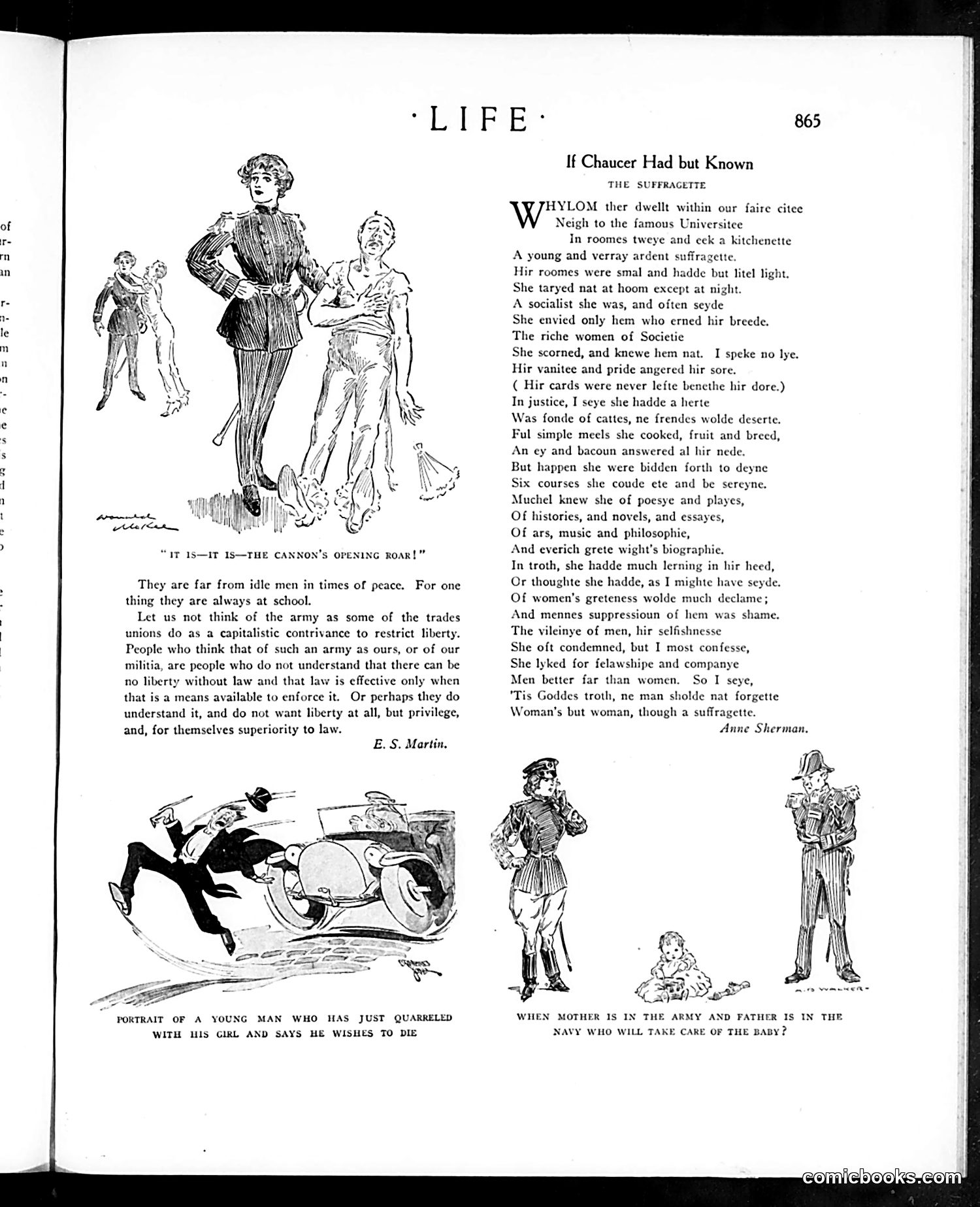
This page satirizes early 20th-century gender politics through two main pieces: **"If Chaucer Had but Known"** (by Anne Sherman) is a poem mocking an educated "suffragette" living near a university. She's depicted as bookish and intellectual but vain, proud, and condemning of other women. The satire suggests such women are hypocritical—they demand equality and education while judging less-ambitious women harshly. The concluding couplet undercuts feminist arguments by reducing the suffragette to "Woman's but woman, though a suffragette." **The cartoons below** illustrate domestic/military absurdities: a young couple's quarrel, and the question of childcare when both parents serve in the military—poking fun at women's new public roles during wartime. The overall message is anti-suffrage, portraying educated women activists as self-righteous and their aspirations as fundamentally at odds with traditional family life.
📄 Transcribed text from this page (OCR, searchable)
Machine-transcribed from the original scan — historical spelling and the odd misread are preserved.
a a Oe os If Chaucer Had but Known THE SUFFRAGETTE HYLOM ther dwellt within our faire citee Neigh to the famous Universitee In roomes tweye and eck a kitchenette A young and verray ardent suffragette. Hir roomes were smal and hadde but litel light, She taryed nat at hoom except at night. A socialist she was, and often seyde She envied only hem who erned hir breede. The riche women of Societie She scorned, and knewe hem nat, I speke no lye. Hir vanitee and pride angered hir sore. ( Hir cards were never lefte benethe hir dore.) In justice, I seye she hadde a herte Was fonde of cattes, ne frendes wolde deserte. Ful simple meels she cooked, fruit and breed, An ey and bacoun answered al hir nede, But happen she were bidden forth to deyne Six courses she coude ete and be sereyne. Muchel knew she of poesye and playes, Ne EH i Of histories, and novels, and essayes, HORTA N Ht = Of ars, music and philosophie, And everich grete wight’s biographic. In troth, she hadde much lerning in hir heed, Or thoughte she hadde, as I mighte have seyde. Of women’s greteness wolde much declame; And mennes suppressioun of hem was shame. The vileinye of men, hir selfishnesse She oft condemned, but I most confesse, “IT 1S—IT IS—THE CANNON'S OPENING ROAR!" They are far from idle men in times of peace. For one thing they are always at school. Let us not think of the army as some of the trades unions do as a capitalistic contrivance to restrict liberty. People who think that of such an army as ours, or of our militia, are people who do not understand that there can be She lyked for felawshipe and companye no liberty without law and that law is effective only when Men better far than women. So I seye, that is a means available to enforce it. Or perhaps they do 'Tis Goddes troth, ne man sholde nat forgette understand it, and do not want liberty at all, but privilege, Woman's but woman, though a suffragette. and, for themselves superiority to law. Anne Sherman. E. S. Martin. HAS JUST QUARRELED N MOTHER IS IN THE ARMY AND FATHER IS IN THE PORTRAIT OF A YOUNG MAN WHO NAVY WHO WILL TAKE CARE OF THE BABY? WITH LIS GIRL AND SAYS HE WISHES TO DIE