
A complete issue · 44 pages · 1913
Life — October 16, 1913
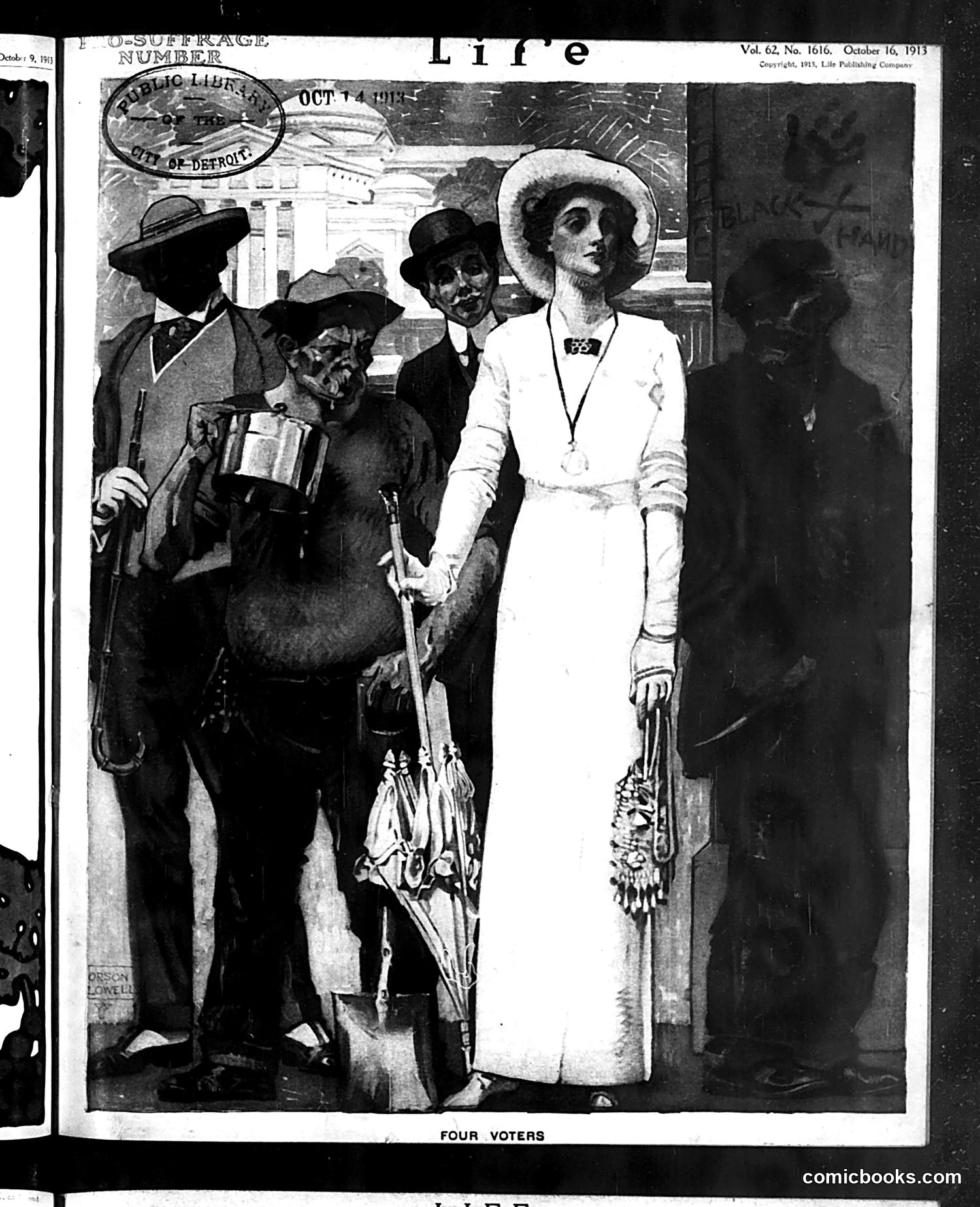
This satire concerns women's suffrage. The caption "Four Voters" ironically presents four figures: three men in formal attire and one woman in an elegant white dress with a large hat, all holding umbrellas. The woman appears to be the only actual voter among caricatured male figures—likely representing politicians, possibly including a leprechaun-like character (possibly Irish-American political stereotype). The joke appears to satirize the contradiction between women gaining voting rights while other groups remained marginalized or mocked. The woman's refined appearance contrasts with the grotesque caricatures of the men, perhaps critiquing which groups society deemed worthy of political participation. The Library of Detroit stamp suggests this addresses Michigan suffrage debates specifically.

This is a **toothpaste advertisement**, not political satire. The page promotes Pebeco Tooth Paste from Lehn & Fink Manufacturing. The ad features two smiling people (a man and woman) as generic examples of attractive individuals with good oral hygiene. The marketing claims Pebeco prevents "Acid Mouth"—a condition allegedly caused by mouth acid slowly damaging teeth and enamel. The ad emphasizes that good oral health is essential to personal attractiveness and social success, reflecting early 20th-century advertising conventions that tied hygiene products to desirability and social standing. The call-to-action offers a free 10-day trial tube and "Acid Test Papers," attempting to give the product scientific credibility. This was typical of period advertising before modern FDA regulations.
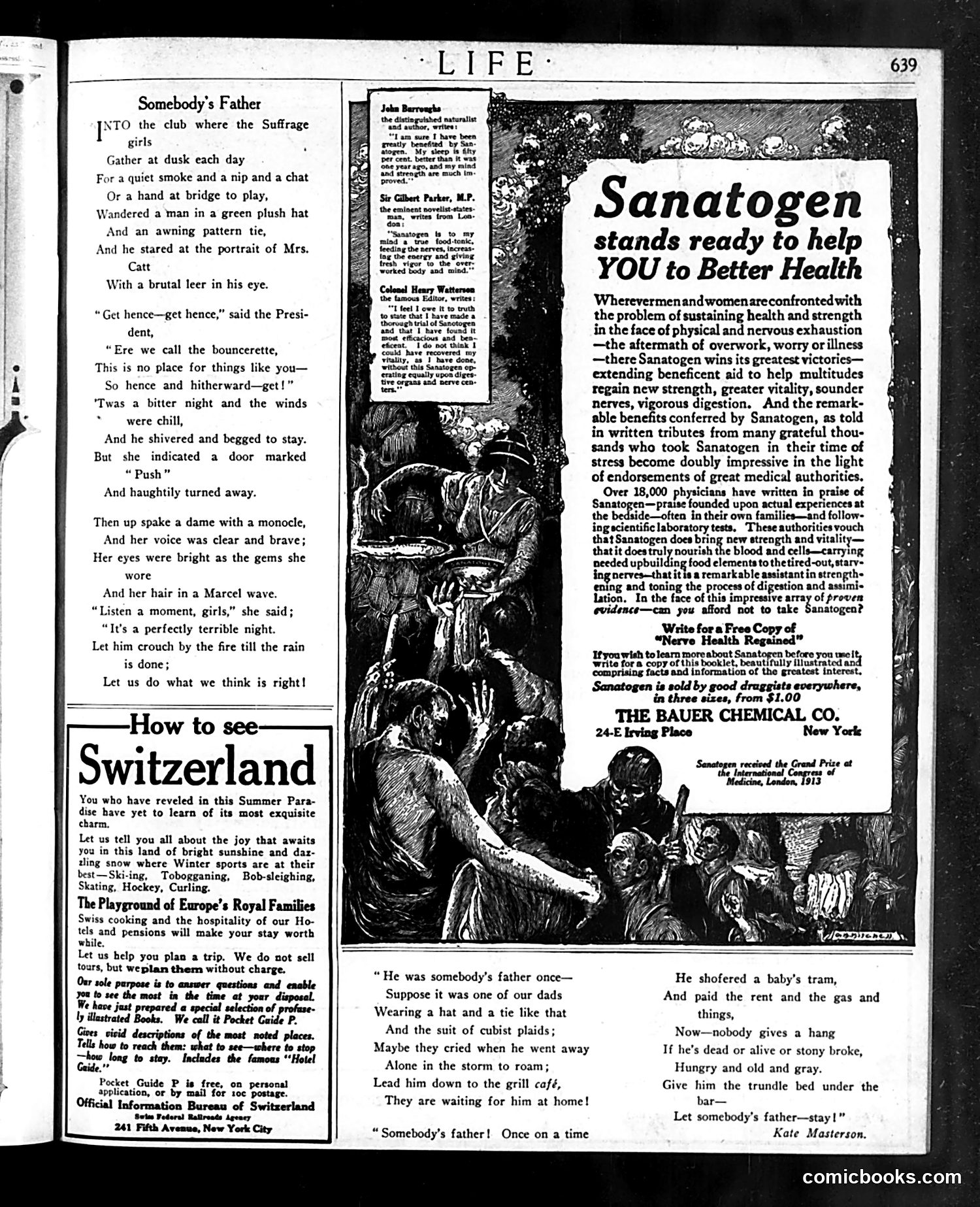
The left page features a poem titled "Somebody's Father" that appears to critique suffrage activism. The poem describes a man encountering "suffrage girls" at a club and includes dialogue where a character dismisses them as a "bouncerette," suggesting the speaker views women's suffrage advocacy with disdain. The narrative depicts the man abandoning the club to escape the women's political presence. The right side contains an advertisement for "Sanatogen," a health tonic claiming medical endorsements. This was common patent medicine advertising of the era. The page reflects early 20th-century tensions around women's suffrage, presenting anti-suffrage sentiment through satirical verse that mocks activist women rather than engaging with their political arguments.
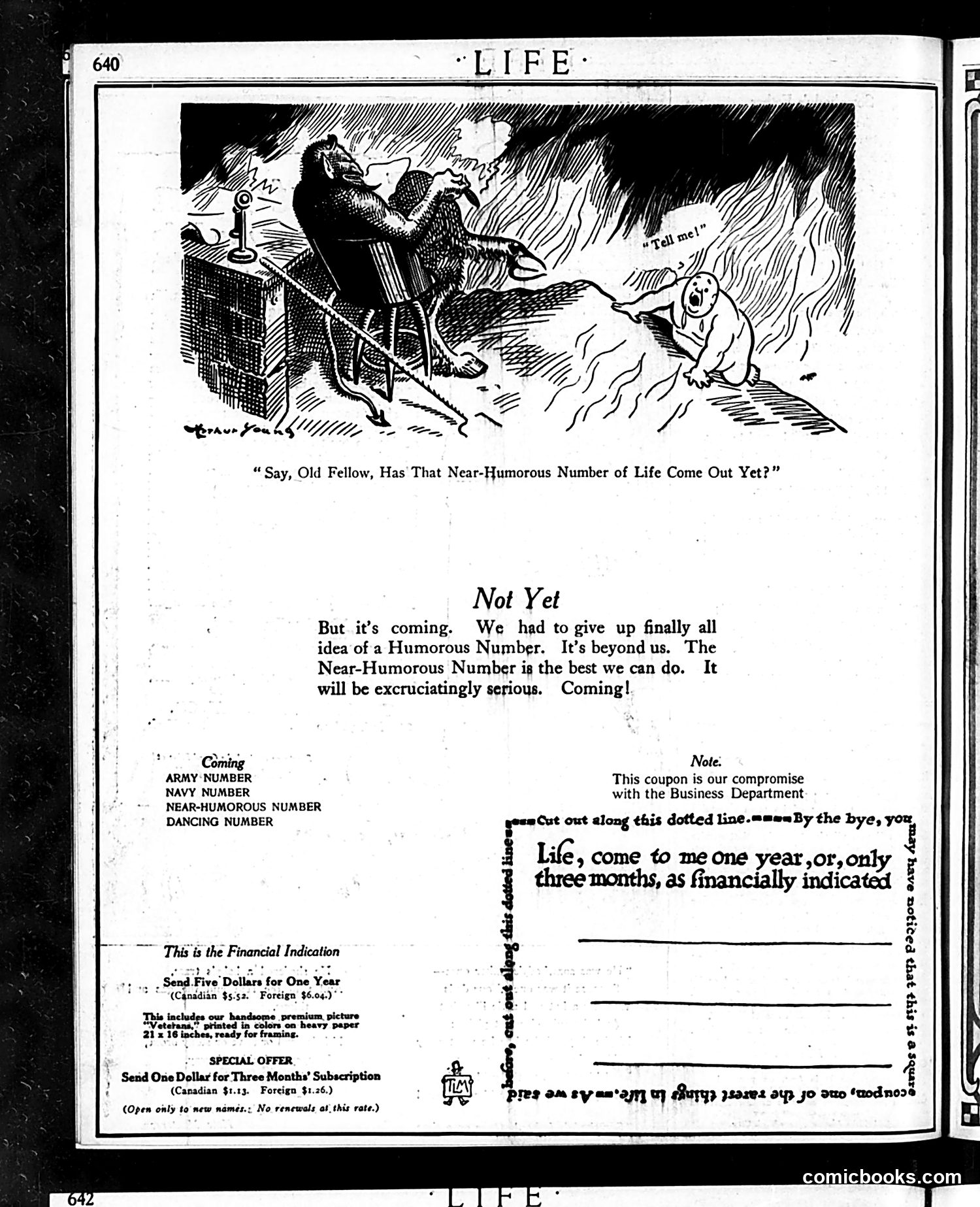
This page is primarily a **subscription advertisement** rather than political satire. The main cartoon depicts two figures in Hell or a fiery underworld setting. One asks the other: "Say, Old Fellow, Has That Near-Humorous Number of Life Come Out Yet?" The joke plays on **Life magazine's self-promotion**—even in Hell, subscribers anxiously await their copies. The "Near-Humorous Number" is a self-deprecating reference, suggesting the magazine acknowledged its humor could be hit-or-miss. The advertisement section below announces upcoming subscription options and "coming" issues including an "Army Number," "Navy Number," "Near-Humorous Number," and "Dancing Number." The satire is gentle and meta: it's Life joking about its own comedic reliability while encouraging subscriptions.
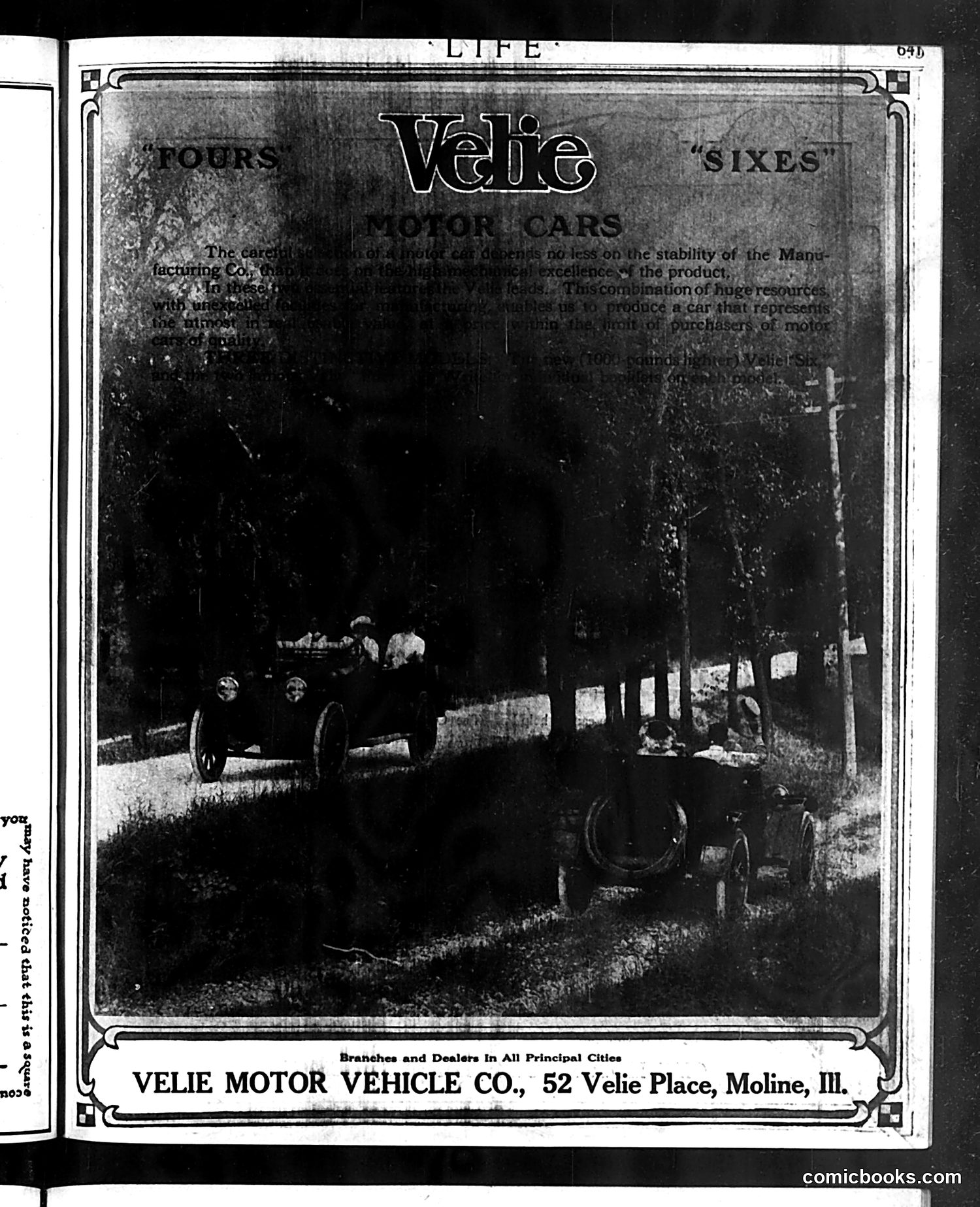
This page is **primarily an advertisement**, not a political cartoon. It advertises Velie Motor Cars, a real automobile manufacturer based in Moline, Illinois. The company marketed "Fours" and "Sixes" — likely referring to engine types. The image shows racing or high-performance vehicles on a tree-lined road, suggesting speed and capability. The ad's text emphasizes engineering excellence and manufacturing resources, positioning Velie as producing quality automobiles comparable to established competitors. This represents early automotive advertising (appears to be 1910s-1920s era based on vehicle design and publication style), when such magazines featured both satirical content and commercial advertisements to fund operations. There is no political satire evident on this particular page.
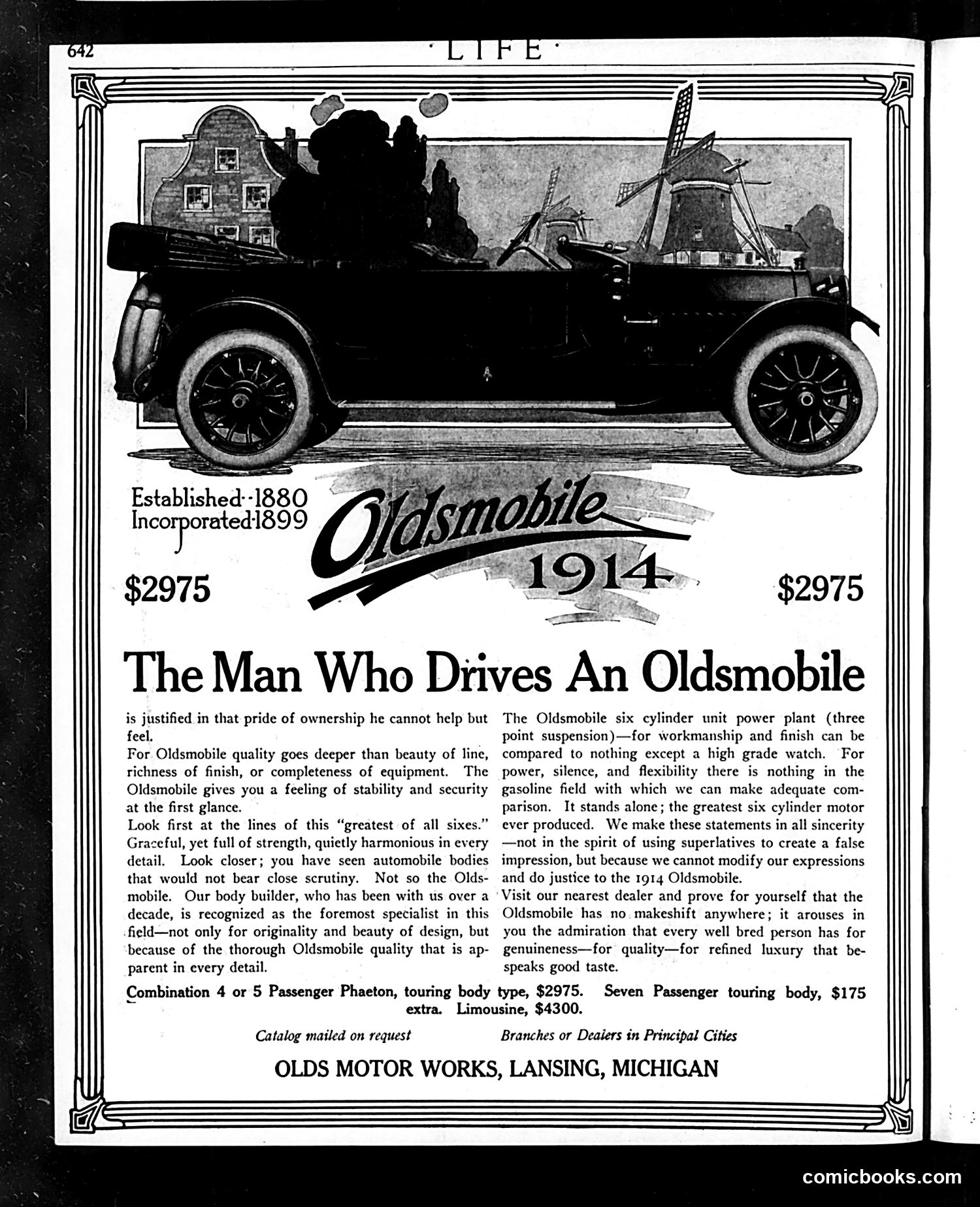
This is **not a cartoon or satirical content** — it's a straightforward automobile advertisement for the 1914 Oldsmobile, published in *Life* magazine. The page features a full-page ad promoting Oldsmobile's luxury vehicle with a silhouette illustration of the car against a Dutch landscape (windmills visible). The headline "The Man Who Drives An Oldsmobile" appeals to class aspirations, arguing that ownership reflects good taste and refinement. The ad emphasizes technical specifications (six-cylinder engine), quality craftsmanship, and pricing ($2,975 base model). It concludes with the company name and location: Olds Motor Works, Lansing, Michigan. This represents early 20th-century automotive marketing targeting affluent consumers through appeals to status and engineering excellence.
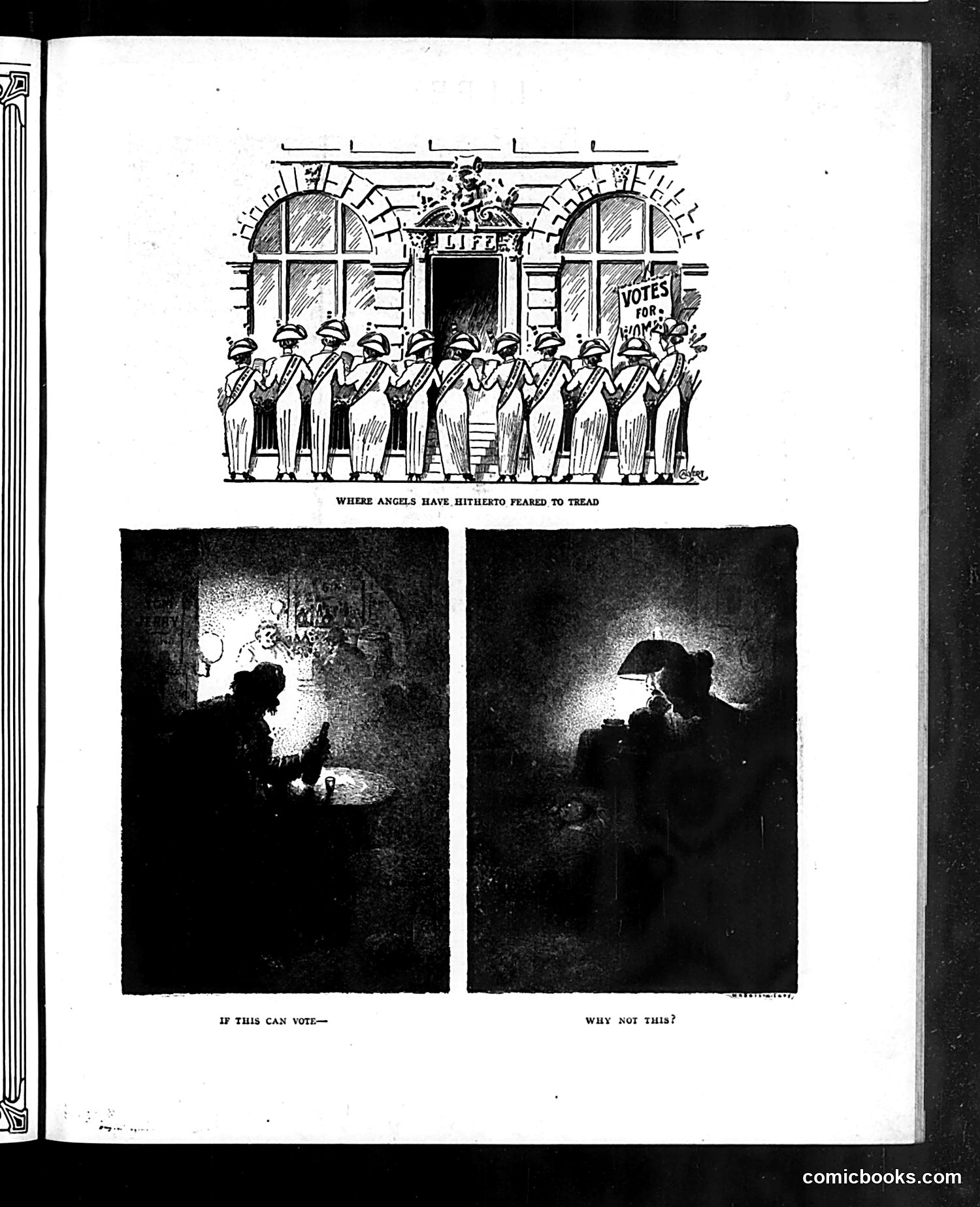
This page presents a suffrage advocacy cartoon with the headline "WHERE ANGELS HAVE HITHERTO FEARED TO TREAD." The top illustration depicts armed soldiers standing guard before a government building labeled "LIFE," with a sign reading "VOTES FOR WOMEN." The two photographs below compare scenarios: "IF THIS CAN VOTE—" (left image, showing what appears to be a person in shadow) contrasted with "WHY NOT THIS?" (right image, similarly shadowed). The implication is that if certain groups already possess voting rights, women should logically receive them too. This appears to be early 20th-century women's suffrage advocacy, arguing for voting equality through a comparative logic about who already participates in democracy. The "angels fearing to tread" reference suggests this was previously considered a controversial or dangerous political position.
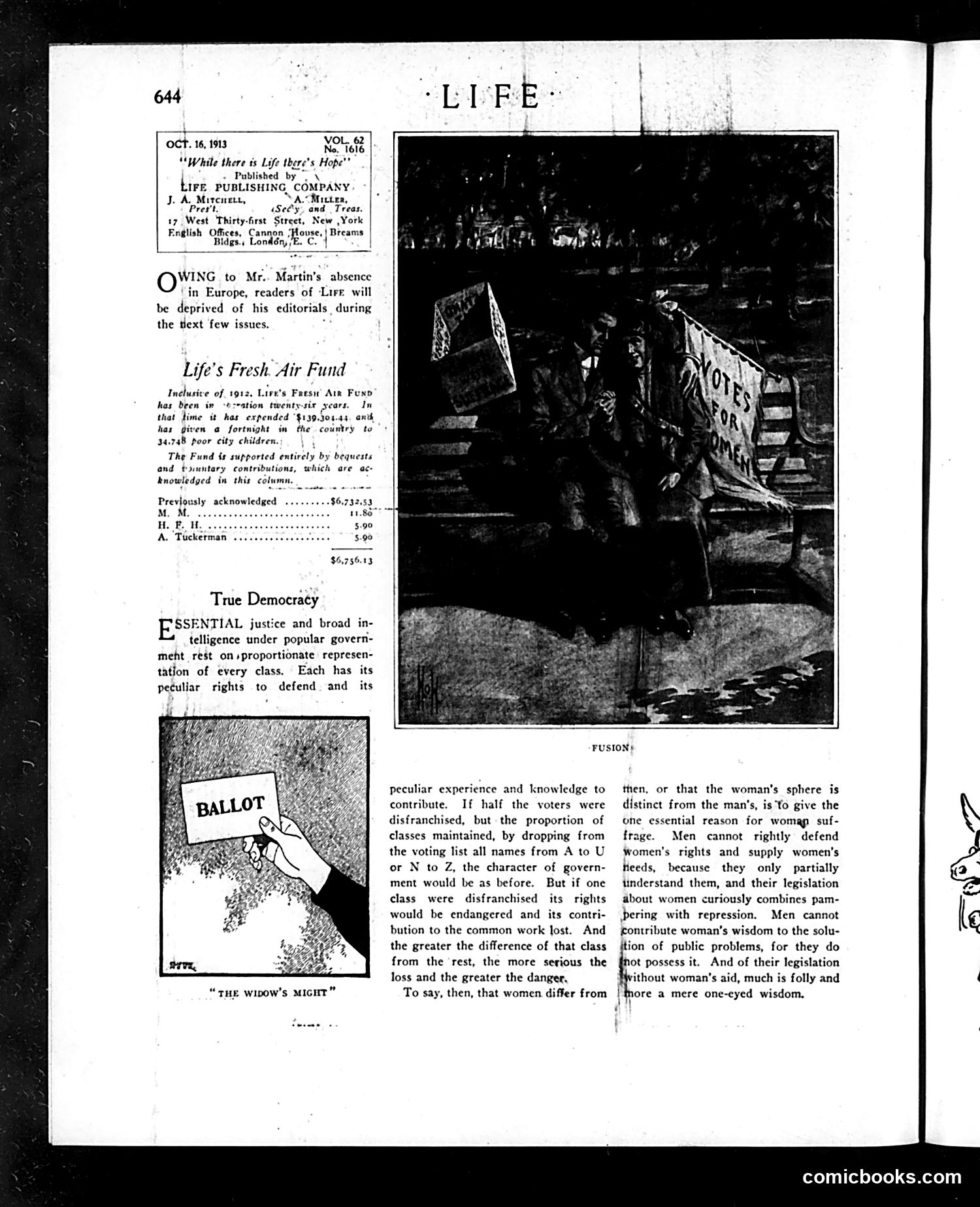
This page contains a political cartoon titled **"The Widow's Mite"** alongside text debating women's suffrage. The cartoon depicts a hand dropping a ballot into a ballot box, symbolizing voting rights. The accompanying article, **"True Democracy,"** argues against women's suffrage. It claims women lack the "peculiar experience and knowledge" for voting and that their exclusion wouldn't harm governance. The text then counters this position, arguing that women's exclusion from voting actually weakens democracy and that women possess essential wisdom needed for solving public problems. The page reflects the intense 1913 suffrage debate in America, with the cartoon and dueling arguments presenting both anti-suffrage and pro-suffrage perspectives.
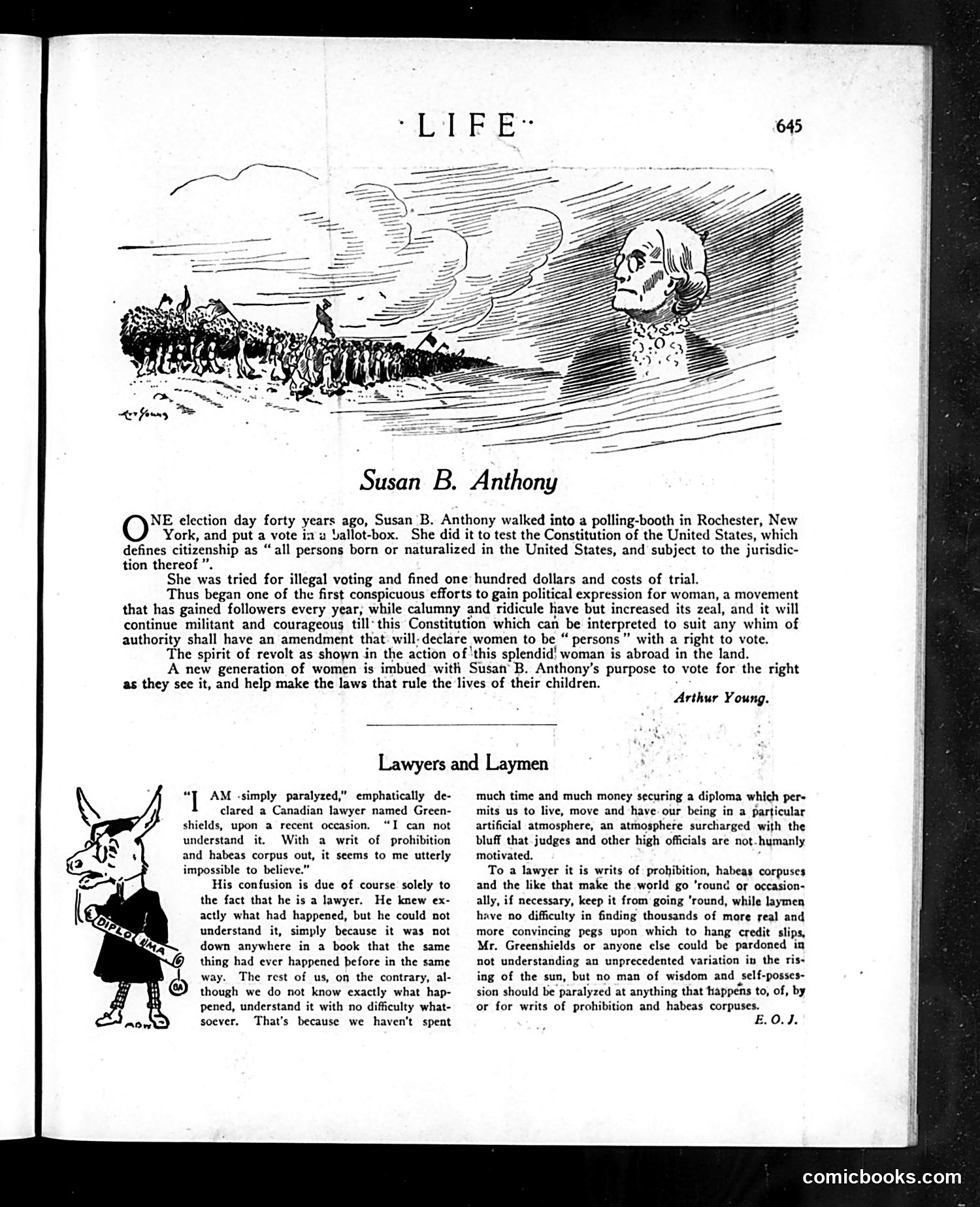
The page features two distinct pieces: **Susan B. Anthony section** (top): A sketch and biographical text about Anthony's 1872 illegal voting attempt in Rochester, New York. She was arrested, tried, and fined $100. The text celebrates her as a pioneer for women's political expression, noting that her action inspired ongoing efforts to secure voting rights for women. Arthur Young's accompanying commentary emphasizes that a "new generation of women" continues this fight for constitutional equality. **Lawyers and Laymen** (bottom): A satirical piece featuring a Canadian lawyer named Greenshields complaining he's "simply paralyzed" by legal prohibitions and writs. The humor mocks lawyers' tendency to blame legal technicalities for inaction, suggesting they lack understanding of practical matters that laypeople grasp intuitively. The cartoon's horned devil figure underscores the satirical tone regarding legal obstructionism.
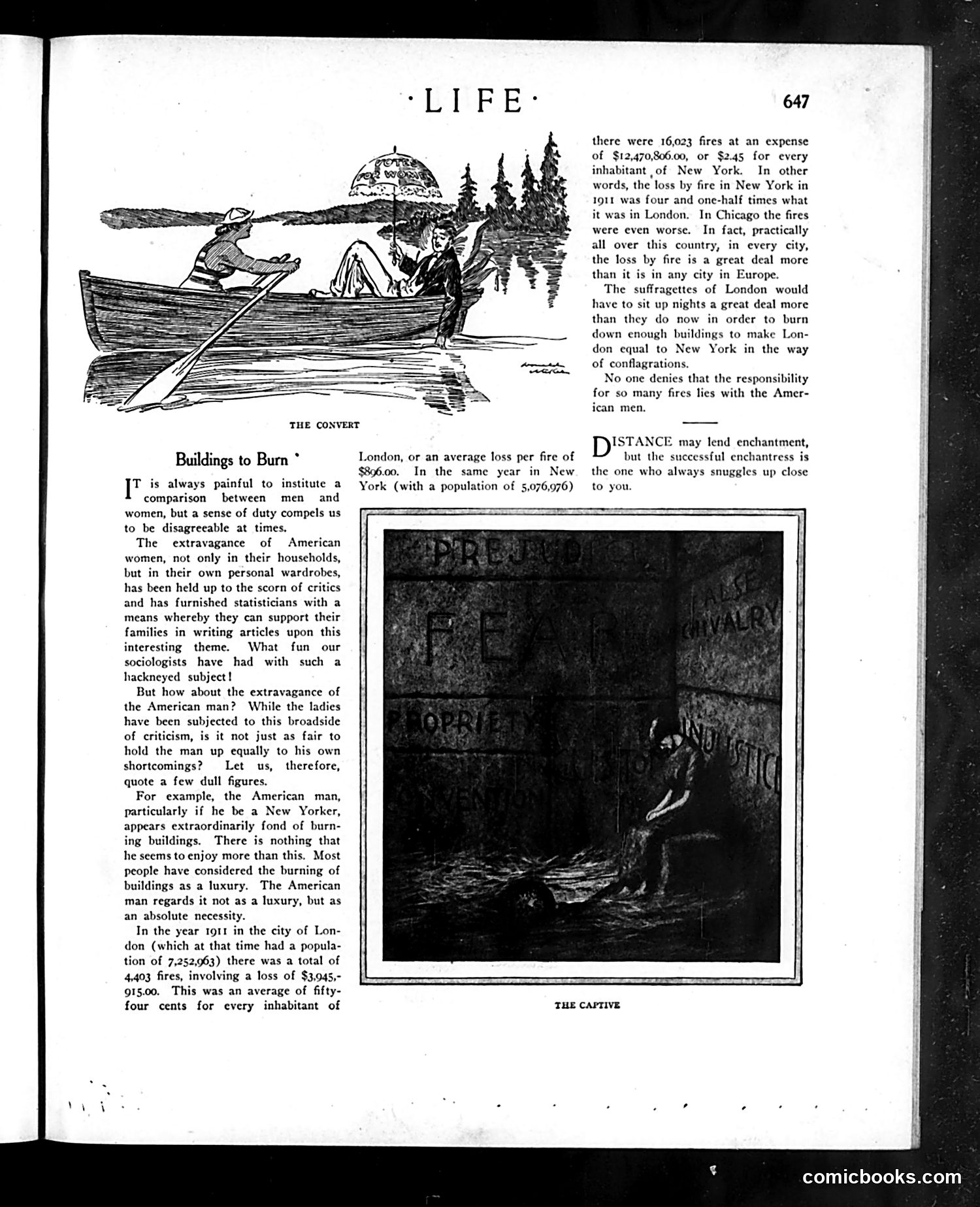
This page satirizes American excess and destructiveness, comparing men's and women's extravagance. The article argues that while female extravagance has been criticized by sociologists, American men—particularly New Yorkers—are equally culpable: they appear "extraordinarily fond of burning buildings." The satire is darkly humorous. The author presents building fires as a "luxury" and "absolute necessity" for American men, citing 1911 London fire statistics to mock American carelessness. The implication: Americans are so wasteful they practically *enjoy* destructive fires, treating property loss as entertainment rather than tragedy. The accompanying illustrations ("The Convert" and "The Captive") appear to visualize this absurdist commentary on American male behavior and consumption patterns.
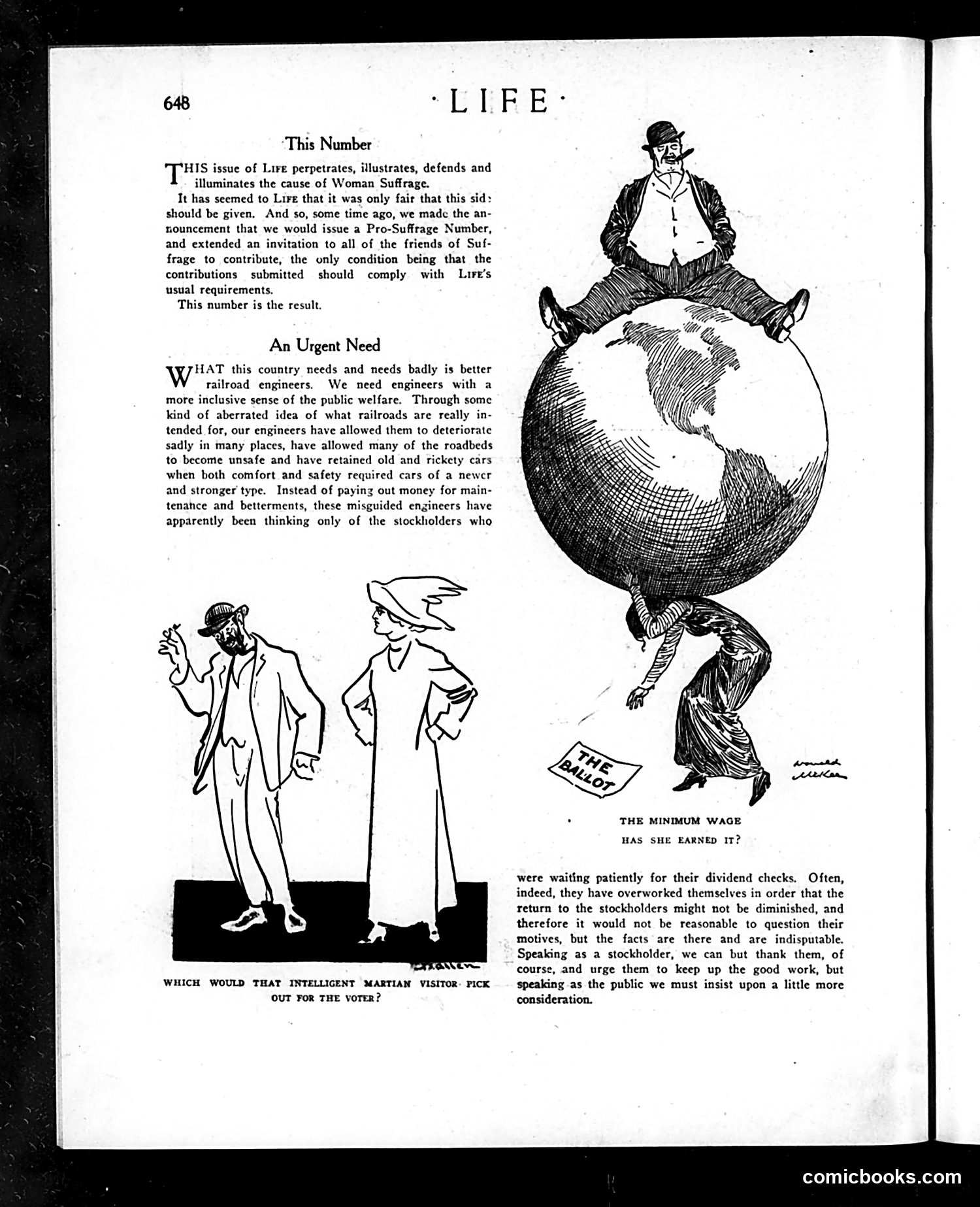
This page announces Life's decision to issue a pro-woman suffrage number, inviting contributions from suffrage supporters. The magazine positions itself as providing fair coverage by dedicating an issue to this cause. The main cartoon depicts a woman struggling to balance a large globe labeled "THE BALLOT" while men (likely railroad stockholders or businessmen) watch from below with the caption "WHICH WOULD THAT INTELLIGENT MARTIAN VISITOR PICK OUT FOR THE VOTES?" The accompanying article criticizes railroad engineers for prioritizing stockholder profits over public welfare. The cartoon's point appears to be that outsiders would find it absurd that women are denied voting rights while burdened with other responsibilities—contrasting what an "intelligent" observer would expect with actual American political practices.
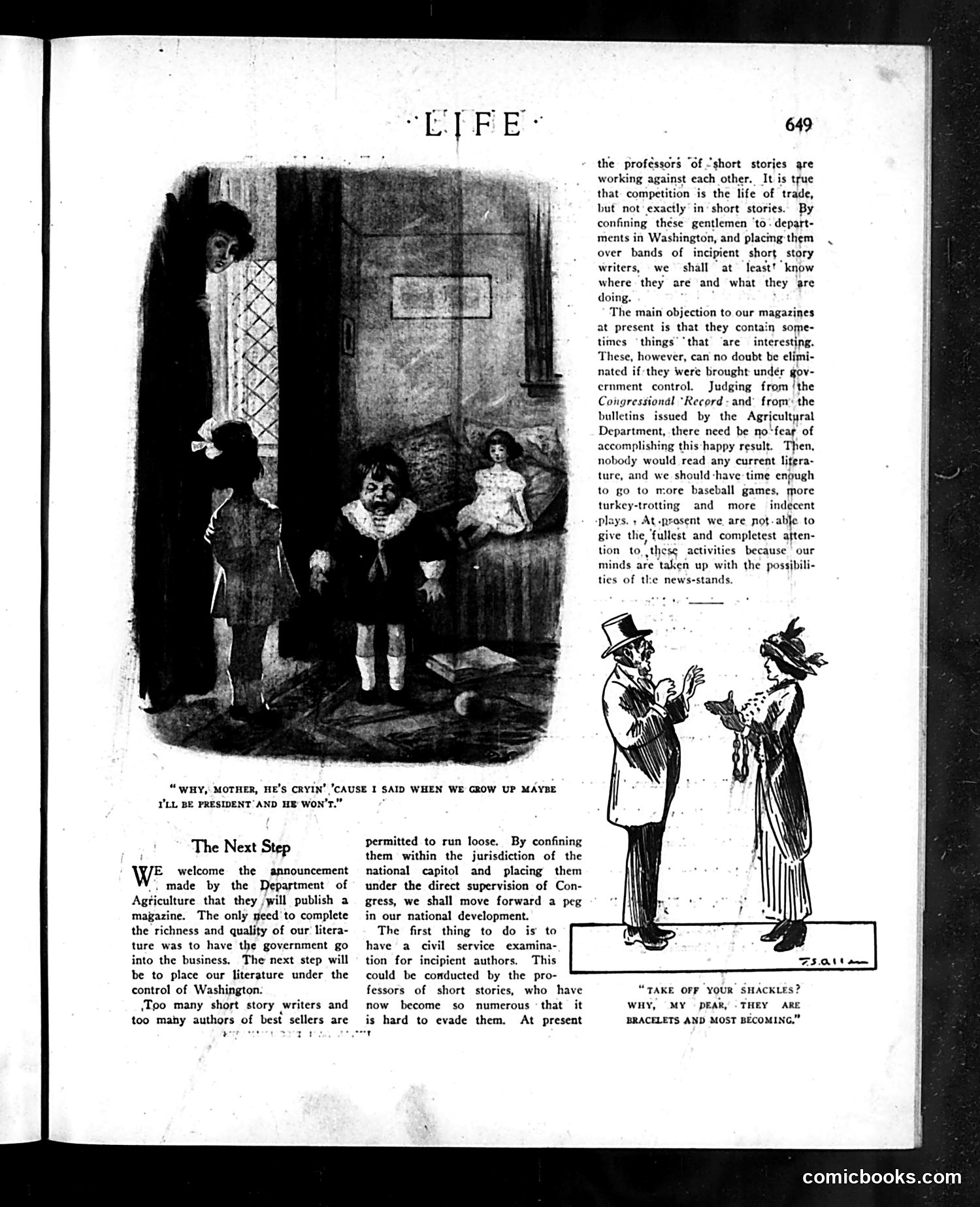
**Main Article ("The Next Step"):** The editorial advocates placing American literature under government control via the Department of Agriculture. It criticizes the proliferation of short-story writers and proposes a civil service examination for "incipient authors" to regulate literary output. The satire mocks excessive government control and bureaucratization of creative work. **Top Illustration:** Shows a mother with children in what appears to be poverty or domestic hardship, captioned with a child's aspirational quote about becoming president—ironic commentary on American social conditions and opportunity. **Bottom Cartoon:** A man tells a woman to "take off your shackles"—she responds "Why, my dear, they're bracelets and must become." This appears to satirize women's fashion or perhaps gender roles, suggesting women mistake constraints for adornment.
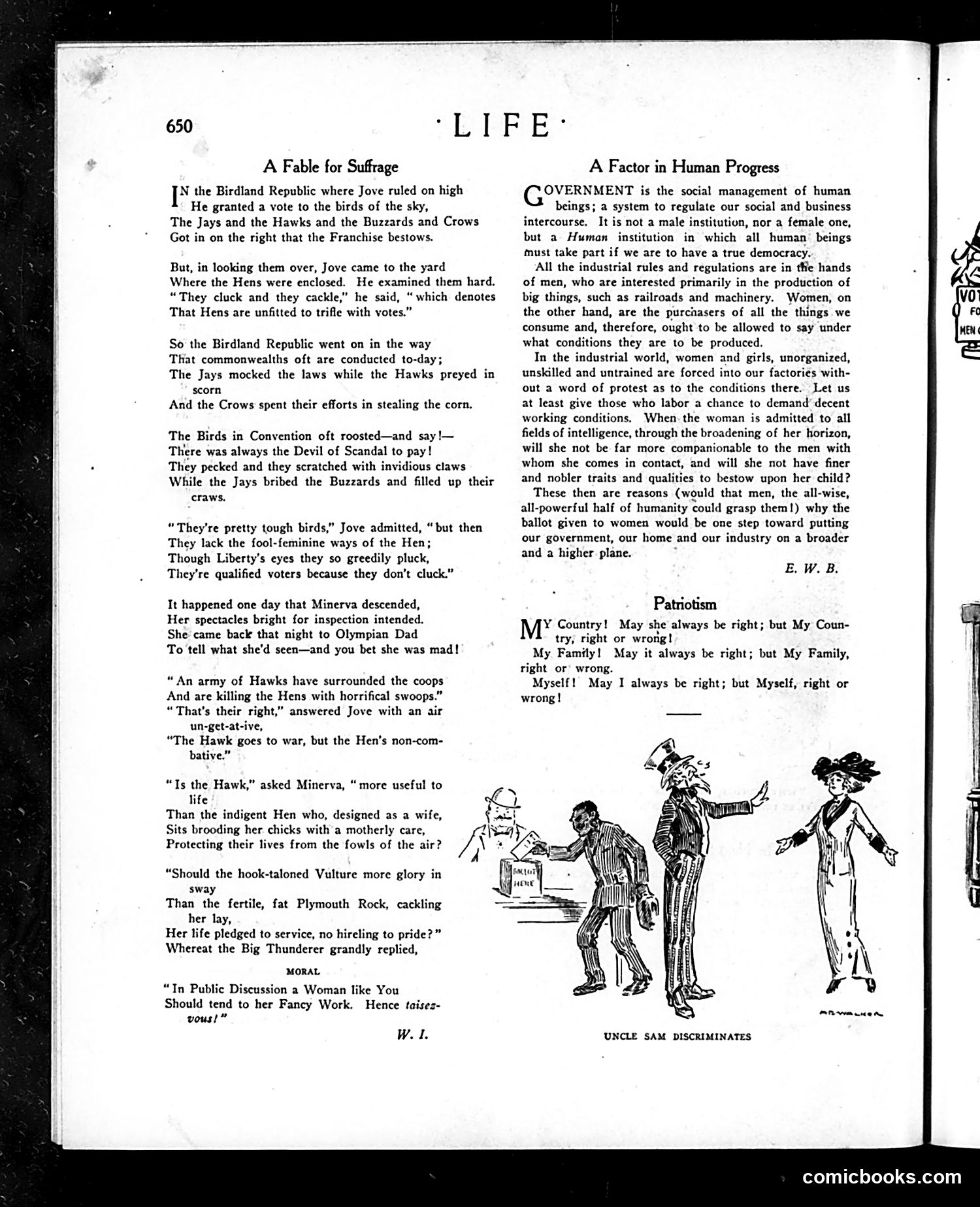
This page contains two distinct pieces: **"A Fable for Suffrage"** (left): A satirical poem using birds as metaphors for voting rights. The story depicts a "Birdland Republic" where only certain birds (Hawks, Jays, Crows, Buzzards) received voting rights while Hens were excluded. When Hens protest their exclusion, they're dismissed as lacking "fool-feminine ways." The fable argues women deserve voting rights, comparing their domestic value to that of other birds and questioning why women shouldn't participate in government. **"Uncle Sam Discriminates"** (right): A cartoon showing Uncle Sam (the American government figure) distributing voting rights unequally. The illustration satirizes how the U.S. government grants voting privileges selectively while denying them to women. Both pieces advocate for women's suffrage, presenting it as a logical democratic issue rather than a radical demand.
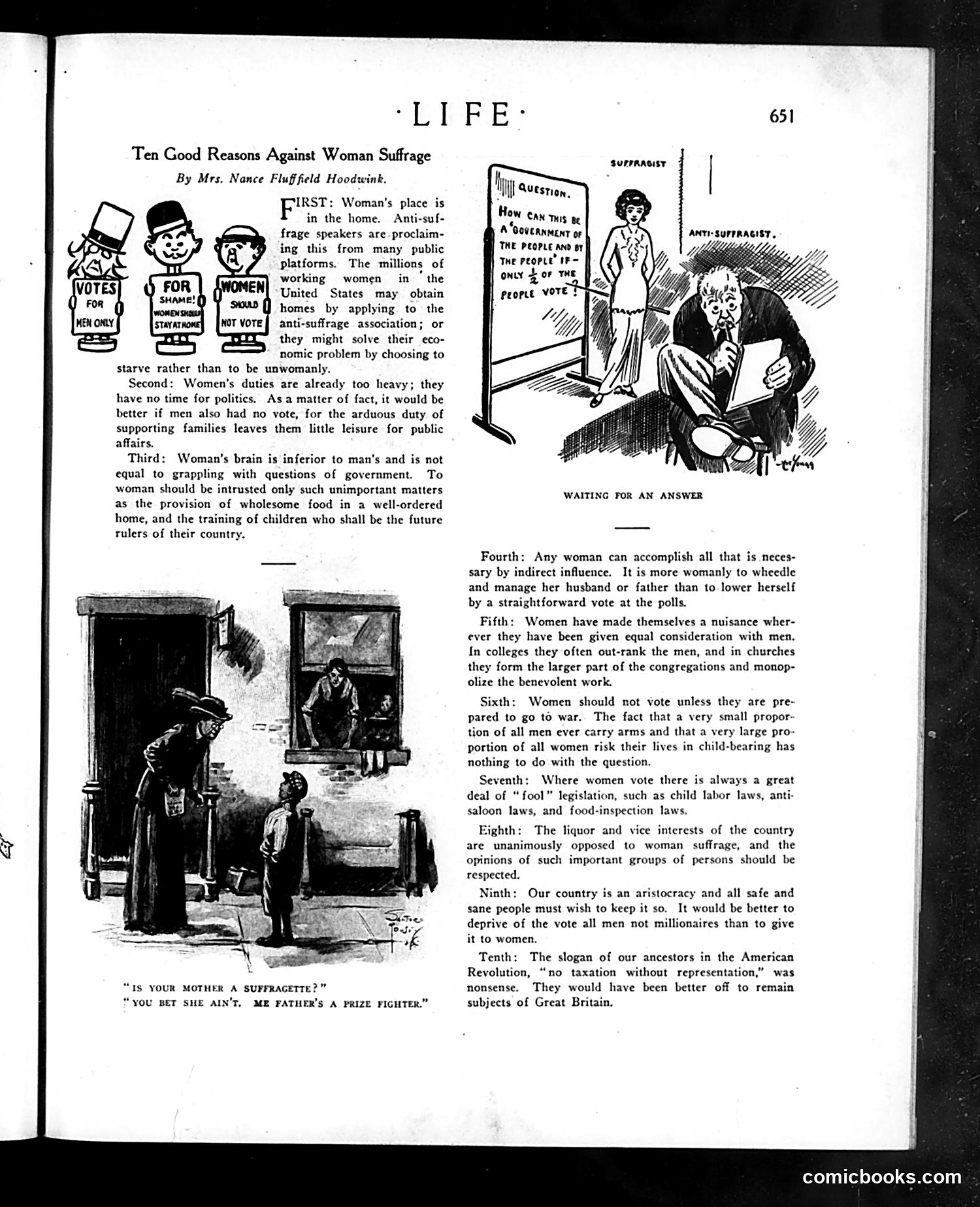
This is satirical anti-suffrage rhetoric presented as if serious argument, authored by the fictional "Mrs. Nance Fluffield Hoodwink"—a transparent parody name mocking anti-suffrage advocates. **The cartoons illustrate the absurdity:** - Top: Three figures labeled "votes for men only," "for women don't vote," and "women" wearing voting boxes, showing the arbitrary restriction - Bottom: A child asks if his mother is a suffragette; father (a "prize fighter") declares she isn't—ironic since the father's physical strength doesn't qualify him politically, yet supposedly disqualifies educated mothers - Right panel: A suffragist poses the logical question about "government of the people" while an anti-suffragist struggles for an answer **The satire targets anti-suffrage arguments** by listing them earnestly—claiming women's brains are inferior, that voting demeans femininity, that child-labor laws are "fool legislation," and absurdly suggesting denying votes to non-millionaire men rather than granting them to women. The author mocks these positions as logically indefensible.
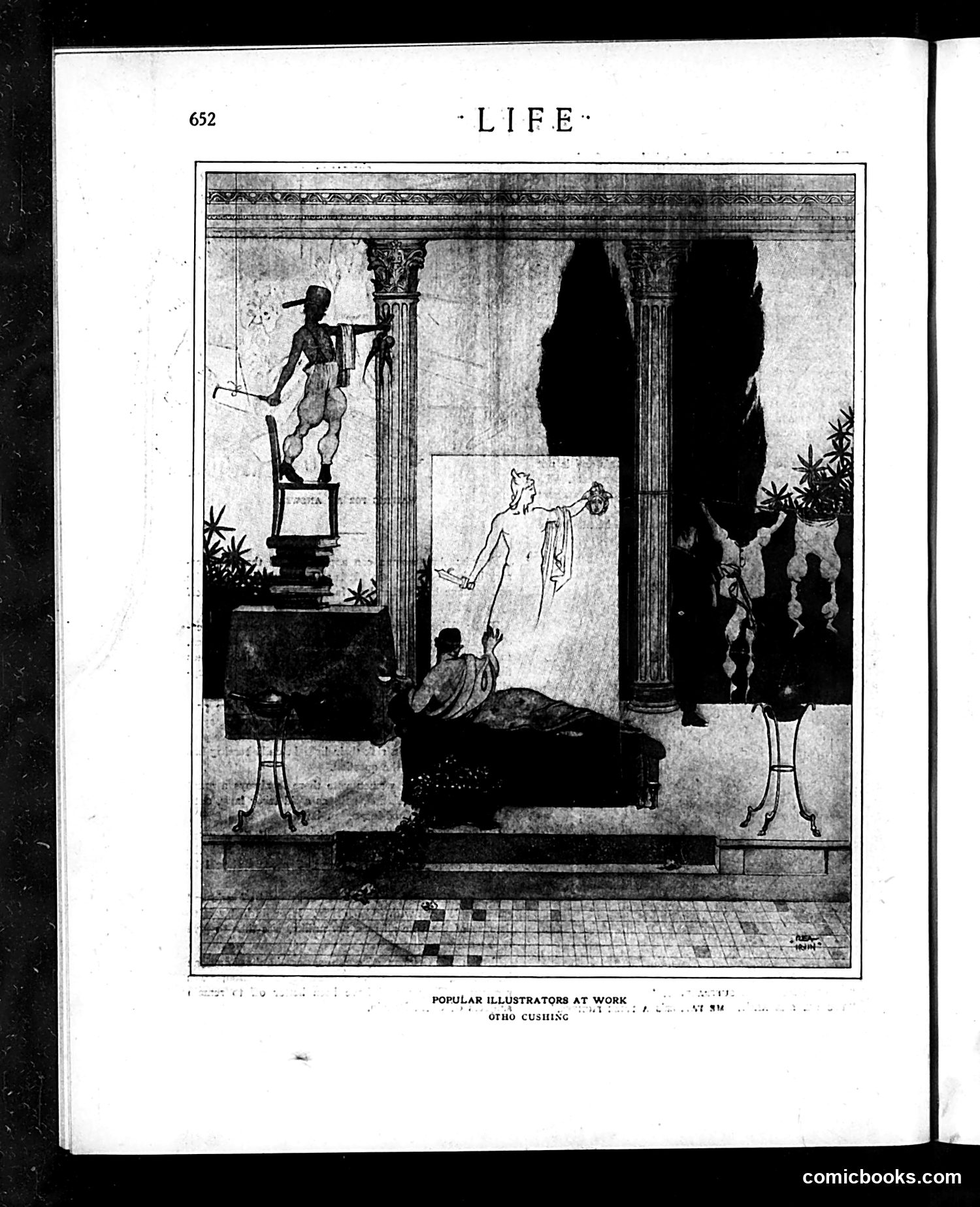
This page from *Life* magazine (page 652) shows an illustration titled "Popular Illustrators at Work" and credits "Otho Cushing" as the artist. The image depicts an artist's studio scene with classical architectural elements—columns, statuary, and draped figures. A figure seated at an easel works on a drawing while nude or semi-nude classical models pose nearby. Sculptural busts and decorative plants complete the studio setting. The satire likely mocks the pretensions of popular illustrators of the era who drew inspiration from classical art and mythology to create commercial artwork. By showing the contrast between the artist's serious classical references and the commercial nature of magazine illustration, Cushing appears to be gently ridiculing illustrators' attempts to elevate their work through association with fine art traditions.
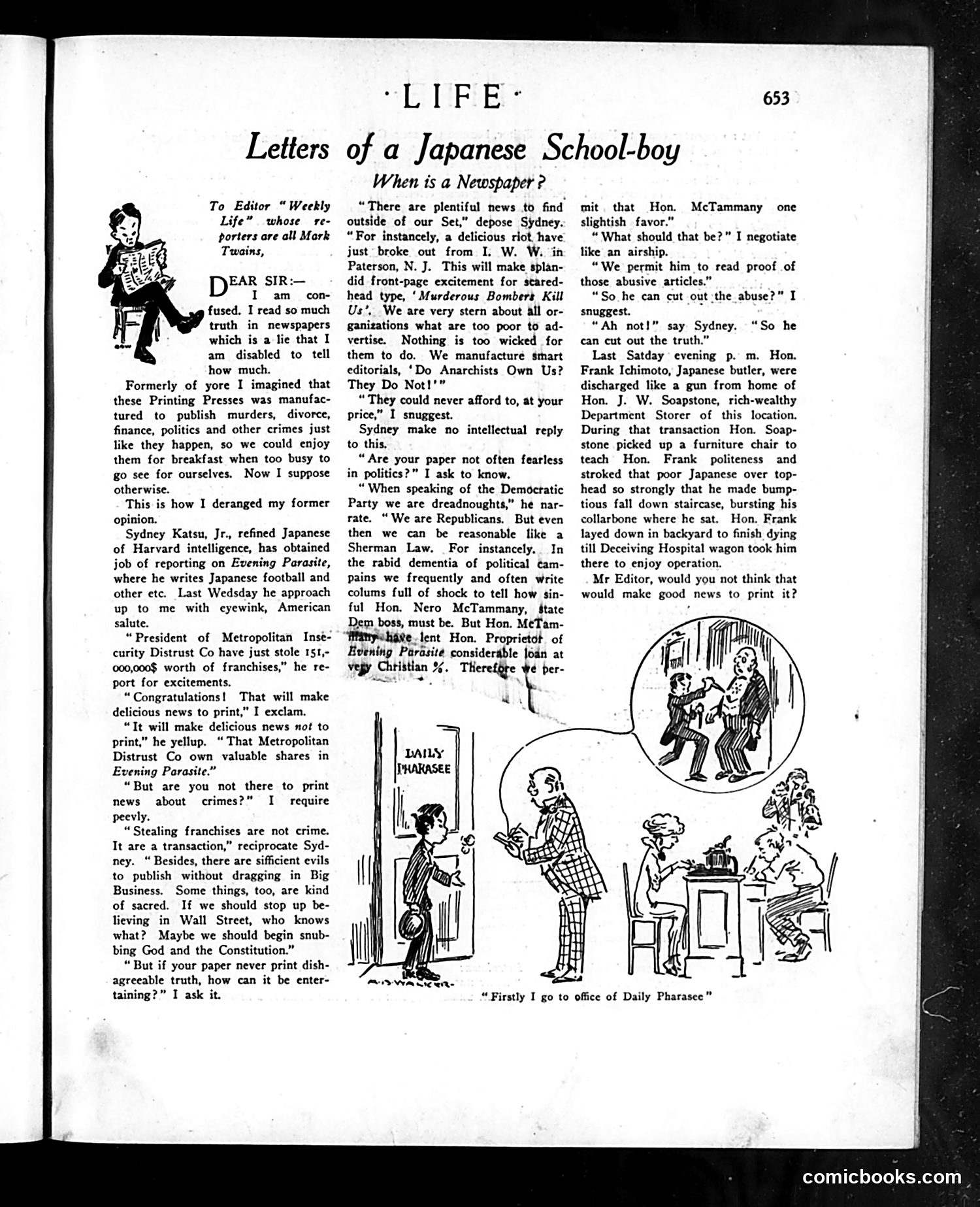
This satirical letter mocks American newspaper corruption and hypocrisy through the voice of a naive observer questioning a Japanese journalist named Sydney Katsu Jr. **The Satire:** The piece exposes how newspapers claim to report truth but actually suppress news that threatens their financial interests. Sydney explains that the "Evening Parasite" (a fictional paper) won't print the Metropolitan Insecurity Distrust Company's stock fraud because that company owns shares in the paper itself. Similarly, the paper fearlessly attacks Democratic politicians—but only because the Republican paper's owner receives loans from Democratic boss "Hon. Nero McTammany," who controls what gets printed. **Key Point:** The final anecdote drives home the hypocrisy: a genuine crime (a wealthy man brutally assaulting his servant) goes unpublished, while sensational but less-important events (like riots) get front-page coverage based on advertising value and political convenience. **The Joke:** By using broken English and the innocent questions of a Japanese schoolboy, the author highlights how absurd—and transparently corrupt—American newspaper practices actually are.
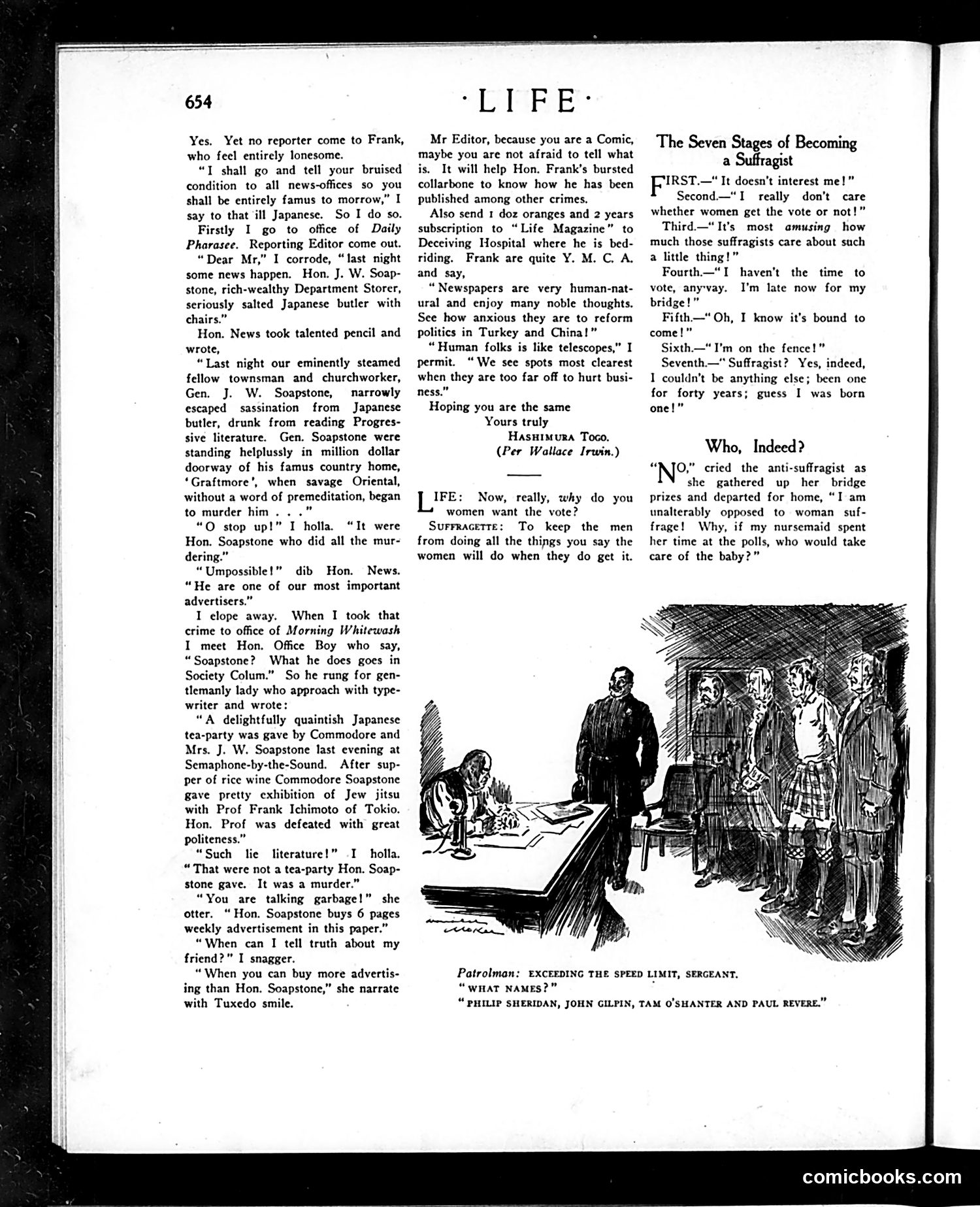
This Life magazine page contains two distinct pieces of satire: **The Main Story** (by Wallace Irwin): A Japanese visitor witnesses wealthy businessman Hon. Soapstone assault a Japanese butler, then attempts to report it to newspapers. Both the *Daily Pharasee* and *Morning Whitewash* (transparent names mocking yellow journalism) refuse to publish the truth because Soapstone is a major advertiser. The satire exposes how newspapers suppress inconvenient facts to protect wealthy clients—a real Progressive Era concern about press corruption and corporate influence. **The Suffrage Cartoons**: Two pieces mock anti-suffrage arguments. "Seven Stages" traces a woman's journey from dismissing suffrage to becoming devoted to it. "Who, Indeed?" ridicules an anti-suffragist's claim that women can't vote because housework prevents it—implying the argument prioritizes convenience over women's rights. The context is pre-1920, during intense suffrage debates, when such satire criticized both media dishonesty and anti-women's-equality positions.
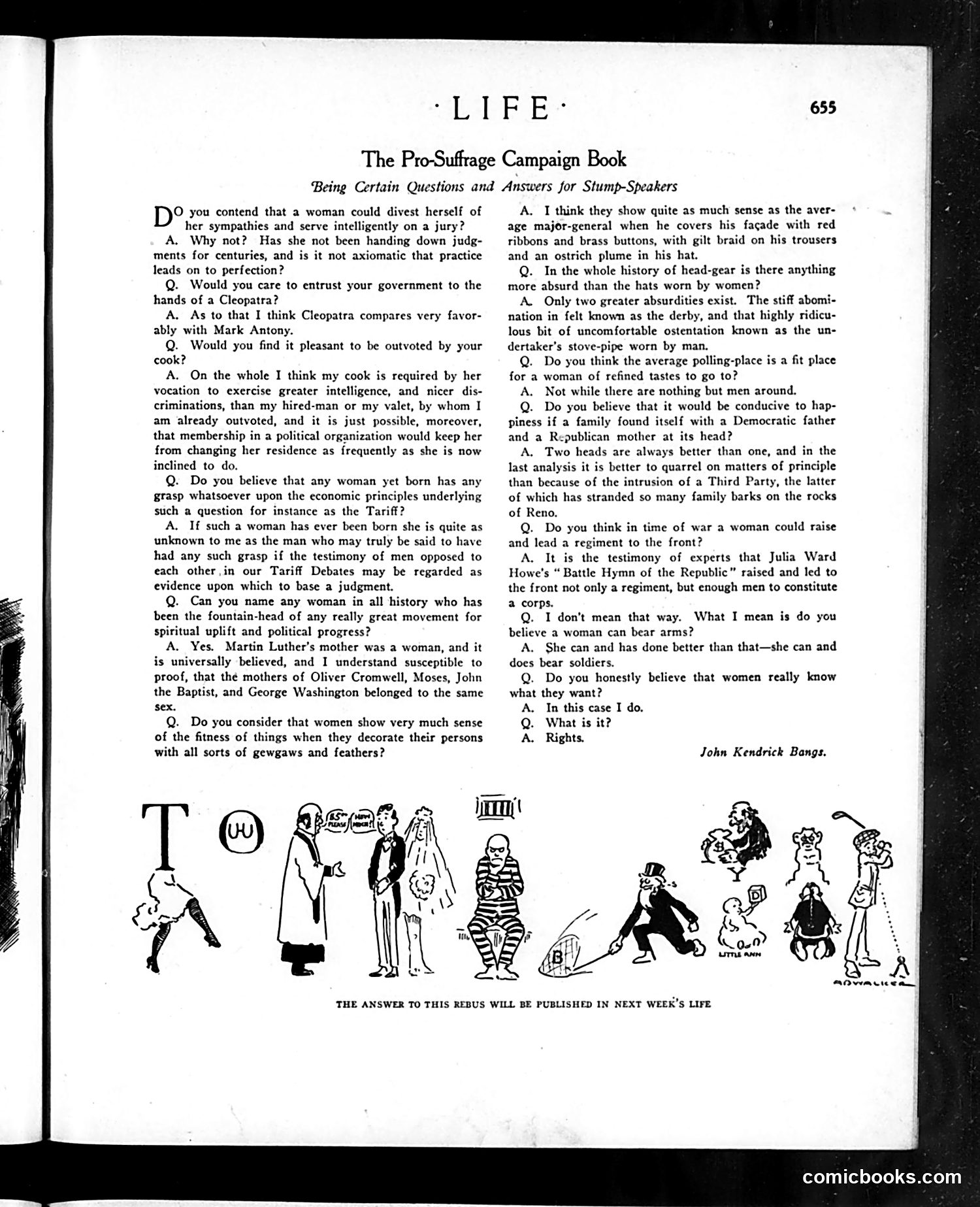
This is a pro-women's suffrage piece by John Kendrick Bangs using satirical Q&A format for stump speakers arguing for voting rights. The answers employ wit to counter common anti-suffrage arguments of the era. Key tactics: - **Turn-the-tables logic**: Women are already capable judges (of household matters for centuries); men wear equally absurd fashions and decorations - **Historical examples**: Martin Luther's mother, Julia Ward Howe—suggesting women have driven great movements - **Reframing concerns**: Worried about women in polling places? The real problem is "nothing but men around" - **Political humor**: Democratic/Republican households are fine—better than Third Party divisions causing divorces ("rocks of Reno") The final comic rebus (partially visible) likely punches the same theme. Overall, this satirizes anti-suffrage objections by suggesting they reveal men's own inconsistencies and limitations rather than women's incapacity. The conclusion—women want "Rights"—states the core demand plainly.
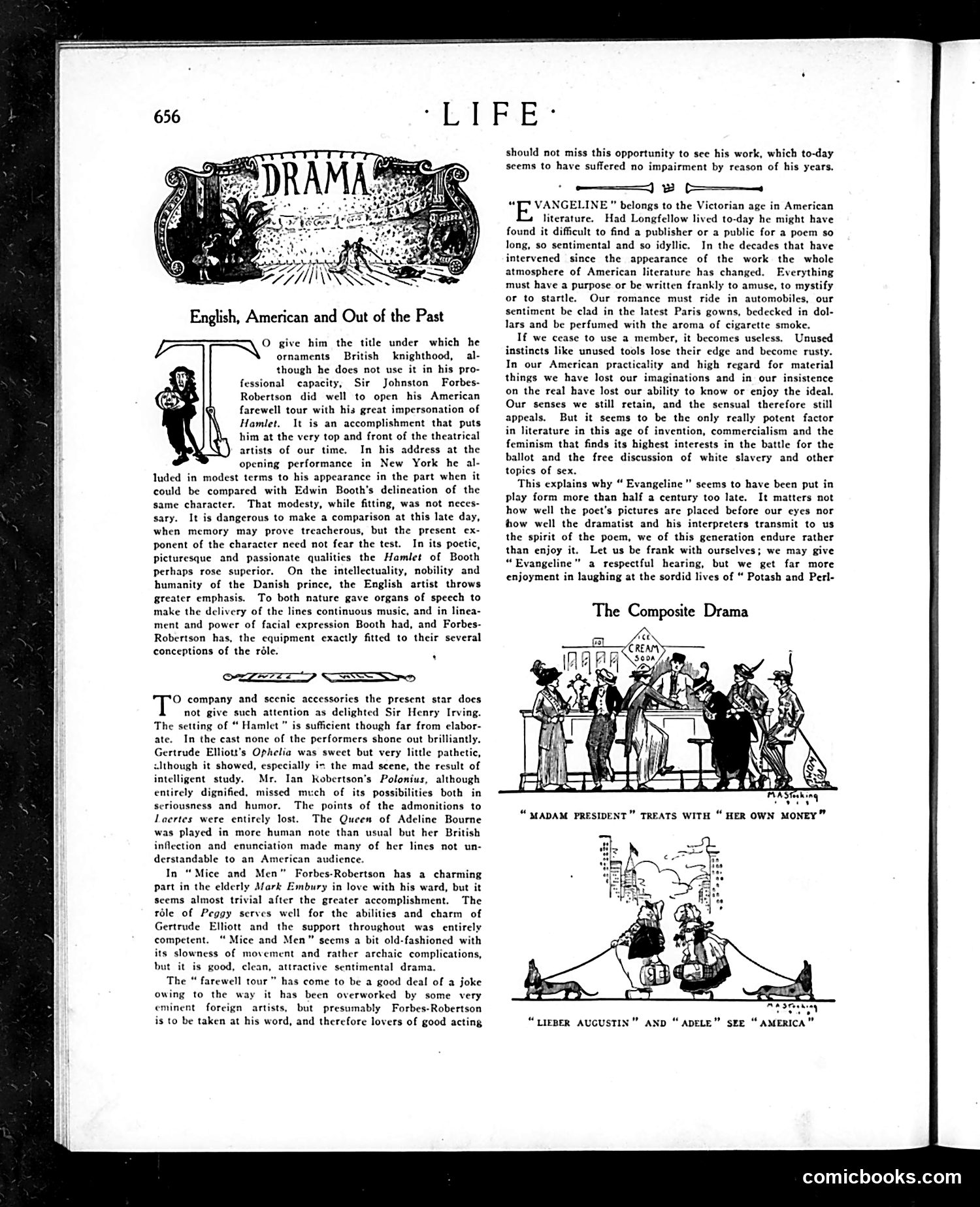
This page reviews British actor Sir Johnston Forbes-Robertson's American farewell tour, focusing on his performances in *Hamlet* and *Mice and Men*. **Main Review:** The text praises Forbes-Robertson's *Hamlet* as superior in "intellectuality, nobility and humanity" compared to Edwin Booth's famous interpretation, though acknowledges Booth's version was more "poetic" and "picturesque." Supporting cast members receive mixed reviews—Gertrude Elliott's Ophelia is noted as sweet but lacking pathos. **"Evangeline" Essay:** A separate piece critiques Longfellow's Victorian poem as unmarketable to modern audiences, who demand purpose, amusement, or shock rather than sentimentality. The author notes American literature's tastes have fundamentally shifted away from romantic idealism. **Cartoons:** Two illustrated sketches titled "The Composite Drama" appear to satirize theatrical conventions, though specific references are unclear from the image alone. The page reflects early 20th-century theatrical criticism and anxieties about changing American cultural values.
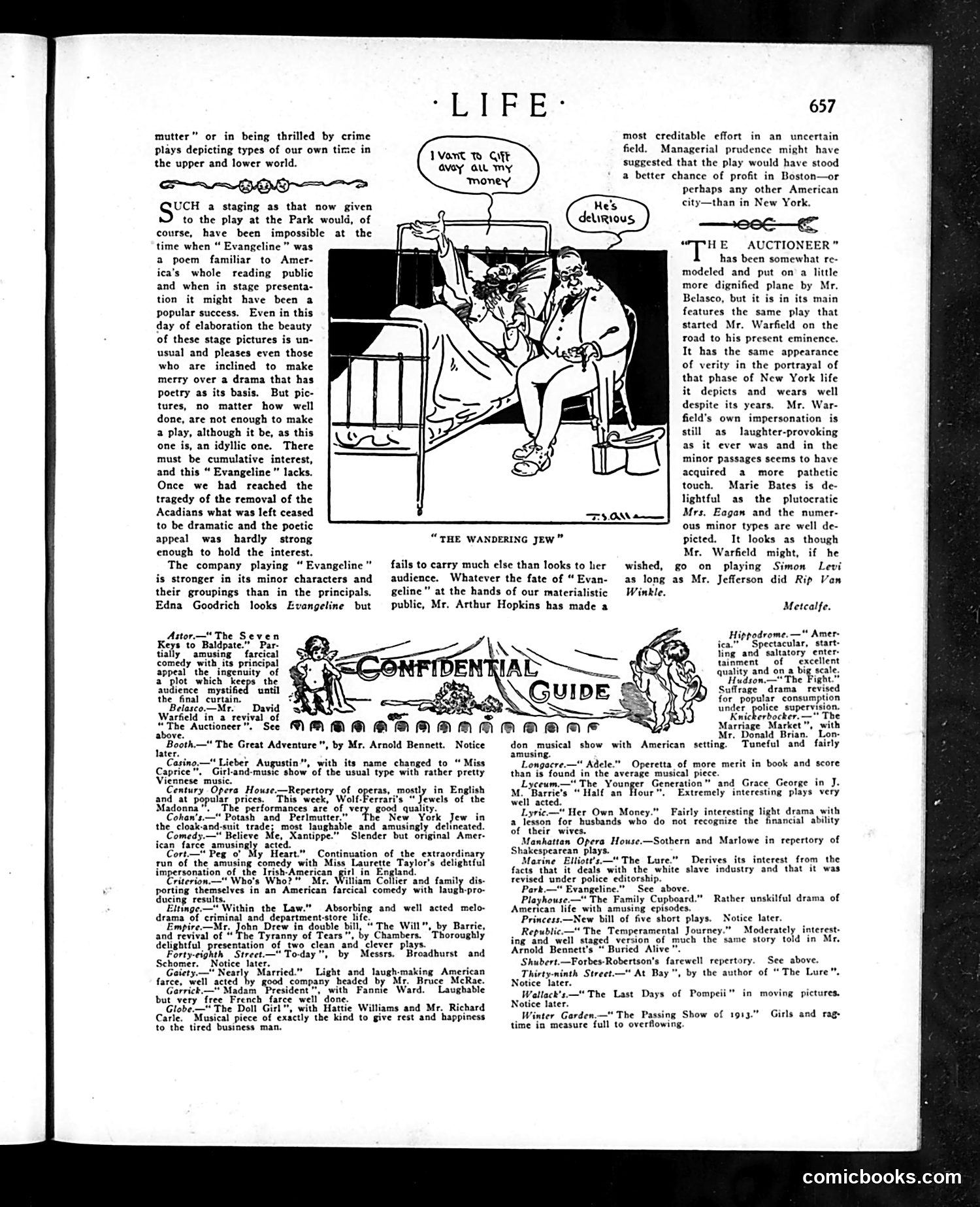
This page reviews theatrical productions on New York stages, featuring two cartoon illustrations by artist "Damn" (signature visible). **"The Wandering Jew" cartoon** (top): Shows a woman in a bed surrounded by men, with one saying "I want to cut away all my money" and another responding "He's delicious." The caption notes the play "fails to carry much else than looks to her audience"—satirizing a theatrical production that relies on visual spectacle and attractive performers rather than substantive drama. **"Confidential Guide" section** (center): A decorative banner introducing capsule reviews of current Broadway shows, with small cartoon figures suggesting theatrical entertainment. The reviews discuss productions like "Evangeline," "The Auctioneer," and various comedies and operas, evaluating their merits and appeal to audiences. The overall tone suggests Life magazine's role as cultural arbiter, mocking both pretentious dramatic productions and lightweight entertainment while acknowledging audience tastes of the era.
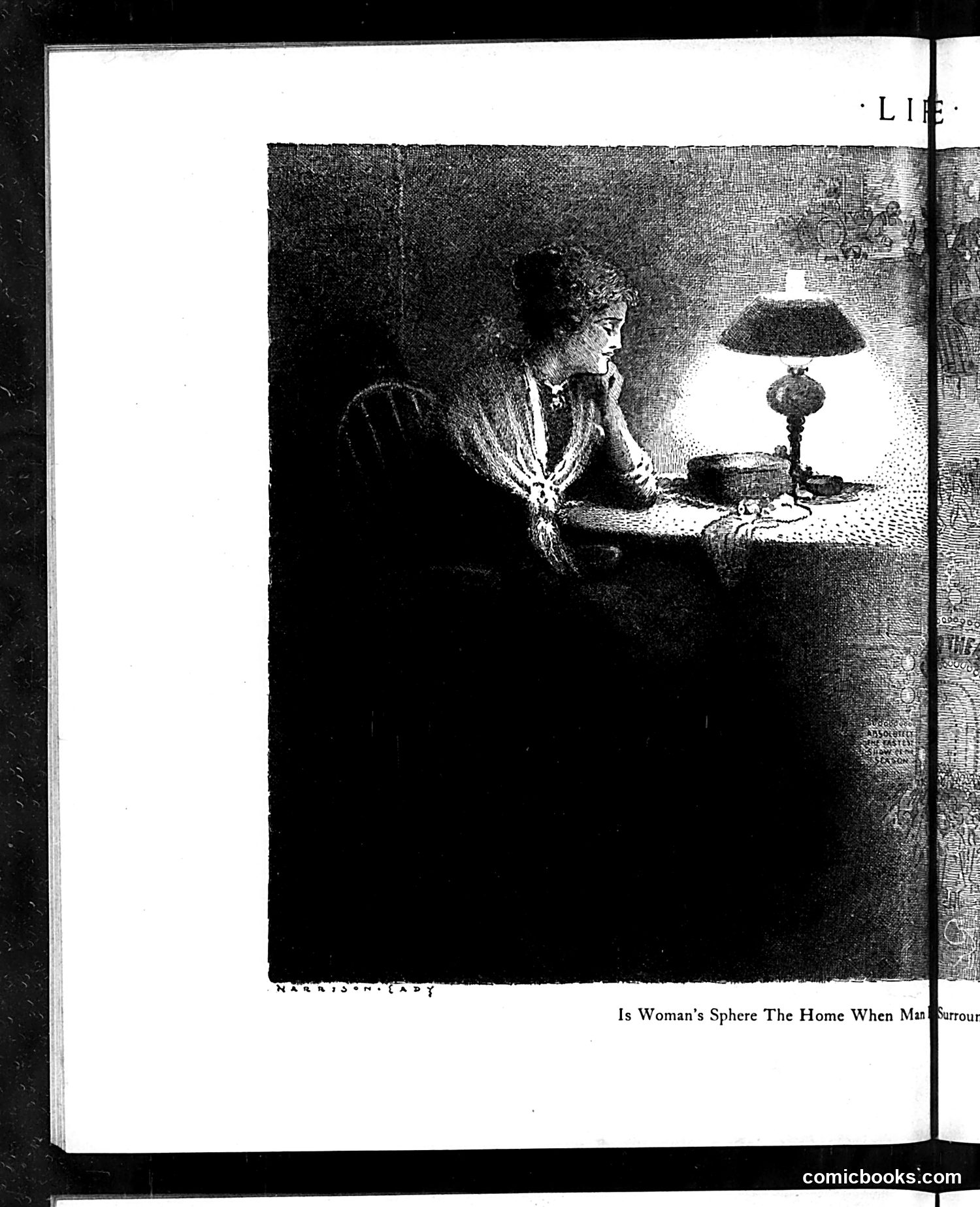
This page features an illustration showing a woman seated alone at a desk or table under a lamp, appearing pensive or troubled. The caption asks: "Is Woman's Sphere The Home When Man [text cut off]" The cartoon satirizes Victorian-era debates about women's proper role in society. The solitary, contemplative figure—dressed formally and isolated indoors—ironically visualizes the "separate spheres" ideology that confined women to domestic life. The incomplete caption suggests the question of whether home remains woman's sphere when circumstances (a man's situation, likely unemployment or absence) change. This reflects early 20th-century social discussions about female independence and whether traditional gender roles could adapt to economic or social necessity. The satire lies in depicting the confining nature of restricting women's sphere solely to the home.
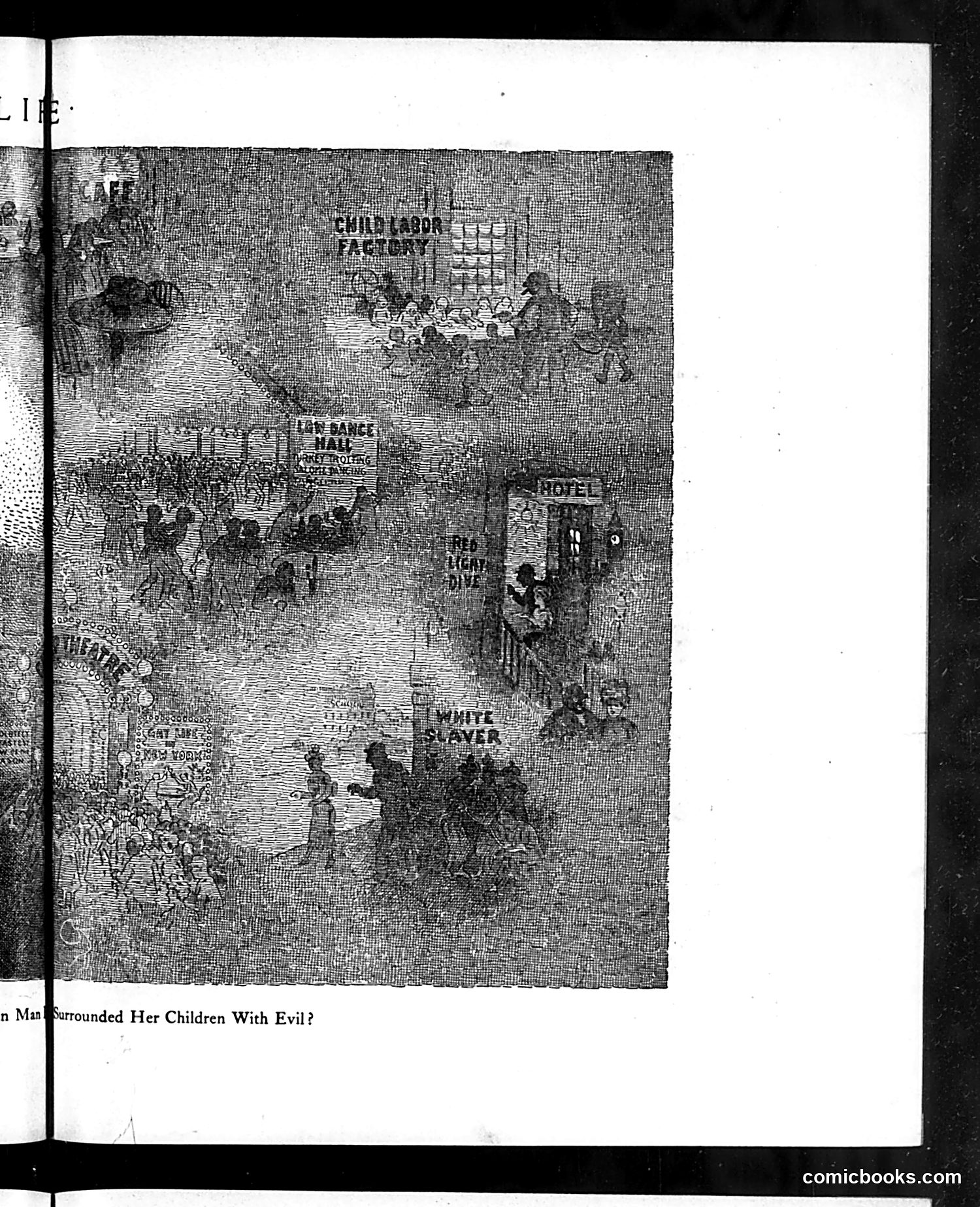
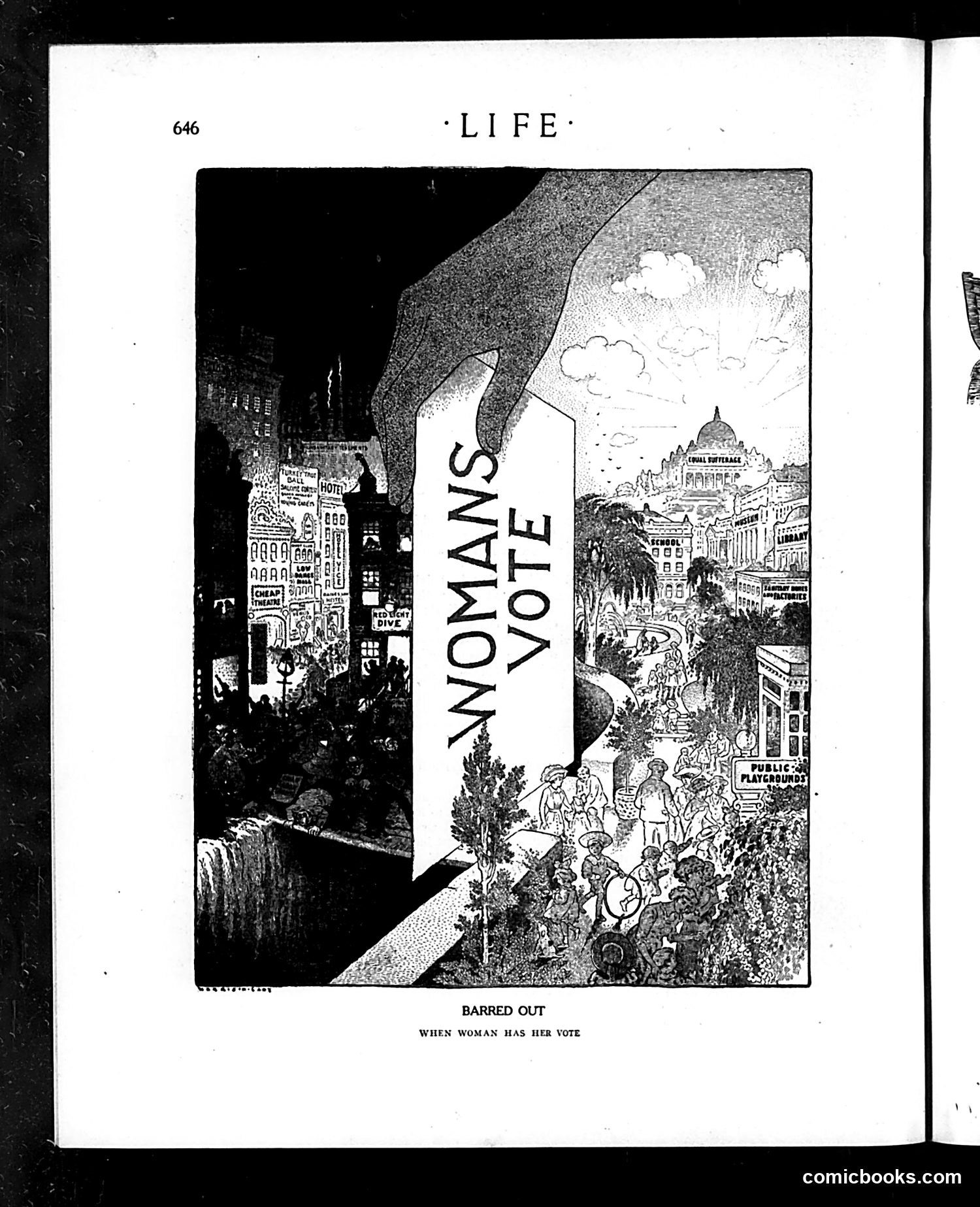
This page appears to be from Life magazine and contains a satirical engraving or illustration depicting an urban street scene. Visible text includes signs for "Child Labor Factory," "Inn Dance," "Hotel," "Red Light," and "White Slaver" — all markers of urban vice and exploitation. The caption at bottom reads: "Surrounded Her Children With Evil?" The satire appears to critique how poverty, vice industries, and moral dangers surround vulnerable populations in cities. The crowded street scene shows various establishments associated with exploitation and moral corruption juxtaposed together, likely commenting on how poor families — particularly children — become trapped in environments rife with child labor, prostitution, and trafficking. This reflects Progressive Era concerns about urban social problems and exploitation of the vulnerable.
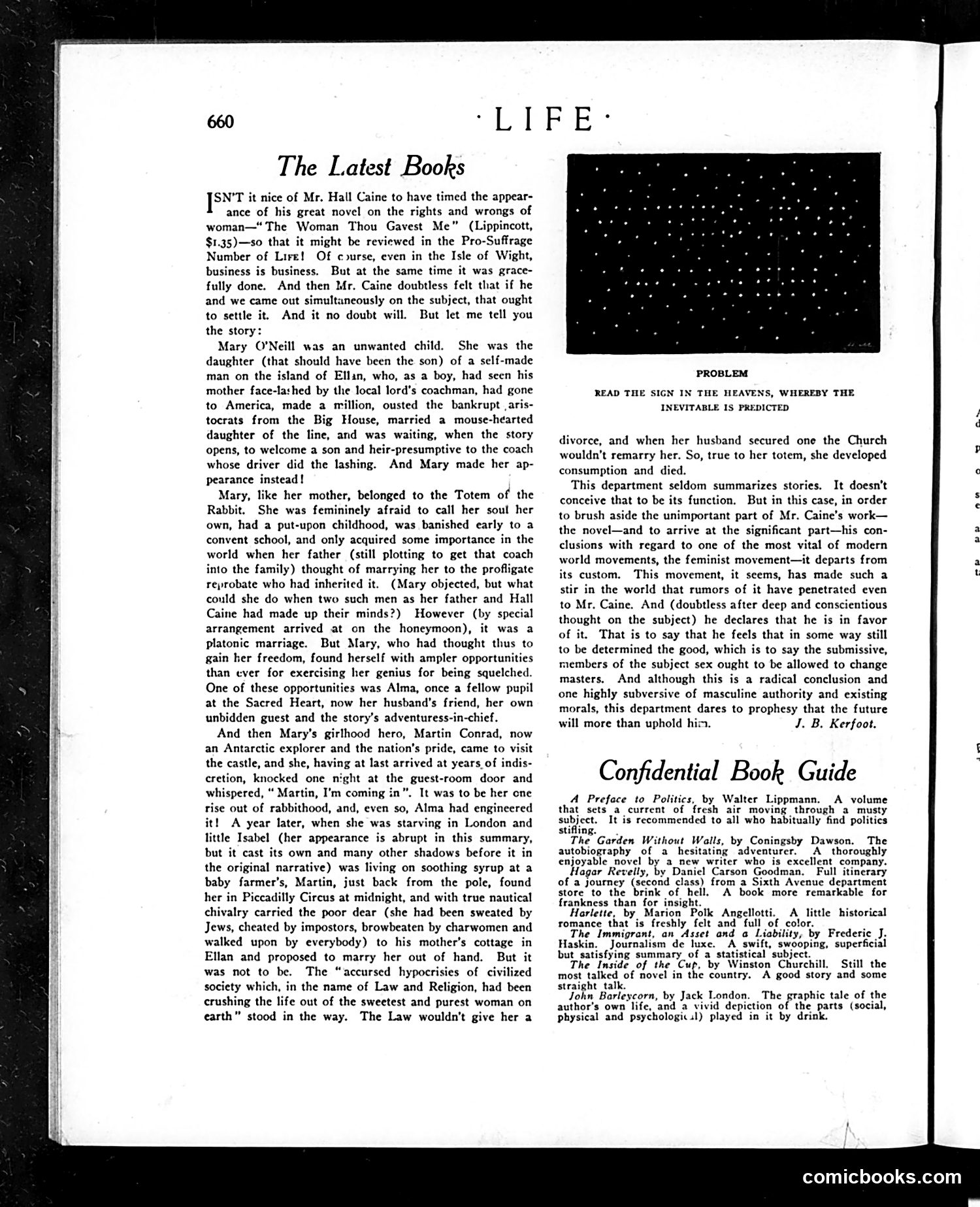
This page satirizes Hall Caine's novel "The Woman Thou Gavest Me," published strategically in Life's Pro-Suffrage issue. The unnamed reviewer mocks both the book's melodramatic plot and Caine's apparent opportunism in timing its release. The satire targets the novel's treatment of women's limited agency. The protagonist Mary—described through animal metaphors as rabbit-like and submissive—suffers throughout: forced into a loveless marriage, denied divorce, prevented from remarrying by Church law, and ultimately dying of consumption. The reviewer's sardonic tone—particularly the opening—suggests this coincidental publication timing allows Caine to pose as progressive on women's issues while his actual narrative demonstrates how "civilized society" and religious institutions crush women's autonomy. The joke is the disconnect between the novel's apparent stance and its depiction of female powerlessness. The black rectangular "Problem" box appears to be a visual puzzle or advertisement unrelated to the text.
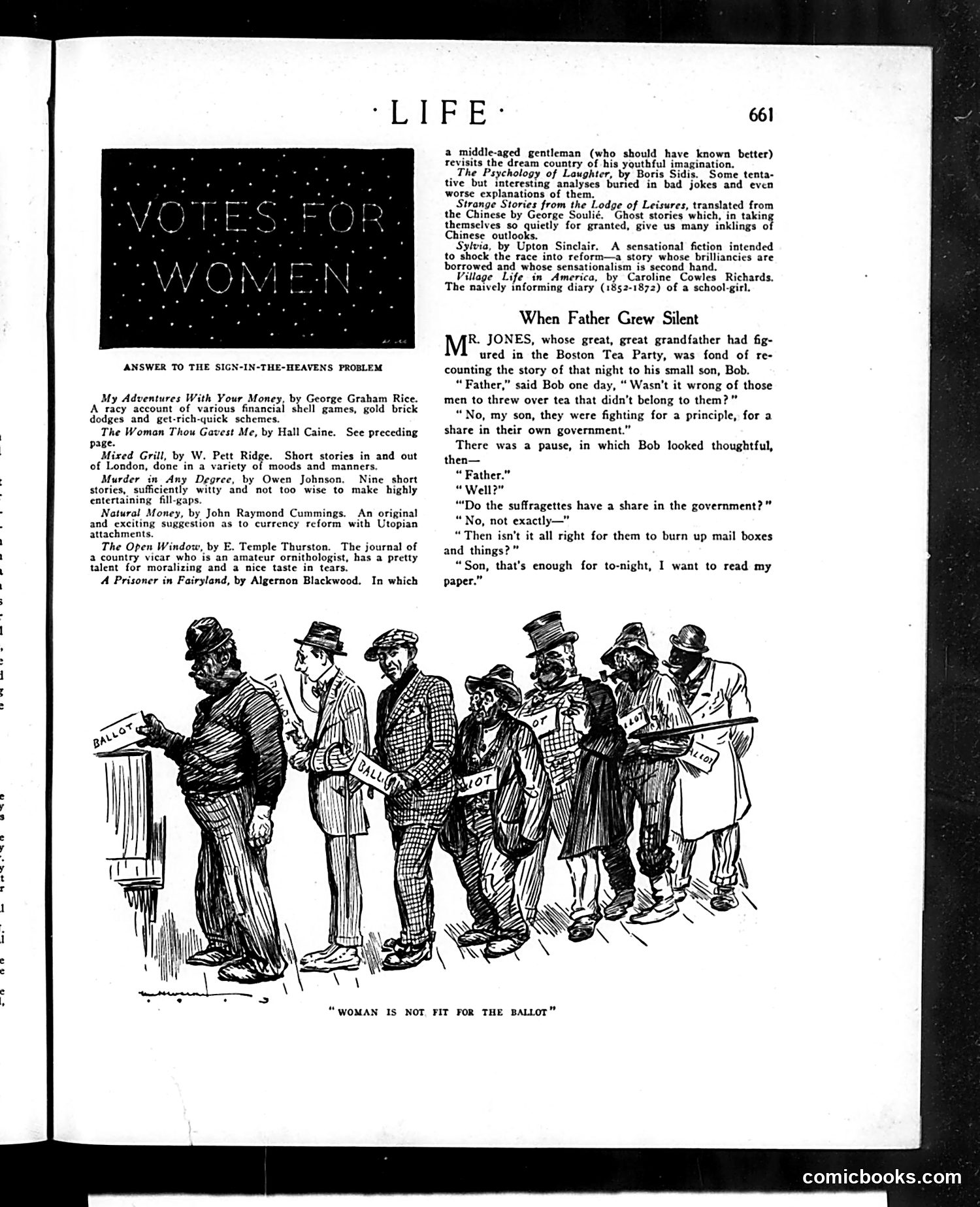
This page satirizes opposition to women's suffrage through a multi-layered approach. The main cartoon depicts men at a ballot box with the caption "Woman is Not Fit for the Ballot," while the accompanying story "When Father Grew Silent" undermines this argument through irony. In the story, Mr. Jones lectures his son Bob about the Boston Tea Party—men justifiably destroying property to fight for political representation. When Bob innocently applies the same logic to suffragettes burning mailboxes to demand voting rights, his father cannot logically object without exposing the hypocrisy of his anti-suffrage position. The father's retreat ("that's enough for to-night") represents the satire's point: opponents of women's suffrage lack rational justification. The page mocks the double standard: men's violent political protest is patriotic principle; women's equivalent action is condemned. This reflects the women's suffrage debate active in early 20th-century America.
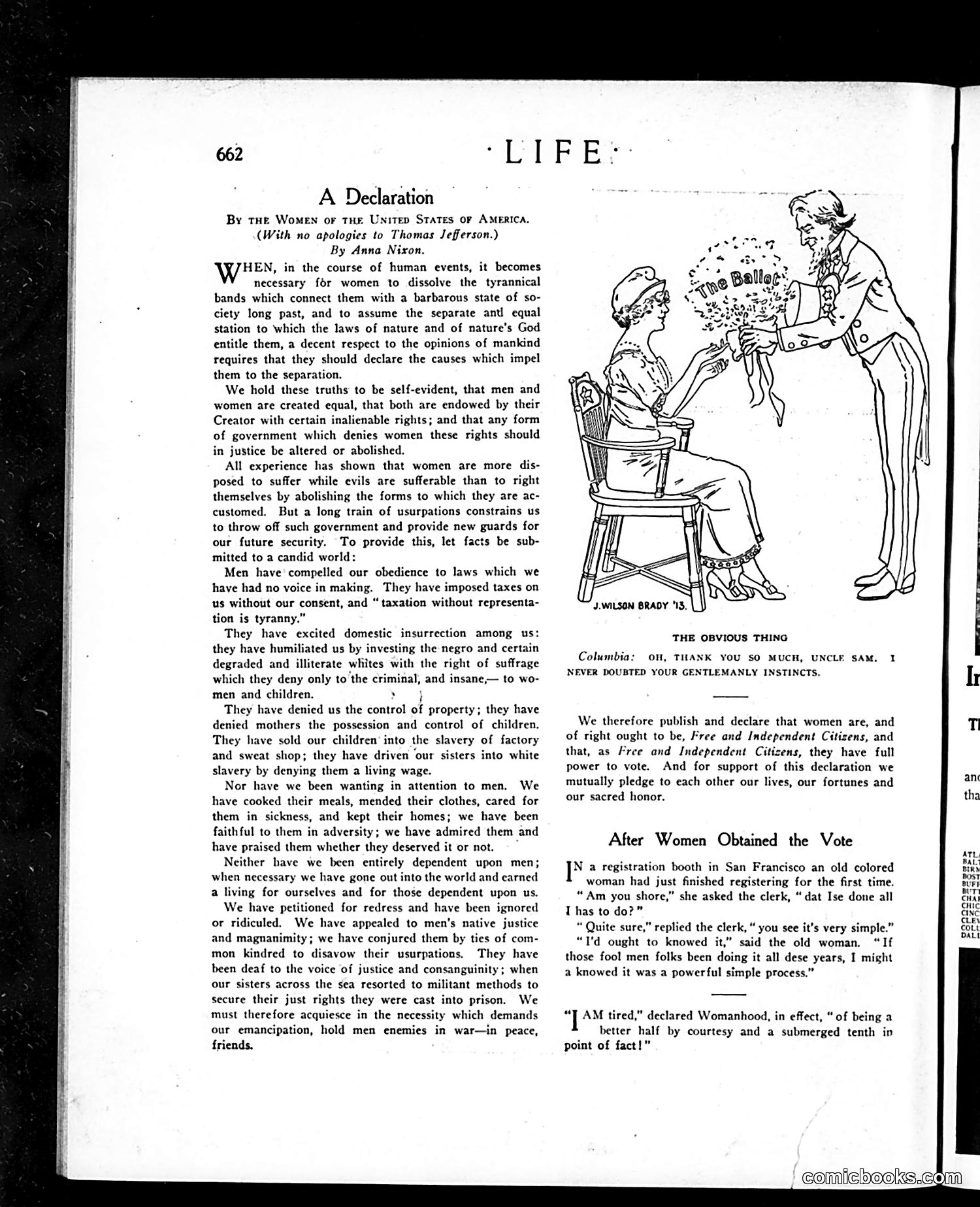
This page satirizes the women's suffrage movement through parody and irony. **Main Text:** Anna Nixon's "A Declaration" mimics the Declaration of Independence, listing grievances against male tyranny—taxation without representation, denial of property rights, exploitation in factories and "white slavery." The satire lies in applying revolutionary language to women's political exclusion, treating suffrage as an independence struggle equivalent to the American Revolution. **Cartoon "The Obvious Thing":** Shows Columbia (representing America) thanking "Uncle Sam" for granting women voting rights. The caption's irony suggests women should be grateful for what is portrayed as male generosity, mocking the notion that basic rights are gifts rather than justice. **"After Women Obtained the Vote":** A brief anecdote about an elderly Black woman registering to vote in San Francisco, noting the simplicity of the process. This appears to acknowledge that women (and some Black citizens) have gained voting access, though the historical context suggests this is likely mocking rather than celebrating, given Life magazine's complex relationship with progressive reform. The page's overall tone blends feminist argument with satirical commentary on American democratic hypocrisy.
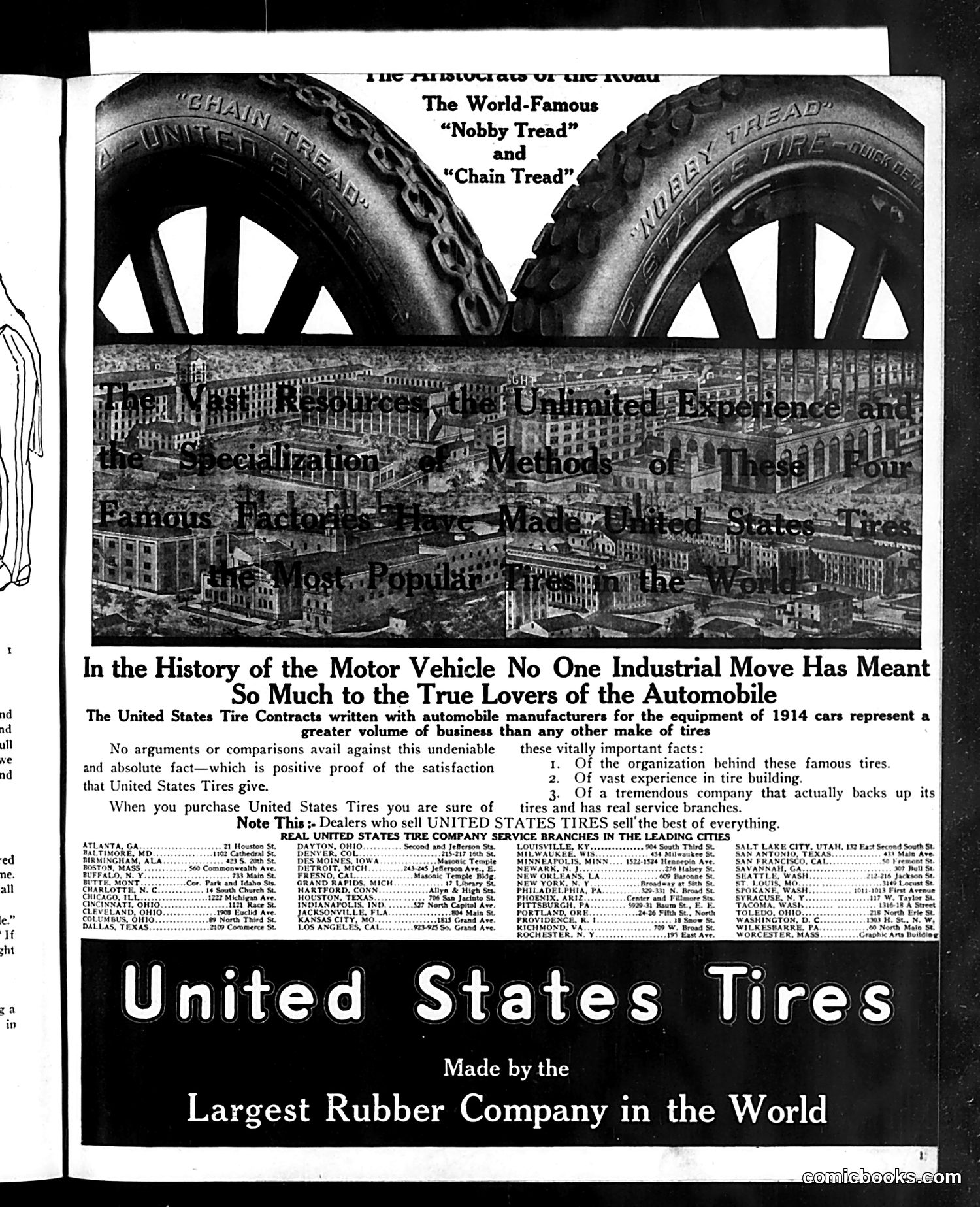
This is a **full-page advertisement**, not satire. United States Tires is promoting their "Nobby Tread" and "Chain Tread" products to modern automobile owners in 1914. The image shows two tires framing a cityscape, emphasizing industrial scale and progress. The ad's core claim: United States Tires secured the largest contract to equip 1914 automobiles, proving their superiority through market dominance rather than argument. Key selling points listed are the company's organizational strength, tire-building experience, and service branches across America—reassuring buyers they're investing in a backed, established product. The note to dealers ("sell the best of everything") positions the brand as premium. This reflects early automotive culture when tire choice significantly affected driving reliability, and when manufacturers' endorsements carried real weight as proof of quality.
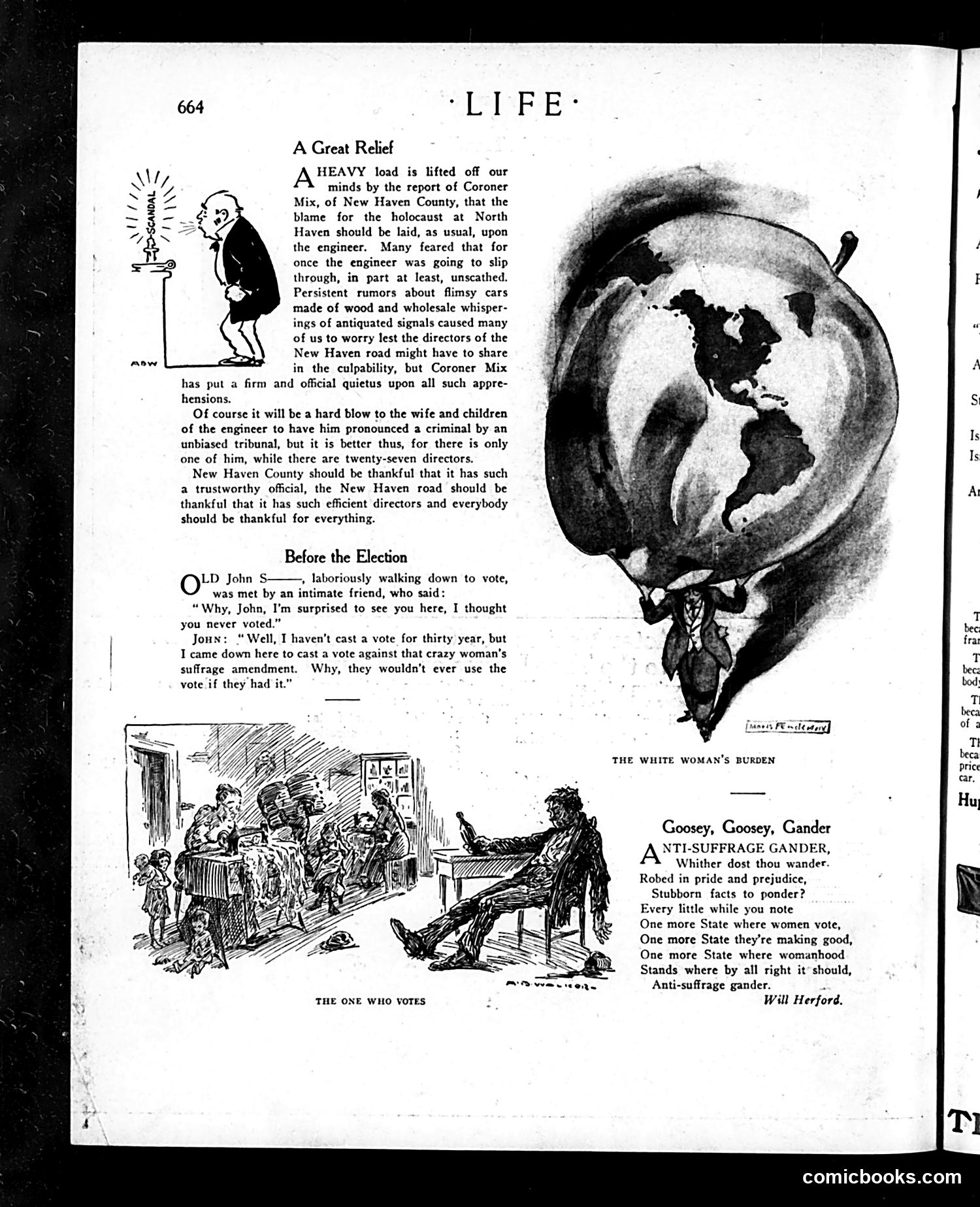
This page mocks opponents of women's suffrage through three pieces: **"A Great Relief"** sarcastically praises Coroner Mix for blaming a North Haven railroad disaster solely on the engineer rather than the railroad's directors—suggesting it's convenient to blame one powerless worker rather than investigate systemic failures (flimsy cars, outdated signals, corporate negligence). **"Before the Election"** depicts an elderly man voting against women's suffrage for the first time in thirty years, claiming women "wouldn't ever use the vote if they had it"—absurdly suggesting women wouldn't exercise rights they've been denied. **"Goosey, Goosey, Gander"** (by Will Herford) is a versified attack on anti-suffrage activists, mocking their "pride and prejudice" while noting states progressively granting women voting rights. The poem suggests opposition to suffrage is obstinate denial of women's rightful place. The large illustration captioned "THE WHITE WOMAN'S BURDEN" appears to show the weight of responsibility, likely satirizing anti-suffrage arguments about women's limited capacity. The magazine clearly supports women's voting rights.
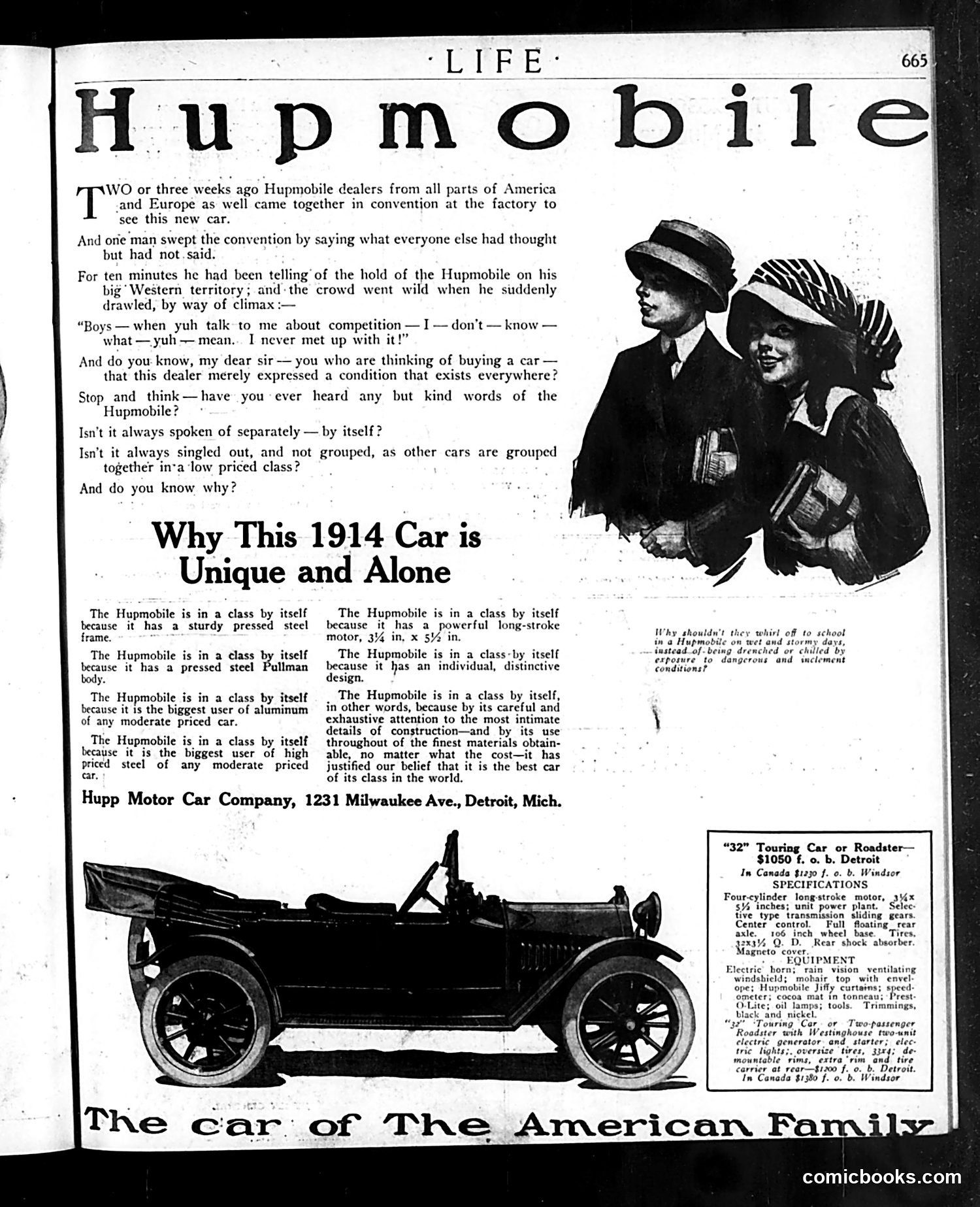
This is primarily a **car advertisement**, not a political cartoon. It promotes the 1914 Hupmobile as a superior automobile through testimonial-style marketing. The page opens with a narrative: a Hupmobile dealer at a convention claims he's never encountered competition for the car—a boast meant to impress potential buyers. The advertisement then rhetorically asks readers if they've ever heard anything but "kind words" about the Hupmobile, implying universal praise. The bulk of the page lists reasons why the Hupmobile stands "alone"—superior materials, distinctive design, powerful engine. The illustration shows a family (two adults and a child) in the vehicle, emphasizing its appeal as "the car of the American Family." The small photograph of a girl being driven to school in rainy weather suggests safety and reliability. This is standard early-automotive advertising: establishing brand superiority through claimed uniqueness and family-centered messaging. There is no satirical content visible; it's straightforward promotional material.
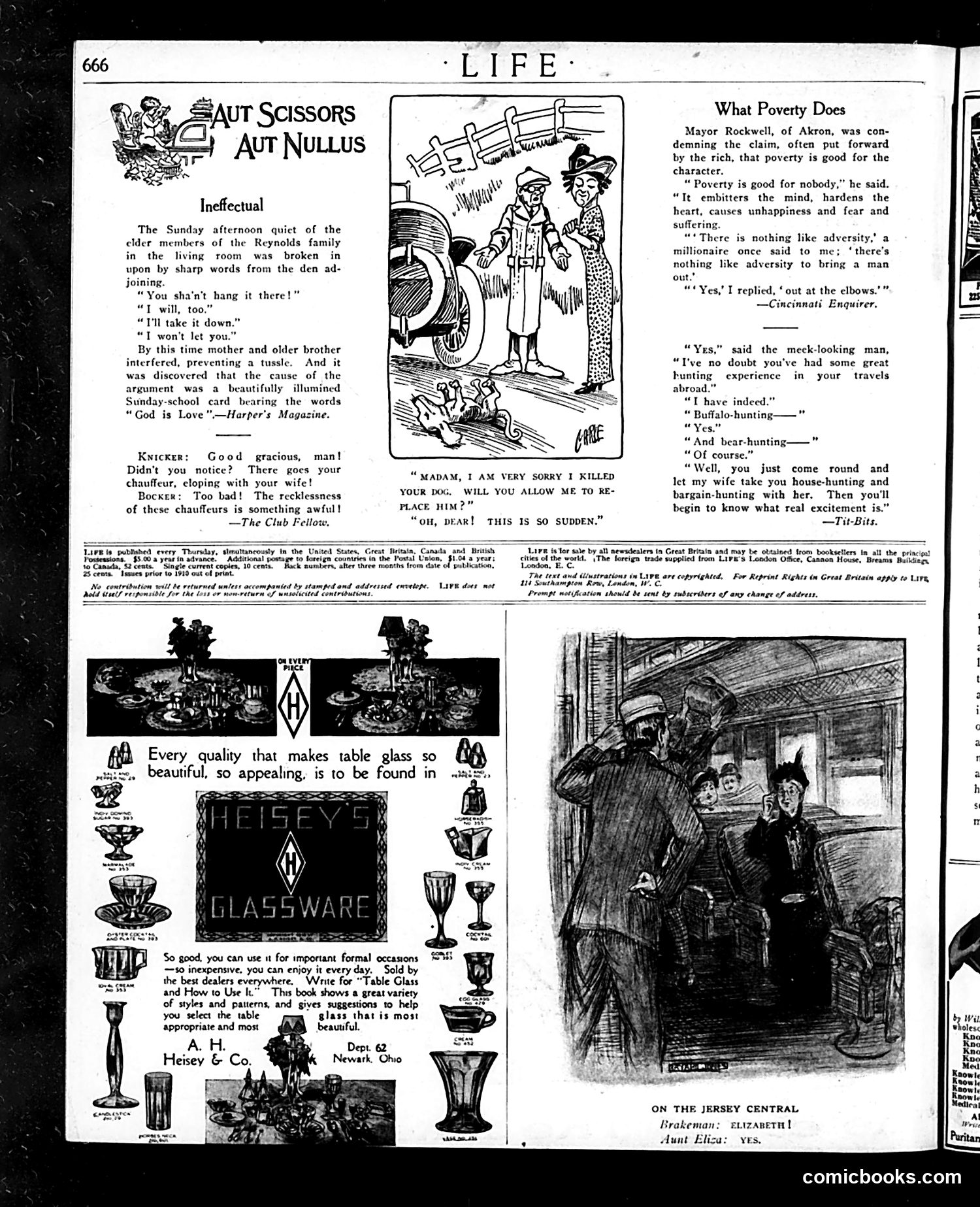
This page contains several satirical pieces typical of early 20th-century American humor: **"Aut Scissors Aut Nullus" (top):** A domestic quarrel over hanging a Sunday School card reading "God is Love" escalates absurdly between family members. The satire mocks pointless household disputes and religious sentimentality. **"What Poverty Does":** Mayor Rockwell of Akron argues poverty harms character, countering the wealthy's claim it builds virtue. The anecdotes that follow satirize rich people's self-serving rationalizations—one millionaire claims adversity ennobles, prompting the reply "out at the elbows" (broke). Another wealthy man's hunting boasts are deflated when his wife offers to take the guest "house-hunting and bargain-hunting"—implying his boasted adventures are less impressive than domestic economy. **"Knicker/Bockex dialogue:** A chauffeur eloping with someone's wife is dismissed as merely the "recklessness" typical of servants. The page is primarily advertising (Heisey Glassware dominates the lower half). One illustration shows a train scene labeled "On the Jersey Central."
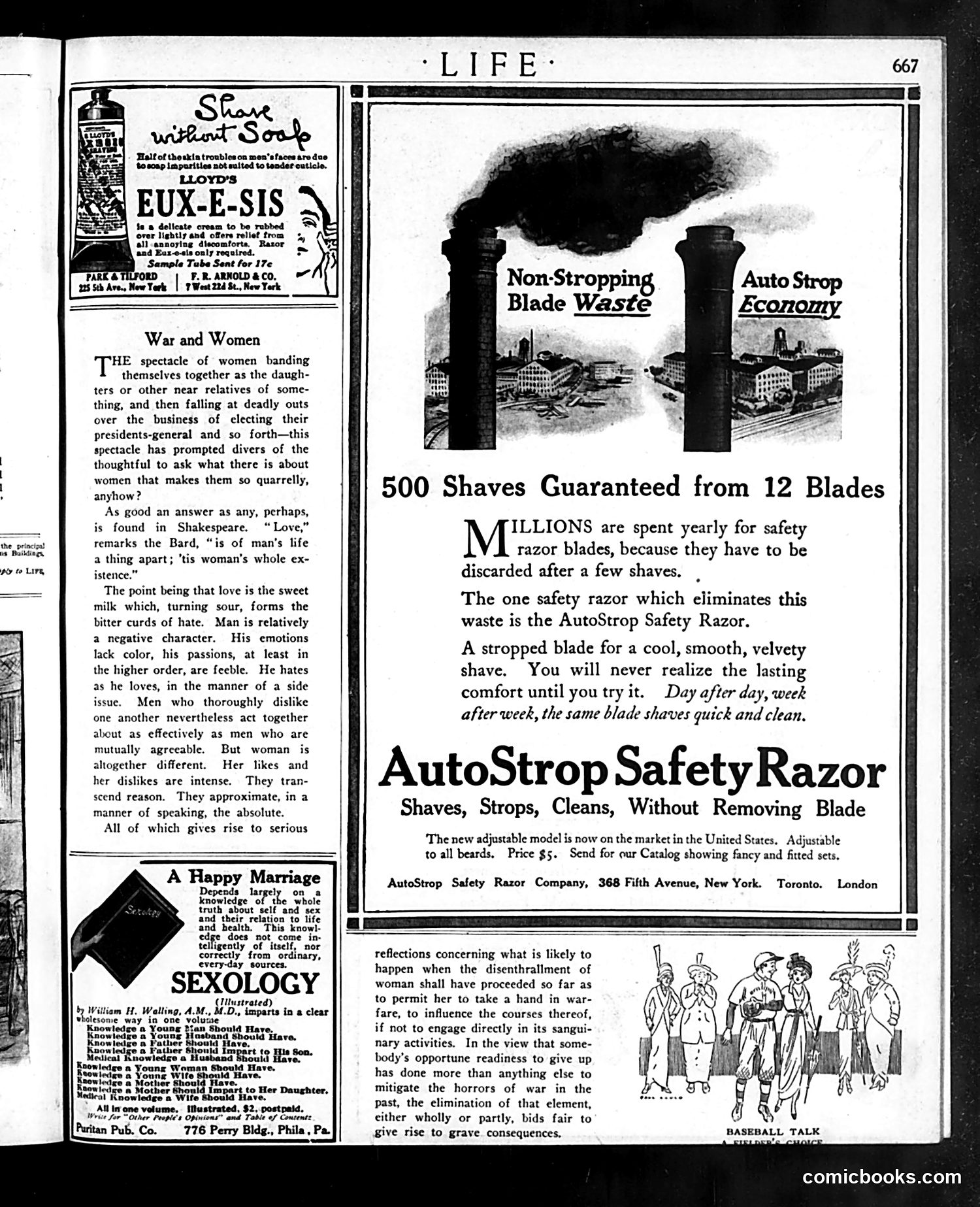
This page mixes advertisements with editorial content about gender and war. The main article, "War and Women," uses Shakespeare to explain why women are quarrelsome: unlike men (emotionally "feeble"), women experience love and hate intensely as "her whole existence." The piece then pivots to darker implications—speculating that women's historical role in *mitigating* war's horrors through their reluctance to support it may disappear if they gain political power and direct military involvement. The author warns this could lead to "grave consequences." The advertisements—for razors, cosmetics, and a "Sexology" book—reflect the page's underlying assumptions about gender roles and appearance. The "Baseball Talk" cartoon at bottom appears unrelated to the main content. The satire is subtle: the article frames women's peacefulness as emotional intensity rather than moral superiority, while expressing anxiety about female political empowerment during (likely) the WWI era.
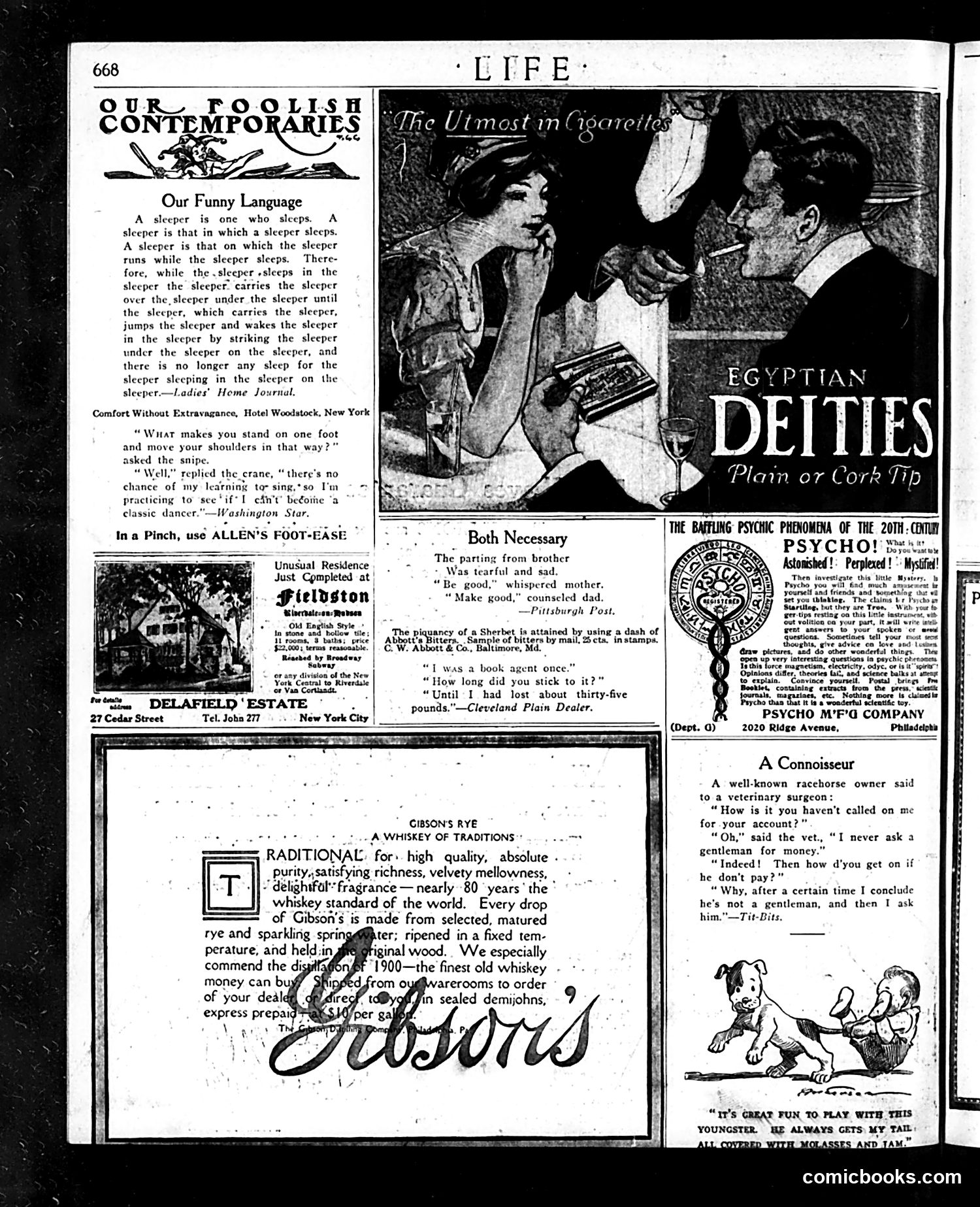
This page mixes humor columns with period advertisements. The main satirical content includes: **"Our Funny Language"** uses recursive wordplay about "sleepers" (train cars and people who sleep in them), deliberately confusing the same word's multiple meanings until the sentence becomes nonsensical. The joke targets the absurdity of English homonyms. **Miscellaneous jokes** scattered throughout mock contemporary figures: a crane practicing to become a "classic dancer," a book agent who lost thirty-five pounds (implying failure), and a veterinarian who stops treating deadbeat clients by concluding they're not gentlemen. **The cartoon** (lower right) shows a child playing roughly with a dog, captioned about getting the dog's tail covered in molasses and jam—slapstick humor at the child's expense. The page is primarily **advertisements** for whiskey (Gibson's Rye), real estate (Fieldston Estate), cigarettes (Egyptian Deities), and a psychic company—reflecting early 20th-century consumer culture. The satirical content is secondary to commercial messaging.
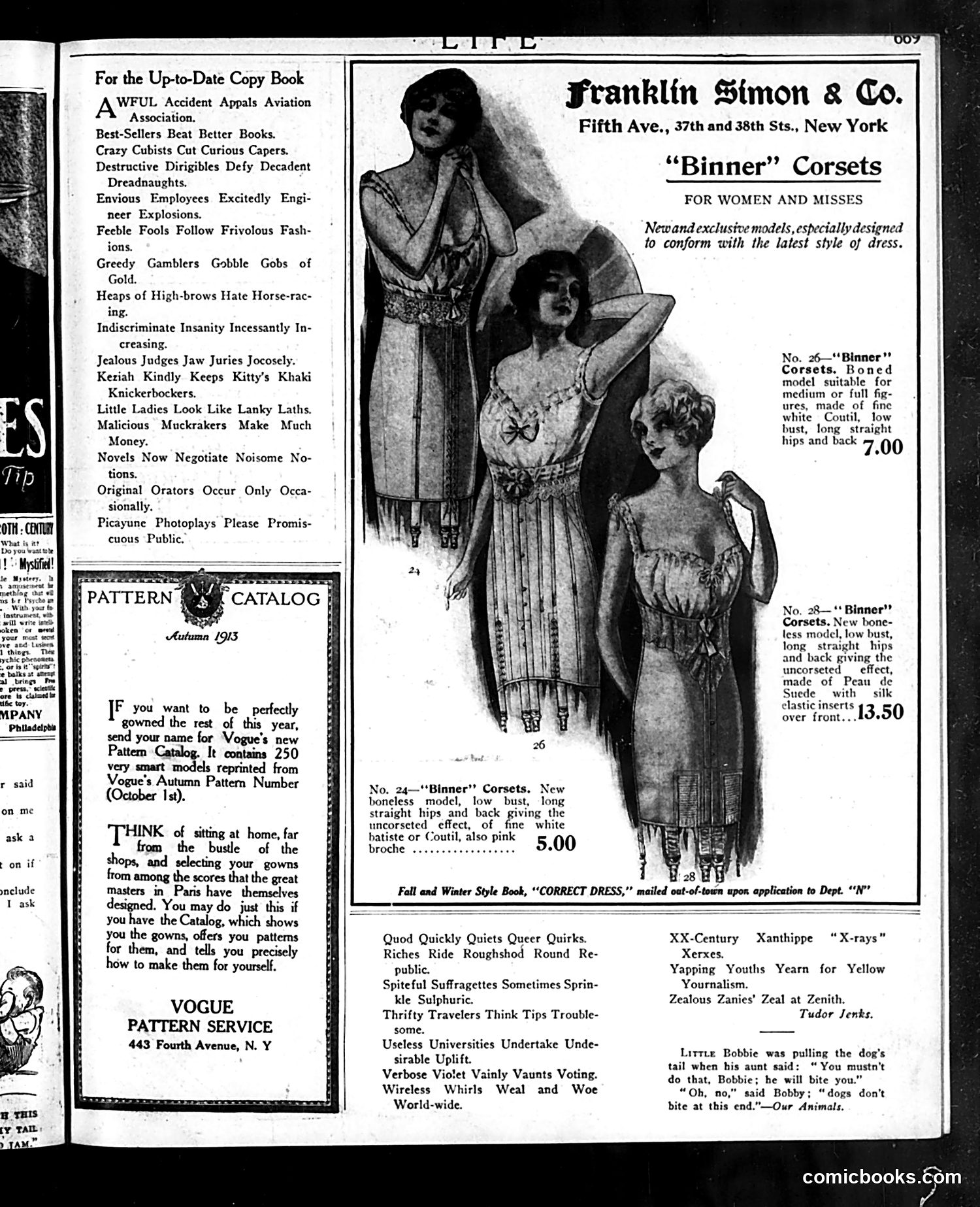
This page is primarily **advertising and copybook content**, not political satire. The main elements are: **Left side**: An alphabetical "Up-to-Date Copy Book" listing alliterative phrases (e.g., "Accident Appals Aviation Association," "Spiteful Suffragettes Sometimes Sprinkle Sulphuric"). This appears to be educational wordplay, though the suffragettes reference reflects contemporary dismissive attitudes toward the women's voting movement. **Right side**: Franklin Simon & Co. corset advertisements featuring illustrated women modeling three "Binner" corset styles at various price points ($5–$13.50). **Bottom**: Minor humor items—a Vogue pattern service advertisement and a brief children's joke about a dog's tail. The page reflects 1915 commercial culture: fashion advertising, educational copybooks, and casual period attitudes (including the suffragettes line, which mocks women's rights activists).
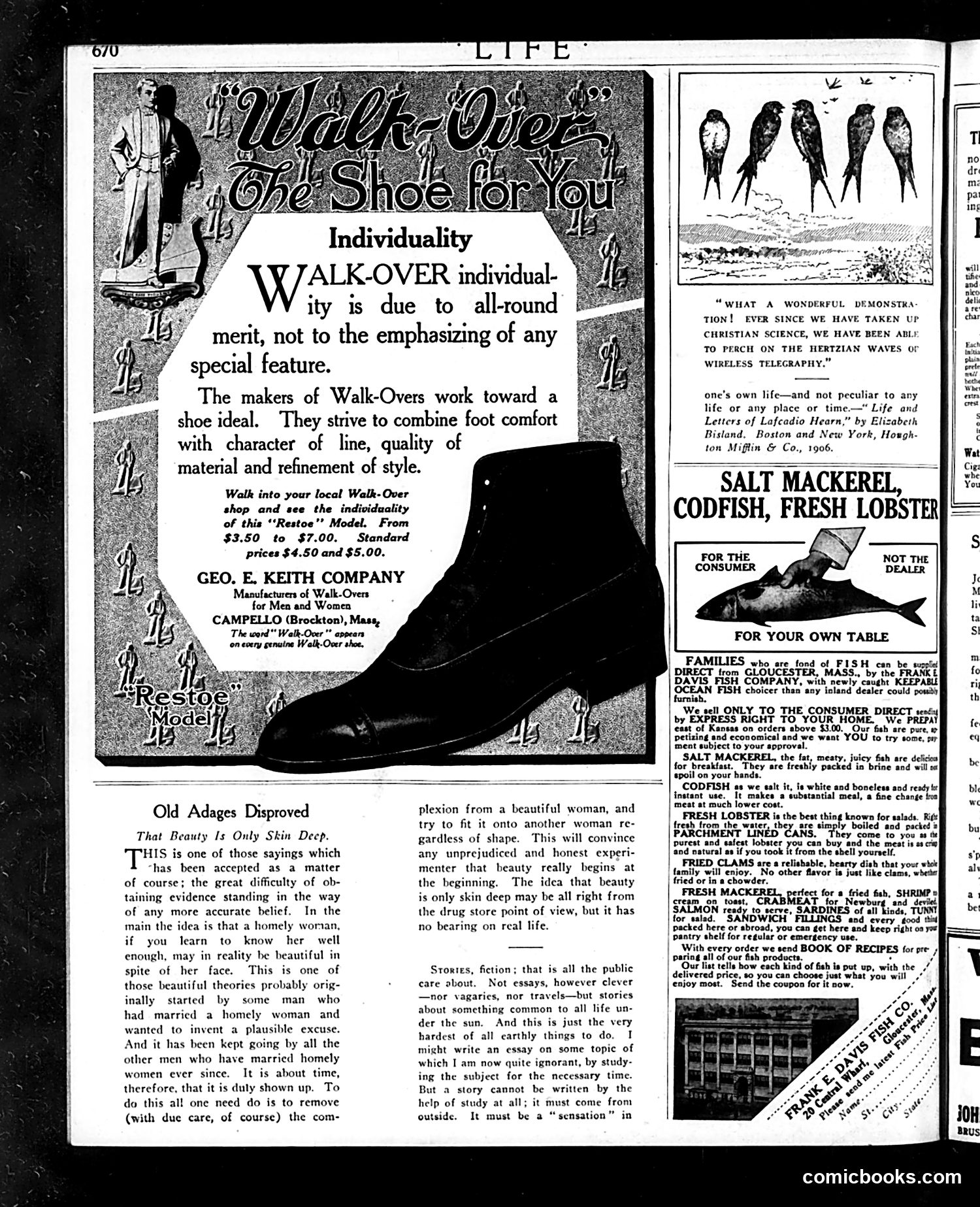
This page is primarily **advertising**, not satire or political commentary. The dominant content includes: - A **Walk-Over shoe advertisement** emphasizing "individuality" through quality craftsmanship - An essay titled "Old Adages Disproved: That Beauty Is Only Skin Deep"—a humorous argument (likely tongue-in-cheek) claiming beauty is literally superficial, not character-based - A cartoon captioned with a Christian Science practitioner marveling at wireless telegraphy as a "wonderful demonstration"—**light satire of Christian Science's claims** about spiritual power - Multiple **fish market advertisements** (salt mackerel, codfish, fresh lobster) selling directly to consumers The Christian Science cartoon is the only satirical element, gently mocking the religious movement's tendency to attribute modern scientific achievements to spiritual principles rather than technological innovation. The overall page reflects early 1900s consumer culture and contemporary debates about materialism versus spirituality.
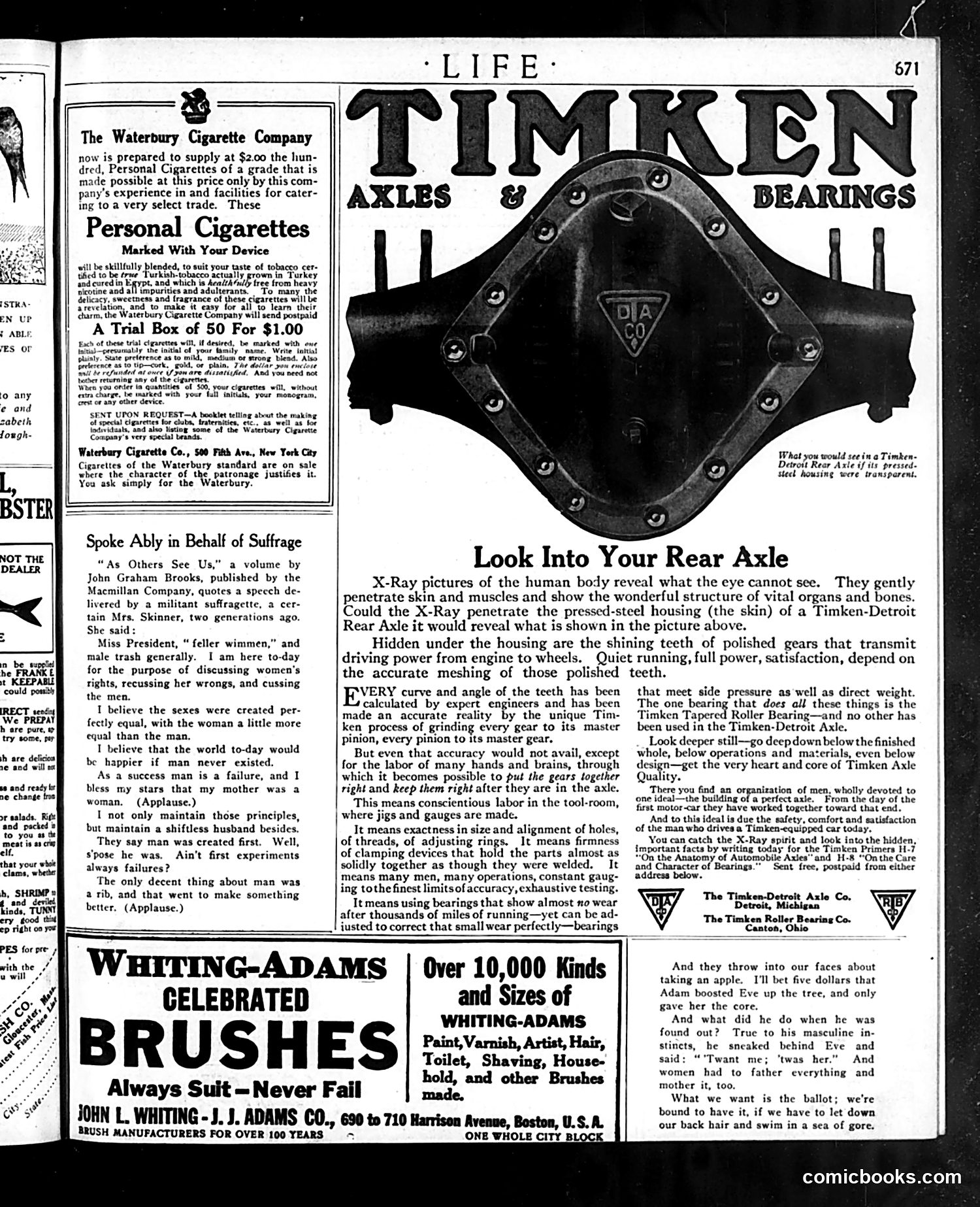
This page is primarily **advertising**, not political satire. The dominant content is a Timken-Detroit Rear Axle advertisement featuring an X-ray style image of automotive gears and bearings. The ad uses medical imaging as a metaphor to showcase internal mechanical precision—comparing invisible car components to invisible human organs. A secondary advertisement promotes Whiting-Adams brushes as reliable products "Always Suit—Never Fail." The only editorial content is a brief suffrage-related piece quoting Mrs. Skinner, a militant suffragette from "two generations ago" (appearing to reference late 1800s activism). Her speech uses colloquial, confrontational language ("feller wimmen," "male trash") to argue for women's equality and against men—presented here as historical testimony to earlier feminist rhetoric rather than contemporary satire. The page reflects early 20th-century advertising aesthetics and the lingering cultural memory of suffrage debates.
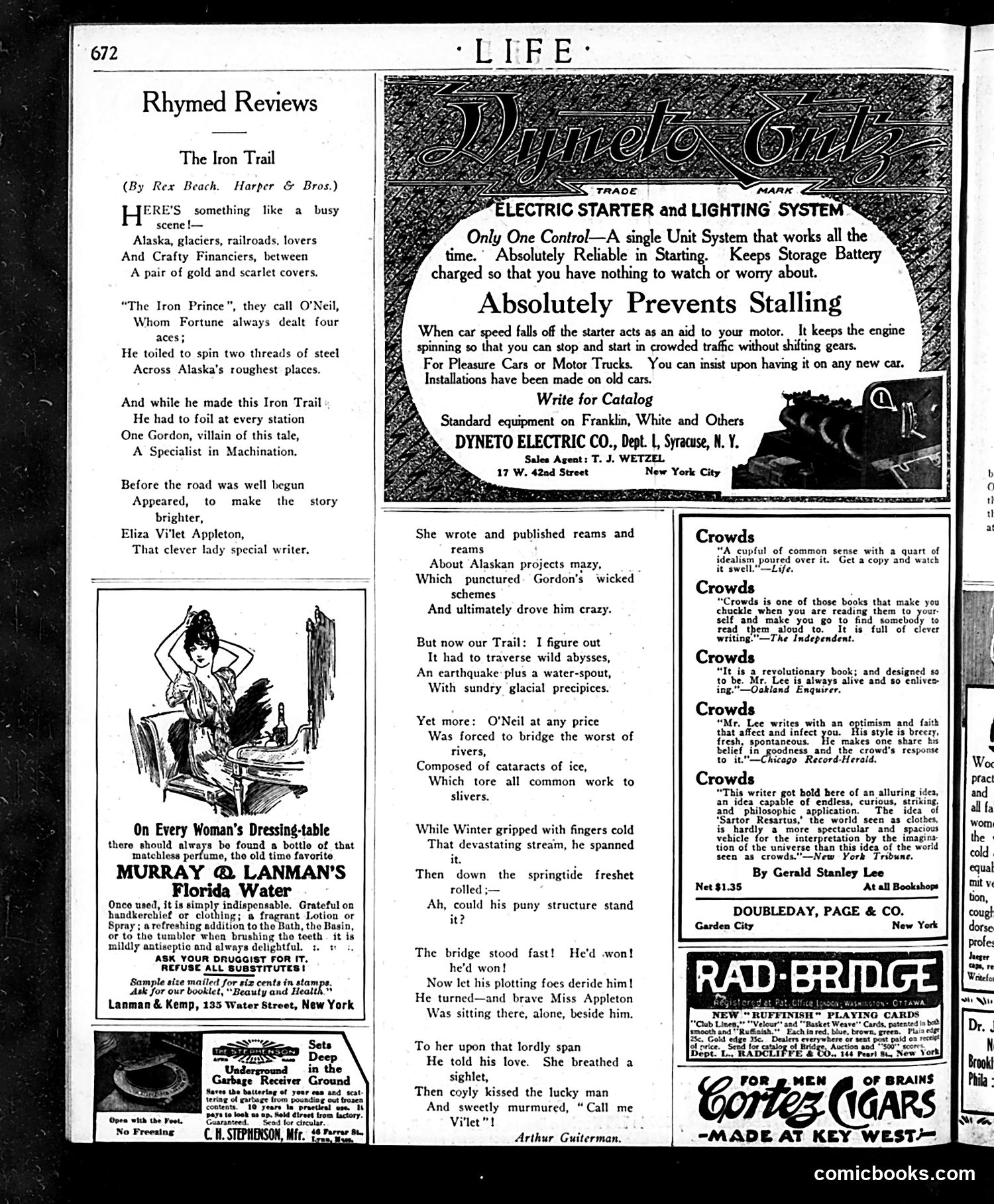
This page contains a book review in verse of *The Iron Trail* by Rex Beach—an adventure novel set in Alaska featuring an ambitious railroad builder ("The Iron Prince" O'Neil), a villainous schemer (Gordon), and a clever female journalist (Eliza Violet Appleton) who exposes the villain's plots. The poem humorously summarizes the melodramatic plot: the protagonist must build a steel railroad across brutal Alaskan terrain, bridge a catastrophic ice river during spring thaw, and ultimately wins both the engineering challenge and the heroine's heart. The satire lies in how the reviewer (Arthur Guiterman) exaggerates the story's overwrought romanticism and manufactured obstacles—earthquakes, waterspouts, glaciers, and cataracts of ice—all conveniently resolved so the hero can kiss the girl beside a triumphant bridge. The surrounding advertisements (perfume, electrical starter systems, books) were standard Life magazine content; they're not satirical themselves.
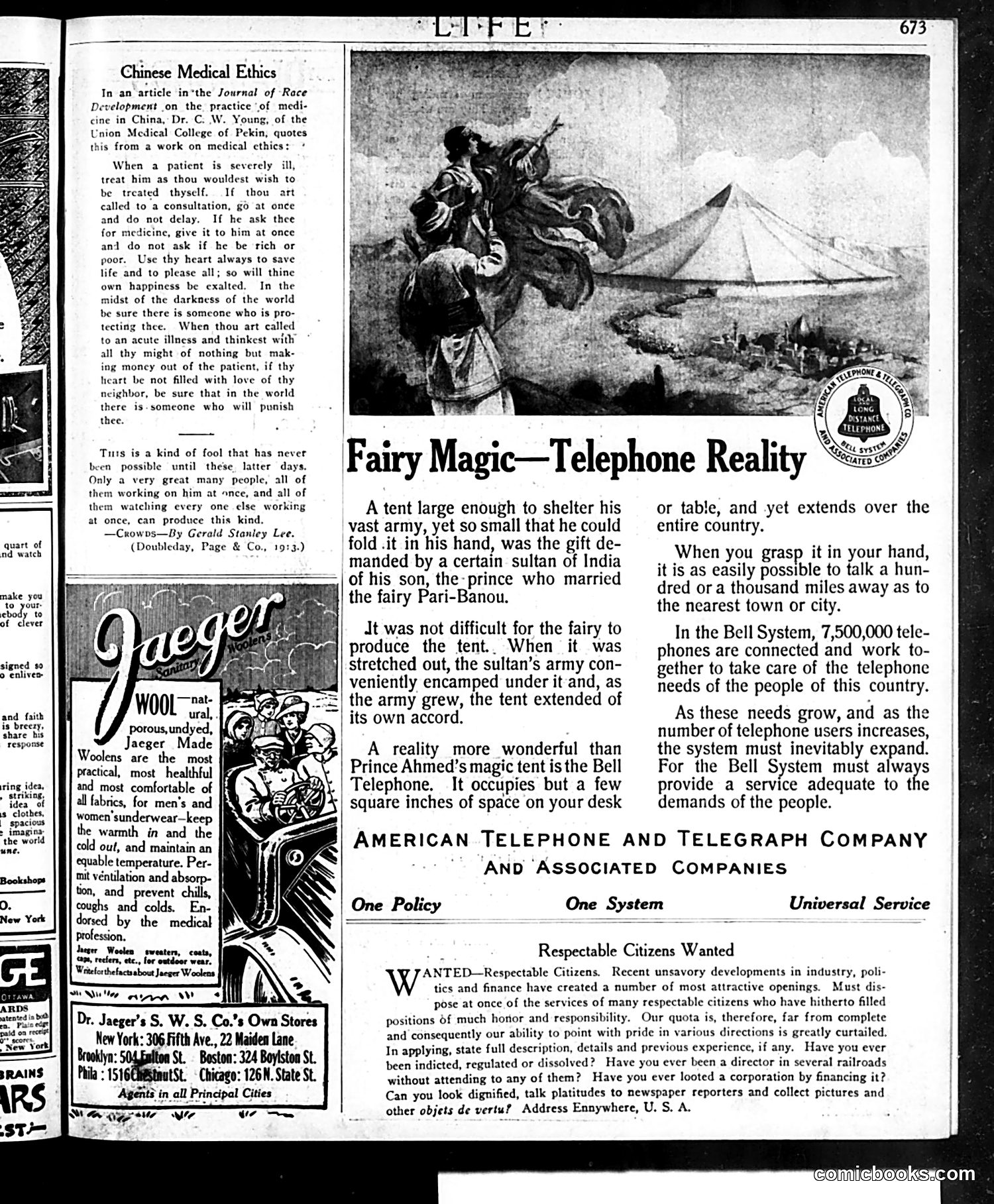
This page mixes editorial content with advertising. The main satirical piece is **"Fairy Magic—Telephone Reality,"** which compares the Bell Telephone System to a magical tent from Arabian Nights folklore. The joke equates modern telephone technology with fairy-tale magic: just as Prince Ahmed's tent miraculously expanded to shelter an entire army while remaining pocket-sized, the Bell Telephone—occupying mere inches of desk space—magically connects users across vast distances. The piece presents this technology as genuinely wondrous, comparing it favorably to ancient fantasy. The accompanying illustration shows a figure (likely representing a fairy or genie) gesturing toward a distant mountain landscape, visually reinforcing the "magic across distance" theme. The **"Respectable Citizens Wanted"** job advertisement is satirical social commentary, appearing to mock corporate corruption by "humorously" advertising for replaceable ethical employees—implying recent business scandals required disposing of disgraced executives.
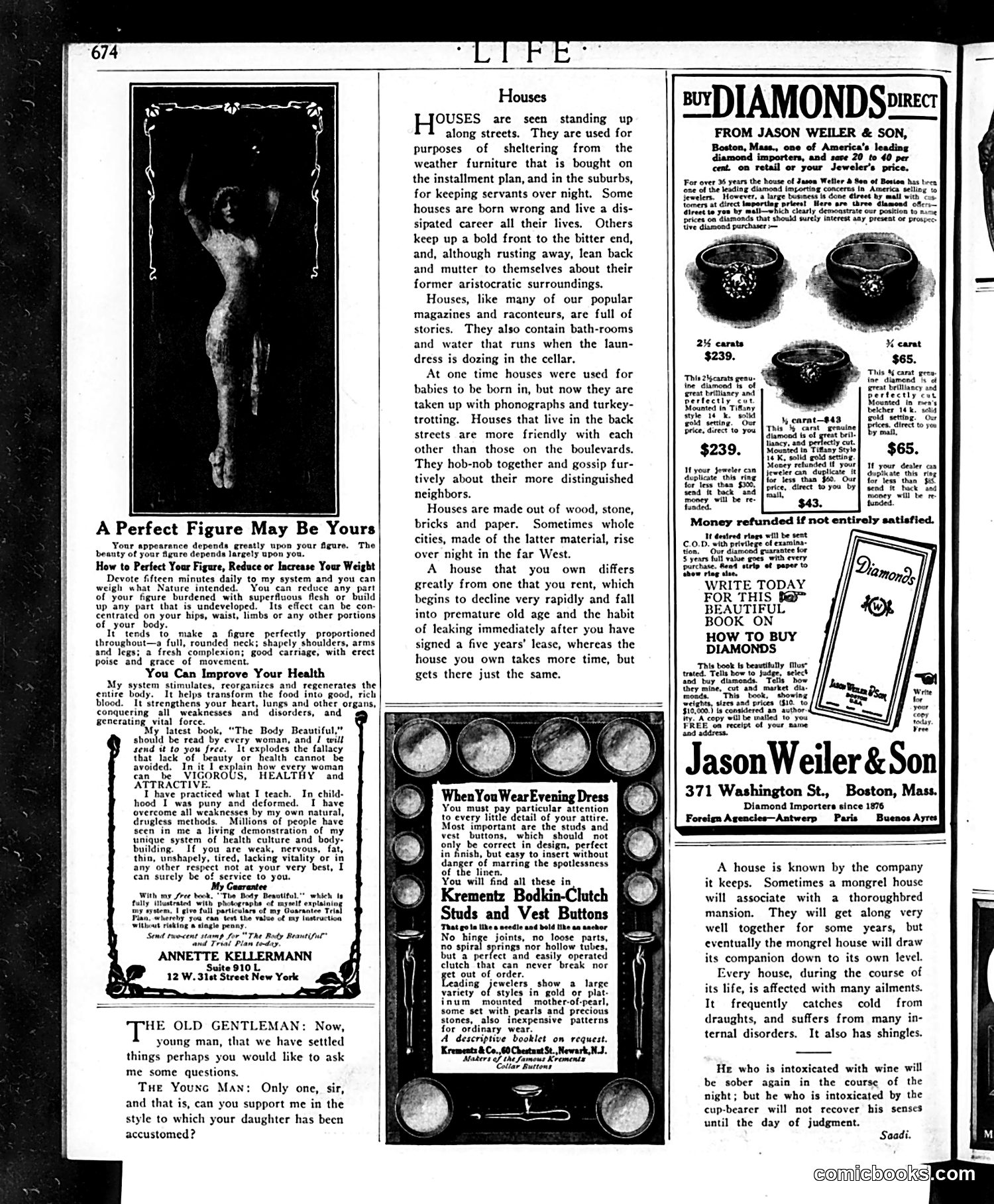
This page contains satirical commentary on American consumer culture and social pretension, wrapped around period advertisements. **The Main Satire ("Houses"):** The unmarked article mocks the American obsession with home ownership and appearances. It describes houses as vessels for installment-plan furniture, symbols of status maintenance, and repositories of gossip—suggesting that homeownership is pursued more for social standing than practical shelter. The cynical observation that renters' homes "decline" while owned homes "take more time" to deteriorate is satirical commentary on how people delude themselves about property ownership's value. **The Sidebar Joke:** A classic marriage-proposal satire where a young suitor asks the father only whether he can afford the daughter's lifestyle—implying women are financial burdens measured by consumption. **The Advertisements:** Annette Kellermann (a real swimmer/performer) advertises body-improvement; Jason Weiler & Son sells diamonds. These juxtapose physical self-improvement with conspicuous consumption—exactly what the satirical text mocks. The page critiques 1920s materialism, installment-plan culture, and the performance of respectability.
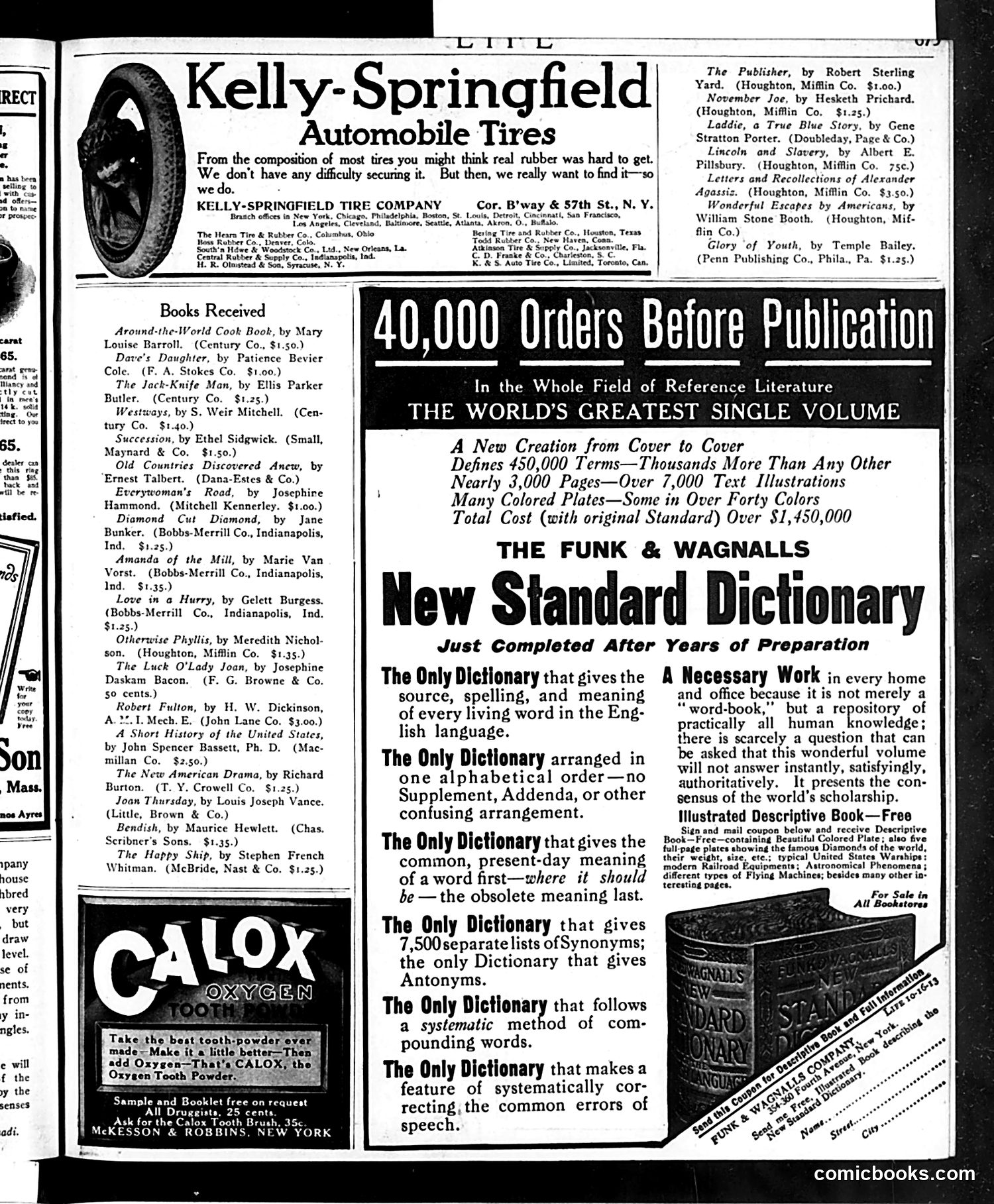
This page is primarily **advertising and book listings**, not editorial content or satire. The dominant feature is a large advertisement for the **Funk & Wagnalls New Standard Dictionary**, emphasizing it received "40,000 Orders Before Publication." The ad repeatedly claims superiority—it's "the only dictionary" with various features (complete alphabetical order, present-day meanings first, separate synonyms and antonyms, etc.). This reflects early 20th-century marketing hyperbole common to reference works. The page also includes: - A Kelly-Springfield automobile tire advertisement - A Calox oxygen toothpowder ad - A "Books Received" section listing newly published titles with publishers and prices There is **no political cartoon or satire visible**. The content represents typical Life magazine filler—commercial advertising and book announcements. The dictionary ad's boastful claims about being "the world's greatest single volume" reflect competitive publishing marketing of the era, not satirical commentary.
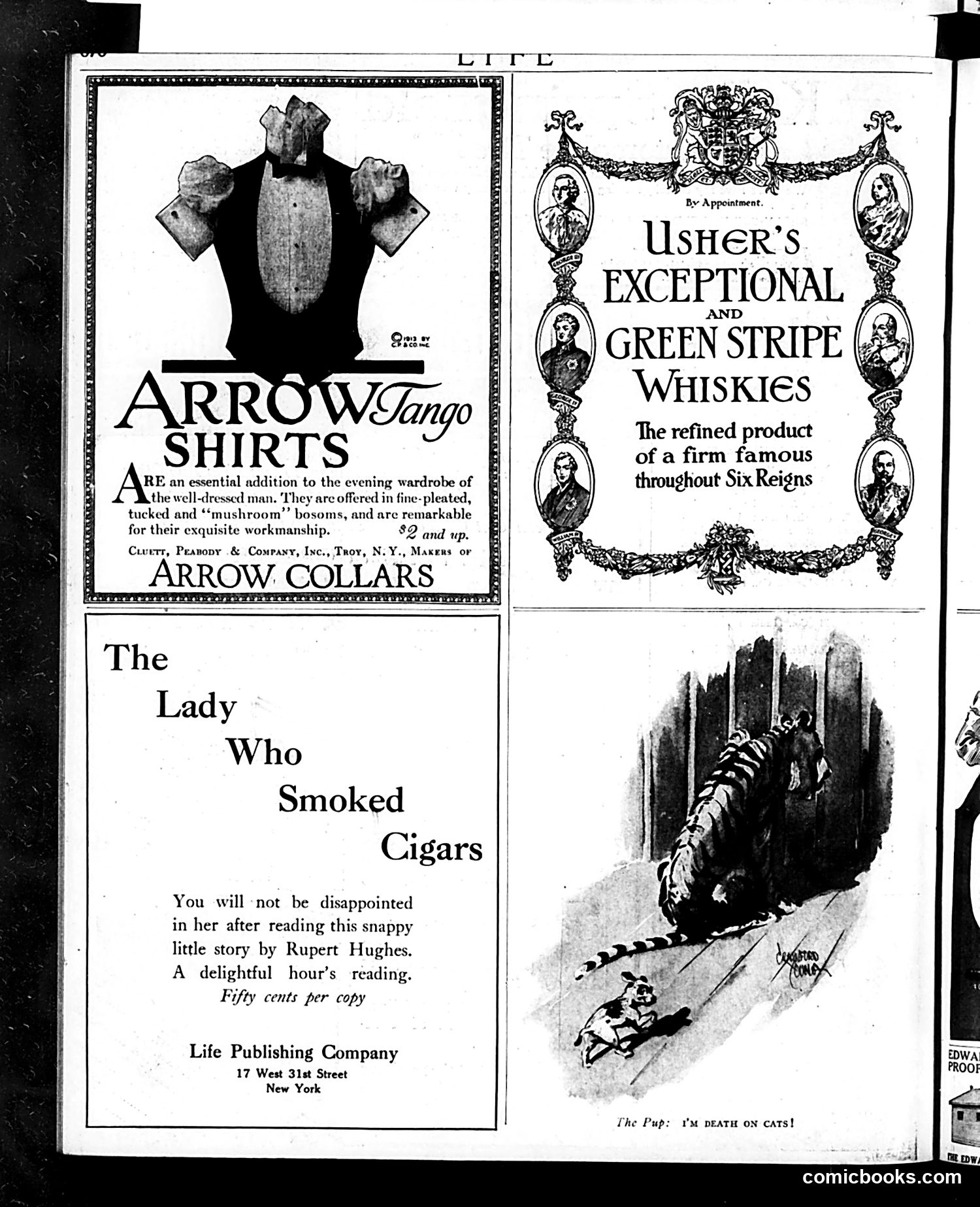
This is primarily an **advertising page** from Life magazine, containing four distinct advertisements with minimal editorial content. The main items are: 1. **Arrow Tango Shirts & Collars** — a men's formal wear ad emphasizing quality craftsmanship for evening dress 2. **Usher's Green Stripe Whiskies** — a luxury liquor advertisement claiming prestige spanning "Six Reigns" (British monarchy) 3. **"The Lady Who Smoked Cigars"** — a short story advertisement by Rupert Hughes, priced at fifty cents, suggesting scandalous or humorous content about unconventional female behavior 4. **A cartoon** (bottom right) showing a small figure saying "I'S DEATH ON CATS!" while appearing to ride or control a large cat — likely a humorous illustration unrelated to the other ads. The page reflects early 20th-century consumer culture and social attitudes, including the novelty/shock value of women smoking.
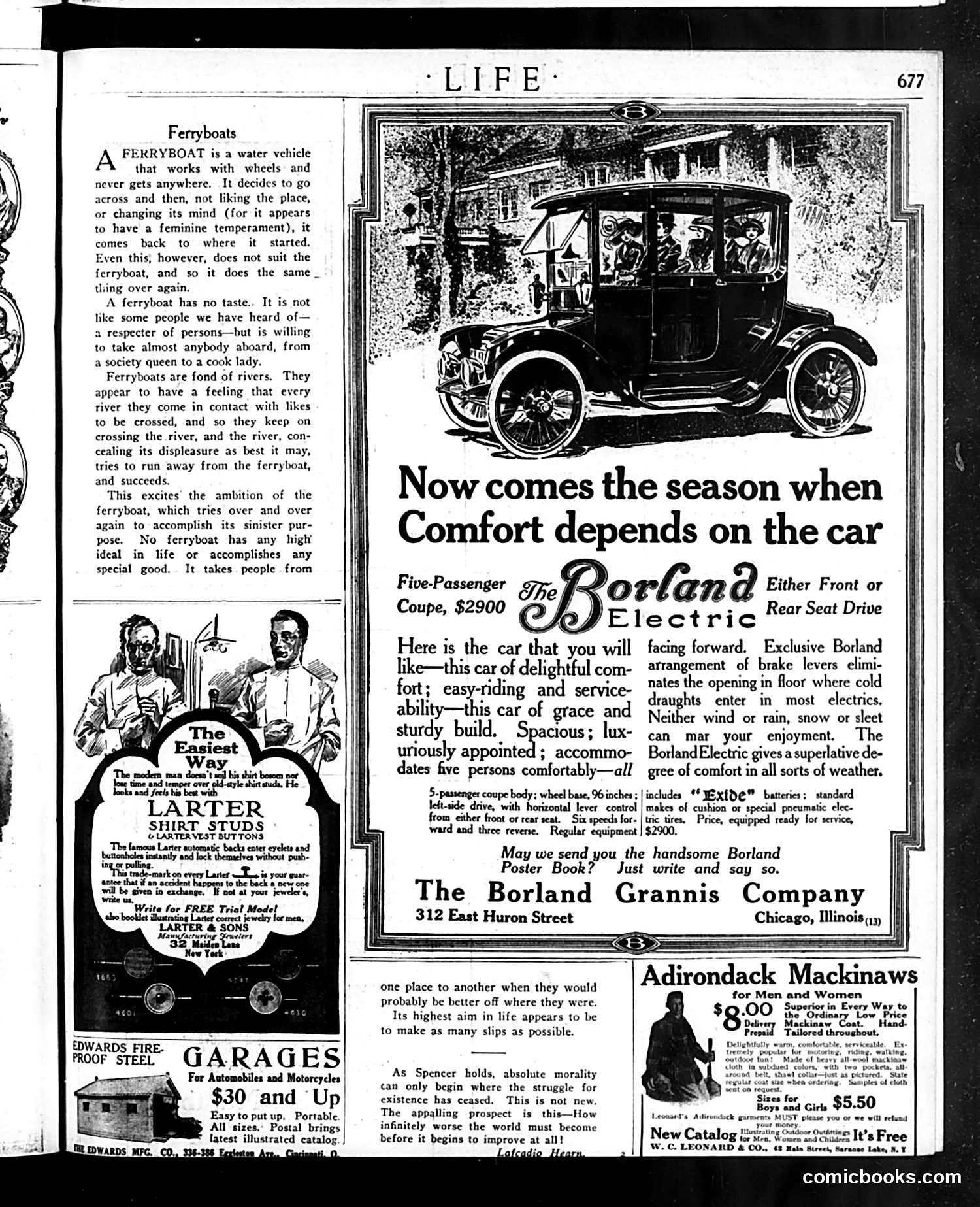
This is primarily an advertisement page for cars and other products, but it opens with a humorous essay satirizing ferryboats. The satire uses the ferryboat as a metaphor for a particular type of person—likely someone aimless, indecisive, and lacking purpose. The ferryboat is personified as having a "feminine temperament," constantly going back and forth without accomplishment ("decides to go across and then... comes back to where it started"). It's described as willing to take "almost anybody aboard, from a society queen to a cook lady"—suggesting a non-discriminatory but ultimately useless service. The essay culminates in dark philosophy: quoting Spencer on morality only beginning after survival struggles cease, then pessimistically suggesting the world must "become infinitely worse" before improving. This mockery of aimlessness and futility sits ironically next to earnest advertisements for cars, garages, and electric automobiles—products promising genuine progress and purpose. The juxtaposition itself may be part of the satire.
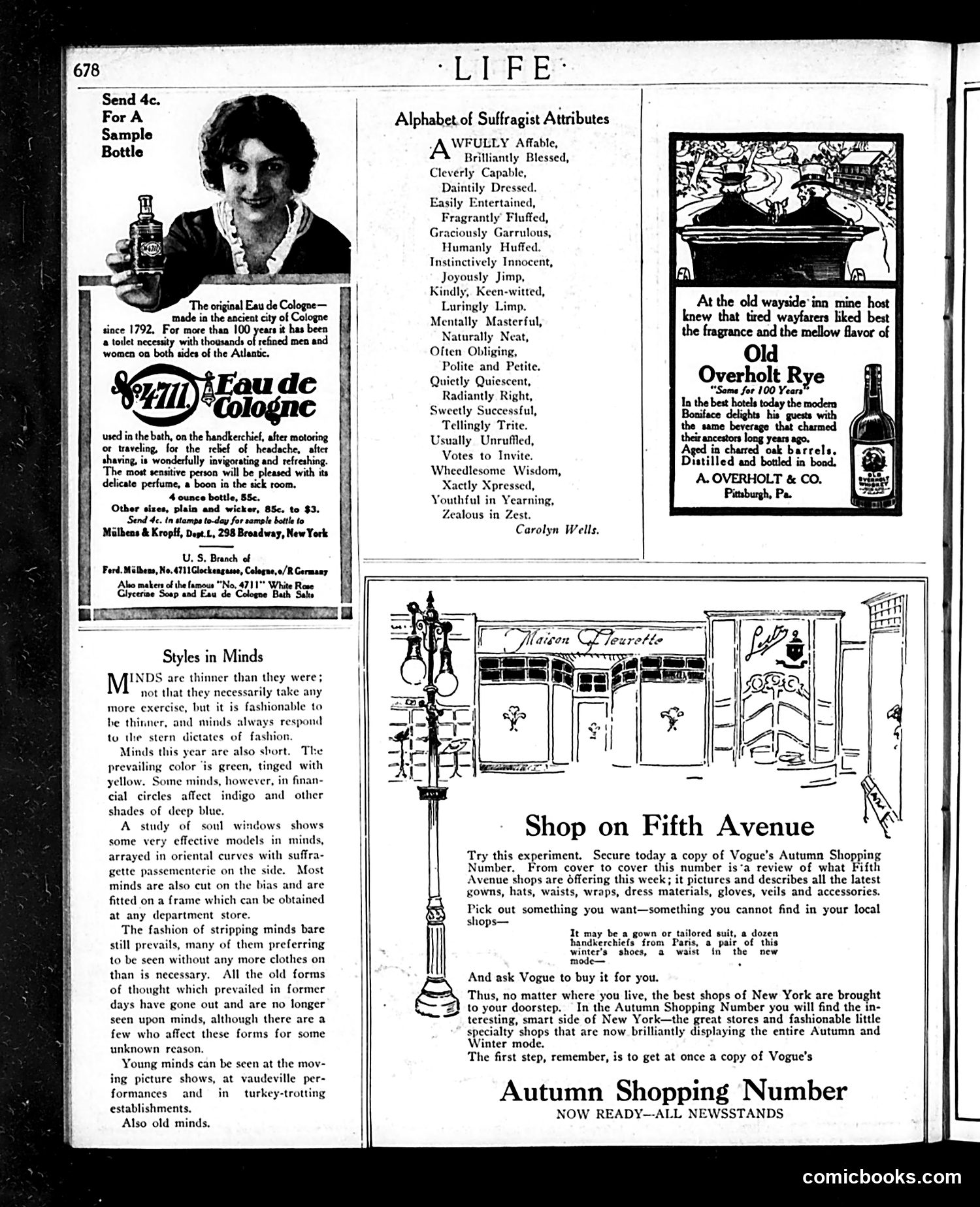
This page contains satirical content mocking the women's suffrage movement. The "Alphabet of Suffragist Attributes" by Carolyn Wells presents a tongue-in-cheek A-Z list characterizing suffragists with superficially flattering but ultimately trivializing adjectives—"Affable," "Daintily Dressed," "Fragrantly Fluffed," culminating in "Votes to Invite." The satire reduces suffragists to stereotypes, suggesting their demands for voting rights are frivolous rather than substantive. The "Styles in Minds" essay continues this mockery, using fashion metaphors to dismiss women's intellectual capacity, claiming minds are "thinner" and follow fashion trends rather than substance. The remainder of the page consists of period advertisements (Eau de Cologne, Old Overholt Rye whiskey, Vogue magazine) representing typical early-1900s marketing. This juxtaposition—placing anti-suffrage satire alongside consumer goods advertising—reflects Life magazine's role as entertainment for affluent readers skeptical of women's rights.
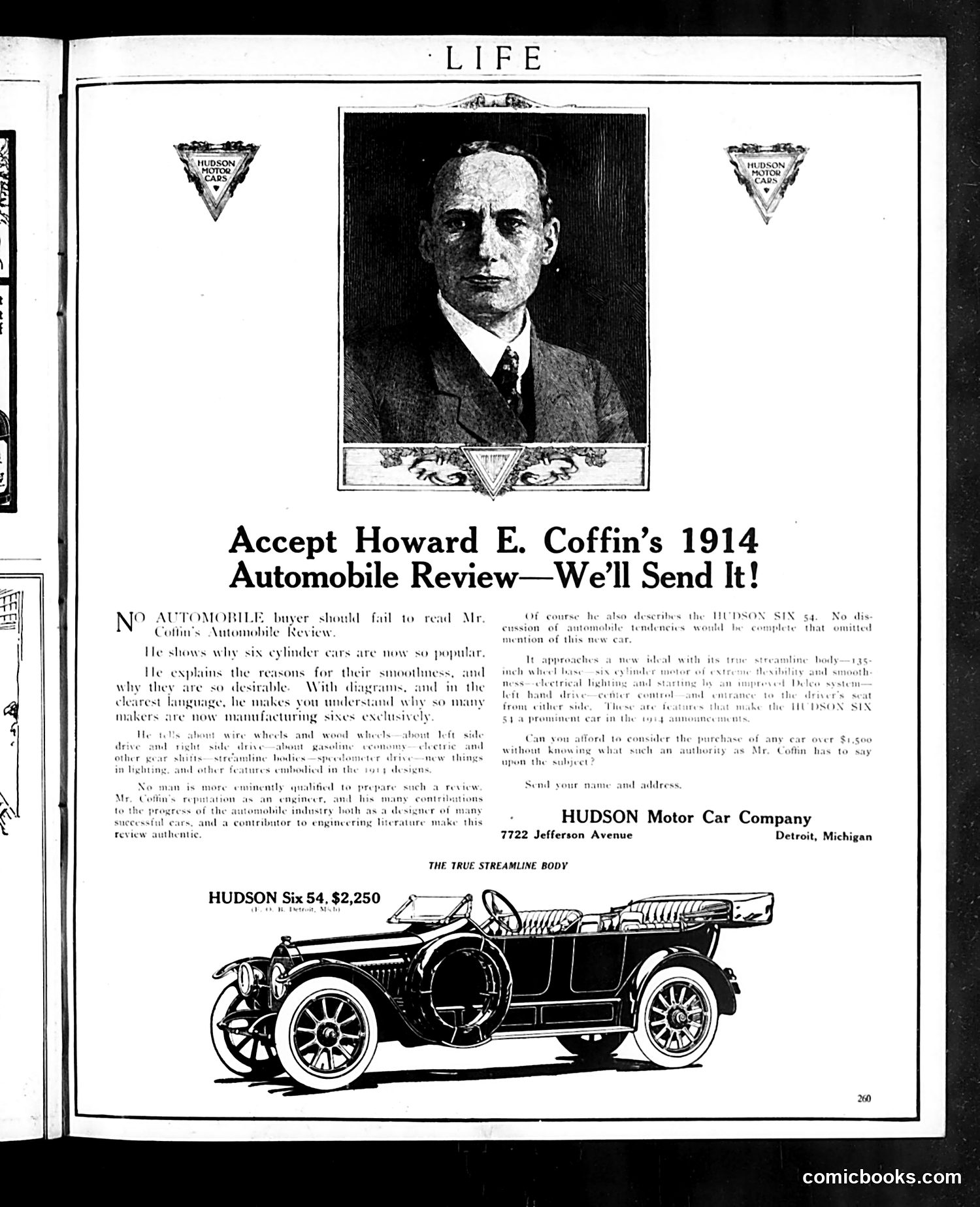
This is primarily **automobile advertising**, not satire or political commentary. The page promotes Howard E. Coffin's 1914 "Automobile Review" for the Hudson Motor Car Company. **The appeal**: The ad leverages Coffin's credibility as an engineer and automotive industry expert. It suggests that any serious car buyer considering vehicles over $5,000 should read his authoritative review—which, conveniently, discusses the Hudson Six favorably. **The pitch**: Rather than directly selling the Hudson Six ($2,250), the ad sells the *review itself* as essential reading, then notes that Coffin's analysis includes praise for Hudson's new "True Streamline Body." This indirect approach lends the product endorsement greater weight than direct advertising would. **For modern readers**: This reflects early automotive marketing's reliance on technical credibility and expert authority to build consumer confidence in an emerging, expensive product category.
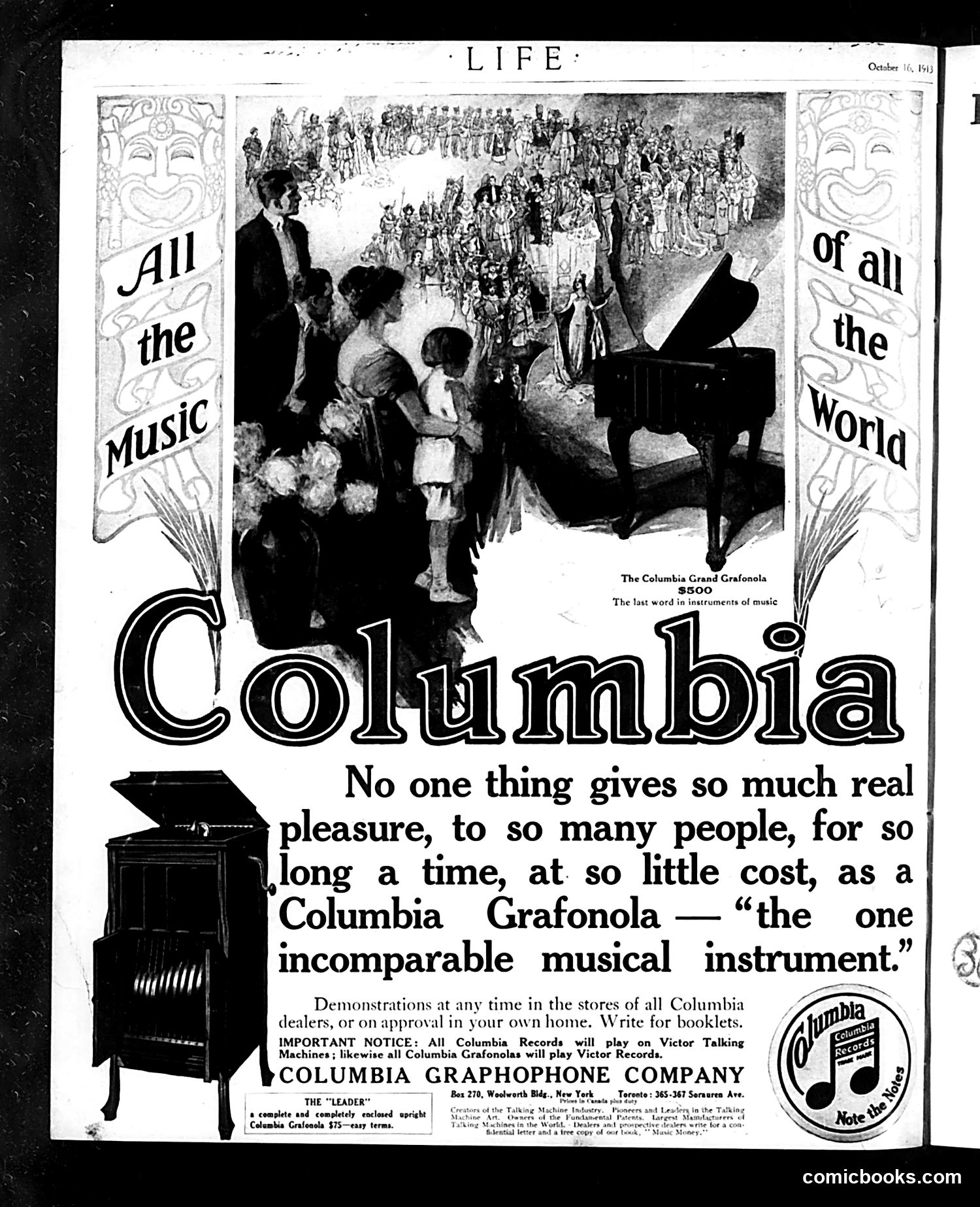
This is primarily a **product advertisement**, not political satire. It promotes Columbia's gramophone (record player), the "Columbia Grand Grafonola" priced at $500. The visual imagery depicts an idealized concert scene: a grand piano dominates the foreground while a large audience gathers in the background, establishing the aspirational message that this device brings "all the music of all the world" into homes. The marketing pitch emphasizes **accessibility and democratization**: "No one thing gives so much real pleasure, to so many people, for so long a time, at so little cost." The advertisement targets middle-class consumers by suggesting that owning a grafonola provides concert-hall-quality entertainment affordably. A notable detail: the text states Columbia records play on Victor machines and vice versa—indicating **industry standardization** efforts during this early recording era. The "LEADER" model referenced at bottom suggests a product line strategy. This reflects 1910s consumer culture, where mechanical reproduction technology promised to bring cultural refinement to ordinary households.