
Life, 1913-10-16 · page 19 of 44
Life — October 16, 1913 — page 19: what you’re looking at
What you’re looking at
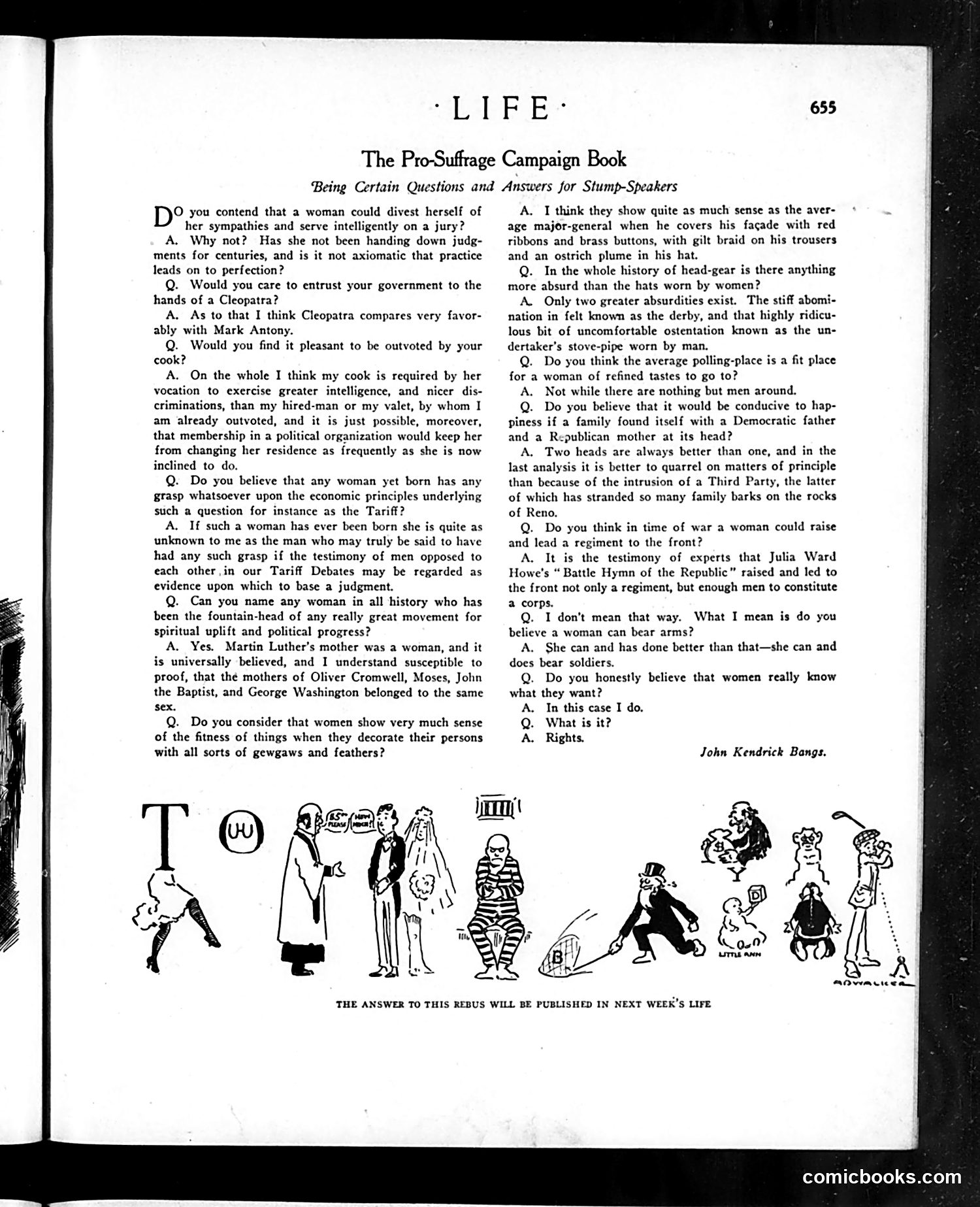
This is a pro-women's suffrage piece by John Kendrick Bangs using satirical Q&A format for stump speakers arguing for voting rights. The answers employ wit to counter common anti-suffrage arguments of the era. Key tactics: - **Turn-the-tables logic**: Women are already capable judges (of household matters for centuries); men wear equally absurd fashions and decorations - **Historical examples**: Martin Luther's mother, Julia Ward Howe—suggesting women have driven great movements - **Reframing concerns**: Worried about women in polling places? The real problem is "nothing but men around" - **Political humor**: Democratic/Republican households are fine—better than Third Party divisions causing divorces ("rocks of Reno") The final comic rebus (partially visible) likely punches the same theme. Overall, this satirizes anti-suffrage objections by suggesting they reveal men's own inconsistencies and limitations rather than women's incapacity. The conclusion—women want "Rights"—states the core demand plainly.
📄 Transcribed text from this page (OCR, searchable)
Machine-transcribed from the original scan — historical spelling and the odd misread are preserved.
“EP E* The Pro-Suffrage Campaign Book Being Certain Questions and Answers Sor Stump-Speakers D° you contend that a woman could divest herself of her sympathies and serve intelligently on a jury? A. Why not? Has she not been handing down judg- ments for centuries, and is it not axiomatic that practice leads on to perfection? Q. Would you care to entrust your government to the hands of a Cleopatra? A. As to that I think Cleopatra compares very favor- ably with Mark Antony. Q. Would you find it pleasant to be outvoted by your cook? A. On the whole I think my cook is required by her vocation to exercise greater intelligence, and nicer dis- criminations, than my hired-man or my valet, by whom I am already outvoted, and it is just possible, moreover, that membership in a political organization would keep her from changing her residence as frequently as she is now inclined to do. Q. Do you believe that any woman yet born has any grasp whatsoever upon the economic principles underlying such a question for instance as the Tariff? A. If such a woman has ever been born she is quite as unknown to me as the man who may truly be said to have had any such grasp if the testimony of men opposed to each other,in our Tariff Debates may be regarded as evidence upon which to base a judgment. Q. Can you name any woman in all history who has been the fountain-head of any really great movement for spiritual uplift and political progress? A. Yes. Martin Luther’s mother was a woman, and it is universally believed, and I understand susceptible to proof, that the mothers of Oliver Cromwell, Moses, John the Baptist, and George Washington belonged to the same sex. Q. Do you consider that women show very much sense of the fitness of things when they decorate their persons with all sorts of gewgaws and feathers? A. I think they show quite as much sense as the aver- age major-general when he covers his facade with red ribbons and brass buttons, with gilt braid on his trousers and an ostrich plume in his hat. Q. In the whole history of head-gear is there anything more absurd than the hats worn by women? A. Only two greater absurdities exist. The stiff abomi- nation in felt known as the derby, and that highly ridicu- lous bit of uncomfortable ostentation known as the un- dertaker’s stove-pipe worn by man. Q. Do you think the average polling-place is a fit place for a woman of refined tastes to go to? A. Not while there are nothing but men around. Q. Do you believe that it would be conducive to hap- piness if a family found itself with a Democratic father and a Republican mother at its head? A. Two heads are always better than one, and in the last analysis it is better to quarrel on matters of principle than because of the intrusion of a Third Party, the latter of which has stranded so many family barks on the rocks of Reno. Q. Do you think in time of war a woman could raise and lead a regiment to the front? A. It is the testimony of experts that Julia Ward Howe's “ Battle Hymn of the Republic” raised and led to the front not only a regiment, but enough men to constitute a corps. Q. I don’t mean that way. What I mean is do you believe a woman can bear arms? A. She can and has done better than that—she can and does bear soldiers. Q. Do you honestly believe that women really know what they want? A. In this case I do. Q. What is it? A. Rights. John Kendrick Bangs. THE ANSWER TO THIS REBUS WILL BE PUBLISHED IN NEXT WEEK'S LIFE comicbooks.com