
Life, 1913-10-16 · page 21 of 44
Life — October 16, 1913 — page 21: what you’re looking at
What you’re looking at
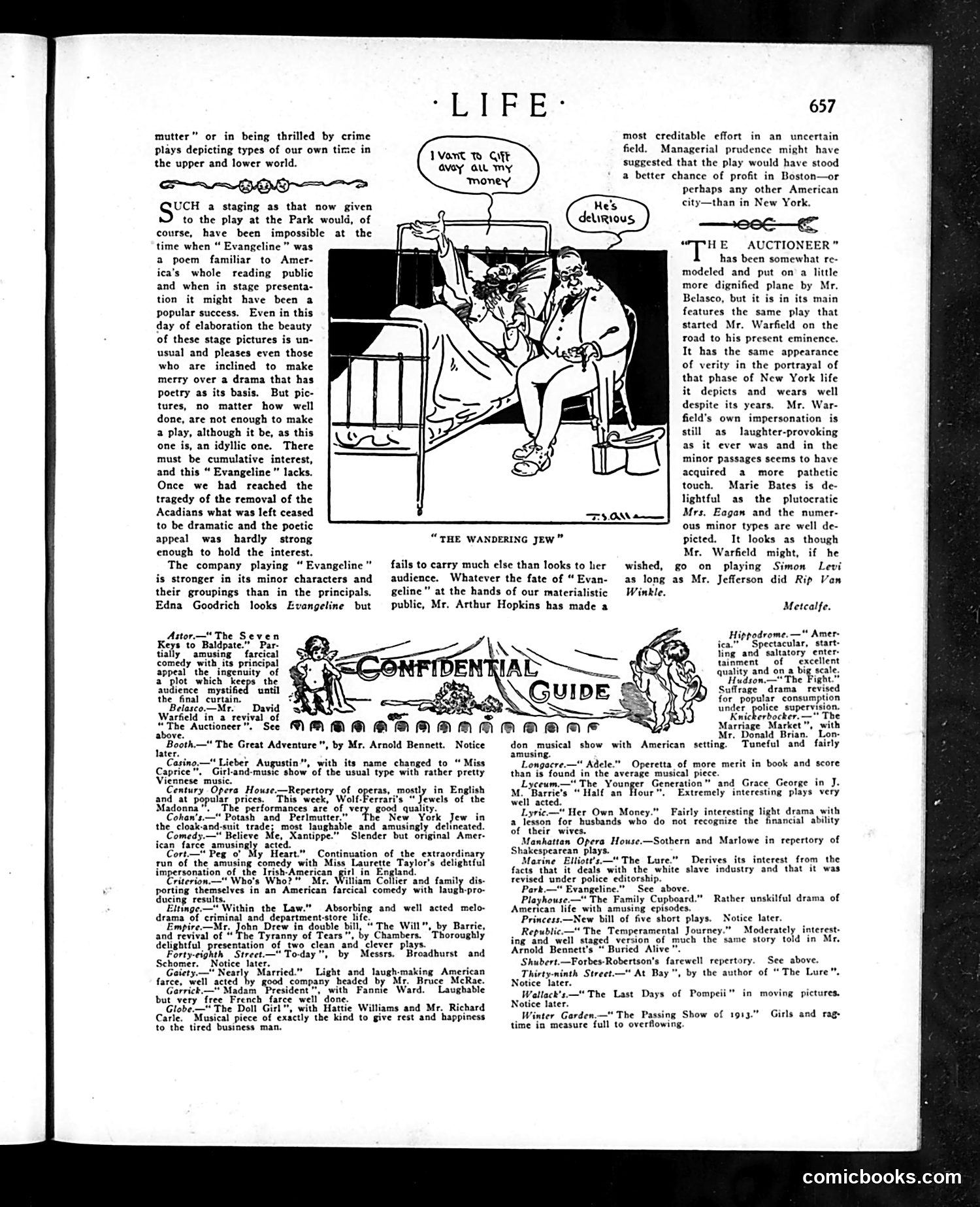
This page reviews theatrical productions on New York stages, featuring two cartoon illustrations by artist "Damn" (signature visible). **"The Wandering Jew" cartoon** (top): Shows a woman in a bed surrounded by men, with one saying "I want to cut away all my money" and another responding "He's delicious." The caption notes the play "fails to carry much else than looks to her audience"—satirizing a theatrical production that relies on visual spectacle and attractive performers rather than substantive drama. **"Confidential Guide" section** (center): A decorative banner introducing capsule reviews of current Broadway shows, with small cartoon figures suggesting theatrical entertainment. The reviews discuss productions like "Evangeline," "The Auctioneer," and various comedies and operas, evaluating their merits and appeal to audiences. The overall tone suggests Life magazine's role as cultural arbiter, mocking both pretentious dramatic productions and lightweight entertainment while acknowledging audience tastes of the era.
📄 Transcribed text from this page (OCR, searchable)
Machine-transcribed from the original scan — historical spelling and the odd misread are preserved.
mutter" or in being thrilled by crime plays depicting types of our own time in the upper and lower world. PDO Suz a staging as that now given to the play at the Park would, of course, have been impossible at the time when “ Evangeline” was a poem familiar to Amer- ica’s whole reading public and when in stage presenta- tion it might have been a popular success. Even in this day of elaboration the beauty of these stage pictures is un- usual and pleases even those who are inclined to make merry over a drama that has Poetry as its basis. But pic- tures, no matter how well done, are not enough to make a play, although it be, as this one is, an idyllic one. There must be cumulative interest, and this “ Evangeline” lacks. Once we had reached the tragedy of the removal of the Acadians what was left ceased to be dramatic and the poetic appeal was hardly strong enough to hold the interest, The company playing “ Evangeline” is stronger in its minor characters and their groupings than in the principals. Edna Goodrich looks Evangeline but Astor —“The Seven Keys to Baldpate.” Par- tially amusing farcical comedy with its principal appeal the ingenuity of a slot which keeps the Sulience mystifed until the final curtain. farfield in a revival o si The Auctioneer". See Ow) above. aBeoth—" The Great Adventure, by Mr. Arnold Bennett. Notice ater. Casing,—"' Lieber Augustin”, with its name changed to “ Miss Caprice Girl-and-music show of the usual type with rather pretty Viennese’ music. Century Opera House.—Repertory of operas, mostly in English and at popular prices, This week, Wolf-Ferrari’s “Jewels of the Madonna", The performances are of very good quality. Cohan’s.—" Potash and Perlmutter. he New York Jew in the cloak-and-suit trade; most laughable and amusingly delineated. “Believe Me, Xantippe.” Slender but original Amer- amusingly acted. 7 . Peg o' My Heart.” Continuation of the extraordinary run of the somusing comedy with Miss Laurette Taylor's delightful i rsonation of the Irish-A: irl in England. Who's Who? iam Collier and family dis- porting themselves in an American farcical comedy with laugh-pro- ducing results. Eltinge- Within the Law. Absorbing and well acted melo- drama of criminal and department-store life. n Empire-—Mr. John Drew in double bill, “The Will”, by Barrie, and revival of “ The Tyranny of Tears”, by Chambers. Thoroughly delightful presentation of two clean and clever plays. Forty-eighth Street.—" To-day", by Messrs. Broadhurst and fice later. Nearly Married.” Light and laugh-making American by good company headed by Mr. Bruce McRae. Madam President”, with Fannie Ward. Laughable but. very free French farce well’ done. ; Globe.—" The Doll Girl”, with Hattie Williams and Mr. Richard Musical piece of exactly the kind to give rest and happiness to the tired business man. 1Vomt To QTE avey att my “THE WANDERING JEW” fails to carry much else than looks to her audience. Whatever the fate of “ Evan- geline" at the hands of our materialistic public, Mr. Arthur Hopkins has made a 657 most creditable effort in an uncertain field. Managerial prudence might have suggested that the play would have stood a better chance of profit in Boston—or perhaps any other American city—than in New York. —<8 = HE AUCTIONEER” has been somewhat re- modeled and put on a little more dignified plane by Mr. Belasco, but it is in its main features the same play that started Mr. Warfield on the road to his present eminence. It has the same appearance of verity in the portrayal of that phase of New York life it depicts and wears well despite its years. Mr. War- field's own impersonation is still as laughter-provoking as it ever was and in the minor passages seems to have acquired a more pathetic touch. Marie Bates is de- lightful as the plutocratie Mrs, Eagan and the numer- ous minor types are well de- picted. It looks as though Mr. Warfield might, if he wished, go on playing Simon Levi as long as Mr. Jefferson did Rip Van Winkle. Metcalfe. Hippodrome.—" Amer- ica." Spectacular, start- ling and saltatory’ enter- tainment of excellent auality and ona big seal; Hudson.—" The Fight.” Suffrage “drama revised for popular consumption under, police supervision. Knickerbocker.—" The Marriage Market”, wi Mr. Donald Brian.” Le don musical show with American setting. Tuneful and fairly amusing. Longacre.— Adele.” Operetta of more merit in book and score than is found in the average musical piece. The Younger Generation” and Grace George in J. “Half an Hour”, Extremely interesting plays very Lyric—" Her Own Money.” Fairly interesting light drama with a lesson for husbands who do not recognize the financial ability of their wives. Manhattan Opera House.—Sothern and Marlowe in repertory of Shakespearean plays. Marine Elliott’s—"The Lure.” Derives its interest from the facts that it deals with the white slave industry and that it was revised under police editorship. Park.—" Evangeline.” See above. Playhouse-—" The Family Cupboard. American life with amusing episodes. Princess.—New bill of five short plays, Notice later. Republic—" The Temperamental Journey.” Moderately interest: ing and well staged version of much the same story told in Mr Arnold Bennett’s “ Buried Alive". Shubert.—Forbes-Robertson’s farewell repertory. See above. Thirty-ninth Street.—" At Bay", by the author of “The Lure”. Notice later. Wallack’ Notice later. Winter Garden,—" The Passing Show of 1913.” Girls and rage time in measure full to overflowing Rather unskilful drama of The Last Days of Pompeii” in moving pictures. comicbooks.com