
Life, 1913-10-16 · page 24 of 44
Life — October 16, 1913 — page 24: what you’re looking at
What you’re looking at
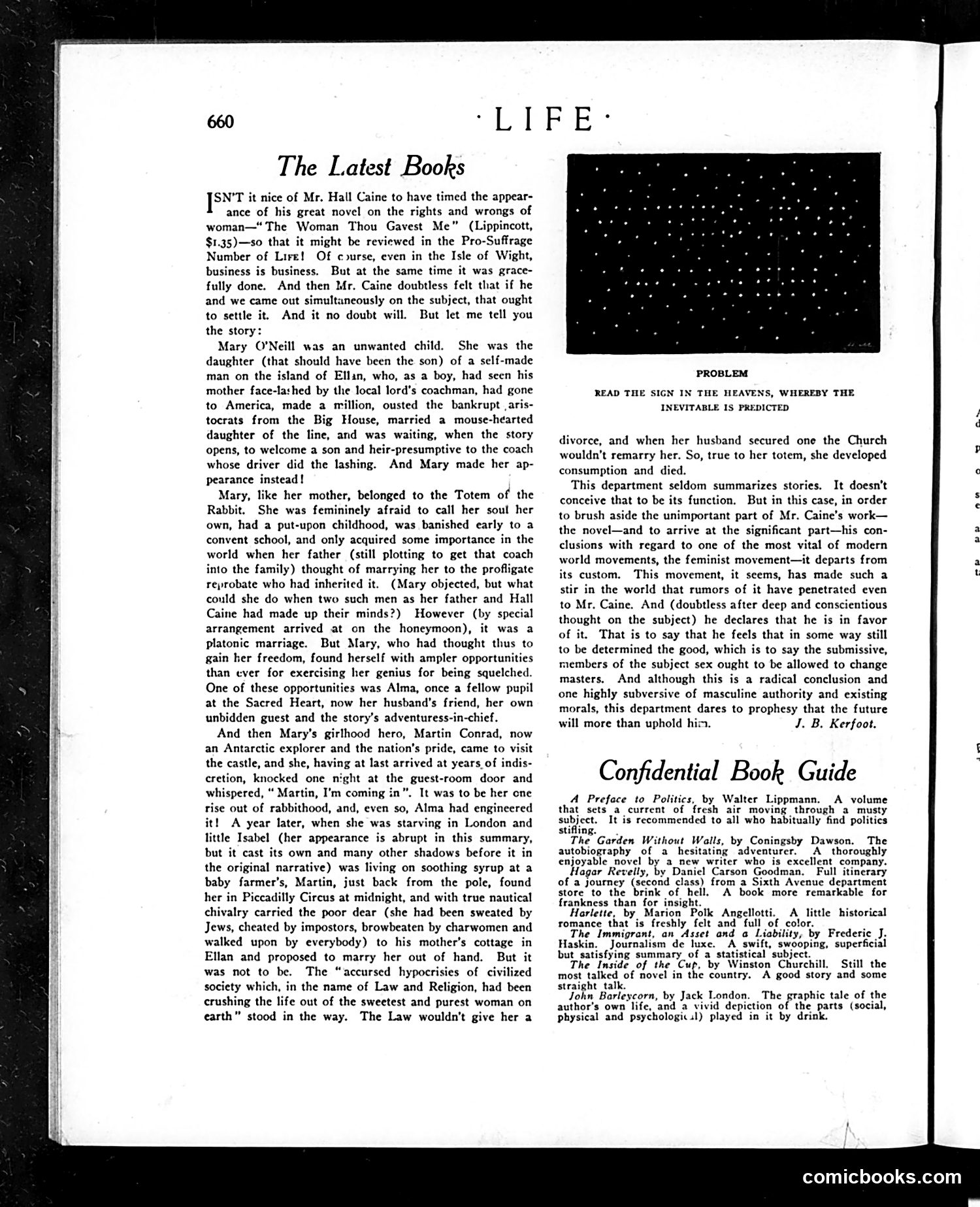
This page satirizes Hall Caine's novel "The Woman Thou Gavest Me," published strategically in Life's Pro-Suffrage issue. The unnamed reviewer mocks both the book's melodramatic plot and Caine's apparent opportunism in timing its release. The satire targets the novel's treatment of women's limited agency. The protagonist Mary—described through animal metaphors as rabbit-like and submissive—suffers throughout: forced into a loveless marriage, denied divorce, prevented from remarrying by Church law, and ultimately dying of consumption. The reviewer's sardonic tone—particularly the opening—suggests this coincidental publication timing allows Caine to pose as progressive on women's issues while his actual narrative demonstrates how "civilized society" and religious institutions crush women's autonomy. The joke is the disconnect between the novel's apparent stance and its depiction of female powerlessness. The black rectangular "Problem" box appears to be a visual puzzle or advertisement unrelated to the text.
📄 Transcribed text from this page (OCR, searchable)
Machine-transcribed from the original scan — historical spelling and the odd misread are preserved.
‘LIP E- The Latest Books SN’T it nice of Mr. Hall Caine to have timed the appear- ance of his great novel on the rights and wrongs of woman—“ The Woman Thou Gavest Me” (Lippincott, $1.35)—so that it might be reviewed in the Pro-Suffrage Number of Lire! Of course, even in the Isle of Wight, business is business. But at the same time it was grace- fully done. And then Mr. Caine doubtless felt that if he and we came out simultaneously on the subject, that ought to settle it. And it no doubt will. But let me tell you the story: Mary O'Neill was an unwanted child. She was the daughter (that should have been the son) of a self-made man on the island of Ellan, who, as a boy, had seen his mother face-lashed by the local lord’s coachman, had gone to America, made a million, ousted the bankrupt ,aris- tocrats from the Big House, married a mouse-h¢arted daughter of the line, and was waiting, when the story opens, to welcome a son and heir-presumptive to the coach whose driver did the lashing. And Mary made her ap- pearance instead! Mary, like her mother, belonged to the Totem of the Rabbit. She was femininely afraid to call her soul her own, had a put-upon childhood, was banished early to a convent school, and only acquired some importance in the world when her father (still plotting to get that coach into the family) thought of marrying her to the profligate reprobate who had inherited it. (Mary objected, but what could she do when two such men as her father and Hall Caine had made up their minds?) However (by special arrangement arrived at on the honeymoon), it was a platonic marriage. But Mary, who had thought thus to gain ker freedom, found herself with ampler opportunities than ever for exercising her genius for being squelched. One of these opportunities was Alma, once a fellow pupil at the Sacred Heart, now her husband's friend, her own unbidden guest and the story’s adventuress-in-chief. And then Mary’s girlhood hero, Martin Conrad, now an Antarctic explorer and the nation’s pride, came to visit the castle, and she, having at last arrived at years of indis- cretion, knocked one night at the guest-room door and whispered, “ Martin, I'm coming in”. It was to be her one rise out of rabbithood, and, even so, Alma had engineered it! A year later, when she was starving in London and little Isabel (her appearance is abrupt in this summary, but it cast its own and many other shadows before it in the original narrative) was living on soothing syrup at a baby farmer's, Martin, just back from the pole, found her in Piccadilly Circus at midnight, and with true nautical chivalry carried the poor dear (she had been sweated by Jews, cheated by impostors, browbeaten by charwomen and walked upon by everybody) to his mother’s cottage in Ellan and proposed to marry her out of hand. But it was not to be. The “accursed hypocrisies of civilized society which, in the name of Law and Religion, had been crushing the life out of the sweetest and purest woman on earth" stood in the way. The Law wouldn't give her a PROBLEM READ THE SIGN IN THE HEAVENS, WHEREBY THE INEVITABLE IS PREDICTED divorce, and when her husband secured one the Church wouldn't remarry her. So, true to her totem, she developed consumption and died. This department seldom summarizes stories. It doesn’t conceive that to be its function. But in this case, in order to brush aside the unimportant part of Mr. Caine’s work— the novel—and to arrive at the significant part—his con- clusions with regard to one of the most vital of modern world movements, the feminist movement—it departs from its custom. This movement, it seems, has made such a stir in the world that rumors of it have penetrated even to Mr. Caine. And (doubtless after deep and conscientious thought on the subject) he declares that he is in favor of it. That is to say that he feels that in some way still to be determined the good, which is to say the submissive, members of the subject sex ought to be allowed to change masters. And although this is a radical conclusion and one highly subversive of masculine authority and existing morals, this department dares to prophesy that the future will more than uphold him. J. B. Kerfoot. Confidential Book Guide A Preface to Politics, by Walter Lippmann. A volume that sets a current of fresh air moving through a musty subject. It is recommended to all who habitually find polities stifling. The Garden Without Walls, by Coningsby Dawson. The autobiography of a hesitating adventurer. A thoroughly enjoyable novel by a_new writer who is excellent company. Hagar Revelly, by Daniel Carson Goodman. Full itinerary of a journey (second class) from a Sixth Avenue department store to the brink of hell. A book more remarkable for frankness than for insight. Harlette, by, Marion Polk Angellotti. A_ little historical romance that is freshly felt and full of color. The Immigrant, an Asset and a Liability, by Frederic J. Haskin, Journalism de luxe. A_ swift, swooping, superficial but satisfying summary of a statistical subject. The Inside of the Cup, by Winston Churchill. Still the most talked of novel in the country. A good story and some straight talk. ; John Barleycorn, by Jack London. The graphic tale of the author’s own life, and a vivid depiction of the parts (social, physical and psychologici!) played in it by drink. comicbooks.com