
Life, 1913-10-16 · page 13 of 44
Life — October 16, 1913 — page 13: what you’re looking at
What you’re looking at
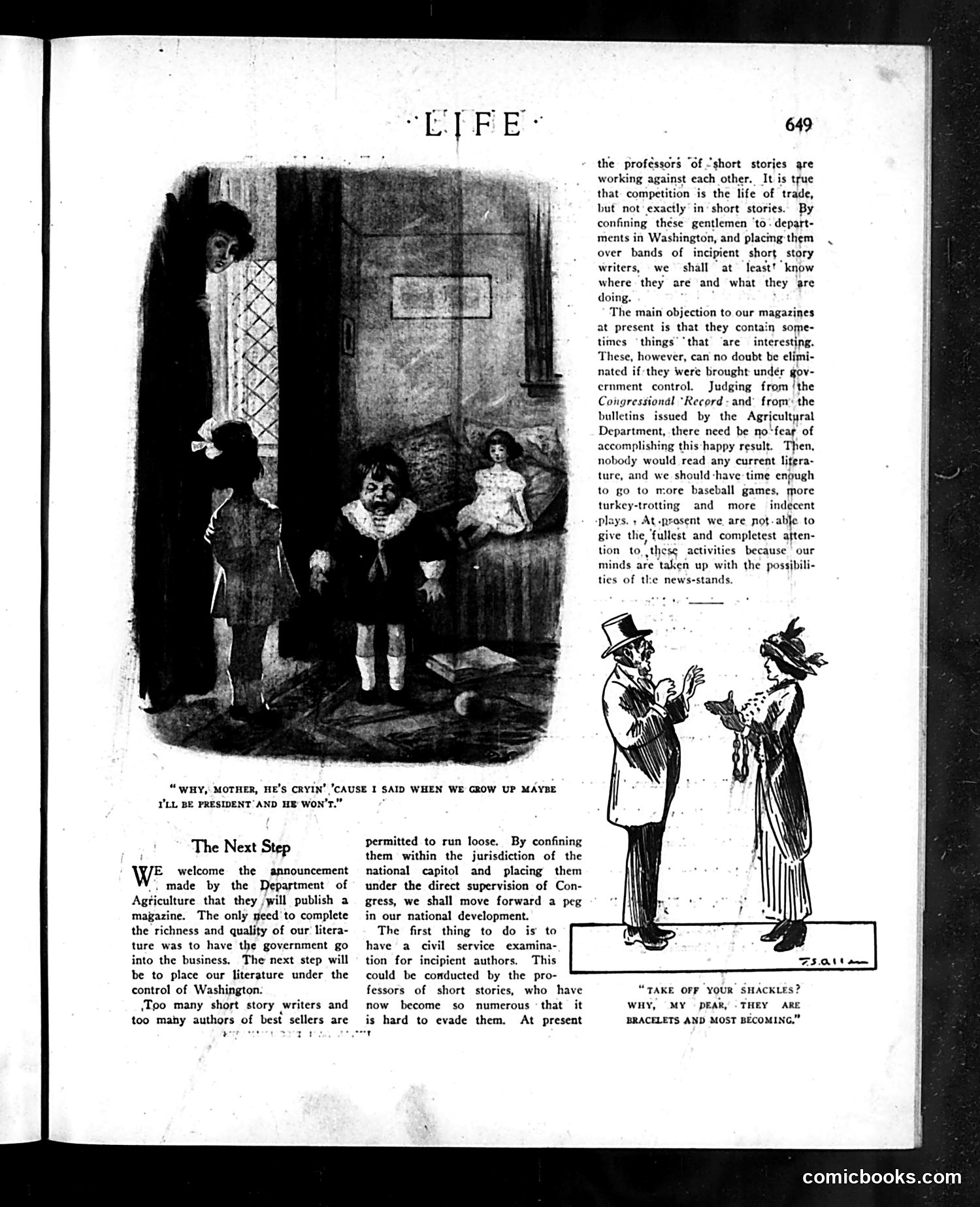
**Main Article ("The Next Step"):** The editorial advocates placing American literature under government control via the Department of Agriculture. It criticizes the proliferation of short-story writers and proposes a civil service examination for "incipient authors" to regulate literary output. The satire mocks excessive government control and bureaucratization of creative work. **Top Illustration:** Shows a mother with children in what appears to be poverty or domestic hardship, captioned with a child's aspirational quote about becoming president—ironic commentary on American social conditions and opportunity. **Bottom Cartoon:** A man tells a woman to "take off your shackles"—she responds "Why, my dear, they're bracelets and must become." This appears to satirize women's fashion or perhaps gender roles, suggesting women mistake constraints for adornment.
📄 Transcribed text from this page (OCR, searchable)
Machine-transcribed from the original scan — historical spelling and the odd misread are preserved.
“ WHY, MOTHER, HE'S CRYIN’ ’CAUSE I SAID WHEN WE GROW UP MAYBE Y'LL BE PRESIDENT AND HE WON'T.” y The Next Step E welcome the apnouncement . made by the Department of Agriculture that they ,will publish a magazine. The only geed to complete the richness and quality of our litera- ture was to have the government go into the business. The next step will be to place our literature under the control of Washington: ‘Too many short story writers and too mahy authors of best sellers are RIPEN IIT | permitted to run loose. By confining them within the jurisdiction of the national capitol and placing them under the direct supervision of Con- gress, we shall move forward a peg in our national development. The first thing to do is to have a civil service examina- tion for incipient authors. This could be conducted by the pro- fessors of short stories, who have now become so numerous that it is hard to evade them. At present the professors working against each other. It is true that competition is the life of trade, but not exactly in’ short stories. By confining these gentlemen ‘to - depart- ments in Washington, and placmg them over bands of incipient short story writers, we shall at leastt “know where they are and what they are doing. ‘ The main objection to our magazines at present is that they contain some- times ‘things’ ‘that ‘are interesting. These, however, can no doubt be elimi- nated if-they Were brought undér gov- ernment control. Judging from /the Congressiondl "Record - and’ from the bulletins issued by the Agricultyral Department, there need be no“fear of accomplishing this ‘happy result. Then, nobody would read any current litera- ture, and we should-have time enough to go to more baseball games, more turkey-trotting and more indecent “plays. + At-prosent we. are pot-able to e the, fullest and completest aften- tion to these activities because our minds are taken up with the possibili- ties of the news-stands. “TAKE OFF YOUR SHACKLES? WHY, MY PEAR, - THEY ARE BRACELETS AND MOST BECOMING.” comicbooks.com