
Life, 1913-10-16 · page 11 of 44
Life — October 16, 1913 — page 11: what you’re looking at
What you’re looking at
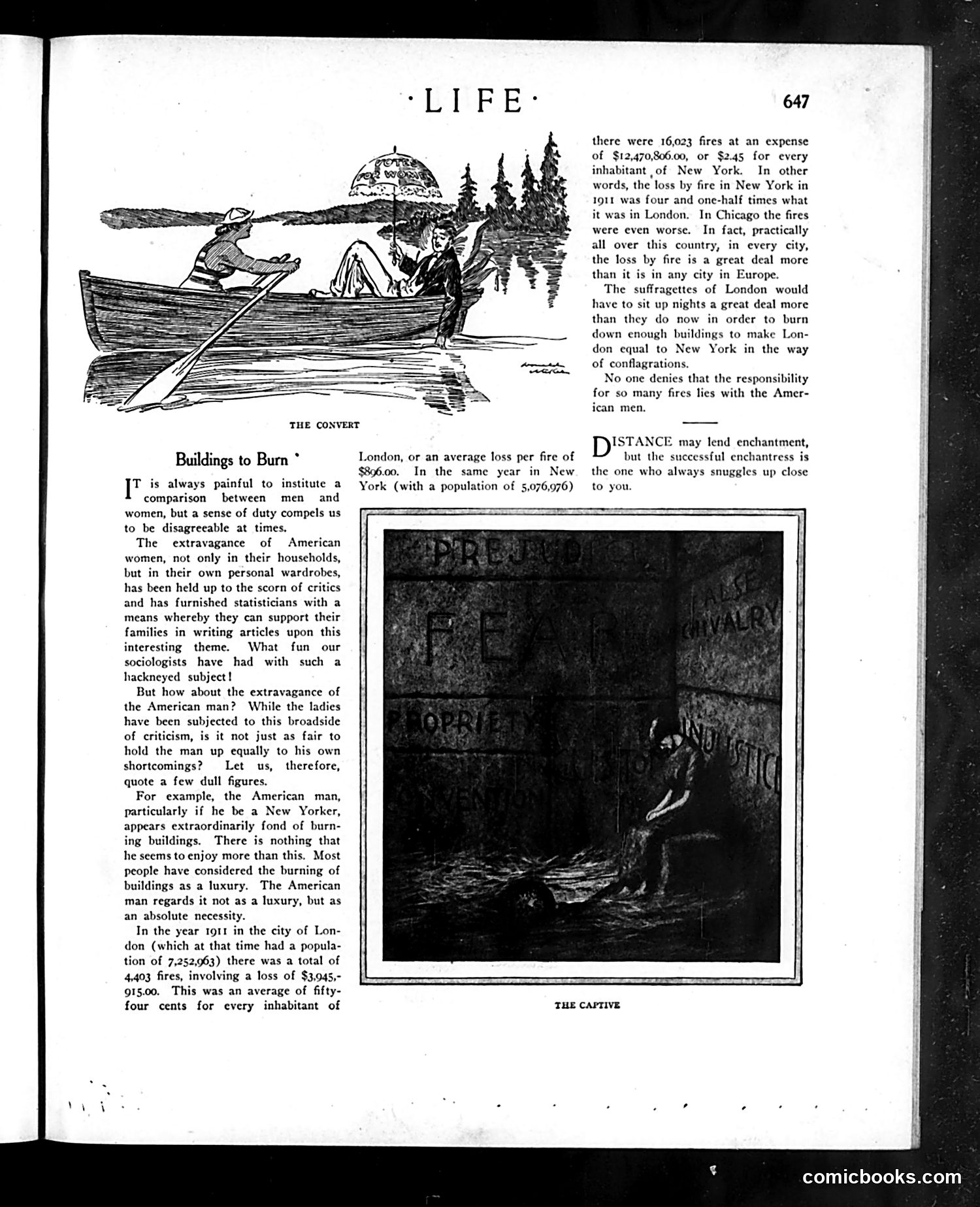
This page satirizes American excess and destructiveness, comparing men's and women's extravagance. The article argues that while female extravagance has been criticized by sociologists, American men—particularly New Yorkers—are equally culpable: they appear "extraordinarily fond of burning buildings." The satire is darkly humorous. The author presents building fires as a "luxury" and "absolute necessity" for American men, citing 1911 London fire statistics to mock American carelessness. The implication: Americans are so wasteful they practically *enjoy* destructive fires, treating property loss as entertainment rather than tragedy. The accompanying illustrations ("The Convert" and "The Captive") appear to visualize this absurdist commentary on American male behavior and consumption patterns.
📄 Transcribed text from this page (OCR, searchable)
Machine-transcribed from the original scan — historical spelling and the odd misread are preserved.
THE CONVERT Buildings to Burn * T is always painful to institute a comparison between men and women, but a sense of duty compels us to be disagreeable at times. The extravagance of American women, not only in their households, but in their own personal wardrobes, has been held up to the scorn of critics and has furnished statisticians with a means whereby they can support their families in writing articles upon this interesting theme. What fun our sociologists have had with such a hackneyed subject! But how about the extravagance of the American man? While the ladies have been subjected to this broadside of criticism, is it not just as fair to hold the man up equally to his own shortcomings? Let us, therefore, quote a few dull figures. For example, the American man, particularly if he be a New Yorker, appears extraordinarily fond of burn- ing buildings. There is nothing that he seems to enjoy more than this. Most people have considered the burning of buildings as a luxury. The American man regards it not as a luxury, but as an absolute necessity. In the year 1911 in the city of Lon- don (which at that time had a popula- tion of 7,252,963) there was a total of 4,403 fires, involving a loss of $3,045,- 915.00. This was an average of fifty- four cents for every inhabitant of London, or an average loss per fire of $896.00. In the same year in New York (with a population of 5,076,976) 647 there were 16,023 fires at an expense of $12,470,806.00, or $2.45 for every inhabitant ,of New York. In other words, the loss by fire in New York in 1911 was four and one-half times what it was in London. In Chicago the fires were even worse. In fact, practically all over this country, in every city, the loss by fire is a great deal more than it is in any city in Europe. The suffragettes of London would have to sit up nights a great deal more than they do now in order to burn down enough buildings to make Lon- don equal to New York in the way of conflagrations. No one denies that the responsibility for so many fires lies with the Amer- ican men. ISTANCE may lend enchantment, but the successful enchantress is the one who always snuggles up close to you. comicbooks.com