
Life, 1913-10-16 · page 25 of 44
Life — October 16, 1913 — page 25: what you’re looking at
What you’re looking at
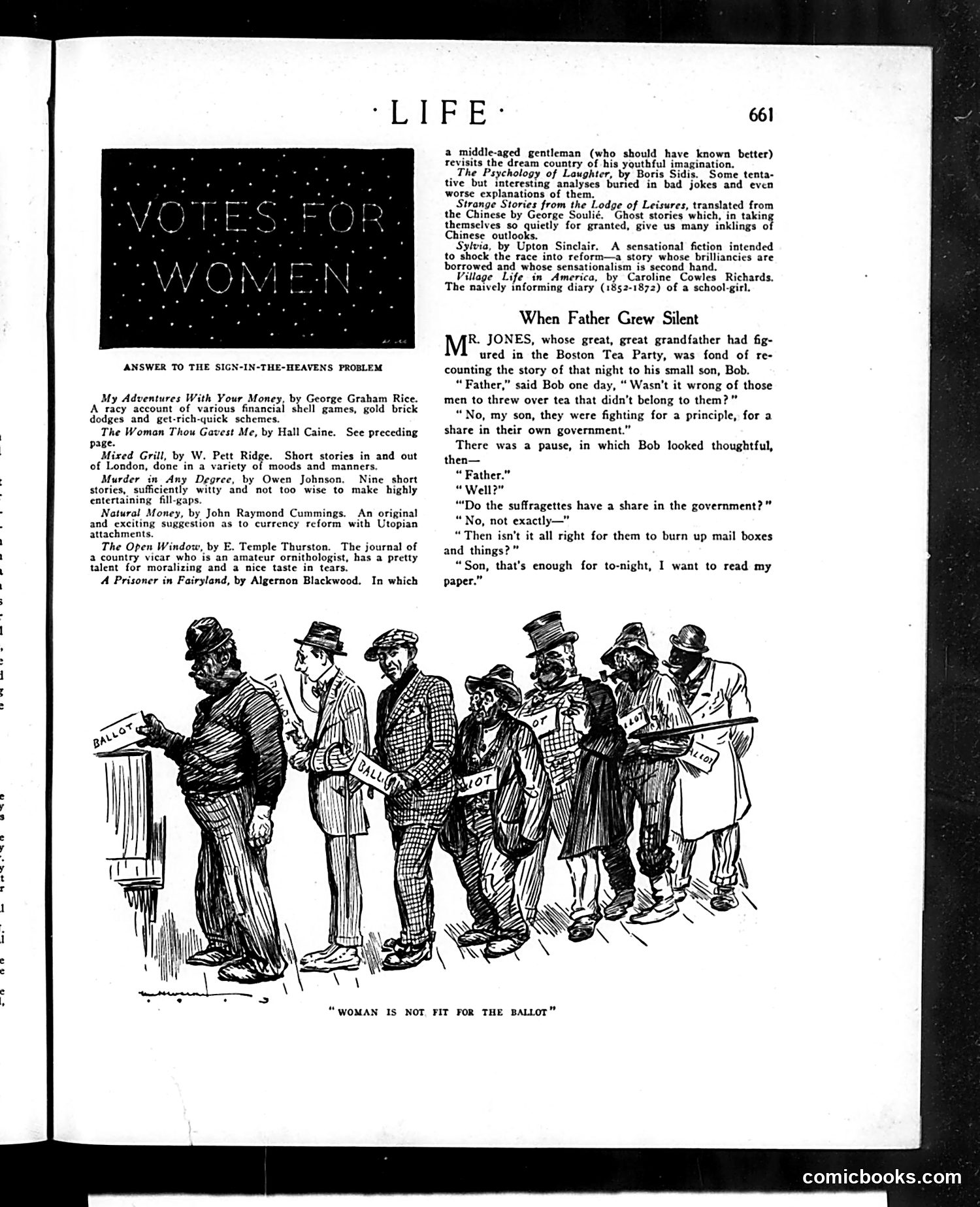
This page satirizes opposition to women's suffrage through a multi-layered approach. The main cartoon depicts men at a ballot box with the caption "Woman is Not Fit for the Ballot," while the accompanying story "When Father Grew Silent" undermines this argument through irony. In the story, Mr. Jones lectures his son Bob about the Boston Tea Party—men justifiably destroying property to fight for political representation. When Bob innocently applies the same logic to suffragettes burning mailboxes to demand voting rights, his father cannot logically object without exposing the hypocrisy of his anti-suffrage position. The father's retreat ("that's enough for to-night") represents the satire's point: opponents of women's suffrage lack rational justification. The page mocks the double standard: men's violent political protest is patriotic principle; women's equivalent action is condemned. This reflects the women's suffrage debate active in early 20th-century America.
📄 Transcribed text from this page (OCR, searchable)
Machine-transcribed from the original scan — historical spelling and the odd misread are preserved.
“LIFE: 661 ANSWER TO THE SIGN-IN-THE-HEAVENS PROBLEM My Adventures With Your Money, by George Graham Rice. A racy account of various financial shell games, gold brick dodges and get-rich-quick schemes. The Woman Thou Gavest Me, by Hall Caine. See preceding page. Mixed Grill, by W. Pett Ridge. Short stories in and out of London, done in a variety of moods and manners. Murder in Any Degree, by Owen Johnson, Nine short stories, sufficiently witty and not too wise to make highly entertaining fill-gaps. Natural Money, by John Raymond Cummings. An original and exciting suggestion as to currency reform with Utopian attachments. The Open Window, by E. Temple Thurston. The journal of a country vicar who is an amateur ornithologist, has a pretty talent for moralizing and a nice taste in tears, A Prisoner in Fairyland, by Algernon Blackwood. In which a middle-aged gentleman (who should have known better) revisits the dream country of his youthful imagination. _ The Psychology of Laughter, by Boris Sidis. Some tenta- tive but interesting analyses buried in bad jokes and even worse explanations of them, Strange Stories from the Lodge of Leisures, translated from the Chinese by George Soulié, Ghost stories which, in takin, themselves so quietly for granted, give us many inklings of Chinese outlooks. Sylvia, by Upton Sinclair. A sensational fiction intended to shock the race into reform—a story whose brilliancies are borrowed and whose sensationalism is second hand. Village Life in America, by Caroline Cowles Richards. The naively informing diary (1852-1872) of a school-girl, When Father Grew Silent 'R. JONES, whose great, great grandfather had fig- ured in the Boston Tea Party, was fond of re- counting the story of that night to his small son, Bob. “Father,” said Bob one day, “ Wasn't it wrong of those men to threw over tea that didn’t belong to them?" “No, my son, they were fighting for a principle, for a share in their own government.” There was a pause, in which Bob looked thoughtful, then— “ Father.” “Well?” “Do the suffragettes have a share in the government?” No, not exactly—” “Then isn’t it all right for them to burn up mail boxes and things?” “Son, that's enough for to-night, I want to read my paper.” “WOMAN IS NOT FIT FOR THE BALLOT” comicbooks.com