
Life, 1913-10-16 · page 20 of 44
Life — October 16, 1913 — page 20: what you’re looking at
What you’re looking at
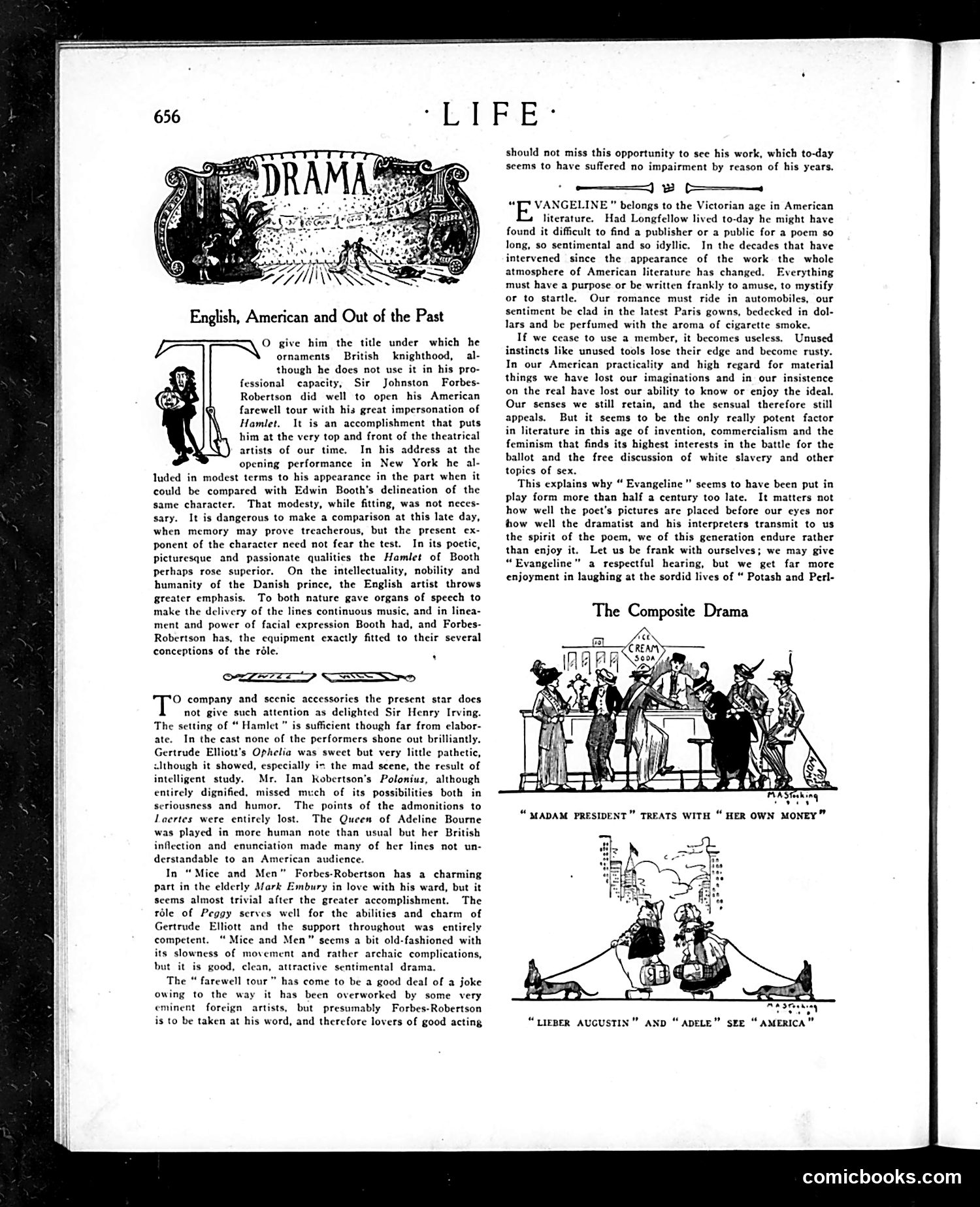
This page reviews British actor Sir Johnston Forbes-Robertson's American farewell tour, focusing on his performances in *Hamlet* and *Mice and Men*. **Main Review:** The text praises Forbes-Robertson's *Hamlet* as superior in "intellectuality, nobility and humanity" compared to Edwin Booth's famous interpretation, though acknowledges Booth's version was more "poetic" and "picturesque." Supporting cast members receive mixed reviews—Gertrude Elliott's Ophelia is noted as sweet but lacking pathos. **"Evangeline" Essay:** A separate piece critiques Longfellow's Victorian poem as unmarketable to modern audiences, who demand purpose, amusement, or shock rather than sentimentality. The author notes American literature's tastes have fundamentally shifted away from romantic idealism. **Cartoons:** Two illustrated sketches titled "The Composite Drama" appear to satirize theatrical conventions, though specific references are unclear from the image alone. The page reflects early 20th-century theatrical criticism and anxieties about changing American cultural values.
📄 Transcribed text from this page (OCR, searchable)
Machine-transcribed from the original scan — historical spelling and the odd misread are preserved.
English, American and Out of the Past O give him the title under which he ornaments British knighthood, al- though he does not use it in his pro- fessional capacity, Sir Johnston Forbes- Robertson did well to open his American farewell tour with his great impersonation of Hamlet. It is an accomplishment that puts him at the very top and front of the theatrical artists of our time. In his address at the opening performance in New York he al- luded in modest terms to his appearance in the part when it could be compared with Edwin Booth’s delineation of the same character. That modesty, while fitting, was not neces- sary. It is dangerous to make a comparison at this late day, when memory may prove treacherous, but the present ex- ponent of the character need not fear the test. In its poetic, picturesque and passionate qualities the Hamlet of Booth perhaps rose superior. On the intellectuality, nobility and humanity of the Danish prince, the English artist throws greater emphasis. To both nature gave organs of speech to make the delivery of the lines continuous music, and in linea- ment and power of facial expression Booth had, and Forbes- Robertson has, the equipment exactly fitted to their several conceptions of the réle. OEE > © company and scenic accessories the present star docs not give such attention as delighted Sir Henry Irving. The setting of “ Hamlet ” is sufficient though far from elabor- ate. In the cast none of the performers shone out brilliantly. Gertrude Elliott's Ophelia was sweet but very little pathetic, though it showed, especially in the mad scene, the result of intelligent study. Mr. Ian Kobertson’s Polonius, although entirely dignified, missed much of its possibilities both in seriousness and humor. The points of the admonitions to Lacrtes were entirely lost. The Queen of Adeline Bourne was played in more human note than usual but her British inflection and enunciation made many of her lines not un- derstandable to an American audience. In “Mice and Men” Forbes-Robertson has a charming part in the elderly Mark Embury in love with his ward, but it seems almost trivial after the greater accomplishment. The réle of Peggy serves well for the abilities and charm of Gertrude Elliott and the support throughout was entirely competent. “ Mice and Men” seems a bit old-fashioned with its slowness of movement and rather archaic complications, but it is good, clean, attractive sentimental drama. The “farewell tour” has come to be a good deal of a joke owing to the way it has been overworked by some very eminent foreign artists, but’ presumably Forbes-Robertson is to be taken at his word, and therefore lovers of good acting F.E* should not miss this opportunity to see his work, which to-day seems to have suffered no impairment by reason of his years. ————J »W@ ‘Es NGELINE " belongs to the Victorian age in American literature. Had Longfellow lived to-day he might have found it difficult to find a publisher or a public for a poem so long, so sentimental and so idyllic. In the decades that have intervened since the appearance of the work the whole atmosphere of American literature has changed. Everything must have a purpose or be written frankly to amuse, to mystify or to startle. Our romance must ride in automobiles, our sentiment be clad in the latest Paris gowns, bedecked in dol- lars and be perfumed with the aroma of cigarette smoke. If we cease to use a member, it becomes useless. Unused instincts like unused tools lose their edge and become rusty. In our American practicality and high regard for material things we have lost our imaginations and in our insistence on the real have lost our ability to know or enjoy the ideal. Our senses we still retain, and the sensual therefore still appeals. But it seems to be the only really potent factor in literature in this age of invention, commercialism and the feminism that finds its highest interests in the battle for the ballot and the free discussion of white slavery and other topics of sex. This explains why “ Evangeline" seems to have been put in play form more than half a century too late. It matters not how well the poet's pictures are placed before our eyes nor how well the dramatist and his interpreters transmit to us the spirit of the poem, we of this generation endure rather than enjoy it. Let us be frank with ourselves; we may give “ Evangeline" a respectful hearing, but we get far more enjoyment in laughing at the sordid lives of “ Potash and Perl- The Composite Drama sheng “LIEBER AUGUSTIN" AND “ ADELE” SEE “ AMERICA” comicbooks.com