
A complete issue · 44 pages · 1913
Life — September 18, 1913
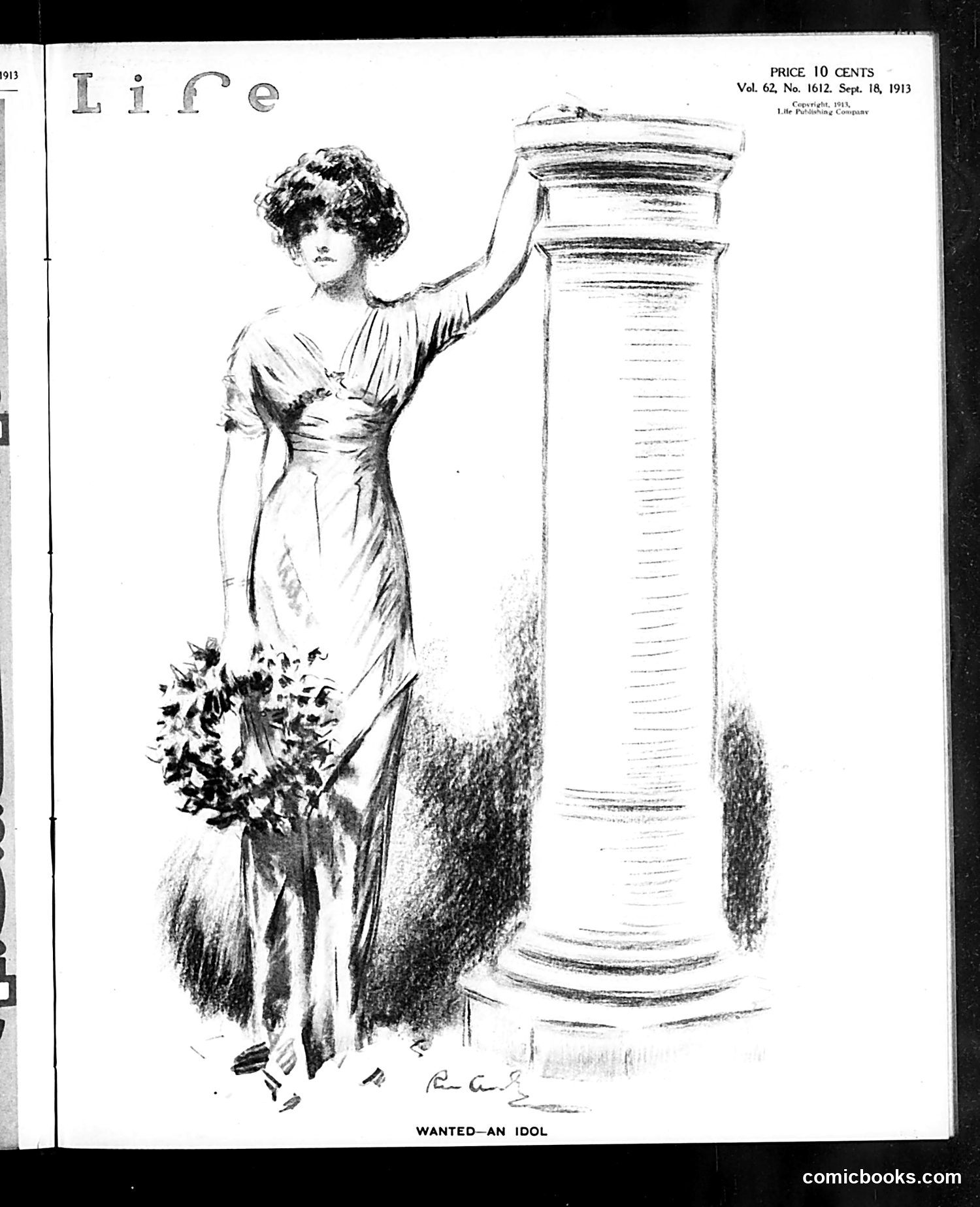
This sketch satirizes early 20th-century American culture's obsession with celebrity and idealization. The elegant woman in classical dress, posed beside a Grecian column, represents the public's insatiable appetite for heroic figures and idols to worship. The caption "Wanted—An Idol" suggests society is searching for someone to elevate and admire. The classical artistic style—the draped gown, flowers, and architectural setting—evokes traditional notions of beauty and perfection, implying Americans construct idealized versions of public figures rather than accepting real people. This appears to critique both celebrity culture and the gap between public personas and reality, a timeless theme that remains relevant today.
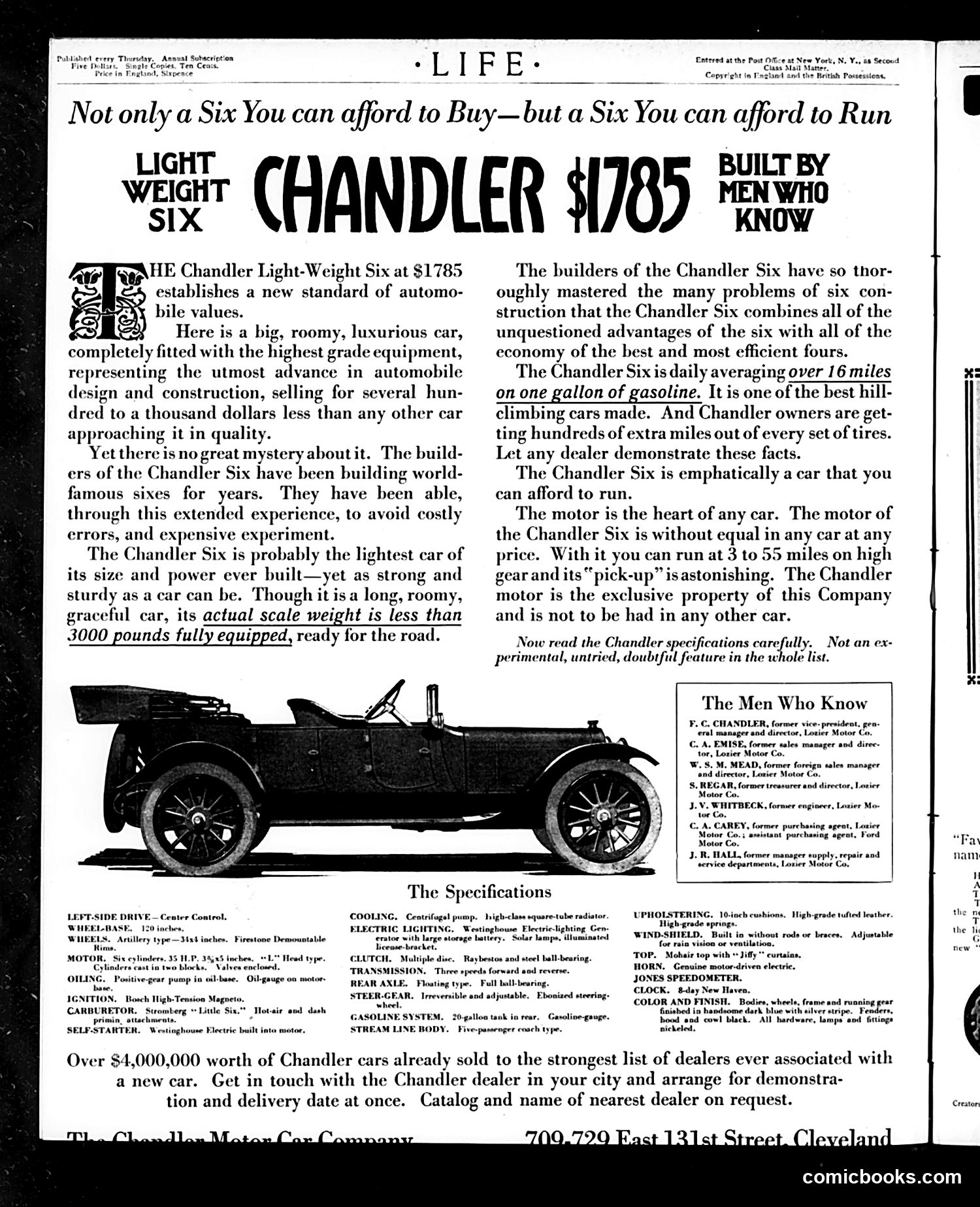
This page is **primarily an automobile advertisement**, not satirical content. It promotes the Chandler Light-Weight Six automobile priced at $1,785, marketed as affordable yet luxurious. The ad emphasizes the car's efficiency (over 16 miles per gallon) and light weight (under 3,000 pounds fully equipped) while claiming superior engineering. It features a side-view illustration of the vehicle and lists "The Men Who Know"—executives from Chandler and Lasier Motor Company who supposedly guarantee quality. The headline's phrase "a Six You can afford to Run" plays on the contemporary appeal of six-cylinder engines as a middle-class luxury. The copy targets buyers seeking economical performance without sacrificing prestige—a key marketing strategy during the 1920s automobile boom. No political satire is present; this is straightforward commercial messaging.
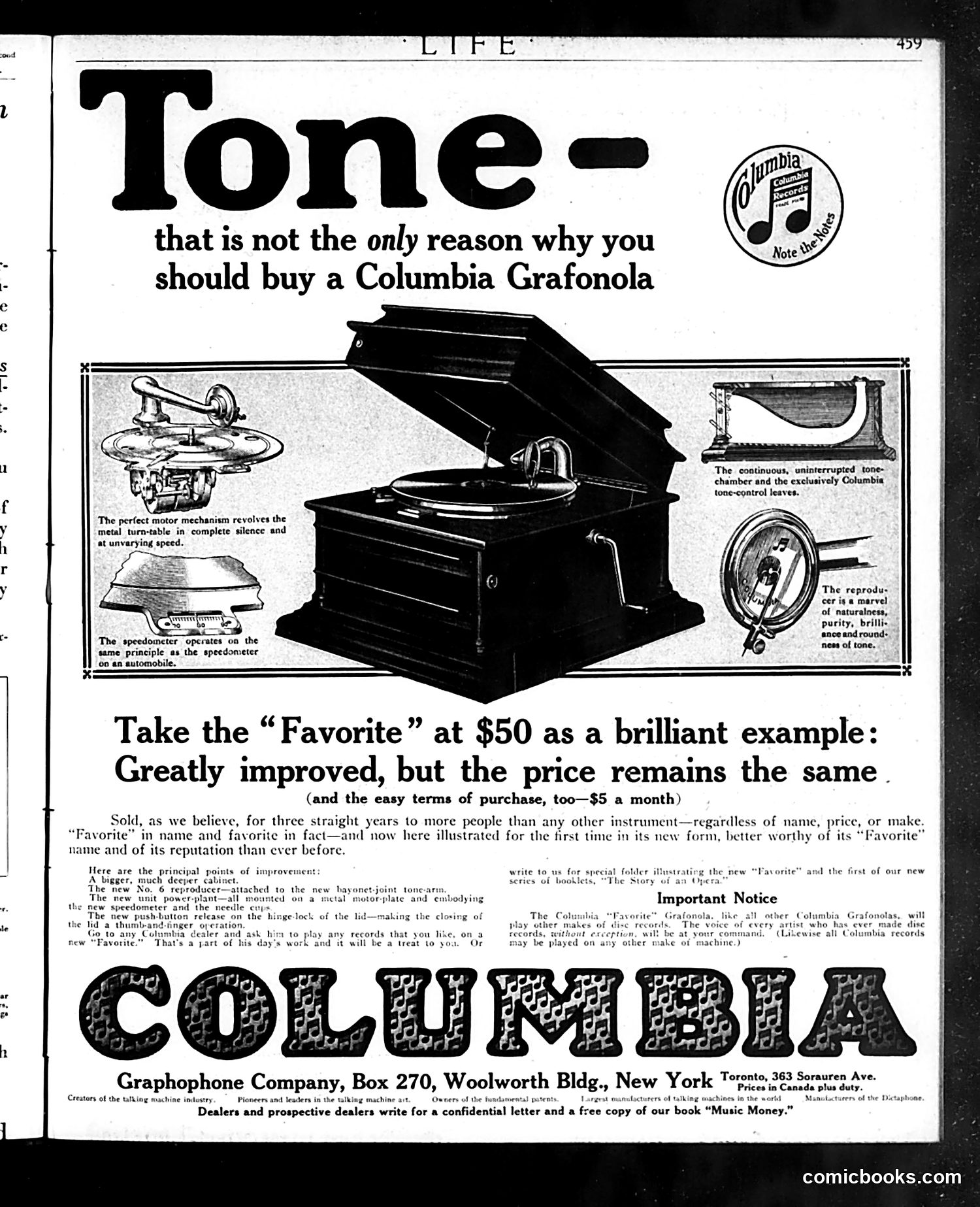
This is primarily a **commercial advertisement**, not political satire. It promotes Columbia's "Favorite" phonograph model at $50, emphasizing improved mechanical features while maintaining the same price point. The ad highlights technical innovations: a superior motor mechanism, improved tone-arm, continuous uninterrupted tone-chamber, and refined reproducer for "purity, brilliance and richness of tone." The "Tone" headline suggests Columbia is positioning sonic quality as a primary selling point beyond mere affordability. An "Important Notice" warns that Columbia records work exclusively on Columbia machines, protecting their market. The page reflects early 20th-century consumer culture, where phonographs were becoming household products. There is **no satire or political commentary**—this is straightforward product marketing aimed at middle-class buyers through Life magazine's readership.
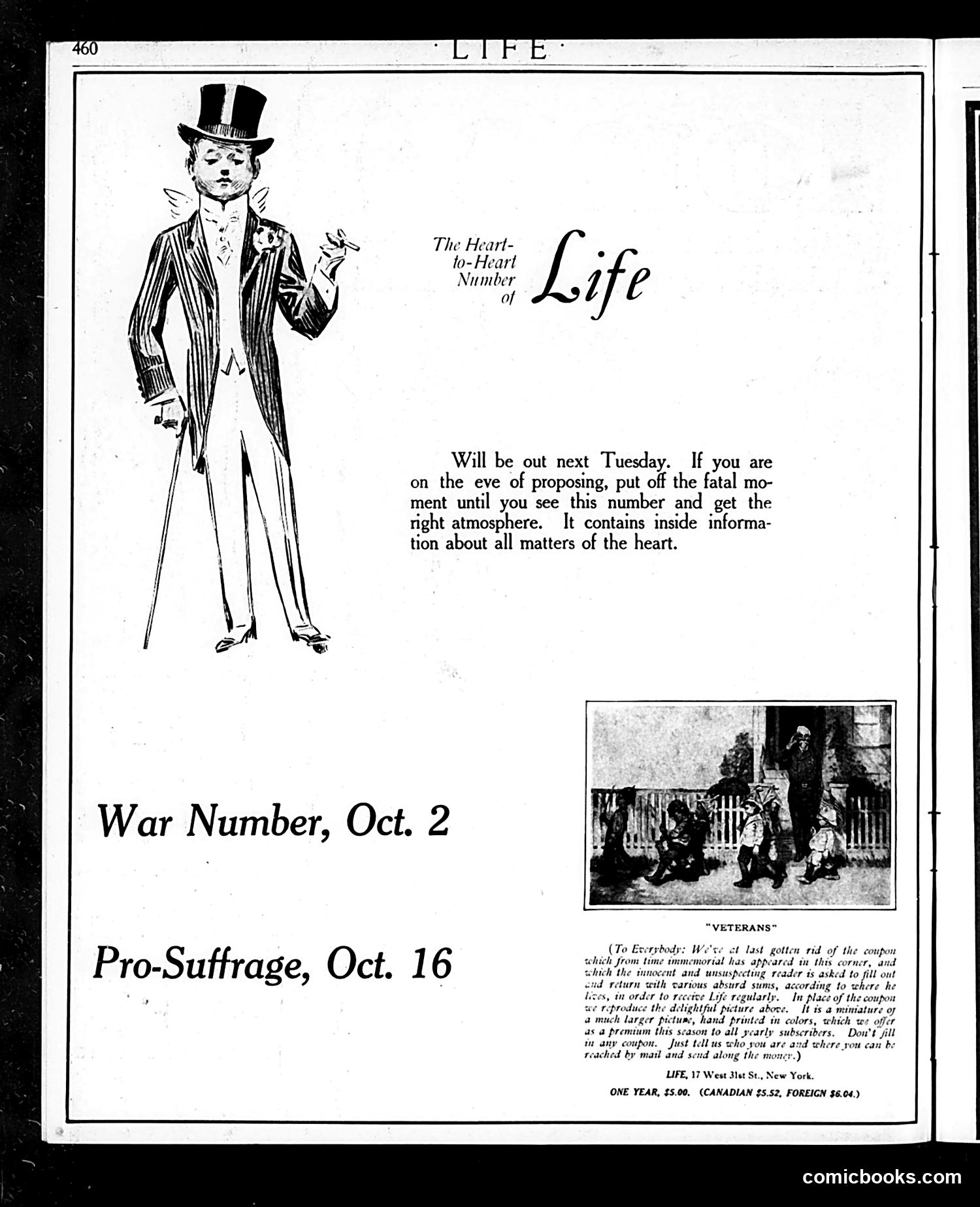
This page advertises Life magazine's upcoming "Heart-to-Heart Number," promoting it as essential reading for anyone considering marriage proposals. The elegant illustration shows a well-dressed gentleman in top hat and tailcoat—appearing to represent an idealized suitor or romantic figure of the era. The page also announces two special upcoming issues: a "War Number" (October 2) and a "Pro-Suffrage" issue (October 16). These dates suggest this is from 1915 or 1916, when women's suffrage was a major political debate in America, and World War I dominated international news. The juxtaposition humorously presents romance and politics as equally momentous Life magazine topics, reflecting the magazine's satirical approach to contemporary American concerns.
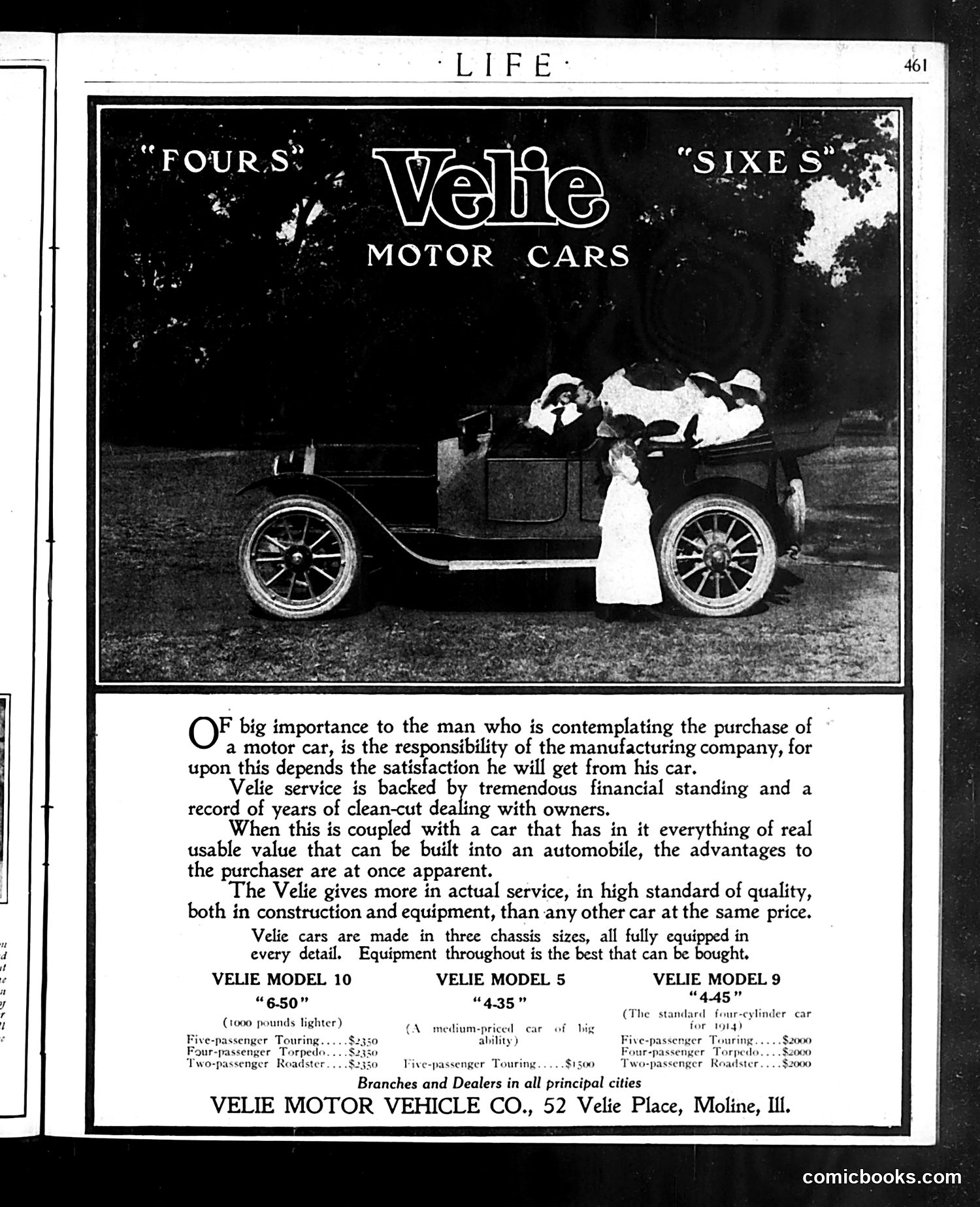
This page is primarily **advertising, not satire or political cartooning**. It's a full-page advertisement for Velie Motor Cars, appearing in *Life* magazine (page 461). The image shows an early automobile (appears to be from around 1910s-1920s era) with passengers in period dress, demonstrating the vehicle's spaciousness. The ad emphasizes Velie's reliability, financial stability, and quality construction compared to competitors at similar prices. The text highlights three chassis sizes available—Models 10, 5, and 9—with pricing and specifications. The company, based in Moline, Illinois, positions itself as a trustworthy manufacturer offering superior value. No political commentary or satirical content is present; this is straightforward automotive marketing targeted at potential buyers considering a motor car purchase.
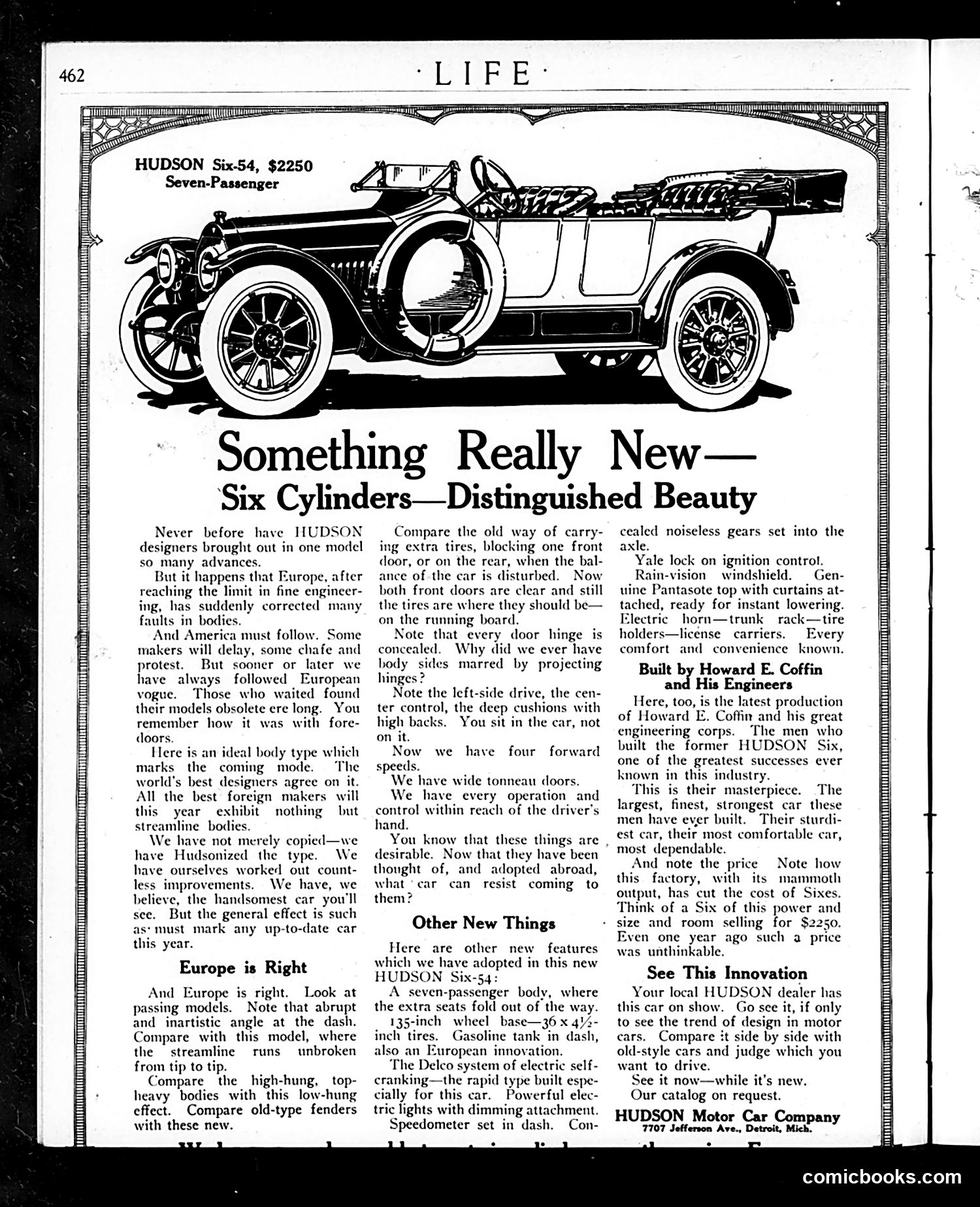
This is **not a cartoon or satire page**, but rather a **straightforward automobile advertisement** from Life magazine. The page advertises the **Hudson Six-54**, a seven-passenger car priced at $2250. The content is a genuine product pitch, not political satire. It emphasizes the vehicle's European-influenced engineering innovations: six cylinders, four forward speeds, improved door mechanisms, and electric self-starting. The text compares Hudson favorably to European models and older American designs, highlighting features like the left-side drive and improved comfort. The manufacturer boasts the car represents cutting-edge American industrial achievement. This reflects the 1910s-1920s automotive boom when manufacturers competed aggressively and Life's pages mixed editorial content with paid advertising.
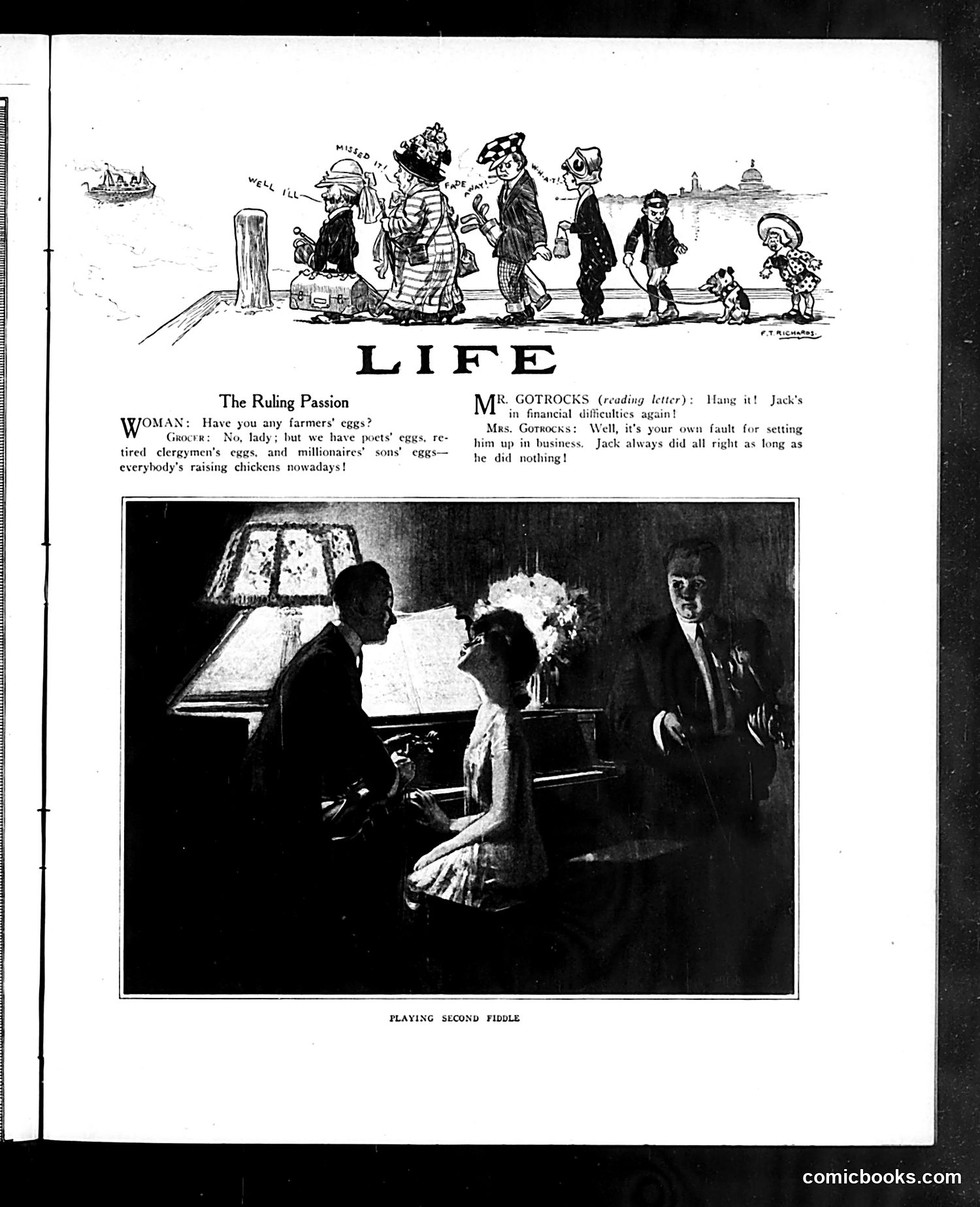
This satirical page critiques wealthy Americans' obsession with raising chickens as a status symbol. The top cartoon shows various society figures parading along a waterfront—a visual commentary on how this hobby has become fashionable among the elite. The dialogue satirizes class pretension: a woman asks a grocer about "farmers' eggs" versus expensive eggs from "retired clergymen" and "millionaires' sons," mocking how the wealthy attach social prestige to ordinary farm products. The photograph titled "Playing Second Fiddle" shows elegantly dressed people gathered around a piano, suggesting that even sophisticated domestic entertainments have taken a backseat to the obsession with poultry-raising among the upper classes. The satire targets how arbitrary status markers become fashionable among the wealthy.
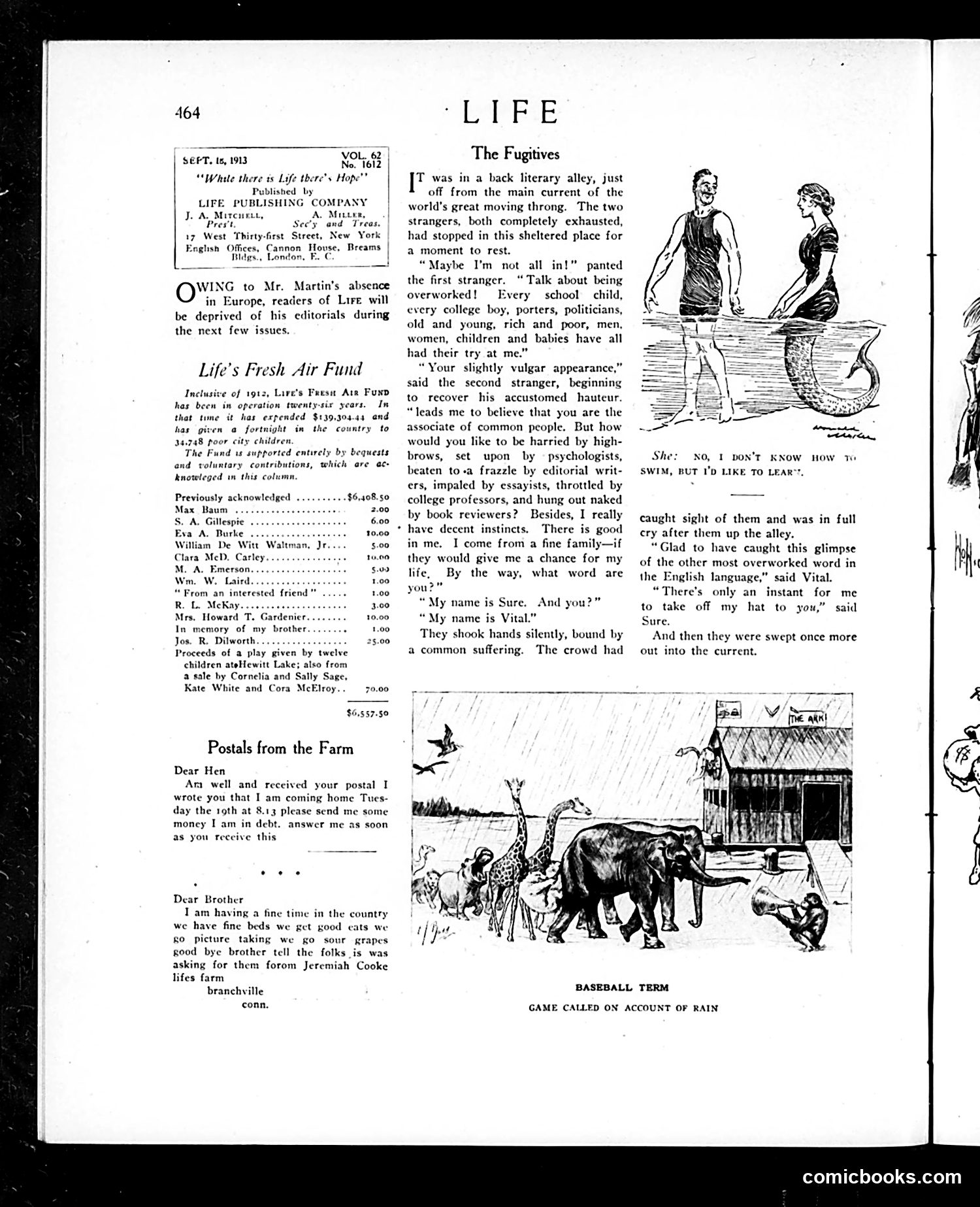
This short story depicts two exhausted strangers meeting in a back alley. The first character complains about being "overworked"—mentioning that "every school child, every college boy, porters, politicians, old and young, rich and poor, men, women, children and babies have all had their try at me." The second stranger, introduced as "Vital," responds by saying there's "only one instant" to escape their shared burden. **The satirical point**: This appears to be personifying abstract concepts—likely "Hope" and "Vital" (as mentioned in the issue's subtitle "While there is Life there's Hope")—as fugitives fleeing from constant public overuse and misapplication. It's social commentary on how these idealistic concepts are exhausted by constant, often shallow invocation by all social classes.
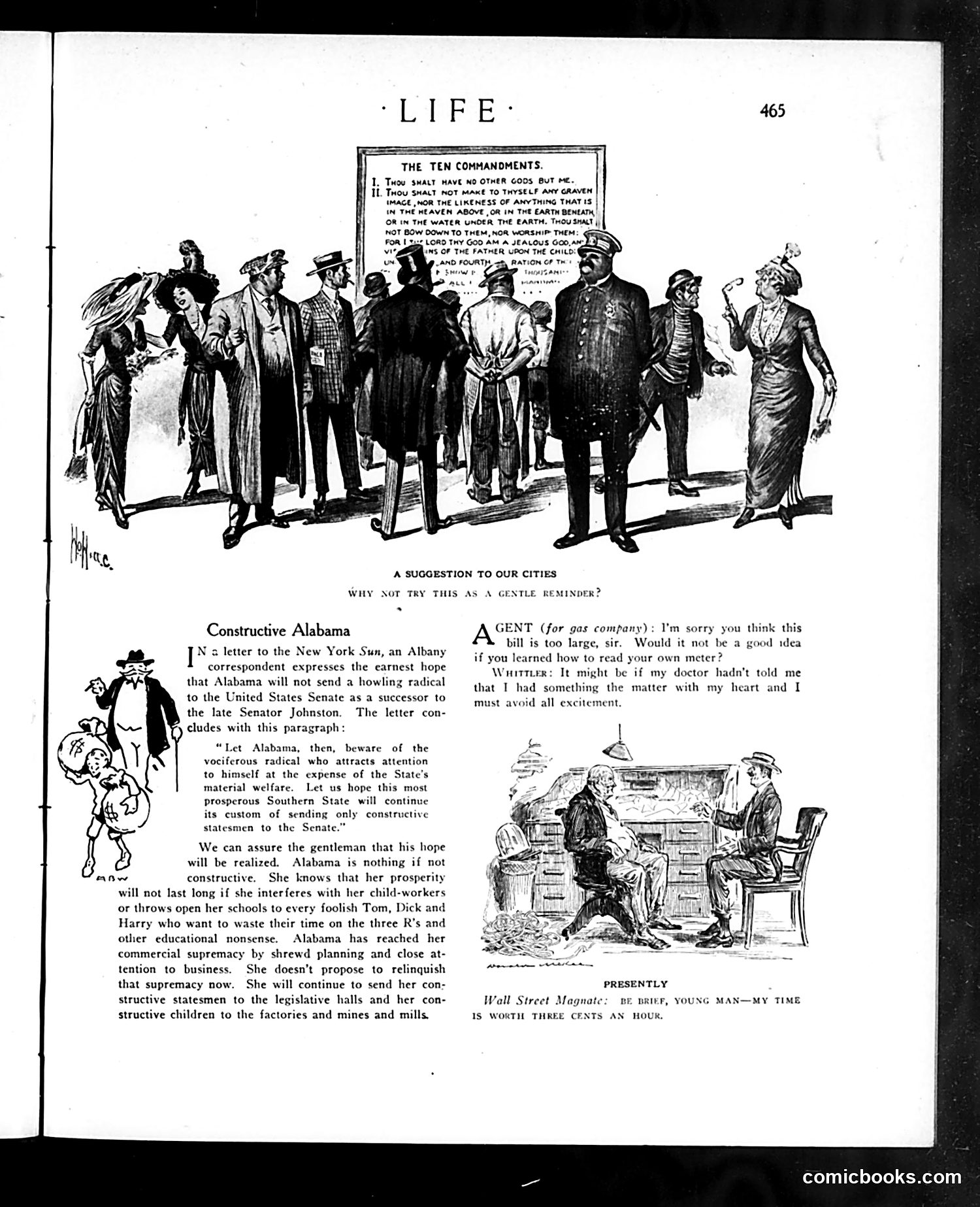
**Top Cartoon: "A Suggestion to Our Cities"** This depicts a group of well-dressed citizens gathered around a tablet displaying the Ten Commandments. The satire suggests that American cities should display religious moral guidance as a "gentle reminder" to their populations—implying that contemporary urban society has abandoned ethical standards. **"Constructive Alabama" Article** This piece praises Alabama for sending "constructive statesmen" rather than "howling radicals" to the Senate, referencing Senator John H. Bankhead. The text celebrates Alabama's commitment to business interests and industrial development while warning against radical political interference. **Bottom Comic: "Presently"** A Wall Street magnate dismisses a young man's labor concerns, asserting his time is worth only three cents per hour—satirizing the era's exploitation of workers and corporate indifference to human dignity.
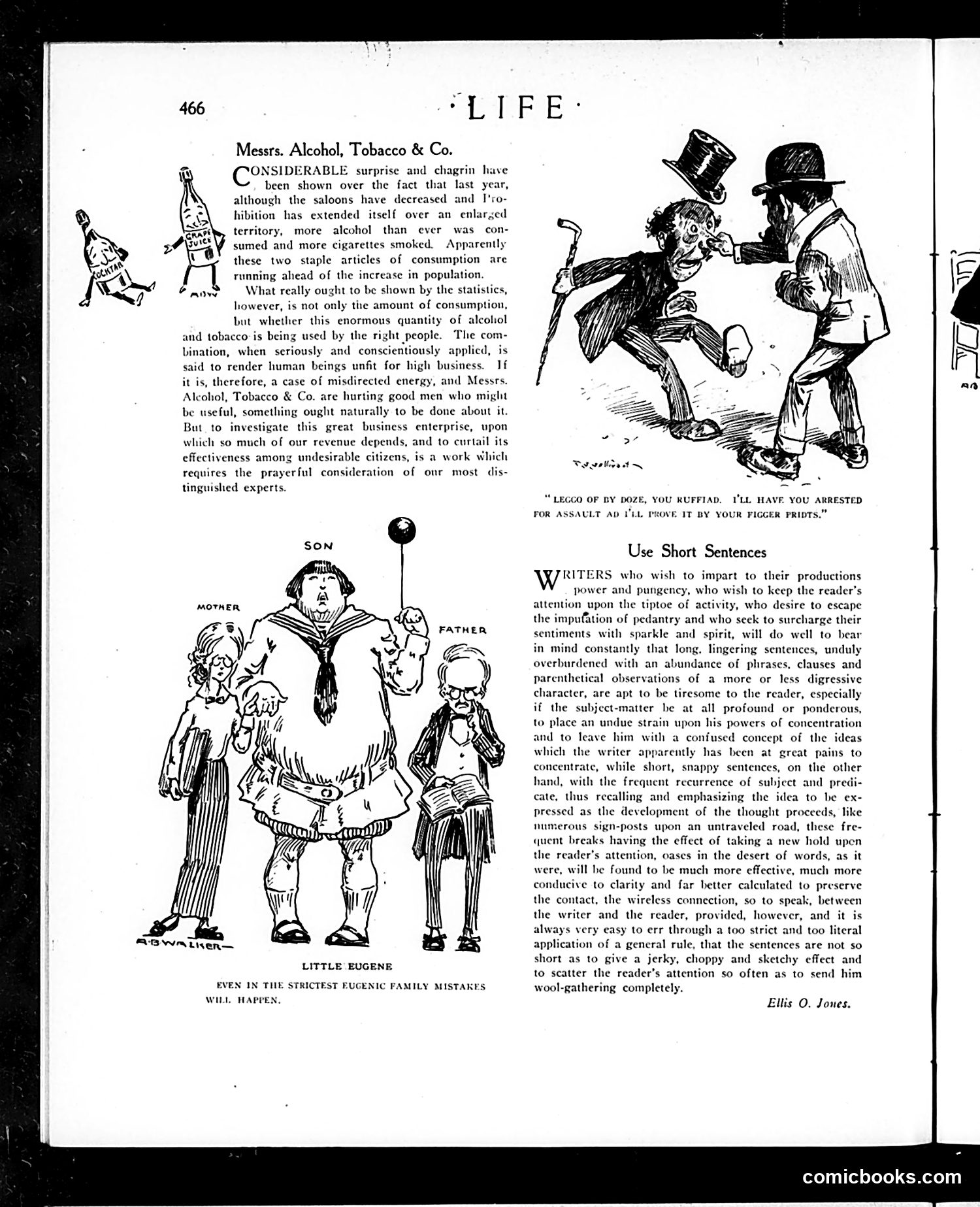
**Top Section - "Messrs. Alcohol, Tobacco & Co.":** This article satirizes the increased consumption of alcohol and tobacco despite Prohibition's expansion. The personified bottles of alcohol and tobacco are depicted as characters "hurting good men." The piece argues these substances render people unfit for business, critiquing both their consumption and the industries profiting from them. **Political Cartoon - "Little Eugene":** Shows a child labeled "Little Eugene" flanked by Mother and Father figures, with a central authority figure (labeled "Son") controlling them via strings like a puppet master. The caption states: "Even in the strictest eugenic family mistakes will happen." This satirizes eugenics pseudoscience popular in the early 20th century, mocking the notion that selective breeding could produce "perfect" humans. **Right Section - "Use Short Sentences":** Writing advice by Ellis O. Jones about effective prose style.
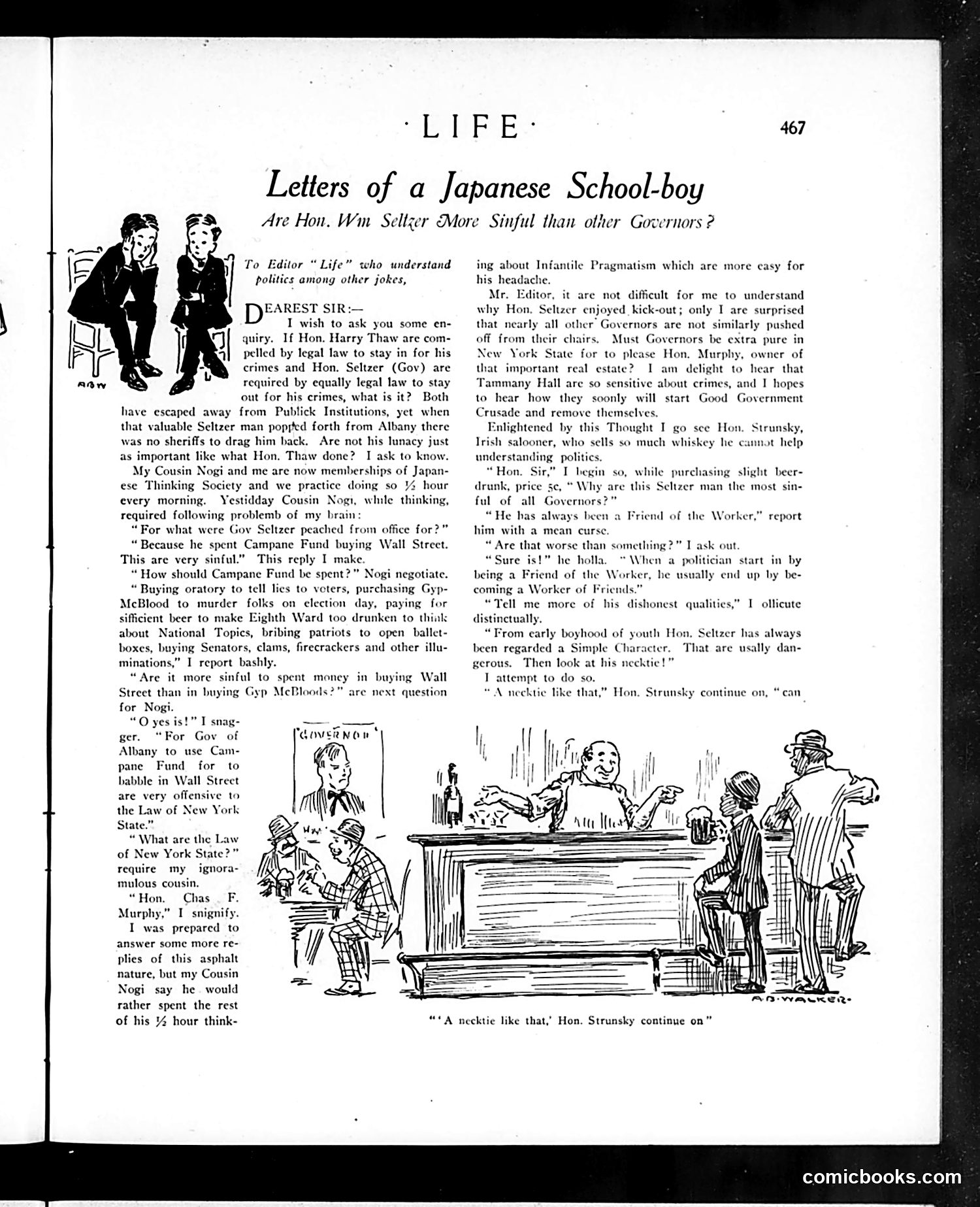
This satirical piece critiques New York State Governor **Hon. William Seltzer** (likely a fictional or obscured name, as the text playfully misspells it). A Japanese observer humorously questions why Seltzer escaped corruption charges while other governors face legal consequences. The letter writer ironically praises Seltzer as a "Friend of the Worker" while listing corrupt practices: buying political support through gyms, using campaign funds for Wall Street speculation, and purchasing voters' loyalty with beer. The joke exposes how Seltzer apparently avoids prosecution for activities other politicians are prosecuted for—suggesting either selective enforcement or genuine untouchability. The illustration shows men at a bar, reinforcing the theme of political corruption tied to drinking establishments and backroom deals.
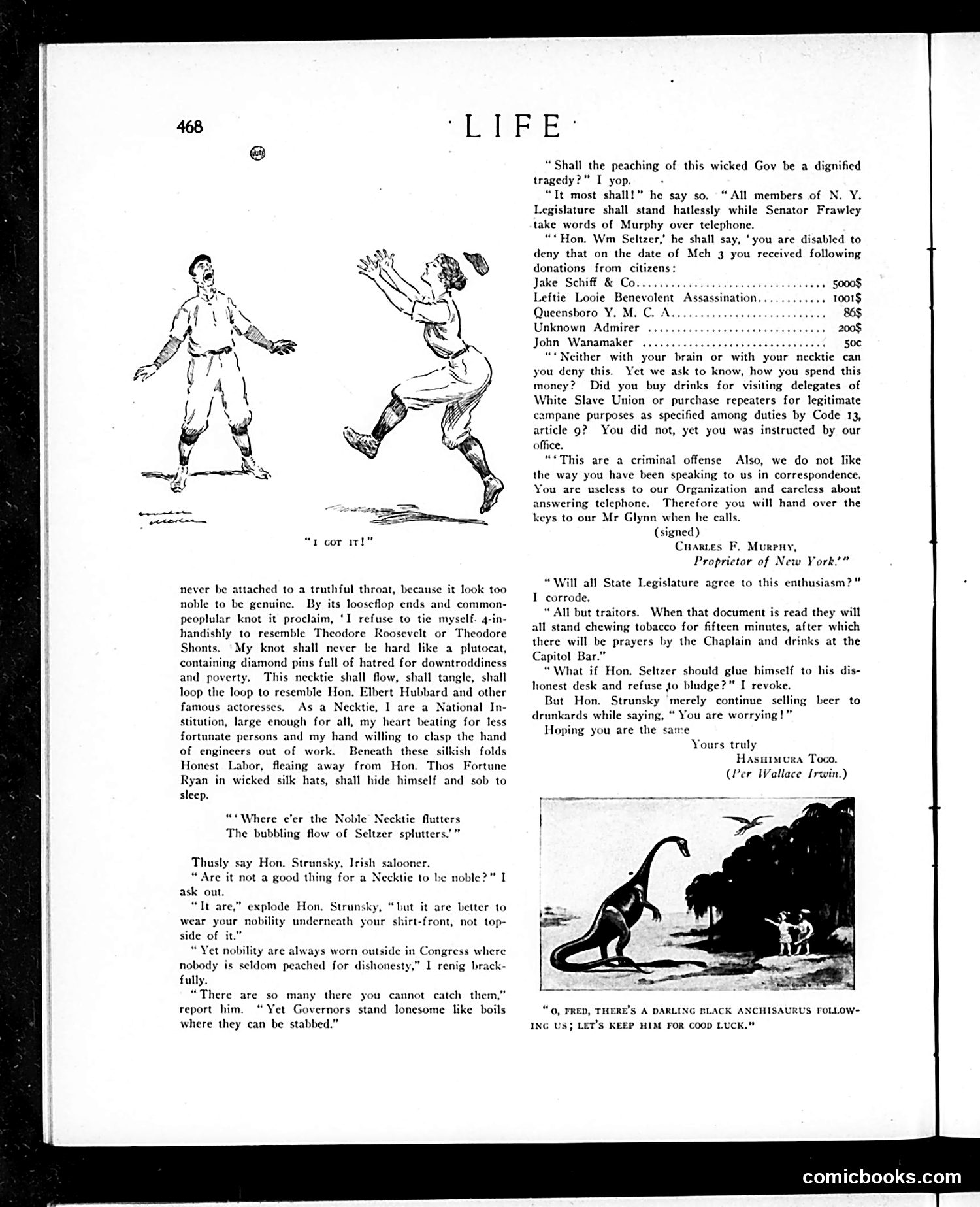
This page contains satirical letters mocking New York politician Senator Frawley and Hon. William Seltzer. The letters accuse them of receiving questionable donations and misusing funds—possibly for the "White Slave Union" or purchasing "repeaters" (fraudulent voters), suggesting electoral corruption. The cartoon at top left shows two figures in what appears to be a boxing or fighting stance, labeled "I GOT IT!" The satire emphasizes these politicians' dishonesty and hypocrisy. The bottom illustration depicts a dinosaur (labeled as a "black archisaurus"), likely a metaphor for corrupt, extinct political practices or outdated politicians who should disappear. The overall point: exposing graft, bribery, and electoral fraud among New York political figures through ridicule and caricature.
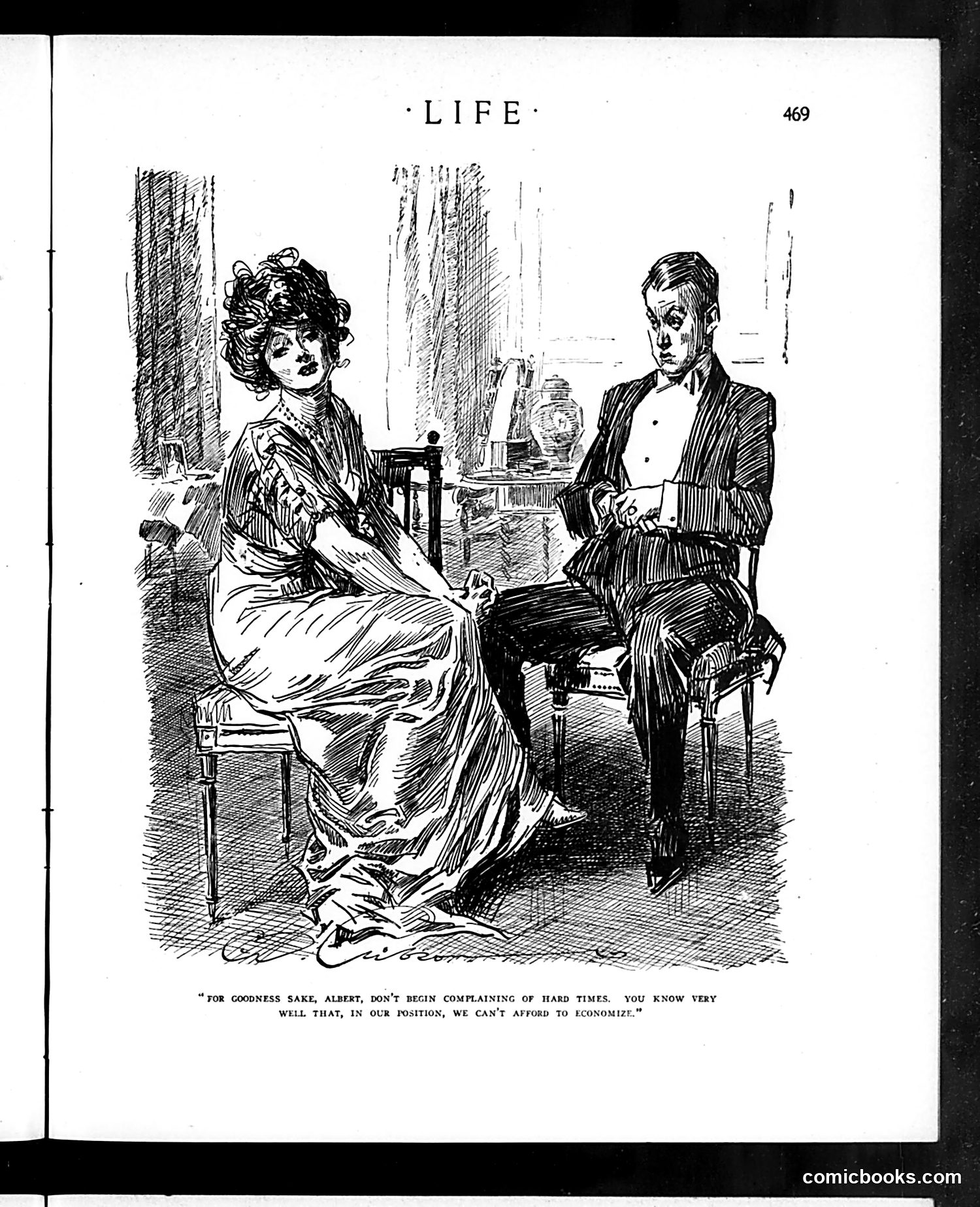
This single-panel cartoon depicts an elegantly dressed couple in an interior setting. A woman in an elaborate gown sits while a man in formal evening wear (tuxedo) stands nearby. The caption reads: "For goodness sake, Albert, don't begin complaining of hard times. You know very well that, in our position, we can't afford to economize." The satire targets wealthy upper-class hypocrisy during economic hardship. The woman's statement is paradoxical—she claims they cannot afford to cut expenses *because* of their high social status, suggesting that maintaining appearances and luxury is more important than actual financial prudence. This mocks the wealthy's self-serving rationalizations for continued extravagance while ordinary citizens struggle economically.
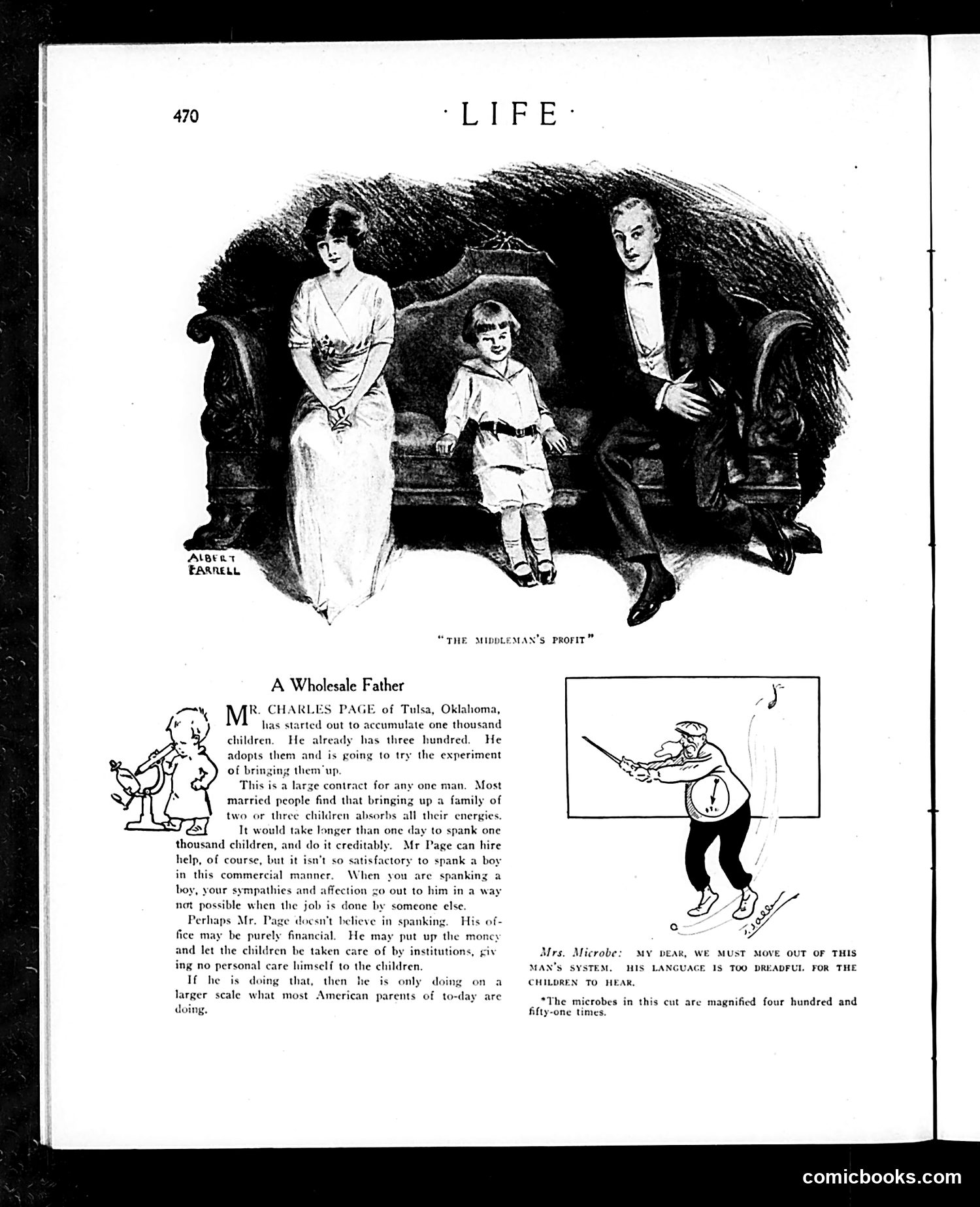
This page satirizes Mr. Charles Page of Tulsa, Oklahoma, who plans to adopt one thousand children. The top illustration ("The Middleman's Profit") shows a well-dressed couple with their own child, suggesting the financial incentive behind such mass adoption. The article mocks Page's scheme as impractical and emotionally cold. While adopting a few children might be manageable, caring for a thousand is absurd—Page would likely hire institutional care rather than provide personal attention. The satire critiques wealthy individuals who use children as a financial enterprise or tax benefit rather than genuinely parenting them. The microscope cartoon joke (right) appears unrelated, offering comic relief about magnified microbes. The satire targets the commodification of child welfare and questions whether large-scale adoption serves children's actual needs.
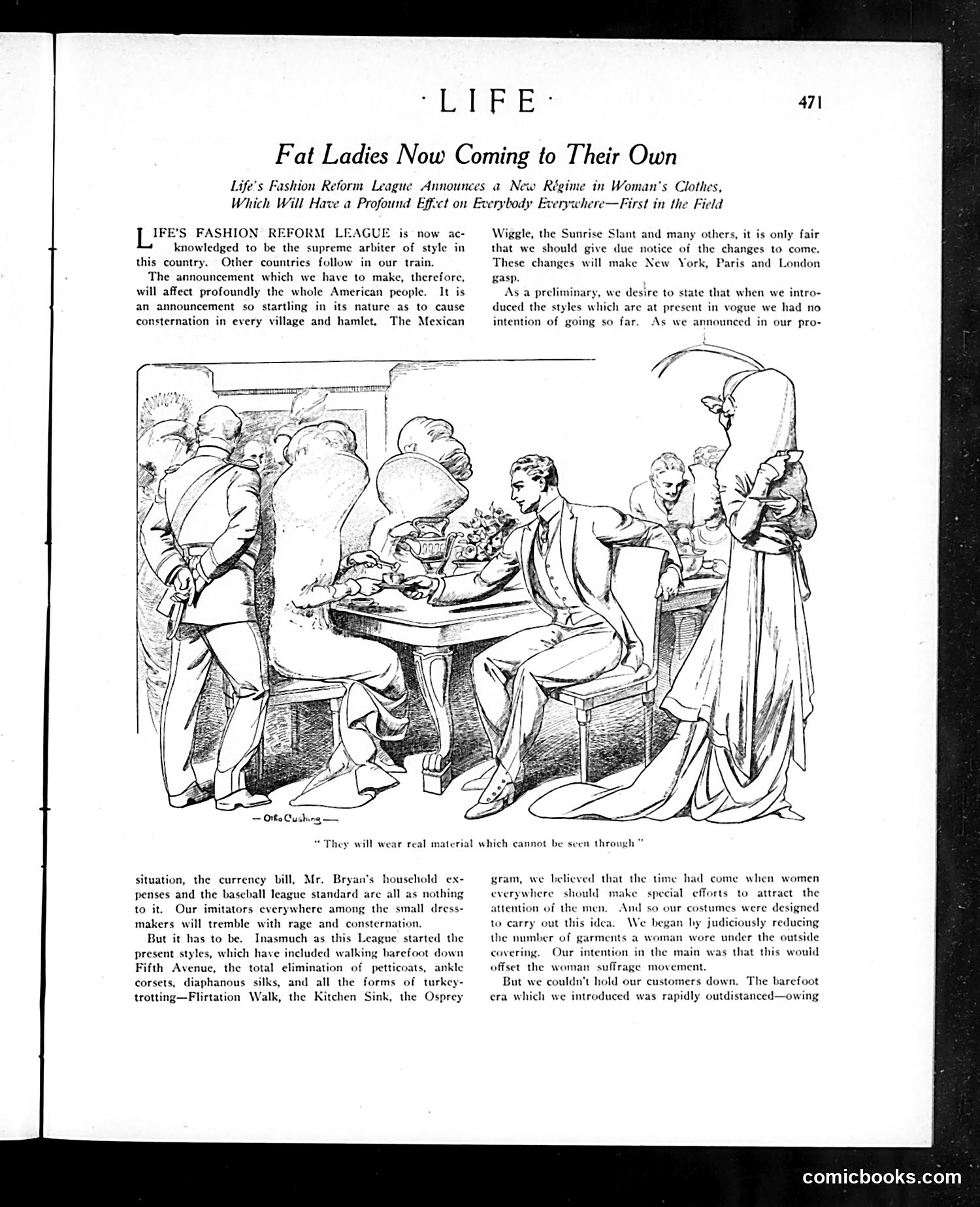
This 1910s satirical piece mocks fashion trends and women's fashion reform. Life magazine's "Fashion Reform League" ironically claims credit for extreme styles—bare feet on Fifth Avenue, elimination of petticoats and corsets, "diaphanous silks"—ostensibly to distract women from the suffrage movement. The cartoon shows portly women at a social gathering, illustrating the headline's joke: "Fat Ladies Now Coming to Their Own." The caption "They will wear real material which cannot be seen through" suggests that previous transparent fashions were scandalous; now heavier fabrics will be required. The satire targets both fashion excess and anti-suffrage sentiment. By attributing women's fashion choices to male-controlled fashion magazines rather than women's agency, and by suggesting fashion was designed to counter suffrage activism, Life ridicules both the fashion industry and those who underestimate women's independence.
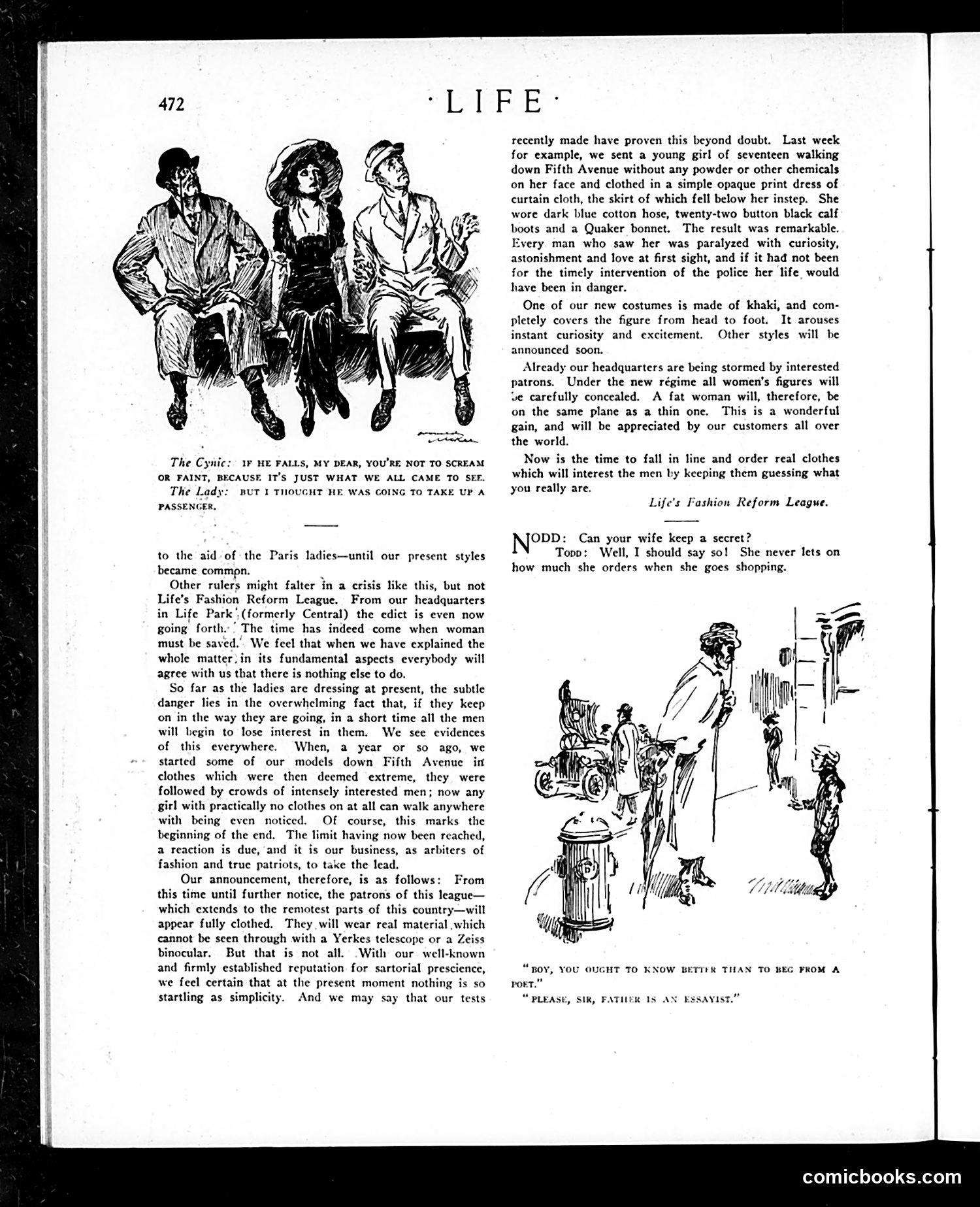
This 1910s *Life* magazine page satirizes women's fashion through "Life's Fashion Reform League," a fake organization proposing an absurd solution to a perceived crisis: men are losing interest in women because fashion has become too revealing. The satire operates on multiple levels. The league claims that showing *less* skin paradoxically generates more male attention—demonstrated by their "experiment" where a fully-clothed teenage girl drew such crowds that police intervention was needed. The khaki costume hiding all body shapes is praised for equalizing women regardless of appearance. The humor targets both fashion excess and the paternalistic male gaze: the league positions itself as "saving" women while actually reinforcing the idea that women's primary value is male attention. The accompanying dialogue jokes mock domestic life (a wife hiding shopping expenses) and class anxiety (a beggar's father being an "essayist"). The top cartoon shows observers expecting a mishap—visual humor about public spectacle—while the middle illustration depicts a street scene with onlookers, reinforcing the fashion display theme.
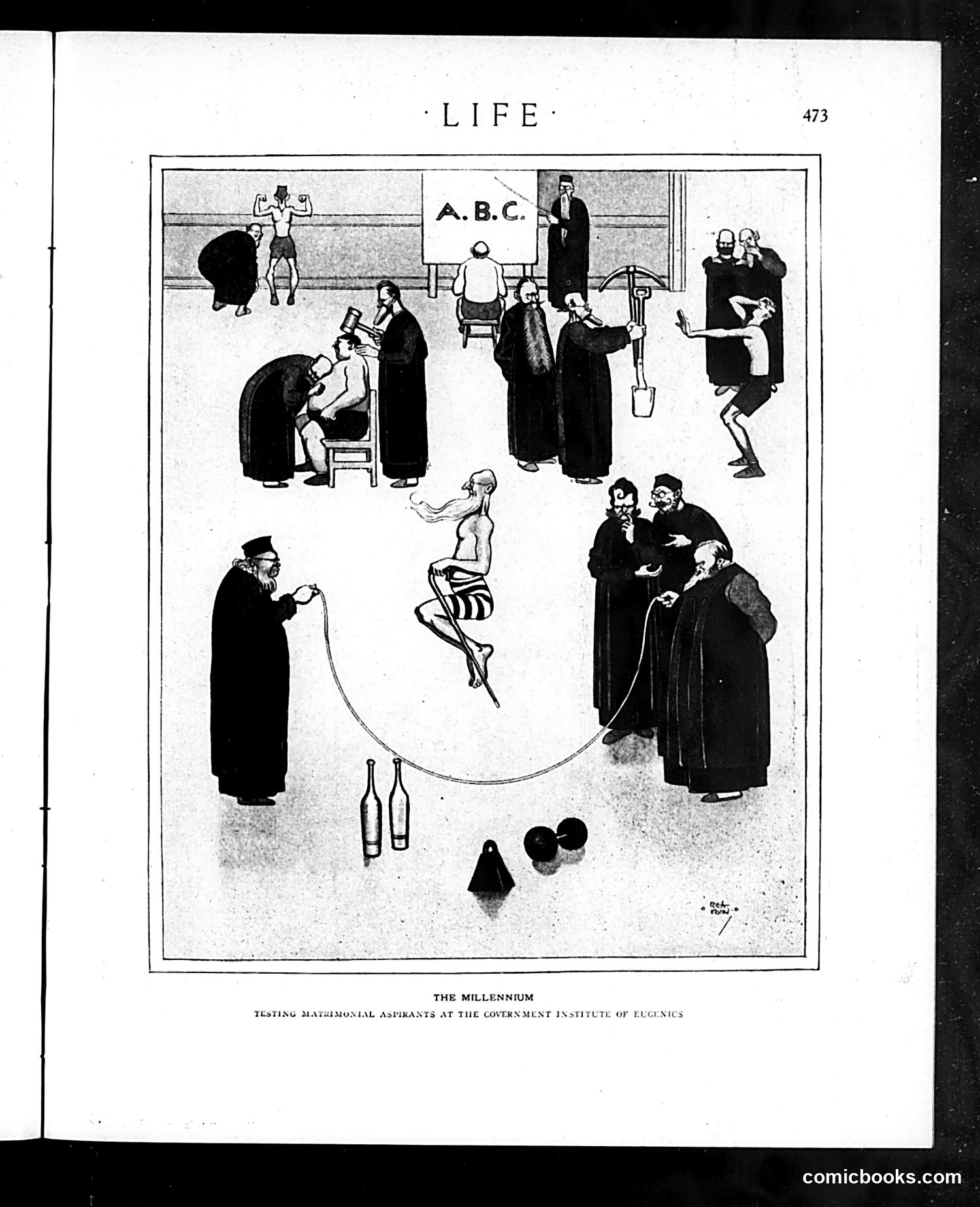
This satirical cartoon titled "The Millennium" mocks early 20th-century eugenics movements by depicting a "Government Institute of Eugenics" where matrimonial candidates are tested and selected. The scene shows various people being evaluated—some exercising to display physical fitness, others being examined by officials in robes. There's an "A.B.C." sign (possibly indicating grading/classification), bottles and other testing apparatus visible, and officials observing candidates like they're livestock at auction. The satire targets the pseudoscientific eugenics craze that was gaining traction in this era, particularly the absurd notion that governments should scientifically control human breeding to "improve" populations. The cartoon ridicules both the pretensions of eugenicists and the dehumanizing aspects of treating human reproduction as a state-controlled scientific project.
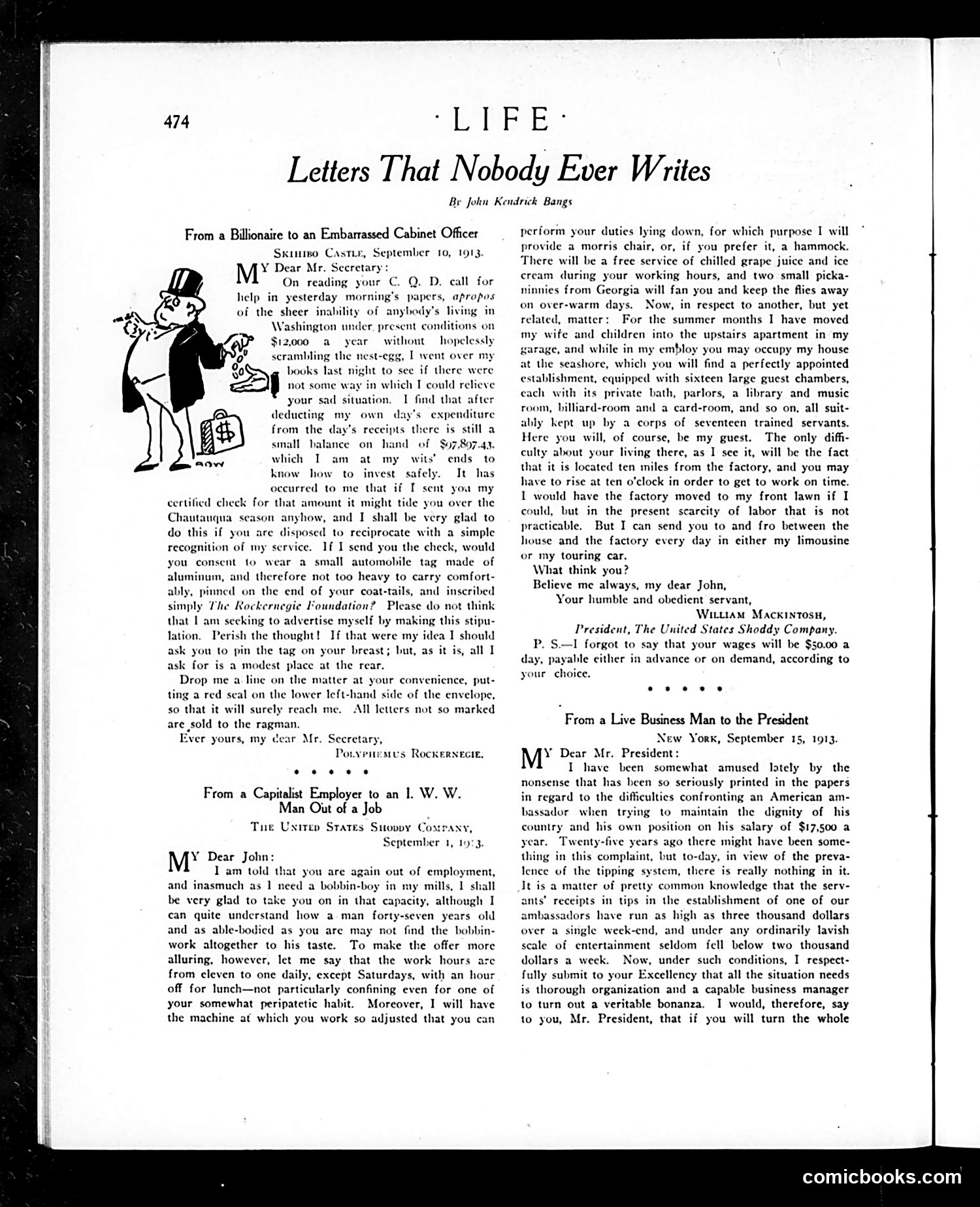
This satirical column by John Kendrick Bangs mocks wealthy industrialists' patronizing attitudes toward workers during the Progressive Era (1913). **First letter:** A billionaire offers financial help to an embarrassed Cabinet Secretary earning $12,000 annually—supposedly insufficient in Washington. The billionaire's "generosity" comes with a humiliating catch: the Secretary must wear an advertising tag on his coat-tails promoting the "Rockefeller Foundation" (the name appears satirically altered). The joke ridicules how the wealthy use charitable donations for self-aggrandizement rather than genuine benevolence. **Second letter:** A factory owner offers employment to an unemployed IWW (Industrial Workers of the World) member with absurdly paternalistic "benefits": lying-down work, grape juice service, and enslaved attendants ("pickaninnies"). The offer's elaborate fakeness—moving the factory to help the worker commute—exposes capitalist hypocrisy about labor conditions. The satire targets wealthy employers' condescension toward workers and their refusal to acknowledge genuine workplace hardships. Both letters exemplify how the rich dress exploitation in false generosity.
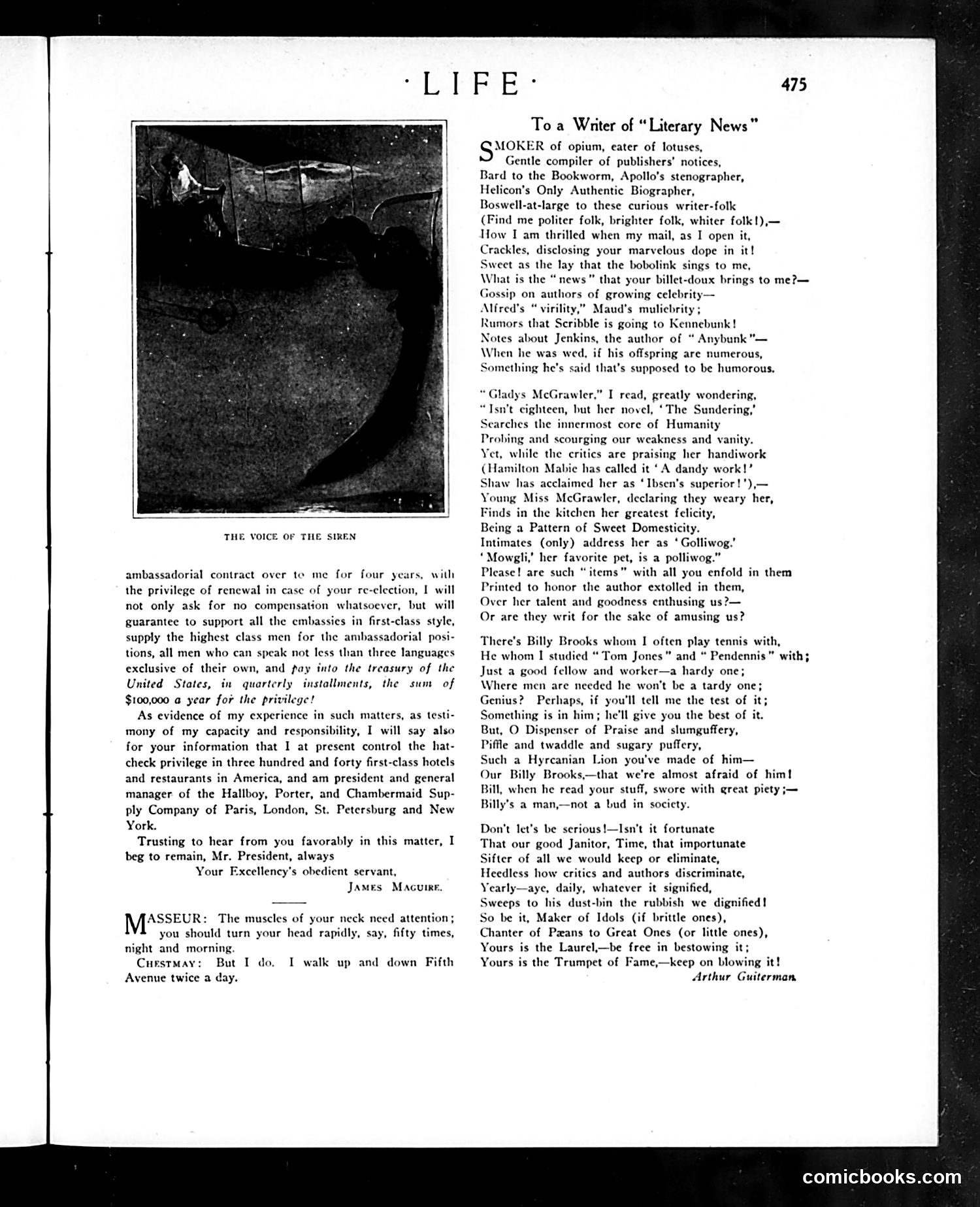
This page contains two distinct satirical pieces targeting American literary and social pretension circa early 1900s. **"The Voice of the Siren"** mocks political patronage and corruption. A character named James Maguire—apparently a self-made businessman controlling hat-check privileges and porter services across major hotels and cities—petitions the President for an ambassadorial post. The satire lies in his audacious offer: he'll pay $100,000 yearly *for the privilege* while staffing embassies with multilingual men. This skewers how wealthy businessmen essentially purchased diplomatic positions through political connections rather than merit. **"To a Writer of Literary News"** lampoons literary journalism and celebrity gossip culture. The poet mocks "Literary News" columns that breathlessly report trivial details about authors (marriages, children, pets' names) while inflating mediocre writers through hyperbolic praise. Young novelist Gladys McGrawler represents the absurdity: critics hail her as superior to Ibsen, yet she finds "greatest felicity" in kitchen domesticity. The piece satirizes both the puffery of literary promotion and the gap between critical acclaim and actual talent.
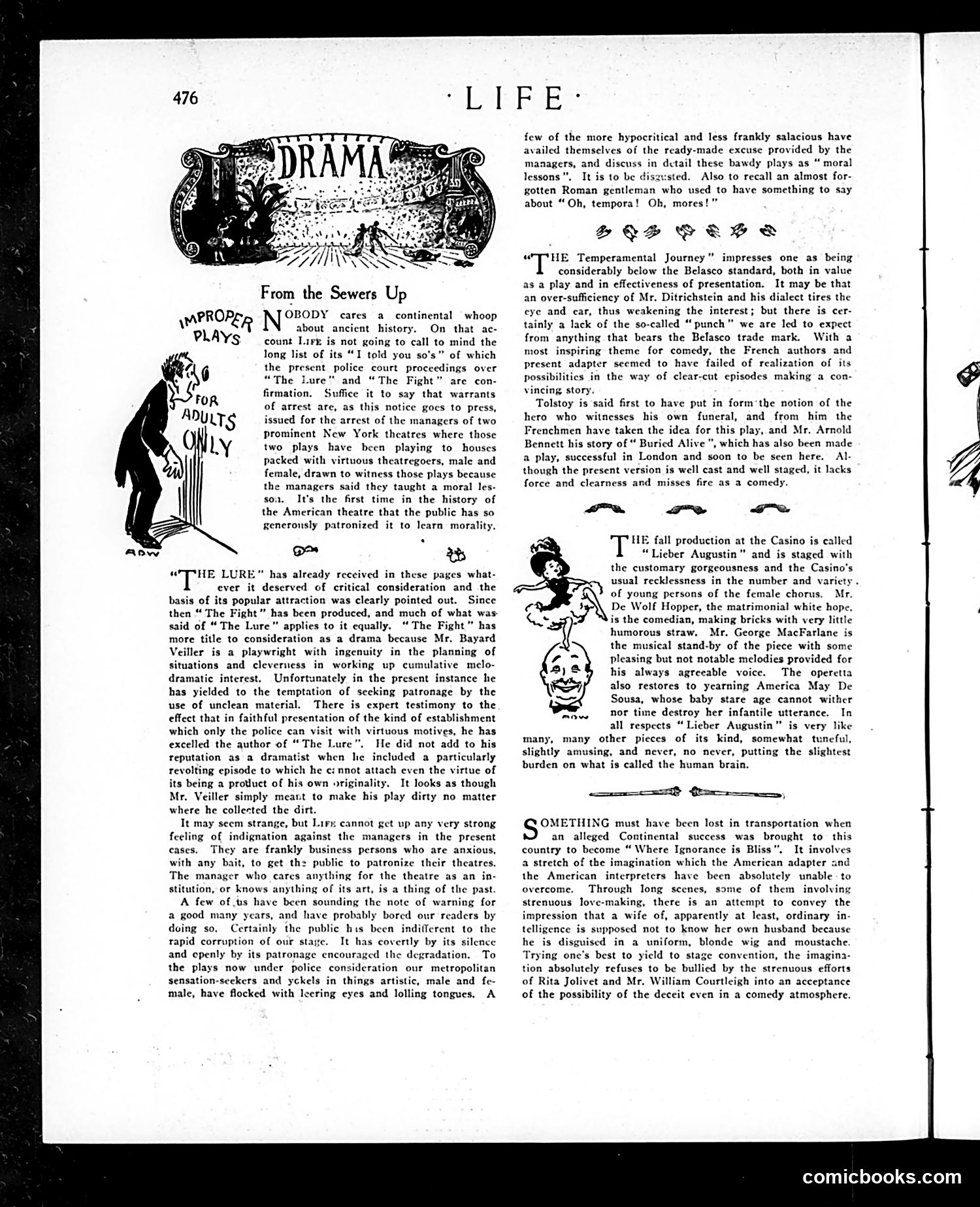
This page critiques two Broadway plays—"The Lure" and "The Fight"—that have been arrested for obscenity. The satire targets theatrical hypocrisy: managers claimed these morally instructive plays justified their salacious content, yet they deliberately packed them with lewd material to attract audiences. The author mocks both the managers (opportunistic businessmen exploiting public appetite for scandal) and the supposedly "virtuous" theatergoers who attend while pretending moral interest. A small cartoon shows a figure labeled "Improper Plays for Adults Only," emphasizing the irony. The piece references Bayard Veiller's playwriting and invokes "Oh tempora, oh mores!"—a Roman exclamation lamenting societal decay—suggesting American theater has become morally corrupt. The criticism extends to the indifferent public that enables degradation through patronage and silence. The page also briefly reviews "The Temperamental Journey," finding it disappointing.
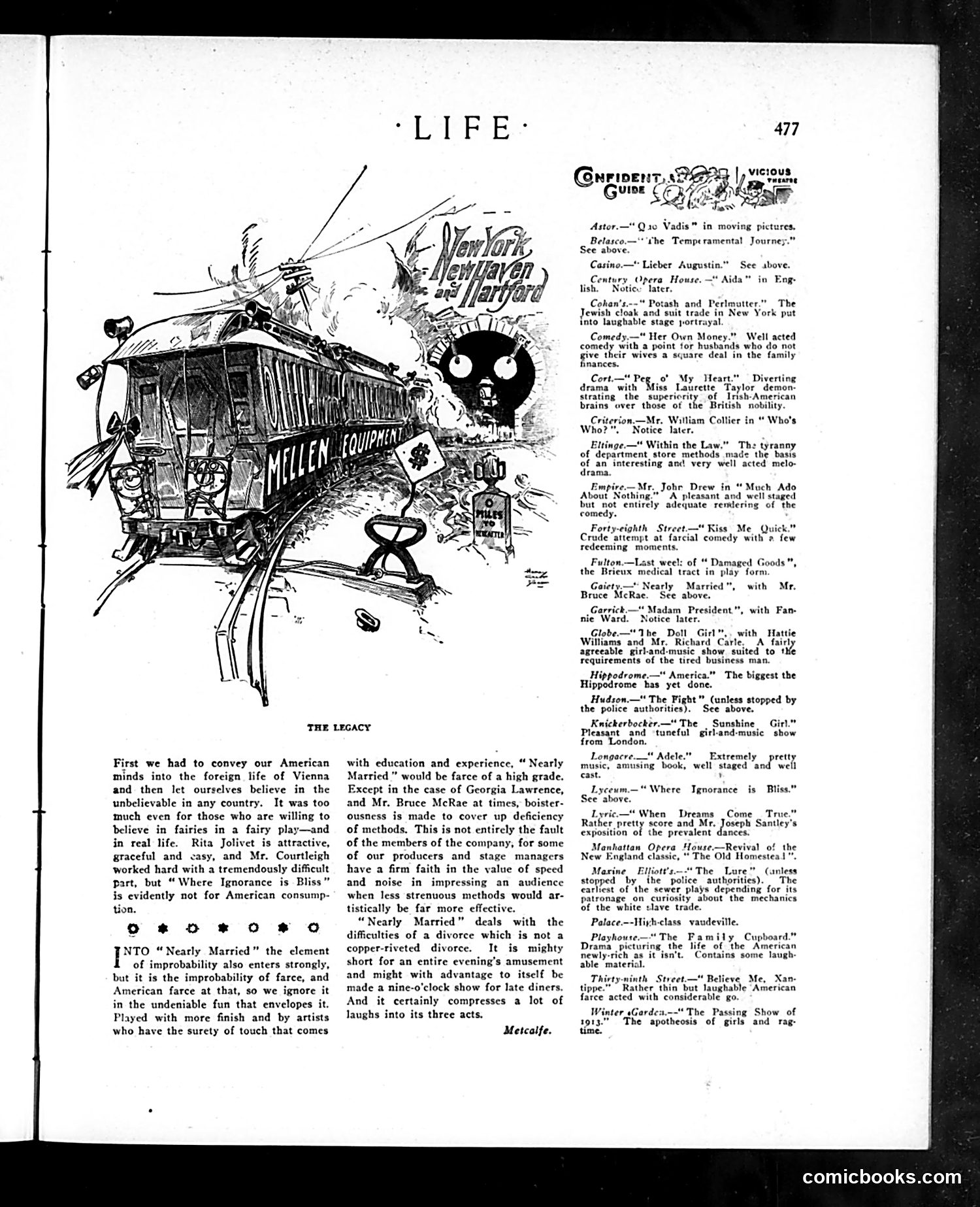
This page reviews theatrical productions on Broadway, circa 1910s. The prominent cartoon depicts a derailed "Millen Equipment" train—a visual metaphor for the failure of the play "Where Ignorance is Bliss," which the reviewer (Metcalfe) critiques severely. **Key points:** The review argues that American audiences cannot suspend disbelief for European-set stories like this Viennese drama, finding it implausible. By contrast, American farces—even improbable ones—work because audiences accept their conventions. "Nearly Married," a farce about divorce complications, succeeds through American humor despite weak acting and excessive noise covering poor technique. The reviewer suggests it's too short for a full evening and would work better as a late-dinner show. The cartoon's train wreck visualizes the play's commercial and artistic collision. The reviews throughout reflect early 20th-century theatrical standards: plot coherence, adequate acting, and appropriate venue-matching matter more than spectacle.
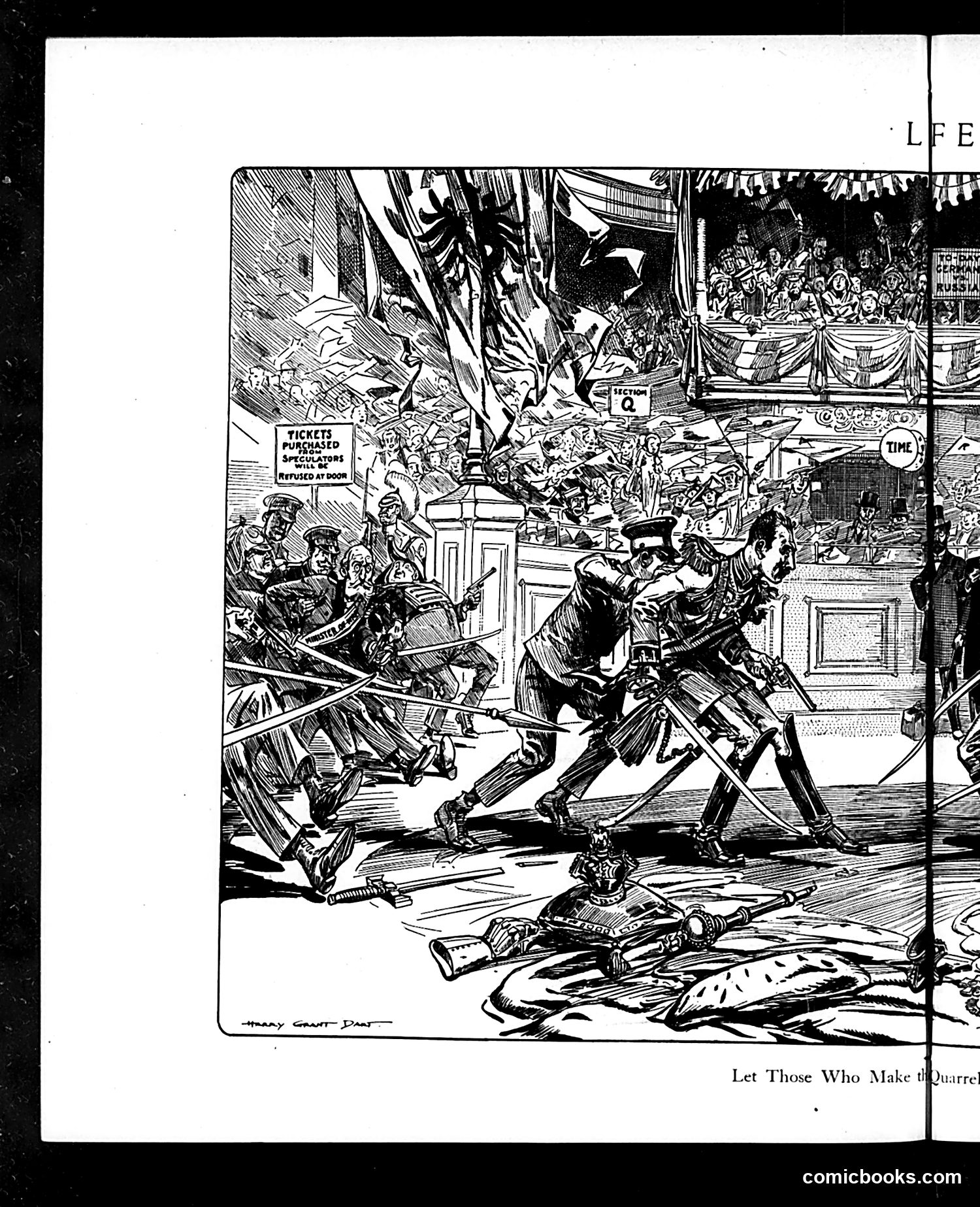
This cartoon by Jimmy Grant Day depicts a violent confrontation at what appears to be a public venue or theater (visible ticket booth and audience). Military or uniformed figures with bayoneted rifles clash with civilians in the street below. The partial caption reads "Let Those Who Make the Quarrel..." suggesting commentary on responsibility for violence or conflict. The chaotic scene—with weapons, struggling figures, and spectators watching from above—appears to satirize state or military suppression of civilian activity, possibly during labor unrest, political protest, or civil disorder. Without the full caption or publication date, the specific historical event remains unclear, but the composition critiques those in power who initiate violence against ordinary people.
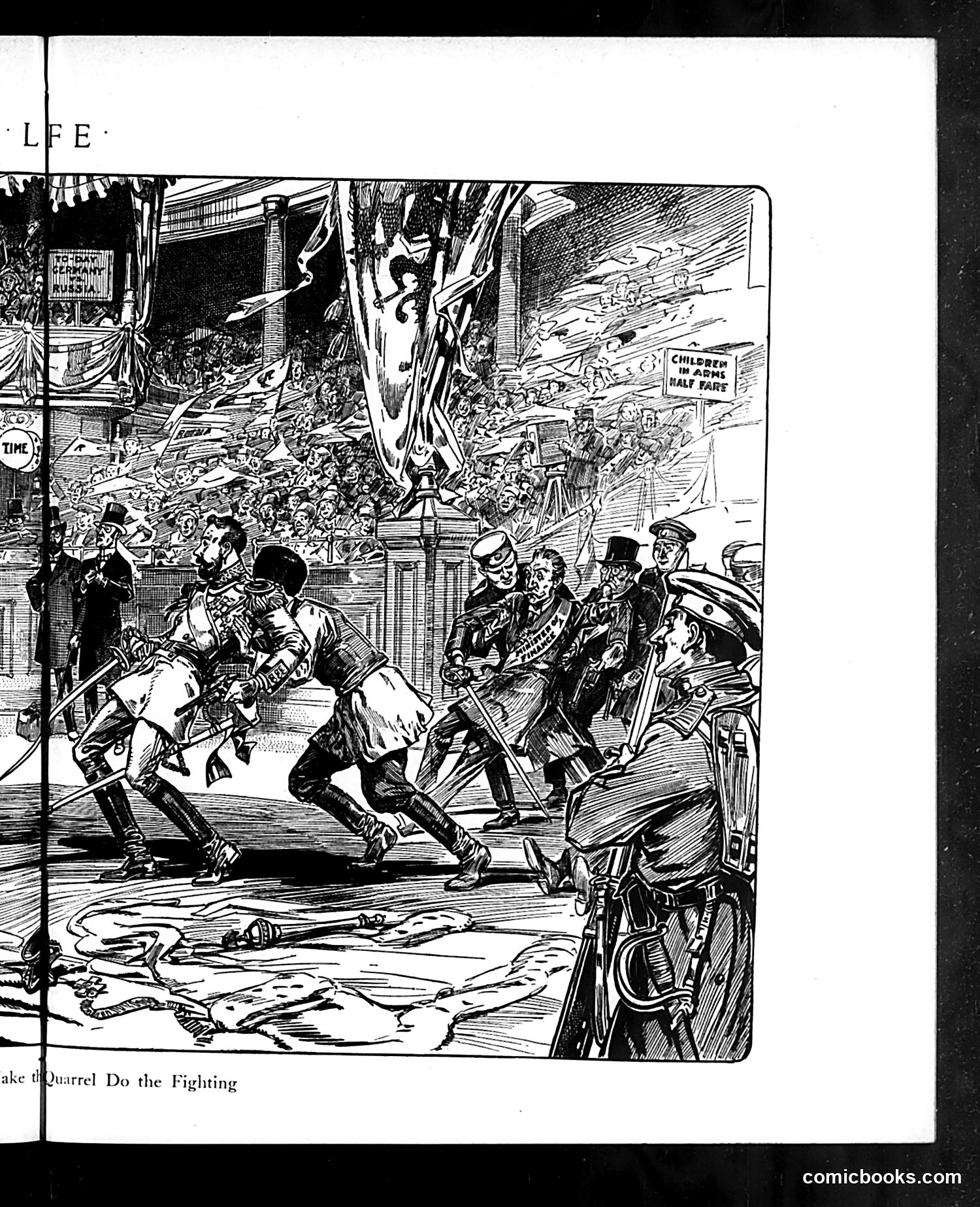
This page depicts a dramatic street confrontation between military officers and civilians during what appears to be a period of civil unrest or revolution. The illustration shows uniformed soldiers with drawn swords facing off against a crowd, with a monument or statue visible in the background and a banner reading "CITIZENS IN ARMS" partially visible. The caption reads "Make the Quarrel Do the Fighting," suggesting satire about how political disputes escalate into violent conflict involving ordinary people and military forces. Without a clear date visible, the specific historical event remains unclear, though the artistic style and content suggest this is early 20th-century American commentary on European or domestic civil conflict. The satire appears to critique how leadership promotes violence rather than resolution.
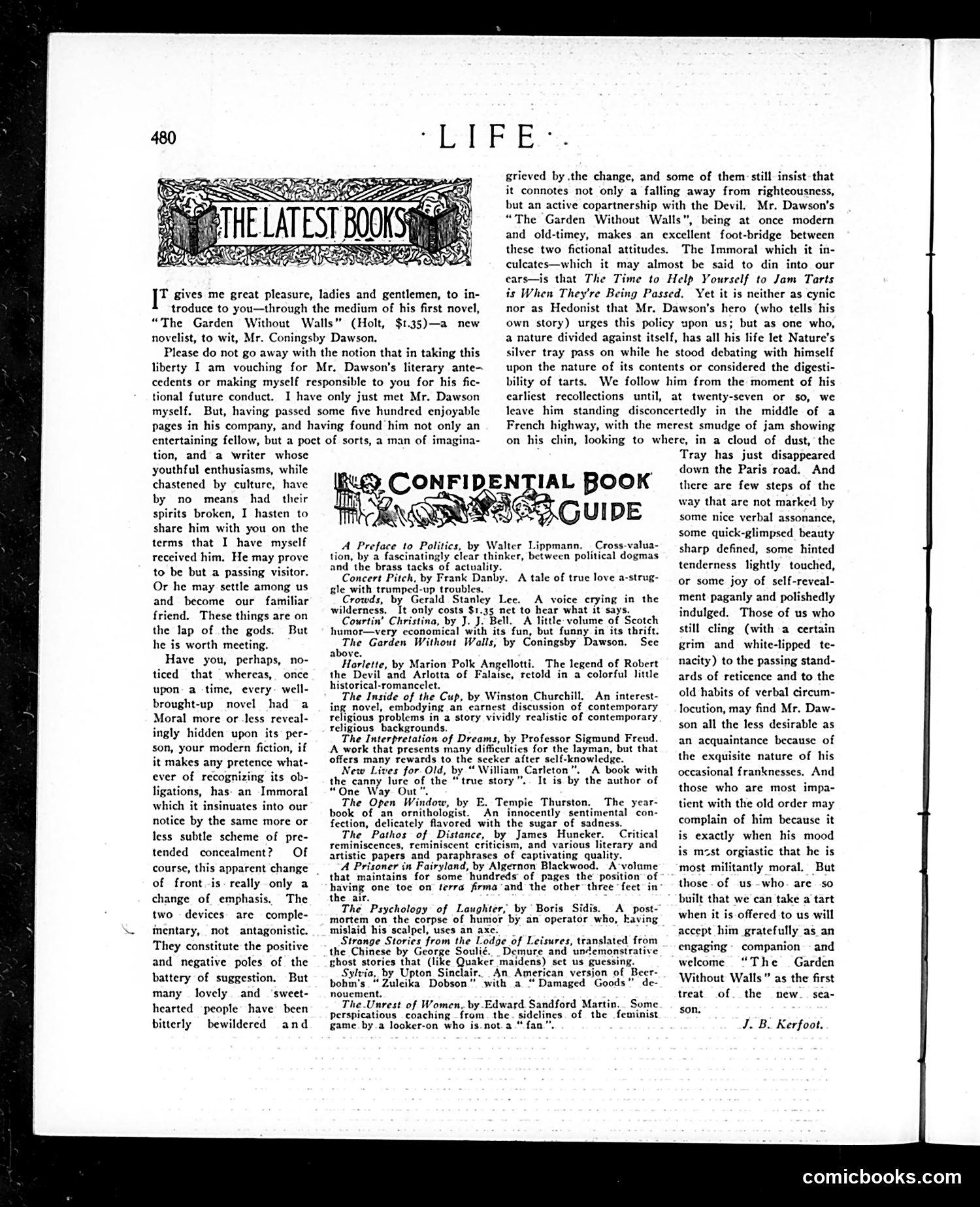
This is a book review section, not a political cartoon. The main content is J.B. Kerfoot's introduction to Coningsby Dawson's debut novel *The Garden Without Walls*, with a sidebar listing other recent publications. **The Key Point:** Kerfoot discusses a shift in modern fiction from novels with hidden "Morals" to those with emphasized "Immorals"—a change he presents as complementary rather than antagonistic. He uses Dawson's novel as an example: its protagonist learns to seize life's pleasures (symbolized by jam tarts offered on a passing tray) rather than overthink and miss them. The satire is gentle—targeting both old-fashioned moralists who see modern fiction as actively sinful, and modern cynics. Kerfoot positions Dawson's work as a "foot-bridge" between these attitudes, suggesting the protagonist's conflict reflects contemporary anxieties about changing social values. This reflects early 20th-century debates about literary modernism and morality.
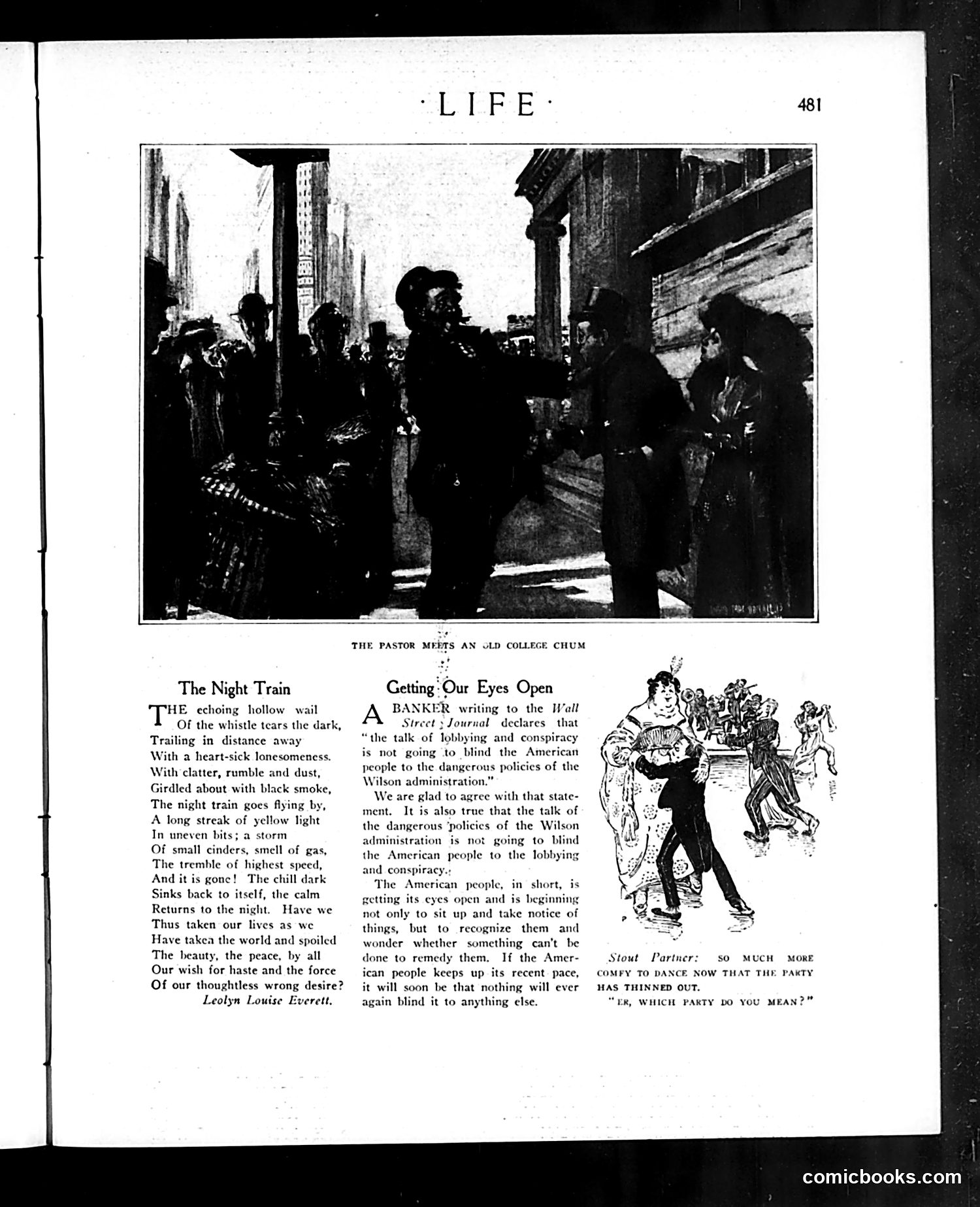
This page from *Life* contains political commentary critical of the Wilson administration (likely from WWI era, based on references). The text "Getting Our Eyes Open" argues that American citizens are becoming aware of both government misconduct AND lobbying/conspiracy—implying a need for vigilance against all corruption, not just one side's rhetoric. The cartoon at bottom depicts two men dancing as the "party has thinned out," with one asking "Which party do you mean?"—a double entendre. It satirizes political parties literally becoming smaller, or suggests confusion about which political party (Democratic or Republican) is actually declining or reforming. The top photograph shows a street scene labeled "THE PASTOR MEETS AN OLD COLLEGE CHUM," likely illustrating a separate human-interest story. The page emphasizes the public's growing political awareness and skepticism toward institutional claims.
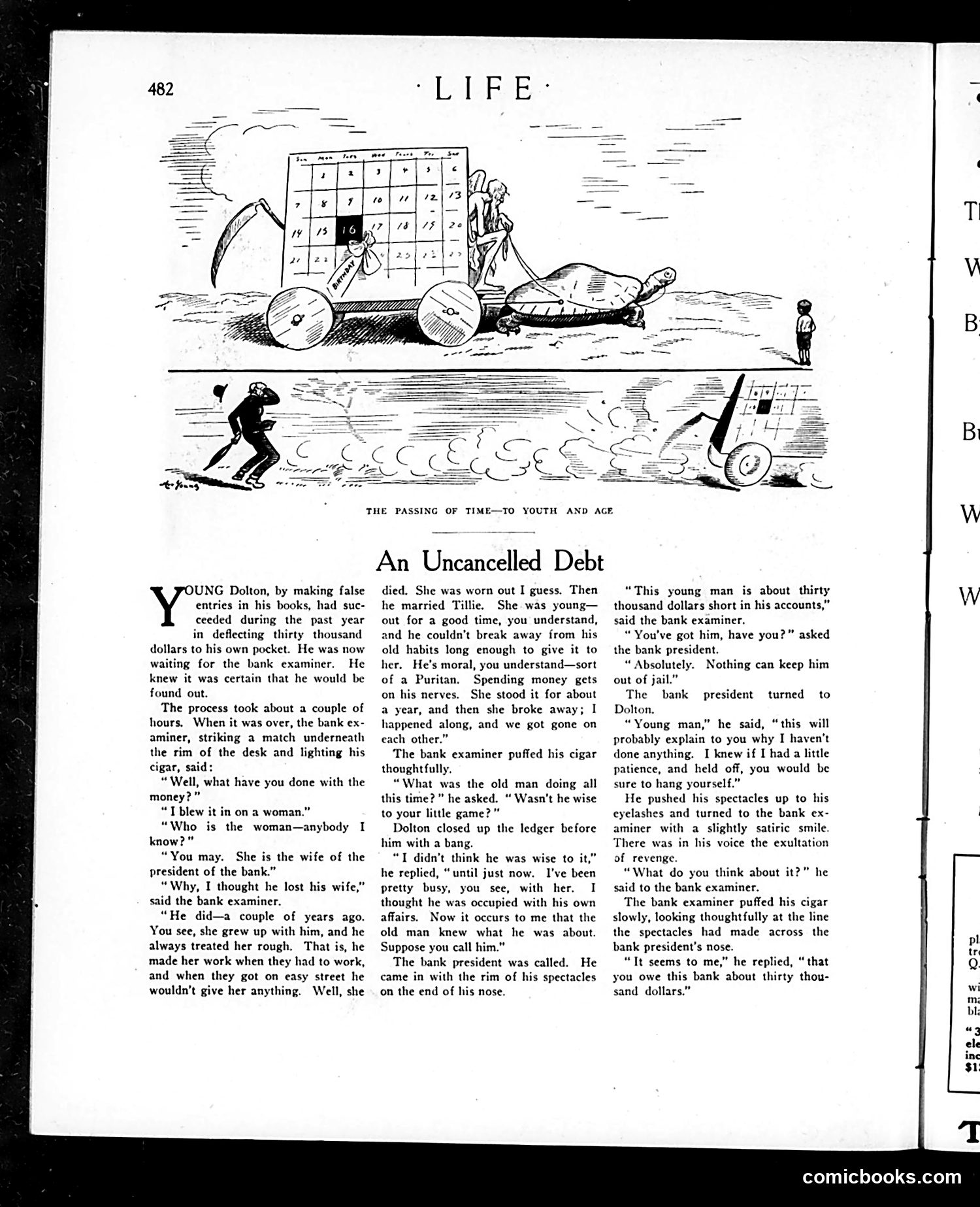
This is a satirical story about moral irony and delayed justice. Young bank clerk Dolton embezzles $30,000 to court the bank president's young second wife (Tillie), who was mistreated by her austere, penny-pinching husband. The president discovers the affair but says nothing, patiently waiting for Dolton to expose himself through his own guilt and carelessness. When caught, the president reveals his silence was calculated revenge: he knew Dolton would eventually hang himself. However, the bank examiner's final line provides the twist—the president's inaction allowed the theft to occur, making *him* financially responsible to the bank for the thirty thousand dollars. The satire critiques how moral rigidity and emotional neglect (the president's Puritan stinginess toward his wife) breed infidelity and theft, while his passive revenge ultimately costs him money. Justice becomes circular and self-defeating.
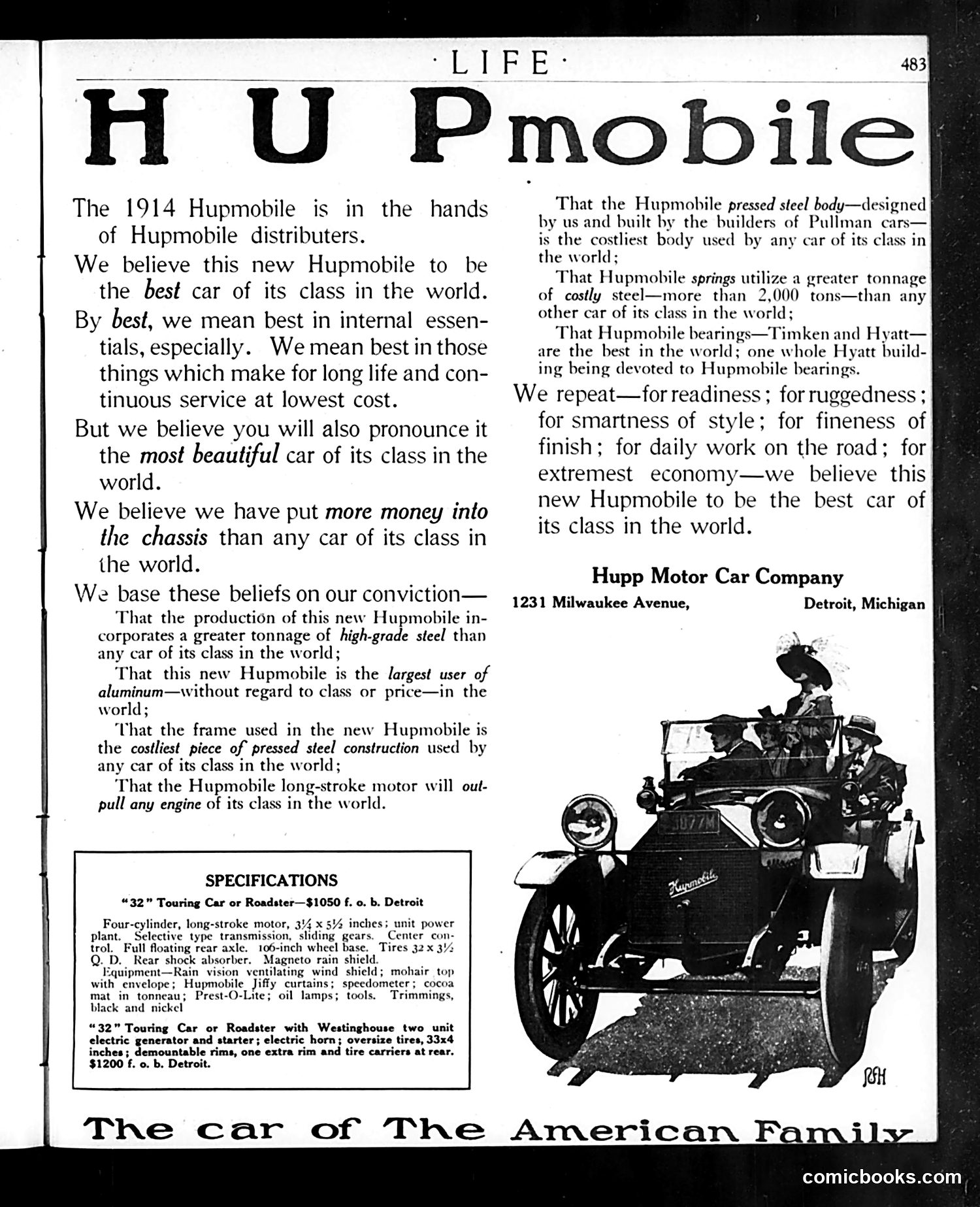
This is **not satire or political commentary**—it's a straightforward automobile advertisement from Life magazine (circa 1914). The page promotes the Hupmobile, a mid-range American car manufactured by the Hupp Motor Car Company in Detroit. The ad uses repetitive superlatives ("best car of its class") and detailed specifications to appeal to practical buyers seeking durability and value. The illustration shows a well-dressed couple in an open-air touring car, representing the aspirational lifestyle the car promises. The tone is bombastic by modern standards—the company makes nearly identical claims multiple times (about steel, aluminum, bearings, springs). This hyperbolic marketing style was typical of early automotive advertising, when consumers needed persuasion that automobiles were reliable investments rather than novelties. The tagline "The car of The American Family" positions the vehicle as accessible to the emerging middle class, emphasizing economy alongside quality.
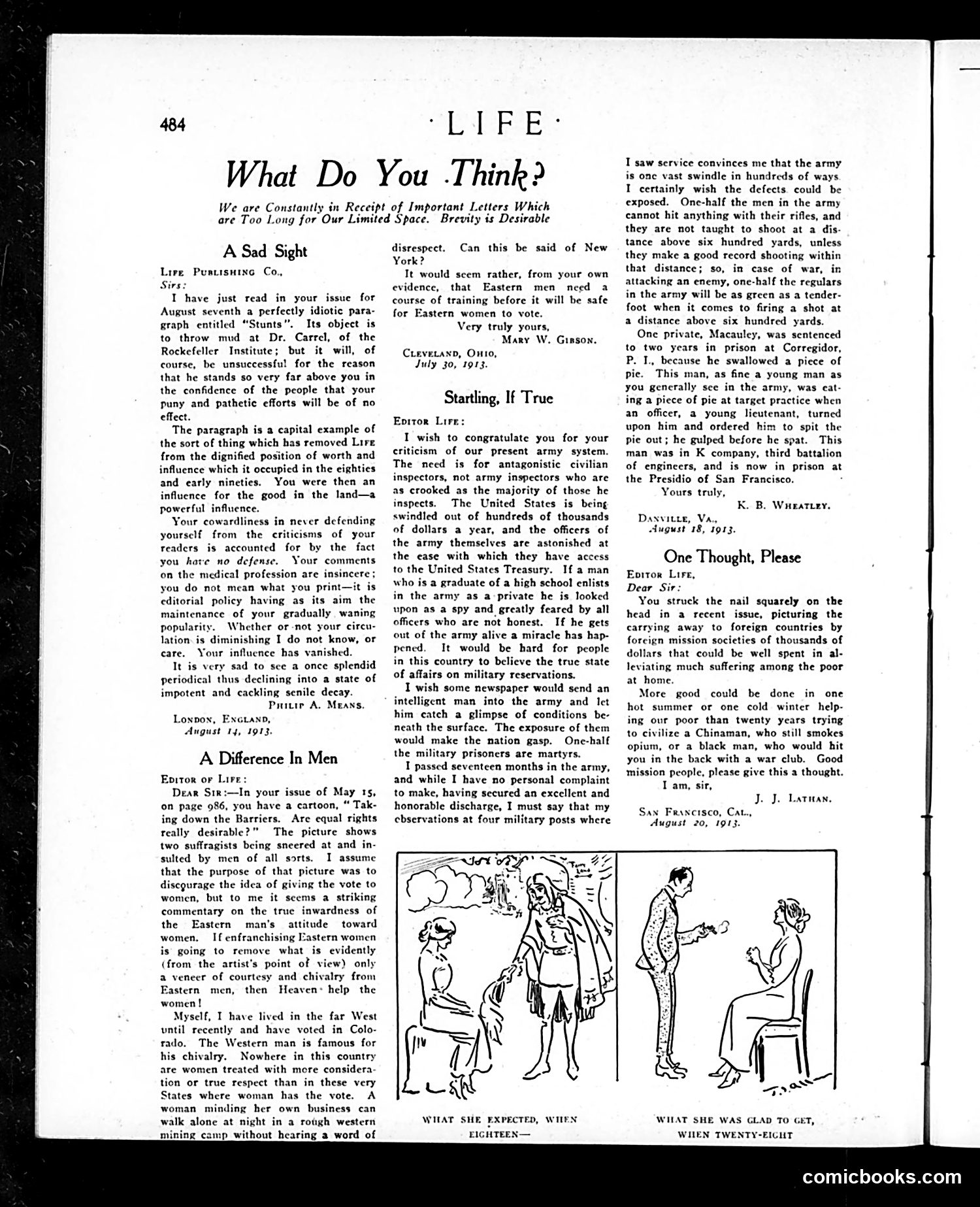
This page features reader responses to Life magazine articles. The letters address three topics: **"A Sad Sight"** criticizes Life for attacking Dr. Alexis Carrel of the Rockefeller Institute, claiming the magazine has lost its former influence and dignity. **"A Difference In Men"** responds to a pro-suffrage argument, defending women's voting rights by contrasting respectful Western men (in voting states like Colorado) with disrespectful Eastern men who oppose suffrage. The writer argues that enfranchisement actually *improves* men's behavior toward women. **"Startling, If True"** attacks corruption in the U.S. Army, alleging officers systematically defraud the Treasury and mistreat enlisted men. The bottom cartoon (caption visible) depicts gender dynamics, likely related to the suffrage debate above it, showing expectations versus reality for young women. These letters reflect 1913 debates over women's voting rights and military accountability.
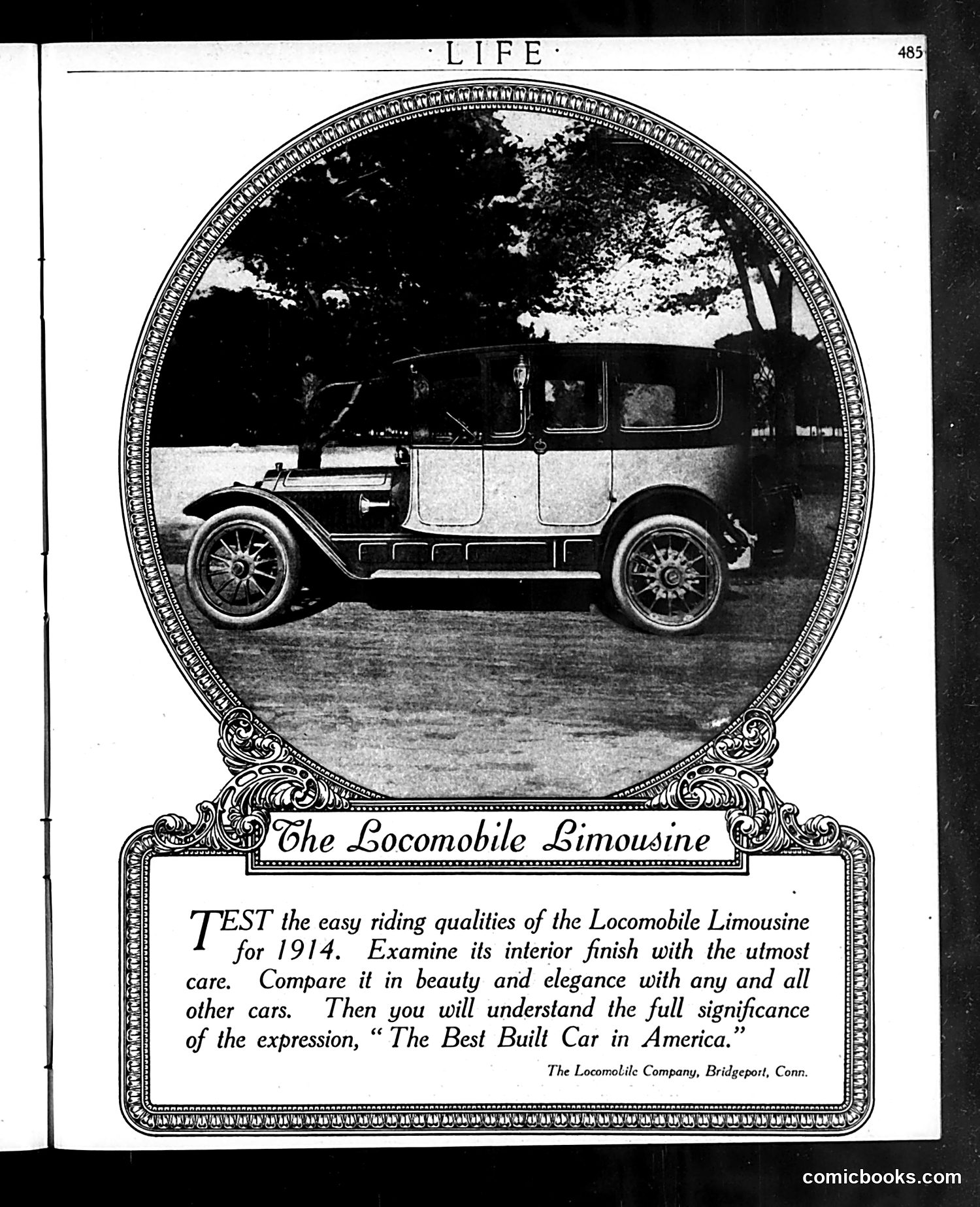
This is a straightforward advertisement, not satire or political content. It promotes the Locomobile Limousine for 1914, manufactured by The Locomobile Company in Bridgeport, Connecticut. The image shows a side view of an early automobile with an enclosed passenger cabin, typical of luxury cars of that era. The ad targets affluent buyers by emphasizing the vehicle's "easy riding qualities," interior craftsmanship, and aesthetic appeal, culminating in the slogan "The Best Built Car in America." There is no cartoon, caricature, or satirical commentary present—this is simply a vintage automobile advertisement from Life magazine's advertising pages.
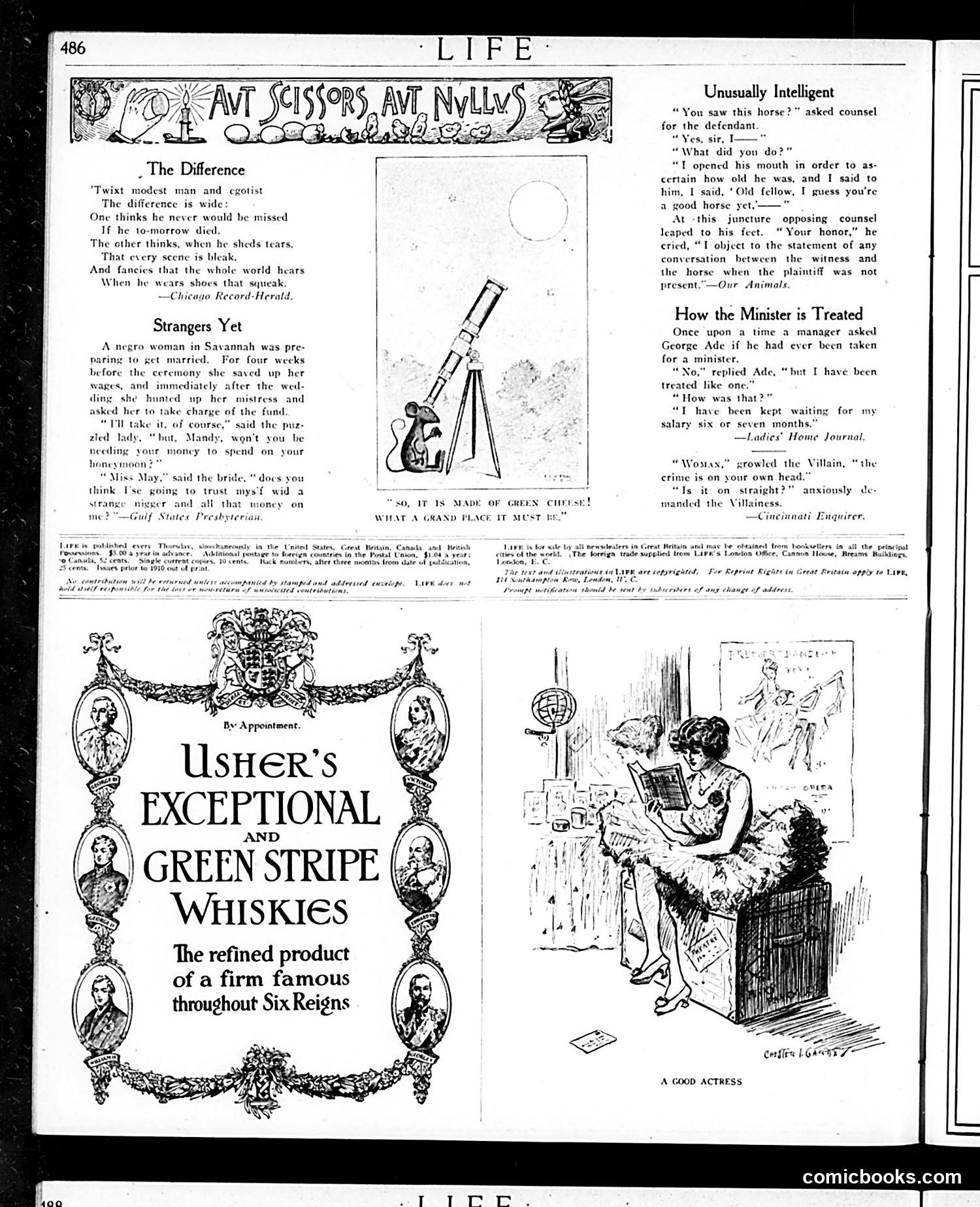
This page from *Life* magazine contains several humor pieces typical of early 20th-century American satire: **"The Difference"** and **"Strangers Yet"** are poems/anecdotes contrasting modesty with egotism and exploring social awkwardness—standard themes requiring no historical context. **"Unusually Intelligent"** satirizes courtroom absurdity: a witness describes examining a horse's age by opening its mouth and conversing with it. The opposing counsel objects that this "conversation" occurred without the plaintiff present—humor derived from the legal fiction that a witness has testified to a private exchange between man and animal, treating it as factual testimony requiring corroboration. **"How the Minister is Treated"** uses humorist George Ade to joke about clergy underpayment—managers treat ministers poorly by delaying salaries months. The telescope illustration captioned **"SO, IT IS MADE OF GREEN CHEESE!"** appears to reference the old moon-mythology joke, likely mocking naive astronomical observation or gullibility. **"A Good Actress"** (illustration) shows a woman at a drafting table—unclear without more context. The page also contains a prominent **Usher's whisky advertisement** emphasizing product refinement and longevity.
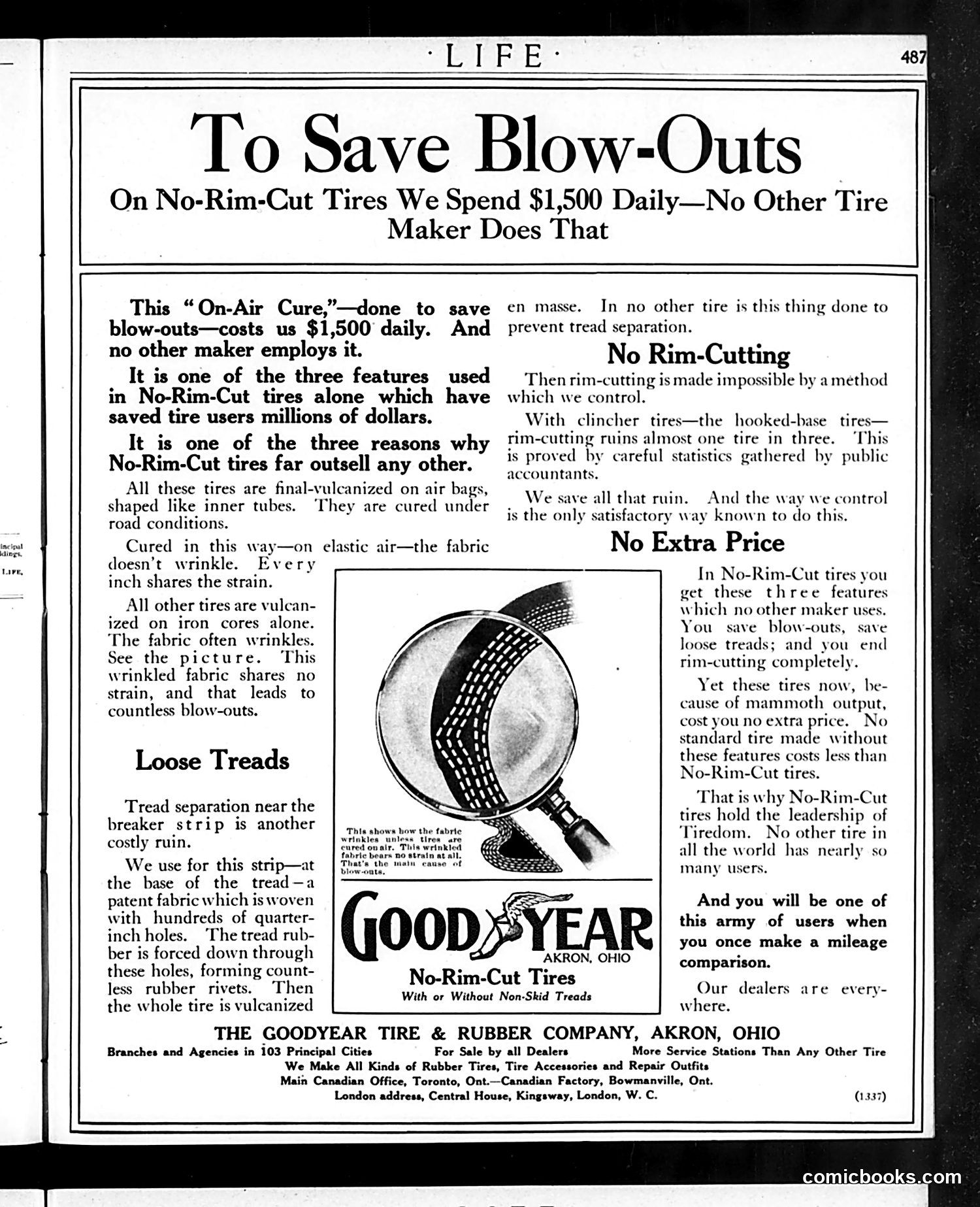
This is primarily a **Goodyear tire advertisement**, not satirical content. It appeared in *Life* magazine, which carried advertising alongside humor and commentary. The ad promotes Goodyear's "No-Rim-Cut" tires by highlighting three technical innovations: air-bag vulcanization (curing), a patented anti-tread-separation fabric, and rim-cutting prevention. The central image shows a cross-section of the tire's fabric structure. The **sales pitch** emphasizes that Goodyear alone employs these features (claiming to spend $1,500 daily on quality control) while offering them at no premium price. The rhetoric positions this as consumer protection—preventing costly "blow-outs" and tread failure common in competitors' products. For a modern reader: this reflects early-20th-century automotive culture when tire failure was routine and expensive. Goodyear positions itself as the quality leader through technological superiority and manufacturing investment, a standard advertising strategy still used today.
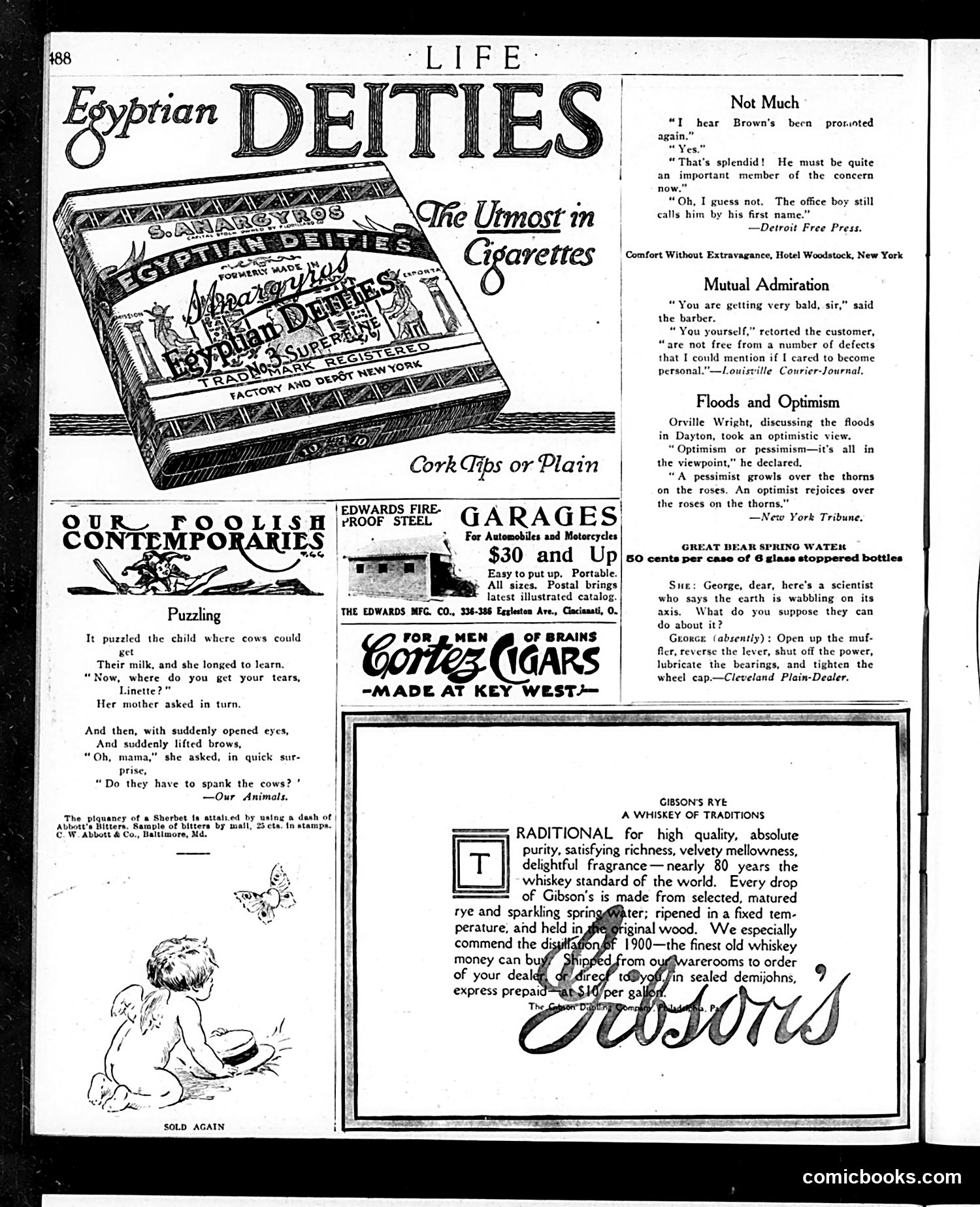
This page contains several short humorous anecdotes and advertisements typical of early 20th-century Life magazine. **The jokes** satirize everyday social situations: a promotion that means nothing (the office boy still uses the employee's first name), mutual insults between barber and customer, and a child's innocent question about where cows get tears. These reflect period attitudes about workplace hierarchy, social pretense, and childhood naiveté. **The Orville Wright reference** mentions the famous aviator discussing 1913 Dayton floods with characteristic optimism—a topical reference showing Wright's public prominence and philosophical outlook. **The advertisements** for Egyptian Deities cigarettes, Edwards garages, Corfee cigars, Gibson's whiskey, and Great Bear spring water represent standard period marketing, emphasizing quality and tradition. The page is primarily **light humor and advertising** rather than political satire—typical of Life's entertainment-focused content during this era.
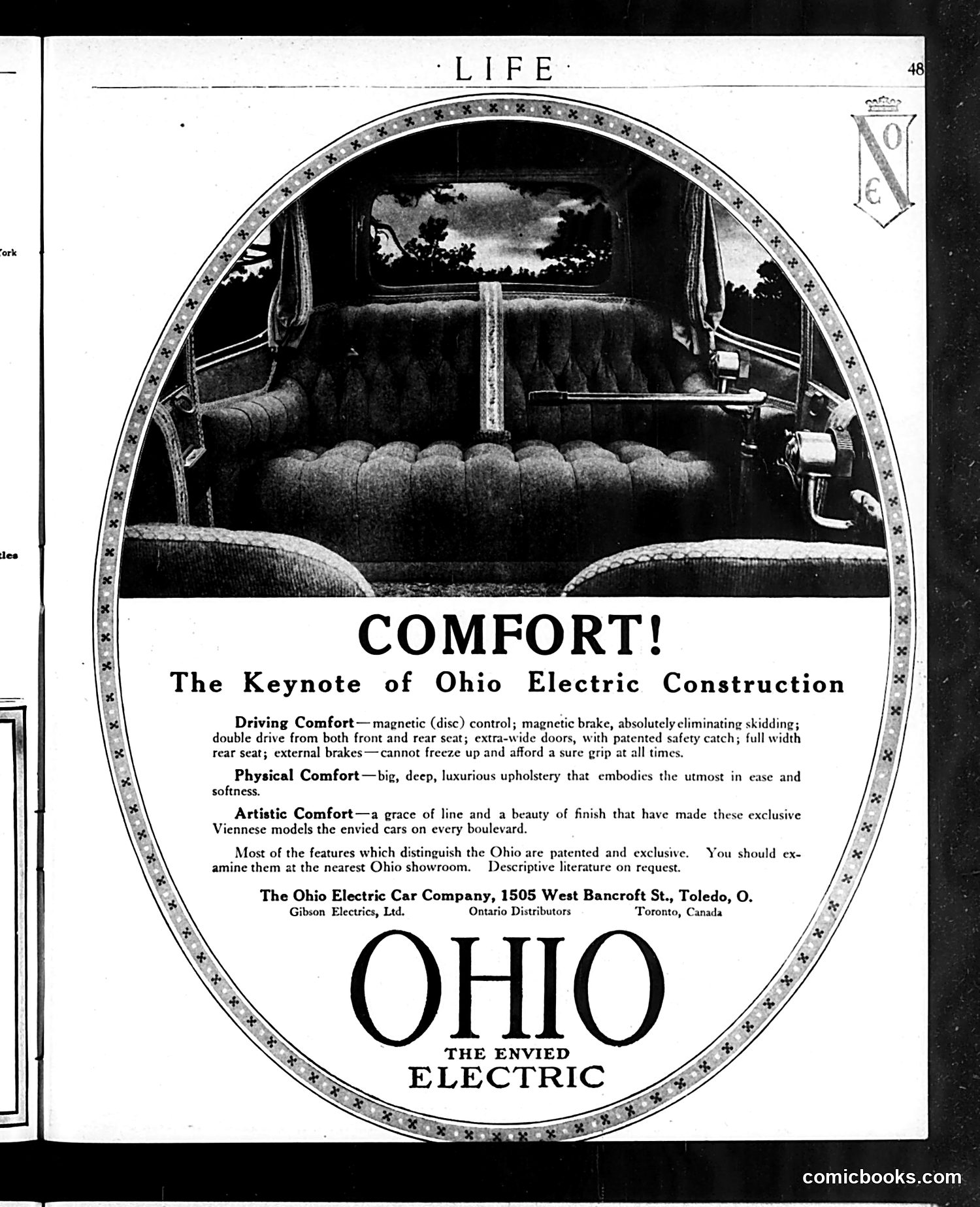
This is a **full-page advertisement**, not political satire. It promotes the Ohio Electric Car, manufactured in Toledo, Ohio, and distributed in Canada by Gibson Electrics. The ad emphasizes three types of "comfort": driving comfort (magnetic controls, safety features), physical comfort (luxurious upholstery), and artistic comfort (elegant design). The interior photograph shows the spacious, cushioned seating that was a selling point. The phrase "the envied electric" suggests these were prestigious vehicles. This advertisement reflects the **early 1900s automotive era** when electric cars competed seriously with gasoline vehicles—electric cars were considered quieter, cleaner, and more refined, particularly appealing to wealthy and urban buyers. The reference to "Viennese models" suggests European design prestige. There is no political cartoon or satire on this page—it is purely commercial promotion.
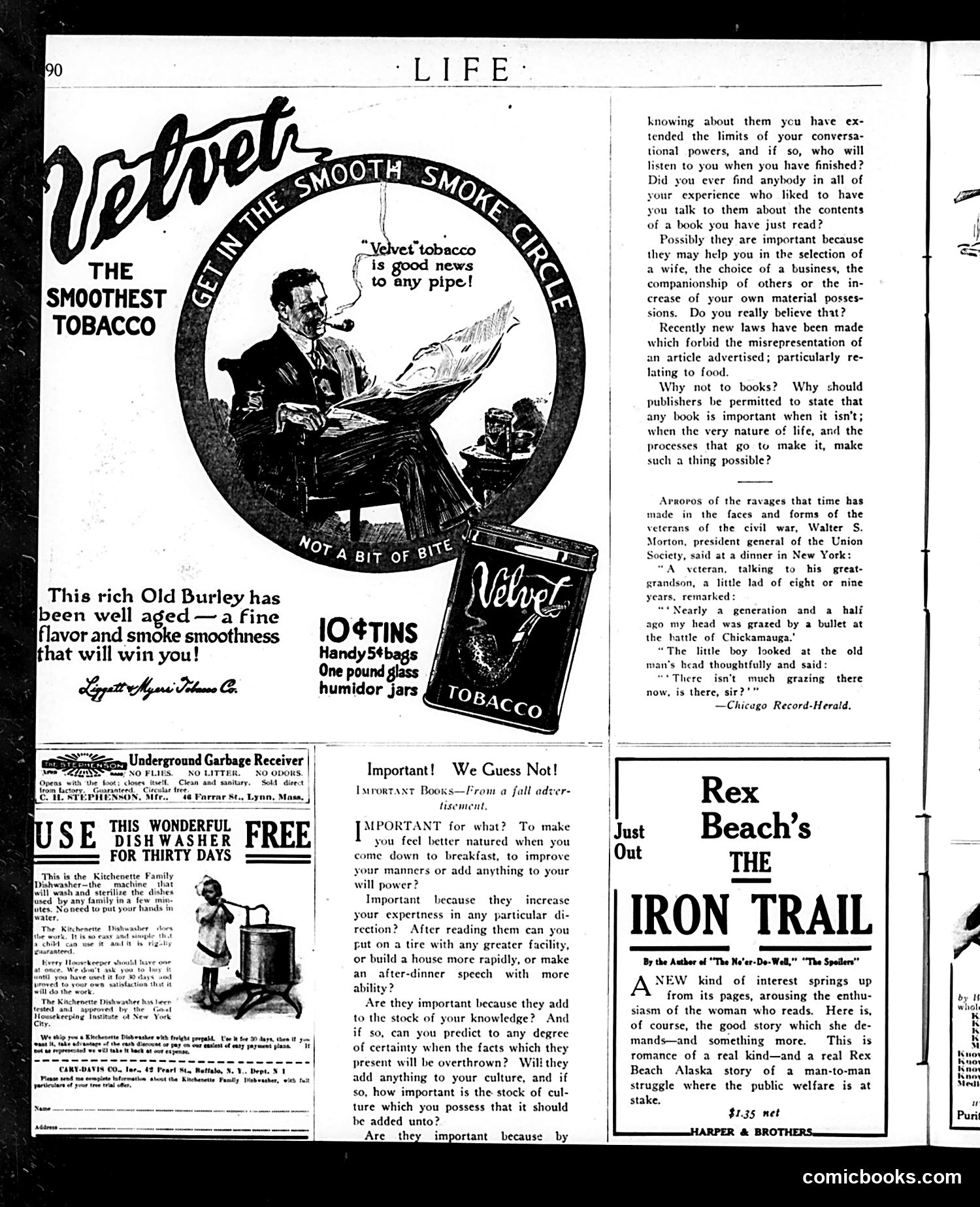
This page mixes advertisements with satirical editorial content typical of early 20th-century *Life* magazine. The **Velvet tobacco ad** uses a circular design showing a man reading a newspaper, claiming the tobacco won't bite—standard product marketing of the era. The **"Important! We Guess Not!"** section is sharp satire questioning publishers' claims that books are "important." The author argues books offer little practical value—they don't help you fix a tire or build a house, their facts become outdated, and people don't actually enjoy listening to others discuss books. The piece sarcastically asks why books should be allowed to claim importance when food advertisements are now legally restricted from misrepresentation. This critiques both publishing's inflated marketing and the era's new consumer protection laws. The **Civil War veteran anecdote** is gentle humor: an old soldier mentions being grazed by a bullet; his great-grandson replies there's not much grazing left on his now-bald head—a joke about aging. The remaining content includes household appliance advertisements (dishwasher, garbage receiver) and a novel advertisement for Rex Beach's *The Iron Trail*.
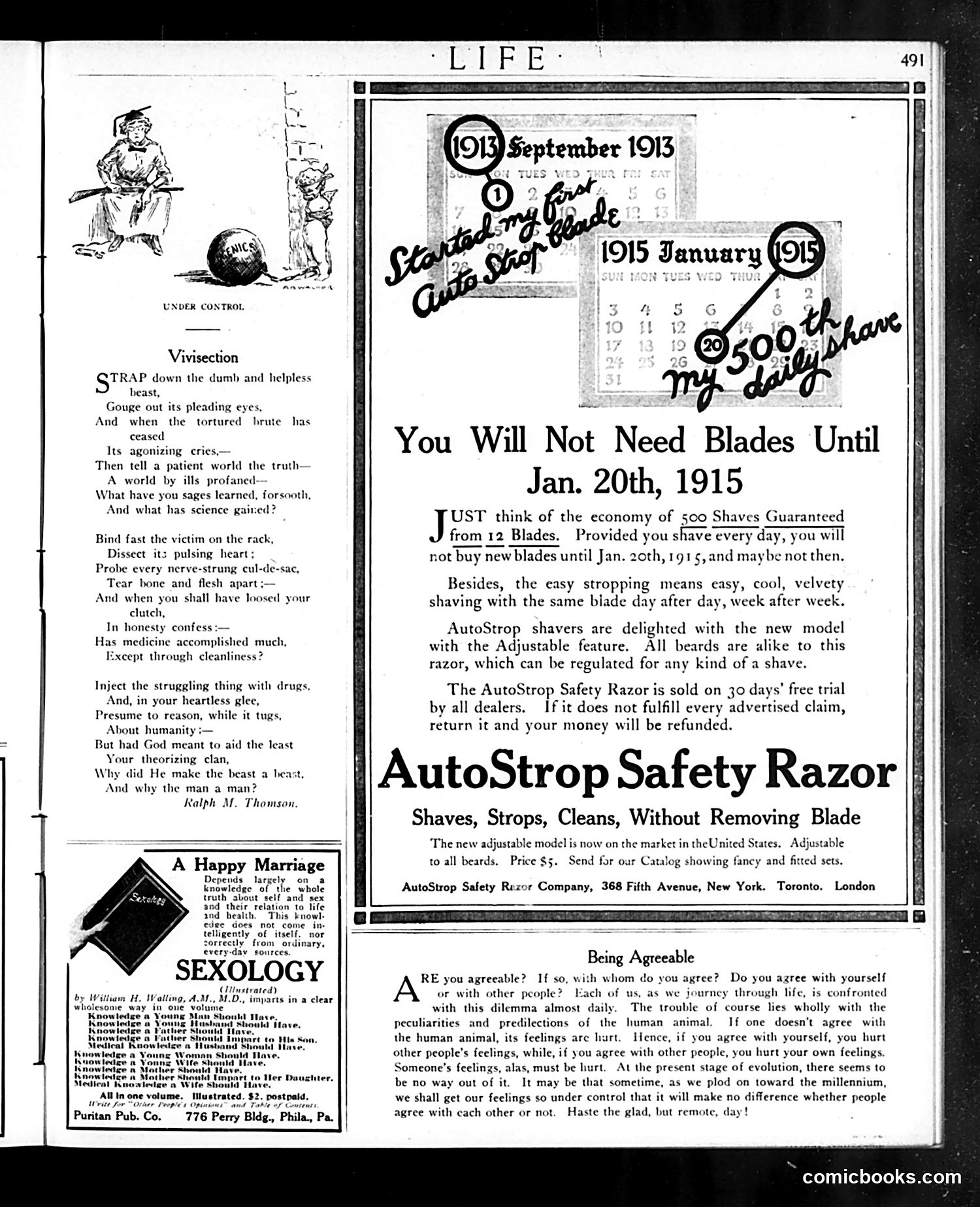
This page contains three distinct pieces: **"Vivisection" Poem (left):** A satirical attack on animal testing in medical research. The poem, credited to Ralph M. Thomson, argues that vivisection (dissecting live animals) is cruel and questions whether it actually advances medicine—suggesting cleanliness, not animal torture, drives medical progress. It frames the practice as morally indefensible, questioning God's purpose in creating animals if humans are meant to exploit them this way. This reflects early 20th-century anti-vivisection sentiment. **AutoStrop Safety Razor Advertisement (center/right):** A straightforward commercial promising 500 shaves from 12 blades, good until January 20, 1915. Notable mainly for dating the magazine. **"Being Agreeable" Essay (bottom):** A humorous philosophical piece observing the social paradox that agreeing with oneself hurts others' feelings, while agreeing with others hurts one's own feelings. It's lighthearted social commentary rather than satire. The page mixes serious animal-welfare advocacy with consumer advertising and whimsical philosophy—typical of Life's eclectic editorial approach.
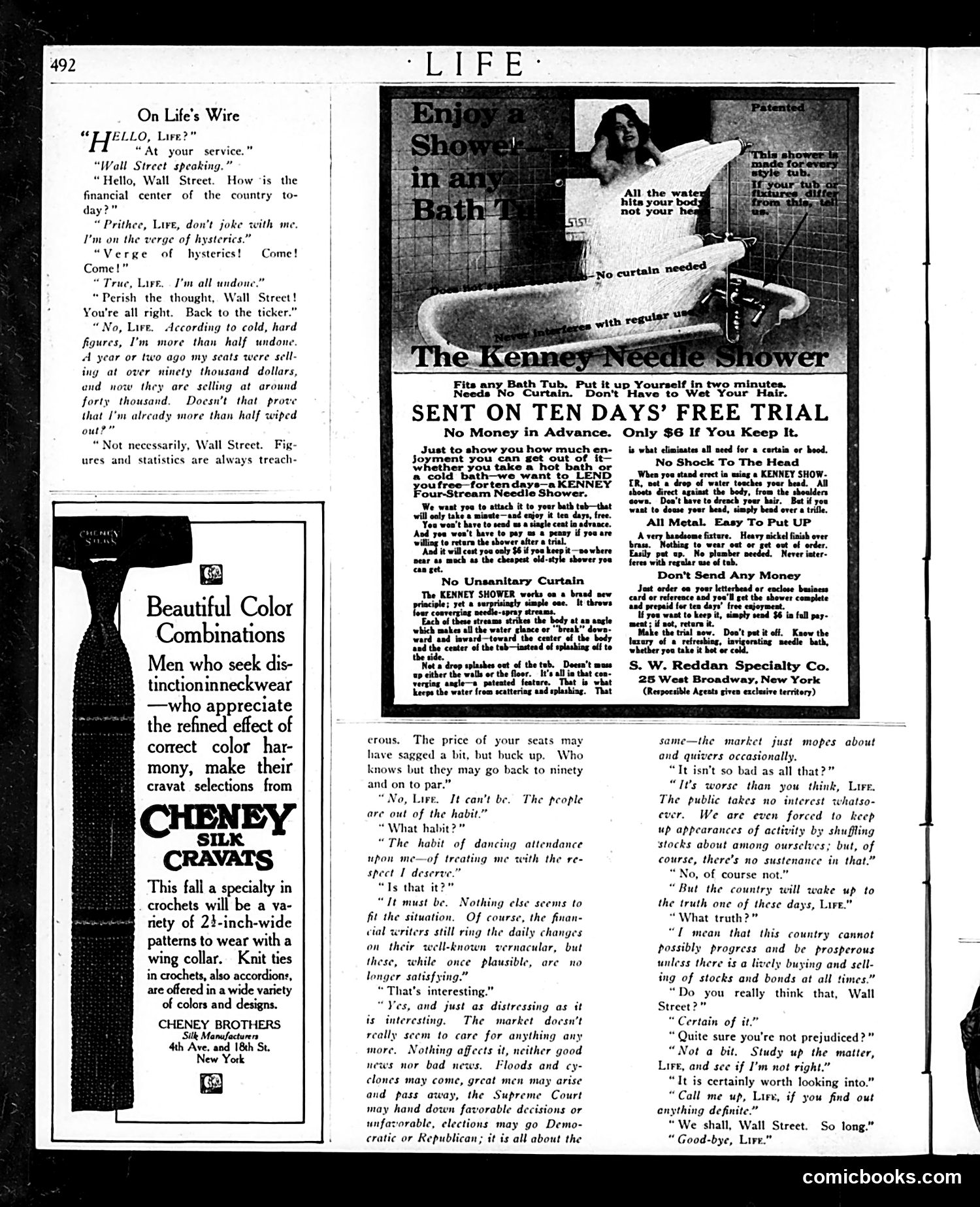
This dialogue satirizes Wall Street's anxiety during what appears to be a post-boom economic downturn. "Life" personifies Wall Street as distressed because stock prices have crashed—theater seat values dropped from $90,000 to $40,000. Wall Street complains that the public has lost "the habit of dancing attendance upon me—of treating me with the respect I deserve." The satire's point: financial markets once commanded public attention and deference, but that has evaporated. Life counters that statistics are "treacherous," suggesting Wall Street's pessimism may be exaggerated. The broader joke mocks Wall Street's narcissism and dependency on public worship. Market crashes reveal not economic collapse but wounded pride—nobody cares anymore. This reflects early 20th-century skepticism toward financial elites and their self-importance, suggesting markets are indifferent to news, events, and sentiment alike. The remainder of the page contains period advertisements unrelated to the satire.
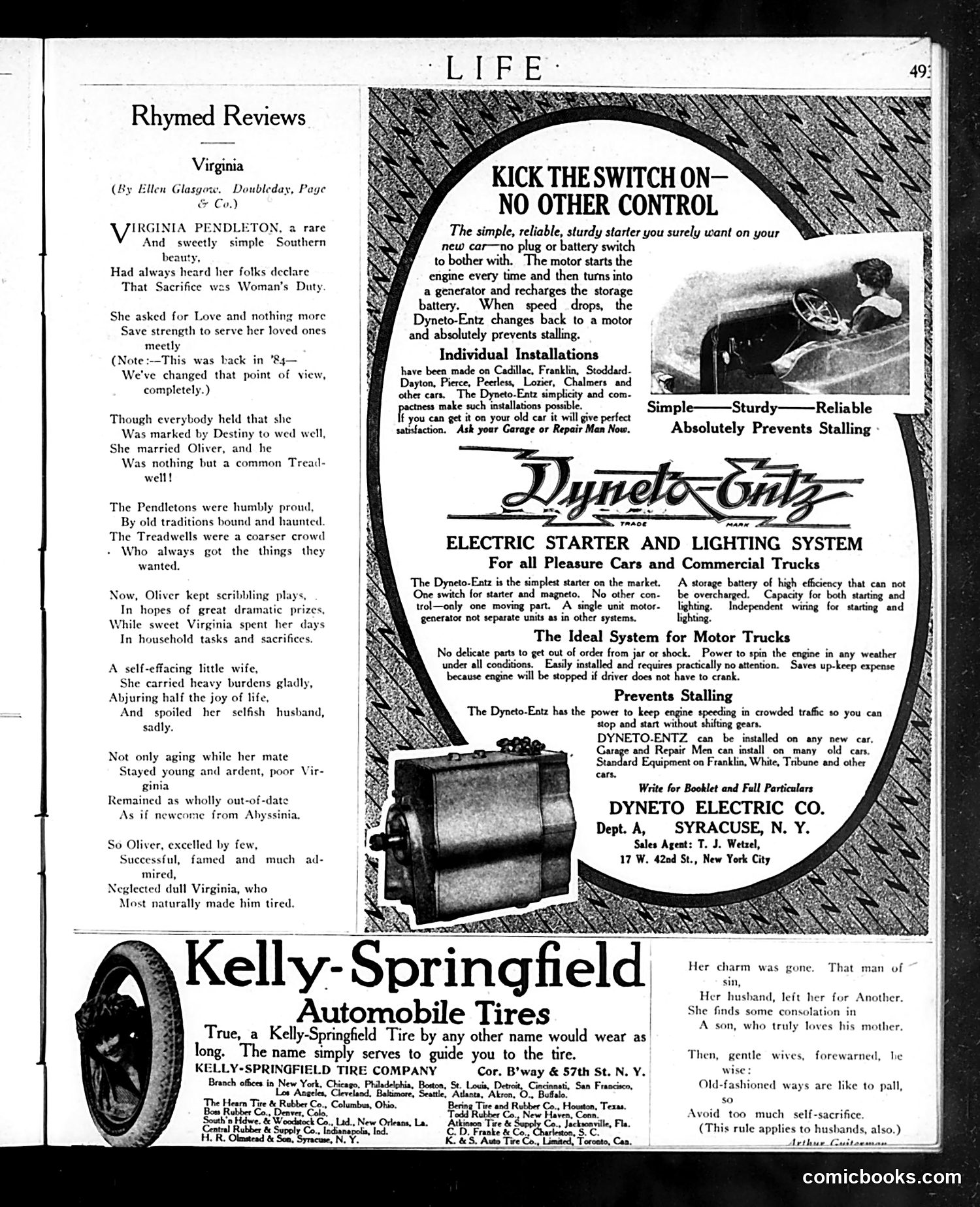
This page combines literary criticism with period automobile advertising, reflecting early 1900s concerns. **The "Virginia" Review (left column):** A book review in rhyming verse critiques Ellen Glasgow's novel about Virginia Pendleton, a Southern woman who sacrifices her youth and happiness to serve an ungrateful husband. The reviewer notes the book depicts outdated 1880s values—that women's duty is self-sacrifice—but adds a pointed modern commentary: "This was back in '84— / We've changed that point of view, completely." This suggests Life's readership in the 1910s held more progressive views about women's roles, even while the story itself condemns Virginia's selflessness as enabling male selfishness. **The Advertisements:** The Dyneto-Entz electric starter and Kelly-Springfield tires represent cutting-edge automotive technology marketed as reliable and modern—reflecting the era's technological optimism. **The Moral Tale (bottom right):** A cautionary verse warns wives against excessive self-sacrifice, concluding "Avoid too much self-sacrifice. (This rule applies to husbands, also.)"—a modern, somewhat sardonic note suggesting changing gender expectations in the 1910s.
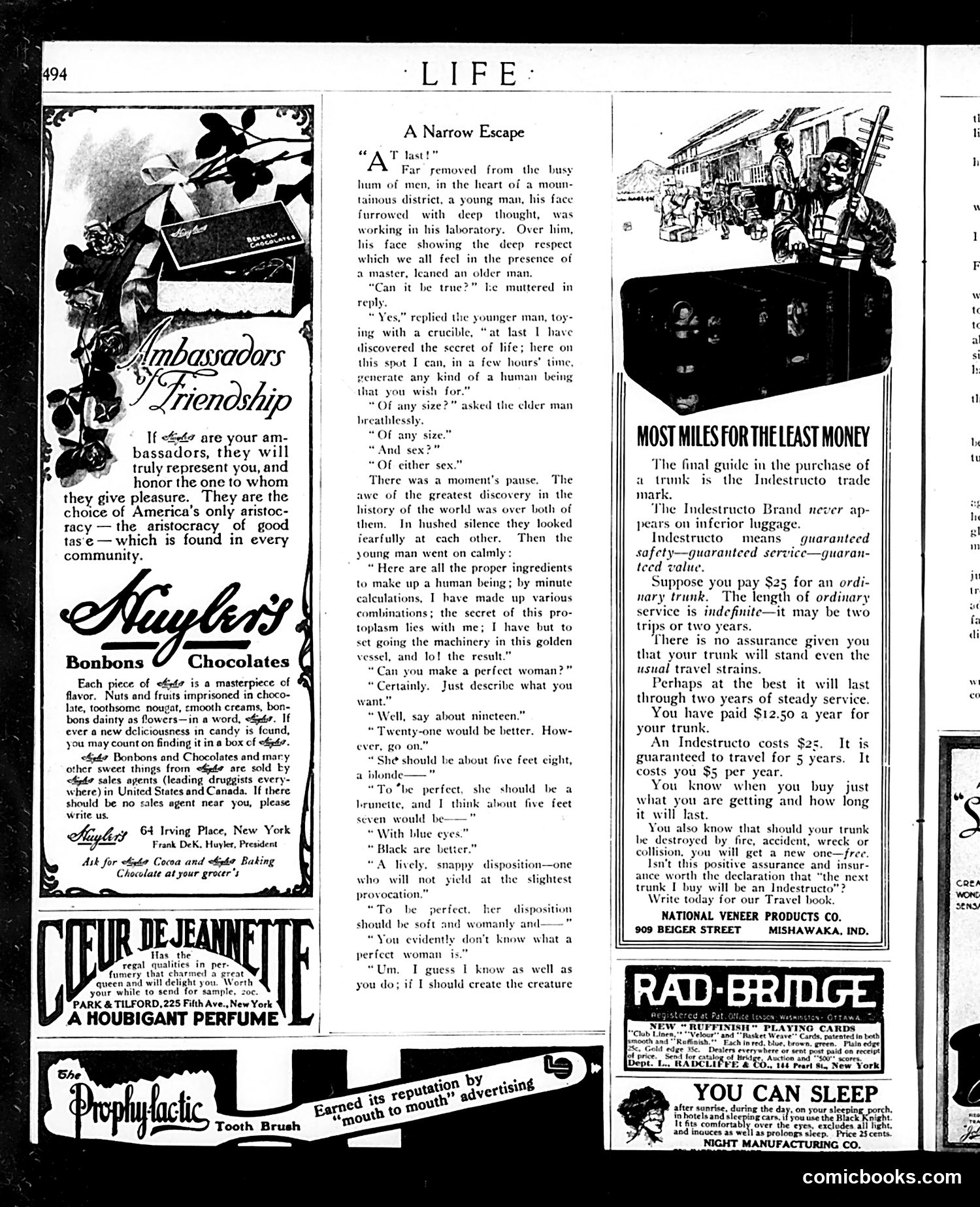
This story-cartoon satirizes male attitudes about women by presenting a scientist who has discovered how to create human life. When asked to manufacture "a perfect woman," the older man and younger scientist immediately disagree on specifications: she should be 19 vs. 21; blonde vs. brunette; five feet eight vs. five feet seven; blue eyes vs. black; and—most tellingly—she should have a "lively, snappy disposition" versus being "soft and womanly." The satire's point: no "perfect woman" exists because men's contradictory expectations are impossible to satisfy. The two male characters cannot agree on any detail, suggesting that male ideals of femininity are fundamentally incompatible. This was likely published during the early 20th century, when debates about women's roles and suffrage were heated, making the joke a commentary on male confusion and unreasonable standards regarding women.
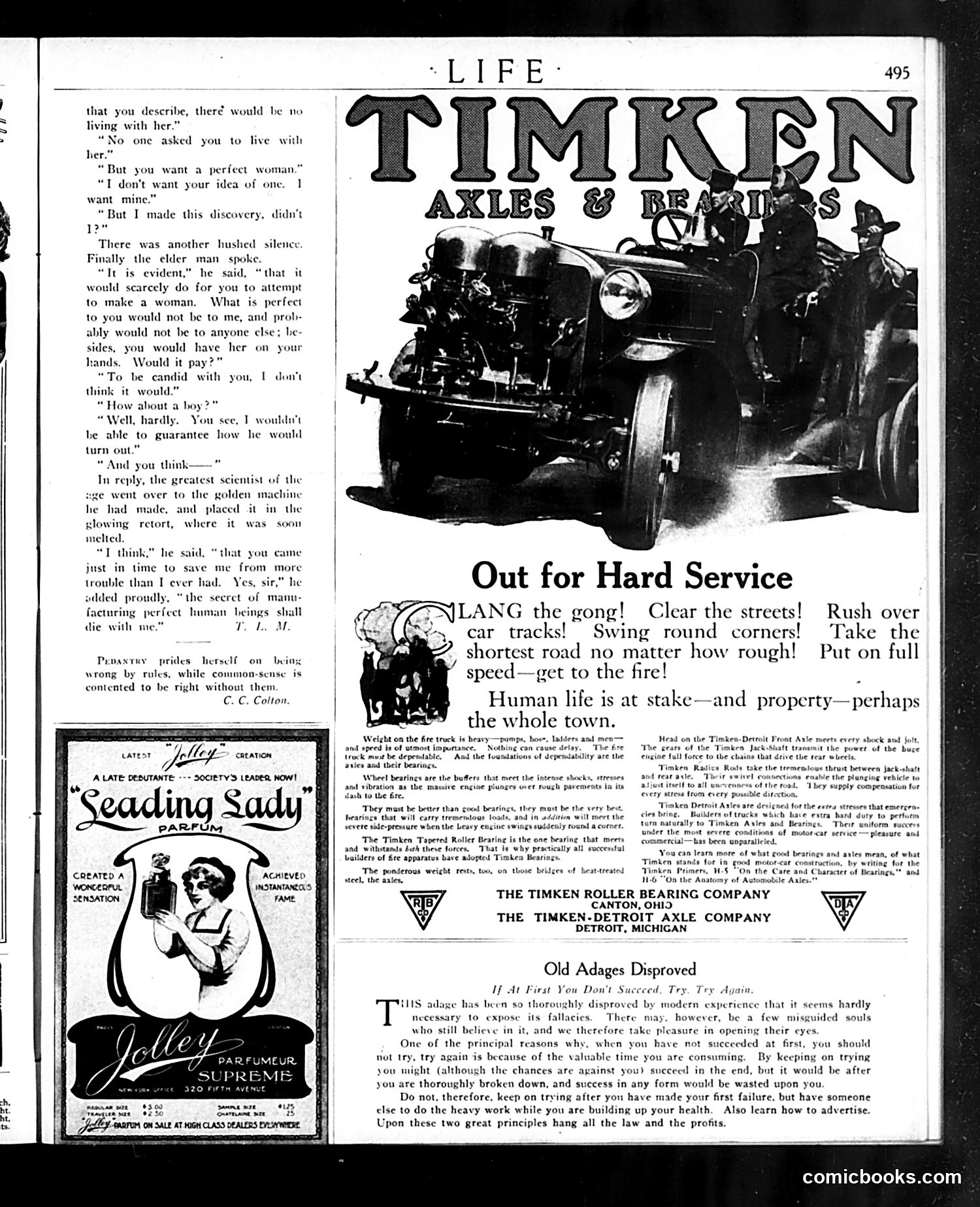
This page contains a satirical science fiction story and period advertisements. The main narrative depicts a brilliant scientist who has invented a "golden machine" capable of manufacturing perfect human beings. When confronted about the ethics and practicality of creating an ideal woman or child, the scientist realizes the folly of his ambition—perfection is subjective and dependent on individual perspective. He ultimately destroys his creation, concluding that attempting to manufacture perfect humans would cause more problems than it solves. The satire targets early 20th-century scientific hubris and utopian thinking, mocking the idea that technology could engineer ideal people. The supporting advertisements for Timken bearings and Volley perfume reflect period consumer culture. The "Old Adages Disproved" section humorously debunks the saying "if at first you don't succeed, try again," suggesting that persistence after failure wastes effort—a cynical commentary typical of Life's satirical approach.
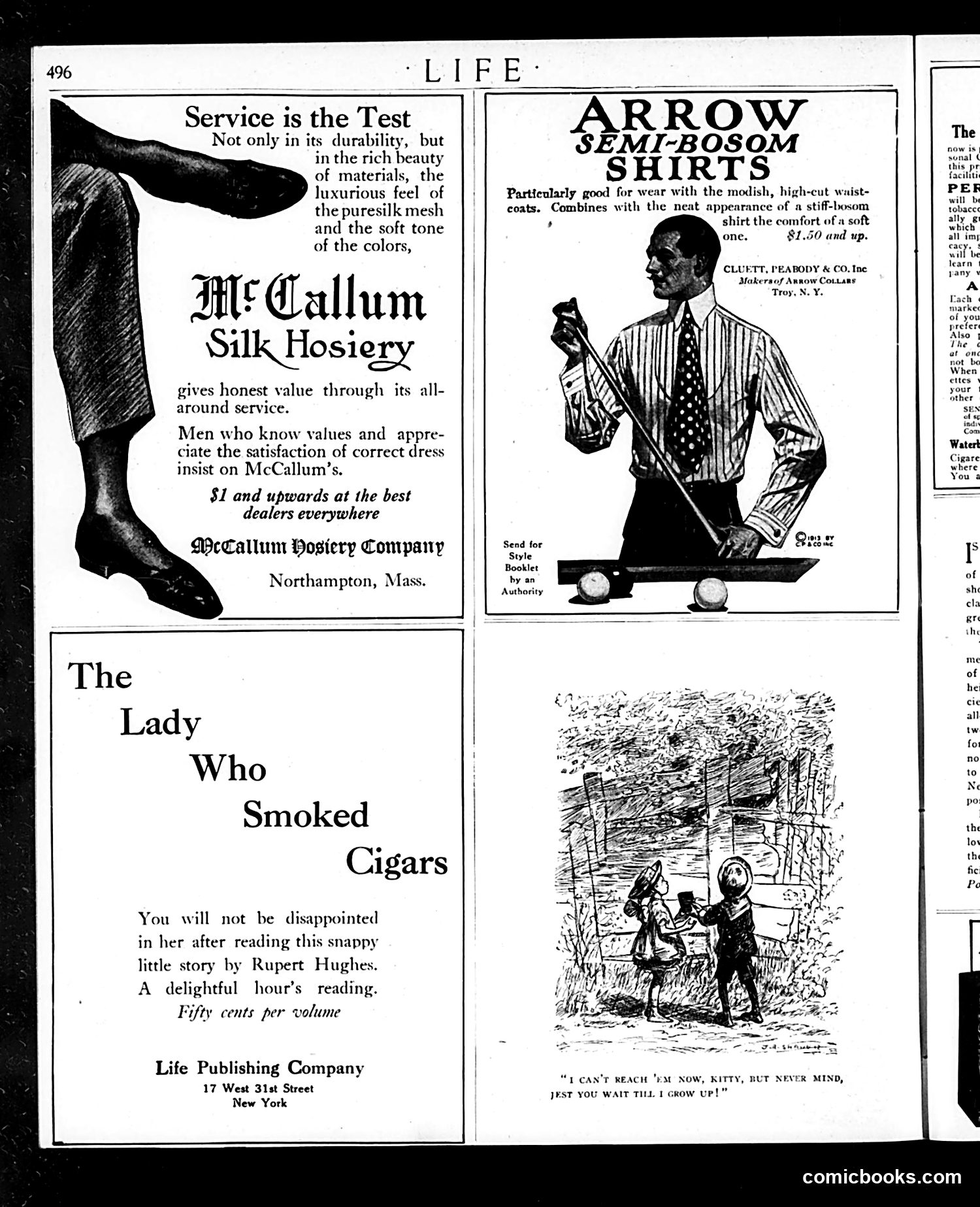
This page consists almost entirely of **period advertisements** (circa 1910s-1920s) with no political satire or editorial cartoons. The ads showcase: 1. **McCallum Silk Hosiery** — marketed to men concerned with "correct dress" 2. **Arrow Semi-Bosom Shirts** — positioning a hybrid garment combining stiffness with comfort for fashionable high-cut waistcoats 3. **"The Lady Who Smoked Cigars"** — a Rupert Hughes story advertised by Life Publishing Company 4. **A small illustration** of children, with one saying she can't reach cigars now but will when grown—likely promoting smoking as aspirational The page reflects **early 20th-century consumer culture** aimed at middle/upper-class men concerned with fashion and propriety. The children's caption implies cigarettes/cigars as markers of maturity and sophistication—reflecting pre-health-warning advertising norms. This is primarily a **commercial page**, not editorial commentary.
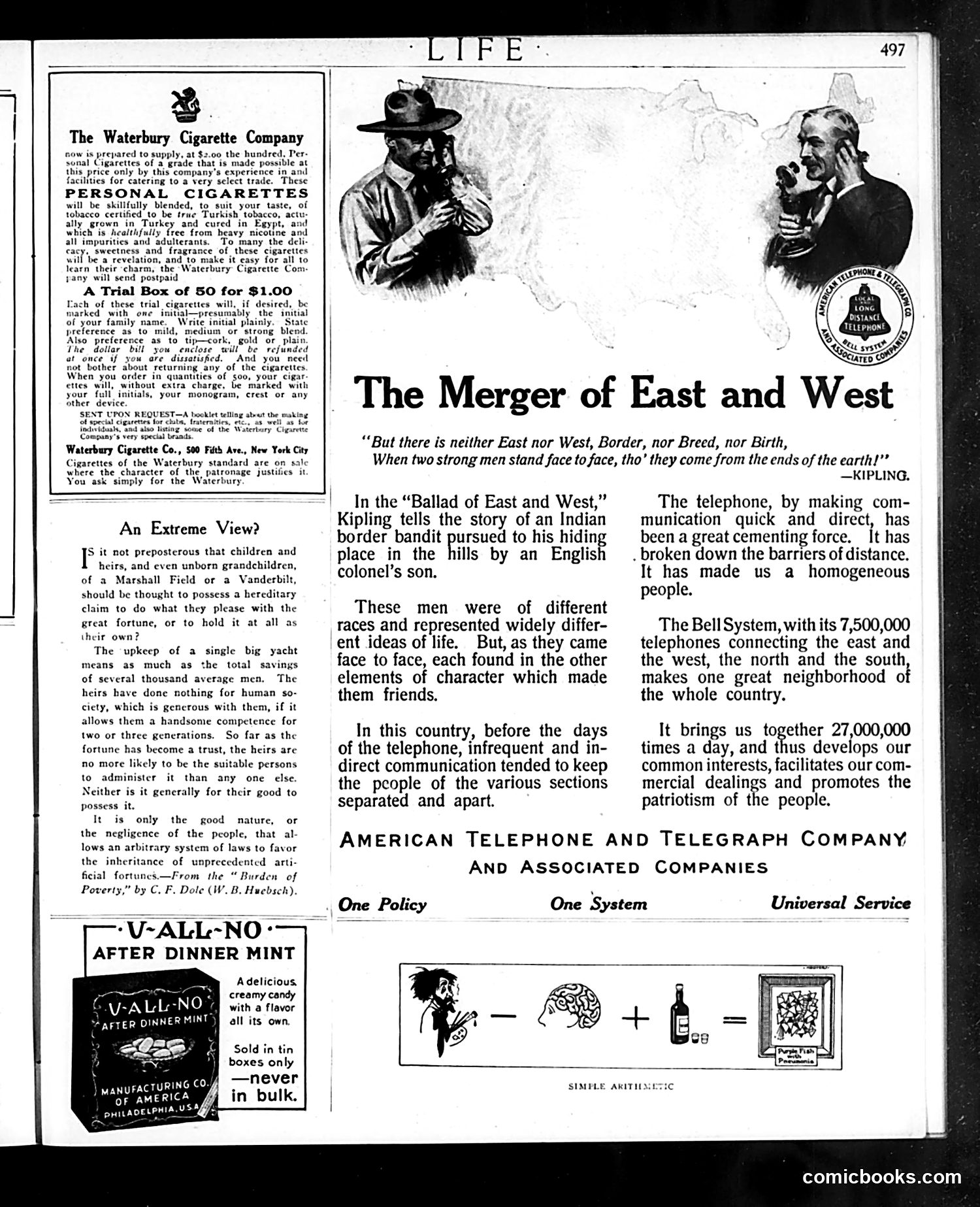
This page combines advertisements with editorial content promoting the American Telephone and Telegraph Company. The main article, "The Merger of East and West," uses Rudyard Kipling's famous poem to argue that the telephone unites a divided nation. It draws a parallel between Kipling's story of an English colonial and Indian bandit who overcome their differences, and America's regional divisions. Before the telephone, the article claims, lack of direct communication kept "people of the various sections separated and apart." The Bell System, with 7.5 million telephones connecting east and west, is presented as creating national unity and patriotism among 27 million daily users. The surrounding advertisements (Waterbury Cigarettes, V-ALL-NO mints) are typical period marketing, emphasizing personalized luxury goods for the "select trade." The article essentially functions as corporate propaganda, portraying the telephone monopoly as a force for national cohesion and social progress—a common early 20th-century promotional strategy.
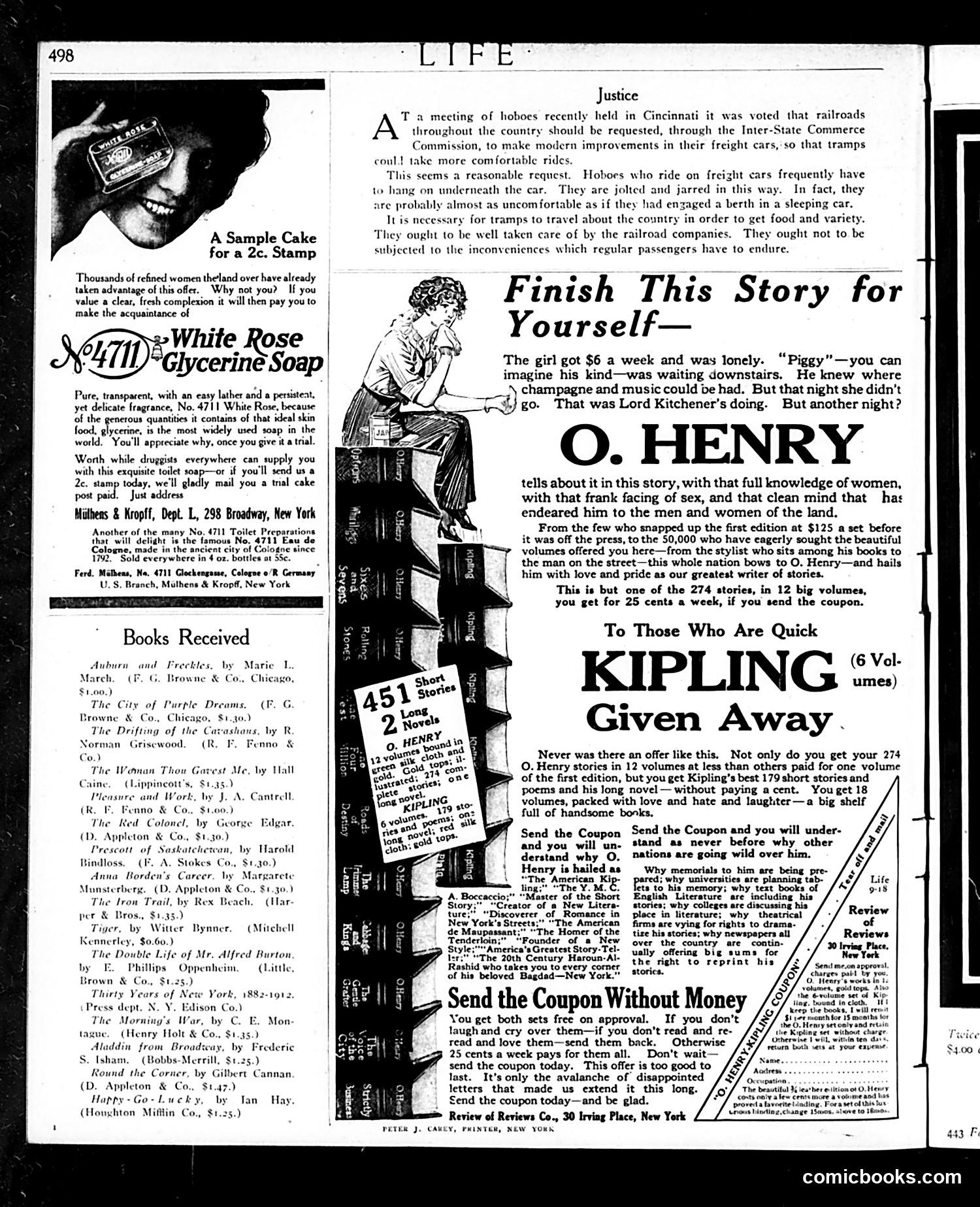
This page mixes advertising with editorial content. The **"Justice" section** satirizes a hobo convention in Cincinnati that voted to request better freight-car conditions through the Interstate Commerce Commission. The satire is gentle: the author notes that hoboes hanging underneath freight cars are nearly as uncomfortable as sleeping-car passengers, and therefore deserve railroad company care. The piece treats the hoboes' request as surprisingly *reasonable*—a humorous inversion of typical attitudes toward vagrants as nuisances rather than people deserving basic dignity. The bulk of the page consists of advertising (White Rose Glycerine Soap) and a promotional offer for O. Henry stories, plus a "Books Received" section listing new publications. There is no political cartoon visible—rather, the satire operates through the editorial commentary on the hobo convention.
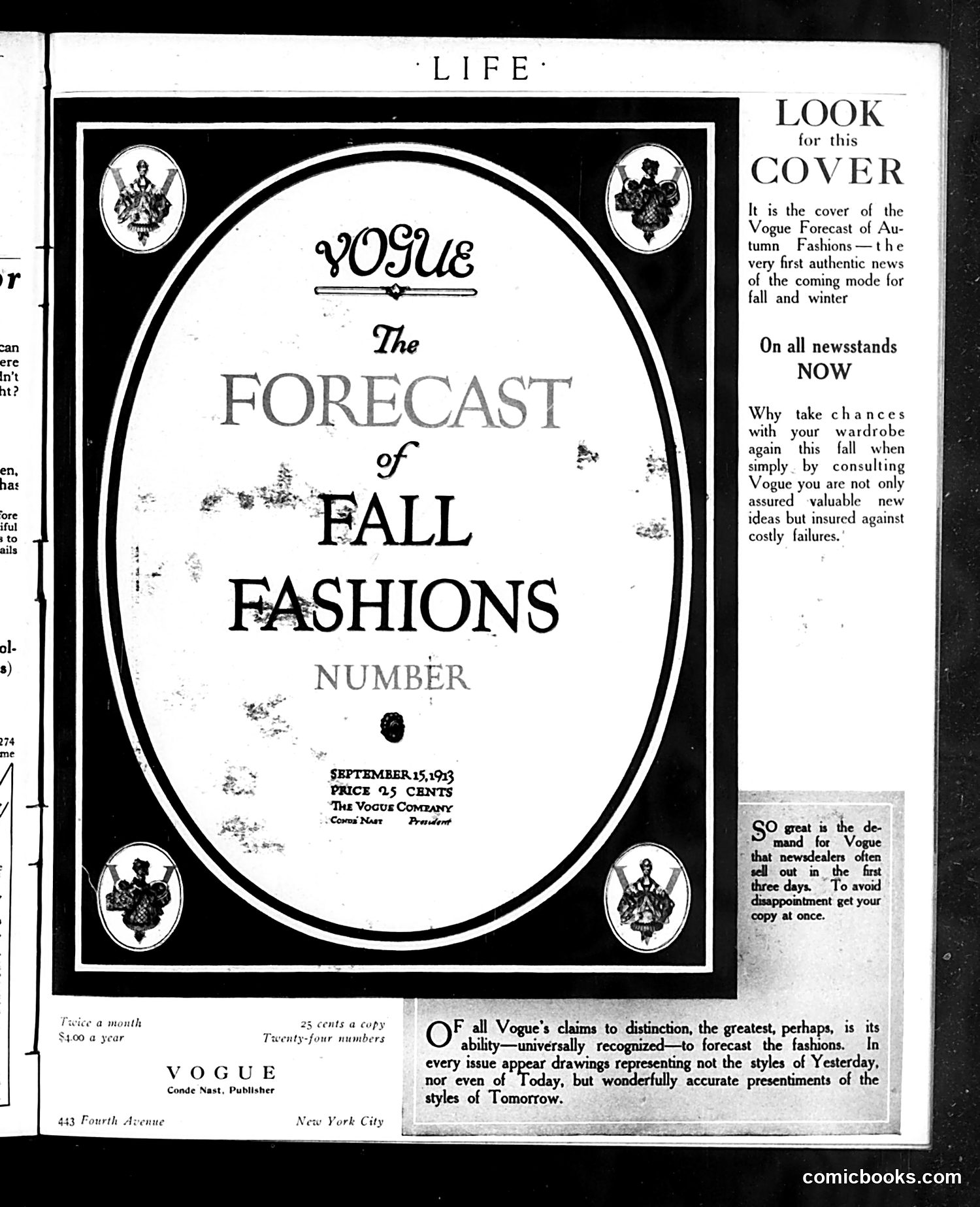
This is primarily **advertising**, not satire. It's a cover advertisement for Vogue magazine's "Forecast of Fall Fashions" issue (September 15, 1933), placed in *Life* magazine. The page promotes Vogue's authority in predicting upcoming fashion trends rather than merely reporting current styles. The accompanying text emphasizes that consulting Vogue protects readers from "costly failures" in wardrobe choices—positioning the magazine as an essential, authoritative guide. The urgency messaging ("sell out in the first three days") and decorative oval border with ornamental corners reflect 1930s advertising design conventions meant to convey elegance and exclusivity. **Context for modern readers**: This reflects pre-internet era dependence on magazines as the primary source for fashion forecasting. Vogue's predictive function was genuinely valuable when trend information traveled slowly and fashion was more centralized.
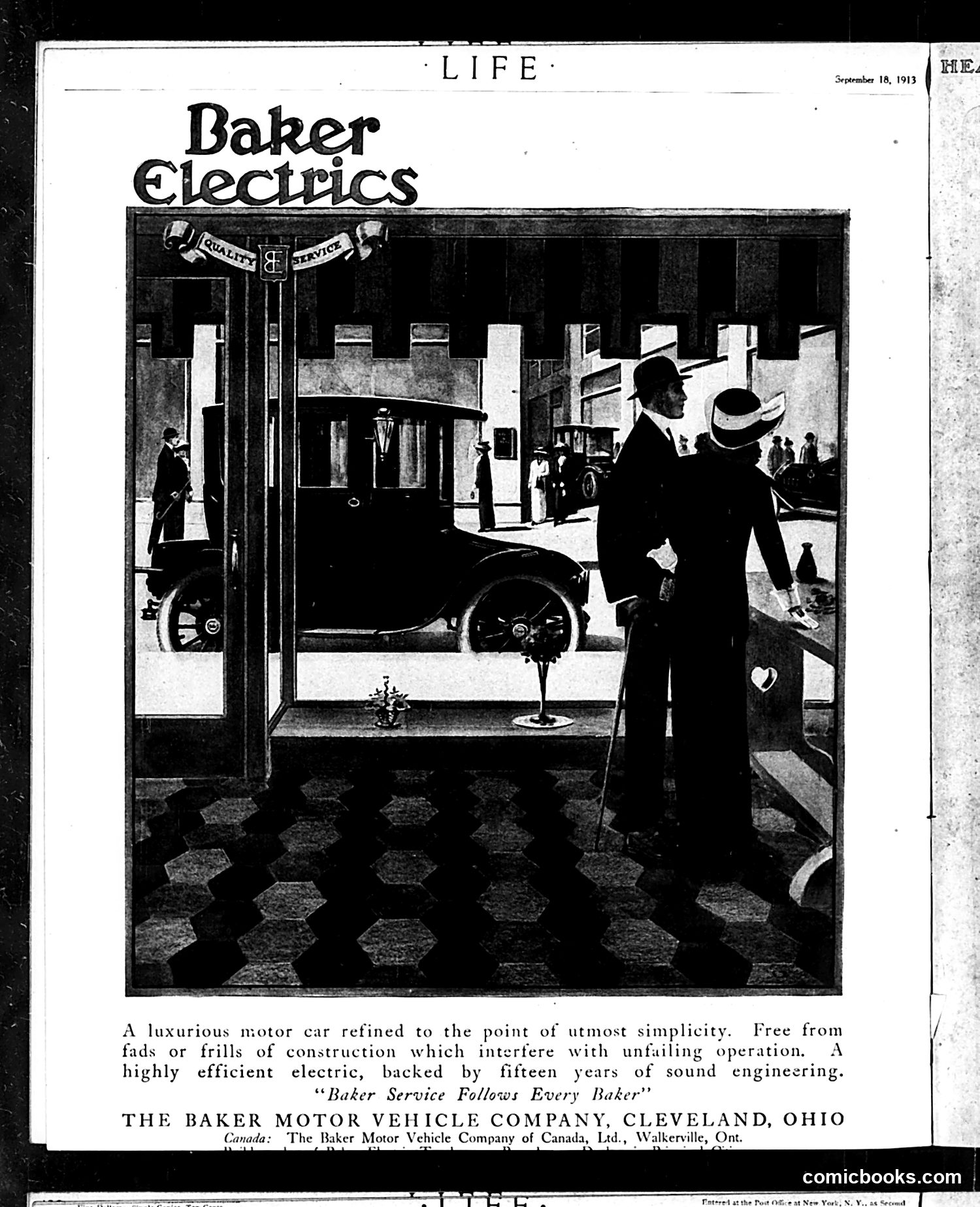
This is **not satire or political commentary**—it's a straightforward advertisement for Baker electric automobiles, published in *Life* magazine on September 18, 1913. The image shows a showroom scene with well-dressed men in suits and hats examining a Baker electric vehicle through a storefront window. The advertisement emphasizes the car's luxury, simplicity of design, reliability, and electrical efficiency. The tagline "Baker Service Follows Every Baker" promises customer support. This represents the early automotive era when electric vehicles competed with gasoline cars; Baker was a legitimate Cleveland, Ohio manufacturer of electric automobiles that operated until 1916. For modern readers: this reflects a time when electric cars were considered upscale, practical alternatives to gas-powered vehicles—a surprisingly parallel situation to today's electric vehicle market.