
Life, 1913-09-18 · page 10 of 44
Life — September 18, 1913 — page 10: what you’re looking at
What you’re looking at
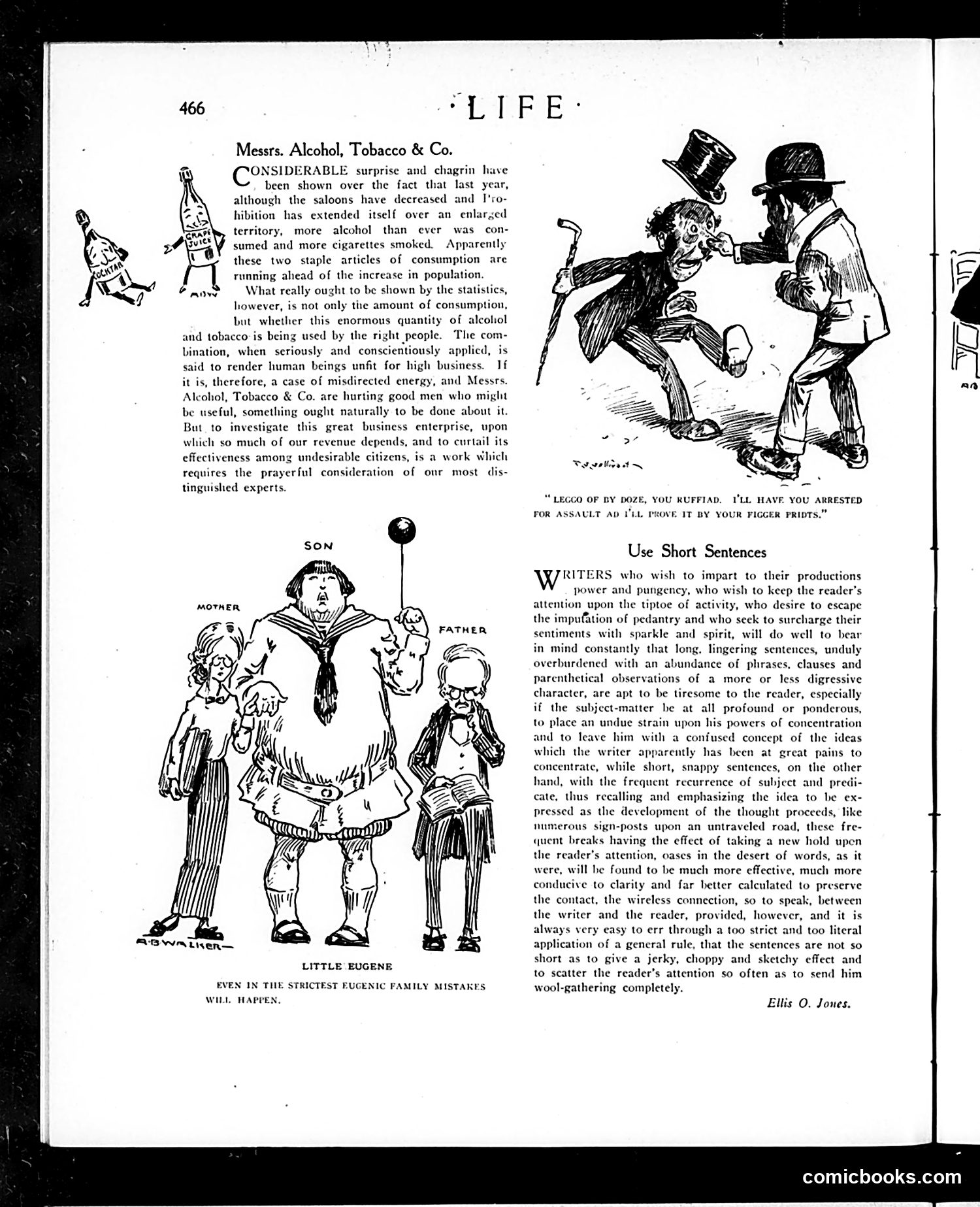
**Top Section - "Messrs. Alcohol, Tobacco & Co.":** This article satirizes the increased consumption of alcohol and tobacco despite Prohibition's expansion. The personified bottles of alcohol and tobacco are depicted as characters "hurting good men." The piece argues these substances render people unfit for business, critiquing both their consumption and the industries profiting from them. **Political Cartoon - "Little Eugene":** Shows a child labeled "Little Eugene" flanked by Mother and Father figures, with a central authority figure (labeled "Son") controlling them via strings like a puppet master. The caption states: "Even in the strictest eugenic family mistakes will happen." This satirizes eugenics pseudoscience popular in the early 20th century, mocking the notion that selective breeding could produce "perfect" humans. **Right Section - "Use Short Sentences":** Writing advice by Ellis O. Jones about effective prose style.
📄 Transcribed text from this page (OCR, searchable)
Machine-transcribed from the original scan — historical spelling and the odd misread are preserved.
ie bell fella Messrs. Alcohol, Tobacco & Co. CONSIDERABLE surprise and chagrin have been shown over the fact that last year, although the saloons have decreased and I'ro- hibition has extended itself over an enlarged territory, more alcohol than ever was con- sumed and more cigarettes smoked. Apparently these two staple articles of consumption are running ahead of the increase in population. What really ought to be shown by the statistics, however, is not only the amount of consumption, but whether this enormous quantity of alcohol and tobacco is being used by the right people. The com- Lination, when seriously and conscientiously applicd, is said to render human beings unfit for high business. If it is, therefore, a case of misdirected energy, and Messrs. Alcohol, Tobacco & Co. are hurting good men who might be useful, something ought naturally to be done about it. But to investigate this great business enterprise, upon which so much of our revenue depends, and to curtail its effectiveness among undesirable citizens, is a work which requires the prayerful consideration of onr most dis- tinguished experts. A / FATHER ot ES Cy ABWALisen— LITTLE EUGENE EVEN IN THE STRICTEST EUGENIC FAMILY MISTAKES, WILL, HAPPEN. VeeeleedtS “LEGCO OF BY DOZE, YOU RUFFIAD. I'LL HAVE. YOU ARRESTED FOR ASSAULT AD I'LL. e IT BY YOUR FIGGER PRIDTS.” Use Short Sentences WRITERS who wish to impart to their productions power and pungency, who wish to keep the reader's attention upon the tiptoe of activity, who desire to escape the impufation of pedantry and who seek to surcharge their sentiments with sparkle and spirit, will do well to bear in mind constantly that long, lingering sentences, unduly overburdened with an abundance of phrases, clauses and parenthetical observations of a more or less digressive character, are apt to be tiresome to the reader, especially if the subject-matter be at all profound or ponderous, to place an undue strain upon his powers of concentration and to leave him with a confused concept of the ideas which the writer apparently has been at great pains to concentrate, while short, snappy sentences, on the other hand, with the frequent recurrence of subject and predi- cate, thus recalling and emphasizing the idea to be ex- pressed as the development of the thought proceeds, like numerous sign-posts upon an untraveled road, these fre- quent breaks having the effect of taking a new hold upon the reader's attention, oases in the desert of words, as it were, will be found to be much more effective, much more conducive to clarity and far better calculated to preserve the contact, the wireless connection, so to speak, between the writer and the reader, provided, however, and it is always very easy to err through a too strict and too literal application of a general rule, that the sentences are not so short as to give a jerky, choppy and sketchy effect and to scatter the reader’s attention so often as to send him wool-gathering completely. Ellis O. Jones. comicbooks.com