
Life, 1913-09-18 · page 28 of 44
Life — September 18, 1913 — page 28: what you’re looking at
What you’re looking at
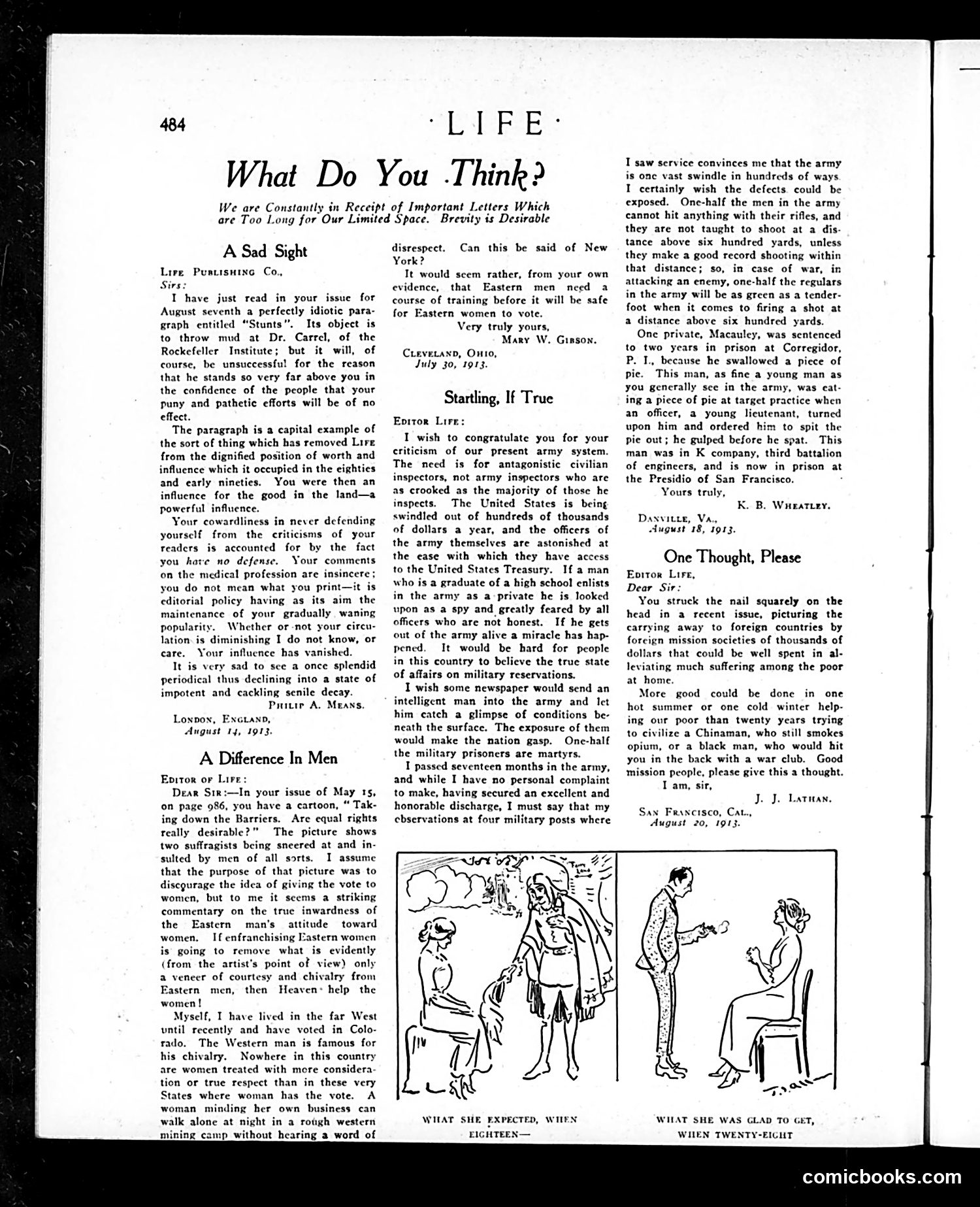
This page features reader responses to Life magazine articles. The letters address three topics: **"A Sad Sight"** criticizes Life for attacking Dr. Alexis Carrel of the Rockefeller Institute, claiming the magazine has lost its former influence and dignity. **"A Difference In Men"** responds to a pro-suffrage argument, defending women's voting rights by contrasting respectful Western men (in voting states like Colorado) with disrespectful Eastern men who oppose suffrage. The writer argues that enfranchisement actually *improves* men's behavior toward women. **"Startling, If True"** attacks corruption in the U.S. Army, alleging officers systematically defraud the Treasury and mistreat enlisted men. The bottom cartoon (caption visible) depicts gender dynamics, likely related to the suffrage debate above it, showing expectations versus reality for young women. These letters reflect 1913 debates over women's voting rights and military accountability.
📄 Transcribed text from this page (OCR, searchable)
Machine-transcribed from the original scan — historical spelling and the odd misread are preserved.
“ERE: What Do You .Think? We are Constantly in Receipt of Important Letters Which are Too Loug for Our Limited Space. A Sad Sight Lire Puatisuixc Co., Sirs: I have just read in your issue for August seventh a perfectly idiotic para- graph entitled “Stunts”. Its object is to throw mud at Dr. Carrel, of the Rockefeller Institute; but it will, of course, be unsuccessful for the reason that he stands so very far above you in the confidence of the people that your puny and pathetic efforts will be of no effect. The paragraph is a capital example of the sort of thing which has removed Lire from the dignified position of worth and influence which it occupied in the eighties and early nineties. You were then an influence for the good in the land—a powerful influence. Your cowardliness in never defending yourself from the criticisms of your readers is accounted for by the fact you hate no defense. Your comments on the medical profession are insincere; you do not mean what you print—it is editorial policy having as its aim the maintenance of your gradually waning popularity. Whether or-not your circu- lation. is diminishing I do not know, or care. Your influence has vanished. It is very sad to sce a once splendid periodical thus declining into a state of impotent and cackling senile decay. Priuir A. Means. Loxpox, EnGLanp, August 14, 1913. A Difference In Men Epitor or Lire: Dear Sir:—In your issue of May 15, on page 986, you have a cartoon, “ Tak- ing down the Barriers. Are equal rights really desirable?” The picture shows two suffragists being sneered at and in- sulted by men of all sorts. I assume that the purpose of that picture was to discgurage the idea of giving the vote to wonicn, but to me it scems a striking commentary on the true inwardness of the Eastern man’s attitude toward women. If enfranchising Eastern women is going to remove what is evidently (from the artist's point of view) only a veneer of courtesy and chivalry from Eastern men, then Heaven: help the women! Myself, I have lived in the far West until recently and have voted in Colo- rado. The Western man is famous for his chivalry. Nowhere in this country are women treated with more considera tion or true respect than in these very States where woman has the vote. A woman minding her own business can walk alone at night in a roagh western mining camp without hearing a word of Brevity is Desirable disrespect. Can this be said of New York? It would scem rather, from your own evidence, that Eastern men need a course of training before it will be safe for Eastern women to vote. Very truly yours, Mary W. Ginson. Crevetann, Onto, July 30, 1913. Startling, If True Epitor Lr I wish to congratulate you for your criticism of our present army system. The need is for antagonistic civilian inspectors, not army inspectors who are as crooked as the majority of those he inspects. The United States is being swindled out of hundreds of thousands of dollars a year, and the officers of the army themselves are astonished at the ease with which they have access to the United States Treasury. If a man who is a graduate of a high school enlists in the army as a private he is looked upon as a spy and greatly feared by all officers who are not honest. If he gets out of the army alive a miracle has hap- pened. It would be hard for people in this country to believe the true state of affairs on military reservations. I wish some newspaper would send an intelligent man into the army and let him catch a glimpse of conditions be- neath the surface. The exposure of them would make the nation gasp. One-half the military prisoners are martyrs. I passed seventeen months in the army, and while I have no personal complaint to make, having secured an excellent and honorable discharge, I must say that my ebservations at four military posts where WHAT SHE EXPECTED, WIEN EIGHTEEN— T saw service convinces me that the army is onc vast swindle in hundreds of ways. I certainly wish the defects. could be exposed. One-half the men in the army cannot hit anything with their rifles, and they are not taught to shoot at a dis- tance above six hundred yards, unless they make a good record shooting within that distance; so, in case of war, in attacking an enemy, one-half the regulars in the army will be as green as a tender- foot when it comes to firing a shot at a distance above six hundred yards. One private, Macauley, was sentenced to two years in prison at Corregidor, P. I, because he swallowed a piece of pic. This man, as fine a young man as you generally sce in the army, was ecat- ing a piece of pic at target practice when an officer, a young lieutenant, turned upon him and ordered to spit the pie out; he gulped before he spat. This man was in K company, third battalion of engineers, and is now in prison at the Presidio of San Francisco. ‘ Yours truly, K. B. Wueratzey. Danvitte, Va., stugust 18, 1913. One Thought, Please Epitor Lire, Dear Sir: You struck the nail squarely on the head in a recent issue, picturing the carrying away to foreign countries by forcign mission societies of thousands of dollars that could be well spent in al- leviating much suffering among the poor at home. More good could be done in one hot summer or one cold winter help- ing our poor than twenty years trying to civilize a Chinaman, who still smokes opium, or a black man, who would hit you in the back with a war club. Good mission people, please give this a thought. 1 am, sir, J. J. Latitan. Saw Francisco, Cat., August 20, 1913. WHAT SHE WAS GLAD TO GE? WHEN TWENTY-EIGHT comicbooks.com