
Life, 1913-09-18 · page 19 of 44
Life — September 18, 1913 — page 19: what you’re looking at
What you’re looking at
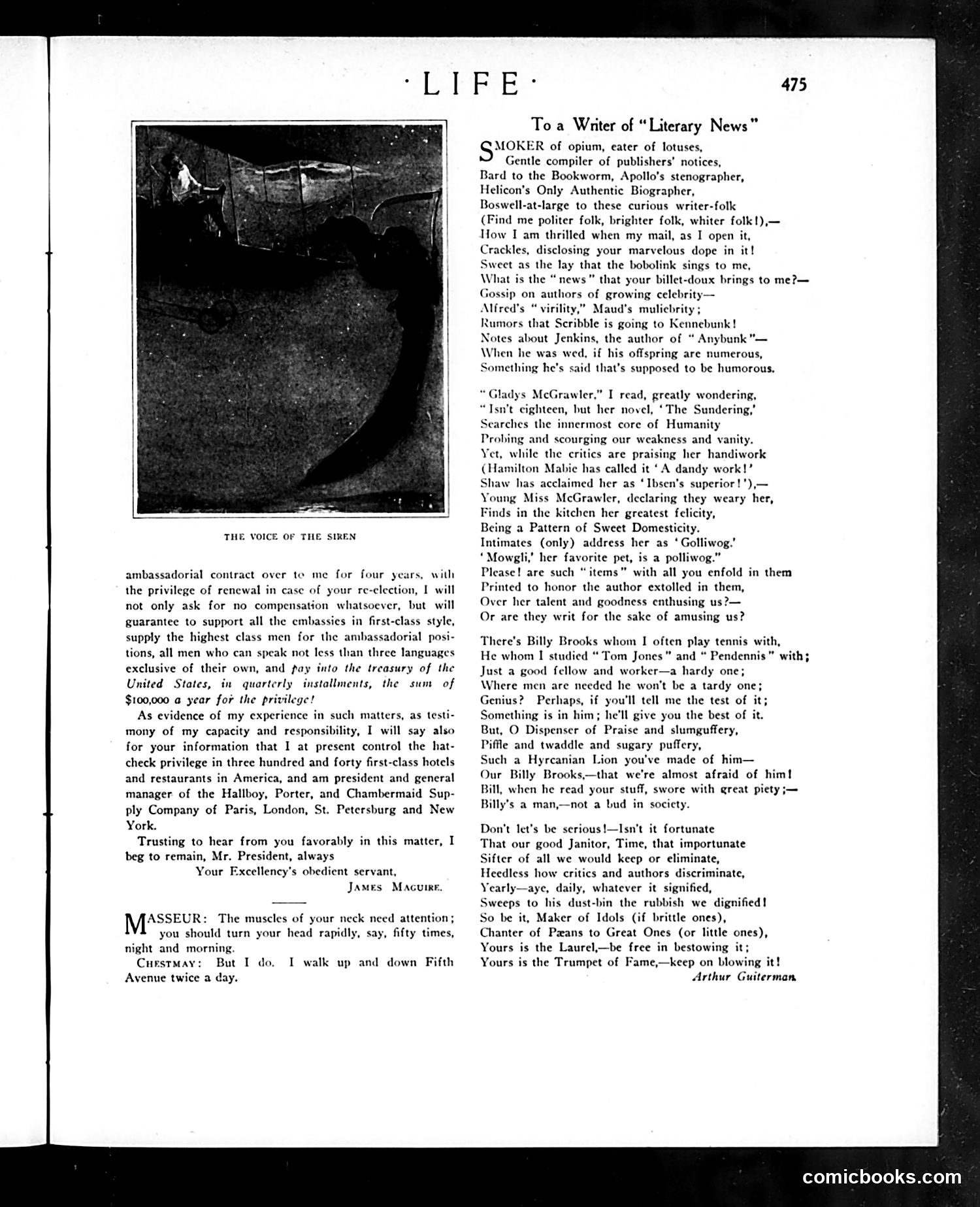
This page contains two distinct satirical pieces targeting American literary and social pretension circa early 1900s. **"The Voice of the Siren"** mocks political patronage and corruption. A character named James Maguire—apparently a self-made businessman controlling hat-check privileges and porter services across major hotels and cities—petitions the President for an ambassadorial post. The satire lies in his audacious offer: he'll pay $100,000 yearly *for the privilege* while staffing embassies with multilingual men. This skewers how wealthy businessmen essentially purchased diplomatic positions through political connections rather than merit. **"To a Writer of Literary News"** lampoons literary journalism and celebrity gossip culture. The poet mocks "Literary News" columns that breathlessly report trivial details about authors (marriages, children, pets' names) while inflating mediocre writers through hyperbolic praise. Young novelist Gladys McGrawler represents the absurdity: critics hail her as superior to Ibsen, yet she finds "greatest felicity" in kitchen domesticity. The piece satirizes both the puffery of literary promotion and the gap between critical acclaim and actual talent.
📄 Transcribed text from this page (OCR, searchable)
Machine-transcribed from the original scan — historical spelling and the odd misread are preserved.
gs i a oa THE VOICE OF THE SIREN ambassadorial contract over te me for four years, with the privilege of renewal in case of your re-election, I will not only ask for no compensation whatsoever, but will guarantee to support all the embassies in first-class style, supply the highest class men for the ambassadorial posi- tions, all men who can speak not less than three languages exclusive of their own, and pay into the treasury of the United States, in quarterly installments, the sum of $100,000 a year for the privilege! As evidence of my experience in such matter: mony of my capacity and responsibility, I will say also for your information that I at present control the hat- check privilege in three hundred and forty first-class hotels and restaurants in America, and am president and general manager of the Hallboy, Porter, and Chambermaid Sup- ply Company of Paris, London, St. Petersburg and New York. Trusting to hear from you favorably in this matter, I beg to remain, Mr. President, always Your Excellency’s obedient servant, James Macuire. as testi- ASSEUR: The muscles of your neck need attention; you should turn your head rapidly, say, fifty times, night and morning. Curstmay: But I do. Avenue twice a day. I walk up and down Fifth To a Whiter of “Literary News” GMORER of opium, eater of lotuses, Gentle compiler of publishers’ notices, Bard to the Bookworm, Apollo's stenographer, Helicon’s Only Authentic Biographer, Boswell-at-large to these curious writer-folk (Find me politer folk, brighter folk, whiter folk!),— How I am thrilled when my mail, as I open it, Crackles, disclosing your marvelous dope in it! Sweet as the lay that the bobolink sings to me, What is the “news” that your billet-doux brings to me?— Gossip on authors of growing celebrity— Alfred's “ virility, Rumors that Scribble is going to Kennebunk! Notes about Jenkins, the author of “ Anybunk "— When he was wed, if his offspring are numerous, Something he's said that’s supposed to be humorous, “Gladys McGrawler,” I read, greatly wondering, “Isn't eighteen, but her novel, ‘The Sundering,’ Searches the innermost core of Humanity Probing and scourging our weakness and vanity, Yet, while the critics are praising her handiwork (Hamilton Mabie has called it ‘A dandy work!’ Shaw has acclaimed her as ‘Ibsen's superior !'),— Young Miss McGrawler, declaring they weary her, Finds in the kitchen her greatest felicity, Being a Pattern of Sweet Domesticity. Intimates (only) address her as ‘Golliwog.’ ‘Mowgli,’ her favorite pet, is a polliwog.” Please! are such “items” with all you enfold in them Printed to honor the author extolled in them, Over her talent and goodness enthusing us?— Or are they writ for the sake of amusing us? There's Billy Brooks whom I often play tennis with, He whom I studied “Tom Jones" and “ Pendennis” with; Just a good fellow and worker—a hardy one; Where men are needed he won't be a tardy one; Genius? Perhaps, if you'll tell me the test of it; Something is in him; he'll give you the best of it. But, O Dispenser of Praise and slumguffery, Piffle and twaddle and sugary puffery, Such a Hyrcanian Lion you've made of him— Our Billy Brooks,—that we're almost afraid of him! Bill, when he read your stuff, swore with great piety ;— Billy's a man,—not a bud in society. Don't let's be serious!—Isn't it fortunate That our good Janitor, Time, that importunate Sifter of all we would keep or eliminate, Heedless how critics and authors discriminate, Yearly—aye, daily, whatever it signified, Sweeps to his dust-bin the rubbish we dignified! So be it, Maker of Idols (if brittle ones), Chanter of Pzxans to Great Ones (or little ones), Yours is the Laurel,—be free in bestowing it; Yours is the Trumpet of Fame,—keep on blowing it! Arthur Guiterman comicbooks.com