
Life, 1913-09-18 · page 26 of 44
Life — September 18, 1913 — page 26: what you’re looking at
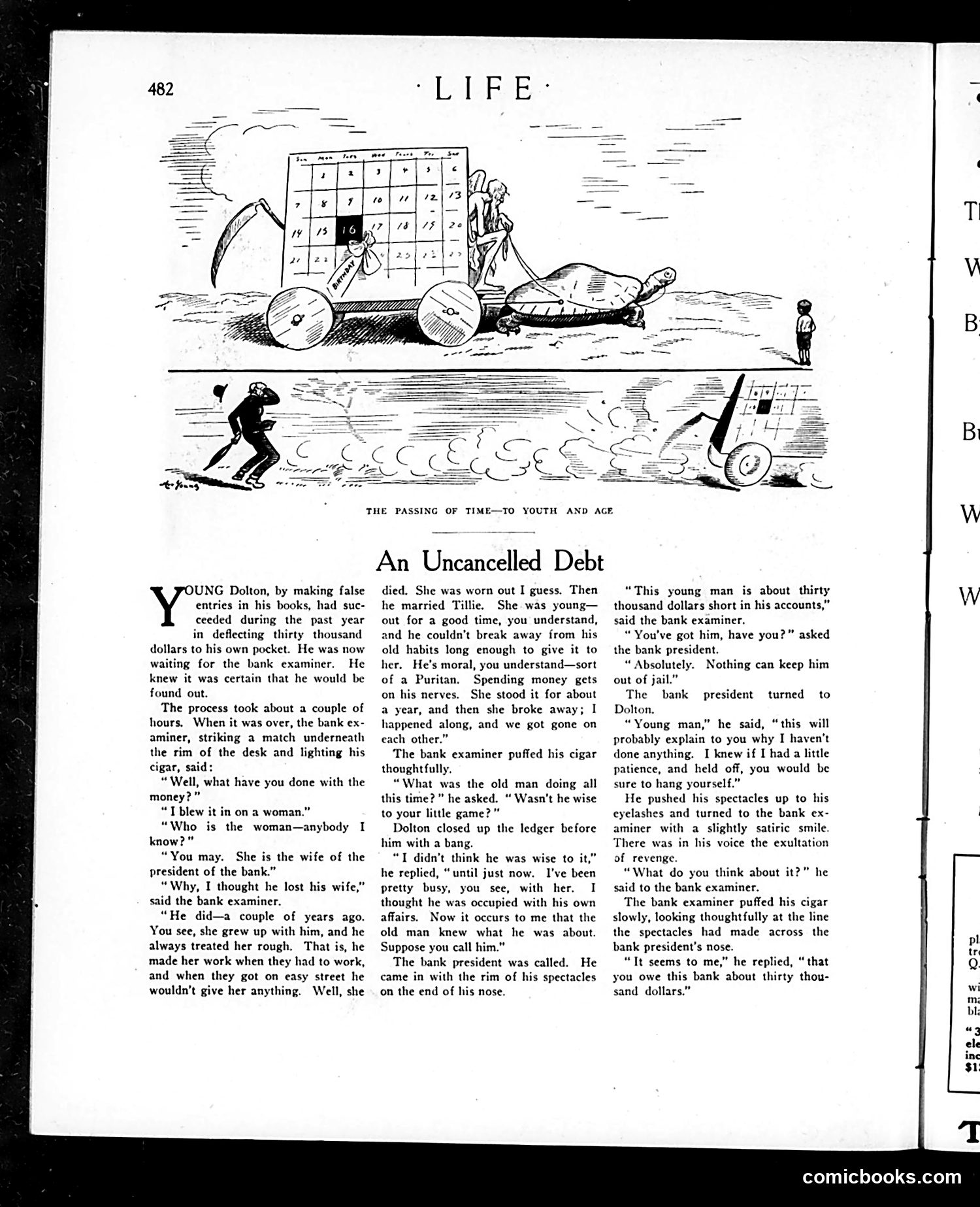
What you’re looking at
This is a satirical story about moral irony and delayed justice. Young bank clerk Dolton embezzles $30,000 to court the bank president's young second wife (Tillie), who was mistreated by her austere, penny-pinching husband. The president discovers the affair but says nothing, patiently waiting for Dolton to expose himself through his own guilt and carelessness. When caught, the president reveals his silence was calculated revenge: he knew Dolton would eventually hang himself. However, the bank examiner's final line provides the twist—the president's inaction allowed the theft to occur, making *him* financially responsible to the bank for the thirty thousand dollars. The satire critiques how moral rigidity and emotional neglect (the president's Puritan stinginess toward his wife) breed infidelity and theft, while his passive revenge ultimately costs him money. Justice becomes circular and self-defeating.
📄 Transcribed text from this page (OCR, searchable)
Machine-transcribed from the original scan — historical spelling and the odd misread are preserved.
UNG Dolton, by making false entries in his books, had suc- ceeded during the past year in deflecting thirty thousand dollars to his own pocket. He was now waiting for the bank examiner. He knew it was certain that he would be found out. The process took about a couple of hours. When it was over, the bank ex- aminer, striking a match underneath the rim of the desk and lighting his cigar, said: “Well, what have you done with the money?” “T blew it in on a woman.” “Who is the woman—anybody I know?” “You may. She is the wife of the president of the bank.” “Why, I thought he lost his wife,” said the bank examiner. “He did—a couple of years ago. You see, she grew up with him, and he always treated her rough. That is, he made her work when they had to work, and when they got on easy street he wouldn’t give her anything. Well, she An Uncancelled Debt died, She was worn out I guess. Then he married Tillie. She was young— out for a good time, you understand, and he couldn't break away from his old habits long enough to give it to her. He's moral, you understand—sort of a Puritan. Spending money gets on his nerves. She stood it for about a year, and then she broke away; I happened along, and we got gone on each other.” The bank examiner puffed his cigar thoughtfully, “What was the old man doing all this time?” he asked. “ Wasn't he wise to your little game?” Dolton closed up the ledger before him with a bang. “T didn’t think he was wise to it,” he replied, “until just now. I’ve been pretty busy, you see, with her. I thought he was occupied with his own affairs. Now it occurs to me that the old man knew what he was about. Suppose you call him.” The bank president was called. He came in with the rim of his spectacles ‘on the end of his nose. THE PASSING OF TIME—TO YOUTH AND AGE “This young man is about thirty thousand dollars short in his accounts,” said the bank examiner. “You've got him, have you?” asked the bank president. “Absolutely. Nothing can keep him out of jail.” The bank Dolton, “Young man,” he said, “this will probably explain to you why I haven't done anything. I knew if I had a little patience, and held off, you would be sure to hang yourself.” He pushed his spectacles up to his eyelashes and turned to the bank ex- aminer with a slightly satiric smile. There was in his voice the exultation of revenge. “What do you think about it?” he said to the bank examiner. The bank examiner puffed his cigar slowly, looking thoughtfully at the line the spectacles had made across the bank president’s nose. “Tt seems to me,” he replied, “that you owe this bank about thirty thou- sand dollars.” president turned to comicbooks.com