
Life, 1913-09-18 · page 24 of 44
Life — September 18, 1913 — page 24: what you’re looking at
What you’re looking at
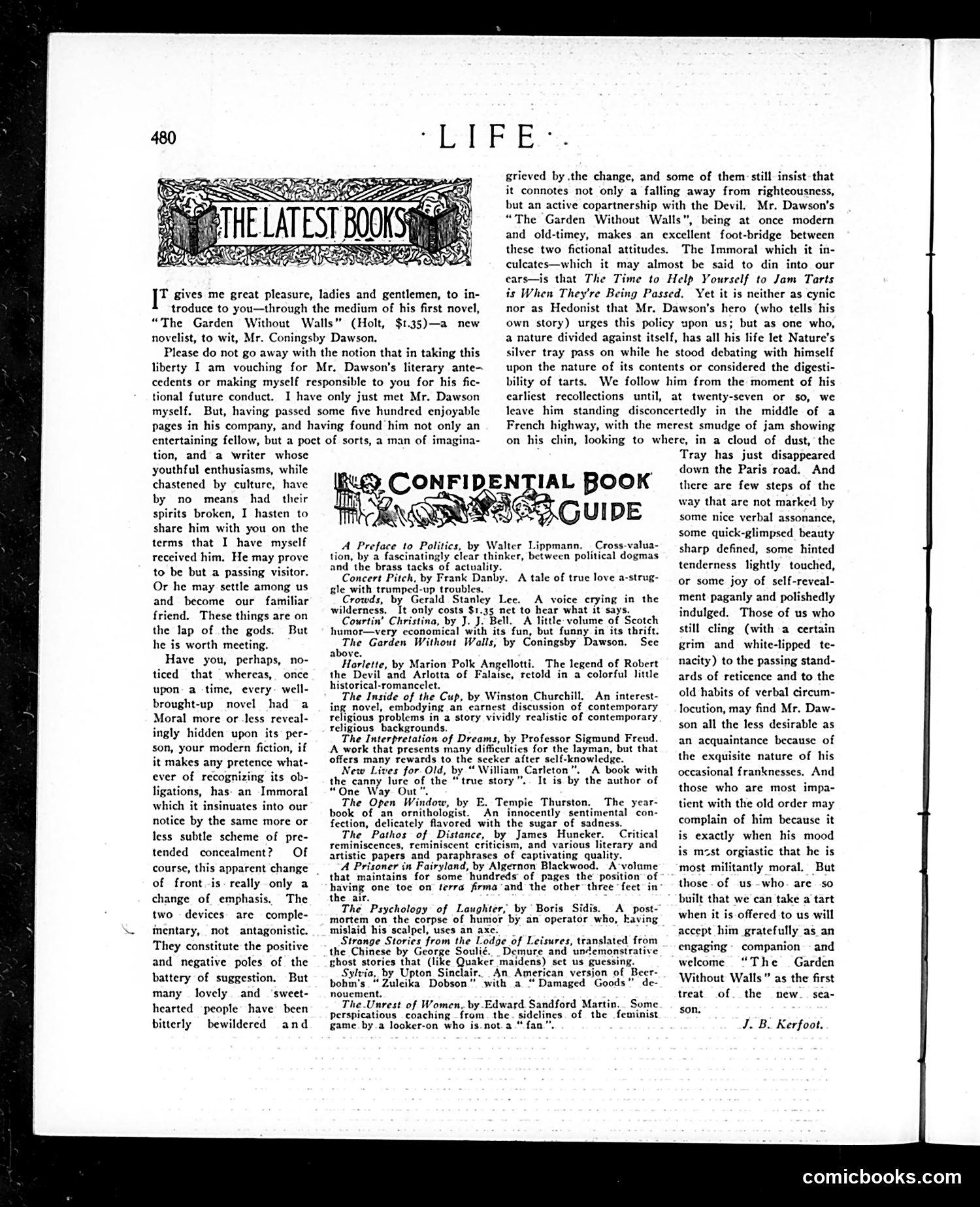
This is a book review section, not a political cartoon. The main content is J.B. Kerfoot's introduction to Coningsby Dawson's debut novel *The Garden Without Walls*, with a sidebar listing other recent publications. **The Key Point:** Kerfoot discusses a shift in modern fiction from novels with hidden "Morals" to those with emphasized "Immorals"—a change he presents as complementary rather than antagonistic. He uses Dawson's novel as an example: its protagonist learns to seize life's pleasures (symbolized by jam tarts offered on a passing tray) rather than overthink and miss them. The satire is gentle—targeting both old-fashioned moralists who see modern fiction as actively sinful, and modern cynics. Kerfoot positions Dawson's work as a "foot-bridge" between these attitudes, suggesting the protagonist's conflict reflects contemporary anxieties about changing social values. This reflects early 20th-century debates about literary modernism and morality.
📄 Transcribed text from this page (OCR, searchable)
Machine-transcribed from the original scan — historical spelling and the odd misread are preserved.
ad Ua) (es age c gives me great pleasure, ladies and gentlemen, to in- troduce to you—through the medium of his first novel, “The Garden Without Walls” (Holt, $1.35)—a new novelist, to wit, Mr. Coningsby Dawson. Please do not go away with the notion that in taking this liberty I am vouching for Mr. Dawson's literary ante~ cedents or making myself responsible to you for his fic- tional future conduct. I have only just met Mr. Dawson myself. But, having passed some five hundred enjoyable pages in his company, and having found him not only an entertaining fellow, but a poct of sorts, a man of imagina- grieved bythe change, and some of them: still insist that it connotes not only a falling away from righteousness, but an active copartnership with the Devil. Mr. Dawson's “The Garden Without Walls”, being at once modern and old-timey, makes an excellent foot-bridge between these two fictional attitudes. The Immoral which it in- culcates—which it may almost be said to din into our ears—is that The Time to Help Yourself to Jam Tarts is When They're Being Passed. Yet it is neither as cynic nor as Hedonist that Mr. Dawson's hero (who tells his own story) urges this policy upon us; but as one who, a nature divided against itself, has all his life let Nature’s silver tray pass on while he stood debating with himself upon the nature of its contents or considered the digesti- bility of tarts. We follow him from the moment of his earliest recollections until, at twenty-seven or so, we leave him standing disconcertedly in the middle of a French highway, with the merest smudge of jam showing on his chin, looking to where, in a cloud of dust, the tion, and a writer whose youthful enthusiasms, while chastened by culture, have by no means had their spirits broken, I hasten to share him with you on the terms that I have myself received him. He may prove to be but a passing visitor. Or he may settle among us and become our familiar friend. These things are on the lap of the gods. But he is worth meeting. Have you, perhaps, no- ticed that whereas, once upon: a time, every: well- brought-up novel had a Moral more or less reveal- ingly hidden upon its. per- son, your modern fiction, if it makes any pretence what- ever of recognizing its ob- ligations, has: an Immoral which it insinuates into our notice by the same more or less subtle scheme of pre- tended concealment? Of course, this apparent change of front is- really only a change of emphasis. The two devices are comple- mentary, not antagonistic. They constitute the positive and negative poles of the battery of suggestion. But many lovely and ‘sweet- hearted people have been bitterly bewildered and CONFIDENTIAL BooK RVING GUIDE A Preface to Politics, by Walter Lippmann, Cross-valua- tion, by a fascinatingly clear thinker, between political dogmas and the brass tacks of actuality. Concert Pitch, by Frank Danby. A tale of true love a-strug- gle with trumped-up troubles. Crowds, by Gerald Stanley Lee. A voice crying in the wilderne: It only costs $1.35 net to hear what it says. Courtin’ Christina, by J. J. Bell. A little volume of Scotch humor—very economical with its fun, but funny in its thrift. The Garden Without Walls, by Coningsby Dawson. See above. Horlette, by Marion Polk Angellotti. The legend of Robert the Devil and Arlotta of Falaise, retold in a colorful little historical-romancelet. The Inside of the Cup, by Winston Churchill, An interest- ing novel, embodying an earnest discussion of contemporary religious problems in a story vividly realistic of contemporary religious backgrounds, The Interpretation of Dreams, by Professor Sigmund Freud. A_work that presents many difficulties for the layman, but that offers many rewards to the seeker after self-knowledge. New Lives for Old, by “ William Carleton”. A book with the canny lure of the “true story”. It is by the author of “One Way Out”. The Open Window, by E. Tempie Thurston, The year- book of an ornithologist. An innocently sentimental con- fection, delicately flavored with the sugar of sadness. The Pathos of Distance, by James Huncker. Critical reminiscences, reminiscent criticism, and various literary and artistic papers and paraphrases of captivating quality A Prisoner in Fairyland, by Algernon Blackwood. A-volume that maintains for some hundreds of pages the position of having one toe on terra firma and the other three “feet in the air. The Psychology of Laughter, by Boris Sidis. A post- mortem on the corpse of humor by an operator who, having mislaid his scalpel, uses an axe. Strange Stories from the Lodge of Leisures, ttanslated from the Chinese by George Soulié. Demure and undemonstrative ghost stories that (like Quaker maidens) set us guessing. Sylvia, by Upton Sinclair. An American version of Beer- bohin's “ Zuleika Dobson” with a “ Damaged Goods” de- nouement. TheUnrest of Women, by Edward Sandford Martin. Some Perspicatious coaching from. the. sidelines of the feminist game by.a looker-on who is.not.a “ fan” Tray has just disappeared down the Paris road. And there are few steps of the way that are not marked by some nice verbal assonance, some quick-glimpsed beauty sharp defined, some hinted tenderness lightly touched, or some joy of self-reveal- ment paganly and polishedly indulged. Those of us who still cling (with a certain grim and white-lipped te- nacity) to the passing stand- ards of reticence and to the old habits of verbal circum- locution, may find Mr. Daw- son all the less desirable as an acquaintance because of the exquisite nature of his occasional franknesses. And those who are most impa- tient with the old order may complain of him because it is exactly when his mood is mst orgiastic that he is most militantly moral. But those of us -who. are so built that we can take a tart when it is offered to us will accept him gratefully as an engaging companion and welcome “The Garden Without Walls” as the first treat of. the new son. sea- J.B. Kerfoot. comicbooks.com