
Life, 1913-09-18 · page 20 of 44
Life — September 18, 1913 — page 20: what you’re looking at
What you’re looking at
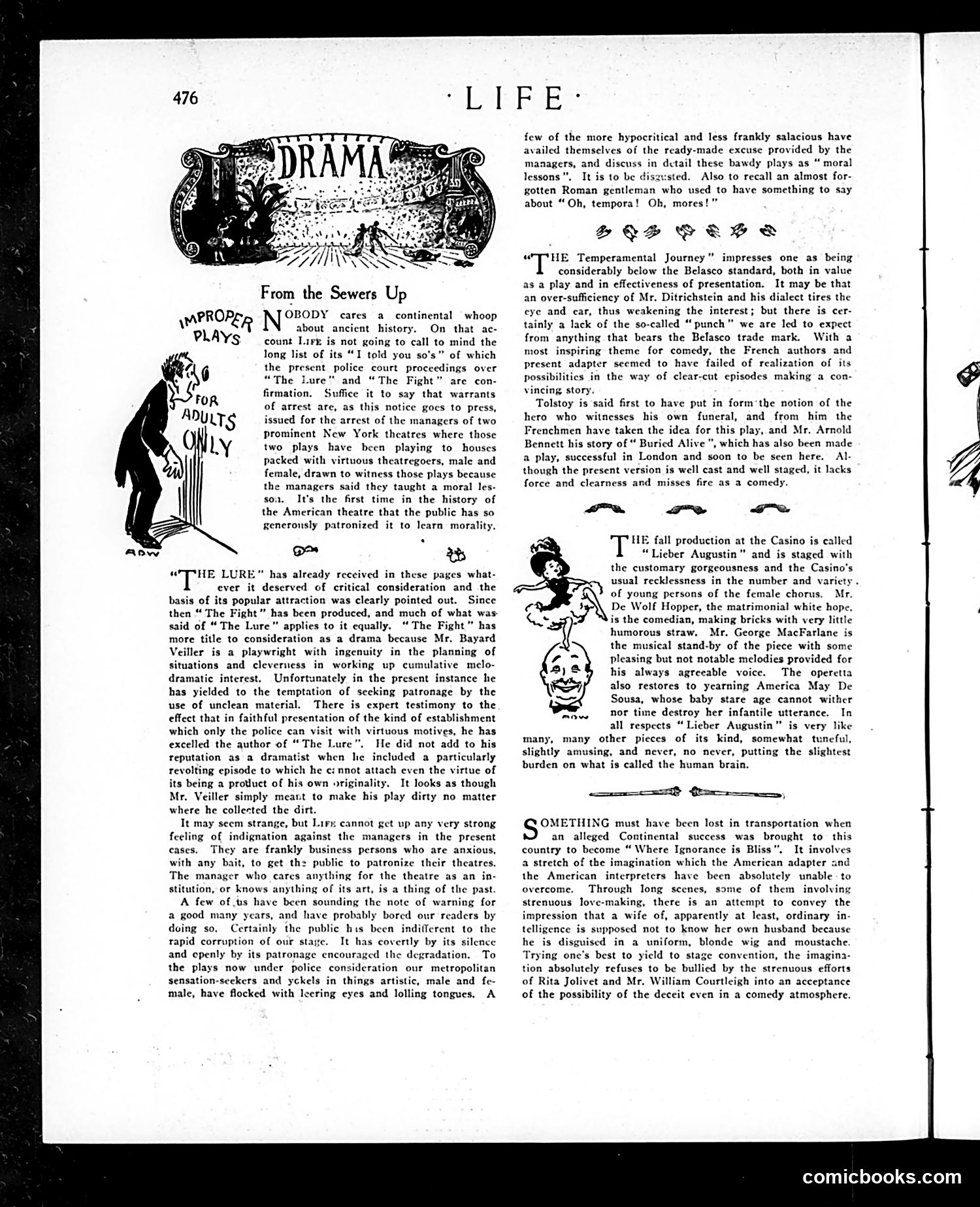
This page critiques two Broadway plays—"The Lure" and "The Fight"—that have been arrested for obscenity. The satire targets theatrical hypocrisy: managers claimed these morally instructive plays justified their salacious content, yet they deliberately packed them with lewd material to attract audiences. The author mocks both the managers (opportunistic businessmen exploiting public appetite for scandal) and the supposedly "virtuous" theatergoers who attend while pretending moral interest. A small cartoon shows a figure labeled "Improper Plays for Adults Only," emphasizing the irony. The piece references Bayard Veiller's playwriting and invokes "Oh tempora, oh mores!"—a Roman exclamation lamenting societal decay—suggesting American theater has become morally corrupt. The criticism extends to the indifferent public that enables degradation through patronage and silence. The page also briefly reviews "The Temperamental Journey," finding it disappointing.
📄 Transcribed text from this page (OCR, searchable)
Machine-transcribed from the original scan — historical spelling and the odd misread are preserved.
aR RGE@ From the Sewers Up PROP, OBODY cares a continental whoop Nereida about ancient history. On that ac- count Lire is not going to call to mind the long list of its “I told you so’s” of which AG the present police court proceedings over Y Sion “The Lure” and “The Fight” are con- firmation, Suffice it to say that warrants of arrest are, as this notice gocs to press, issued for the arrest of the managers of two Prominent New York theatres where those two plays have been playing to houses packed with virtuous theatregoers, male and female, drawn to witness those plays because the managers said they taught a moral les- son. It's the first time in the history of the American theatre that the public has so generously patronized it to learn morality, es bac) “THE LURE” has already received in these pages what- ever it deserved of critical consideration and the basis of its popular attraction was clearly pointed out. Since then “ The Fight” has been produced, and much of what was said of “The Lure" applies to it equally. “The Fight” has more title to consideration as a drama because Mr. Bayard Veiller is a playwright with ingenuity in the planning of situations and cleveruess in working up cumulative melo- dramatic interest. Unfortunately in the present instance he has yielded to the temptation of secking patronage by the use of unclean material. There is expert testimony to the effect that in faithful presentation of the kind of establishment which only the police can visit with virtuous motives, he has excelled the author of “The Lure”, He did not add to his reputation as a dramatist when he included a particularly revolting episode to which he ci nnot attach even the virtue of its being a protluct of his own originality. It looks as though Mr. Veiller simply meant to make his play dirty no matter where he collected the dirt. It may seem strange, but Lirx cannot get up any very strong feeling of indignation against the managers in the present cases. They are frankly business persons who are anxious, with any bait, to get the public to patronize their theatres, The manager who cares anything for the theatre as an in- stitution, or knows anything of its art, is a thing of the past. A few of us have been sounding the note of warning for a good many years, and have probably bored our readers by doing so. Certainly the public his been indifferent to the rapid corruption of our stage. It has covertly by its silence and cpenly by its patronage encouraged the degradation. To the plays now under police consideration our metropolitan sensation-seekers and yckels in things artistic, male and fe- male, have flocked with leering eyes and lolling tongues. A few of the more hypocritical and less frankly salacious have availed themselves of the ready-made excuse provided by the and discuss in detail these bawdy plays as “ moral Tt is to be zusted. Also to recall an almost for- gotten Roman gentleman who used to have something to say about “Oh, tempora! Oh, mores!” OS PRBS «“"THE Temperamental Journey” impresses one as being considerably below the Belasco standard, both in value asa play and in effectiveness of presentation. It may be that an over-sufficiency of Mr. Ditrichstein and his dialect tires the eye and car, thus weakening the interest; but there is cer- tainly a lack of the so-called “punch” we are led to expect from anything that bears the Belasco trade mark. With a most inspiring theme for comedy, the French authors and present adapter seemed to have failed of realization of its possibilitics in the way of clear-cut episodes making a con- vincing story. Tolstoy is said first to have put in form'the notion of the hero who witnesses his own funeral, and from him the Frenchmen have taken the idea for this play, and Mr. Arnold Bennett his story of “ Buried Alive ", which has also been made a play, successful in London and soon to be seen here. Al- though the present version is well cast and well staged, it lacks force and clearness and misses fire as a comedy. Fae Pe fra HE fall production at the Casino is called “Lieber Augustin” and is staged with the customary gorgeousness and the Casino's usual recklessness in the number and variety . of young persons of the female chorus. Mr. De Wolf Hopper, the matrimonial white hope, is the comedian, making bricks with very little humorous straw. Mr. George MacFarlane is the musical stand-by of the piece with some pleasing but not notable melodies provided for his always agreeable voice. The operetta also restores to yearning America May De Sousa, whose baby stare age cannot wither nor time destroy her infantile utterance. In all respects “Lieber Augustin” is very like many, many other pieces of its kind, somewhat tuneful, slightly amusing, and never, no never, putting the slightest burden on what is called the human brain. ae ft, OMETHING must have been lost in transportation when an alleged Continental success was brought to this country to become “ Where Ignorance is Bliss”. It involves a stretch of the imagination which the American adapter and the American interpreters have been absolutely unable to overcome. Through long scenes, some of them involving strenuous love-making, there is an attempt to convey the impression that a wife of, apparently at least, ordinary in- telligence is supposed not to know her own husband because he is disguised in a uniform, blonde wig and moustache. rying one’s best to yield to stage convention, the imagina- tion absolutely refuses to be bullied by the strenuous efforts of Rita Jolivet and Mr, William Courtleigh into an acceptance of the possibility of the deceit even in a comedy atmosphere. comicbooks.com