
A complete issue · 44 pages · 1913
Life — July 10, 1913
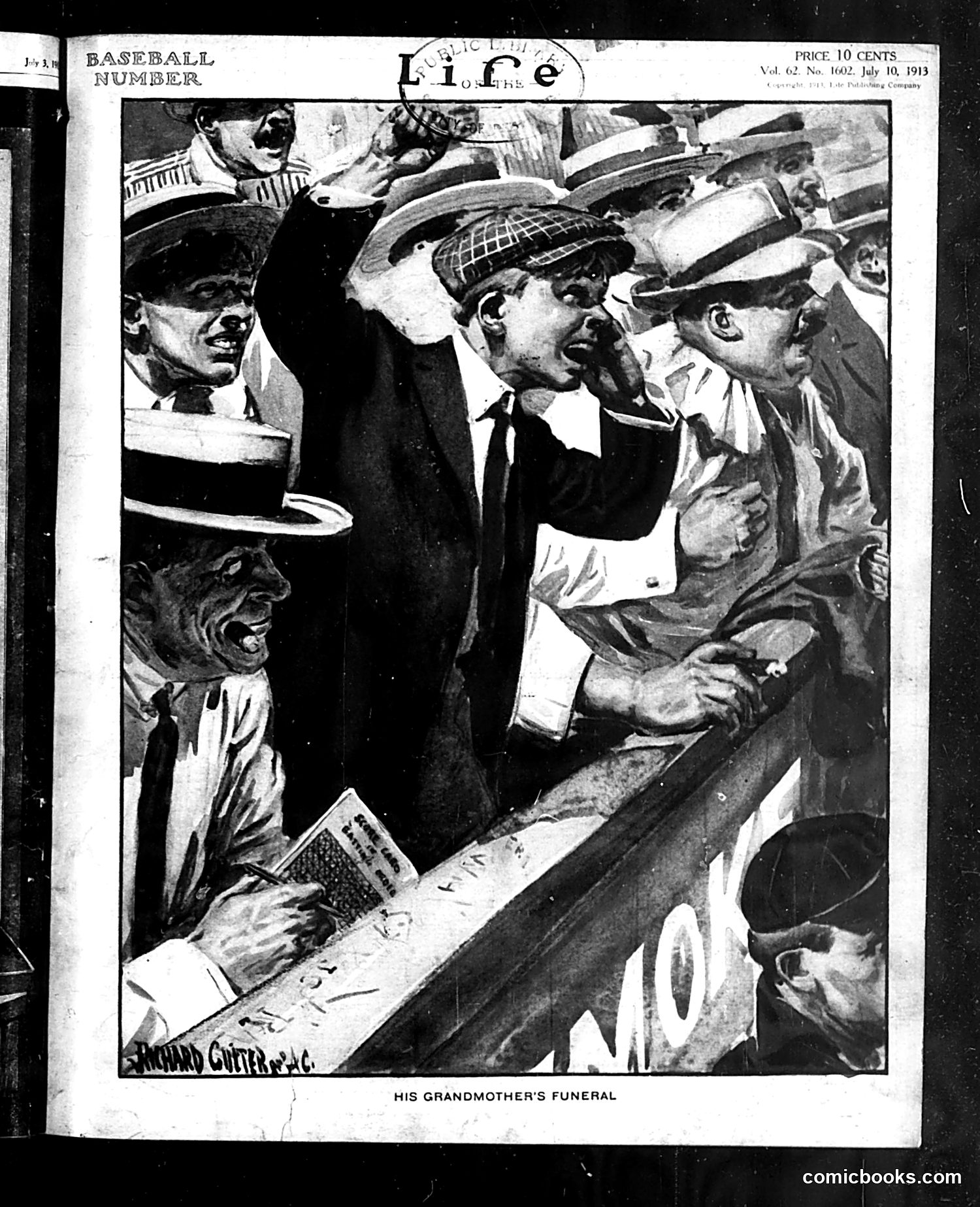
This is a satirical cartoon from *Life* magazine (July 10, 1913) mocking baseball fans' obsession with the sport. The caption "His Grandmother's Funeral" is the joke's setup: despite attending his grandmother's funeral—presumably a solemn occasion—the man in the center is distracted and excited, craning his neck to watch a baseball game happening nearby (visible at the bottom of the image). The surrounding figures represent fellow mourners whose attention is similarly divided. The satire critiques how baseball had become so culturally dominant in early 20th-century America that even serious life events couldn't compete for fans' attention. It's a commentary on the sport's grip on the American public imagination during the Progressive Era.
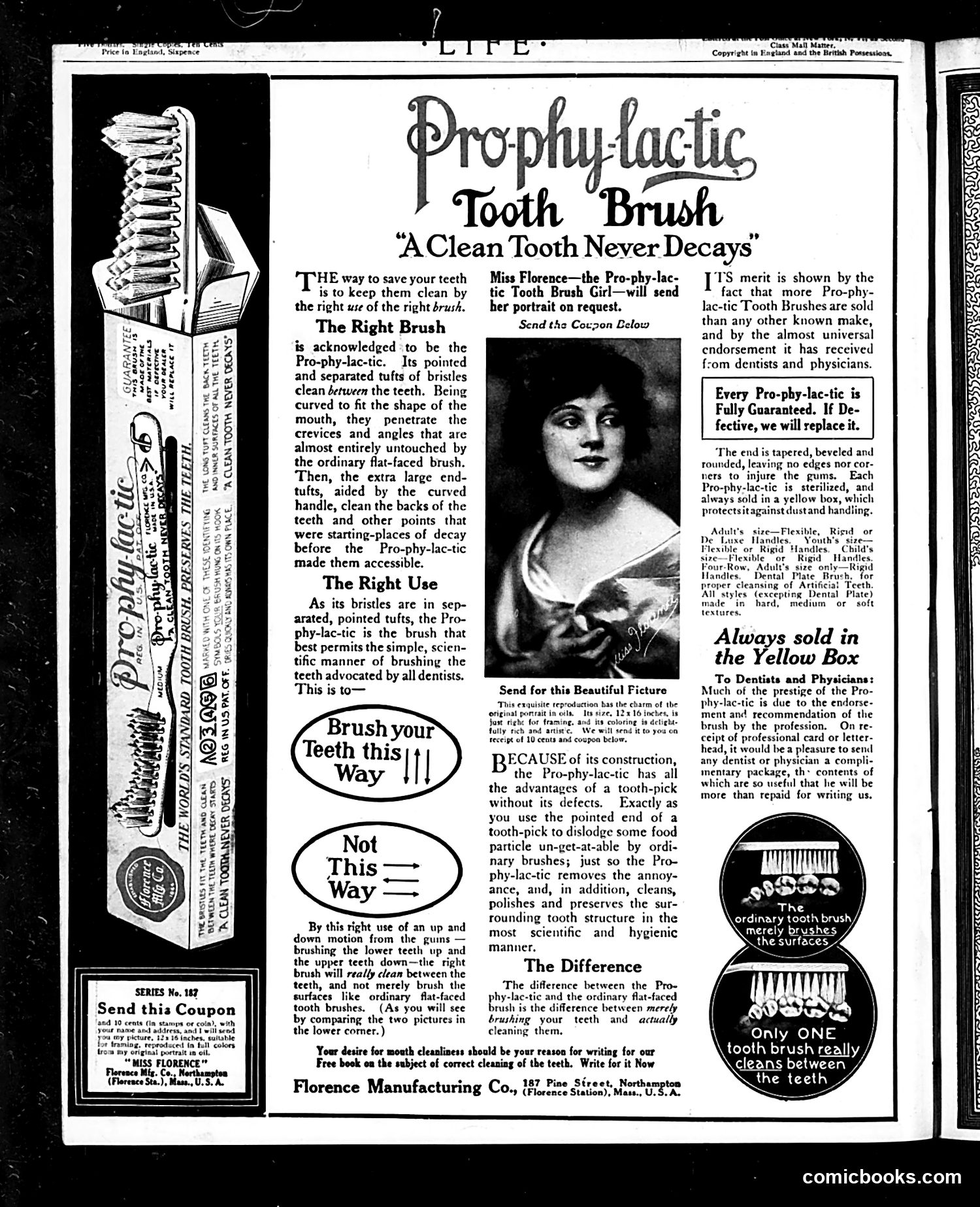
This page is **primarily advertising**, not satire or political commentary. It's a vintage advertisement for the "Pro-phy-lactic" toothbrush from Florence Manufacturing Co. The ad features a photograph of a woman (identified as "Miss Florence—the Pro-phy-lactic Tooth Brush Girl") and detailed product information. The marketing emphasizes the brush's unique "separated, pointed tufts" design, claiming superiority over ordinary flat brushes for cleaning between teeth. Key selling points include endorsement by dentists and physicians, a money-back guarantee, and comparison diagrams showing how the brush differs from competitors. A coupon at bottom-left offers a free sample. This reflects early 20th-century advertising practices: celebrity endorsement, scientific claims, competitive comparison, and direct-mail marketing.
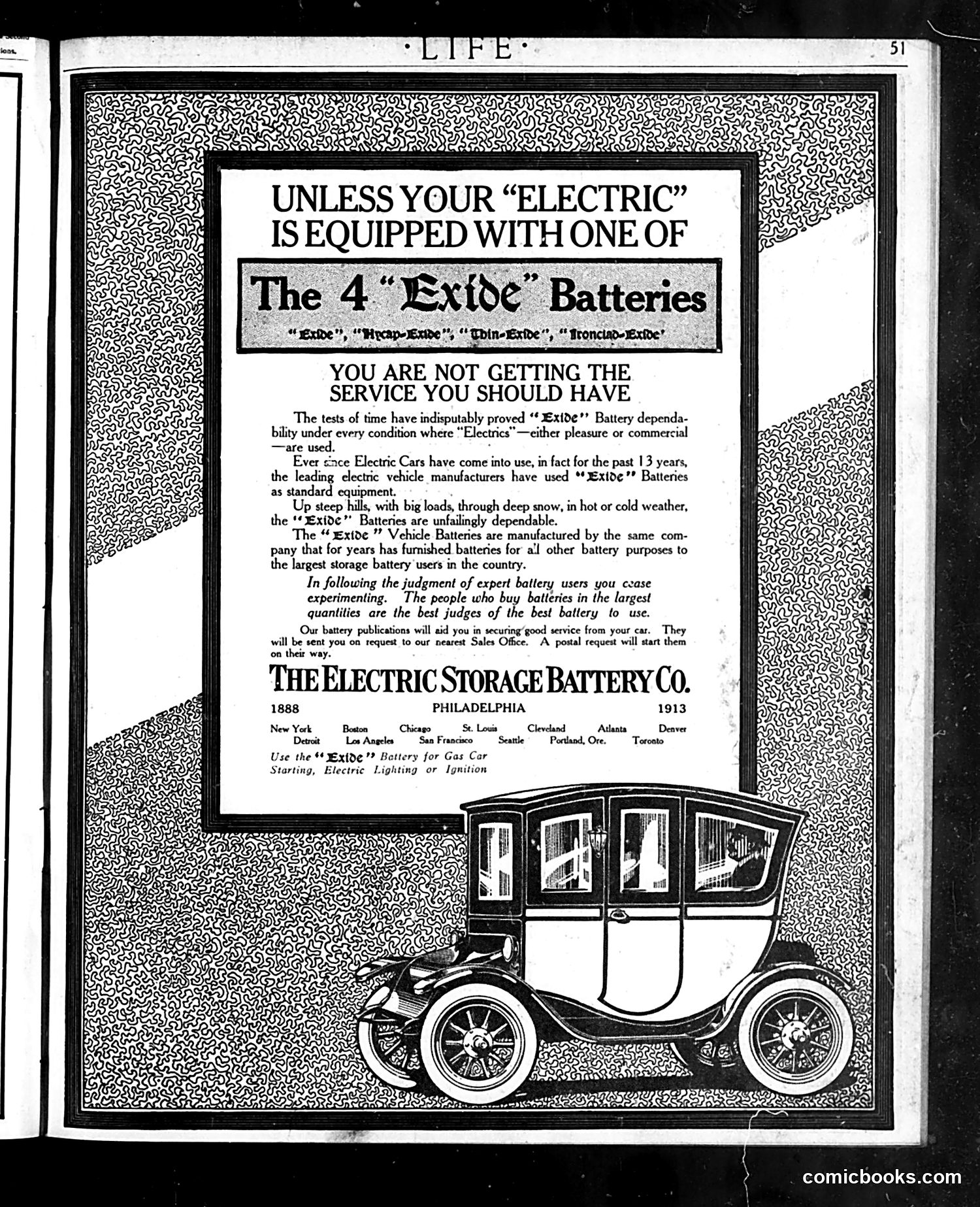
This page is **primarily an advertisement**, not satire or political commentary. It's a 1913 ad for "Exide" batteries by The Electric Storage Battery Company of Philadelphia. The ad targets owners of electric vehicles—a technology that competed with gasoline cars in the early 1900s. The headline warns that unless your electric car uses Exide batteries, "you are not getting the service you should have." The ad emphasizes Exide's reliability in harsh conditions (snow, hills, cold weather) and notes that leading electric car manufacturers used them as standard equipment. The accompanying illustration shows a period electric automobile, reinforcing the product's association with quality and established manufacturers. This reflects a historical moment when electric vehicles were still viable commercial products before gasoline engines became dominant.
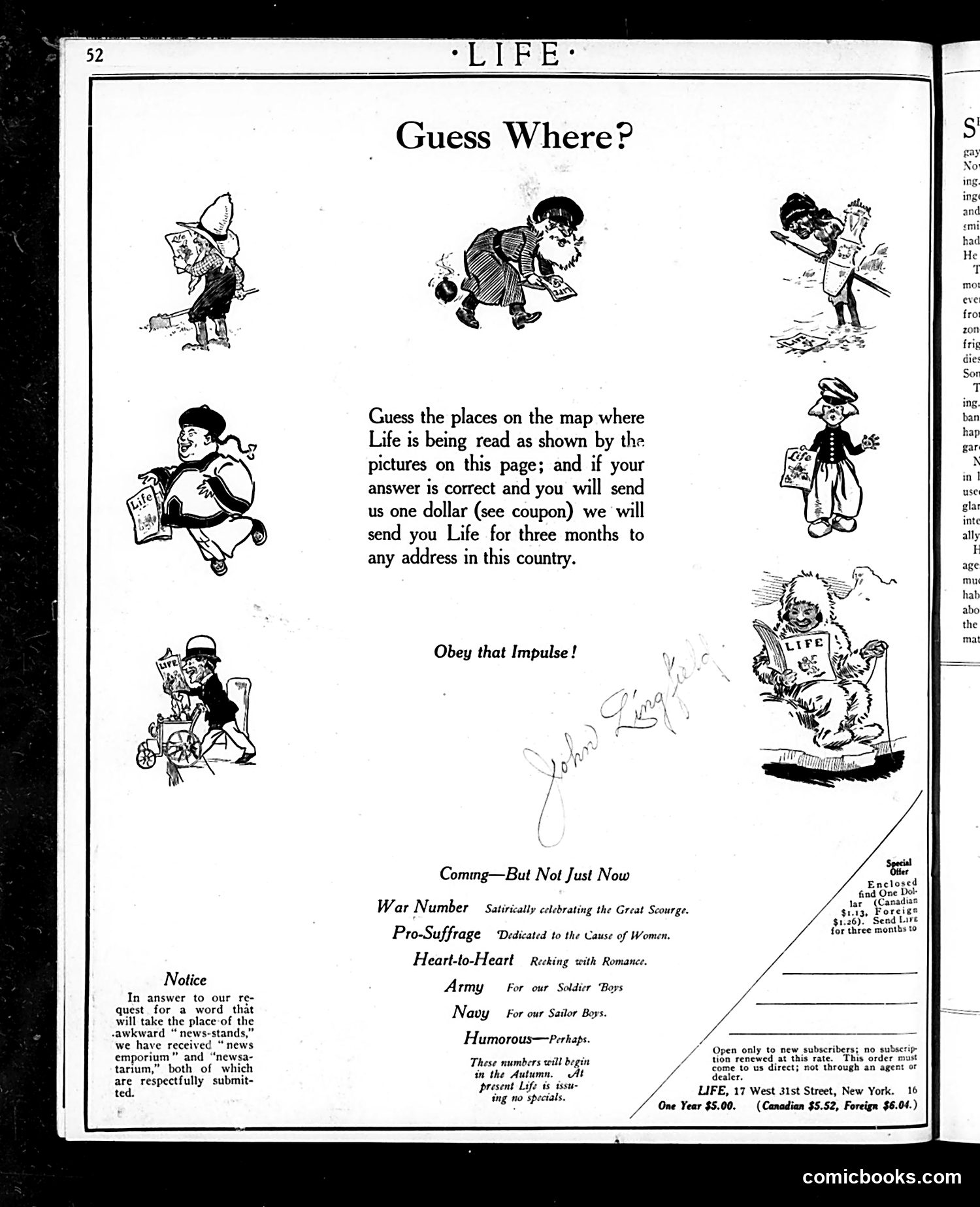
This page is primarily a **subscription promotion contest** rather than political satire. Readers must identify locations on a map corresponding to seven illustrated characters shown on the page, then submit their answer with one dollar for a three-month Life subscription. The cartoons appear to depict **stereotyped international or regional figures**—including what looks like a Dutchman, a rotund businessman, and various costumed characters—likely representing different countries or regions. The humor relies on visual stereotypes recognizable to 1920s readers. The page includes notices about upcoming issues featuring war, suffrage, romance, military content, and humor—typical magazine promotion strategy of the era. The contest itself was Life's marketing mechanism to gain new subscribers during this period.
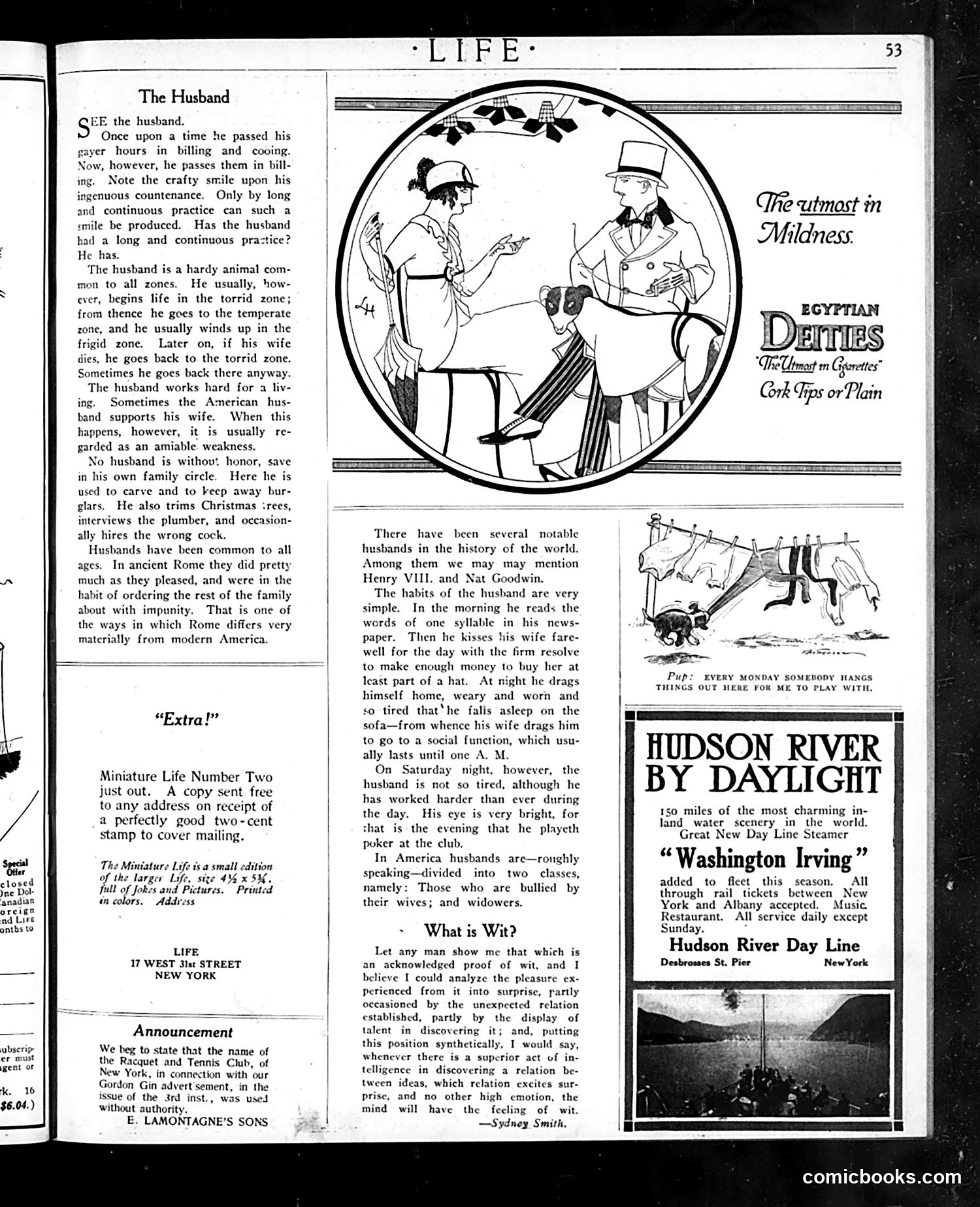
This page satirizes traditional husband behavior through two sections: **Main Article:** "The Husband" describes husbands as hardy animals adapted to all climates, noting their ingrained habits of billing/cooing during courtship, then reading one-syllable newspaper words to their wives. The satire mocks how American husbands divide into two classes: those married to their wives, and widowers—implying wives find married life unbearable. **The Circular Illustration:** Shows a well-dressed couple in domestic interaction, likely depicting the "courtship phase" behavior the text describes. **Caption:** "Every Monday somebody hangs things out here for me to play with"—depicting laundry, sarcastically suggesting husbands view household tasks as trivial play rather than serious domestic responsibility. The satire targets early 20th-century gender dynamics and male domestic indifference.
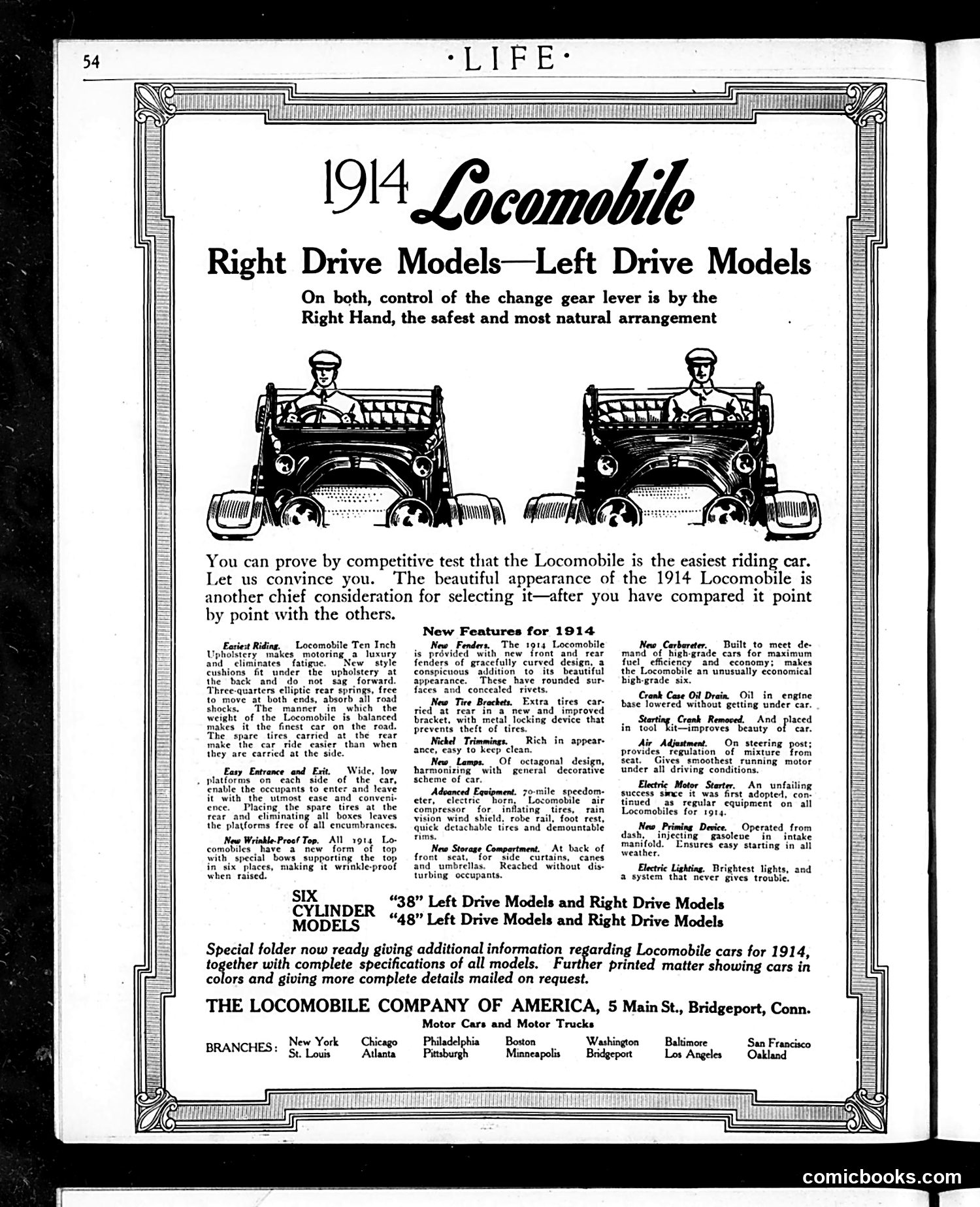
This page is **primarily an automobile advertisement**, not political satire or commentary. It advertises the 1914 Locomobile automobile, featuring two illustrations of the vehicle (right-drive and left-drive models) with a driver at the steering wheel. The "cartoon" element is minimal—just simplified line drawings of the cars themselves, not caricatures of political figures. The ad emphasizes practical features like ease of entry/exit, tire security, improved steering, and crash protection. The humor, if any exists, is subtle advertising copy claiming the Locomobile is "the easiest riding car" and inviting competitive testing. This appears to be standard early-20th-century automotive marketing rather than satirical political commentary.
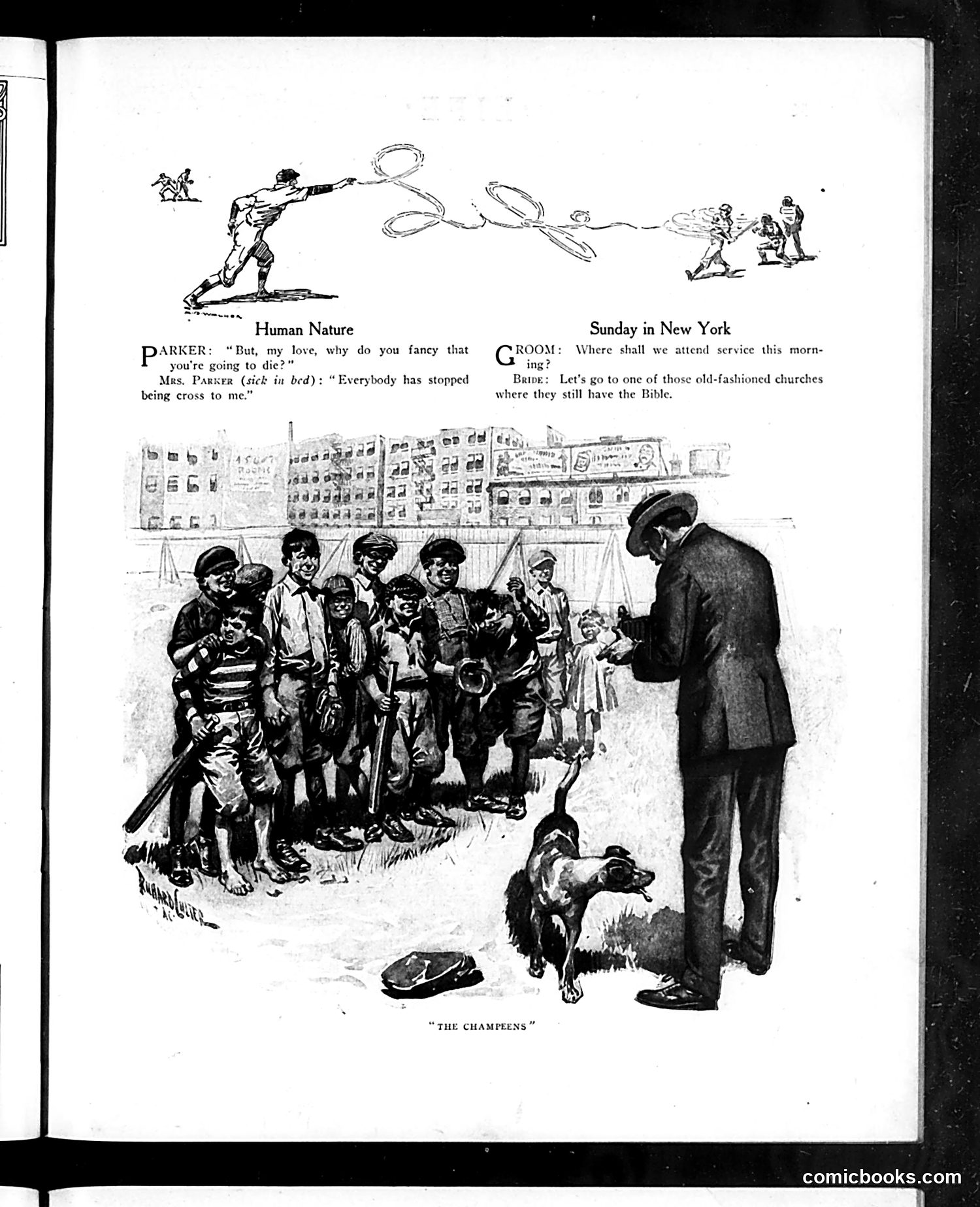
This page contains two satirical pieces: **"Human Nature"** (top): A brief dialogue where Parker asks Mrs. Parker why she's "going to die," and she responds that "everybody has stopped being cross to me." The accompanying illustration shows a man lassoing figures, satirizing sudden niceness toward someone in extremis. **"Sunday in New York"** (bottom): Titled "The Champeens," this cartoon depicts a well-dressed man with a cane addressing a group of street children and a dog in what appears to be a working-class urban setting (New York waterfront visible). The groom suggests attending "old-fashioned churches where they still have the Bible," suggesting satire of either religious hypocrisy or condescension toward the poor. The title "Champeens" (champions) is ironic, likely mocking self-righteous charitable efforts.
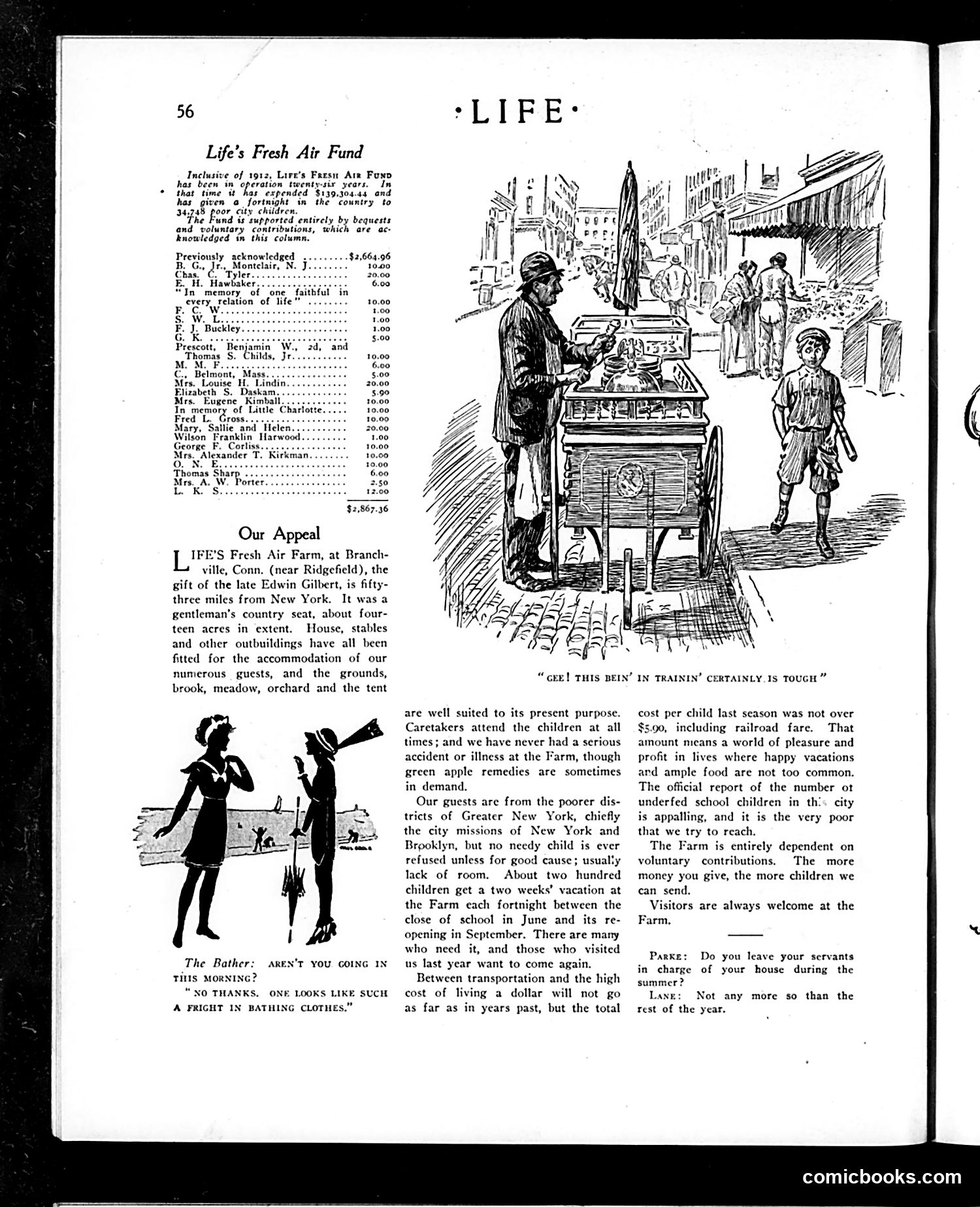
This page documents **Life's Fresh Air Fund**, a charitable program providing vacations for underprivileged children from New York City's poorest neighborhoods. The main illustration depicts a street vendor or cart operator interacting with city children in an urban setting. The satirical cartoon at bottom ("The Bather") jokes about class anxieties: a well-dressed man expresses horror at bathing in the morning, calling it improper. His companion responds that one shouldn't wear "bathing clothes" casually. This mocks Victorian-era class pretensions about proper conduct and attire. The page balances social commentary with charitable appeal—highlighting the Farm's role serving poor children while gently ridiculing wealthy readers' fastidiousness about social propriety.
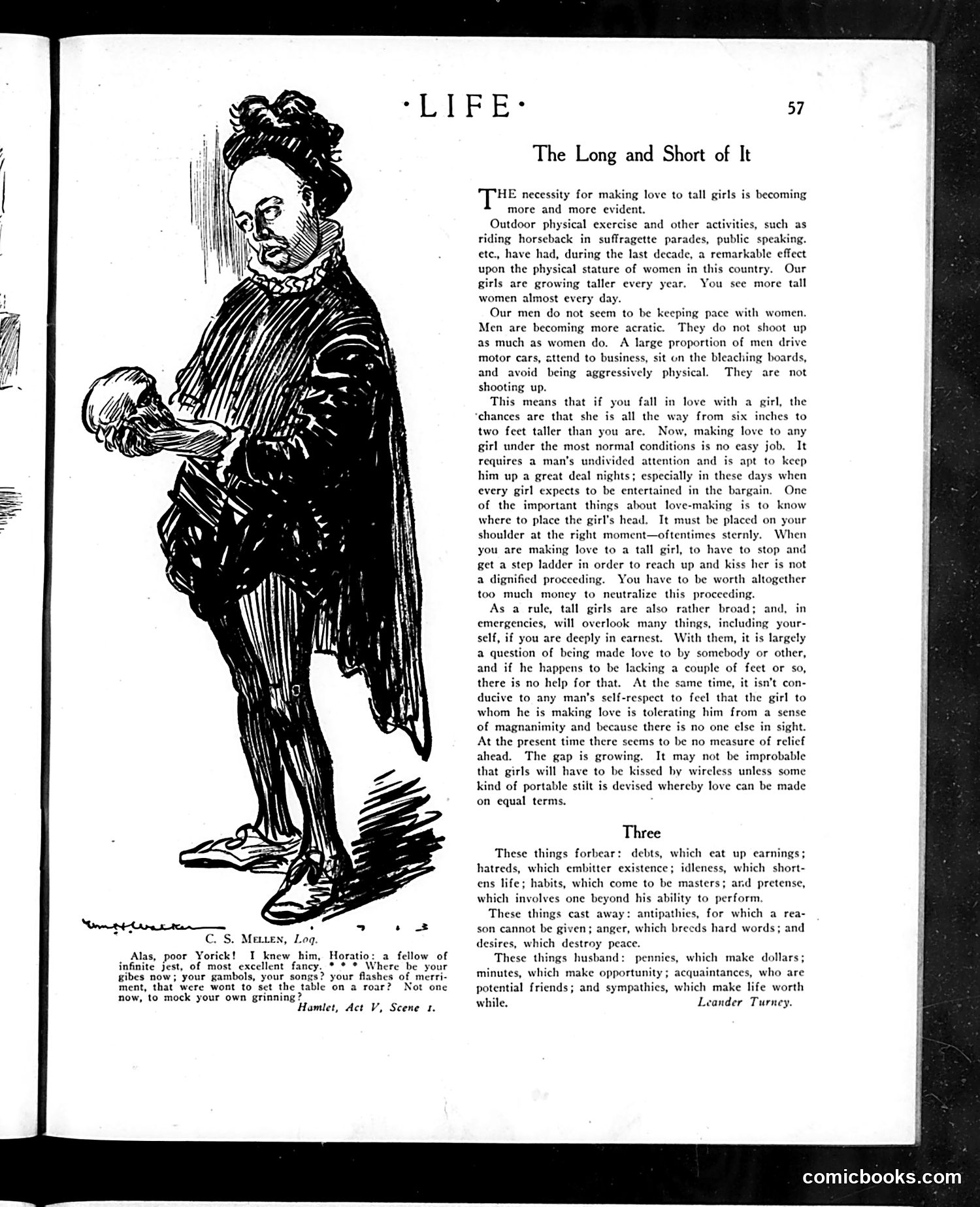
The illustration depicts a tall woman holding a small man, visually inverting traditional size dynamics. The accompanying article addresses the growing height disparity between men and women in early 20th-century America. The text explains that women are becoming taller through outdoor activities and exercise (including suffragette parades), while men remain relatively static in stature and increasingly sedentary—driving cars, attending business, avoiding physical activity. The satire highlights anxieties about changing gender roles: if women literally grow taller than men, this threatens established masculine dominance. The article humorously advises men on courtship challenges when women exceed them in height, including the indignity of requiring "a step ladder" to kiss a tall girl. The Hamlet quote beneath emphasizes social upheaval and role reversals.
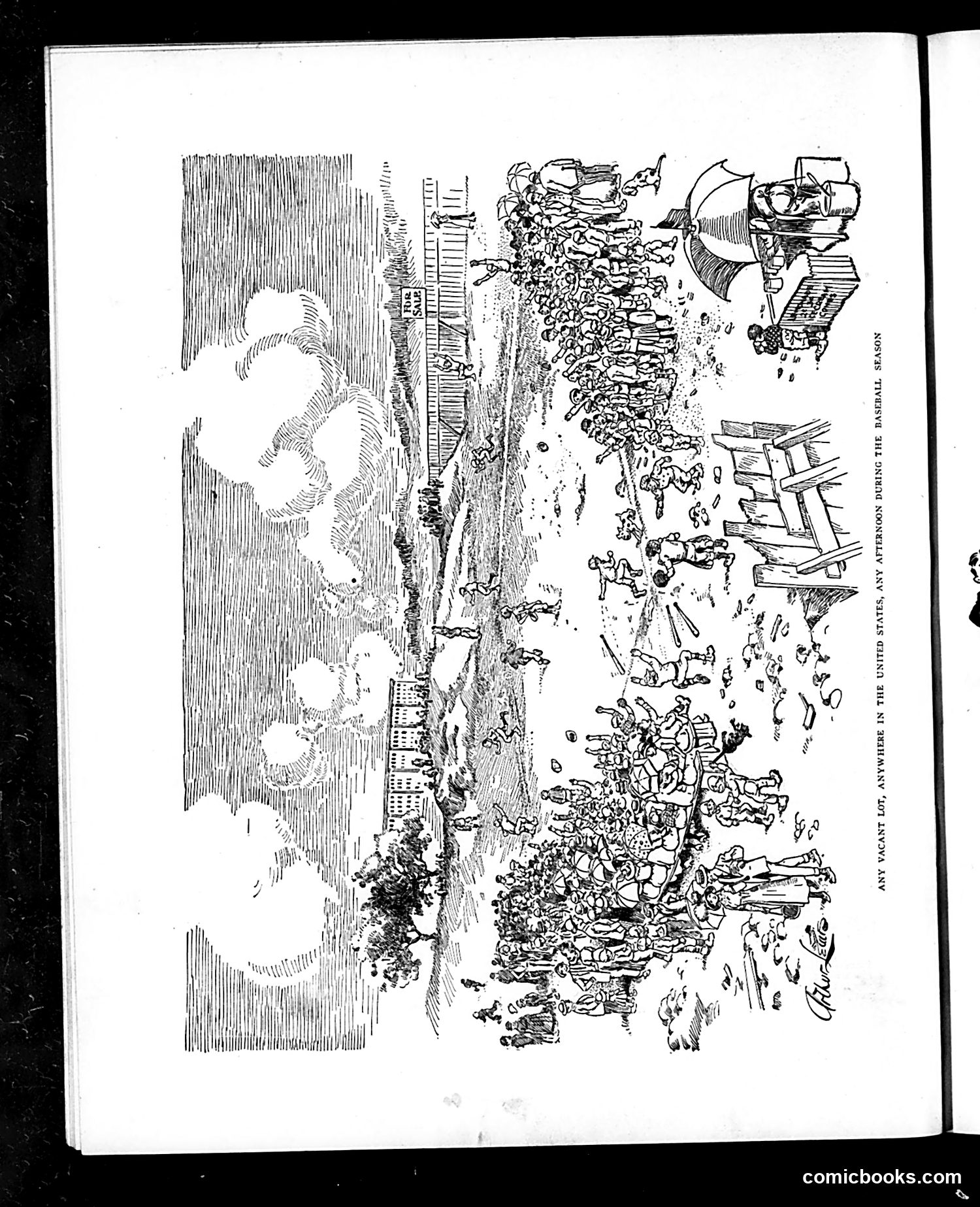
This page contains a single engraved illustration depicting a chaotic scene rotated 90 degrees. The image shows a densely crowded gathering of numerous figures engaged in various activities—some appear to be fighting, socializing, or working. The style suggests 19th-century satirical artwork, with detailed cross-hatching typical of period engravings. The caption text along the right margin reads: "ANY MORSEL FOR, A WANDERER IN THE UNITED STATES AFTERNOON PURSUIT THE GENERAL STORES" Without clearer visibility of specific character details or additional context text, I cannot definitively identify the particular political figures or social commentary intended. The crowded, chaotic composition suggests satire about American public life or commerce, but the specific subject and satirical point remain unclear from this image quality.
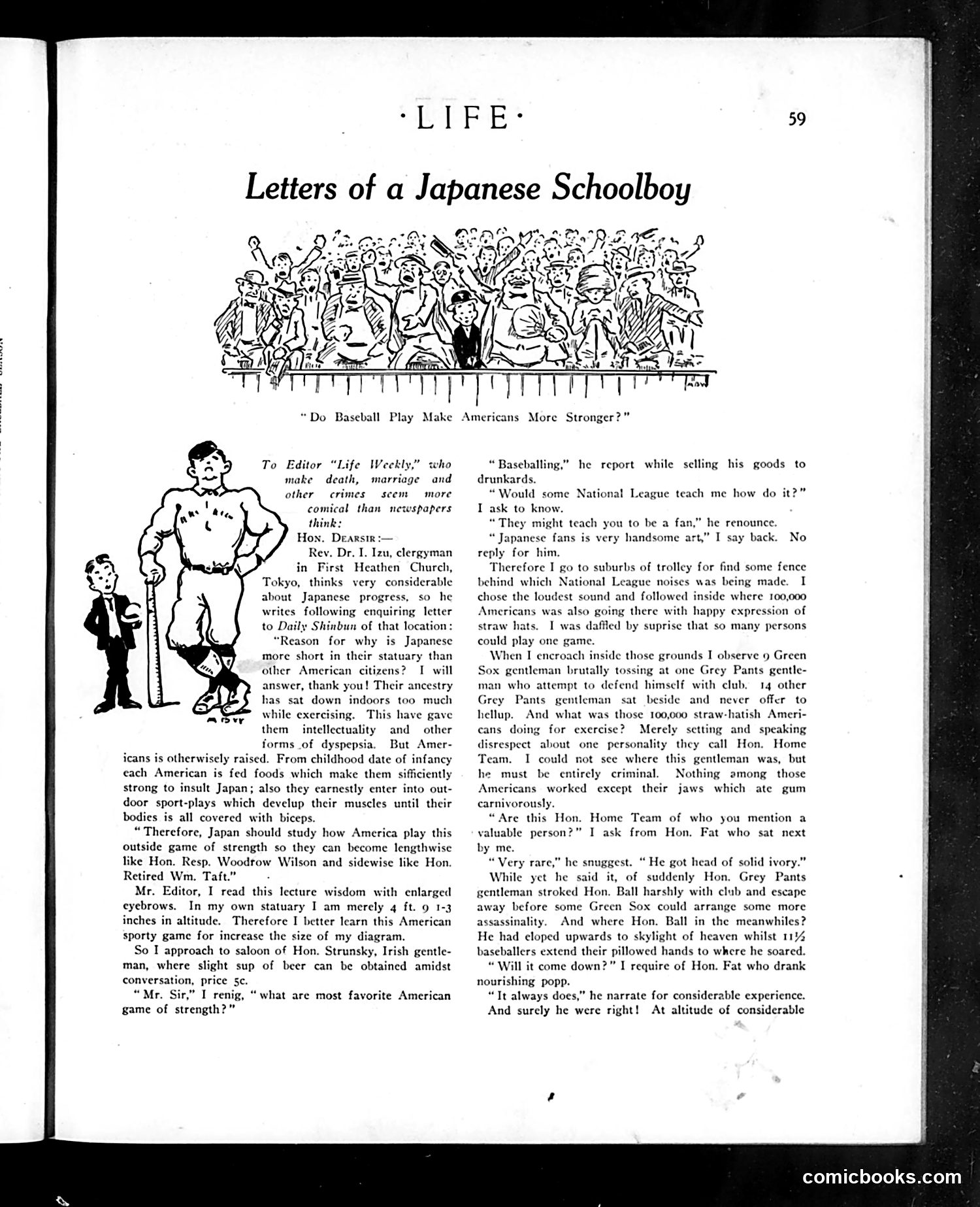
This satirical piece mocks both Japanese and American attitudes through a fictional Japanese correspondent's observations. The schoolboy writes to Life's editor questioning why Japanese are "more short in their stature" than Americans, then describes visiting American baseball games and athletic venues. The satire works on multiple levels: the naive Japanese observer expresses wonder at American physical culture and sports, while also gently mocking American behavior (crude fans, excessive drinking, violence in games). The illustrations show a muscular American contrasted with a small Japanese boy, playing into racial stereotypes of the era. The piece appears designed to be humorous through cultural misunderstanding—presenting American sports and physical development as objects of foreign curiosity while subtly critiquing American conduct and values through an outsider's perspective.
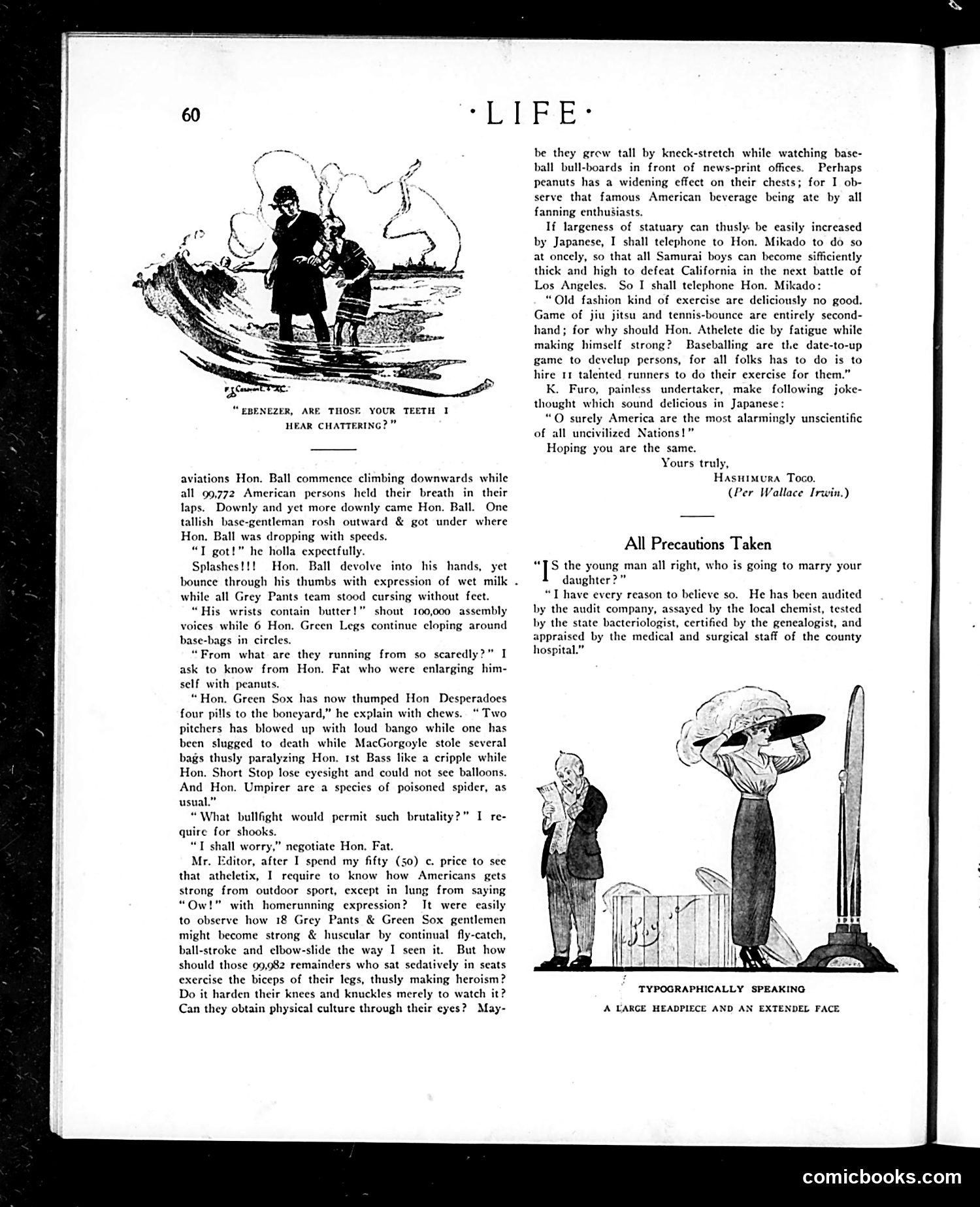
This page contains a satirical letter (attributed to "Hashimura Toco") mocking American sports culture and physical fitness. The writer, using a Japanese persona, ironically praises American athletic development while criticizing how Americans actually achieve it—through passive spectatorship (sitting in bleachers) rather than active participation. The letter sarcastically suggests that watching baseball and football somehow makes Americans physically strong. The accompanying cartoon titled "Typographically Speaking: A Large Headpiece and an Extended Face" shows two figures with exaggerated proportions—one with an oversized head, the other with an elongated face—illustrating the absurdity of physical distortion through typography/text layout. The section "All Precautions Taken" presents a brief dialogue about auditing a prospective son-in-law, humorously emphasizing bureaucratic vetting rather than personal character judgment.
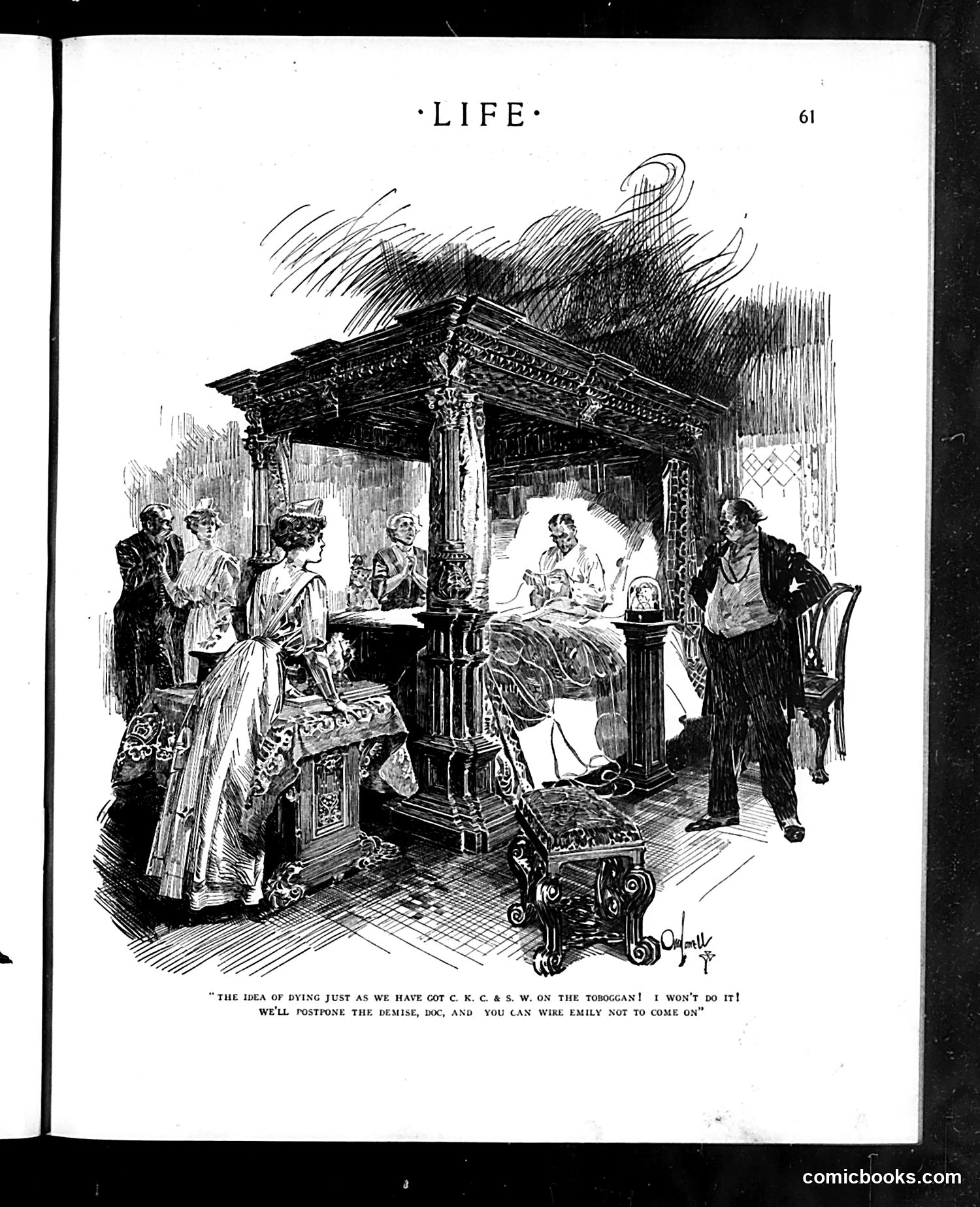
This single-panel cartoon depicts a deathbed scene. A dying person lies in an ornate bed beneath a canopy while well-dressed visitors gather around. The caption reads: "The idea of dying just as we have got C.K.C & S.W. on the Toroogan! I won't do it! We'll postpone the demise, Doc, and you can wire Emily not to come on." The satire mocks the priorities of the wealthy and privileged: the dying person refuses to actually die because they've recently acquired certain possessions or accomplishments (likely abbreviated references to luxury items or social achievements—"C.K.C & S.W." and "Toroogan" are unclear without additional context). The joke highlights materialistic preoccupation and vanity even in mortality's face, suggesting the absurdity of postponing death for earthly possessions.
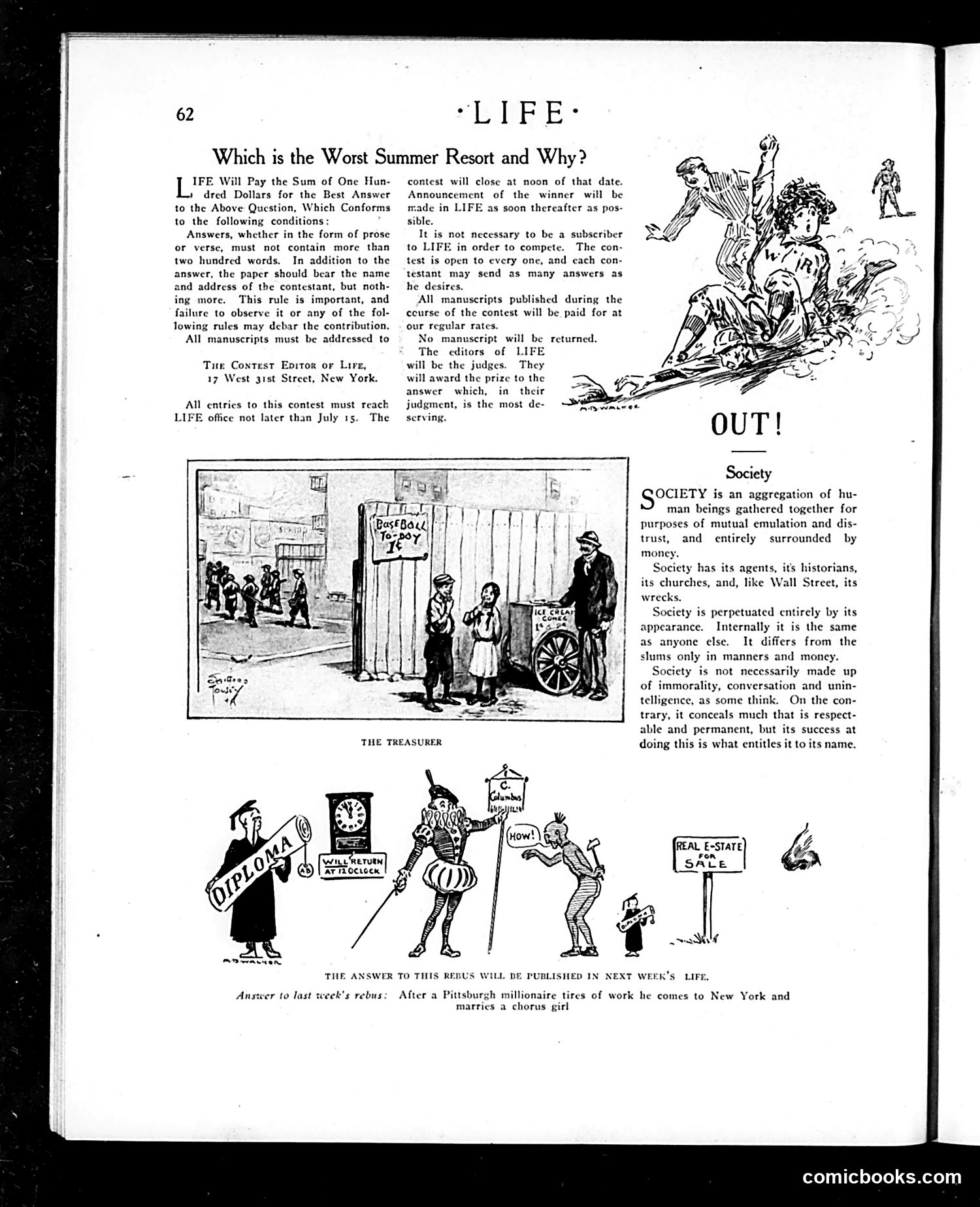
This page announces a **LIFE magazine contest** soliciting reader essays (up to 200 words) about the worst summer resort, with a $100 prize. Entries close July 13. The cartoon "**THE TREASURER**" satirizes what appears to be a shabby, rundown seaside resort—depicted with ramshackle structures and poor conditions. A figure labeled "Treasurer" oversees the operation, while other characters represent typical resort-goers or operators in distress. Below, "**THE ANSWER TO THIS REBUS**" presents visual riddles (a diploma, clock, pumpkin, Santa figure, and "Real Estate Sale" sign) whose solution relates to the rebus answer from the previous week's issue. The page also includes a definition of "Society" as an aggregation maintained by appearance and money rather than substance—satirizing high-society pretension.
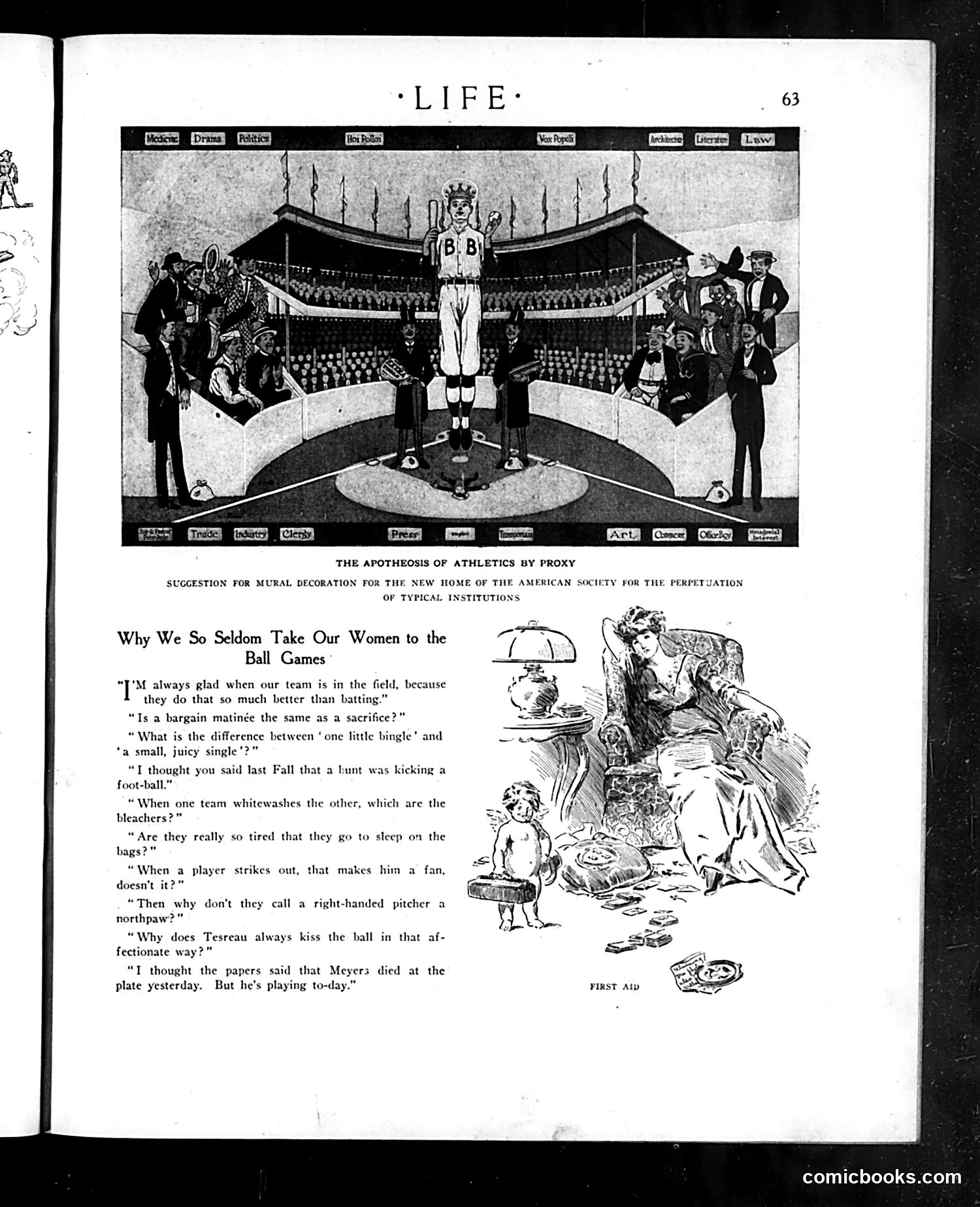
The top image satirizes the obsession with athletics by depicting a female athlete figure as a deity in a grand stadium, crowned and worshipped—mocking how American institutions elevate sports to pseudo-religious status. The text below, "Why We So Seldom Take Our Women to the Ball Games," presents mock-naïve questions supposedly asked by women at baseball games. These aren't genuine confusion but **sexist satire**: they ridicule women as intellectually incapable of understanding sports terminology and rules. References like "bunt," "single," "whitewashes," and "bags" are baseball jargon presented as if women comically misinterpret them. The humor relies on 1910s-era stereotypes portraying women as ignorant outsiders to male domains. The illustration captioned "First Aid" shows women with food/refreshments, reinforcing the period's assumption that women belonged at games only for domestic/social purposes, not as genuine sports fans. The satire aims at both institutional absurdity (athletics worship) and gender exclusion from sports culture.
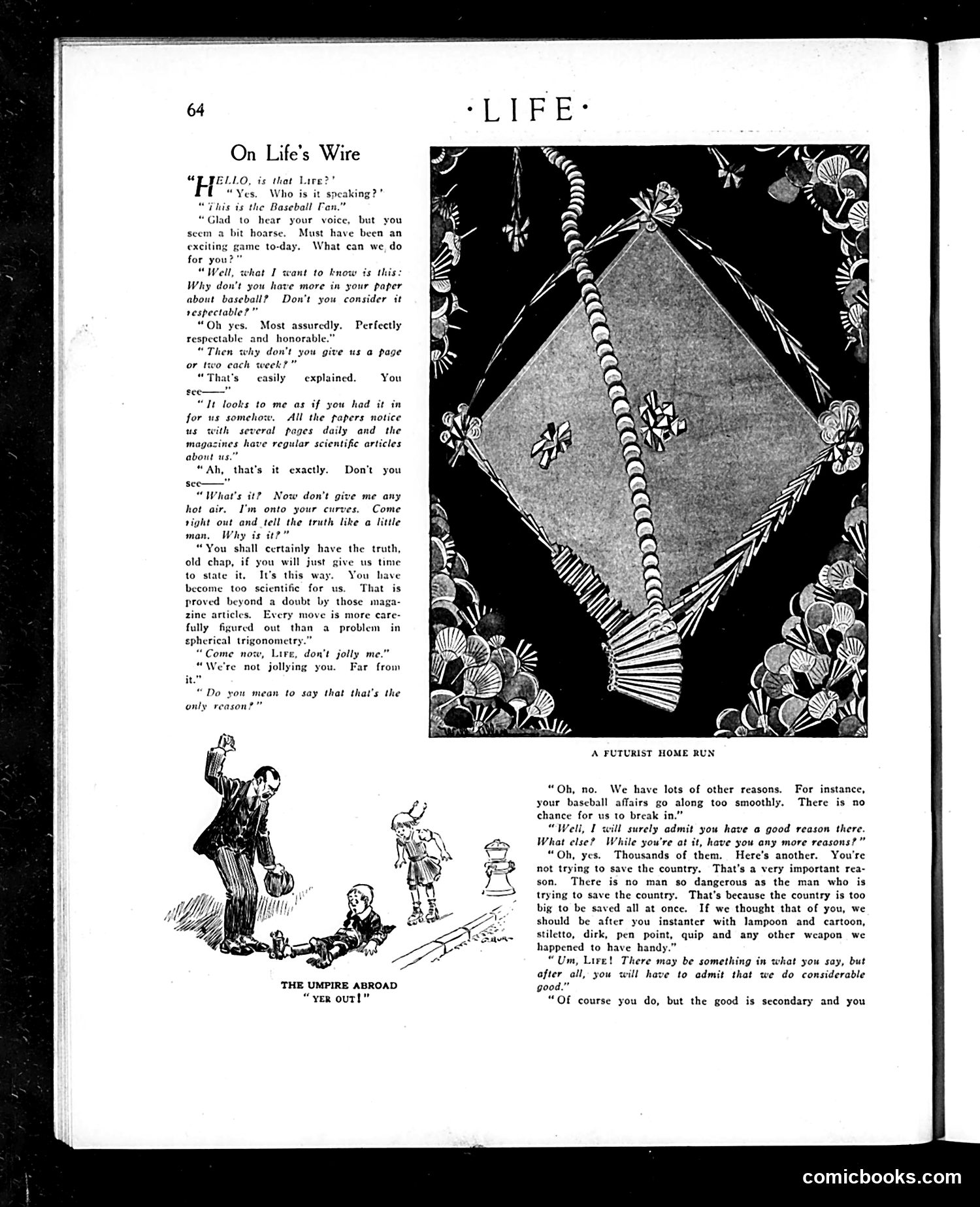
This is a humorous dialogue between "Life" magazine and personified "Baseball," complaining that Life doesn't cover the sport adequately despite its popularity. **The Setup:** Baseball calls Life's editor demanding more coverage, claiming other publications feature it daily with scientific articles. **The Satire's Point:** Life's editor explains they won't cover baseball extensively because: 1. It's become **too scientifically analyzed**—every move is calculated like trigonometry problems, leaving nothing for satirists to mock 2. Baseball is **too smooth and scandal-free**—there's no controversy to exploit 3. **Baseball isn't "saving the country,"** unlike genuinely dangerous social causes that invite lampoons and cartoons **The Joke:** Life magazine, a satirical publication, exists to mock and criticize. Baseball is too well-organized, too popular, and too uncontroversial to satirize effectively. The editor politely tells Baseball its virtue is actually its weakness—good behavior makes for bad satire. The accompanying illustration shows a futurist home run, playing on the scientific language discussed in the dialogue.
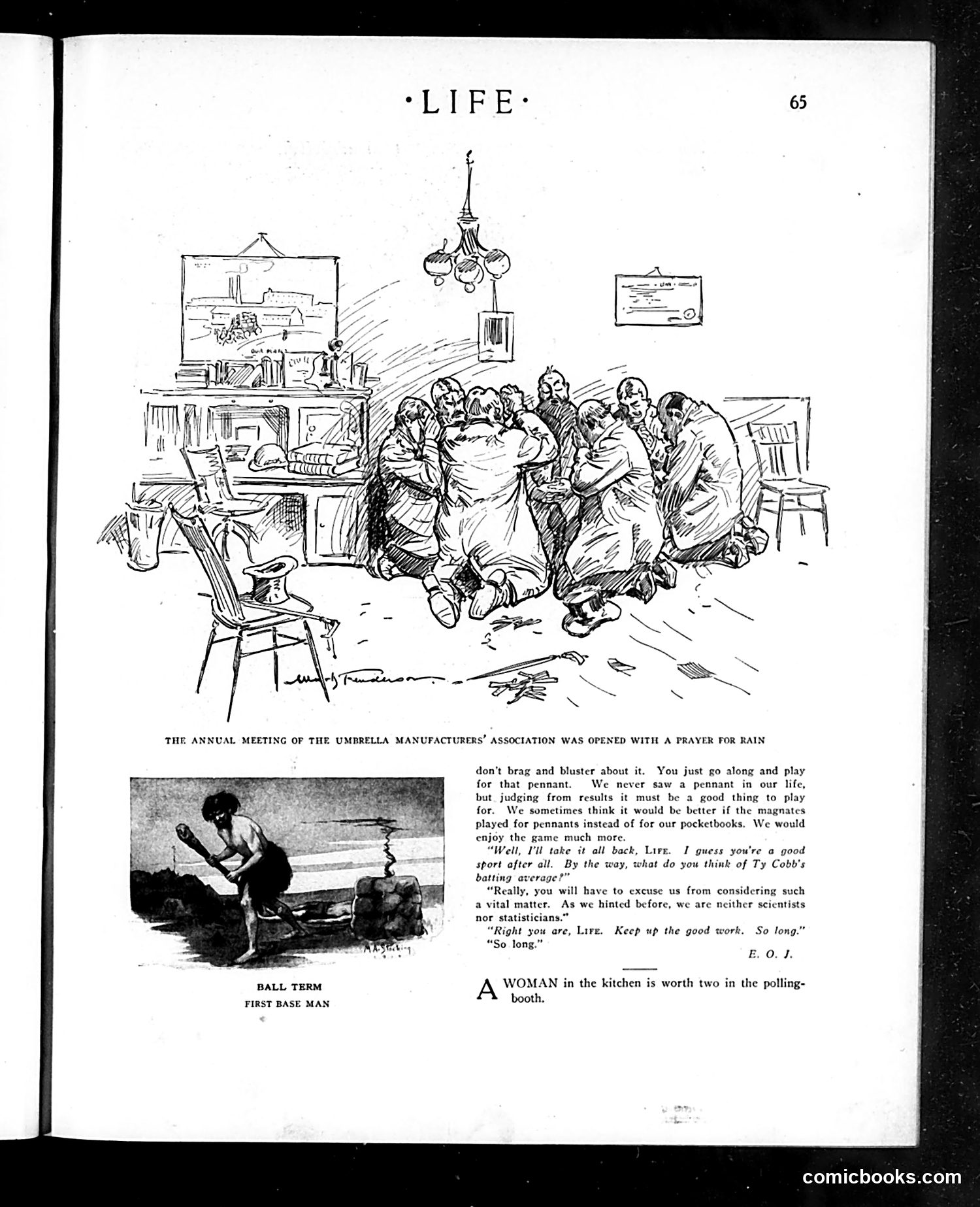
The main cartoon depicts an **umbrella manufacturers' association meeting opening with a prayer for rain**—an ironic joke about self-interest. The manufacturers literally pray for the weather condition that drives sales of their product, satirizing how businesses profit from circumstances beyond their control and may subtly encourage conditions harmful to the general public. Below is a separate baseball-themed dialogue about a player named "Lire" discussing pennant races and Ty Cobb's batting average. The conversation satirizes casual sports talk and the disconnect between serious matters (baseball statistics) and actual importance. The final line—"A woman in the kitchen is worth two in the polling-booth"—is a sexist aphorism mocking women's exclusion from voting, suggesting their value lies only in domestic work rather than political participation. The page reflects early 20th-century American satirical humor targeting business self-dealing, sports obsession, and gender inequality.
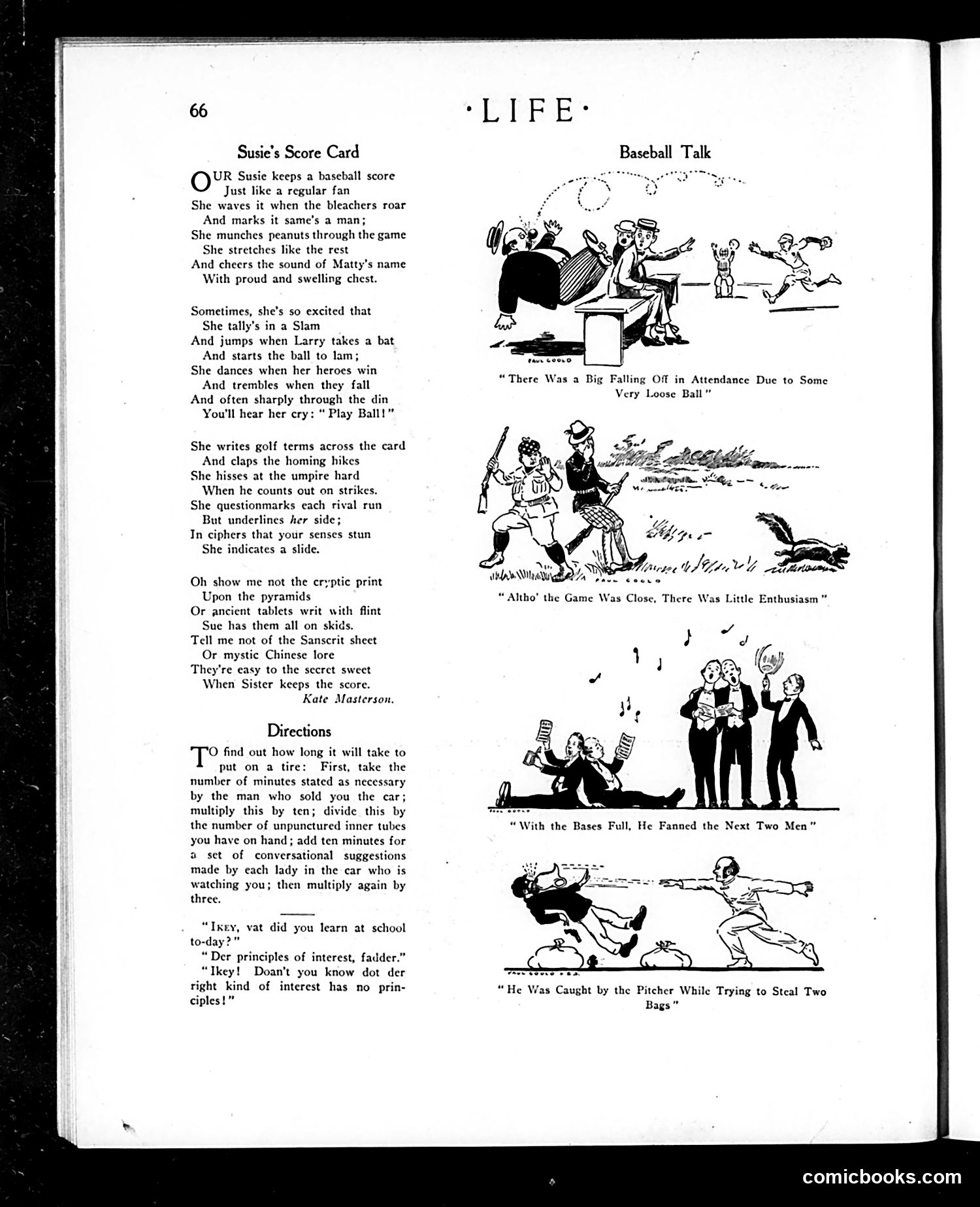
This page contains three separate pieces of early 20th-century humor: **"Susie's Score Card"**: A poem celebrating a woman who keeps detailed baseball scorecards with the same enthusiasm and expertise as male fans. The satire gently mocks the "cryptic" notation system women use while establishing them as serious, knowledgeable baseball enthusiasts—notable since women's sports fandom was still novel. **"Baseball Talk"** (cartoons): Six illustrated jokes playing on baseball terminology misunderstood by non-fans. References like "Matty" likely mean pitcher Christy Mathewson. The humor exploits double meanings (e.g., "stealing bases" causing actual theft) and the gap between baseball jargon and everyday language. **"Directions"** (bottom left): A satirical "how-to" for changing a tire that mocks both car salesmen's inflated time estimates and the chattiness of female passengers—typical period gender humor. The overall tone reflects 1910s-era amusement at women entering traditionally male spaces (sports fandom, car ownership) and general wordplay-based comedy common to *Life* magazine's style.
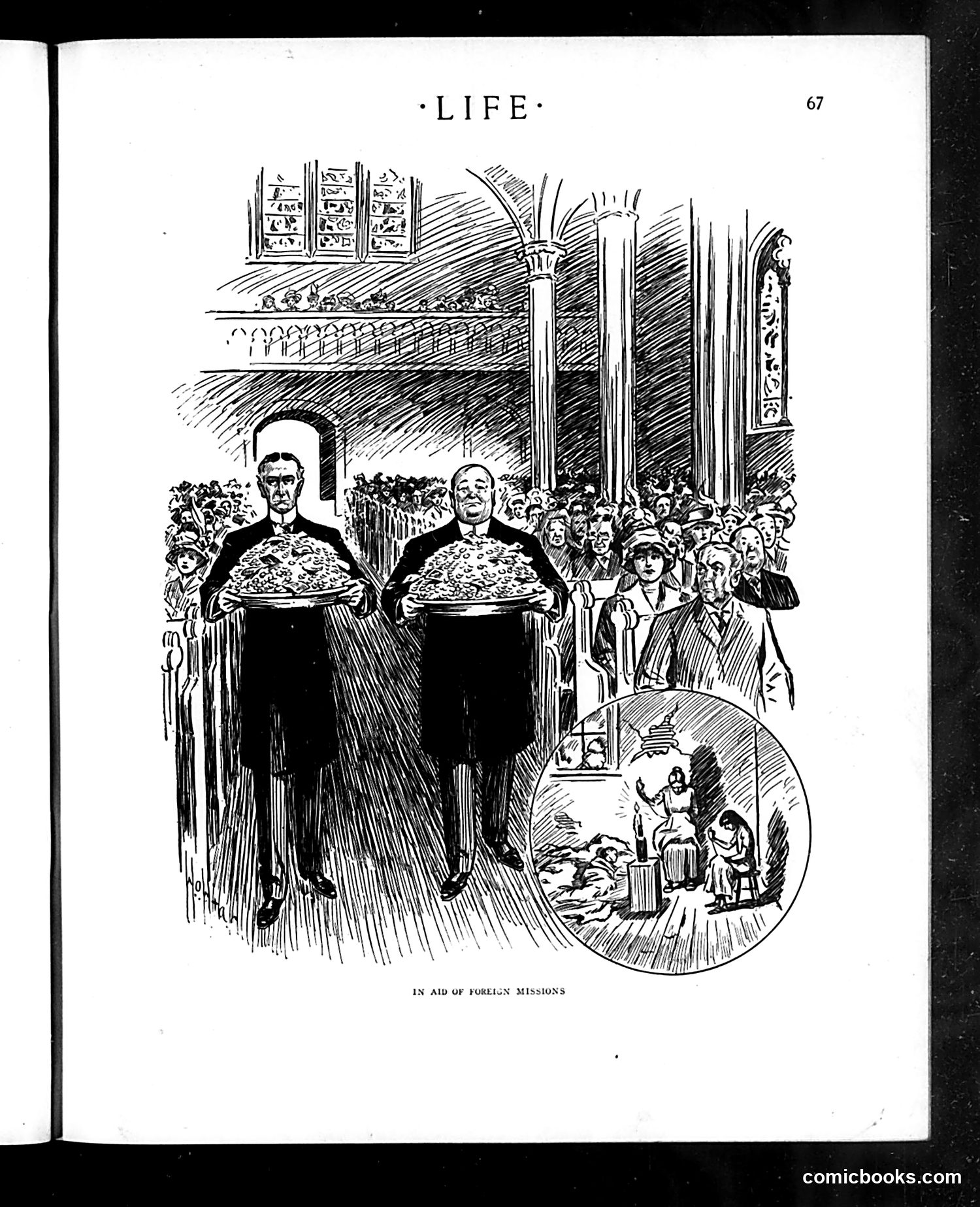
This satirical cartoon from *Life* magazine shows two well-dressed men carrying enormous covered dishes before a crowd in what appears to be a grand institutional building (likely a church or government hall). The caption reads "IN AID OF FOREIGN MISSIONS." The satire critiques wealthy donors who ostentatiously display charitable giving. The oversized dishes suggest these men are presenting their donations as impressive public spectacles rather than genuine charity. The inset circular vignette shows actual missionary work—modest figures helping impoverished people—contrasting sharply with the grandiose display above. The cartoon mocks how wealthy individuals use charitable giving for self-aggrandizement and social status rather than focusing on the actual needy populations missionaries serve. It's social commentary on the vanity underlying philanthropic gestures.
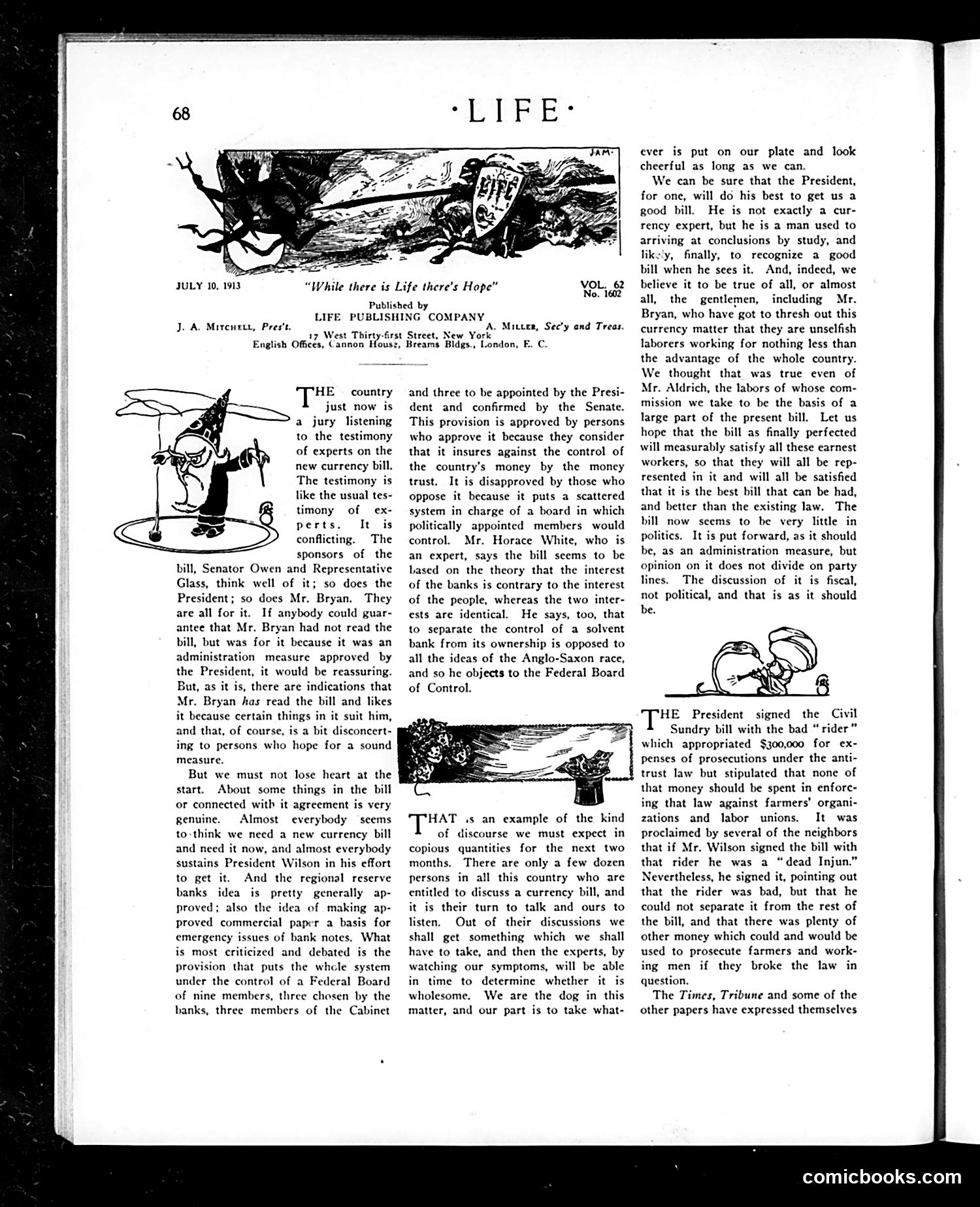
This editorial discusses the Federal Reserve Act then under debate in Congress. The page contains **no prominent cartoon**, but rather political commentary on currency reform. **The Context:** President Wilson is pushing a new currency bill through Congress with support from Senator Owen, Representative Glass, and Secretary of State William Jennings Bryan. The article notes that while experts disagree sharply about the bill's merits, the public must simply accept whatever legislation emerges—comparing citizens to a dog that must "take what" is given. **Key Debate:** The central controversy concerns a Federal Board controlling the banking system. Critics like economist Horace White object to this centralized control, arguing it separates bank ownership from control and reflects distrust of banks themselves. **The Satire:** The author gently mocks Bryan's sudden support for an administration measure, suggesting it's oddly convenient that he approves legislation he supposedly read and studied independently. The overall tone is resigned: the public is merely an audience to expert testimony, expected to accept the outcome without complaint.
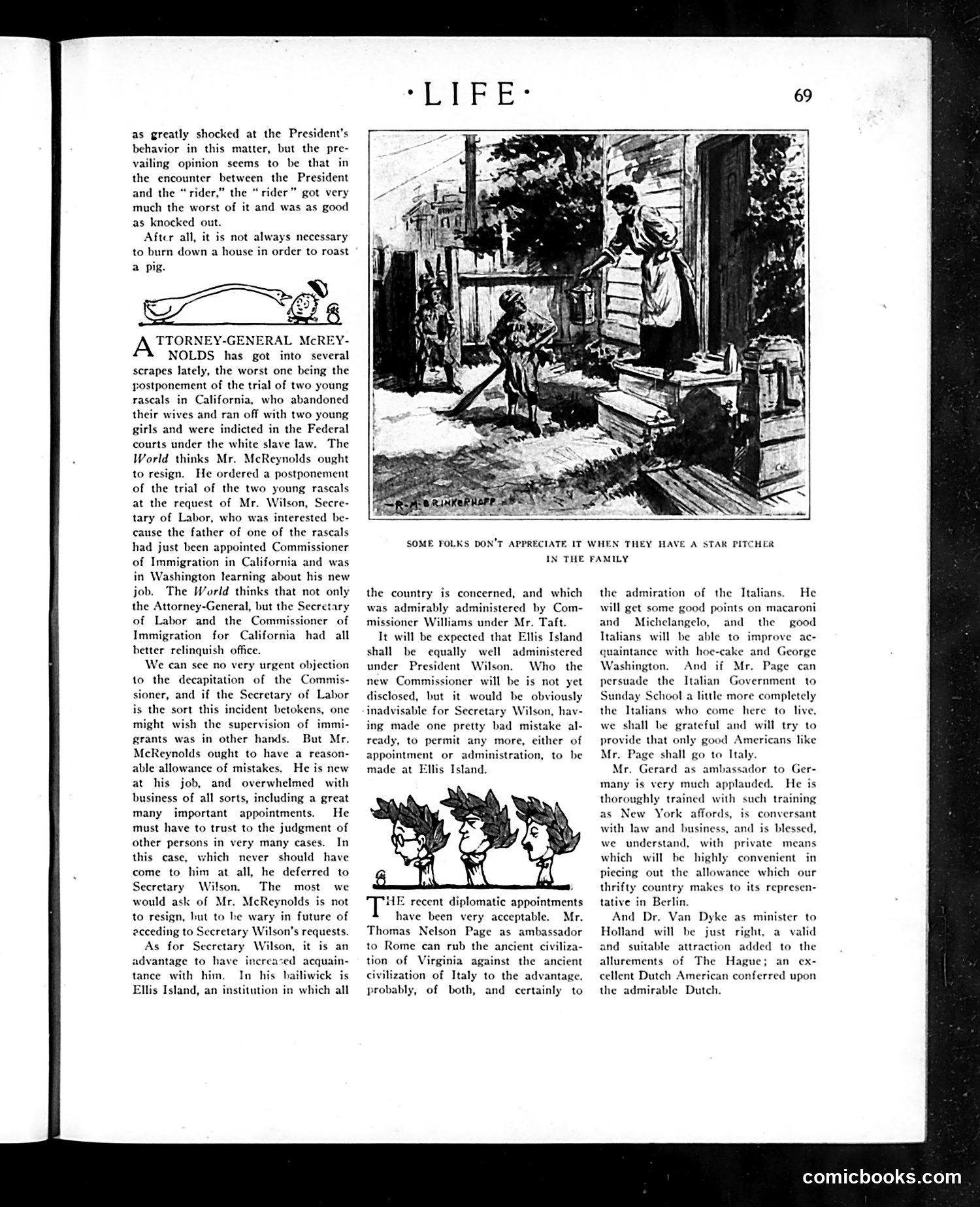
This page critiques the Wilson administration's handling of several political matters circa 1913-1914. **Main Cartoon:** The illustration captioned "SOME FOLKS DON'T APPRECIATE IT WHEN THEY HAVE A STAR PITCHER IN THE FAMILY" depicts a domestic scene where a woman appears upset while a man (likely representing someone with political influence) sits nearby. This satirizes nepotism—specifically, the appointment of an immigration commissioner in California whose son had abandoned his wife. The "star pitcher" metaphor suggests having a talented family member in power doesn't guarantee good behavior. **Text Critiques:** The article attacks Attorney General McReynolds for postponing a white slave law trial at Secretary of Labor Wilson's request, motivated by Wilson's personal interest (the appointee was the rascal's father). Life argues that while McReynolds deserves some leniency as new to the job, Secretary Wilson showed poor judgment and should be cautious going forward. The piece also discusses diplomatic appointments—praising Thomas Nelson Page and Gerard while noting these require private wealth to supplement government salaries. The satire targets political favoritism and patronage networks in the Wilson administration.
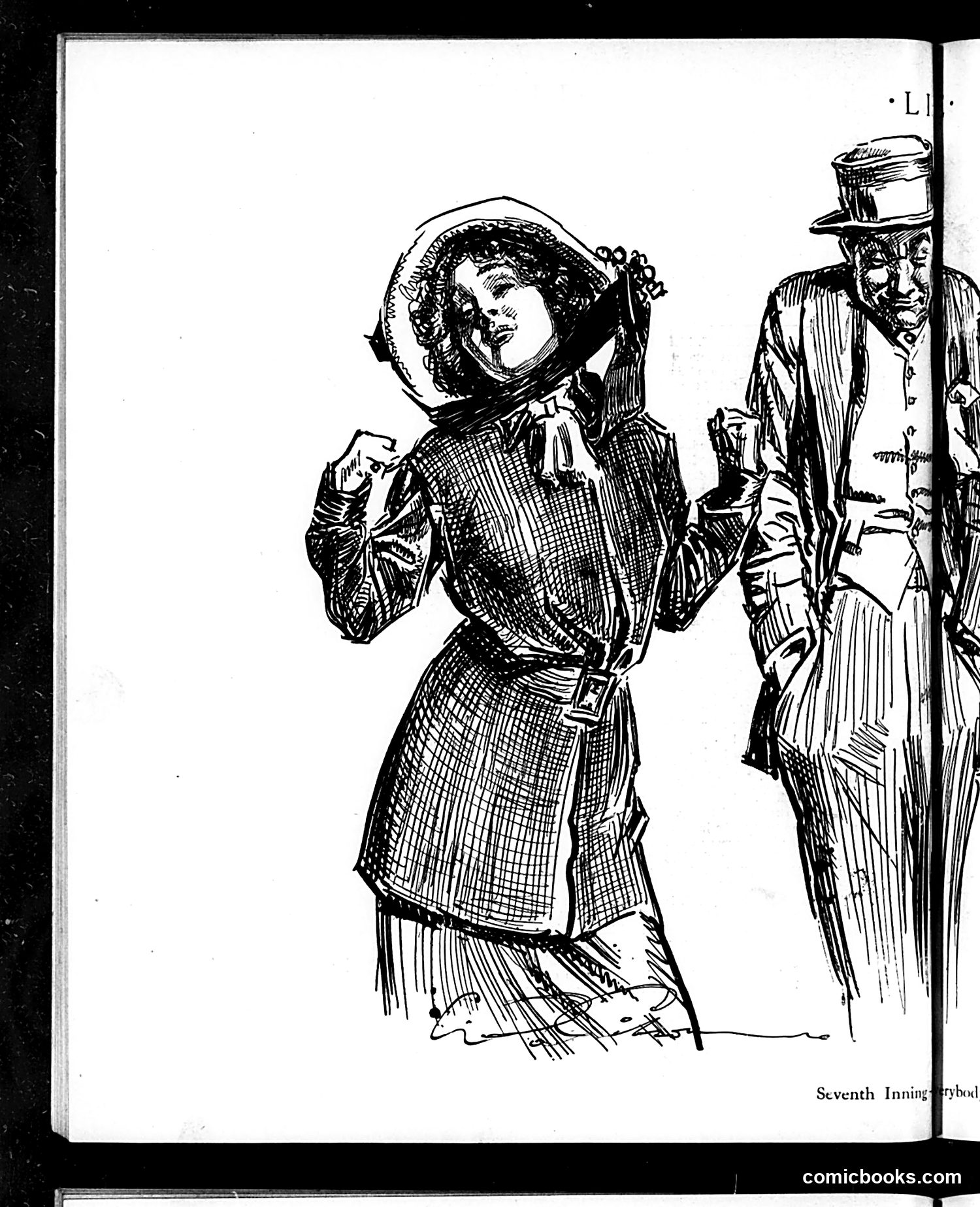
This illustration depicts a scene from a baseball game at the "seventh inning stretch"—a traditional break in the action during the seventh inning when spectators stand and stretch. The cartoon shows a woman in fashionable early-20th-century attire (bonnet, fitted jacket, long skirt) prominently stretching in the foreground, with a man in a top hat beside her. The humor likely satirizes the social spectacle of baseball attendance, particularly how well-dressed urban audiences used the game as an occasion for public display and socializing rather than purely sporting interest. The woman's exaggerated, theatrical pose suggests satire of performative leisure and fashion-consciousness among the wealthy or middle-class attendees of the era.
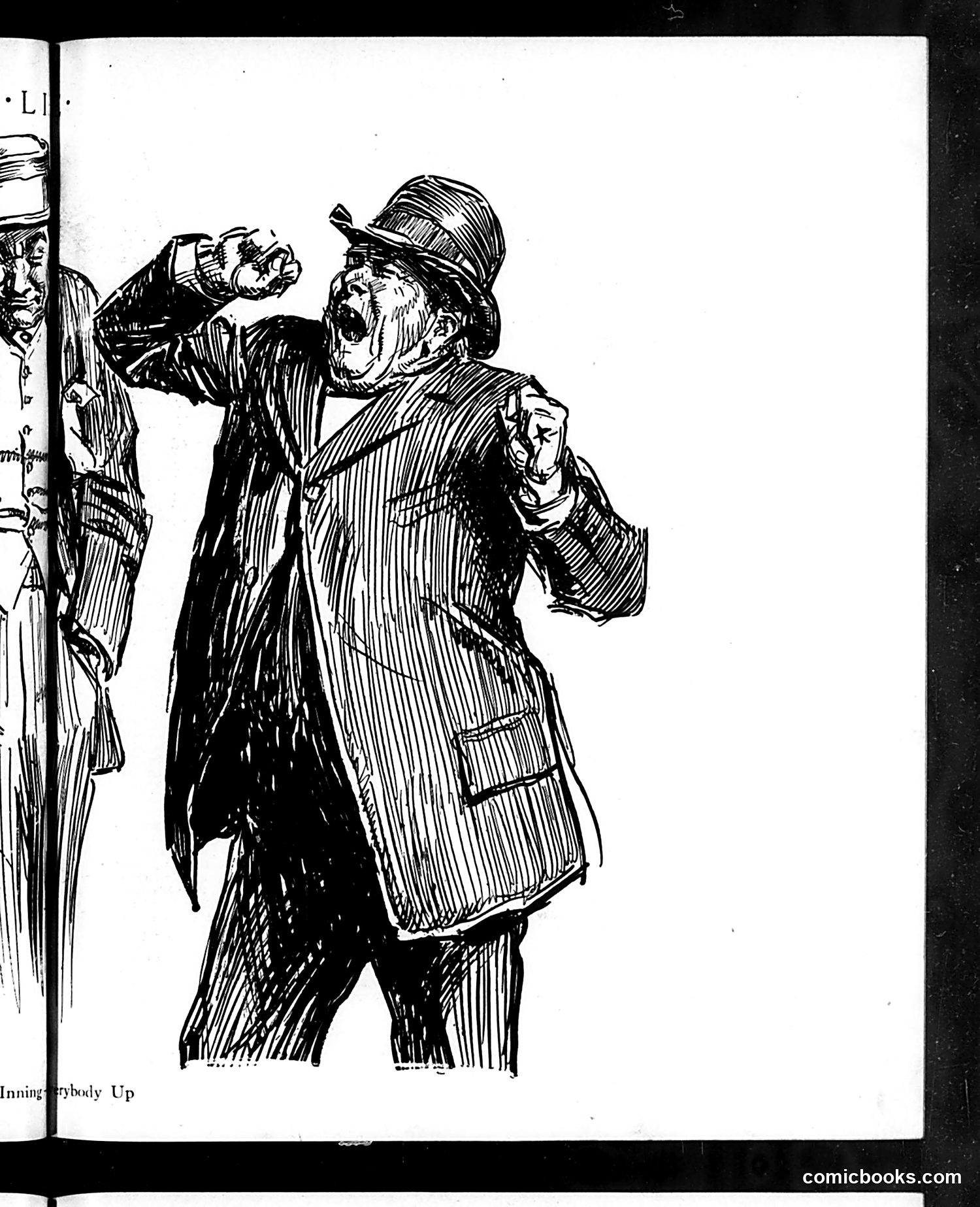
This political cartoon depicts a caricatured figure in a bowler hat and suit, appearing to be a wealthy or powerful man, engaged in what the title suggests is baseball-related activity ("Inning Anybody Up"). The exaggerated facial features and caricature style are typical of early 20th-century satirical cartooning. The figure's body language—raising his fist or hand—suggests aggressive action or confrontation. The "inning" reference likely plays on baseball terminology as metaphor for political or social maneuvering. However, without clearer context about the specific publication date or political moment, I cannot definitively identify which public figure this represents or what particular policy or event prompted the satire. The style suggests early-to-mid 20th century American political commentary.
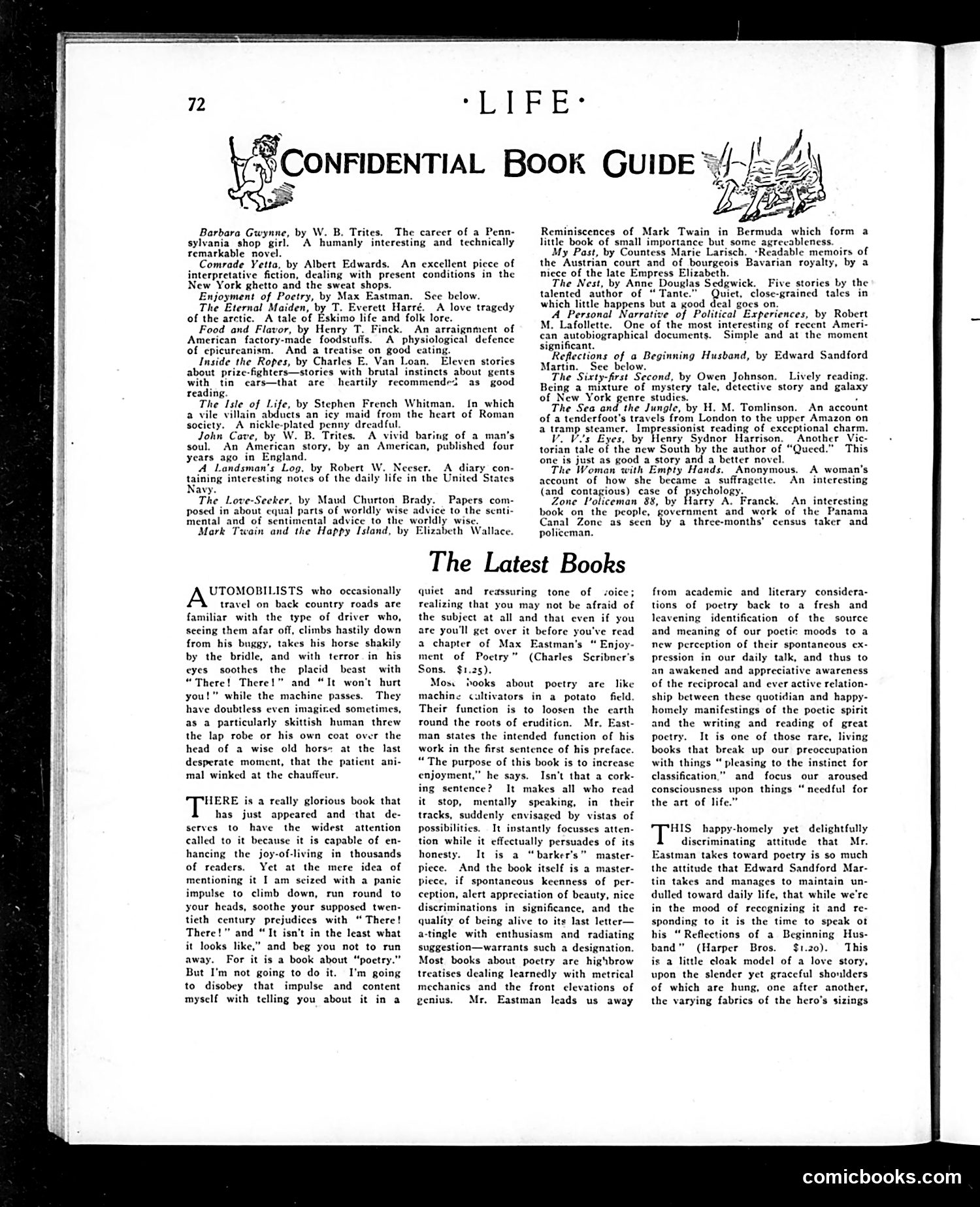
This is a book review section titled "Confidential Book Guide" from *Life* magazine, not a political cartoon page. It catalogs contemporary novels and non-fiction, offering brief critical assessments. Notable entries reveal early 1900s progressive concerns: "Comrade Yetta" addresses sweat shop conditions; Robert La Follette's autobiography on "Political Experiences" reflects interest in reform politics; and "The Woman with Empty Hands" describes how a woman became a suffragette—noted as "contagious" psychology, suggesting contemporary anxiety about women's activism. The lower section discusses Max Eastman's "Enjoyment of Poetry," debating whether poetry should be intellectually highbrow or accessible to ordinary readers. The automobile anecdote illustrates rural tension between old and new technology—horses panicking at cars. The page reflects Progressive Era literary culture: socially conscious fiction, political memoir, and debates about modernization versus tradition.
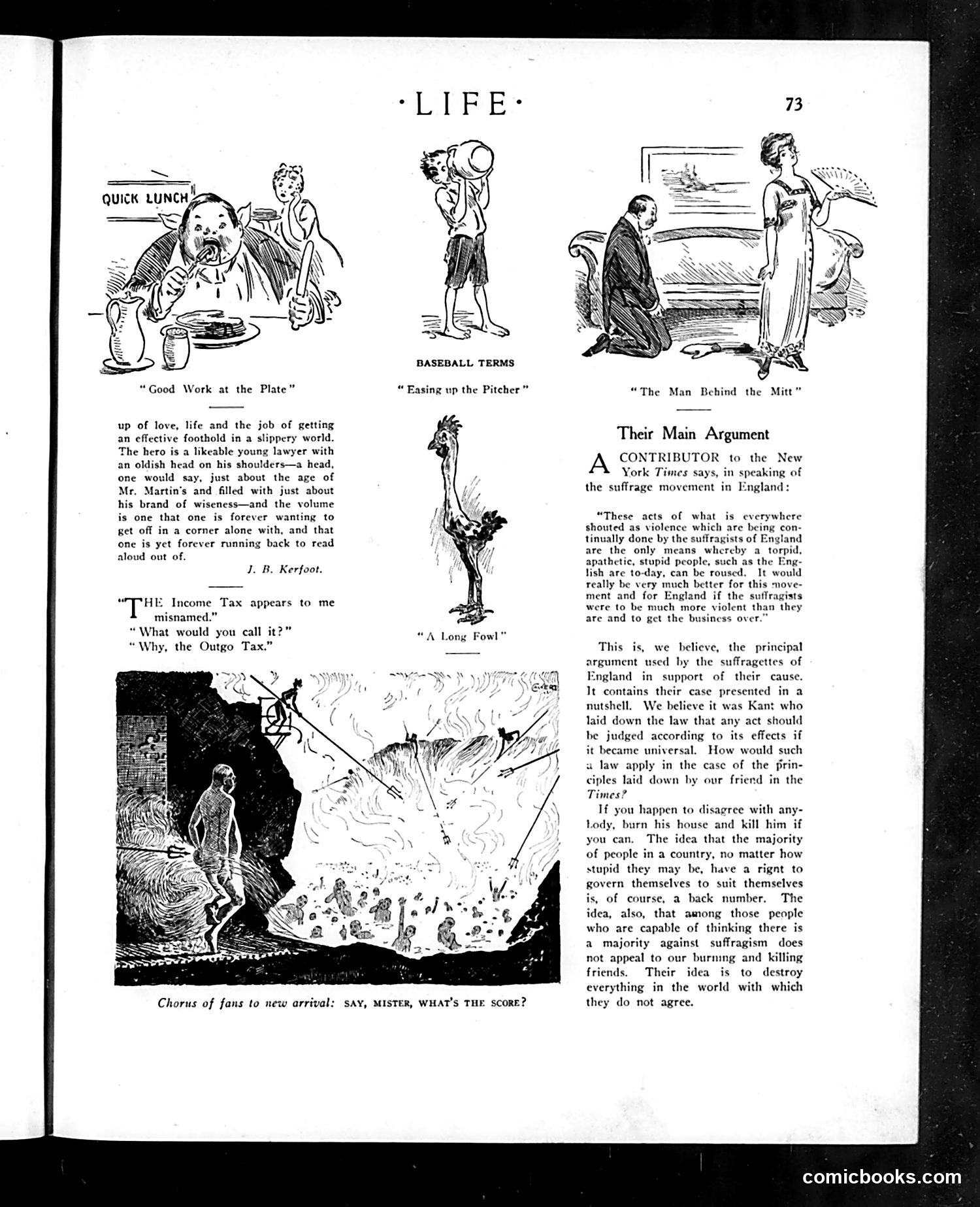
This page combines baseball-themed cartoons with serious political commentary on the British suffrage movement. The three top cartoons use baseball terminology as double entendre ("Good Work at the Plate," "Easing up the Pitcher," "The Man Behind the Mitt"). The main article critiques a *New York Times* contributor's argument defending suffragette violence in England. That contributor claimed violent acts were necessary to "rouse" the apathetic British public into supporting women's voting rights. Life's editorial response is scathing: it applies the contributor's logic universally—if violence is justified whenever you want change, then anyone could burn houses and kill opponents they disagree with. The piece argues this destroys the principle that majorities have the right to self-governance, and that this extremism undermines the suffragists' own cause. The satire targets both the suffragettes' violent tactics and the intellectuals defending them as justified means to an end.
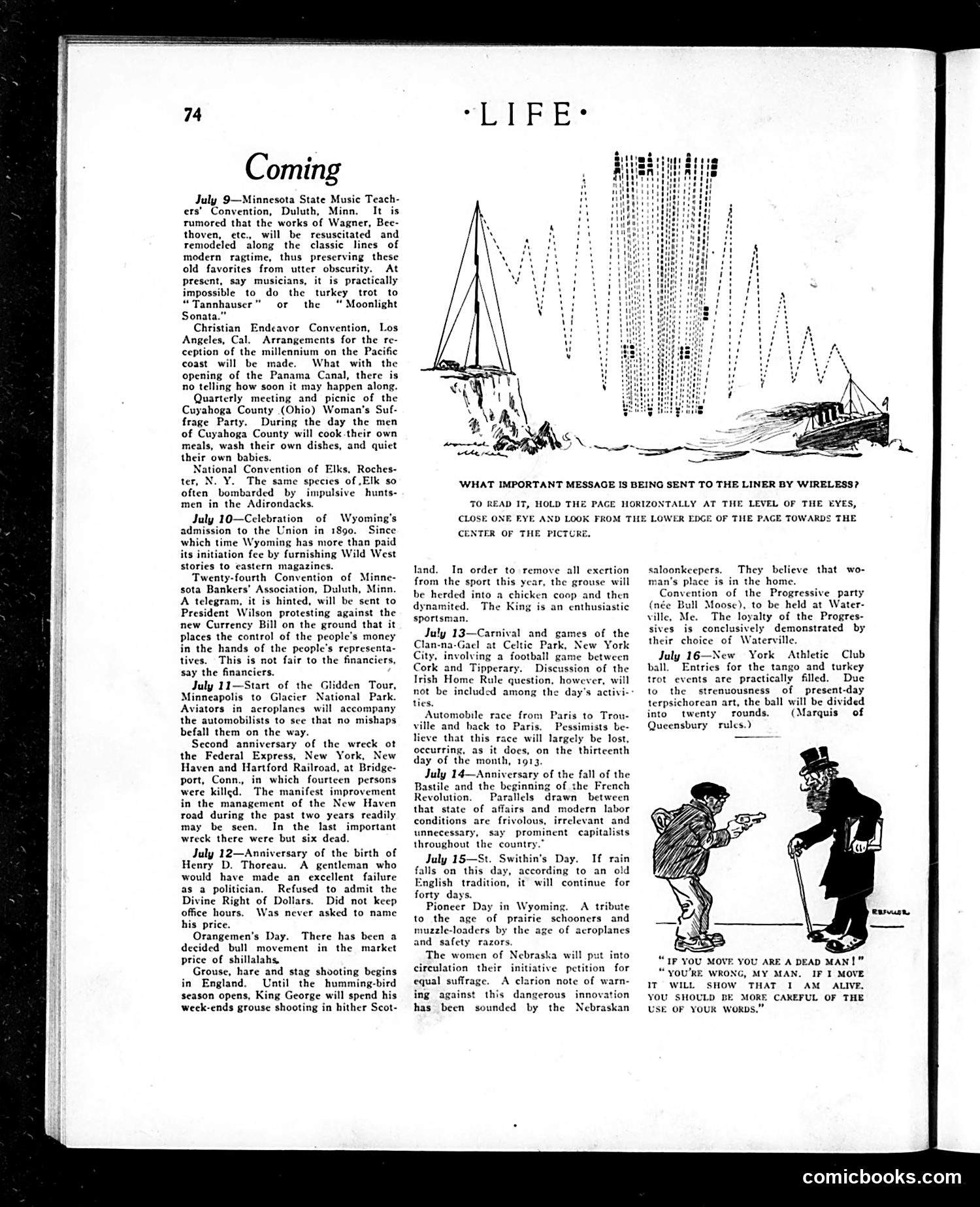
This page from Life magazine contains a satirical "Coming Events" column listing upcoming July 1913 gatherings, paired with a visual puzzle cartoon. The cartoons mock contemporary issues: the Minnesota Bankers' Convention entry sarcastically suggests bankers will protest the new Currency Bill because it puts money control "in the hands of the people's representatives"—a jab at financiers' resistance to democratic monetary reform. The Orangemen's Day entry jokes about a "bull movement in the market price of shillahs" (Irish clubs), playing on financial/sectarian tensions. The embedded cartoon shows a wireless message being transmitted to a ship. Readers must tilt the page horizontally to decode the message by reading the dotted pattern as text—a visual puzzle reflecting the era's fascination with wireless technology. The July 14th entry sardonically dismisses comparisons between the French Revolution and modern labor conditions as "frivolous, irrelevant and unnecessary," implying capitalists' defensive denial of legitimate working-class grievances during this period of labor unrest.
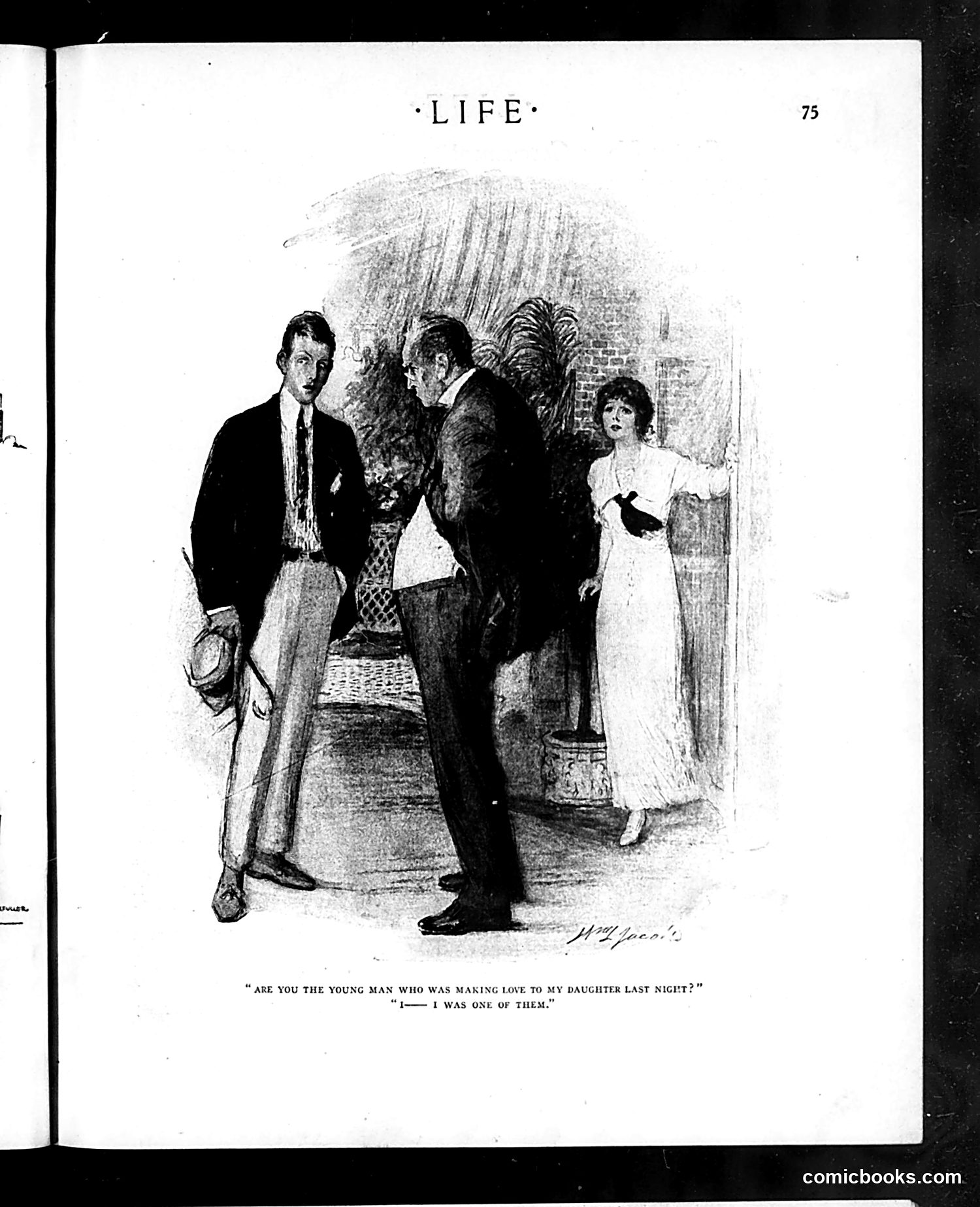
This is a humor cartoon satirizing young men's dating behavior in the early 20th century. An older man (apparently the father) confronts a young man, asking if he was "making love" to his daughter the previous evening. The young man's reply—"I was one of them"—suggests multiple suitors were courting the daughter simultaneously, and he cannot even recall which evening is being referenced. The joke targets both the casualness of young men's romantic intentions and the apparent popularity of the daughter, who entertained multiple callers. The cartoon satirizes shifting social attitudes toward courtship and suggests concerns among older generations about the loosening of Victorian-era dating conventions. The woman visible in the background appears to be the daughter in question.
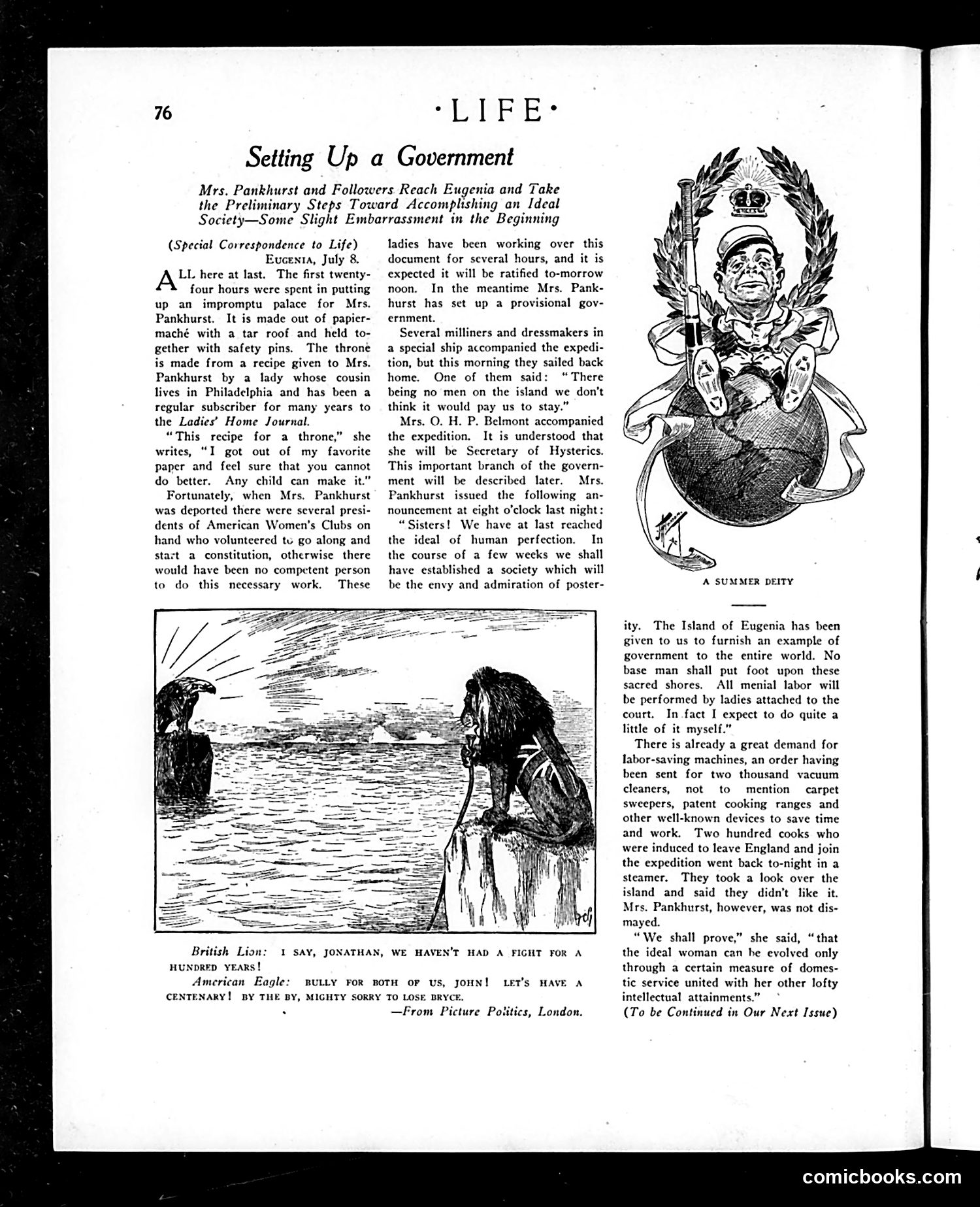
This 1913 article satirizes **Emmeline Pankhurst** and the British suffragette movement by imagining them establishing an all-female society on a fictional island called "Eugenia." The satire mocks several targets: 1. **Pankhurst's authority**: She's depicted as authoritarianly establishing a government with comically improvised infrastructure (a papier-mâché palace held together with safety pins). 2. **Female competence claims**: American women's club presidents supposedly draft the constitution, yet the throne comes from a *Ladies' Home Journal* recipe, undercutting intellectual seriousness. 3. **Labor contradictions**: The all-female utopia immediately requires 2,000 vacuum cleaners and 200 cooks (who flee after seeing the island), exposing the gap between feminist ideals and practical dependence on domestic service. 4. **"Hysterics" ministry**: Mrs. O.H.P. Belmont's role as "Secretary of Hysterics" relies on period misogyny stereotyping women as emotionally unstable. The cartoon at bottom references Anglo-American relations, separate from the main satire. The piece ridicules suffragettes' vision of female independence as naive and impractical.
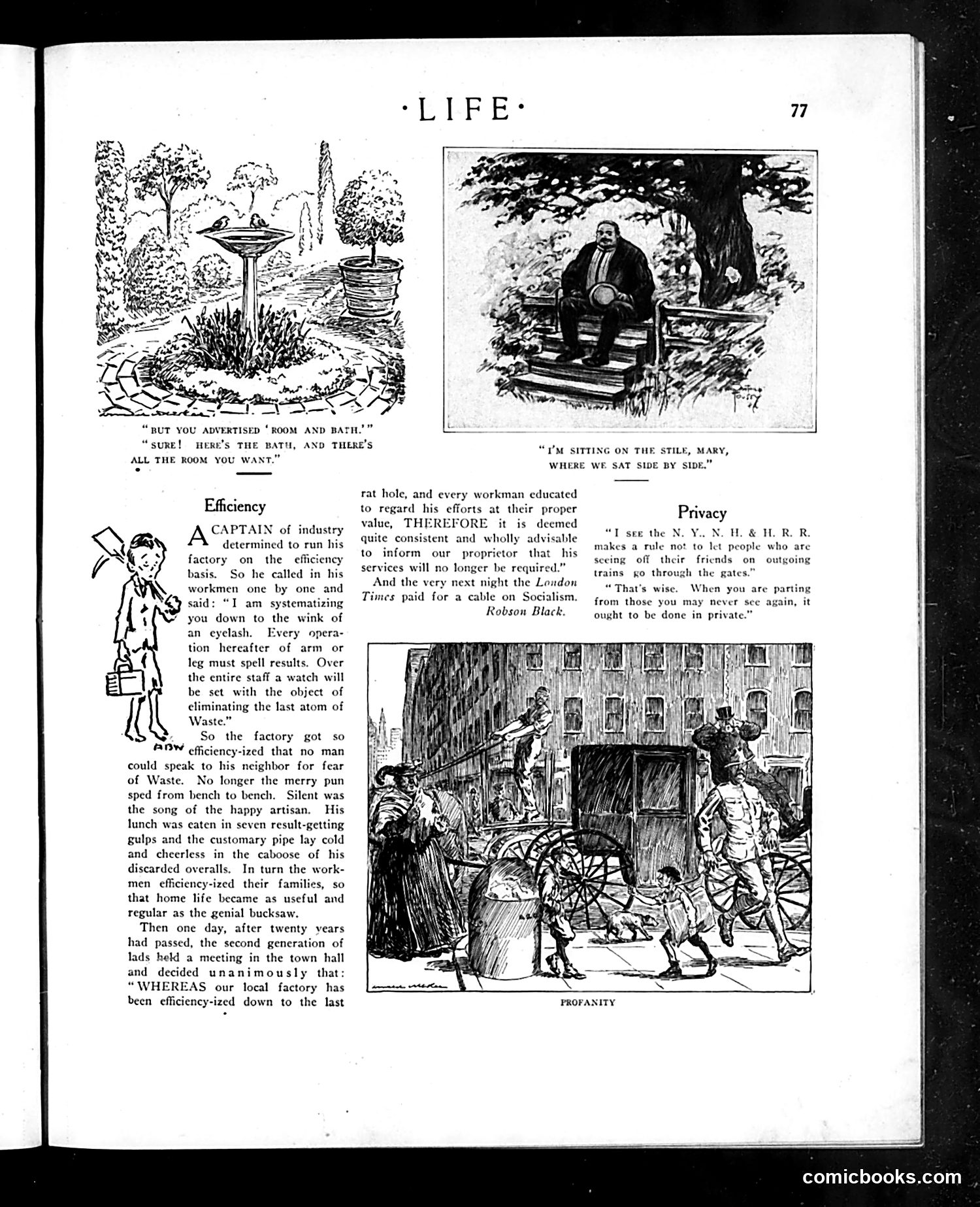
This page contains three separate satirical pieces mocking early 20th-century social trends: **"Efficiency"** ridicules obsessive factory optimization. A captain of industry eliminates all "waste"—including worker conversation and leisure—to maximize productivity. The joke: after twenty years, the second generation of workers unanimously fires him, and the London *Times* reports it as evidence of rising Socialism. The satire suggests that extreme efficiency destroys human dignity and ironically breeds the very worker rebellion management fears. **"Privacy"** jokes about railroad rules preventing people from accompanying friends to train gates during farewells. The punchline is darkly sentimental: parting from loved ones "ought to be done in private"—implying these may be final goodbyes. **"Profanity"** (bottom cartoon) appears to show a landlord's dishonest rental advertisement—promising a "room and bath" but delivering only a bathtub in a hallway as the "room." All three pieces mock institutional or commercial dishonesty and the dehumanizing effects of modern life.
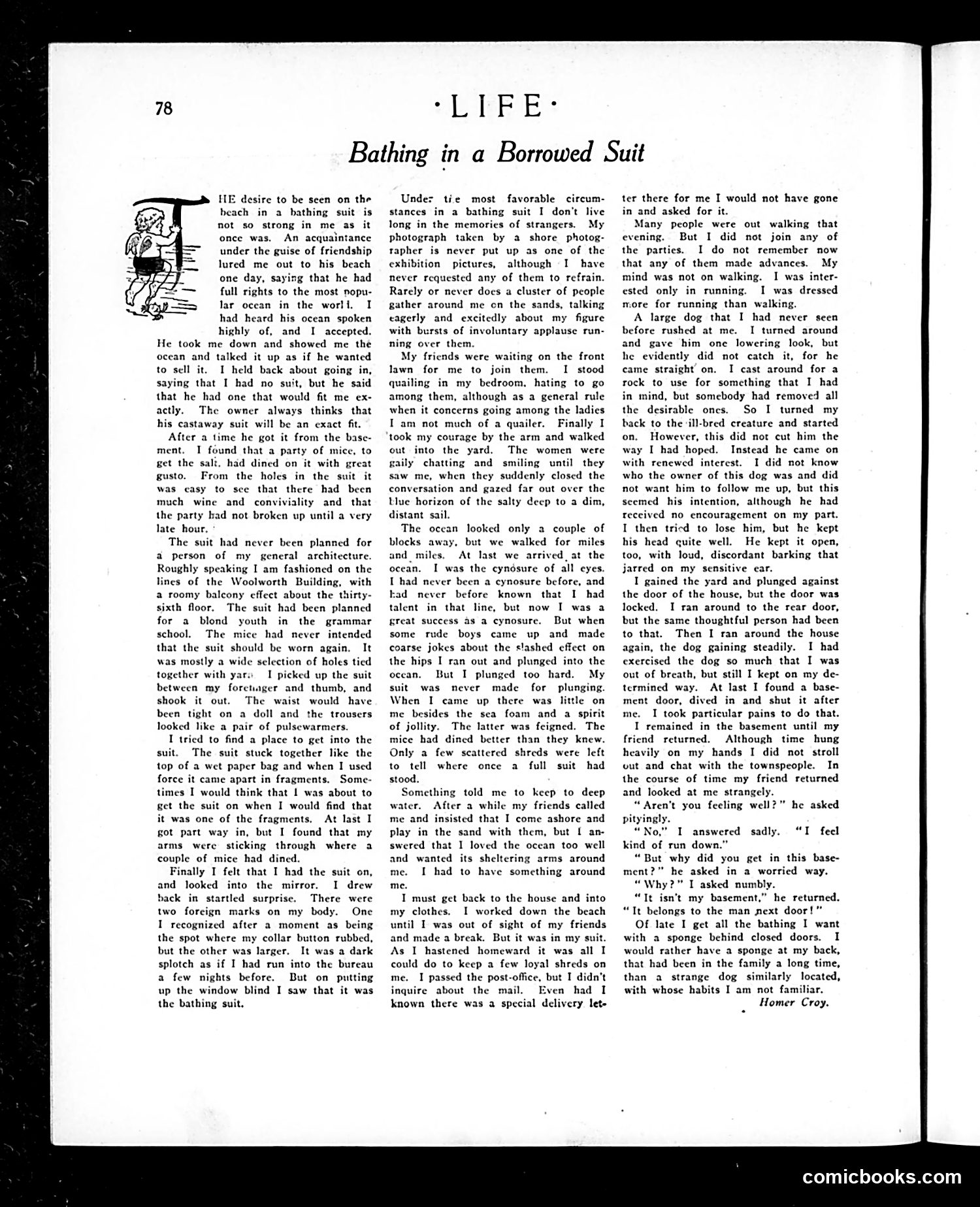
This is a humorous essay with accompanying cartoon about the indignity of borrowing an ill-fitting bathing suit. The author, a heavyset man (self-described as built like the Woolworth Building), is invited to the beach by a friend who loans him an ancient, deteriorated bathing suit originally made for a small grammar-school boy. The suit is moth-eaten, with holes throughout, and barely holds together. The comedy centers on the gap between masculine self-perception and public reality: the author expects to be ignored at the beach but instead becomes a spectacle—a "cynosure of all eyes"—though not flatteringly. The small illustration shows him attempting to put on the disintegrating garment, visualizing the physical comedy. The satire mocks vanity, borrowed pretensions, and the universal male anxiety about appearing ridiculous before others, particularly women. It's gentle, self-aware humor typical of Life magazine's satirical approach.
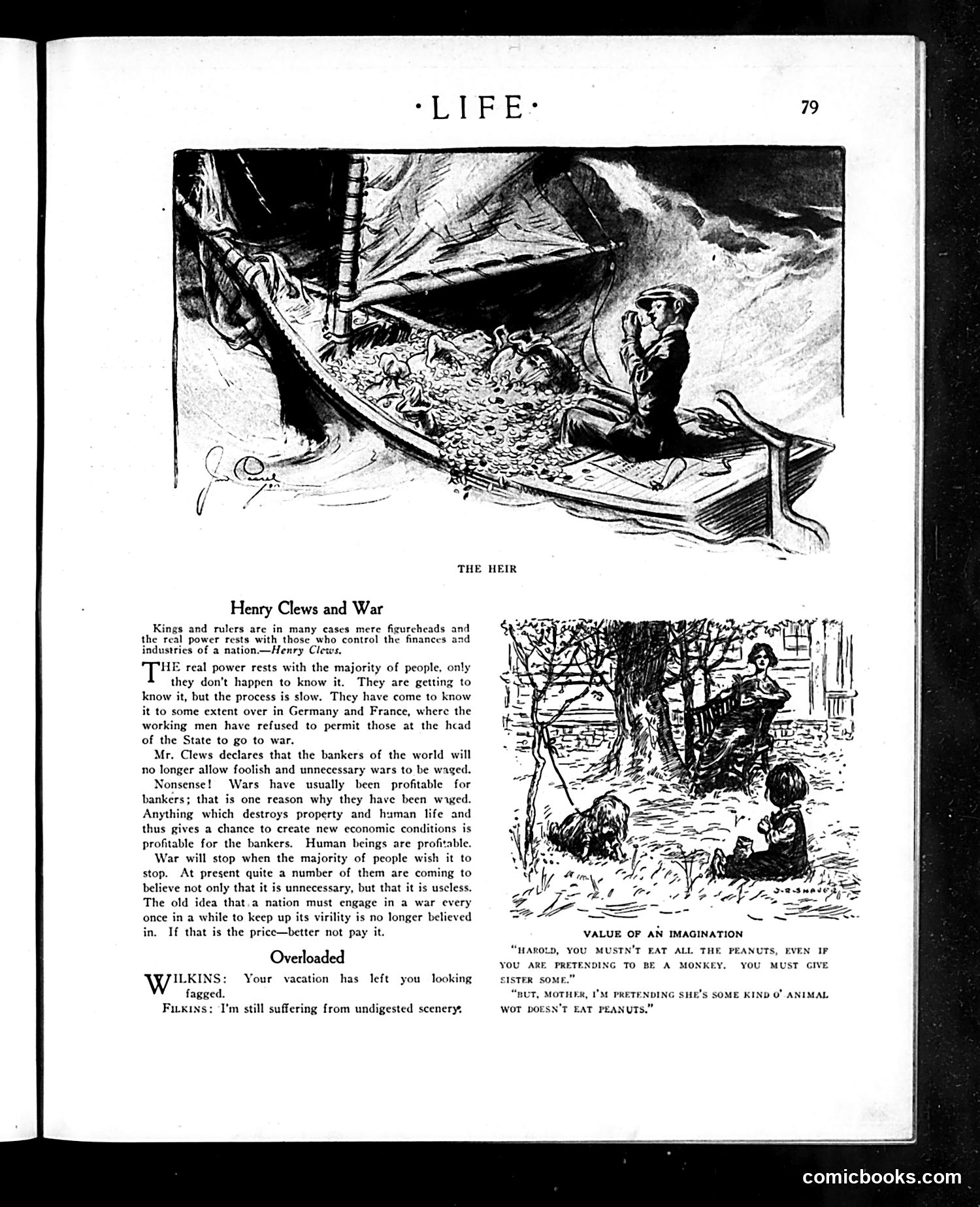
This page contains anti-war political commentary attributed to financier Henry Clews, likely from the World War I era. The article satirizes Clews's claim that bankers will prevent future wars, sarcastically countering that wars are actually *profitable* for bankers—making property destruction and human loss economically advantageous for financial interests. The piece argues that only popular resistance (as allegedly occurred in Germany and France with worker refusals) can stop war. The page includes two separate comic sections: "Overloaded" (a brief joke about vacation indigestion) and "Value of an Imagination" (children's humor about a boy pretending his sister is a non-peanut-eating animal to avoid sharing). The top illustration titled "The Heir" appears to depict poverty or hardship, though its specific reference is unclear from the visible context.
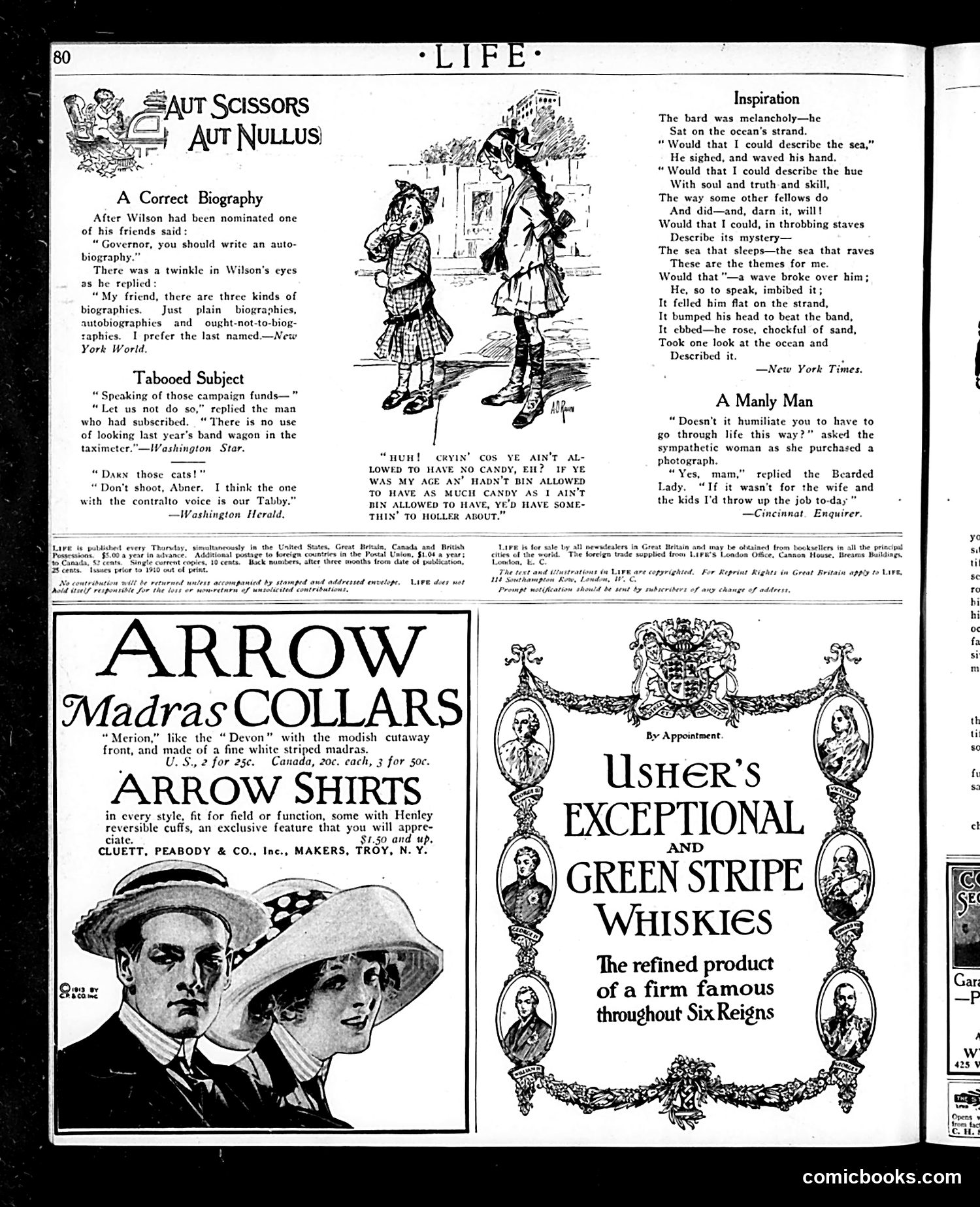
This page from *Life* magazine contains several satirical pieces and advertisements from the early 20th century. **Political Content:** The "Correct Biography" section references President Wilson, who had recently been nominated (likely for re-election). The joke plays on Wilson's reluctance to write an autobiography, distinguishing between "plain biographies," autobiographies, and "ought-not-to-biographies"—a veiled reference to potentially embarrassing campaign fund controversies, reinforced by the "Tabooed Subject" section below, which jokes about not discussing campaign finances. **Humor Pieces:** "Inspiration" satirizes poetic pretension through a poet attempting to describe the sea philosophically until literally knocked over by a wave, after which he can only describe it plainly. "A Manly Man" jokes about a bearded lady's resignation to her condition due to family obligations. **Advertisements:** The page includes period clothing ads (Arrow Shirts, collars) and Usher's whiskey, typical of *Life*'s commercial content. The satire reflects Progressive Era concerns about political corruption and campaign financing.
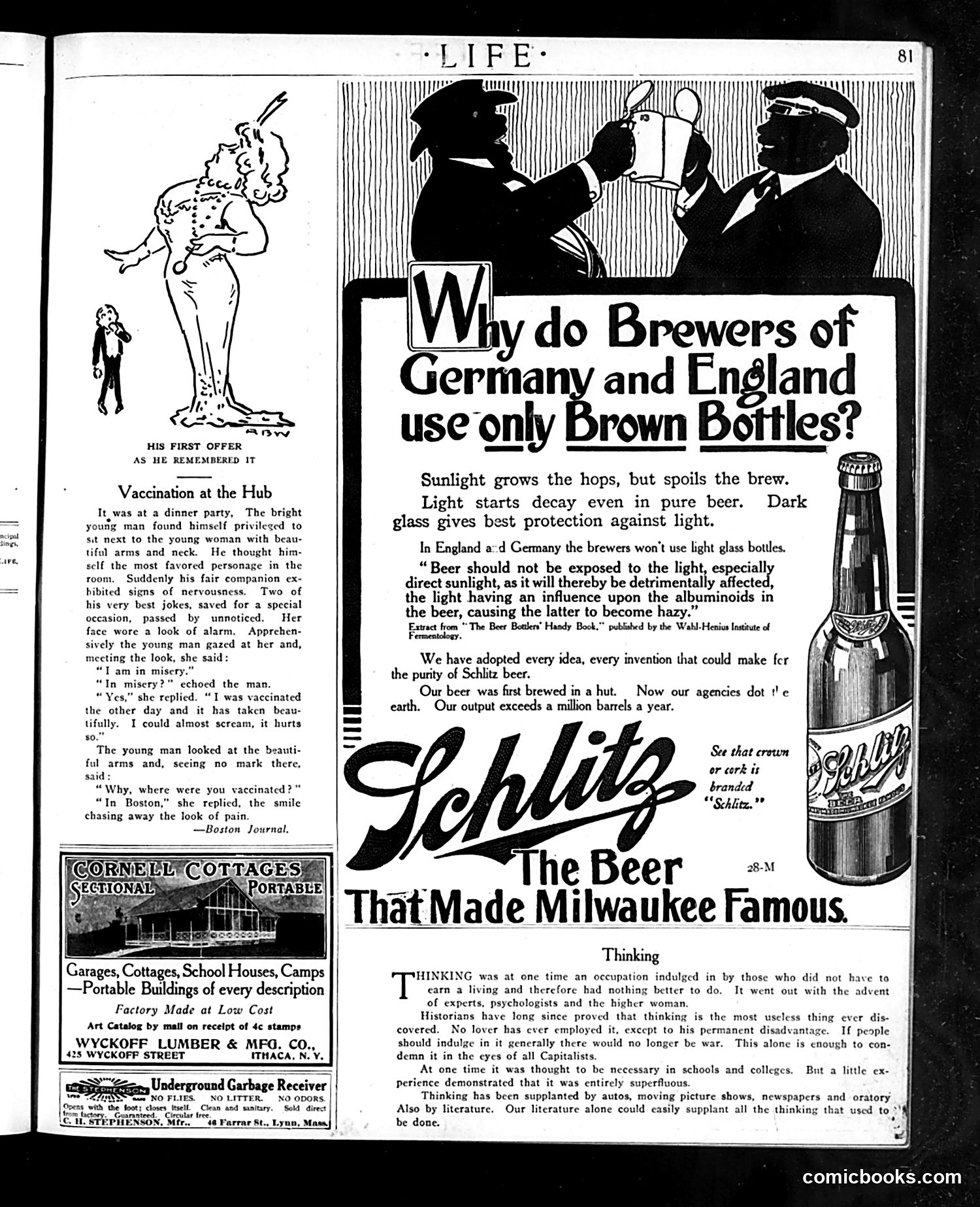
This page mixes humor with advertising. The left cartoon, "Vaccination at the Hub," is a mild joke: a young man at a dinner party sits beside an attractive woman who's nervous and won't engage with his humor. She reveals she was recently vaccinated and her arm hurts—but he can't see a mark on her visible arms, implying the vaccination was administered elsewhere on her body, creating the innuendo that drives the humor. The dominant content is a **Schlitz beer advertisement** addressing why German and English brewers use brown bottles. It explains that sunlight damages beer by affecting its albuminoids, making the liquid hazy. The ad emphasizes Schlitz's quality and massive production (over a million barrels yearly). Below is a satirical essay titled "Thinking," mocking intellectualism as obsolete and unnecessary for modern life, replaced by automobiles, movies, newspapers, and oratory. It's tongue-in-cheek social criticism typical of *Life* magazine's satirical voice.
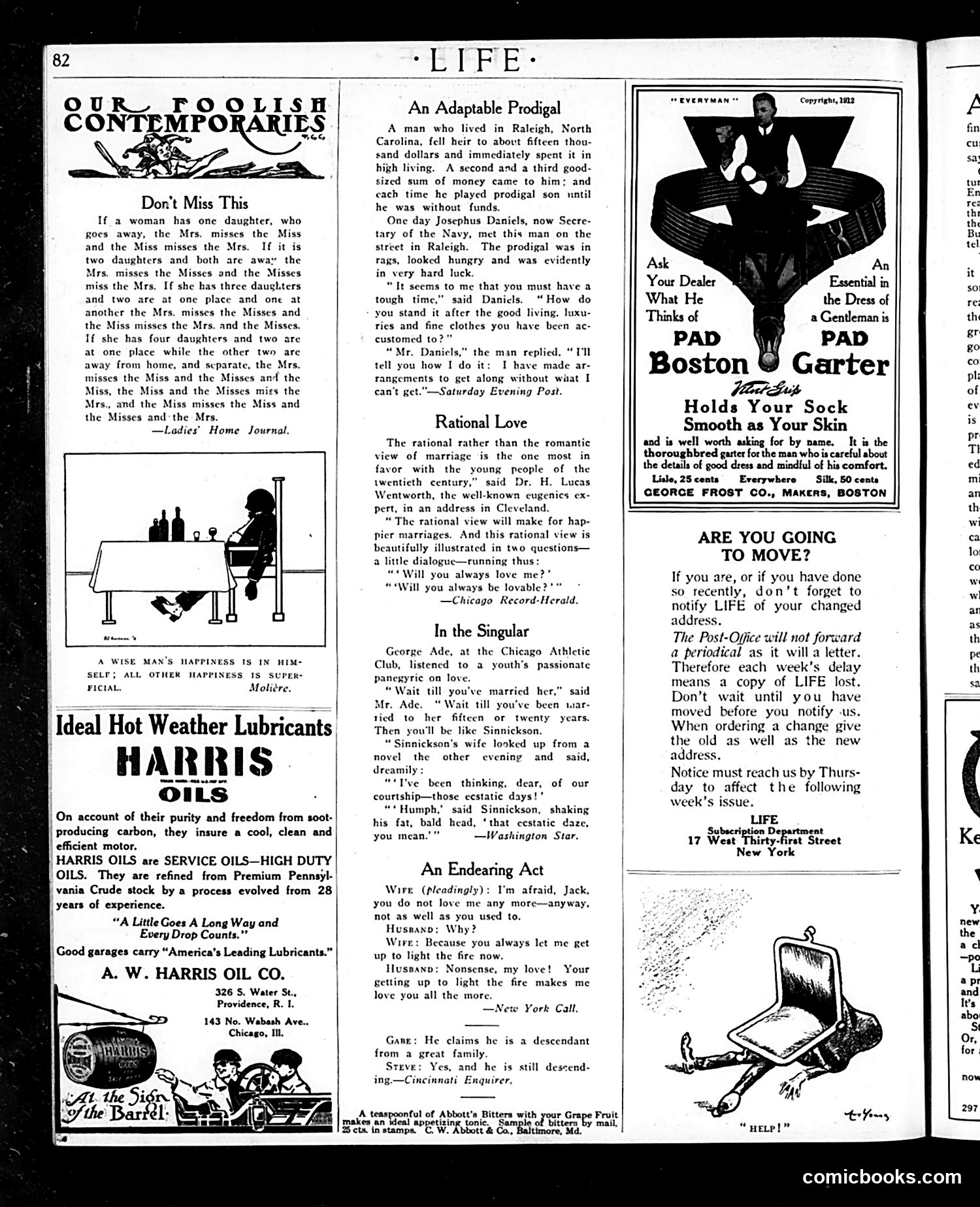
This page from Life combines satirical humor with advertisements typical of early 20th-century magazines. **Main Content:** The "Don't Miss This" piece satirizes the confusing logistics of mothers and daughters separating—a humorous complaint about the emotional complexity of family separation. The joke relies on wordplay between "Mrs." and "Miss" to create deliberately tangled scenarios. **Other Humor Pieces:** - "An Adaptable Prodigal" recounts a true anecdote about a North Carolina man who inherited money multiple times, squandered it repeatedly, then developed a coping strategy: accepting his poverty. - Three pieces about romantic/marital love ("Rational Love," "In the Singular," "An Endearing Act") offer witty observations and punchlines about courtship versus marriage, satirizing both romantic idealism and domestic routine. **Advertisements:** Harris Oils (motor lubricants) and Abbott's Bitters dominate the page visually, representing typical commercial content of the era. The overall tone is light domestic satire targeting middle-class concerns about family, love, and marriage.
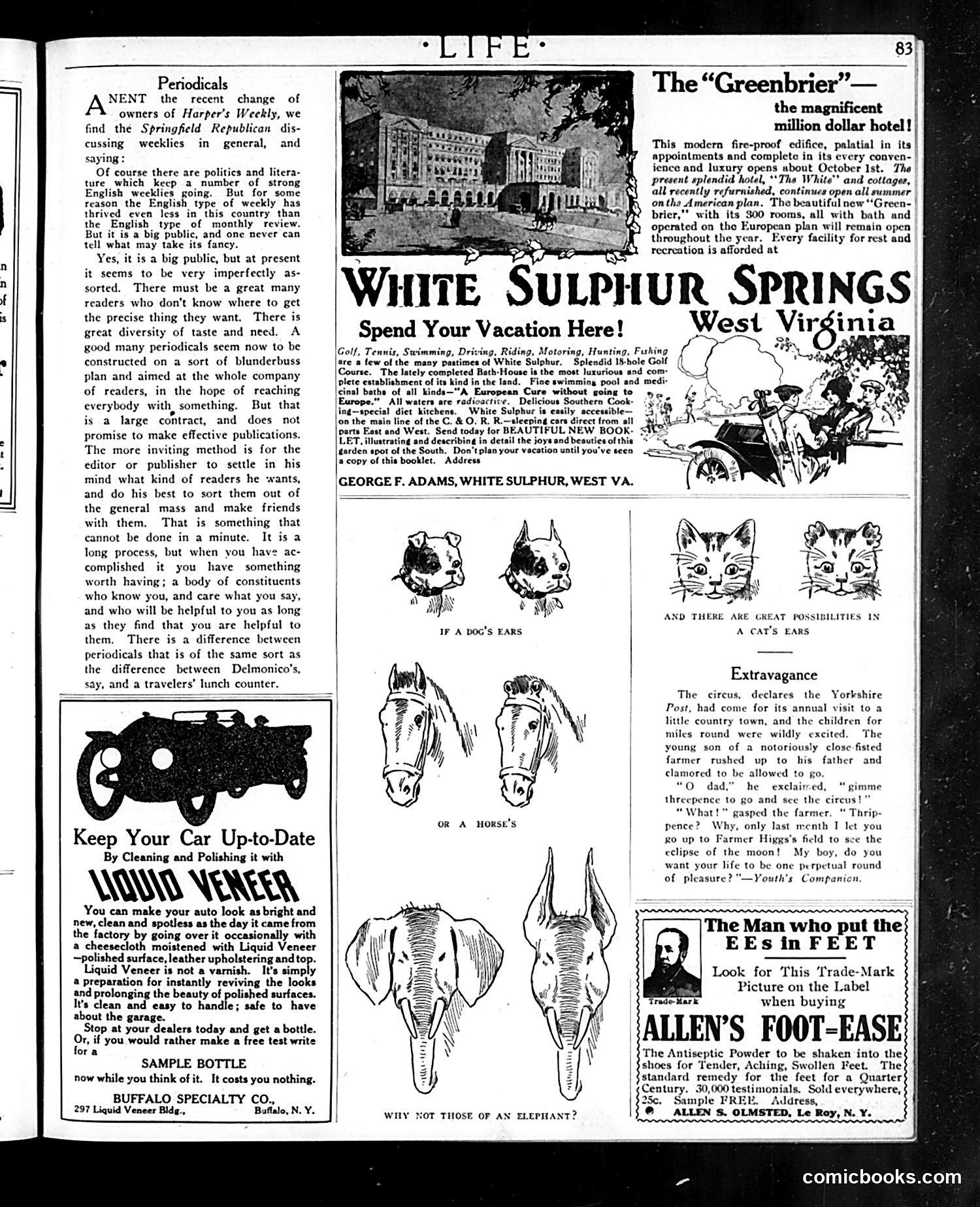
This page is primarily **advertising-driven** rather than satirical content. The main editorial piece discusses periodical publishing strategy—arguing that successful magazines must target specific reader demographics rather than appeal to everyone broadly. The comparison to "Delmonico's" (an upscale restaurant) versus a lunch counter illustrates this principle. The remaining content consists of advertisements: - **White Sulphur Springs, West Virginia**: promoting a luxury resort hotel, "the Greenbrier," with modern amenities - **Liquid Veneer**: automobile polish product - **Allen's Foot-Ease**: foot powder for various foot ailments The page includes **humorous comparative drawings** (dog ears, horse ears, elephant ears, cat ears) illustrating anatomical differences—likely tied to advertising copy about product effectiveness. The small item titled "Extravagance" appears to be a brief humor anecdote about a farmer's son requesting a circus visit. Overall, this is a typical early-1900s magazine layout mixing editorial commentary with substantial advertising rather than political satire.
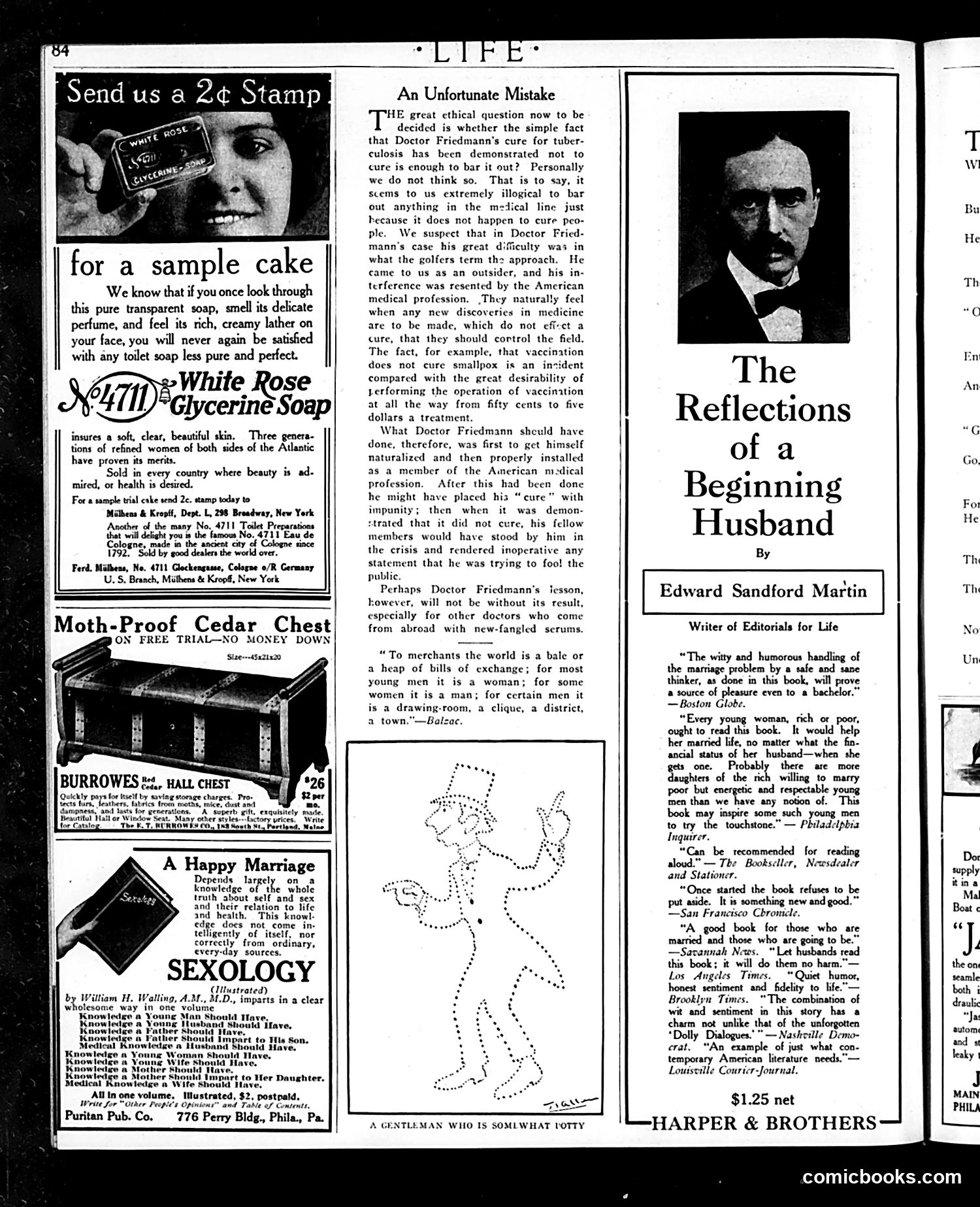
This satirical article mocks American medical establishment's resistance to Dr. Friedmann's tuberculosis cure. Friedmann was a real German doctor whose treatment, promoted around 1910-1912, ultimately proved ineffective. Life's satire cuts multiple ways: it ridicules both Friedmann (for presenting a failed cure) and the American medical profession (for prioritizing professional control over actual healing). The piece argues doctors resented Friedmann as an "outsider" and suggests the profession would have protected him had he been properly credentialed and "naturalized." The article's darkest joke: doctors should control medical discoveries *regardless of whether they work*—sarcastically noting vaccination "does not cure smallpox" yet remains profitable and professionally controlled. The satire exposes how medical authority depends more on institutional membership than efficacy, and how professional gatekeeping can obstruct innovation while protecting established practitioners' interests.
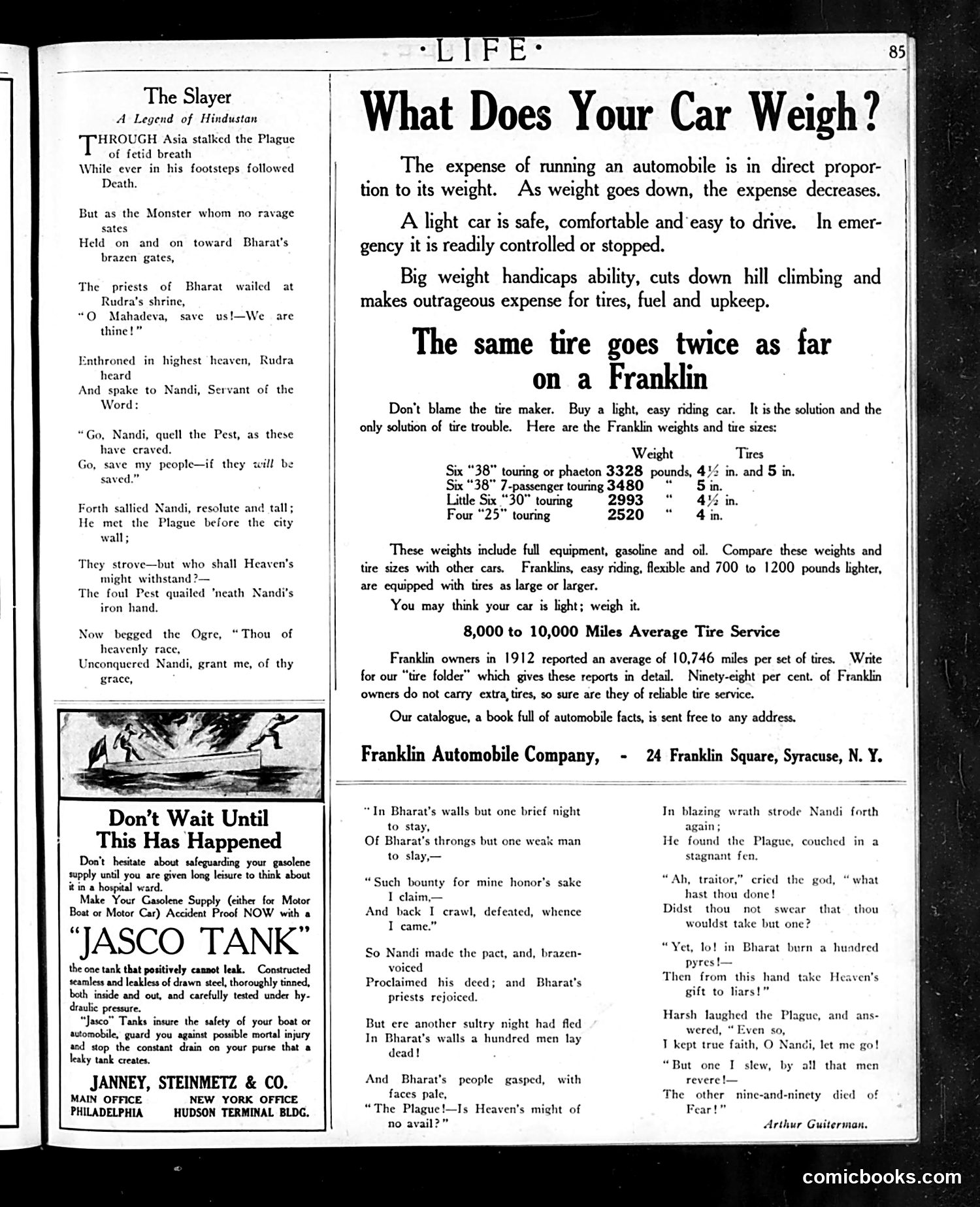
This page mixes literary content with automobile advertising, representing early 20th-century magazine design. **Left side:** "The Slayer: A Legend of Hindustan" is a narrative poem about the Hindu god Nandi defeating the Plague that threatens India. The story uses Hindu mythology metaphorically—the Plague breaches a pact by killing far more than agreed, forcing Nandi to confront it again. This appears to reference real plague outbreaks affecting India during this period, framing divine intervention in classical terms for American readers. **Right side:** Two advertisements—the Jasco Tank (gasoline safety) and Franklin Automobile Company (promoting lightweight cars). The Franklin ad argues that lighter vehicles cost less to operate, citing tire longevity data from 1912 owners. This reflects early automotive competition focused on efficiency rather than power. The juxtaposition is typical of Life's format: serious literature alongside commercial messaging.
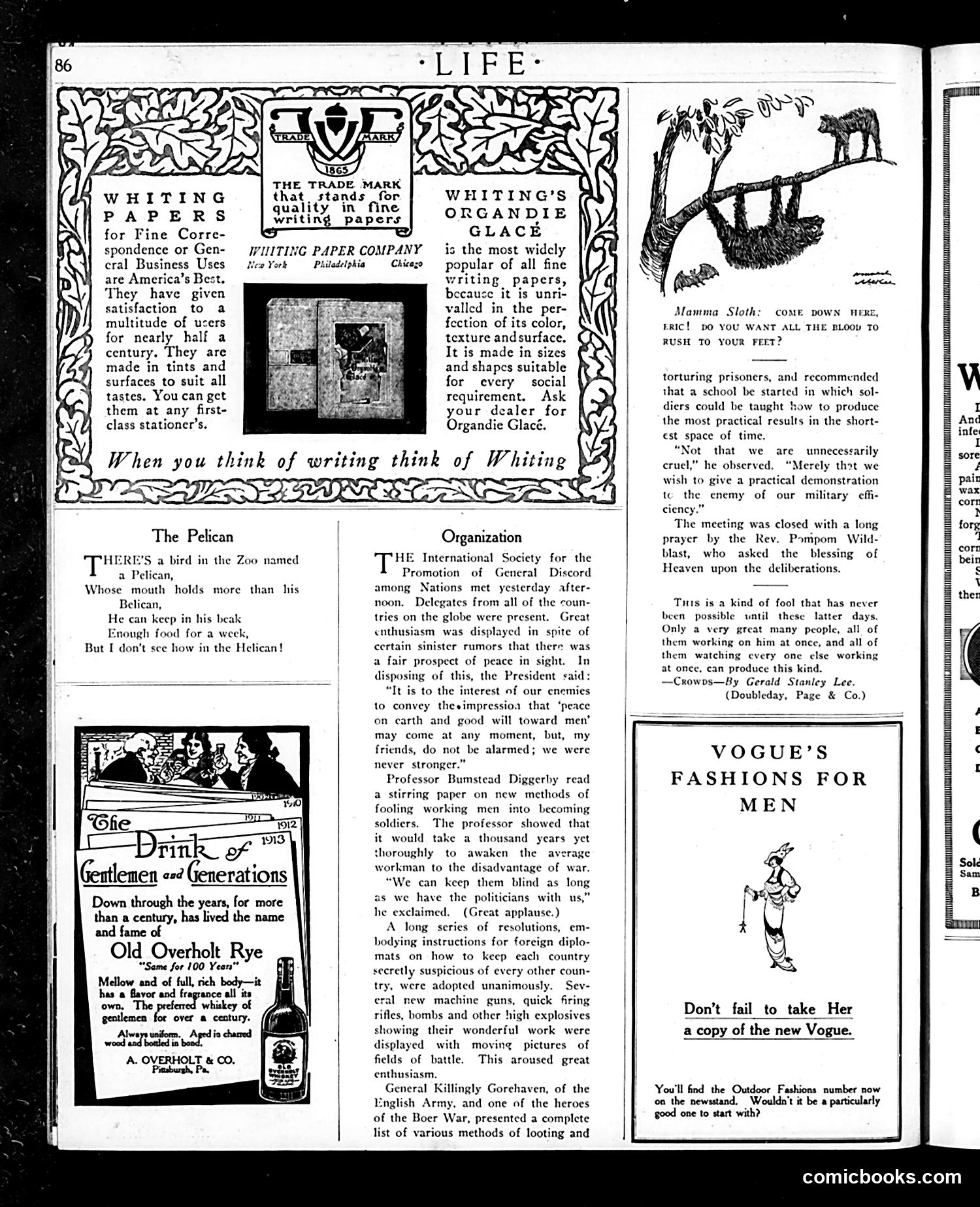
This page contains satirical content targeting early 20th-century militarism and international tensions. The main cartoon is titled "Organization" and describes a fictional "International Society for the Promotion of General Discord among Nations"—a direct mockery of international diplomatic efforts and arms buildup preceding World War I. The satire targets political and military leaders who, despite claiming to want peace, actively promote war through propaganda, weapons development, and soldier recruitment. Characters like "Professor Bumstead Diggerby" and "General Killingly Gorehaven" represent stereotypical warmongering officials. The cartoon criticizes how governments deliberately keep citizens "blind" to war's disadvantages through politicians and media manipulation. The final editorial note (by Gerald Stanley Lee) comments that such widespread deception requires coordinated effort from many people—a pointed critique of propaganda machinery. The page also includes advertisements and a lighthearted poem about a pelican, typical of Life magazine's mixed content format.
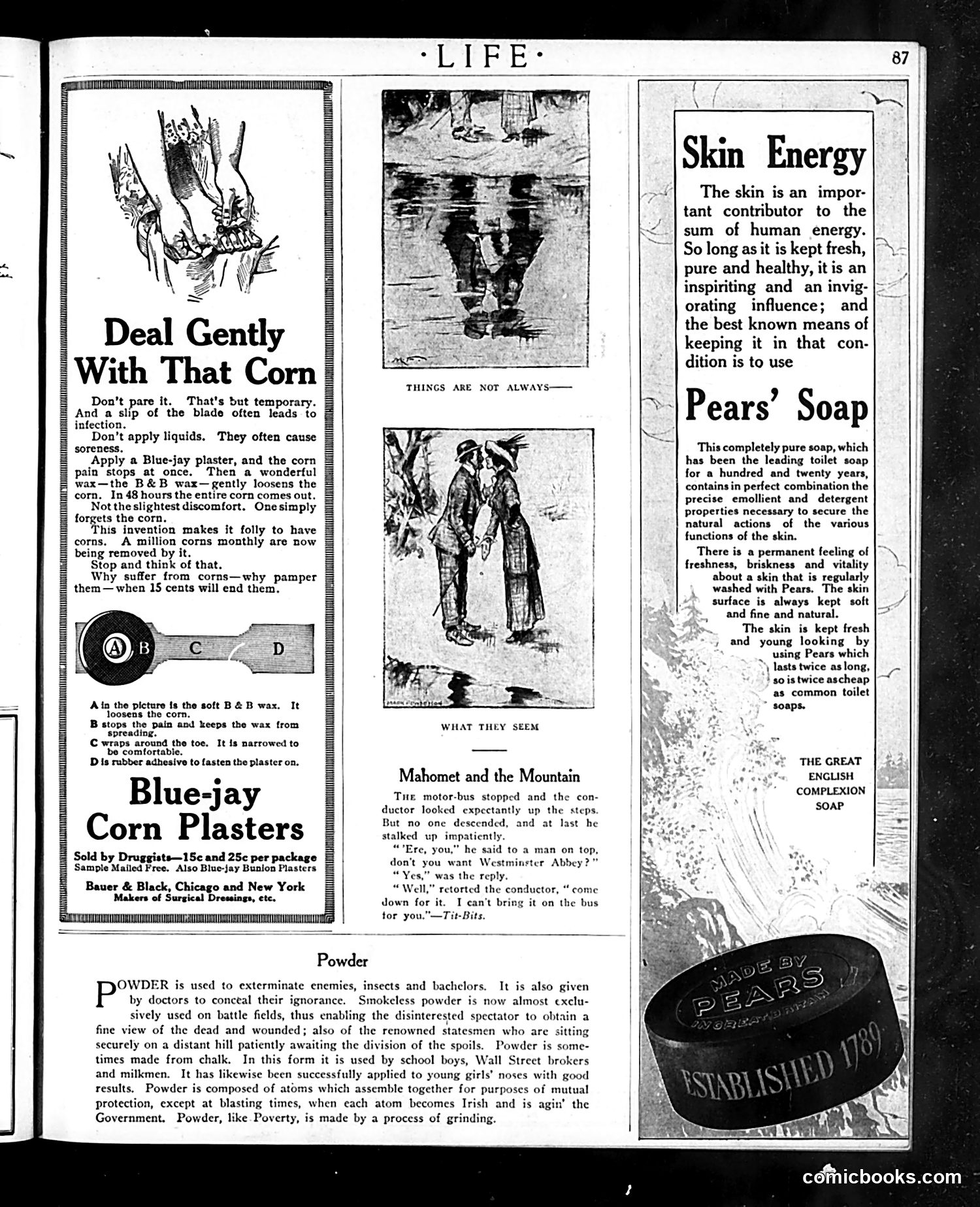
This short comic sketch satirizes the phrase "if the mountain won't come to Mahomet, Mahomet must go to the mountain"—meaning if someone won't cooperate, you must adapt your approach. The joke: A bus conductor waits for a passenger who refuses to disembark at Westminster Abbey. When the conductor finally goes upstairs to investigate, the passenger says he wants to visit the Abbey but won't get off the bus. The conductor replies he can't bring the Abbey onto the bus for him. **The satire:** It mocks stubbornness and unreasonable expectations—the passenger wants the benefit (visiting Westminster Abbey) without the effort (actually leaving the bus). The title invokes the famous proverb to highlight how absurd this expectation is. This appears in *Tit-Bits*, a British periodical, explaining the Westminster Abbey reference and dry English humor typical of the era.
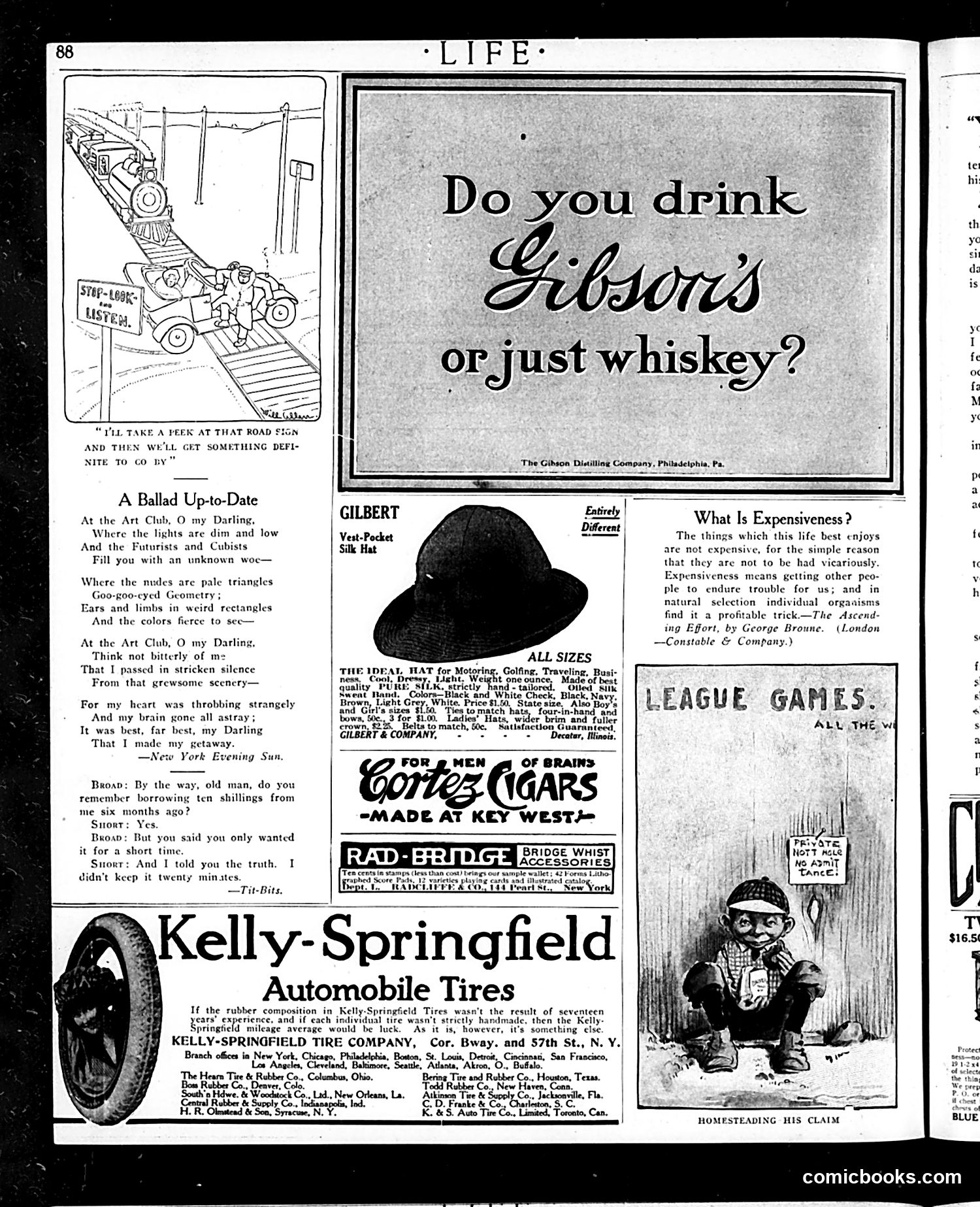
This page is primarily **advertising with minimal editorial content**. The main cartoon shows a car stopped at a road sign, with the caption joking about getting "something definite to go by"—a simple visual gag about unclear directions. The accompanying poem, "A Ballad Up-to-Date," satirizes **modernist art movements** (Cubism, geometric abstraction) popular in early 20th-century art clubs. The speaker flees an art exhibition in embarrassment, unable to appreciate nude figures rendered as "pale triangles" and "weird rectangles." This reflects contemporary mockery of avant-garde art as incomprehensible pretension. The page is dominated by **period advertisements**: Gibson's whiskey (notably published during Prohibition's approach), Kelly-Springfield automobile tires, Cortes cigars, Gilbert vests, and a Rad-Bridge card game accessory. A philosophical quote defines "expensiveness" as requiring others' labor—somewhat incongruous among commercial pitches. The small illustration labeled "Homesteading His Claim" appears unrelated to surrounding content—its meaning is **unclear from context**.
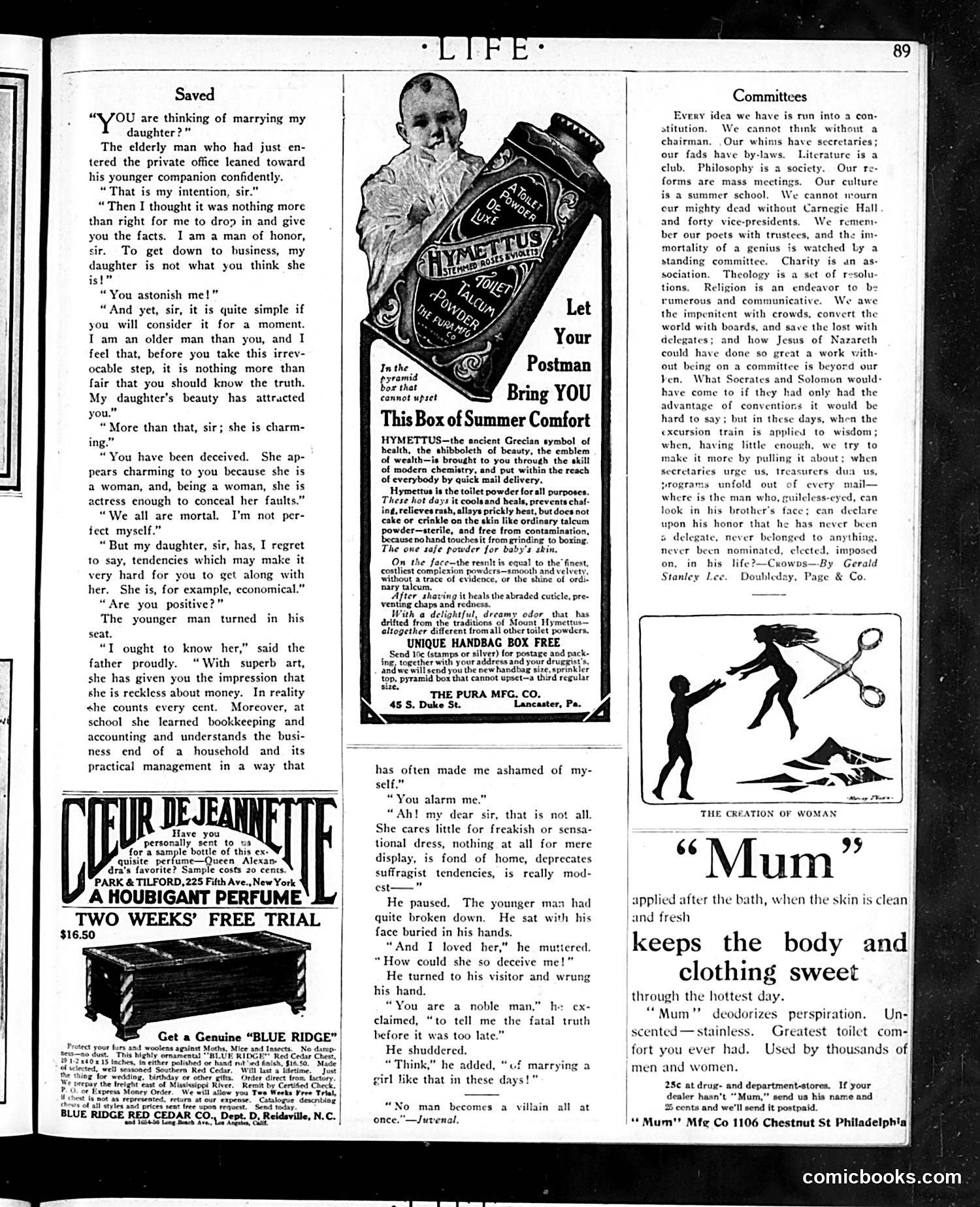
This short story satirizes anti-suffrage arguments of the era. A father "confesses" his daughter's supposedly shameful character flaws to her suitor: she's **economical, practical with household finances, and deprecates suffragist tendencies** — meaning she rejects women's suffrage activism. The joke is inverted: what the father presents as character defects are actually virtues. By listing "she cares little for freakish dress" and "is really modest," he's implying that suffragists were frivolous, immodest, and impractical — tired stereotypes used to oppose women's rights. The suitor's devastated reaction ("How could she so deceive me!") amplifies the satire: *Life* magazine is mocking men who found educated, fiscally responsible, modest women threatening because they didn't fit the dependent "angel of the home" ideal. The piece ridicules both anti-suffrage prejudices and the double standard where women's competence and independence became character flaws in conservative eyes.
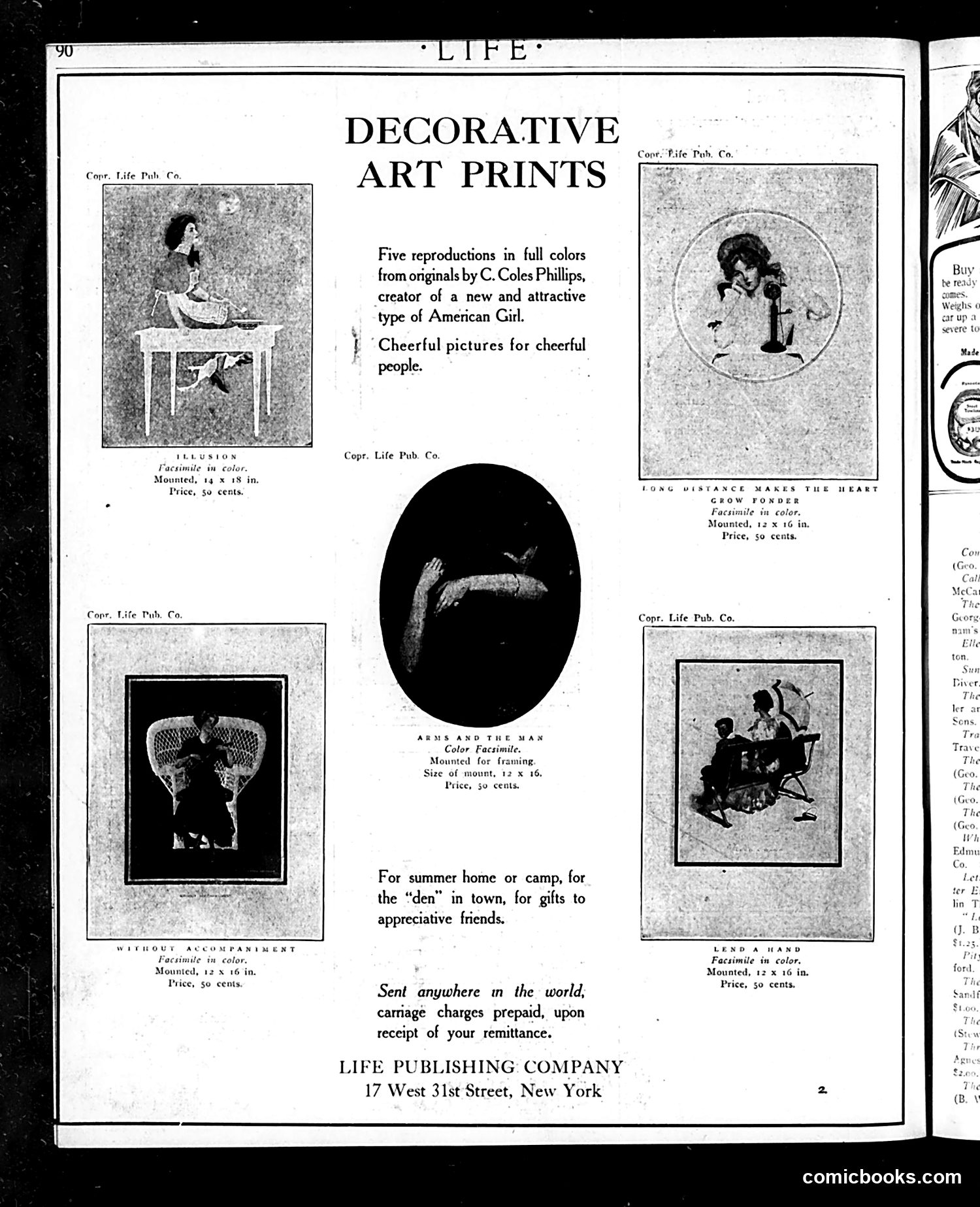
This is primarily a **product advertisement**, not satire. Life Publishing Company is promoting decorative art prints by C. Coles Phillips, a popular illustrator known for depicting an idealized "American Girl" type—typically young, fashionable women in graceful poses. The five prints shown feature Phillips' characteristic style: elegant female figures in romanticized scenarios (titles include "Illusion," "Long Distance Makes the Heart Grow Fonder," and "Arms and the Man"). The text emphasizes these are suitable gifts for "summer home or camp" and the "den in town"—targeting affluent consumers furnishing leisure spaces. At 50 cents mounted, these were affordable luxuries for middle-class homes. This reflects early 20th-century consumer culture: mass-produced art reproductions bringing "high culture" aesthetics into American domestic interiors. The advertisement's prominence in *Life* magazine demonstrates how advertising increasingly subsidized such publications.
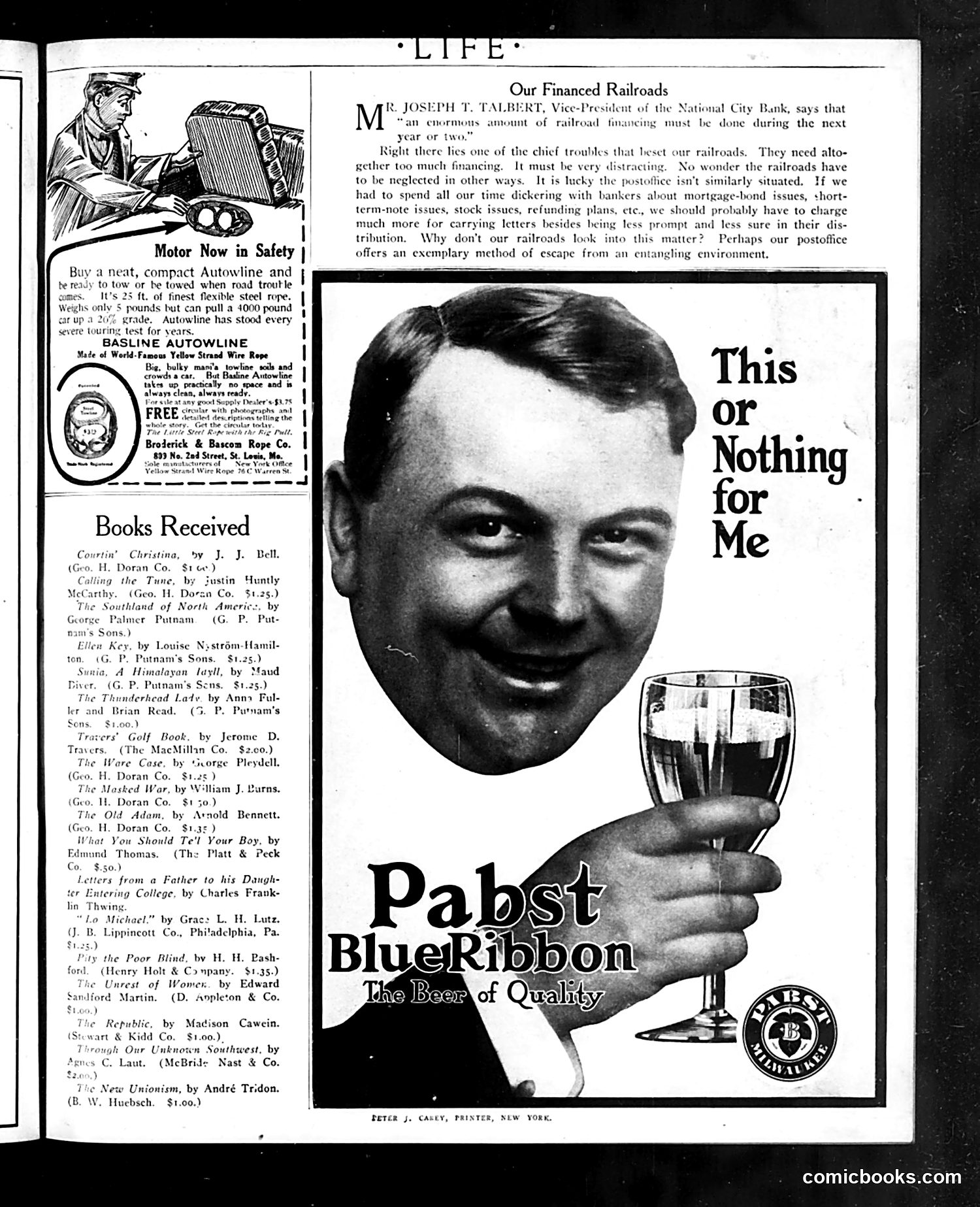
This page contains **satirical commentary on railroad financing** alongside period advertisements and a book list. The main article criticizes railroad companies for spending excessive time and resources on complex financial arrangements (bonds, stock issues, refinancing) with banks. The satire's point: if the U.S. Post Office operated similarly—constantly negotiating with bankers instead of delivering mail—service would suffer dramatically. Yet railroads somehow manage this distraction while still functioning. The implied criticism targets both the railroads' inefficiency and the banking system's entanglement with corporate operations. The author suggests the Post Office represents a better model: government-run, focused on service rather than financial manipulation. The **Pabst Blue Ribbon advertisement** ("This or Nothing for Me") uses a dramatic face and glass to market beer as a quality product—typical early 20th-century luxury branding. The remaining content—automotive rope products, book listings—represents standard magazine filler of the era.
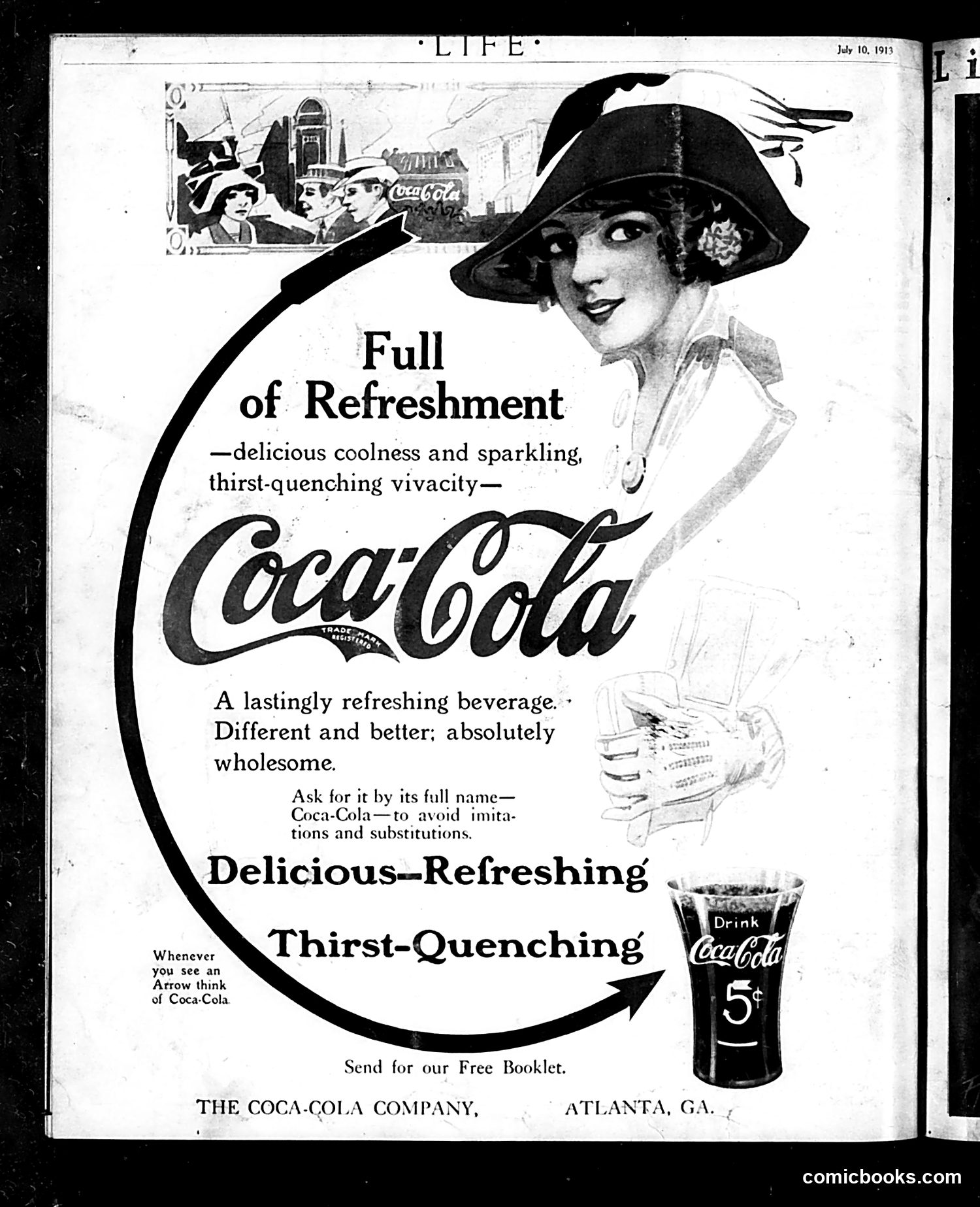
This is **not a political cartoon or satire**—it's a straightforward **Coca-Cola advertisement** from July 10, 1913 in Life magazine. The page features a stylized illustration of a fashionable woman in a wide-brimmed hat (typical 1910s fashion) holding a glass of Coca-Cola. The ad emphasizes the product as "delicious," "refreshing," and "wholesome"—standard marketing language of the era. The small vignette in the upper left appears to show people in a social setting, possibly at a soda fountain or public venue, reinforcing Coca-Cola as a social beverage. Notable is the warning to "Ask for it by its full name—Coca-Cola—to avoid imitations and substitutions," suggesting the brand faced significant competition or counterfeit products in 1913. The 5¢ price shown was standard for the era. This is period advertising, not commentary or satire.